TL;DR
- A safety representative in the statutory sense is appointed by a recognised trade union, not by the employer. Regulation 3(1) of the Safety Representatives and Safety Committees Regulations 1977 (in operation 1 October 1978) says a recognised trade union "may appoint safety representatives from amongst the employees".
- Everyone not represented that way falls under the Health and Safety (Consultation with Employees) Regulations 1996 (in force 1 October 1996), whose regulation 3 requires the employer to consult those employees "in good time". There is no version of the law in which an employer consults nobody.
- The two roles are not equivalent. A union-appointed representative has the regulation 4 functions plus inspection and document rights; a representative of employee safety has three functions under regulation 6 and no statutory right to inspect the workplace.
Ask an employer who their safety representative is and the answer is usually one of two wrong ones. Either "we have no union, so that does not apply to us", or "we appointed one". In the statutory sense a safety representative is appointed by a recognised trade union, not by the employer, and where nobody has been appointed that way a second set of regulations takes over. The duty to consult does not disappear.
This post covers both regimes, who falls under each, what each kind of representative can do, and the point employers get wrong most often: which one applies is not a management choice. It is general information about the position in Great Britain and not legal advice. Northern Ireland has its own health and safety legislation and is not covered here.
Consultation is a cycle with stages, named participants and a record, not a meeting. See how New Dynamics workflows let you shape the stages, participants and reminders around your own process, so the evidence that you consulted exists without anyone reconstructing it later.
Two regimes, and why you do not get to choose
Two general sets of regulations govern consulting a workforce about health and safety, and both are live:
- The Safety Representatives and Safety Committees Regulations 1977 (SI 1977/500), in operation from 1 October 1978 under regulation 1. These apply where a trade union is recognised and has appointed representatives.
- The Health and Safety (Consultation with Employees) Regulations 1996 (SI 1996/1513), in force from 1 October 1996 and extending to Great Britain under regulation 1. These apply to employees not represented under the 1977 Regulations.
The Health and Safety Executive puts the division plainly on its page on what the law says about consulting workers: if you recognise trade unions in any part of the business, "the Safety Representatives and Safety Committees Regulations 1977 will apply", and where employees are not represented under those Regulations, "the Health and Safety (Consultation with Employees) Regulations 1996 will apply". It is "quite common", HSE adds, to run both at once.

So an employer cannot elect to be a 1996 Regulations employer because that regime is lighter. If a recognised union appoints a representative for a group, that group is covered by the 1977 Regulations. The only real choice sits inside the 1996 Regulations, and it is narrower than it sounds.
Who falls under the 1977 Regulations
Regulation 3(1) is the gateway. For the purposes of section 2(4) of the Health and Safety at Work etc. Act 1974, "a recognised trade union may appoint safety representatives from amongst the employees in all cases where one or more employees are employed by an employer by whom it is recognised". The appointment is the union's act, and there is no size threshold: one employee is enough.
Section 2(6) of the 1974 Act carries the duty on top of it. Every employer must consult those representatives on arrangements that "will enable him and his employees to co-operate effectively in promoting and developing measures to ensure the health and safety at work of the employees, and in checking the effectiveness of such measures".
Two details are easy to miss. Regulation 3(2) ties the functions to written notification: they apply once the union has notified the employer in writing of "the names of the persons appointed as safety representatives" and the groups they represent. And regulation 3(4) expects, "so far as is reasonably practicable", either two years with that employer or "at least two years experience in similar employment", though HSE accepts that is not always practical. For how recognition arises, see our post on trade union recognition.
What a union-appointed safety representative can do
Regulation 4(1) lists the functions, on top of representing employees in the section 2(6) consultation: investigating potential hazards and dangerous occurrences and examining the causes of accidents, "whether or not they are drawn to his attention by the employees he represents"; investigating employees' complaints about their "health, safety or welfare at work"; making representations to the employer on those and on general matters; carrying out inspections; representing employees with inspectors of HSE and other enforcing authorities; receiving information from inspectors under section 28(8) of the 1974 Act; and attending safety committee meetings.
The paragraph then says "no function given to a safety representative by this paragraph shall be construed as imposing any duty on him". These are powers, not obligations, and they do not shift the employer's own section 2 duties or the general duty an HSE manager is appointed to help discharge.
Three rights sit behind the functions.
Inspections. Regulation 5(1) gives an entitlement to inspect the workplace on "reasonable notice in writing", provided it has not been inspected "in the previous three months", with more frequent inspections by agreement. Regulation 5(2) allows an extra one inside the three months after a substantial change in working conditions, and regulation 6 one after a reportable accident, dangerous occurrence or disease. For both, the employer must provide facilities "for independent investigation by them and private discussion with the employees".
Documents and information. Regulation 7(1) entitles representatives, on reasonable notice, to inspect and copy any document the employer must keep under health and safety law, "except a document consisting of or relating to any health record of an identifiable individual". Regulation 7(2) goes wider: the employer must make available "the information, within the employer's knowledge, necessary to enable them to fulfil their functions", subject to five exceptions covering national security, statutory prohibitions, named individuals, substantial injury to the business and material gathered for legal proceedings.
Paid time off, for duties and for training. Regulation 4(2) requires the employer to permit "such time off with pay during the employee's working hours as shall be necessary" both for performing the functions and for training in them "as may be reasonable in all the circumstances". Pay follows the Schedule: normal pay where earnings do not vary, average hourly earnings where they do. Regulation 11 gives a tribunal claim where time off is refused or unpaid, and its limit is now six months rather than three, substituted on 1 October 2026 by Schedule 12 to the Employment Rights Act 2025 and commenced by regulation 3 of SI 2026/954.
The safety committee, and the number that triggers it
Section 2(7) of the 1974 Act requires an employer in prescribed cases to establish a safety committee "having the function of keeping under review the measures taken to ensure the health and safety at work of his employees". Regulation 9(1) prescribes the case: "any cases in which at least two safety representatives request the employer in writing to establish a safety committee".
Two representatives, in writing. That is the whole trigger. Regulation 9(2) then sets the method: consult the representatives who asked and the representatives of recognised unions whose members work in the proposed area; post a notice of the committee's composition and the workplaces covered "in a place where it may be easily read by the employees"; and establish it "not later than three months after the request for it".
Who the 1996 Regulations cover
Regulation 3 is the catch-all: "Where there are employees who are not represented by safety representatives under the 1977 Regulations, the employer shall consult those employees in good time on matters relating to their health and safety at work."
Regulation 4(1) holds the employer's one real choice. Consultation is with "either (a) the employees directly; or (b) in respect of any group of employees, one or more persons in that group who were elected, by the employees in that group at the time of the election, to represent that group". Those elected people are the "representatives of employee safety", and HSE says a combination of the two is also available.
Note what regulation 4(1)(b) requires: election by the group, from within the group. An employer who hands the title to a volunteer has not created a representative of employee safety. Where representatives are used, regulation 4(2) requires the employer to tell employees their names and the group each covers.
So there is no case in which an employer consults nobody. If a recognised union has appointed representatives, you consult them. If it has not, or there is no union, or some employees fall outside what the union covers, those employees are consulted under the 1996 Regulations. "We have no representatives" describes an employer that must consult its people individually.

How the elected role is narrower
Regulation 6 gives a representative of employee safety three functions, and only three: making representations on potential hazards and dangerous occurrences affecting the group; making representations on general matters affecting the group's health and safety, in particular the matters consulted on under regulation 3; and representing the group in consultations with inspectors appointed under section 19(1) of the 1974 Act.
Against regulation 4 of the 1977 Regulations, the gaps are specific. There is no function of investigating hazards or complaints, only of making representations about them. There is no statutory entitlement to inspect the workplace, so no three-month inspection right and no post-incident inspection. There is no right to inspect and copy statutory documents. There is no right to request a safety committee. HSE states it in one line: "Although by law health and safety representatives appointed by trade unions have more functions than representatives elected by employees, you can choose to give your elected representatives extra roles, as long as they agree to this."
Two things are not narrower. Regulation 5(2) requires information necessary to "participate fully and effectively", including the records kept under regulation 12 of the Reporting of Injuries, Diseases and Dangerous Occurrences Regulations 2013. And regulation 7(1)(a) goes further than the 1977 wording on training: the employer must ensure reasonable training is provided and "shall meet any reasonable costs associated with such training including travel and subsistence costs". Regulation 7(2) also gives an election candidate "reasonable time off with pay", which the 1977 Regulations have no equivalent of because there is no election.
"In good time", and on what
Both regimes name the same five subjects in the same words. Regulation 4A(1) of the 1977 Regulations, inserted in 1993, requires every employer to "consult safety representatives in good time with regard to" them, and regulation 3 of the 1996 Regulations uses the identical list for unrepresented employees:
- any measure at the workplace that may substantially affect their health and safety
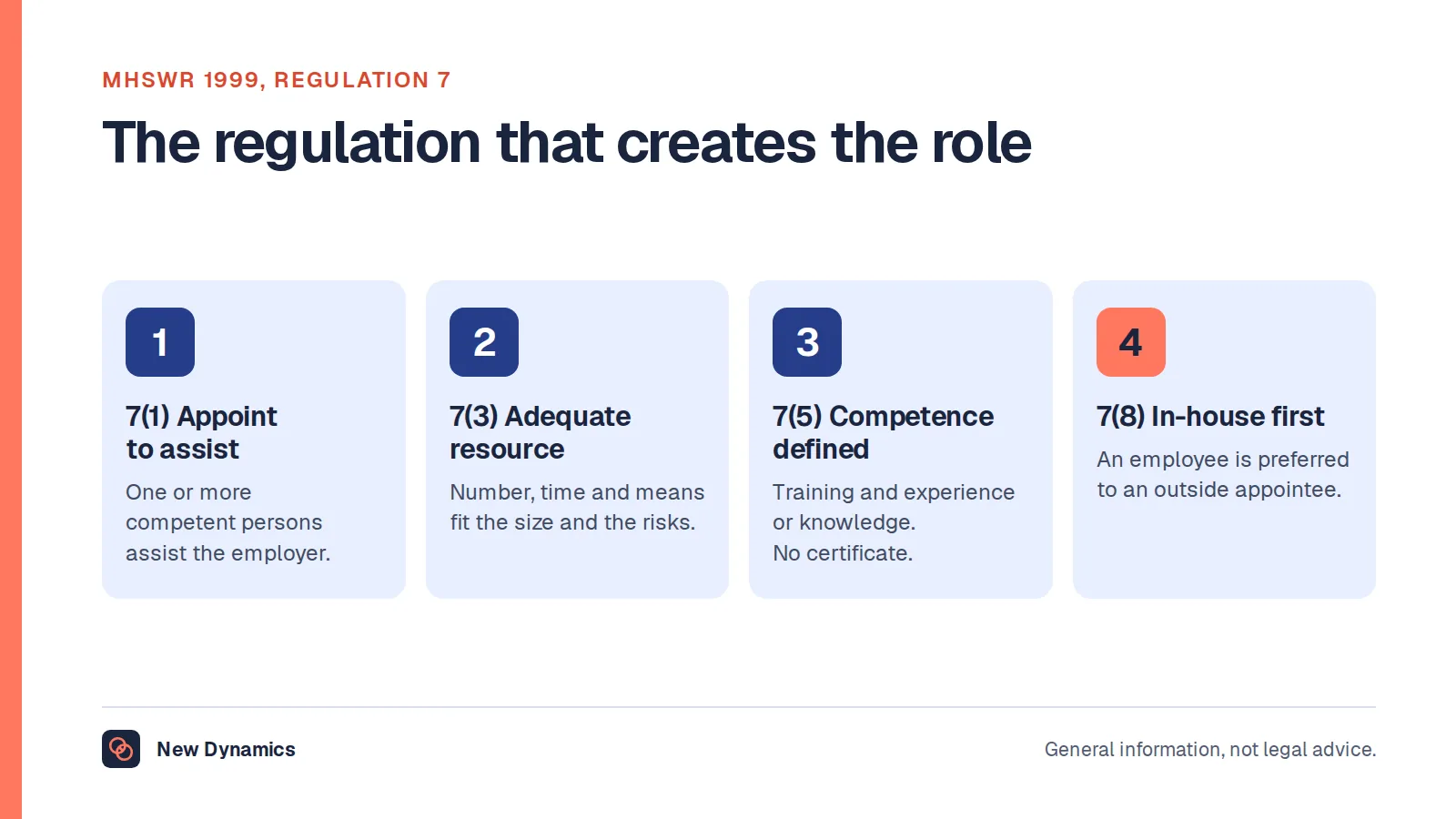
- the arrangements for appointing or nominating competent persons under regulations 7(1) and 8(1)(b) of the Management of Health and Safety at Work Regulations 1999
- any health and safety information the employer must provide to them
- the planning and organisation of any health and safety training the employer must provide
- the health and safety consequences of introducing new technologies, including the planning of it

"In good time" does the work. It means before the decision is settled, not at the point of announcement. Regulation 4A(2) of the 1977 Regulations adds a resourcing duty: every employer must "provide such facilities and assistance as safety representatives may reasonably require". Regulation 7(4) of the 1996 Regulations says the same for representatives of employee safety.
The volume of harm argues for doing this properly rather than minimally. HSE's key figures for Great Britain 2024 to 2025 record 680,000 working people who "sustained an injury at work according to the Labour Force Survey" against 59,219 "injuries to employees reported under RIDDOR". RIDDOR requires only certain categories to be reported, so these are not the same measure, but the distance between them describes how much never reaches a formal report. Our HR statistics hub holds the wider picture, and our post on health and safety tips at the workplace covers the practical side.
Protection from detriment and dismissal
The protection sits in the Employment Rights Act 1996, not in either set of Regulations. Section 44(1) gives an employee the right not to be subjected to any detriment on the ground that, "being a representative of workers on matters of health and safety at work or member of a safety committee", the employee "performed (or proposed to perform) any functions as such a representative or a member of such a committee". Regulation 8 of the 1996 Regulations added a further ground to both section 44(1) and section 100(1), covering an employee who took part in consultation under those Regulations "or in an election of representatives of employee safety ... (whether as a candidate or otherwise)".
Section 100(1) makes a dismissal for those reasons automatically unfair, and section 108(3)(c) disapplies the two-year qualifying period for it. HSE states the effect: workers are protected "regardless of their length of service". Detriment claims under section 48(3)(a) now run to six months rather than three, changed on 1 October 2026 by the same Schedule 12 provisions.
Frequently asked questions
Who appoints a safety representative?
A recognised trade union does. Regulation 3(1) of the Safety Representatives and Safety Committees Regulations 1977 lets it appoint safety representatives from amongst the employees wherever it has one or more members employed by an employer that recognises it. The employer neither appoints them nor can veto the appointment, although the regulation 4 functions apply only once the union has notified the employer in writing of the names and groups represented.
What is the difference between a safety representative and a representative of employee safety?
A safety representative is union-appointed under the 1977 Regulations, with the functions in regulation 4, inspection rights under regulations 5 and 6 and document rights under regulation 7. A representative of employee safety is elected by the group under regulation 4(1)(b) of the 1996 Regulations and has only the three functions in regulation 6, with no statutory right to inspect the workplace or statutory documents.
How many safety representatives have to ask for a safety committee?
Two. Regulation 9(1) of the 1977 Regulations prescribes the case as "any cases in which at least two safety representatives request the employer in writing to establish a safety committee", and regulation 9(2)(c) requires the committee to be established not later than three months after the request.
Does an employer have to consult if there is no union and no elected representative?
Yes. Regulation 3 of the 1996 Regulations requires the employer to consult employees not represented under the 1977 Regulations "in good time on matters relating to their health and safety at work", and regulation 4(1)(a) allows that to be with the employees directly. Having no representatives means consulting people individually, not consulting nobody.
Is a safety representative entitled to paid time off for training?
Yes, under both regimes. Regulation 4(2) of the 1977 Regulations requires time off with pay for training in the functions "as may be reasonable in all the circumstances". Regulation 7(1)(a) of the 1996 Regulations requires the employer to ensure reasonable training is provided and to meet reasonable costs "including travel and subsistence costs", with paid time off under regulation 7(1)(b).
Next steps
Write down which regime covers which group and why, and keep the union's regulation 3(2) notification with it. Diarise the three-month inspection window so a request is not a surprise, and treat a written request from two representatives as a three-month clock on a committee. Then record the five consultation subjects against each decision, with the date you raised it, so "in good time" is demonstrable rather than asserted.
For the policy wording around all of this, read and download our employee handbook guide. The guide is free to read, and the PDF uses our short download form.
Want consultation to leave a record you can show an inspector without assembling it from inboxes? Book a New Dynamics demo and bring your current arrangements. You can also email contact@new-dynamics.com.