TL;DR
- Upward feedback is feedback from an employee to their manager. It works best when it is specific, framed around what helps you to do good work, and offered as a request.
- These 40 examples cover positive feedback, constructive feedback, answers to “How can I support you better?” and comments for a supervisor feedback survey.
- Managers decide whether upward feedback happens. Ask for it often, thank people for it, act on something and say what you changed.
Your manager asks, “Do you have any feedback for me?” Most people say, “No, all good”, and change the subject. It is an understandable answer. Your manager influences your pay, your projects and your prospects. Yet managers cannot fix what nobody tells them, and the people best placed to tell them are their own team.
This article gives you 40 examples of feedback for your manager, positive and constructive, along with a safe way to give it, comments for supervisor feedback surveys and advice for managers on how to receive it.
Upward feedback is easier when feedback flows in every direction as a habit. See how New Dynamics continuous feedback lets people request and give feedback at any time.
Why feedback for managers matters
Managers often know less than anyone about their own effect on people. Praise gets filtered, and criticism rarely travels upwards.
Some organisations build the channel on purpose. Google describes how it develops its managers: “Annually, we ask team members to give feedback on how their managers fulfill the Manager Responsibilities. The manager receives a comprehensive report with qualitative and quantitative feedback from the team, and we encourage ongoing dialogue throughout the year.”
Its guide to effective one-to-one meetings suggests that managers ask for feedback in every one-to-one, with questions such as “Is there anything I should be doing for you that I am not doing?”
If your manager asks questions like these, take them at their word. If they do not, you can still offer feedback. Here is how.
How to give feedback to your manager
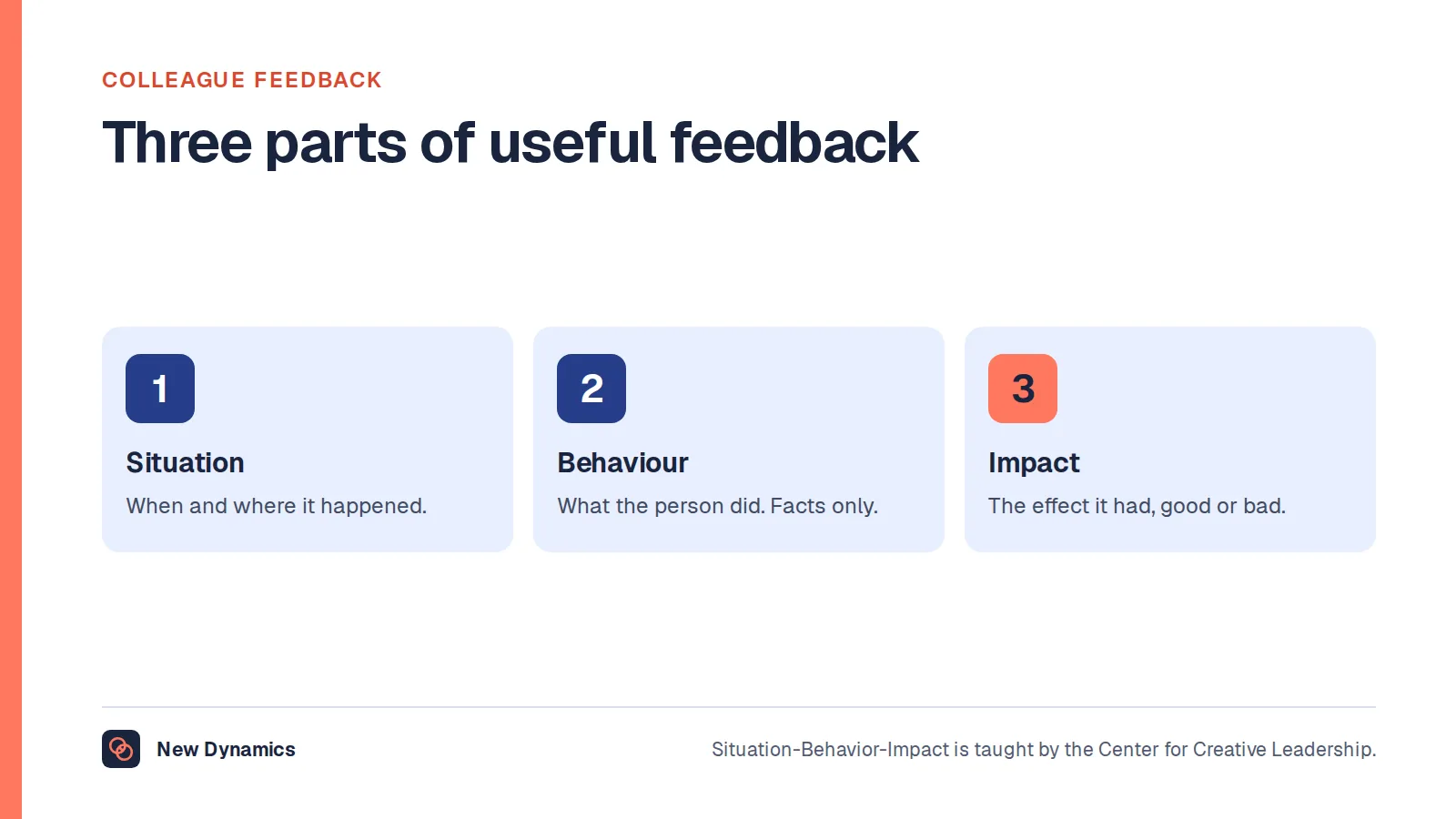
Use the Situation-Behaviour-Impact structure, taught by the Center for Creative Leadership, and add a request. We describe it fully in our colleague feedback examples.
- Situation. When and where it happened.
- Behaviour. What your manager did, in facts.
- Impact. The effect on you and on your work.
- Request. What would help in future.
Six further rules apply when the feedback is going upwards.
- Ask first. “Could I share something that would help me to work better with you?” is hard to refuse.
- Pick your moment. A private one-to-one, when neither of you is rushed or upset. Never in front of others.
- Talk about your work, not their character. “When priorities change mid-week, I lose about a day” is useful. “You are disorganised” is not.
- Assume good intent. Many managers are unaware of the effect. Say what you observed, and ask about their view.
- Offer one thing. One clear request is more likely to be acted on than five.
- Start with positive feedback. Managers hear little genuine praise. Specific thanks builds the trust that makes harder feedback possible.

Positive feedback for your manager: 15 examples
The details are fictional. Replace them with your own.
- When you explained the reason behind the reorganisation before the announcement, it helped me to answer my team's questions with confidence. Thank you for trusting us with the context.
- You gave me the client presentation and let me run it my way. That stretch is the reason I feel ready for the senior role.
- I appreciate that you never cancel our one-to-ones. It tells me that my development matters to you.
- When I made the pricing error in March, you asked what we could learn and not who was to blame. It made me more willing to raise problems early.
- Your feedback on my report was specific enough to act on. The second version was much stronger because of it.
- You gave me the credit for the migration plan in front of the directors. That meant a great deal.
- When my father was ill, you rearranged my deadlines without my having to ask twice. I will not forget that.
- You are clear about priorities. I always know what matters most this week, and it makes saying no to other requests much easier.
- You defended the team's timeline when the launch date was under pressure. We delivered properly because of it.
- I notice that you ask for everyone's view before you give your own. It draws out ideas from people who would otherwise stay quiet.
- Thank you for telling me directly that my updates were too long. Nobody had said it before, and it was easy to fix.
- You admit when you do not know something. It makes it safe for the rest of us to do the same.
- The way you handled the conflict between the two teams, by listening to both and deciding quickly, taught me a lot.
- You have introduced me to people across the business. Those connections have made my projects run far more smoothly.
- You notice when the workload is too high, and you act on it. Moving the audit deadline last month made a real difference to the team.
Constructive feedback for your manager: 15 examples
Each example names the situation, the behaviour, the effect and a request.
- In the last month our one-to-one has been moved or cancelled three times. I end up saving questions for weeks, and small problems grow. Could we protect the slot, or shorten it to twenty minutes if time is tight?
- When priorities change mid-week, as they did twice in May, I lose about a day switching over. Could we agree the week's priorities on Monday, and talk through the trade-off when something urgent comes up?
- I often receive feedback on my work at the final stage, when changes are expensive. An early look at the outline would save us both time. Could I send you a one-page plan first?
- In team meetings you often answer the question before others have spoken. I have noticed that people then hold back. Would you be willing to speak last on some topics?
- When you check in on the project several times a day, I feel that I am not trusted, and I spend time writing updates in place of doing the work. Could we agree a daily update at four o'clock?
- I am not always clear about what good looks like on a new task. On the supplier review I guessed wrongly, and redid it. Could you describe the outcome you want, or show me an example, at the start?
- I rarely hear how I am doing between reviews. A few minutes of feedback in our one-to-ones, about what to keep and what to change, would help me to improve faster.
- When decisions from the leadership meeting reach us a week later, we sometimes work on things that have already changed. Could you share a short summary the same day?
- Messages late in the evening make me feel that I should reply straight away, even if that is not your intention. Could you schedule them for the morning, or tell us that no reply is expected?
- I would like more responsibility. At the moment you review every customer email that I send. Could we agree which types I can send without review?
- When the plan changed last month, the team heard about it from another department. It dented trust. Could we hear such news from you first, even if the details are not final?
- In my review, the examples all came from the last six weeks. I would find it fairer if we kept notes through the year. Could we record two or three points each month?
- When you took over my presentation halfway through, I felt undermined in front of the client. If you think I am going off track, could you pass me a note or raise it afterwards?
- I find it hard to raise concerns when the first response is an explanation of why things are as they are. It would help if you asked a question or two first.
- The work is divided unevenly at the moment, and two of us are regularly working late. Could we review who is doing what at the next team meeting?

When your manager asks, “How can I support you better?”
Have an answer ready. These are honest, specific and easy to act on.
- “It would help to know the reason behind a task, as well as the task. I make better decisions when I understand what it is for.”
- “More notice of changes. Even a rough heads-up lets me plan.”
- “A stretch project this year. I would like to lead something from start to finish.”
- “Quicker decisions on the things that block me. Could I flag them as urgent?”
- “Tell me sooner when something is not right. I would rather hear it in the week than at the review.”
Comments for a supervisor feedback survey
Upward or 360 surveys often ask for short written comments. Write what you would be willing to say in person. Small teams are rarely as anonymous as they seem.
- What does your manager do well? “Sets clear priorities and protects the team from distractions. I always know what matters most.”
- What does your manager do well? “Gives credit generously, and takes responsibility when things go wrong.”
- What could your manager do differently? “Share decisions from leadership meetings sooner. We sometimes continue work that has already changed.”
- What could your manager do differently? “Delegate more decisions. Reviewing everything slows us down, and the team is ready for more.”
- Any other comments? “One-to-ones are often cancelled. When they happen they are excellent, so I would value them being protected.”
If you are designing the survey, keep it short, and ask about observable behaviours such as “My manager gives me useful feedback” and “My manager shares the information I need”. See our 360 feedback guide.
What to avoid
- Feedback in public, or by email when you are angry. Wait a day.
- Labels and generalisations. “You never listen” invites an argument. One specific example invites a conversation.
- Speaking for others. “Everyone thinks…” puts your manager on the defensive, and puts your colleagues in a difficult spot. Speak for yourself.
- A list of grievances. Bring one issue and one request.
- Feedback as a substitute for a formal route. Bullying, harassment and discrimination are not matters for a feedback conversation. Use your organisation's procedure. See how to make an open door policy real.
If you judge that honest feedback is not safe where you work, that tells you something important. Use the anonymous routes that exist, or speak to HR or to a manager you trust.
For managers: how to get, and deserve, honest feedback
- Ask specific questions, often. “What is one thing I could do differently that would make your work easier?” works better than “Any feedback?”
- Make it routine. Ask at the end of every one-to-one, so that it stops feeling like an event.
- Listen without defending. Say “Thank you. Tell me more.” Explanations can wait.
- Act on something, and say so. “You told me that decisions reach you late, so I now send a summary on the same day.” Few things encourage feedback more than seeing it used.
- Go first. Admit a mistake of your own. It makes candour safer for everyone else.
- Never punish honesty. One defensive reaction can end upward feedback in your team for a long time.
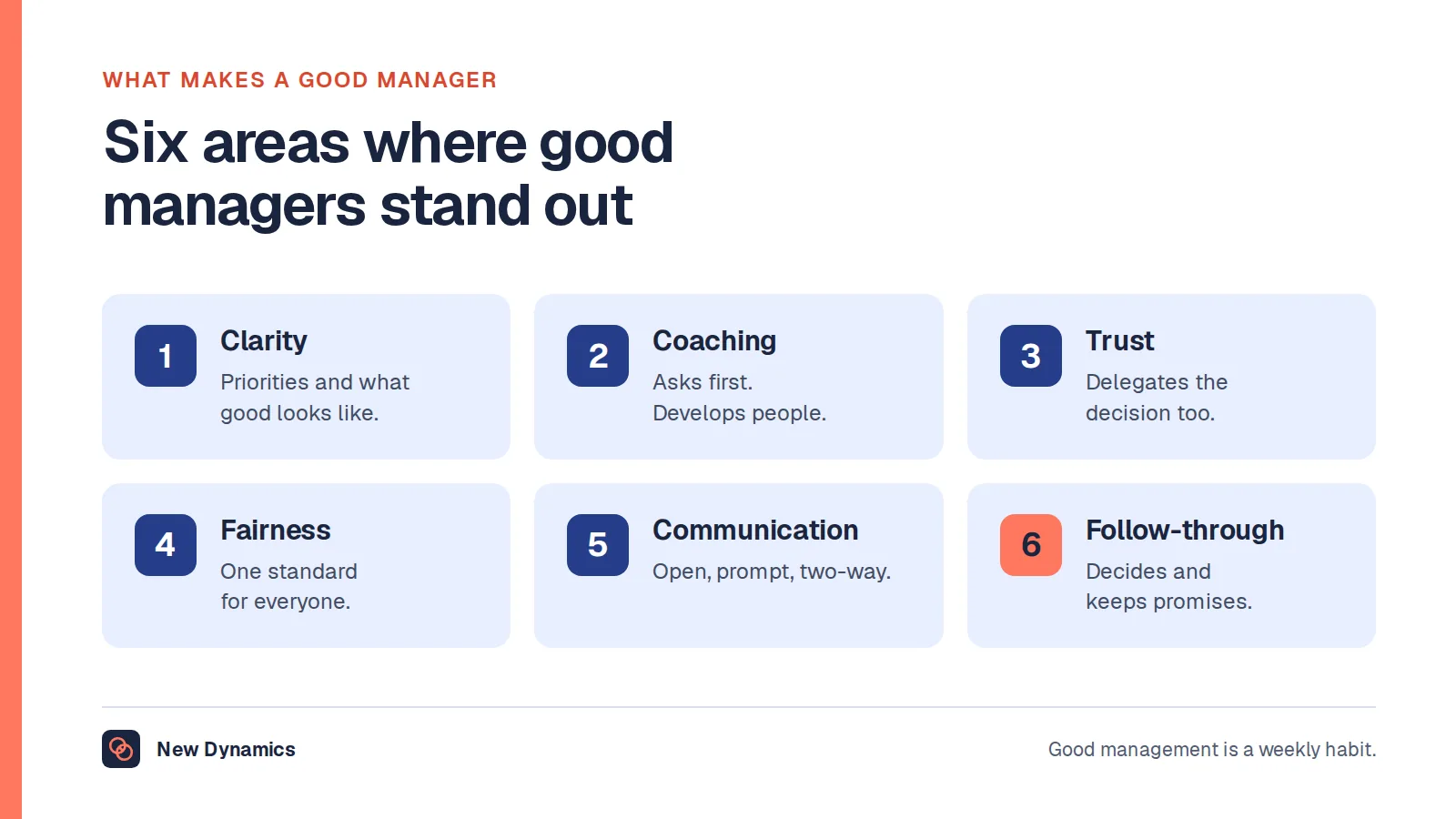
Our guide to what makes a good manager sets out the routines behind this, and boss vs leader explains why inviting challenge matters.

Frequently asked questions
How do you give feedback to your manager?
Ask whether you can share something, choose a private moment, describe a specific situation, what your manager did and the effect on your work, and finish with a request. Keep it to one issue, assume good intent and speak only for yourself.
What is an example of positive feedback for a manager?
“When you explained the reason behind the reorganisation before the announcement, it helped me to answer my team's questions with confidence. Thank you for trusting us with the context.” It is specific, and it names the effect.
What is an example of constructive feedback for a manager?
“Our one-to-one has been moved or cancelled three times in the last month. I end up saving questions for weeks, and small problems grow. Could we protect the slot, or shorten it to twenty minutes if time is tight?”
What should I write in a supervisor feedback survey?
Write specific comments that you would be willing to say in person: what your manager does well, with an example, and one thing they could do differently, with its effect on your work. Avoid personal remarks and speaking for others.
Is it safe to give honest feedback to your boss?
It depends on the manager and the culture. Start with specific positive feedback, then a small constructive request, and watch the response. If honest feedback is punished, use anonymous surveys, HR or a trusted senior colleague.
How should a manager respond to feedback from their team?
Thank the person, ask questions to understand, and avoid defending or explaining straight away. Then act on something, and tell the team what you changed. That response is what makes people willing to be honest again.
Your next step: one piece of feedback in your next one-to-one
- Think of one thing your manager does that helps you, and one change that would help more.
- Write each as situation, behaviour, effect and request.
- Start with the positive one in your next one-to-one.
- If you are a manager, end your next one-to-one by asking what you could do differently.
For a fair way to gather feedback about managers from several people, read and download our 360 feedback guide. The guide is free to read, and the PDF uses our short download form.
Want feedback to flow upwards, downwards and sideways as part of everyday work? Book a New Dynamics demo and bring your current feedback process. You can also email contact@new-dynamics.com.