TL;DR
- A BFOQ is an exception to Title VII, and the statute names only three bases. Section 703(e)(1) permits a preference on the basis of "religion, sex, or national origin" where that characteristic is "a bona fide occupational qualification reasonably necessary to the normal operation of that particular business or enterprise".
- Race and colour are absent from that list, and the EEOC says so directly: "Nor may race or color ever be a bona fide occupational qualification under Title VII." Race was the most frequently cited basis in charges received by the EEOC in financial year 2025, at 29,338 of 88,201.
- The only example the EEOC's own regulation names is authenticity, "e.g., an actor or actress". The same regulation rules out "the preferences of coworkers, the employer, clients or customers". The UK equivalent, an occupational requirement under Schedule 9, works differently and does reach race.
A job advert restricts a role to women. A casting call asks for a man in his sixties. A care home wants only female staff on intimate personal care. Somebody says the letters BFOQ, everyone nods, and the discussion ends. That is usually the moment it should have started.
A bona fide occupational qualification is real, and employers do win on it. It is also the narrowest defence in American employment discrimination law, and it gets used in conversation far more widely than the statute allows. The point most often got wrong is this one: a BFOQ is never available for race. No authenticity argument, no customer argument and no business argument makes race a lawful job requirement.
This post covers the statutory wording, which characteristics the exception reaches, the examples that are accepted, the arguments that fail, the matching provision in the age legislation, and the different test the United Kingdom applies. It answers for the United States and is general information rather than legal advice.
A requirement you may one day have to justify belongs in writing before anyone applies. New Dynamics workflows let you fix the stages, forms and participants in a selection process, so the reason for a criterion sits in the record instead of in somebody's memory.
What a bona fide occupational qualification is
A BFOQ is an exception. Title VII of the Civil Rights Act of 1964 makes it unlawful to refuse to hire someone "because of such individual's race, color, religion, sex, or national origin", in the words of section 703(a). The BFOQ provision carves a hole in that rule for the small number of jobs where the characteristic itself is part of being able to do the work.
Two things follow. The employer raises it and the employer proves it: the candidate does not have to disprove it. And it is read narrowly, as the EEOC's own regulation on sex says in one line: "The commission believes that the bona fide occupational qualification exception as to sex should be interpreted narrowly."
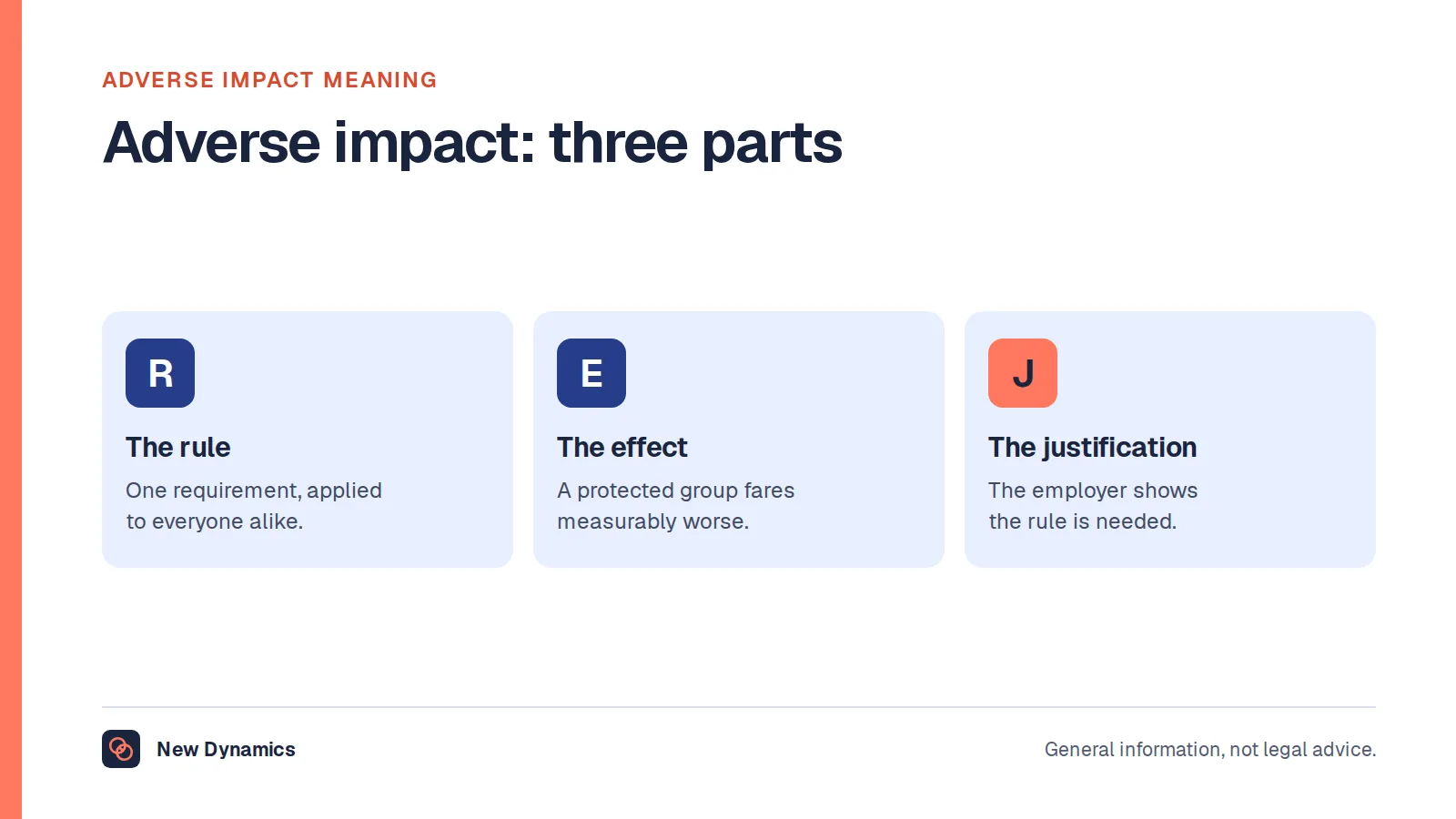
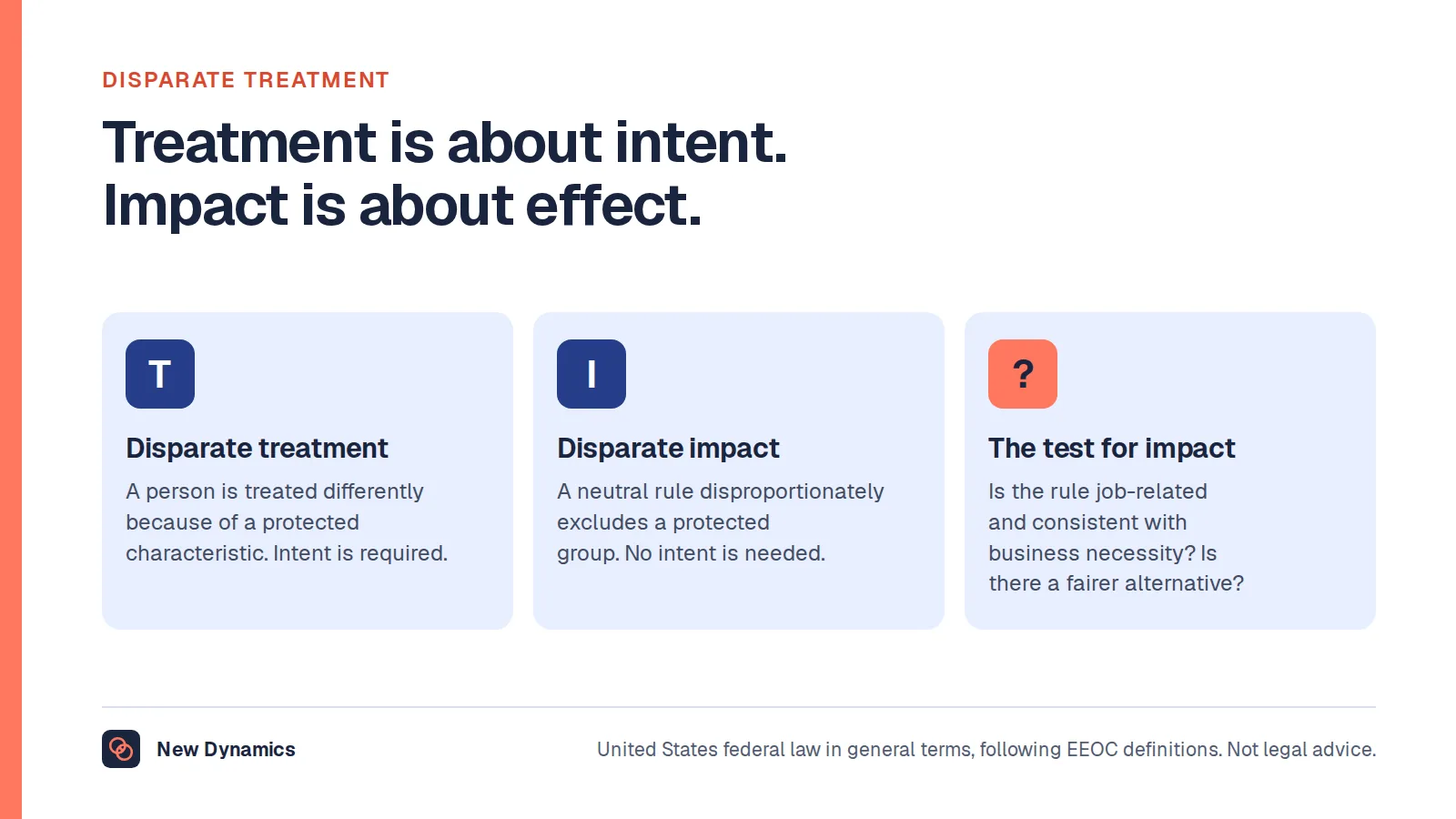
It is not business necessity. Business necessity answers a neutral rule with an uneven effect, the subject of our post on adverse impact. A BFOQ answers a decision made openly on the basis of a protected characteristic, the territory of disparate treatment.
The statutory words, and the phrase that does the work
The provision sits at section 703(e)(1) of Title VII, codified at 42 U.S.C. 2000e-2(e)(1). The text published by the EEOC reads:
"Notwithstanding any other provision of this subchapter, (1) it shall not be an unlawful employment practice for an employer to hire and employ employees ... on the basis of his religion, sex, or national origin in those certain instances where religion, sex, or national origin is a bona fide occupational qualification reasonably necessary to the normal operation of that particular business or enterprise".
Everything turns on "reasonably necessary to the normal operation of that particular business or enterprise". Read it in three parts.
- Reasonably necessary. Not useful, not preferable, not cheaper, not what the client asked for. Necessary.
- The normal operation. The characteristic has to matter to what the business is for, not to a side task or a scheduling convenience.
- That particular business or enterprise. Yours, on its own facts. Nobody gets to rely on what is customary in an industry.
The heading Congress gave the subsection is a useful tell. In the codified text it reads "Businesses or enterprises with personnel qualified on basis of religion, sex, or national origin; educational institutions with personnel of particular religion". Three bases, and no more.
Race is not on the list, and never has been
Set the two subsections side by side. Section 703(a) lists "race, color, religion, sex, or national origin". Section 703(e)(1) lists "religion, sex, or national origin". Race and colour were left out of the exception, and that omission is the whole answer.
The EEOC states it without hedging. In Section 15 of its Compliance Manual, on race and color discrimination (Directives Transmittal 915.003, issued 19 April 2006), it says Title VII "does not permit racially motivated decisions driven by business concerns", giving as examples "concerns about the effect on employee relations" and "the negative reaction of clients or customers". Then: "Nor may race or color ever be a bona fide occupational qualification under Title VII." A footnote to the same document describes the exception as one that "applies to all Title VII bases except race and color", and notes elsewhere that "race and color can never be BFOQs".
This is not a marginal issue. On the EEOC's enforcement and litigation statistics, Table E1a records 88,201 charges received in financial year 2025, of which 29,338 cited race, or 33.3 per cent. That made race the most frequently cited basis in the year, ahead of sex at 26,941 and age at 16,353. The basis employers raise a BFOQ about most casually is the one basis where the defence does not exist. For the wider picture, see our HR statistics hub.

Examples of a BFOQ that are genuinely accepted
Authenticity in a performance role
This is the only example the EEOC commits to in a regulation. 29 CFR 1604.2(a)(2) says: "Where it is necessary for the purpose of authenticity or genuineness, the Commission will consider sex to be a bona fide occupational qualification, e.g., an actor or actress."
Notice how small that permission is. It is a statement about a part, not about a production. It does not reach the crew, the casting assistant or front of house. And it is about authenticity, a quality of the character being depicted, not about what an audience is assumed to prefer. Our post on the casting interview covers how that works inside a selection process.
A religious preference, which usually goes through a different door
Religion is inside the BFOQ provision, but religious employers rarely need it. Section 702(a) exempts "a religious corporation, association, educational institution, or society ... with respect to the employment of individuals of a particular religion to perform work connected with the carrying on ... of its activities". Section 703(e)(2) adds a separate permission for a school or university "owned, supported, controlled, or managed by a particular religion", or whose curriculum "is directed toward the propagation of a particular religion".
The EEOC's Compliance Manual on religious discrimination explains the division of labour: "Religious organizations do not typically need to rely on this BFOQ defense because the 'religious organization' exemption in Title VII permits them to prefer employees of a particular religion." For everyone else it is discouraging: "for employers that are not religious organizations and seek to rely on the BFOQ defense to justify a religious preference, the defense is a narrow one and rarely successfully invoked."
The exemption is narrower than it sounds. The same manual records that "Religious organizations are subject to the Title VII prohibitions against discrimination on the basis of race, color, sex, national origin". A religious employer may prefer co-religionists. It may not prefer a race.
Privacy in care and custodial work
Honesty about sourcing matters here more than a confident answer. The EEOC's regulation on sex names authenticity and nothing else, and the Commission does not publish a line saying that personal privacy supports a sex-based BFOQ. What exists instead is the statutory test, applied job by job, and separate federal rules that describe the privacy interest in operational terms. The Department of Justice's standards under the Prison Rape Elimination Act, at 28 CFR 115.15(d), require a facility to "implement policies and procedures that enable inmates to shower, perform bodily functions, and change clothing without nonmedical staff of the opposite gender viewing their breasts, buttocks, or genitalia", except in exigent circumstances or where the viewing is incidental to routine cell checks.
That is a rule about how a facility must be run. It is not a ruling that sex is a BFOQ for any particular post, and it does not relieve an employer of showing that a sex-based staffing requirement is "reasonably necessary to the normal operation" of its own business. So work out which specific duties create the privacy interest, write down how many posts have to carry those duties, and restrict only those. The blanket rule across every shift and every role is the version that loses.
The arguments that fail
Customer preference
The most common failed argument, and the EEOC rules it out in the regulation itself. Among the situations that "do not warrant the application of the bona fide occupational qualification exception", 29 CFR 1604.2(a)(1)(iii) lists "The refusal to hire an individual because of the preferences of coworkers, the employer, clients or customers except as covered specifically in paragraph (a)(2) of this section." The carve-out at the end points back to authenticity. Everything else is excluded, including the employer's own preference and the preferences of colleagues.
On race the EEOC gives a worked example. A well qualified aide is not hired because the employer "believes its clientele would not be comfortable with an African American aide". Its conclusion: "The employer has violated Title VII because customer preference is not a defense to race discrimination."
Group assumptions and stereotypes
The same regulation rules out a refusal "based on assumptions of the comparative employment characteristics of women in general. For example, the assumption that the turnover rate among women is higher than among men." It also rules out a refusal "based on stereotyped characterizations of the sexes", with the examples "that men are less capable of assembling intricate equipment: that women are less capable of aggressive salesmanship". Then the sentence that disposes of the whole category: "The principle of nondiscrimination requires that individuals be considered on the basis of individual capacities and not on the basis of any characteristics generally attributed to the group."
A restriction borrowed from another statute
Some state laws historically limited women's hours, lifting or night work. The EEOC concluded that these are superseded by Title VII, and that "such laws will not be considered a defense to an otherwise established unlawful employment practice or as a basis for the application of the bona fide occupational qualification exception".

Age: the parallel provision in the ADEA
The Age Discrimination in Employment Act of 1967 carries its own BFOQ, worded almost identically. Section 4(f)(1), codified at 29 U.S.C. 623(f)(1), appears in the text published by the EEOC as a permission "to take any action otherwise prohibited under subsections (a), (b), (c), or (e) of this section where age is a bona fide occupational qualification reasonably necessary to the normal operation of the particular business, or where the differentiation is based on reasonable factors other than age".
The EEOC's interpretation at 29 CFR 1625.6 is unusually candid about scale: "It is anticipated that this concept of a bona fide occupational qualification will have limited scope and application. Further, as this is an exception to the Act it must be narrowly construed."
The same regulation sets out what the employer has to prove: that the age limit is "reasonably necessary to the essence of the business", and either that "all or substantially all individuals excluded from the job involved are in fact disqualified", or that "some of the individuals so excluded possess a disqualifying trait that cannot be ascertained except by reference to age". Where the objective is public safety, the employer "must prove that the challenged practice does indeed effectuate that goal and that there is no acceptable alternative which would better advance it or equally advance it with less discriminatory impact".
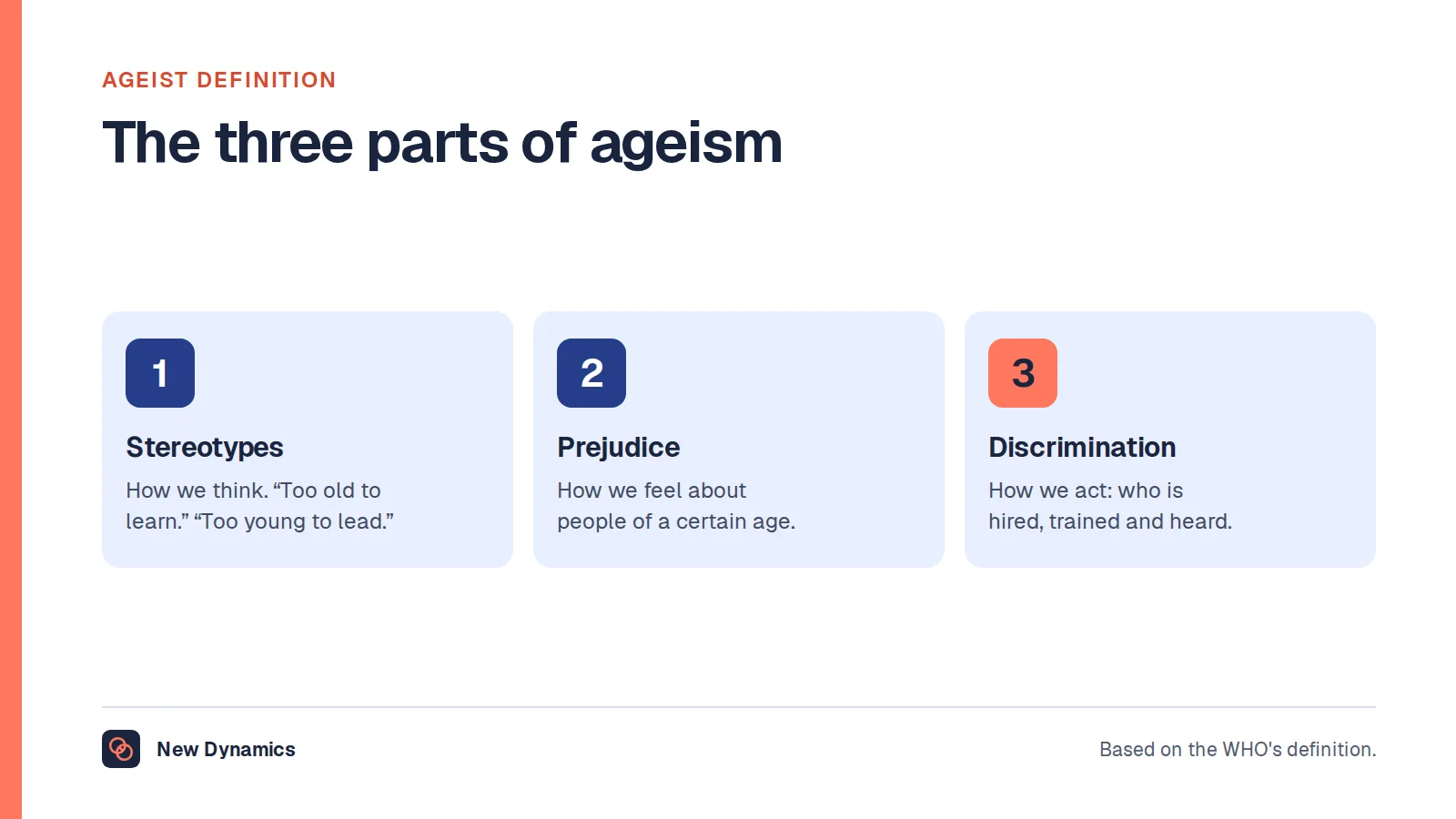
That last clause is the useful one for any age-based rule. If a fitness or competence test would do the same job, the age limit is not necessary. Our post on ageism covers the everyday version.
The UK equivalent: an occupational requirement under Schedule 9
Britain has an equivalent, built differently. Under Schedule 9 to the Equality Act 2010, paragraph 1(1), a person (A) does not contravene the listed provisions "by applying in relation to work a requirement to have a particular protected characteristic, if A shows that, having regard to the nature or context of the work":
- "it is an occupational requirement",
- "the application of the requirement is a proportionate means of achieving a legitimate aim", and
- "the person to whom A applies the requirement does not meet it (or A has reasonable grounds for not being satisfied that the person meets it)".
The provision is marked as extending to England, Wales and Scotland. Three differences from the American defence matter in practice.
First, scope. The British provision refers to "a particular protected characteristic" without naming which. It therefore reaches race, which the Title VII exception never does. That is the sharpest contrast between the two systems, and the reason a policy cannot be copied across in either direction.
Second, the test. The United States asks whether the characteristic is "reasonably necessary to the normal operation" of the business. Britain asks whether the requirement is "a proportionate means of achieving a legitimate aim", a weighing exercise: a real aim, and a requirement that goes no further than the aim needs.
Third, the individual limb. The British test also asks whether this person meets the requirement, and paragraph 1(4) modifies that limb where the requirement is to be of a particular sex. Separate paragraphs of Schedule 9 cover requirements relating to organised religion and employers with an ethos based on religion or belief, so a religious requirement in Britain is usually argued under its own paragraph.
In both countries the burden sits with the employer. "If A shows that" does the same work as the American rule that a BFOQ is an affirmative defence.
Before you rely on one, write it down

Every failed argument above follows the same pattern: the requirement came first, and the reason was found afterwards. Reverse the order. Name the duty the characteristic is supposed to be necessary for, count how many posts carry it, and write the sentence you would have to stand behind in the statutory words of your jurisdiction. Then look for the alternative: a test, a rota change, a chaperone arrangement, a redesign of the task. If an alternative meets the same need, you do not have a defence, you have a preference.
Our guide to recruitment and selection covers the surrounding process and the equal employment opportunity guide the policy layer. For the vocabulary, see our definition of discrimination at work, and for the pattern version, systemic discrimination.
Frequently asked questions
What is an example of a bona fide occupational qualification?
The clearest example in official US guidance is authenticity in a performance role. The EEOC's regulation at 29 CFR 1604.2(a)(2) states that where it is necessary "for the purpose of authenticity or genuineness", it will treat sex as a bona fide occupational qualification, giving the example of an actor or actress. Religion is the other established area, though religious organisations usually rely instead on the separate exemption in section 702(a).
Can race ever be a BFOQ?
No. Section 703(e)(1) of Title VII names only religion, sex and national origin, and the EEOC's Compliance Manual on race and colour discrimination states: "Nor may race or color ever be a bona fide occupational qualification under Title VII." Business reasons do not change that, and neither does customer reaction.
Is customer preference a BFOQ?
No. The EEOC's regulation lists a refusal to hire "because of the preferences of coworkers, the employer, clients or customers" among the situations that do not warrant the exception, with authenticity as the only carve-out. On race, the EEOC's worked example concludes that "customer preference is not a defense to race discrimination".
Which characteristics can a BFOQ apply to?
Under Title VII the statutory exception covers religion, sex and national origin only, and the Age Discrimination in Employment Act adds a parallel provision for age at section 4(f)(1). Race and colour are excluded from the Title VII exception altogether. Because this is a Title VII and ADEA concept, do not assume the same wording appears in other federal statutes.
Does the age discrimination law have its own BFOQ?
Yes. The ADEA permits action "where age is a bona fide occupational qualification reasonably necessary to the normal operation of the particular business". The EEOC's interpretation at 29 CFR 1625.6 says the concept "will have limited scope and application" and "must be narrowly construed". Where public safety is the stated objective, the employer must also show that no acceptable alternative would advance it as well with less discriminatory impact.
What is the UK equivalent of a BFOQ?
An occupational requirement under Schedule 9 to the Equality Act 2010. Paragraph 1(1) allows a requirement to have a particular protected characteristic where, having regard to the nature or context of the work, "it is an occupational requirement" and "the application of the requirement is a proportionate means of achieving a legitimate aim". It works differently from the American defence: a proportionality test rather than a necessity test, and not limited to a named list, so it can reach race.
Who has to prove a BFOQ?
The employer. In the United States it is an affirmative defence to a claim that would otherwise succeed, and in Britain the statutory wording "if A shows that" places the same burden on the person applying the requirement. In neither country does the candidate have to prove the requirement was unnecessary.
Your next step: test one requirement, this week
Jurisdiction: the United States, with the British equivalent named above. Take advice for every jurisdiction you employ in. This is general information and not legal advice.
- Pick one open role where a protected characteristic is specified, implied in the wording, or quietly assumed in who gets shortlisted.
- Write the duty that is supposed to make it necessary, naming the task and when it arises.
- Apply the statutory test in full: "reasonably necessary to the normal operation of that particular business or enterprise" in the United States, "a proportionate means of achieving a legitimate aim" in Britain.
- List the alternatives you have not tried. If one of them works, drop the requirement.
- If the characteristic is race or colour, stop. There is no version of this that is lawful under Title VII.
- Date the decision, record who made it, and put it where the next hiring manager will find it.
Want selection criteria that are set before the first application arrives, applied the same way for everyone, and recorded where you can show them? Book a New Dynamics demo and bring the process you run today. You can also email contact@new-dynamics.com.