TL;DR
- Adverse impact is what a neutral rule, test or cut-off does to a protected group in practice. The United States guidelines define it as “a substantially different rate of selection in hiring, promotion, or other employment decision which works to the disadvantage of members of a race, sex, or ethnic group”.
- The four-fifths rule is a rule of thumb inside a 1978 federal guideline, not a legal threshold. The guideline itself says smaller differences may still count and larger differences may not.
- In Great Britain the same mechanism is indirect discrimination under section 19 of the Equality Act 2010, which sets no numerical threshold and allows a defence of a proportionate means of achieving a legitimate aim. Northern Ireland has its own legislation.
Employers get adverse impact wrong in both directions. Some assume that because a requirement applies to everybody, it cannot be discriminatory. Others hear a number, usually eighty per cent, and treat it as a legal line a selection rate crosses or does not. Both readings are wrong and both are expensive: the first stops you looking, the second tells you the wrong thing when you do.
This article sets out what adverse impact means, how it differs from disparate treatment, and how to run the analysis without fooling yourself. It covers the American framing (disparate impact under Title VII and the Uniform Guidelines on Employee Selection Procedures) and the British framing (indirect discrimination under the Equality Act 2010), quoting the primary sources.
Please note: this is general information, not legal advice. Jurisdiction is marked in every section below, because the rules differ between countries and even between nations of the United Kingdom. Every real situation turns on its own facts, and the law changes. Take professional advice before acting.
Most adverse impact hides inside a process nobody wrote down. See how New Dynamics workflows let you define the stages, participants and rules of your own review and promotion process, so the rule you apply is at least visible.
What adverse impact means
Jurisdiction: the phrase is American in origin; the mechanism it describes is universal.
Adverse impact is the effect of a rule, not the intention behind it. A requirement is written neutrally, applied to everyone alike, and still lets through a smaller share of one protected group than another. That gap is the adverse impact. Nobody has to want it, or know about it.
The tightest definition sits in the American regulation. The Uniform Guidelines on Employee Selection Procedures, published in 1978 and still in the Code of Federal Regulations, define adverse impact at 29 CFR 1607.16(B) as:
A substantially different rate of selection in hiring, promotion, or other employment decision which works to the disadvantage of members of a race, sex, or ethnic group.
Three words do the work. Rate, because adverse impact compares proportions, not headcounts. Selection, because it attaches to a decision that lets people through or keeps them out. Disadvantage, because the gap has a direction.
The same section defines the two terms you need to measure it. A selection procedure is “any measure, combination of measures, or procedure used as a basis for any employment decision”, covering “the full range of assessment techniques from traditional paper and pencil tests, performance tests, training programs, or probationary periods and physical, educational, and work experience requirements through informal or casual interviews and unscored application forms”. A selection rate is “the proportion of applicants or candidates who are hired, promoted, or otherwise selected”.
That list is wider than most people expect: an unscored application form, a casual interview and a probationary period all count.

Adverse impact versus disparate treatment
There is also a narrow statutory defence that permits what would otherwise be direct discrimination, and it is never available for race: see bona fide occupational qualification.
Jurisdiction: both terms are United States federal law, and both have near equivalents in Great Britain.
This is the distinction most worth getting right: the evidence, the defence and the fix all differ.
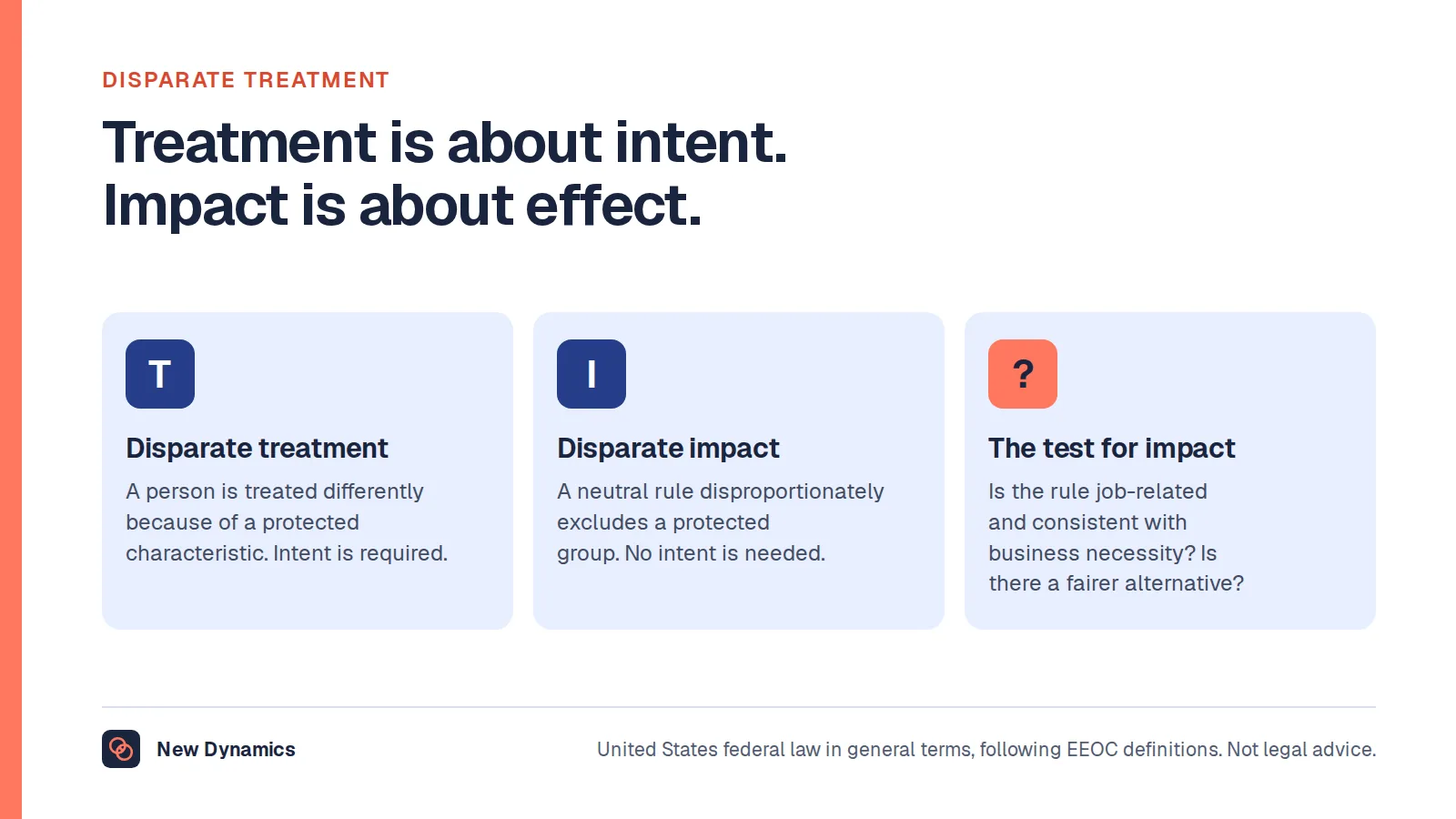
Disparate treatment is about a person treated differently because of who they are. It is intentional. The evidence is comparative: how were others handled, what was said, does the stated reason hold up. Our guide to disparate treatment and disparate impact is the place to start if your question is about an individual decision.
Adverse impact is about a rule's effect on a group. Intent is irrelevant to whether the impact exists. The evidence is numerical: who applied, who passed, at what rate, by group. The defence is not that nobody meant to, but that this requirement is needed for this job and no fairer route meets the same need.
Two consequences follow. A process can be free of disparate treatment and still produce adverse impact, because the problem sits in the criterion rather than the person applying it. And a well-meaning fix for one can create the other, as the section below explains.
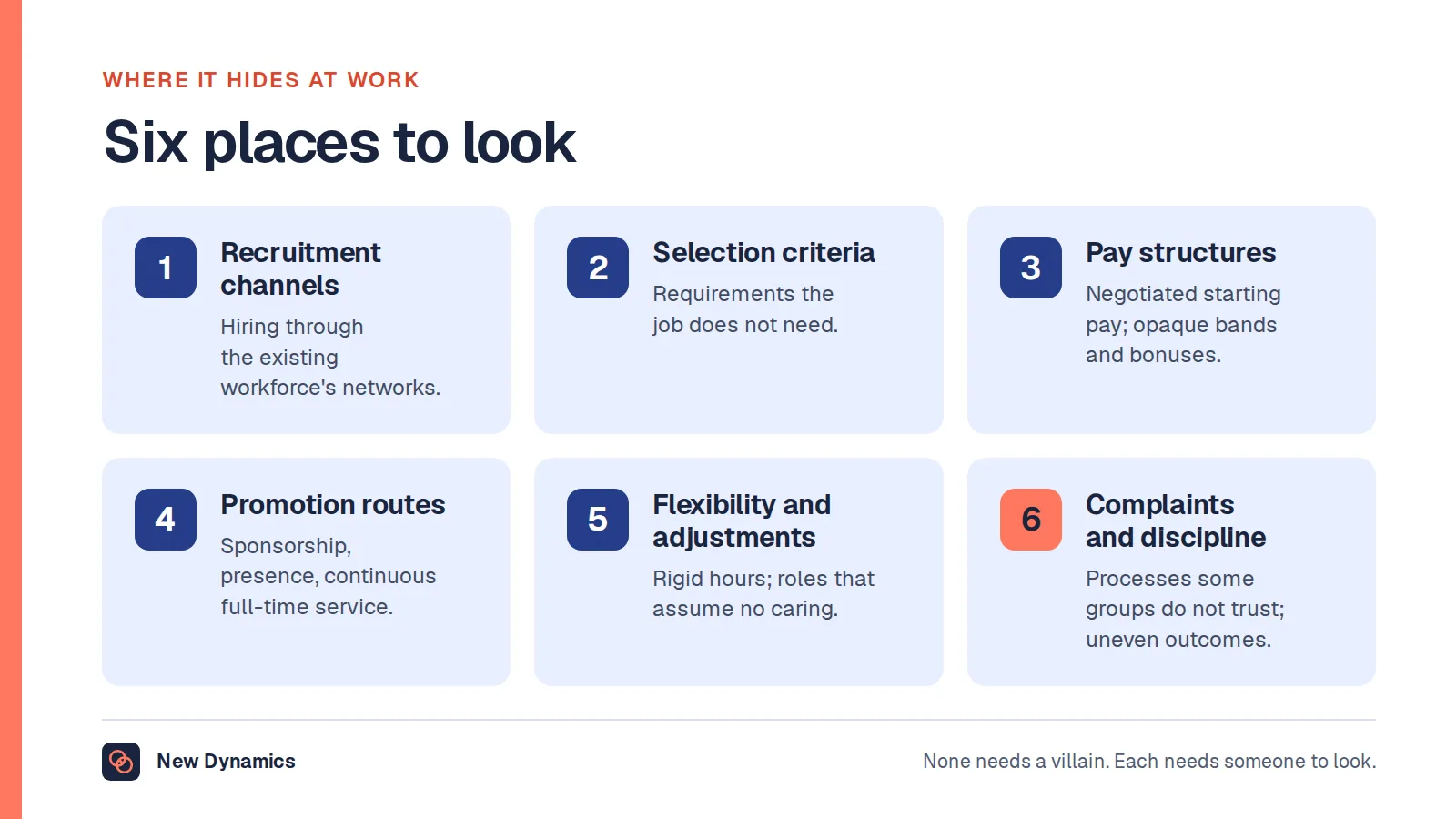
Where the pattern belongs to the whole organisation rather than to one rule, the useful frame is systemic discrimination, which looks at how recruitment channels, pay structures and promotion routes compound. Adverse impact analysis is narrower: one practice, one decision point, one set of numbers.
United States: disparate impact under Title VII
Jurisdiction: United States federal law. State and local law adds protections not covered here. General information, not legal advice.
The legal test lives in the statute, not in any guideline. Title VII of the Civil Rights Act of 1964, as amended in 1991, sets out the burden of proof in disparate impact cases. The text published by the EEOC says that an unlawful employment practice based on disparate impact is established only if:
a complaining party demonstrates that a respondent uses a particular employment practice that causes a disparate impact on the basis of race, color, religion, sex, or national origin and the respondent fails to demonstrate that the challenged practice is job related for the position in question and consistent with business necessity.
Note the word particular. The statute requires that “the complaining party shall demonstrate that each particular challenged employment practice causes a disparate impact”, unless the elements of the employer's decision making process “are not capable of separation for analysis”, in which case “the decision making process may be analyzed as one employment practice”. That is why a serious analysis takes the process apart step by step instead of looking only at the end result.
The EEOC's fact sheet on employment tests and selection procedures turns the statute into three questions, in order:
- Does the employer use a particular employment practice that has a disparate impact on the basis of race, colour, religion, sex or national origin? Determining this, the fact sheet notes, “ordinarily requires a statistical analysis”.
- If so, can the employer show the selection procedure is job-related and consistent with business necessity? An employer meets this standard “by showing that it is necessary to the safe and efficient performance of the job”, and the practice “must evaluate an individual's skills as related to the particular job in question” rather than measuring skills in general.
- If it can, can the person challenging the procedure show that an equally effective, less discriminatory alternative was available?
Two neighbouring federal statutes differ. Under the Age Discrimination in Employment Act, a neutral practice with a discriminatory effect on people aged 40 or older is defensible if the employer shows the action rested on a reasonable factor other than age, a lower bar than business necessity. Under the Americans with Disabilities Act, a test that screens out people with disabilities must be job-related and consistent with business necessity, and the employer must also make reasonable accommodations in how it is given.
The four-fifths rule: what the regulation actually says
Jurisdiction: United States federal law only. There is no British equivalent, as the next section explains.
This is the most common error in the subject, so here is the regulation's own wording. The Uniform Guidelines, in the paragraph on adverse impact and the four-fifths rule at 29 CFR 1607.4(D), say:
A selection rate for any race, sex, or ethnic group which is less than four-fifths (4/5) (or eighty percent) of the rate for the group with the highest rate will generally be regarded by the Federal enforcement agencies as evidence of adverse impact, while a greater than four-fifths rate will generally not be regarded by Federal enforcement agencies as evidence of adverse impact.
Read what that sentence is. It describes how federal enforcement agencies will generally regard a number: a rule of thumb, in a guideline, about enforcement discretion. It is not a statutory threshold, it does not appear in Title VII, and crossing it neither creates nor extinguishes liability. The regulation says so in its next two sentences:
Smaller differences in selection rate may nevertheless constitute adverse impact, where they are significant in both statistical and practical terms or where a user's actions have discouraged applicants disproportionately on grounds of race, sex, or ethnic group. Greater differences in selection rate may not constitute adverse impact where the differences are based on small numbers and are not statistically significant, or where special recruiting or other programs cause the pool of minority or female candidates to be atypical of the normal pool of applicants from that group.
So the ratio can sit above four-fifths and the practice can still be a problem, and it can sit below four-fifths and the practice may not be. Anyone who tells you 0.81 is safe and 0.79 is unlawful has not read the paragraph.
The same text appears in govinfo.gov's annual Code of Federal Regulations if you want the bound edition rather than the live one.
Enforcement priorities also change over time, and a guideline in force is not the same thing as a guideline actively enforced, so check eeoc.gov for the current position and take advice on your own facts.

Great Britain: indirect discrimination under section 19
Jurisdiction: England, Wales and Scotland. The Act marks section 19 as extending to those three nations. Northern Ireland is dealt with separately below. Not legal advice.
British law reaches the same mechanism under a different name and a different structure. Section 19 of the Equality Act 2010 says a person (A) discriminates against another (B) “if A applies to B a provision, criterion or practice which is discriminatory in relation to a relevant protected characteristic of B's”. It is discriminatory if all four of these are true:
(a) A applies, or would apply, it to persons with whom B does not share the characteristic, (b) it puts, or would put, persons with whom B shares the characteristic at a particular disadvantage when compared with persons with whom B does not share it, (c) it puts, or would put, B at that disadvantage, and (d) A cannot show it to be a proportionate means of achieving a legitimate aim.
Four things in that structure matter.
The phrase is “provision, criterion or practice”, usually shortened to PCP. Acas, in its guidance on indirect discrimination, confirms that this is “the legal phrase” and that working practices, policies and rules “can include things like formal and informal policies, decisions and ways of working”, adding that “they are not always written down”. An unwritten habit can be a PCP.
The threshold is “particular disadvantage”, and there is no number. Section 19 sets out no ratio, no percentage and no statistical test, which is the sharpest practical difference from the American framing. Numbers are used as evidence, and good numbers help, but no selection rate ratio decides the question.
The list of relevant protected characteristics is closed, and shorter than the full list. Section 19(3) gives age, disability, gender reassignment, marriage and civil partnership, race, religion or belief, sex, and sexual orientation. Pregnancy and maternity, a protected characteristic elsewhere in the Act, does not appear.
The defence is objective justification. Acas, on objective justification, says there can be objective justification if the employer proves both that “there's a ‘legitimate aim’, such as a genuine business need or a health and safety need” and that “the discrimination is ‘proportionate, appropriate and necessary’”, meaning the aim “is more important than any discriminatory effect”. It adds two warnings employers underweight: “Financial reasons alone are unlikely to justify discrimination”, and “The more the action discriminates, the more difficult it is for an employer to prove it's within the law”.
Since 1 January 2024 there has also been a section 19A, inserted by the Equality Act 2010 (Amendment) Regulations 2023, covering someone who does not share the characteristic but is put “at substantively the same disadvantage” by the same PCP.
GOV.UK's guidance for employers on discrimination in recruitment is a reminder that a PCP can be something you would never call a rule. It warns that “where you advertise might cause indirect discrimination”, giving the example of “advertising only in men's magazines”, and tells employers to use phrases such as “recent graduate” or “highly experienced” only “when these are actual requirements of the job”.
Northern Ireland: separate legislation, different wording
Jurisdiction: Northern Ireland.
Northern Ireland is not covered by the discrimination provisions of the Equality Act 2010, and treating a British answer as a United Kingdom answer is a real error. Section 217 of the Act sets the extent: the Act forms part of the law of England and Wales, and of Scotland apart from section 190 and Part 15, and only three named provisions (section 82 on offshore work, section 105(3) and (4), and section 199 on the presumption of advancement) also form part of the law of Northern Ireland. Section 19 is not among them.
Northern Ireland has its own anti-discrimination legislation, with its own wording. Article 3 of the Fair Employment and Treatment (Northern Ireland) Order 1998, on religious belief and political opinion, carries two indirect discrimination tests side by side. The older one at article 3(2)(b) turns on “a requirement or condition” applied equally, where the proportion of people sharing the belief or opinion “who can comply with it is considerably smaller” than the proportion of others who can comply, and which the employer cannot show to be justifiable. A newer test at article 3(2A)(b), applying to specified Parts of the Order, uses the modern language of a “provision, criterion or practice”, “particular disadvantage” and “a proportionate means of achieving a legitimate aim”.
The point is not the detail of that Order. It is that the words differ, the tests differ, the enforcement bodies differ, and a policy written against section 19 has not answered the question in Belfast. If you employ people across the United Kingdom, take advice for each jurisdiction. This is general information and not legal advice.
Where adverse impact actually shows up
Jurisdiction: the examples below are mechanisms rather than legal conclusions, and arise in every jurisdiction covered above. Whether one is unlawful depends on the evidence and the justification.
A qualification requirement
A degree, a certificate, or a minimum number of years in a named industry. Each stands in for something the employer actually wants (reliability, prior knowledge, judgement) and each also tracks things that have nothing to do with the job: years of experience track age, formal qualifications track background and where someone was educated. The question is not whether the requirement is reasonable in the abstract, but whether this job needs it at this level.
A test or an assessment
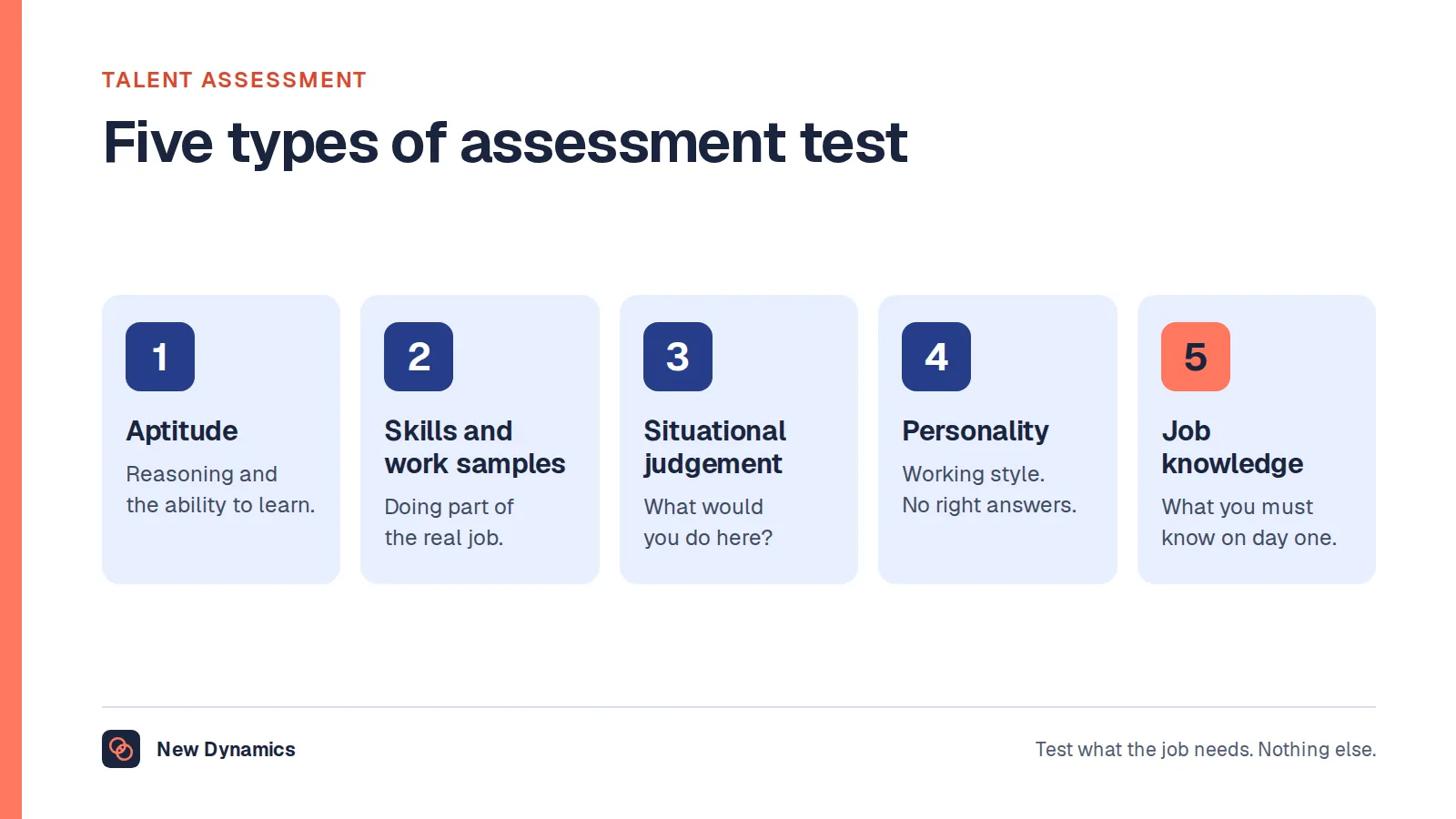
Cognitive tests, personality questionnaires, numeracy screens, timed online assessments. A test with real predictive validity can still have adverse impact, and a test with none has adverse impact for no reason at all. Our guide to talent assessment tests covers the published evidence on that trade-off, including the official guidance that recommends combining methods rather than relying on one.
A physical standard
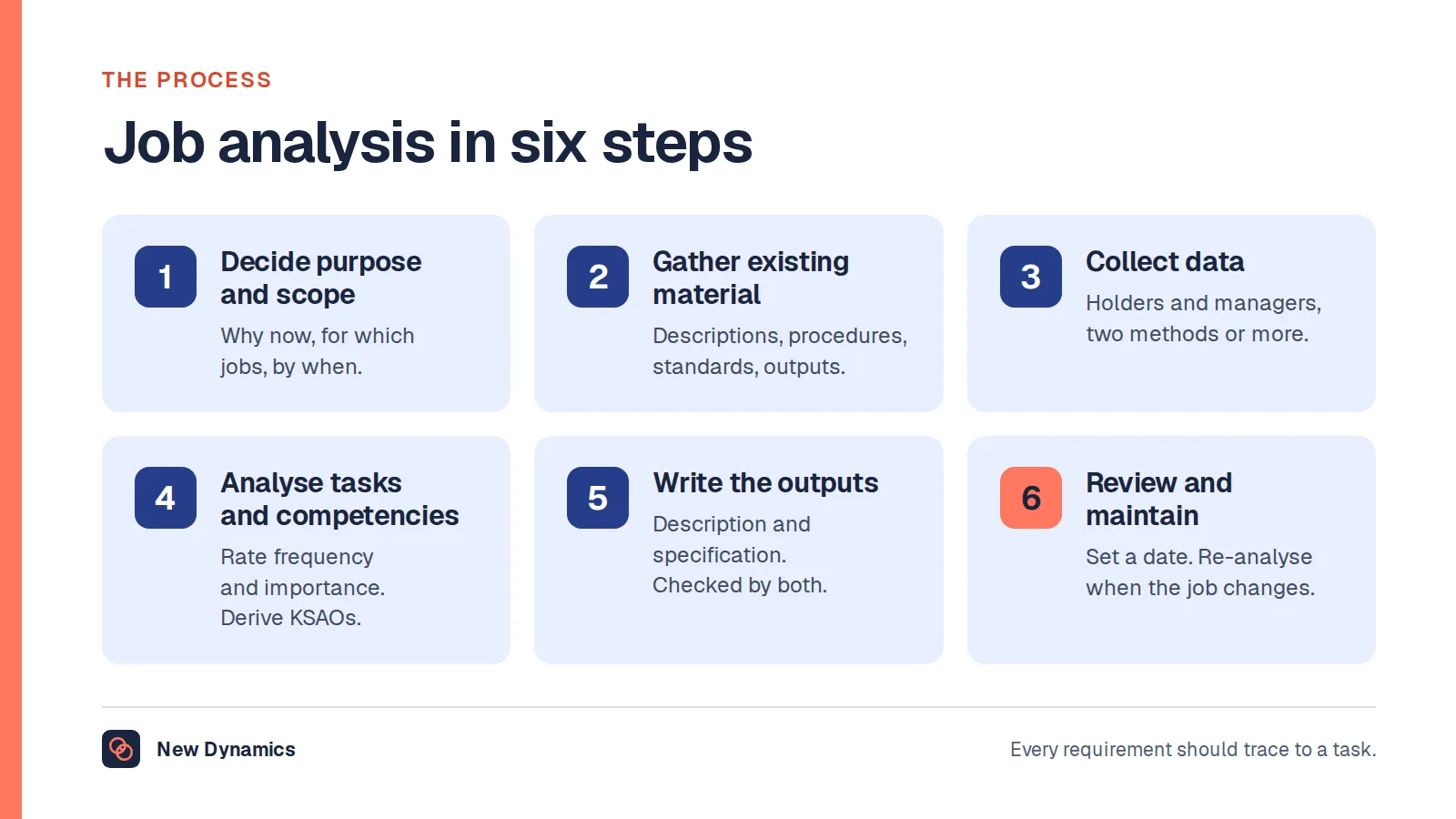
A lifting weight, a running time, a height or reach requirement. These produce the sharpest measurable gaps by sex, and they are the easiest to over-specify, because the number tends to be set at what the strongest current post-holder can do rather than what the work demands. Compare the standard with a documented job analysis.
A shift pattern or a working time rule
Compulsory overtime, rotating nights, a return to five days on site, a 7am start. Each falls unevenly on people with caring responsibilities (in practice, unevenly by sex), on some disabled people and on some religious observances. Acas lists working hours and “policies on ways of working”, such as flexible or home working, among the practices that can be indirectly discriminatory. It also gives a recruitment example easy to produce by accident: a business advertises a head of sales role internally only, and the eligible internal candidates are all men.
A location requirement
A catchment area, a postcode, a travel radius, a requirement to relocate. Geography stands in for a great deal, and a rule built on it carries the demographics of a map into a hiring decision. Acas gives the example of an employer who avoids recruiting from a particular postcode area, and notes that this can indirectly discriminate both against the group concentrated there and against others at the same disadvantage.
An algorithm or a scoring tool
A CV screener, a ranked shortlist, a model trained on who succeeded before, an automated knock-out question. None of this is legally novel: under the American guidelines a scoring tool is a selection procedure like any other, and under section 19 it is a provision, criterion or practice like any other. What is different is that the rule may not be legible even to the people operating it, which makes measurement harder rather than optional. If you cannot say what the tool selects on, you cannot justify it. Our AI governance guide sets out the controls and records to keep.

How to run an adverse impact analysis honestly
Jurisdiction: the method below is general good practice. The legal significance of what you find differs by jurisdiction. Not legal advice.
1. Name the practice, singly. One rule, one test, one cut-off, one stage. The American statute's requirement that each particular practice be identified is also good analysis: measure only the end-to-end result and a harsh stage hides behind a generous one, leaving you no rule to change.
2. Count both outcomes by group. For each stage, the number who entered and the number who got through, broken down by the characteristics you lawfully monitor. The American guidelines expect those records to exist: 29 CFR 1607.4(A) says each user “should maintain and have available for inspection records or other information which will disclose the impact which its tests and other selection procedures have upon employment opportunities of persons by identifiable race, sex, or ethnic group”.
3. Work out each group's selection rate, and compare. Divide those selected by those who entered the stage, then compare each group's rate with the highest rate. In the United States the four-fifths comparison is a useful first screen, as long as you remember what it is. Anywhere else the ratio is evidence and nothing more.
4. Check whether the numbers can bear the weight. This is where most internal analyses go wrong. With twelve applicants, one person's result swings the ratio past any threshold you like. The regulation says greater differences “may not constitute adverse impact where the differences are based on small numbers and are not statistically significant”, and that where evidence “indicates adverse impact but is based upon numbers which are too small to be reliable”, the impact of the procedure “over a longer period of time” may be considered. So pool several cycles before concluding anything, and never put a ratio in a paper without the raw counts beside it.
5. Test the justification, in writing. For each practice that shows a gap, write down what the rule is for, what evidence links it to performance in this job, what level it is set at and why, and what alternatives you considered. In the United States that is the job-relatedness and business necessity case; in Great Britain it is the legitimate aim and proportionality case. In both, the document you want on the day is the one written before anything went wrong.
6. Look for the less exclusionary alternative. Where two procedures are substantially equally valid, 29 CFR 1607.3(B) says the user “should use the procedure which has been demonstrated to have the lesser adverse impact”. Acas puts the same duty as a question: is there another way to achieve the aim that either does not discriminate or discriminates less?
A note on statistics, since invented figures circulate here. The EEOC's fact sheet records charges raising issues of employment testing and exclusions based on criminal background checks, credit reports and other selection procedures “reached a high point in FY 2007 at 304 charges”: the agency's own figure for its own 2007 financial year, and now badly dated. No official source we can find publishes a current count of adverse impact findings, or of how many employers test their selection rules. Our HR statistics hub collects the figures that are published, with their reference periods.
What to do when you find it, and the trap of not looking
Jurisdiction: marked within each point, because this is where the systems diverge. Not legal advice.
Fix the rule, not the result. If a requirement cannot be justified, change it: lower an over-specified standard to what the job needs, replace a stand-in with the thing itself, widen a channel.
In the United States, do not adjust scores by group. This is the trap that catches employers trying to do the right thing. Title VII makes it an unlawful employment practice, in connection with selection or referral for employment or promotion, “to adjust the scores of, use different cutoff scores for, or otherwise alter the results of, employment related tests on the basis of race, color, religion, sex, or national origin”. Fixing an impact problem by moving one group's pass mark can create a treatment problem. Change the test, the cut-off for everyone, or the weighting, and record why.
In Great Britain, mind the line between positive action and positive discrimination. Encouraging applications and removing barriers is a different thing from selecting on a protected characteristic. Take advice before designing anything that touches selection itself.
Keep the comparison, and re-measure. Record the alternatives you examined and why you kept or rejected each: under section 19, proportionality is judged against the alternatives available to you. Book the next measurement when you make the change, and give it an owner. A fix you have not re-measured is a hope.
And do not solve the problem by not looking. There is a caution that amounts to deliberate ignorance: leave the numbers unbroken by group, because if nothing is on paper there is nothing to disclose. The American guidelines address that directly. 29 CFR 1607.4(D) ends by saying that where the user has not maintained data on adverse impact as required, “the Federal enforcement agencies may draw an inference of adverse impact of the selection process from the failure of the user to maintain such data, if the user has an underutilization of a group in the job category, as compared to the group's representation in the relevant labor market”. Not looking is not neutral. In that framework it can be read against you.
The commercial logic agrees. An unmeasured requirement that excludes a group is already excluding candidates you wanted, every cycle, until somebody looks. Finding a problem yourself is an internal decision; having it found for you is a disclosure. And the data protection answer is not to stop collecting: collect the minimum, aggregate it, restrict access, state the purpose. The guidelines themselves tell users to adopt safeguards so that such records are “used for appropriate purposes such as determining adverse impact” and “are not used improperly”.
For the policy scaffolding around this, including how selection criteria are set and recorded, read and download our recruitment and selection guide. The guide is free to read, and the PDF uses our short download form.
Frequently asked questions
Jurisdiction: the United States and Great Britain, as named below. Northern Ireland has its own legislation. Not legal advice.
What is adverse impact?
Adverse impact is the effect of a neutral rule, test or requirement that lets through a smaller proportion of one protected group than another. The United States guidelines define it at 29 CFR 1607.16(B) as a substantially different rate of selection in hiring, promotion or another employment decision which works to the disadvantage of members of a race, sex or ethnic group. Intent is not part of the definition. This is general information, not legal advice.
What is an example of adverse impact?
A strength standard set well above what the job demands, which passes far fewer women than men. A degree requirement for work that does not use one. A rotating night shift that falls unevenly on people with caring responsibilities. A CV screening tool trained on who was hired before. The rule applies to everyone; the outcome does not fall evenly. Mechanisms in any jurisdiction, not legal conclusions.
What is the four-fifths rule?
It is a rule of thumb inside a 1978 federal guideline, 29 CFR 1607.4(D), which says a selection rate less than four-fifths (or eighty per cent) of the rate for the group with the highest rate will generally be regarded by the federal enforcement agencies as evidence of adverse impact. It is not a legal threshold: the same paragraph says smaller differences may still count and larger differences may not, particularly where the numbers are small.
Is adverse impact the same as disparate treatment?
No. Disparate treatment is intentional: a person is treated differently because of a protected characteristic. Adverse impact concerns the effect of a neutral practice on a group, and no intent is required. The evidence differs, and so does the defence.
How do you run an adverse impact analysis?
Name one practice at a time, count who entered and who passed each stage by the characteristics you lawfully monitor, work out each group's selection rate and compare it with the highest rate, check the sample is large enough to mean anything, then write down the justification and the alternatives you considered. Re-measure after any change.
Does the Equality Act 2010 apply in Northern Ireland?
Its discrimination provisions do not. Section 217 states that the Act forms part of the law of England and Wales, and of Scotland apart from section 190 and Part 15, and that only three named provisions also form part of the law of Northern Ireland. Section 19 is not one of them. Northern Ireland has its own anti-discrimination legislation, with wording and tests of its own, so take local advice.
Your next step: pick one requirement and test it
Jurisdiction: all of them. Step 5 is the one people skip.
- Choose one requirement you apply to everybody: a qualification, a test score, a physical standard, a shift pattern or a scoring tool.
- Pull the numbers for the last two or three cycles. Count who entered and who passed, by the characteristics you lawfully monitor, and write the raw counts next to the rates.
- Write one paragraph on why the requirement exists, why it sits at that level, and what else would meet the same need. If you cannot write it, that is the finding.
- Decide, date the decision, book the re-measurement.
- Take legal advice for each jurisdiction you employ in. This is general information and not legal advice.
Want promotion and review decisions to rest on criteria you can see, applied the same way, with the record to show it? Book a New Dynamics demo and bring the process you run today. You can also email contact@new-dynamics.com.