TL;DR
- A boss has authority over people because of a position. A leader has influence with people because of how they behave. The same person can be both, either or neither.
- The difference shows in everyday moments: how work is handed over, what happens after a mistake, who gets the credit and whether people feel safe to disagree.
- Nobody is stuck as a boss. Leadership is a set of behaviours you can practise, such as explaining why, asking before telling, giving authority with the task and asking for feedback.
Think of the best person you ever worked for, and then the worst. Both had the same kind of job title. Both could approve your holiday and sign off your review. The difference was in how they used the position.
That is what people mean by boss vs leader. This article explains the difference in plain terms, walks through 12 everyday situations, offers a ten-question self-check and sets out six habits for anyone who wants to lead better.
Leading well depends on regular, honest conversation. See how New Dynamics continuous feedback helps managers to coach, recognise and listen as part of everyday work.
What is the difference between a boss and a leader?
A boss is someone with formal authority over others. The position gives them the right to assign work, make decisions and judge performance.
A leader is someone whom others choose to follow. Their influence comes from trust, clarity and example, and it does not depend on a job title.
So the two words answer different questions. “Boss” tells you where someone sits in the structure. “Leader” tells you how they behave, and how others respond.
That gives four possibilities.
- A boss who leads. This is the aim. They have authority and rarely need to lean on it.
- A boss who does not lead. People comply while they are being watched, and do the minimum otherwise.
- A leader who is not a boss. The colleague everyone turns to, whatever the organisation chart says.
- Neither. Which is fine. Not everyone wants to lead, and teams need strong individual contributors.
When people say “be a leader, not a boss”, they are describing the second case and wishing for the first.

Boss vs leader: 12 differences in everyday situations
These contrasts describe behaviour, not types of people. Most of us show both columns, depending on the day and the pressure.
| Situation | Relying on authority | Leading |
|---|---|---|
| Handing over work | Gives the task and the method | Explains the outcome and the reason, and agrees the limits |
| Making decisions | Decides alone and announces | Asks those affected, decides and explains the reasoning |
| After a mistake | Looks for who is to blame | Looks for the cause, and owns their own part |
| Credit | Presents the team's work as their own | Names the people who did the work |
| Information | Shares what people “need to know” | Shares context early, including bad news |
| Disagreement | Treats challenge as disloyalty | Invites challenge, and thanks people for it |
| Feedback | Saves it for the annual review | Gives it promptly, specifically and kindly |
| Development | Keeps good people where they are useful | Helps people to grow, even if it means losing them |
| Delegation | Delegates tasks and keeps the decisions | Delegates the decision along with the task |
| Under pressure | Passes the pressure down | Absorbs some of it, and sets priorities |
| Measure of success | Looking good to those above | The team's results and growth |
| Source of influence | “Because I said so” | “Here is why it matters” |
Examples of boss and leader behaviour
A missed deadline. The report is late. One manager sends a sharp email, copied to their own manager. Another asks what got in the way, learns that three urgent requests landed in the same week, and agrees how priorities will be handled next time. The first response protects the manager. The second fixes the problem.
A new idea. A junior colleague suggests a different way to run the weekly meeting. One manager says, “We have always done it this way.” Another says, “Try it for a month, and tell us what you learn.” The cost of the experiment is small. The signal about whether ideas are welcome is large.
A presentation to the directors. The team spent three weeks on the analysis. One manager presents it alone and says “I”. Another brings the analyst, lets her present her section and says “we”. The directors notice. So does the team.
A resignation. A strong performer hands in her notice. One manager takes it personally and goes cold. Another thanks her, asks what the organisation could have done differently and offers to be a reference. Former colleagues talk, and what they say can affect who joins next. Our exit interview questions can help with that conversation.
What the evidence says about effective managers
Much of what is written about bosses and leaders is opinion, including the well-known lists of contrasts. Two published sources are more solid.
Google's people analytics team set out to test a hypothesis held by some of its early leaders: that managers do not matter. Its guide to the research behind great managers reports the opposite finding, and lists ten behaviours of its most effective managers. The first two are “Be a good coach” and “Empower the team without micromanaging”. The list also includes “Create a team environment that values everyone” and “Support career development and discuss performance”. This is evidence from one company, but it matches what many people report from experience.
The UK Civil Service makes similar commitments in its Leadership Statement. Under the heading “Empowering”, leaders promise: “We will give our teams the space and authority to deliver their clearly set objectives”, and “We will be visible, approachable, and welcome challenge, however uncomfortable”.
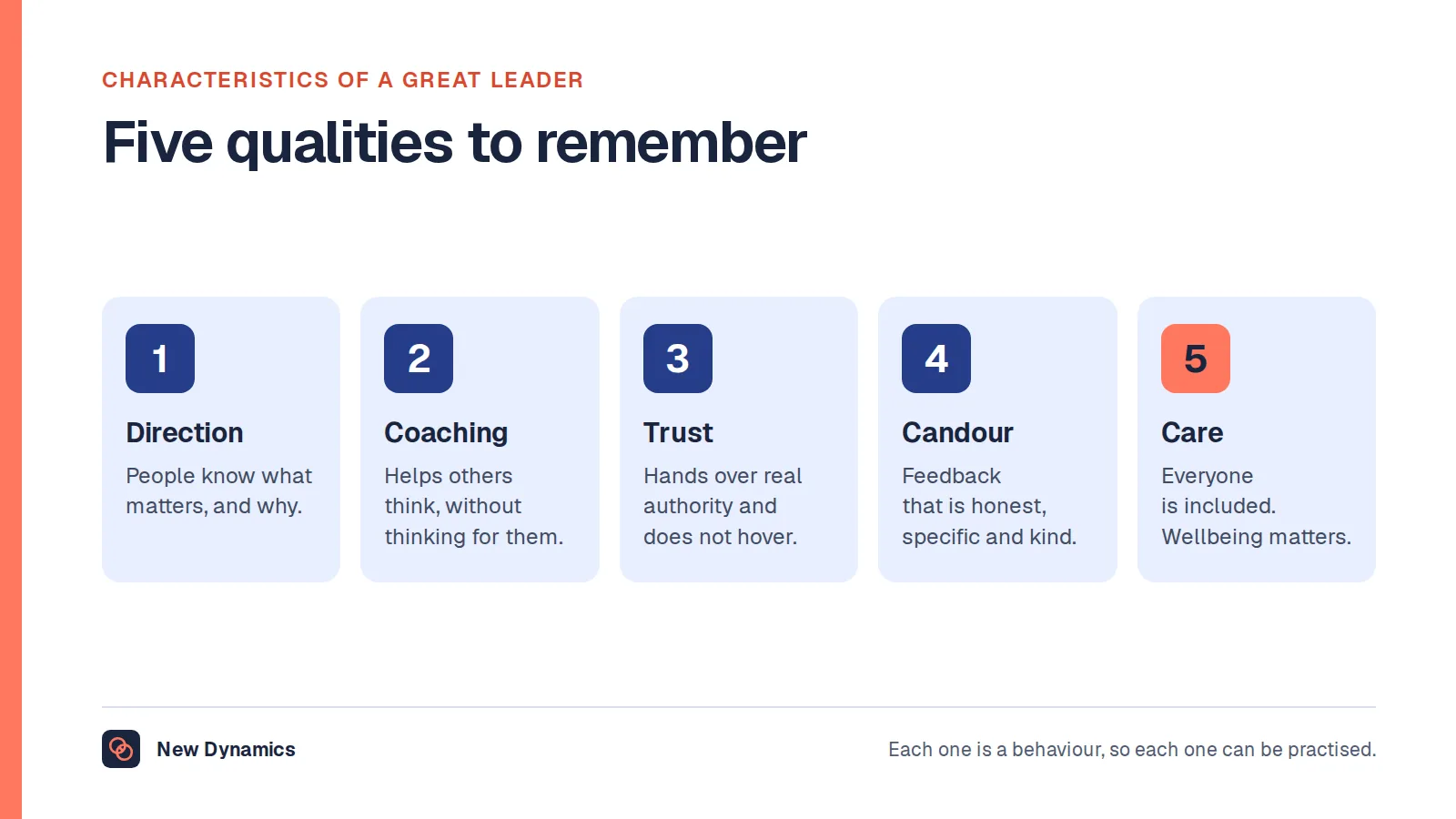
Both lists describe behaviours, and behaviours can be learned. We look at them in more depth in the characteristics of a great leader.
Is being a boss a bad thing?
No. The contrast is useful, but it can turn into a caricature. Three points keep it honest.
Authority is necessary. Someone has to set priorities, make unpopular decisions, deal with poor performance and be accountable. A manager who avoids all of that in order to be liked is not leading either.
Sometimes directing is right. In an emergency, on a safety matter or with someone brand new to a task, clear instructions are a kindness. The skill lies in matching your style to the situation, and in not staying in command mode when the fire is out.
Leadership needs management. Inspiring talk without plans, budgets and follow-through achieves little. Teams need the vision and the rota. We set out the practical side in what makes a good manager.
So the aim is not to stop being a boss. It is to use authority sparingly, in the service of the team and the work.
Are you a boss or a leader? A ten-question self-check
Answer honestly. Better still, ask your team to answer for you.
- Do people bring me bad news early?
- When did someone last disagree with me openly, and what did I do?
- Could my team explain why our current priorities matter?
- When something went wrong recently, was my first question “who?” or “what happened?”
- Whom did I last give credit to, by name, in front of others?
- Which decision have I handed over completely in the past three months?
- Does each person in my team know what I think they do well?
- Has anyone in my team grown into a bigger role with my help?
- Do I ask for feedback on how I manage, and act on it?
- How does the team perform when I am on holiday?
If several answers make you uncomfortable, that is useful. It tells you where to start.

How to move from boss to leader: six habits
- Explain why. Before you hand over any piece of work, say what it is for and what good looks like. People make better decisions when they understand the purpose.
- Ask before you tell. When someone brings you a problem, ask “What do you think we should do?” before you offer your answer. Often they already know.
- Give authority with the task. Say what the person can decide without checking with you. Then let them decide, even if you would have done it differently.
- Share the credit and absorb the blame. Name names when things go well. When they go badly, say “we” to those above you and sort out the detail in private.
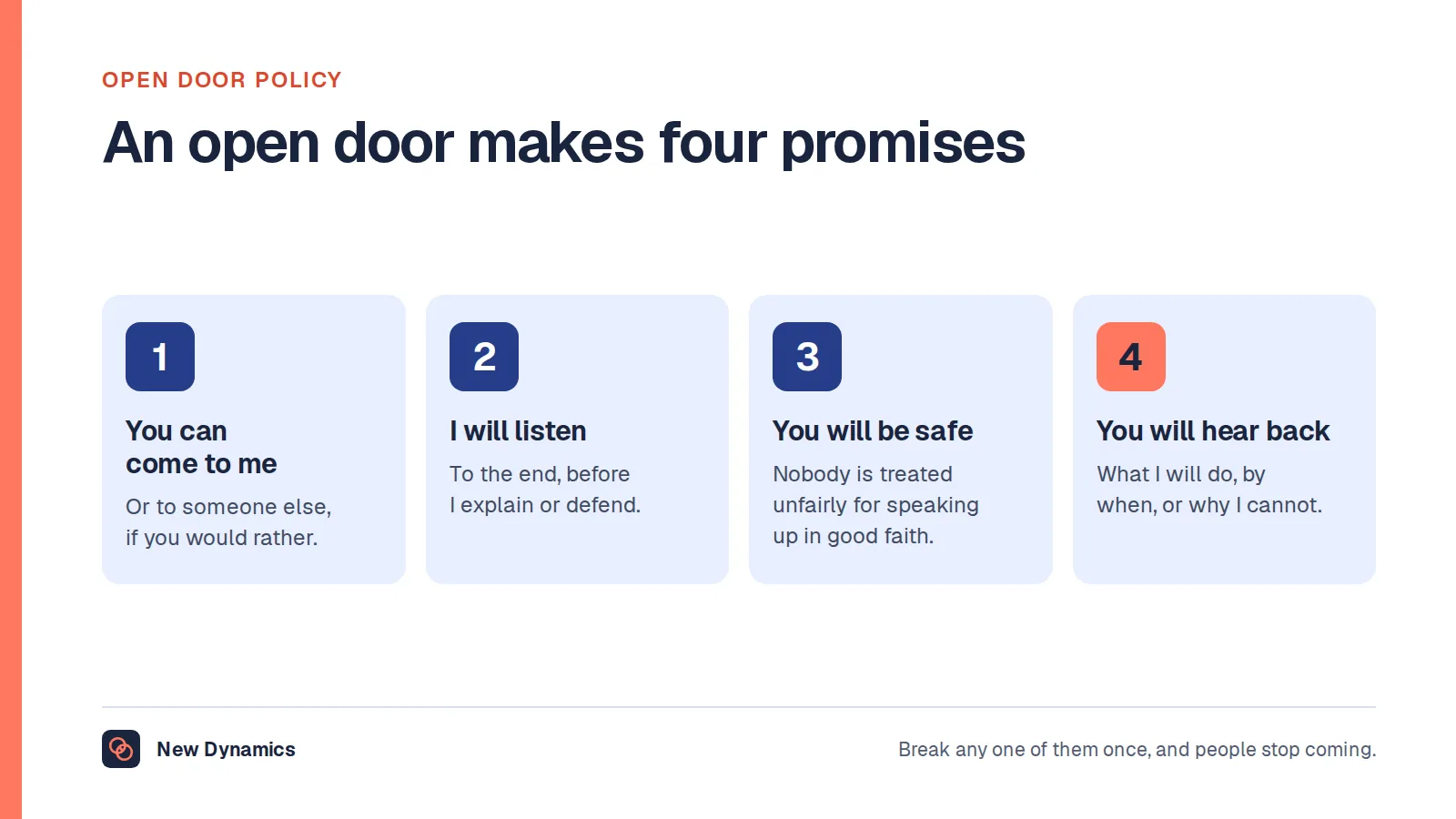
- Make it safe to disagree. Thank the first person who challenges you in a meeting. Others are watching to see what happens. See how to make an open door policy real.
- Ask for feedback on yourself. Try “What is one thing I could do differently that would make your work easier?” Then act on something that you hear, and say that you have.
Pick one habit and practise it for a month. Regular one-to-ones are the natural place for most of them. Our one-to-one meeting guide has an agenda and prompts.
If you work for a boss who does not lead
You cannot change another person, but you have some options.
- Ask for what you need. “It would help me to know why this matters” is a reasonable request.
- Offer updates before you are asked. Close checking is sometimes driven by worry. Regular updates can reduce it.
- Give feedback with care. Describe a specific situation and its effect on your work, and suggest an alternative. Our negative feedback examples show wording that works upwards as well.
- Lead from where you are. Share credit, help colleagues and explain the why in your own work. Leadership does not need permission.
- Know the line. A demanding manager is one thing. Bullying, harassment and discrimination are another, and they call for your organisation's formal procedure.
Common myths about bosses and leaders
“Leaders are born.” The research lists above are lists of behaviours. Behaviours can be practised.
“Leaders are charismatic.” Many of the best are quiet. Reliability and fairness matter more than stage presence.
“Leaders are always nice.” Leading includes honest feedback and hard decisions. Kind and soft are different things.
“Managers manage, leaders lead.” In real organisations, the same person has to do both before lunch.
“A title makes you a leader.” A title makes you a boss. What you do with it decides the rest.

Frequently asked questions
What is the difference between a boss and a leader?
A boss has formal authority over people because of a position. A leader has influence with people because of how they behave: explaining why, listening, sharing credit and developing others. One person can be both. The words describe different things, position and behaviour.
Can a boss also be a leader?
Yes, and that is the aim. The best managers hold authority and rarely need to lean on it, because their teams trust them and understand the purpose of the work. They still make hard decisions and hold people to account.
What are examples of boss vs leader behaviour?
After a missed deadline, a boss asks who is to blame, while a leader asks what got in the way. In a presentation, a boss says “I”, while a leader brings the person who did the work. When challenged, a boss takes offence, and a leader says thank you.
Is it bad to be a boss?
No. Organisations need people with authority to set priorities, make decisions and be accountable. The problem is relying on authority alone. In an emergency or on a safety matter, direct instructions are right. Day to day, explanation and trust achieve more.
How can I become a leader and not just a boss?
Practise six habits: explain why, ask before you tell, give authority with the task, share credit and absorb blame, make it safe to disagree, and ask for feedback on yourself. Choose one and work on it for a month.
Can you be a leader without being a boss?
Yes. Anyone who helps colleagues, shares credit, speaks up constructively and sets an example is leading, whatever their title. Many teams depend on such people.
Your next step: ask one question this week
- In your next one-to-one, ask: “What is one thing I could do differently that would make your work easier?”
- Listen without defending yourself.
- Choose one thing to change, and say that you will.
- Ask again in a month whether it made a difference.
For an agenda and conversation prompts, read and download our one-to-one meeting guide. The guide is free to read, and the PDF uses our short download form.
Want to help every manager to coach, recognise and listen? Book a New Dynamics demo and bring your current management habits. You can also email contact@new-dynamics.com.