TL;DR
- Sourcing is the search that happens before anyone applies, and it competes for attention rather than for applications. The Office for National Statistics puts the UK employment rate for people aged 16 to 64 at 75.3% for June to August 2026 and the unemployment rate at 4.7%, so almost everyone who could do your job is currently doing another one.
- Holding candidate details between vacancies is the part employers get wrong. The ICO's draft recruitment guidance states that data protection law "does not specify timescales for keeping recruitment records", and that keeping information for a new purpose requires having "previously informed candidates" of that purpose and reviewing your lawful basis.
- Sourcing from a profile rather than an application changes your duties. UK GDPR Article 14 covers information to be provided where personal data have not been obtained from the data subject, and it bites at the latest at the time of your first message, not at offer stage.
The vacancy has been open for six weeks. The advert is live, the applications are thin, and the ones that arrive are not close. Somebody suggests sourcing. What usually follows is a burst of messages to strangers, a spreadsheet nobody updates, and a conclusion that sourcing does not work here.
Sourcing does work, but only as a deliberate choice about where to spend attention. This article sets out which candidate sourcing strategies are worth the effort, what each channel is genuinely good for, how to hold a talent pool without breaking the law, how to write an approach that gets answered, what to measure, and when the honest answer is that no amount of sourcing will fix the job you are advertising. It covers the position in the United Kingdom and it is general information, not legal advice.
Before you look outside, it helps to know what you already have. See how New Dynamics org charts make reporting lines, project teams and working relationships visible, so the internal shortlist is something you can read rather than something you reconstruct from memory.
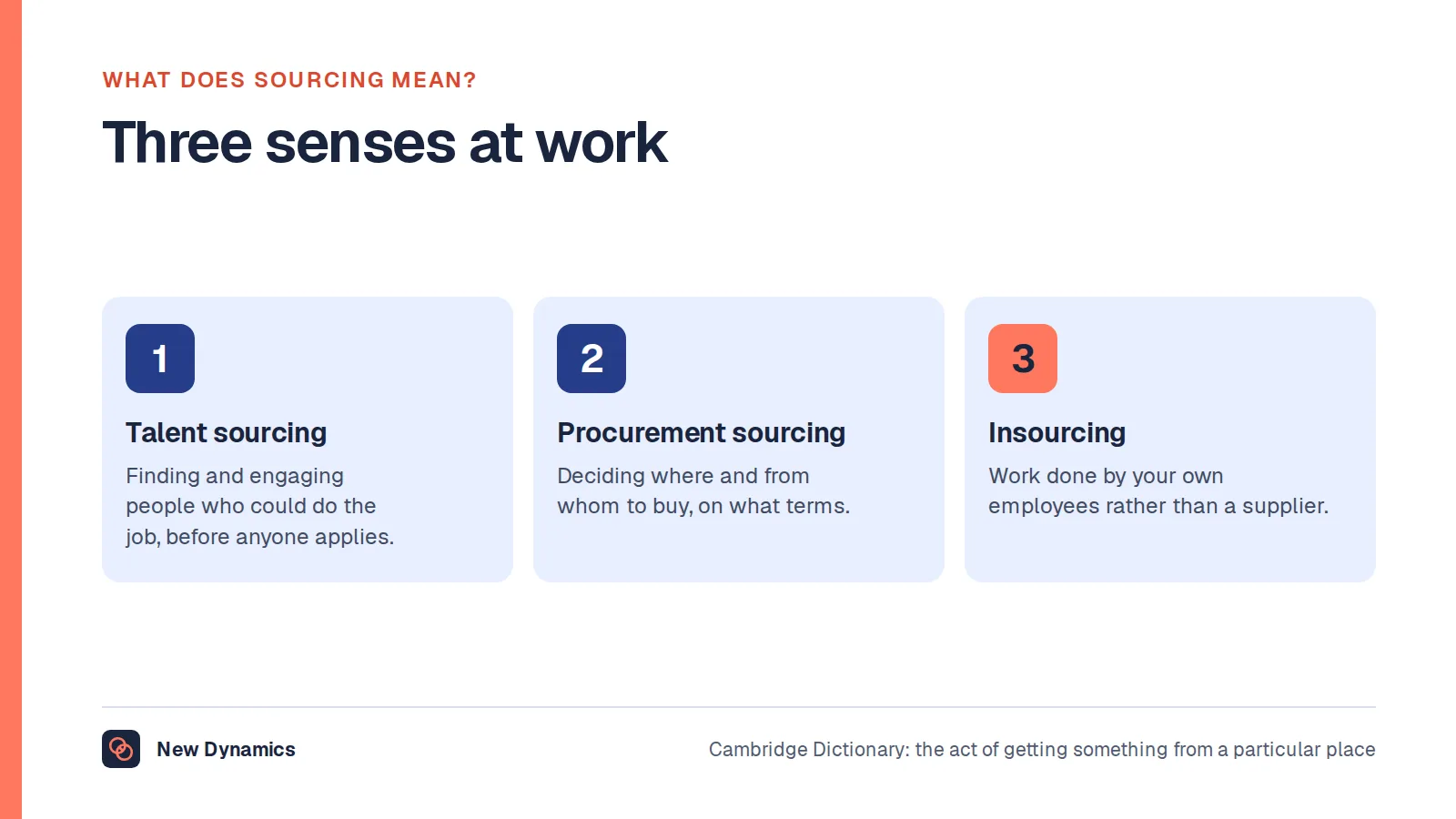
If you need the plain definition of the word first, including its procurement and insourcing senses, start with our post on what sourcing means. This article assumes you have that and moves on to the strategy.
Sourcing, advertising and recruiting are three different jobs
Advertising publishes the role and waits. It competes with every other advert for the attention of people who are actively looking, and its reach is limited to them.
Sourcing goes the other way. You decide who could do the job, find those people, and approach them. The Office for National Statistics defines a vacancy in its own labour market statistics as a position "for which employers are actively seeking recruits from outside their business or organisation", which is the whole of the job in one phrase: actively seeking, not waiting to be found.
Recruiting is everything after the first conversation: screening, interviewing, assessing, offering and closing. In a large team a sourcing recruiter does only the first part and hands over. In most organisations one person does all three, and the sourcing is the part that gets dropped when the week gets busy, because it is the only part with no deadline attached.
That is the first strategic decision, and it is not about technique. Sourcing is a standing activity or it does not happen. Either someone owns a few hours a week for it, or you are advertising and calling it sourcing.
Active and passive candidates, and why it matters
An active candidate is looking: applying, watching listings, answering adverts. A passive candidate is in work, not looking, and reachable only if somebody approaches them.
The arithmetic is what makes this worth taking seriously. In its Labour market overview, UK: October 2026, released on 20 October 2026, the ONS reports that "The UK employment rate (based on the LFS) for people aged 16 to 64 years, including both employees and self-employed, was estimated at 75.3% for June to August 2026" and that "The UK unemployment rate for people aged 16 years and over was estimated at 4.7% in June to August 2026". The economic inactivity rate for people aged 16 to 64 "was estimated at 20.9% in June to August 2026".
Read those together. The great majority of people who could do your job are currently doing a different one. An advert reaches the small slice who are looking this month. Passive candidate sourcing is simply the decision to go after the rest, and it carries a cost: passive people are slower, harder to convince, and more likely to withdraw late, because they have something to lose.
So the distinction is not that passive candidates are better. It is that they are a different market with different economics. Use sourcing where the active market demonstrably cannot supply the skill, and advertising where it can.
Scarcity is not a constant either. The same ONS release reports that early estimates of vacancies for July to September 2026 "suggest a decrease of 21,000 (2.9%) to 691,000, compared with April to June 2026", and that on the year vacancies decreased by 37,000 (5.1%). When vacancies fall, the active market gets deeper and heavy sourcing becomes harder to justify for ordinary roles.
The channels, and what each is actually good for

Treat these as separate strategies with separate costs, not a menu to tick off.
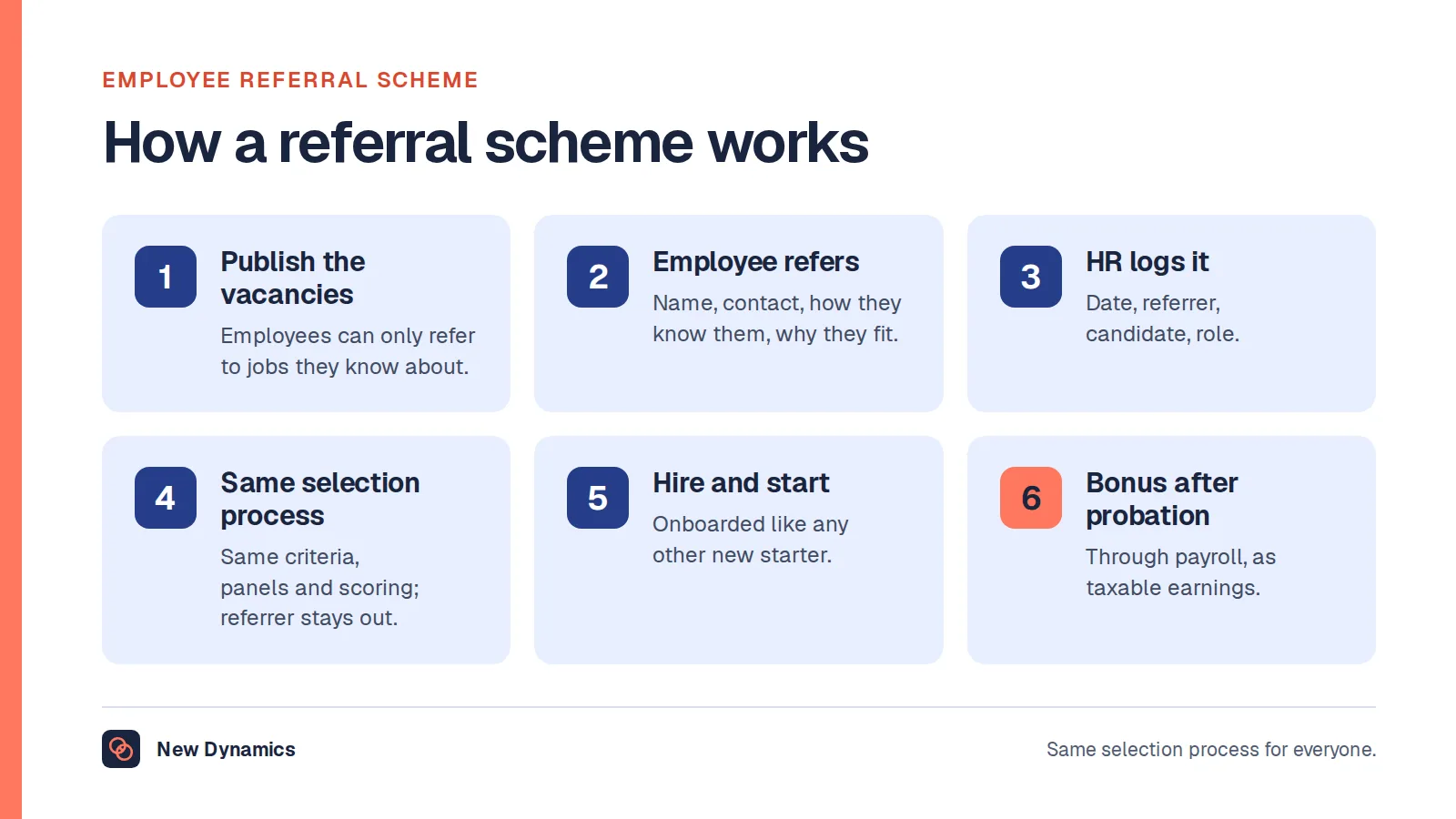
- Referrals. The highest trust and the lowest cost per approach, because an employee has already done the screening socially. They are also the channel most likely to reproduce the existing team, which matters legally as well as practically. Our post on an employee referral programme covers the mechanics.
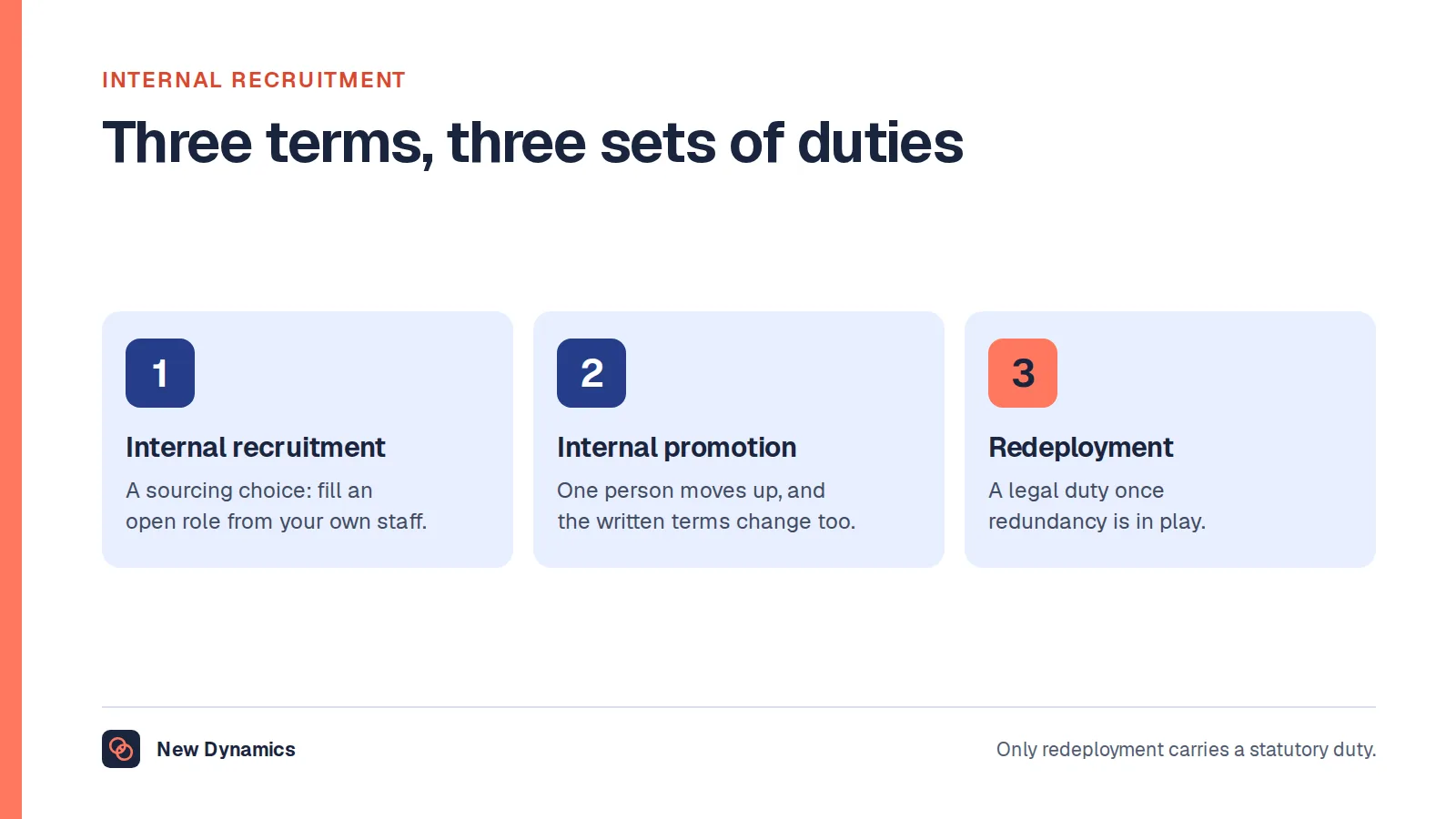
- Internal talent. Fastest, cheapest and routinely skipped. It also creates a second vacancy, which is the cost nobody budgets. See internal recruitment for the fair process it still requires.
- Alumni. Former employees and strong candidates who went elsewhere. Known quantities on both sides, and the shortest ramp-up of any external hire.
- Communities and events. Professional bodies, meetups, conferences, open-source projects, academic groups. Slow to build, very strong for narrow specialisms, and useless as a last-minute tactic.
- Direct outreach. Identifying named individuals and approaching them. The only channel that reaches genuinely scarce skills, and the most expensive per hire in time.
- Agencies. Buying someone else's network and search time. Worth it when the search is genuinely specialist or confidential, and poor value when the role is one the active market supplies readily.
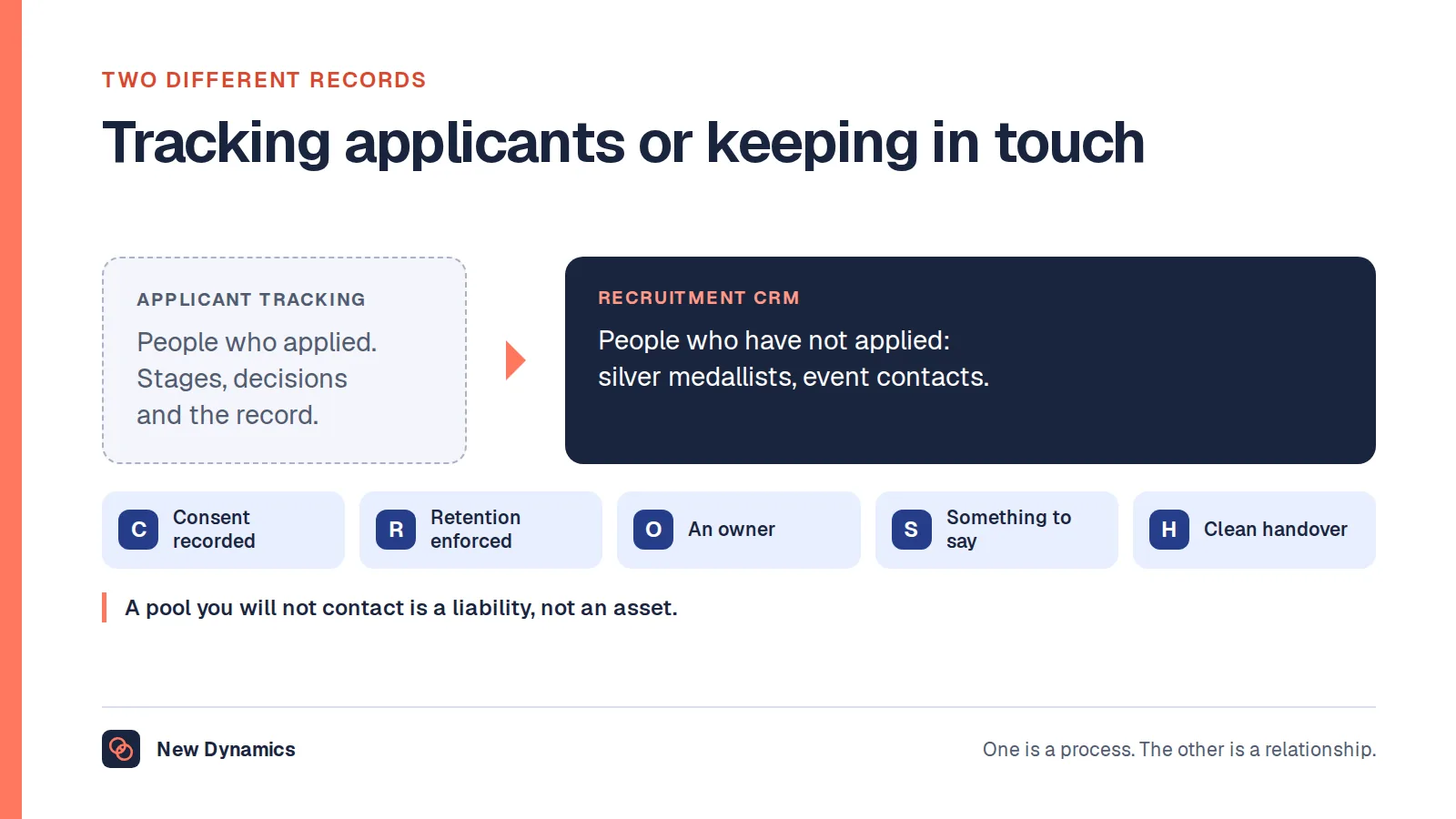
- Talent pools. People who said yes to being contacted again. Cheap to use and expensive to maintain, and subject to the rules in the next section. Our post on a recruitment CRM covers the system side.
Pick two to run well rather than seven to run badly. Most employers get more from referrals and internal talent, done properly, than from a sourcing push they cannot sustain.
Holding a talent pool you are allowed to keep

This is where sourcing strategies most often become a compliance problem, and the reason is simple. Assessing the application in front of you and keeping someone's details for a role that does not exist yet are two different purposes.
Start with the statute. Under Article 5 of the UK GDPR personal data must be "collected ... for specified, explicit and legitimate purposes" and "kept in a form which permits identification of data subjects for no longer than is necessary for the purposes for which the personal data are processed". Article 6 is the gate in front of both: "Processing shall be lawful only if and to the extent that at least one of the following applies", followed by the list that includes consent and legitimate interests.
The Information Commissioner's Office then says what that means for recruitment records. Its guidance on keeping recruitment records states that "Under data protection law, you must not keep information for longer than you need to. However, it does not specify timescales for keeping recruitment records. You should carefully consider how long you need to keep this information for and set clear retention periods." The same page is explicit that if you want to keep candidates' information for a new purpose you must "review whether you may need a different lawful basis (and if required, a condition) for processing the information", must "have previously informed candidates that you will keep their information for another purpose, and explained what this purpose is", and must "destroy the information you do not need". Its general guidance on storage limitation puts it the same way: "The UK GDPR does not set specific time limits for different types of data. This is up to you, and will depend on how long you need the data for your specified purposes."
Two things follow that are worth stating plainly, because a lot of writing on sourcing gets them backwards. There is no legal retention period for a talent pool that you can look up, and the absence of one is not permission to keep records indefinitely. The ICO's own position is that "In general, you should not keep information beyond the statutory period in which a legal claim can potentially be brought" unless you can justify a different purpose.
Note the status of the source. The ICO's recruitment and selection material is draft guidance. Its consultation has closed and the final version is still to be published, and the ICO has added a banner saying the guidance is under review because of changes made by the Data (Use and Access) Act. Read it as the regulator's current stated position rather than as settled text, and check the page before you rely on it.
In practice, four things make a pool defensible. Ask at the point of application, in words a person would recognise. Write down a retention period and let the system enforce it. Make withdrawal one step and act on it everywhere. Keep the notes professional, because everything in the record can be disclosed to the person it describes.
Sourcing from a profile changes your duties
If the details came from the candidate, your privacy information duty is the familiar one. If you found them yourself, a different article applies. Article 14 of the UK GDPR is headed "Information to be provided where personal data have not been obtained from the data subject", and among the things you must tell the person is "from which source the personal data originate, and if applicable, whether it came from publicly accessible sources".
The timing is the part sourcers miss. Article 14(3) requires the information "within a reasonable period after obtaining the personal data, but at the latest within one month", and separately "if the personal data are to be used for communication with the data subject, at the latest at the time of the first communication to that data subject". Your first approach is the deadline, not your offer letter.
The ICO's draft guidance on finding candidates says the same thing in operational terms. Searching is allowed: "Yes, you can search for candidates manually online using appropriate public social media platforms." But "If you use publicly available information for your own purposes, you are a controller and are fully responsible for how you use it", including "providing candidates with your privacy information as soon as possible, and by no later than one month of obtaining it". It draws a line by platform, saying it "may be reasonable to manually search for information using recruitment-based social media platforms, as candidates are reasonably likely to expect their information to be used in this way", while "You should not search for candidates on their personal social media profiles, even when these are public-facing. People are unlikely to expect employers to obtain information about them in this way."
One more point catches people out. On the ICO's draft reading, "Direct messaging on social media constitutes direct marketing and electronic mail under the Privacy and Electronic Communications Regulations (PECR)", so the direct marketing rules apply to the message itself and not only to a recruitment newsletter.
Channel choice is an equality question
Sourcing decides who is considered, which makes it the earliest point at which a hiring process can go wrong. If you source only from one employer, one university, one community or one personal network, the shortlist will look like that source.
Section 19 of the Equality Act 2010 provides that "A person (A) discriminates against another (B) if A applies to B a provision, criterion or practice which is discriminatory in relation to a relevant protected characteristic of B's", and a practice is discriminatory where it puts people sharing the characteristic "at a particular disadvantage" and the employer "cannot show it to be a proportionate means of achieving a legitimate aim". A habitual sourcing route is a practice. Being traditional is not a legitimate aim.
The workable response is not complicated. Write down which channels you used for each role, review whether any one of them supplies most of your hires, and widen deliberately before the shortlist exists rather than defending it afterwards. Our post on adverse impact covers how to look at the numbers.
Right to work checks are not a sourcing step
Employers routinely fold immigration checks into early screening and ask about status in a first message. That is not where the duty sits. GOV.UK states that "You must check that a job applicant is allowed to work for you in the UK before you employ them", on its guidance on checking a job applicant's right to work, last updated on 16 October 2024. The obligation attaches before employment begins, which is after offer and acceptance, not at outreach. Asking at the sourcing stage gathers information you have no use for yet and invites a discrimination argument you do not need.
Writing outreach that gets a reply

A sourcing message is not an advert and not a sales email. It is a request for a few minutes of attention from somebody who did not ask for it, and almost all of them fail for the same four reasons: no sign the sender read anything, no concrete detail about the work, no honest mention of pay, and no easy way to say no.
What tends to work is short and specific. Name the one thing in their background that made you write. Say what the work is in a sentence a practitioner would recognise, not in job advert language. Give the pay range, or say openly what you cannot give and why. Ask for one small thing, usually fifteen minutes. Make declining painless, and mean it.
Then treat it as correspondence rather than a campaign. Reply to everyone who answers, including the people who say no, because they are the ones who refer someone later. One follow-up is reasonable. A third message is a nuisance, and under the direct marketing rules above it can be more than that.
Measuring sourcing without inventing numbers
Three measures tell you most of what you need.
- Response rate by channel. Replies divided by approaches, counted per channel and per role family. The point is not the absolute figure, it is whether one channel is three times another in your hands.
- Time to first qualified candidate. From the day the role opens to the first person a hiring manager agrees is worth interviewing. This is the number that exposes a sourcing problem, because time to hire hides it inside interview scheduling.
- Channel yield. Approaches to hires, by channel, over a year. Also count the cost side honestly, including the hours spent, or referrals will always look free.
No official United Kingdom source publishes sourcing channel effectiveness, outreach response rates or a benchmark for time to first qualified candidate. The ONS publishes vacancies, employment and pay, not how employers filled a post or how many people answered a message. Any benchmark you see for these comes from a supplier describing its own customers, and we do not reproduce figures like that. Measure your own over a year and compare yourself with yourself. For the figures that are officially published, see our HR statistics hub.
When sourcing is the wrong answer
Sourcing fixes a reach problem. It cannot fix the four problems below, and spending on it instead is how a vacancy stays open for a year.
- The pay is wrong. If the people you approach are already paid more than the range, you do not have a sourcing problem. More approaches produce more polite refusals.
- The job is two jobs. A description with two unrelated specialisms is a scarcity you created. Split it, or accept a longer search and say so.
- The process loses people. Six interviews, three weeks of silence, a take-home exercise that costs a day. Sourced candidates were not looking and will not absorb that.
- The reputation precedes you. If approaches are being declined with reasons, the reasons are the work. Sourcing harder makes the pattern more visible, not less.
A useful test before authorising a sourcing push: if a perfect candidate said yes today, is there anything in the offer, the process or the team that would make them change their mind? Fix that first. It is cheaper than a quarter of outreach.
Frequently asked questions
What is sourcing in HR?
Sourcing is the search for people who could do a job, carried out before anyone applies. It covers identifying who those people are, finding them, and making the first approach. It sits before screening and it is separate from advertising, which publishes the role and waits for applications.
What is the difference between sourcing and recruiting?
Sourcing finds and engages people. Recruiting runs the process from the screening call through interviews to the offer. Large teams split the two roles, and a sourcing recruiter does the first part only. In most organisations one person does both, and sourcing is the part that gets squeezed out.
What are the best candidate sourcing strategies?
For most employers, internal talent and employee referrals produce the most hires for the least effort, with alumni close behind. Direct outreach and professional communities earn their cost only for genuinely scarce skills. No official source publishes channel effectiveness, so the honest answer for your organisation is to measure response rate and channel yield for a year.
How do you source passive candidates?
Identify named people whose experience matches the work, approach them individually with a short and specific message, give the pay range, and make declining easy. Expect a slower process than with applicants. In the United Kingdom, check the data protection position first: you must tell the person where their details came from and why you hold them, at the latest when you first contact them.
Can you keep candidate details for future vacancies?
Only if you have a lawful basis and you told the candidate. The ICO's draft recruitment guidance says you must have previously informed candidates that you will keep their information for another purpose and explained what that purpose is, review your lawful basis, and destroy what you do not need. Data protection law sets no fixed retention period for recruitment records, so you set and justify one.
What should you measure for sourcing?
Response rate by channel, time to first qualified candidate, and channel yield measured as approaches per hire. Record the channel on every hire so the yield figure is real. Avoid published benchmarks for these measures, because no official United Kingdom source produces them.
Your next step: pick two channels and a measure
- Write down which channels filled your last ten roles. Most employers find the answer is narrower than they expected.
- Choose two channels to run properly for the next quarter and drop the rest for now.
- Fix the talent pool question before you build a pool: what you asked, what you told people, and when records are deleted.
- Start recording response rate and time to first qualified candidate. You need a year of your own numbers, and nobody else's will do.
- Check the job, the pay and the process before you authorise any outreach.
For the fair, documented process that has to follow the search, read and download our recruitment and selection guide. The guide is free to read, and the PDF uses our short download form.
Want the internal shortlist, the working relationships and the evidence behind each decision to be visible before you look outside? Book a New Dynamics demo and bring your last three open roles. You can also email contact@new-dynamics.com.