TL;DR
- Internal recruitment, internal promotion and redeployment are three different things with three different sets of obligations. Only the third carries a statutory duty, and confusing them is how employers get the easy one wrong.
- An internal-only process is not exempt from discrimination law. The Equality and Human Rights Commission's statutory code of practice says that a decision not to advertise a vacancy internally "counts as a provision, criterion or practice and could amount to indirect discrimination", and that restricting applications to staff at a particular grade needs objective justification.
- Where redeployment is involved the rules are specific: Acas says an employee selected for redundancy "should not have to apply for the role", employees on maternity, shared parental or adoption leave must be offered a suitable role first, and the statutory trial period runs for four weeks unless a longer retraining period is agreed in writing.
A role opens. Someone already on the payroll can do most of it. Filling the job from inside looks like the low-risk option: no agency fee, no notice period to wait out, no onboarding from a standing start. Often it is the right call.
It is also the moment many employers quietly drop the process they would have run for an external hire, on the assumption that recruitment rules are about strangers. They are not. The duty not to discriminate in the way an employer gives access to "opportunities for promotion, transfer or training" sits in the Equality Act 2010 alongside the duty not to discriminate when offering someone a job.
This article separates internal recruitment from internal promotion and from redeployment, sets out the costs nobody budgets for, and covers ring-fencing, a fair process and the conversation that follows it. It describes the position in Great Britain and is general information, not legal advice.
An internal decision is only as good as the record behind it. See how New Dynamics performance reviews keep goals, feedback and ratings attached to the cycle, so a panel reads evidence rather than reputation.
Three different things, and why the distinction matters

Internal recruitment is a sourcing choice. There is a vacancy, and the employer looks for candidates among its own employees instead of, or as well as, the open market.
Internal promotion is a change of level for a particular person. It may be the outcome of an internal recruitment process, or it may happen without one, which is where most of the trouble starts. It also changes the terms of employment, which brings a paperwork duty with a deadline.
Redeployment is a move into a different existing role, usually to avoid a dismissal. In a redundancy situation it is not a choice at all. Acas is direct about it on its guidance for offering alternative employment: "You must try and move anyone selected for redundancy into other jobs within your organisation instead. This is called offering 'suitable alternative employment'."
Treating all three as "we filled it internally" is how an employer runs a competitive interview for a role the law said should have been offered, or hands someone a promotion without ever telling the organisation that it existed.
The advantages, and the cost nobody budgets for
The case for it is real: faster, cheaper, no notice period on the other side, and months or years of evidence about how the person actually works rather than a CV and an hour in a room. Visible internal routes are also what make a career framework believable, which our post on career pathing looks at.
Four costs sit against that, and the first usually goes missing from the business case.
You create a vacancy by filling one. Appointing from inside moves the gap rather than closing it, and the backfill can be harder to fill than the original role. Sometimes the chain runs three deep. Count the whole chain before calling it cheaper.
It narrows the pool. Candidates are limited to people you already employ, so the strongest available candidate may not be in the room. On a specialist or newly created role that matters more than the saving.
It reproduces the existing workforce. The Equality and Human Rights Commission's statutory code of practice on employment puts it plainly at paragraph 16.21: "If the workforce is made up of people with a particular protected characteristic, advertising internally will not help diversify the workforce."
An unsuccessful internal candidate is still in the building. An external rejection ends the relationship. An internal rejection is a managed relationship from Monday morning.
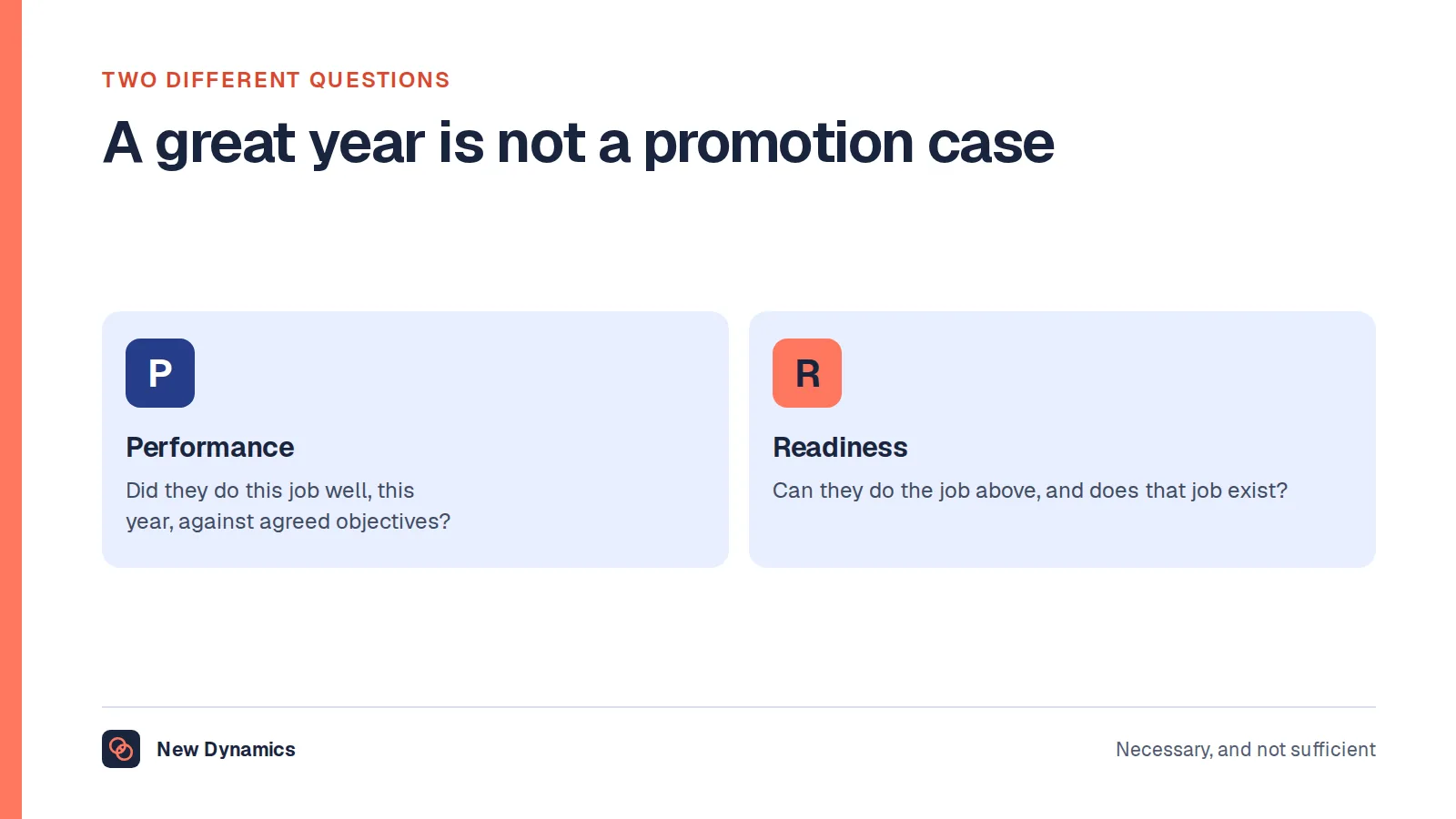
Promotion into the wrong job is the fifth risk. Our post on assessing promotion readiness sets out the four tests and the evidence each needs, so this article does not repeat them.
On the share of roles filled internally
No official source publishes it. The Office for National Statistics publishes vacancy and labour market statistics, but not whether an employer filled a post from its own payroll, and neither Acas nor GOV.UK publishes an internal fill rate. Any percentage quoted for it comes from a jobs board or a consultancy survey of its own customers, and we do not reproduce figures like that. Measure your own: appointments in the last twelve months split by internal and external, with backfills counted separately. For what is officially published, see our HR statistics hub.
The rules people assume apply only to external hiring
Start with your own policy. Acas's guidance on how to advertise a job says: "You're not legally required to advertise a job, but it's a good idea to." It then says you should follow any written rules or recruitment policy your organisation may have, and gives as an example of what such a policy might set out "who you must advertise to", the example given being internal or external applicants. The line that catches employers out comes next: "If you have a recruitment policy, you must apply it in the same way to everyone."
So an internal-only policy is lawful. Applying it to some vacancies and not others, or to some candidates and not others, is the problem.
Then the Equality Act 2010. Section 39(2)(b) makes it unlawful for an employer to discriminate against an employee "in the way A affords B access, or by not affording B access, to opportunities for promotion, transfer or training". Access to the opportunity is itself protected, which is why a quiet appointment can be unlawful even when the appointment is a good one.
Indirect discrimination is where internal processes come unstuck. Section 19 defines it as applying "a provision, criterion or practice" that puts people sharing a protected characteristic at a particular disadvantage, where the employer cannot show it to be "a proportionate means of achieving a legitimate aim". The EHRC code explains at paragraph 4.5 that the phrase is "not defined by the Act but it should be construed widely so as to include, for example, any formal or informal policies, rules, practices, arrangements, criteria, conditions, prerequisites, qualifications or provisions", and that it can include "a 'one-off' or discretionary decision".
That code is not background reading. Paragraph 1.12 says it "has been approved by the Secretary of State and laid before Parliament", and paragraph 1.13 adds that while it "does not impose legal obligations", "Tribunals and courts must take into account any part of the Code that appears to them relevant to any questions arising in proceedings."
Four passages are worth reading before you design an internal process.
- Paragraph 17.83. "Failure to inform workers of opportunities for promotion or transfer may be direct or indirect discrimination. To avoid discrimination, employers are advised to advertise all promotion and transfer opportunities widely throughout the organisation. This includes development or deputising opportunities or secondments that could lead to permanent promotion." The secondment that becomes a job is covered too.
- Paragraph 17.84. "Unless a temporary promotion is absolutely necessary, employers should avoid bypassing the procedures they have adopted for recruiting other staff." Its worked example is a man promoted to section manager without the vacancy being advertised internally, where several qualified women would have applied had they known. The code's conclusion: "The decision not to advertise internally counts as a provision, criterion or practice and could amount to indirect discrimination."
- Paragraph 16.22. Employers should ensure that people absent from work, "including women on maternity leave, those on long-term sick leave, and those working part-time or remotely", "are informed of any jobs that become available so they can consider whether to apply. Failure to do so may amount to discrimination." Paragraph 17.86 repeats it for maternity leave in stronger terms.
- Paragraph 17.90. "Employers should not make assumptions about the suitability of existing workers for promotion or transfer." The information advantage of internal recruitment is also its bias problem.
Ring-fencing, and when it is defensible
Ring-fencing means restricting who may apply: to a grade, a team, employees at risk of redundancy, or employees rather than the open market. It is a provision, criterion or practice, so it needs a reason you could state out loud.
The code addresses the common version at paragraph 17.85: "Employers should consider whether it is really necessary to restrict applications for promotion and other development opportunities to staff at a particular grade or level. This restriction would operate as a provision, criterion or practice and, unless it can be objectively justified, could indirectly discriminate by putting workers sharing a protected characteristic at a particular disadvantage."
It is usually defensible in three situations: a redundancy pool, where the duty to look for suitable alternative employment is owed to those employees; a genuine job-related reason you can evidence, such as clearance already held, a regulated qualification or a restructure in which the new role is substantially the old one; and a development route everyone in the organisation can apply to. It is usually not defensible as habit, as cover for a manager who has already decided, or to avoid the work of a competitive process. Paragraph 16.21 sets the test: "Before deciding only to advertise a vacancy internally, an employer should consider whether there is any good reason for doing so." Write the reason down before the decision, not after a challenge.
And if you do go internal only, 16.21 adds the condition most employers miss: "If there is internal advertising alone, this should be done openly so that everyone in the organisation is given the opportunity to apply." Internal only does not mean quietly.
Running a fair internal process

Publish it to everyone, including the people who are not there. Intranet, email, team meetings, and a direct route to anyone on family leave, long-term sickness, a secondment or a part-time pattern that misses the Tuesday briefing. Keep a note of how you did it.
Use the same criteria you would have used externally. Paragraph 17.89 of the code is explicit: "If posts are advertised internally and externally, the same selection procedures and criteria should apply to all candidates." Write the job description and person specification first, then assess against it. Our post on competencies covers describing requirements observably.
Decide in advance what internal information the panel may see. External recruitment never has to answer this. An internal candidate arrives with appraisal records, a sickness record, an old grievance and a manager's opinion. Agree before shortlisting which of those is in scope, and apply that to every internal candidate the same way. Absence that is disability related or pregnancy related should not be in scope at all. Reaching selectively for one person's history and not another's is the inconsistency Acas warns about.
Settle whether the current manager is told, and write it down. There is no legal rule here, which is why it needs a policy rather than an instinct. The options are: the applicant tells their manager before applying; HR tells the manager at shortlist; or nobody is told until an offer. The first deters anyone with a difficult manager, the third lands a resourcing problem with no notice, and the real damage comes from doing it differently for different people.
The current manager does not hold a veto. A manager can be consulted on release dates and handover. A manager who can block an internal application has, in practice, control over another employee's access to opportunity, which is the territory section 39(2)(b) covers.
Use more than one assessor and record the reason. Both are standard anti-bias practice, and the record is what makes feedback possible afterwards. Our post on adverse impact covers checking the pattern across a whole process rather than one decision.
Agree the release date before you announce anything. An appointment with no agreed start date creates a person doing two jobs, which is how good internal moves acquire a bad reputation.
Redeployment: the version with a statutory duty
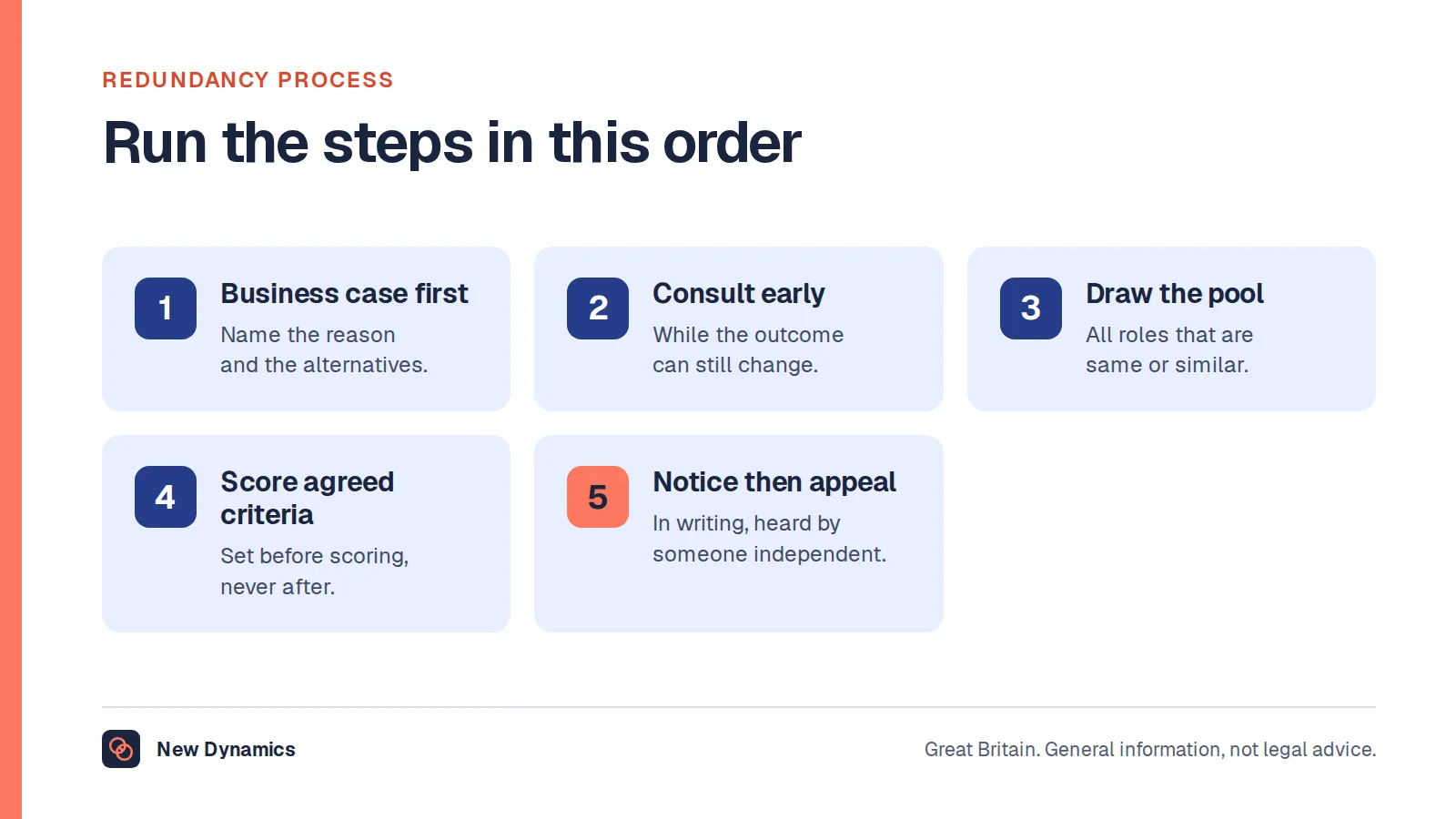
If the move is an alternative to redundancy, most of the above is replaced by specific rules. Acas says an employer "must identify any available jobs in your organisation and talk to the affected employees to see if they agree they're suitable", and then the line that surprises people: "They should not have to apply for the role."
Priority where more than one person wants it. Acas says that if more than one employee is interested in the same role, you must "offer the role to any employees on maternity leave, shared parental leave or adoption leave first", and follow a fair process for everyone else, "for example holding interviews for the role".
That priority has a statutory root. Regulation 10 of the Maternity and Parental Leave etc. Regulations 1999 provides that "Where there is a suitable available vacancy, the employee is entitled to be offered (before the end of her employment under her existing contract) alternative employment". The work must be "of a kind which is both suitable in relation to the employee and appropriate for her to do in the circumstances", on terms "not substantially less favourable". Since 6 April 2024 the protection runs across a protected period of pregnancy and an additional protected period after maternity leave, which the regulation defines by reference to 18 months beginning with the first day of the expected week of childbirth. An entitlement to be offered a role is not an invitation to compete for it, and running a competitive interview over the top of it is the common mistake.
The trial period. Section 138 of the Employment Rights Act 1996 sets it out. Where a redundant employee starts a renewed or new contract within four weeks, the trial period runs for "the period of four weeks beginning with the date on which the employee starts work", or a longer period agreed for retraining. Section 138(6) is strict about the longer version: the agreement must be made before the employee starts the new work, be in writing, specify the date the retraining period ends and specify the terms that apply afterwards. Acas adds the warning in its own words: "If the employee is in the new role beyond the 4-week trial they will lose the right to redundancy. This is unless you have agreed a longer trial period with them."
Our post on the redundancy process covers the whole sequence, and our post on the talent marketplace explains why the voluntary version of internal mobility cannot discharge this duty.
Outside a redundancy situation there is no statutory trial period for an internal move. If you want one on a promotion it is a contractual term you agree and record in writing, and it does not interrupt continuous employment.
What to tell unsuccessful internal candidates

This is where most of the damage is done, and it is almost always done by delay and vagueness rather than by the decision itself.
- Tell them first, in person, before the announcement. Finding out from a team email is the most reliable way to turn a disappointed employee into a leaving one.
- Give the reason against the criteria. Which requirement, what the gap was, and what the successful candidate evidenced that they did not. "It was really close" is not feedback, and people told that twice stop applying.
- Say what would change the answer, and who owns it. The experience needed, the work that would produce it, and a date to look again. If no comparable role will exist for two years, say that rather than implying a development gap.
- Do not invent a consolation. A title with no scope, a vague promise of "the next one" or a project nobody intends to resource all read as a payoff, and all expire.
- Keep the written record. Why each candidate was ranked where they were is both the basis of useful feedback and the only thing you have if the decision is challenged.
- Watch what happens next. Treating someone less favourably because they applied, by moving their work or freezing their development, is a detriment, and section 39(2)(d) of the Equality Act covers subjecting an employee to any other detriment.
A fair process that ends in a bad conversation is remembered as an unfair one. Our post on interview questions for an internal position covers the Monday afterwards in more detail.
The paperwork a promotion triggers
An internal appointment almost always changes the written particulars: pay, job title, hours, place of work or reporting line. Where any of the matters that had to be in the written statement changes, section 4 of the Employment Rights Act 1996 requires the employer to "give to the worker a written statement containing particulars of the change". Section 4(3) sets the deadline: at the earliest opportunity and in any event "not later than one month after the change in question".
GOV.UK's guidance on the written statement of employment particulars says the same in plainer words: "Employers must tell employees or workers about any changes to the written statement. They must do this within one month of making the change."
A congratulations email is not a statement of changed particulars. Issue the document, put the new pay, title, hours and reporting line in it, and date it.
Frequently asked questions
What is internal recruitment?
Internal recruitment is filling a vacancy with someone the organisation already employs, instead of or as well as recruiting from the open market. It covers promotions, sideways moves, secondments and transfers between teams. It is a sourcing decision rather than a legal category, and the same discrimination duties apply as to external hiring.
What is the difference between internal recruitment and internal promotion?
Internal recruitment is the process of filling a vacancy from existing staff. Internal promotion is the outcome for one person, a move to a higher level with changed terms. A promotion can happen with no internal recruitment process at all, which is what the Equality and Human Rights Commission's code warns about: a decision not to advertise a role internally can itself be indirectly discriminatory.
Can you advertise a job internally only?
Yes. Acas says you are not legally required to advertise a job at all, but adds that if you have a recruitment policy you must apply it in the same way to everyone. The EHRC code says that before deciding to advertise only internally an employer should consider whether there is any good reason for doing so, and that internal advertising alone "should be done openly so that everyone in the organisation is given the opportunity to apply".
Do you have to tell someone's manager that they applied for another job?
There is no legal requirement either way, so it is a policy decision. Pick one approach, write it into the recruitment policy and apply it to every internal applicant. Inconsistency is the risk: Acas says a recruitment policy must be applied in the same way to everyone, and an employee who learns their application was disclosed when a colleague's was not has a genuine grievance.
Is there a trial period for an internal move?
Only in a redundancy situation. Section 138 of the Employment Rights Act 1996 gives a redundant employee who starts a new or renewed contract a four-week trial period, or a longer retraining period agreed in writing before they start, specifying when it ends and the terms that follow. Outside redundancy, any trial on a promotion is simply what the parties agree and record.
Do you need new paperwork after a promotion?
Yes, if the promotion changes any of the particulars in the written statement, which it almost always does. Section 4 of the Employment Rights Act 1996 requires a written statement of the change, and GOV.UK says employers must tell employees about changes to the written statement within one month of making the change.
Does someone on maternity leave have to be told about an internal vacancy?
Yes. The EHRC code says employers should ensure that people absent from work, including women on maternity leave, those on long-term sick leave and those working part-time or remotely, are informed of any jobs that become available, and that failure to do so may amount to discrimination. In a redundancy situation it is stronger: Acas says a suitable alternative role must be offered to employees on maternity, shared parental or adoption leave first.
Your next step
- Find the sentence in your recruitment policy that says who a job must be advertised to. If there is no such sentence, that is the gap.
- For the last five appointments, check how the role was published and whether anyone absent from work was told.
- Decide, in writing, whether a current manager is informed when someone applies, and at what stage.
- Agree which internal records a panel may see, and exclude disability-related and pregnancy-related absence from the criteria.
- Separate your redeployment process from your internal recruitment process, and make sure the people running it know that an employee at risk should not have to apply.
For the whole hiring process, from the job description to the offer and the records behind each decision, read and download our recruitment and selection guide. The guide is free to read, and the PDF uses our short download form.
Want the evidence for an internal appointment already gathered before the panel sits? Book a New Dynamics demo and bring your person specification. You can also email contact@new-dynamics.com.