TL;DR
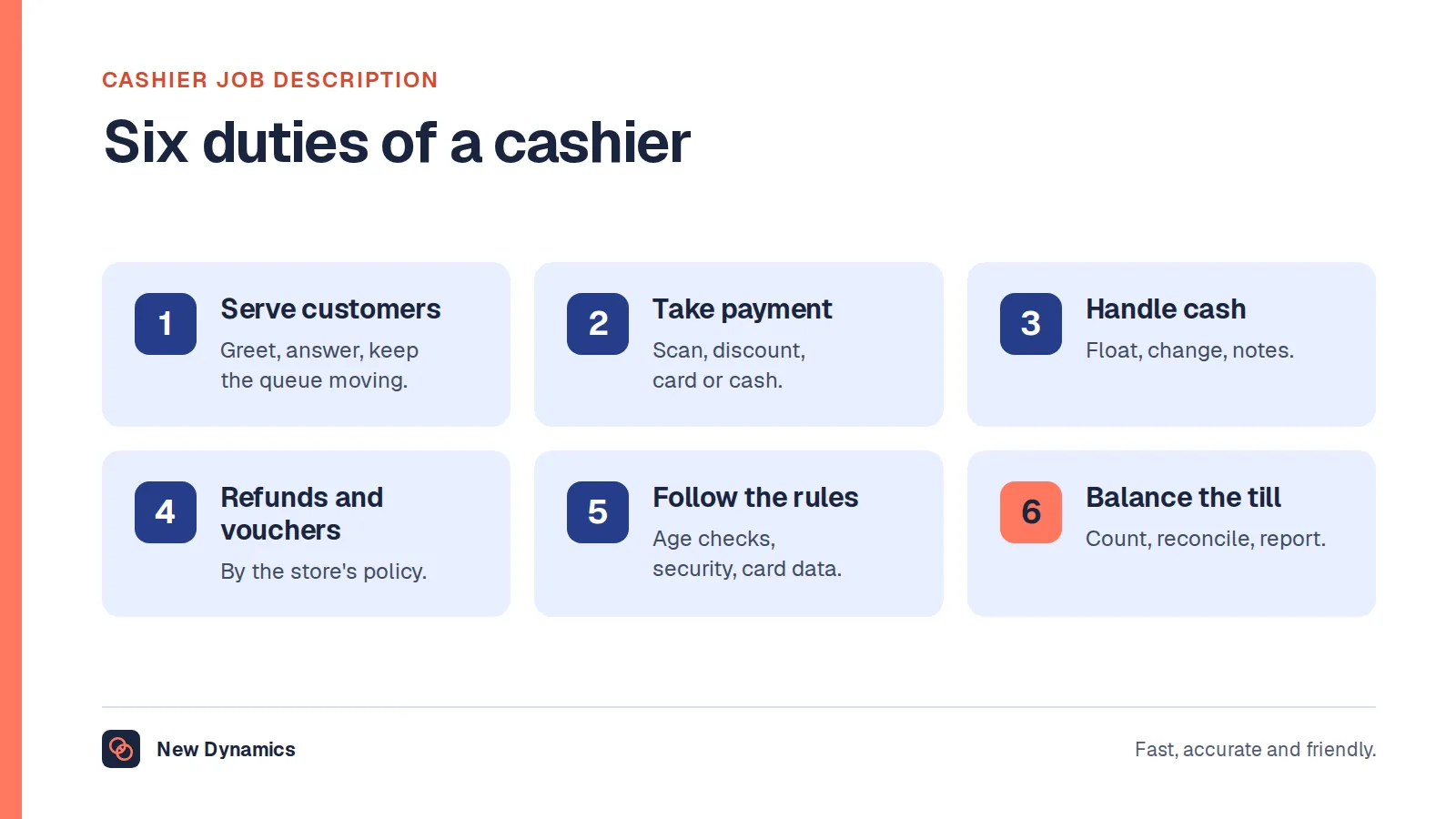
- Cashier duties divide into four groups: the money (float, counting, drawer discipline, cashing up), the transaction (scanning, card, voids, refunds), the law (age-restricted sales) and the people (queues, complaints, working alone).
- The legal duties are real and they sit on the person at the till. In England and Wales the Licensing Act 2003 makes it an offence to sell alcohol to an individual aged under 18, and from 1 January 2027 the Tobacco and Vapes Act 2026 replaces the tobacco age of sale with a date of birth: born on or after 1 January 2009.
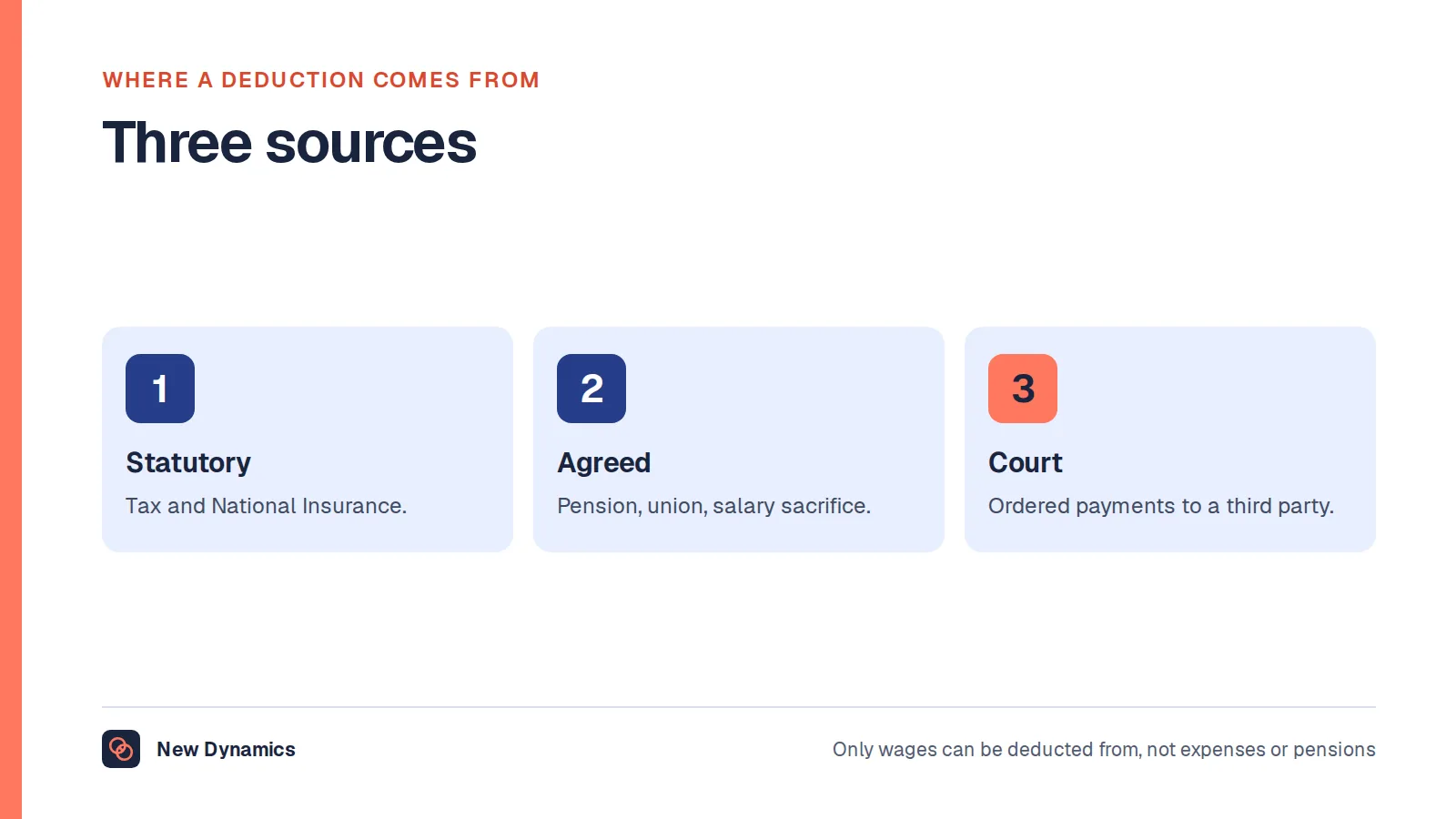
- When a till is short, the Employment Rights Act 1996 governs what an employer may deduct. In retail employment the deduction on any pay day may not exceed one-tenth of gross wages, and a deduction needs a legal basis before the limit even applies.
The duties of a cashier read like a short list until you stand behind the till for a shift. Then the list turns into a sequence: count the float before the doors open, serve for four hours with a queue that never quite clears, refuse a sale to someone almost certainly old enough but with no identification, and count the drawer again at the end while someone waits to lock up.
This article sets out cashier duties in that order, as a shift actually runs: the opening float and the counting discipline, voids and refunds, card payment, the age-restricted sales law that sits on the person at the till, what happens when the drawer is short and what an employer may take from pay, difficult customers, the restaurant variant, the self checkout shift and working alone.
A shift has a shape, and most till errors happen where the shape is vague: the handover, the authorisation, the exception. See how New Dynamics Workflows give a repeated process a named owner and a visible step, so nothing important depends on who is on shift.
The duties, as a shift actually runs
Group the work into four and almost every cashier duty falls into one of them.
- The money. Count the opening float, keep the drawer in order, give correct change, stay within the drawer's cash limit, and cash up and reconcile at the end.
- The transaction. Scan or key items, apply offers and loyalty, take payment, void lines, process refunds and exchanges, and call for authorisation at the right point.
- The law. Check age on restricted products, every time, and refuse the sale when the check fails.
- The people. Keep the queue moving, answer questions, absorb a complaint without passing it to the next customer, and know when to call a supervisor.

What makes this difficult is that the four interleave. The age check arrives in the middle of a queue. The refund arrives while the drawer is near its cash limit. The price argument arrives two minutes before the handover. A good advert describes that, not just the list.
Opening the till: the float, the count and the drawer
The float is the cash the drawer starts with, in the denominations needed to give change. Counting it is the first duty of the shift, and the one most often skipped when the store is late opening.
It is worth doing properly for one reason: the opening count is the only thing that makes the closing count mean anything. A drawer not counted in cannot be shown to be short, so the business cannot tell a shortage from a bad float and the cashier has no record of what they were handed.
A reasonable opening routine fits in half a page of an induction:
- Count the float in, with a second person where the business can staff it, and record the figure before the first sale.
- Sign for it, so the drawer has an owner for the shift.
- Check the denominations, not just the total. A float correct at twenty pounds but with no coin builds a queue.
- Check the terminal and the receipt roll, and know the drawer limit and the procedure for dropping surplus cash to the safe.
Through the shift the discipline is small and repetitive: no personal money in the drawer, the drawer closed between transactions, and the note from a large payment left visible until change has been agreed, which settles most disputes before they start.
One cashier per drawer per shift makes accountability fair. Where several share one drawer, as on a busy food counter, the business has chosen speed over traceability, and cannot then treat a shortage as one person's fault.
Voids, refunds, card and the authorisation line
A void cancels a line or a sale before payment. A refund returns money after it. Both are the point where a till can be used dishonestly, which is why most systems log them and most businesses put a supervisor in the loop. That logging also protects an honest cashier.
What a fair business puts in writing before someone's first shift:
- Which transactions a cashier may complete alone, and which need a supervisor's authorisation. Say the money value where there is one.
- What to do when no supervisor is on the floor. The commonest cause of a bad refund is a cashier left with a queue, an insistent customer and nobody to ask.
- That a high void count is a question, not a verdict. A cashier learning a new system voids more, and so does one with a faulty scanner.
- The refusal script. A cashier declining a refund outside policy needs a sentence to say and a person to escalate to. Without both they will give the refund or take the abuse.
Card payment has changed the duty rather than reduced it, because the money moves through a terminal the cashier does not control. Check the amount on the terminal matches the sale before the customer taps. Let the customer handle their own card and their own number, and never key it, read it aloud or write it down. Handle a decline without commentary, because the queue does not need to know. Know the procedure for a terminal that takes payment but does not print, because that produces both an unhappy customer and an unexplained figure at cash up.
All of this changes what a fair target looks like. Items per minute made sense when the bottleneck was the cashier's hands, less so when it is a customer finding a loyalty app. Measuring a cashier on a number they do not control produces hurried age checks, and those are the duty with legal consequences.
Age-restricted sales: the legal duty that sits at the till
This is the part of the job most adverts reduce to four words, and the part where the consequences land on a person earning close to the statutory minimum.
Three things are true at once. The offence is usually committed by the person who makes the sale. The defence usually depends on steps that person took. And the rules differ by product and by nation, so one memorised age is not enough. What follows is general information and not legal advice, and it names the nation each rule applies to.
Alcohol
In England and Wales the Licensing Act 2003 is direct. Section 146 is headed "Sale of alcohol to children" and subsection (1) reads: "A person commits an offence if he sells alcohol to an individual aged under 18." The section is marked as extending to England and Wales.
Scotland has its own statute. Section 102 of the Licensing (Scotland) Act 2005, headed "Sale of alcohol to a child or young person", provides at subsection (1): "A person who sells alcohol to a child or a young person commits an offence."
Note the grammar. "A person commits an offence." Not the company, in the first instance. The person at the till.
Tobacco, and a change every cashier needs to know about
Here the law is moving, and anyone relying on memory from a previous job is about to be wrong.
The Tobacco and Vapes Act 2026 replaces the tobacco age of sale with a date of birth. Section 1, which extends to England and Wales, provides that "It is an offence to sell any of the following to a person born on or after 1 January 2009", and lists them as a tobacco product, a herbal smoking product and cigarette papers. The commencement note records that it comes into force on 1 January 2027 in so far as it is not already in force.
So from that date, in England and Wales, the question at the till stops being "are they 18?" and becomes "were they born before 1 January 2009?". The two answers diverge permanently, because the cohort covered by the prohibition never ages out of it.
The Act makes the same change elsewhere in the United Kingdom. For Scotland, section 52 amends section 4 of the Tobacco and Primary Medical Services (Scotland) Act 2010 by substituting "born on or after 1 January 2009" for "under the age of 18". For Northern Ireland, section 72 substitutes a new Article 3 for the corresponding article of the Health and Personal Social Services (Northern Ireland) Order 1978, in the same terms.
The defence describes the cashier's duty exactly. Under section 1(2) it is a defence to prove that the seller took such steps as may be specified in regulations to verify that the customer was born before 1 January 2009, "or (b) that they otherwise took all reasonable steps to avoid the commission of the offence". The check is the protection.
The change will be visible at every counter. Section 5, on age of sale notices at the point of sale in England, defines the notice as one containing the statement: "It is illegal to sell tobacco products to anyone born on or after 1 January 2009". It comes into force on the same date.
Vapes and nicotine products
Vapes stay on an age, and that rule is already live. Section 10 of the same Act provides: "It is an offence to sell a vaping product or nicotine product to a person who is under the age of 18." It extends to England and Wales, and its commencement note records it as in force from 29 October 2026 in so far as not already in force.
That gives a genuinely awkward counter: a date of birth test for tobacco, an age test for vapes, sold from the same shelf by the same person. A business that does not address this in training is leaving a trap at its till.
Knives and bladed articles
In England and Wales, section 141A of the Criminal Justice Act 1988 provides that any person who sells to a person under the age of eighteen years an article to which the section applies is guilty of an offence. Subsection (2) sets out what it applies to: "(a) any knife, knife blade or razor blade, (b) any axe, and (c) any other article which has a blade or which is sharply pointed and which is made or adapted for use for causing injury to the person."
Note the breadth of paragraph (c): the duty is not limited to the knife aisle. The page records that this version extends to England and Wales only, with a separate version for Scotland. Subsection (4) gives the defence, which again describes the duty: it is a defence to prove "that he took all reasonable precautions and exercised all due diligence to avoid the commission of the offence".

What this means for the duty, and for the business
- The check is the defence. Every statutory defence quoted above turns on steps taken by the seller. A cashier who completes the check is protected in a way that a cashier who guesses is not.
- A refusal is the correct outcome, not a failure. Any target that makes a refusal feel like a problem is pushing a legal risk onto the lowest paid person in the building. Refusals need a log, and a supervisor who will stand behind them in front of an angry customer.
- The rules change, as the tobacco provisions above show, so "we trained them when they joined" is a weak answer about a rule that changed afterwards.
When the till is down: a fair process, and the law on deductions
Tills go short, mostly by small amounts and for dull reasons: change given in a hurry, a note taken as a different note, a refund keyed as a sale. The cashier's duty is to count honestly and report the difference. The business's duty is a process that makes honest reporting the easy choice.
Our cashier job description states the headline limit on recovering a shortfall from pay. Here is the statutory position behind it.
Deductions from wages in Great Britain are governed by Part II of the Employment Rights Act 1996. Section 13, headed "Right not to suffer unauthorised deductions" and marked as extending to England, Wales and Scotland, provides at subsection (1) that "An employer shall not make a deduction from wages of a worker employed by him unless" either "the deduction is required or authorised to be made by virtue of a statutory provision or a relevant provision of the worker's contract", or "the worker has previously signified in writing his agreement or consent to the making of the deduction". Northern Ireland has its own equivalent, in Part IV of the Employment Rights (Northern Ireland) Order 1996.
So the first question is never "how much can they take?". It is "is there a lawful basis to take anything at all?". Without one of those three things the answer is no, and the percentage limit never applies.
Where there is a basis, retail work gets an extra protection. Section 18 provides that where the employer of a worker in retail employment makes, on account of one or more cash shortages or stock deficiencies, a deduction or deductions from wages payable on a pay day, "the amount or aggregate amount of the deduction or deductions shall not exceed one-tenth of the gross amount of the wages payable to the worker on that day".
One detail there is easy to miss. The deduction, or the first in a series, must be made "not later than the end of the relevant period", which subsection (3) defines as "the period of twelve months beginning with the date when the employer established the existence of the shortage or deficiency or (if earlier) the date when he ought reasonably to have done so". Section 17 supplies the definitions, including that a "cash shortage" means "a deficit arising in relation to amounts received in connection with retail transactions".
GOV.UK's guide to deductions from your pay puts the same rule in plain words for workers in retail: "Your employer cannot take more than 10% from your gross pay (pay before tax and National Insurance) each pay period to cover any shortfalls." Its worked example is a shortfall of £50 against gross pay of £250 a week: the employer "can take 10% of your gross earnings, which is £25", and "must only take £25 one week and then make another deduction from your next pay cheque for £25".
The same page notes a narrow exception to minimum wage protection. A deduction cannot normally reduce pay below the National Minimum Wage even with agreement, except where it is for, among other things, "something you've done and your contract says you're liable for it, for example a shortfall in your till if you work in a shop". That is one of the few places a deduction can take someone below the wage floor, which is why the retail limit and a careful process matter.
For applying any deduction correctly through payroll, including what must appear on the payslip, see our guide to payroll deductions. This is general information and not legal advice.

What a fair process looks like, separate from what is lawful:
- Count twice, with a witness, before anything is called a shortage.
- Check the obvious causes first: a refund keyed as a sale, a float counted wrong, a safe drop not recorded, a terminal that posted twice.
- Ask the person what happened before deciding anything, and treat a plausible explanation as information rather than an excuse.
- Look for the pattern, not the person, separate error from dishonesty, and put the threshold that triggers a conversation in writing. Repeated small shortfalls across several cashiers on one till point at the till or the training.
A business that recovers a £5 shortfall from a cashier's pay has collected £5 and taught the whole shift to hide differences.
A note on pay, honestly
There is no official UK pay figure for cashiers specifically that we are prepared to quote, so we will not borrow one. What is published, and what sets the floor for most till work, is the statutory minimum. GOV.UK's National Minimum Wage and National Living Wage rates table gives, for the rates from April 2026, £12.71 an hour for workers aged 21 and over, £10.85 for those aged 18 to 20, and £8.00 for those under 18 and for apprentices. Anything above the floor is set by the employer. For the figures we do maintain, see our HR statistics.
Queues, difficult customers and working alone
The hardest duty at a till is not arithmetic. It is staying civil through the fortieth interaction of an hour, including the ones that are not civil back.
The Health and Safety Executive defines work-related violence as "Any incident in which a person is abused, threatened or assaulted in circumstances relating to their work", and its guidance for employers is explicit that this includes "verbal abuse or threats, including face to face, online and via telephone" as well as "physical attacks". That makes abuse at a till a health and safety matter rather than a personality test, and puts the response with the employer's risk assessment.
The flashpoints are predictable enough to train for: a refused age-restricted sale, a declined card, a price that does not match the shelf edge, a refund outside policy. For each, a cashier needs a sentence to say, a point at which to stop engaging, and a person to call.
Working alone is a different risk, and single-staffed counters are common. HSE's guidance states that "As an employer, you must manage any health and safety risks before people can work alone", and defines lone workers as "those who work by themselves without close or direct supervision". It adds: "There will always be greater risks for lone workers without direct supervision or anyone to help them if things go wrong." This is United Kingdom health and safety guidance, and general information rather than legal advice.
For a till worked alone, that means cash kept low and dropped regularly, a procedure for the cash run and for locking up, a way to summon help from the till position, and the clear instruction that no amount of cash or stock is worth a confrontation. That last point should be said out loud by a manager.
Duties of a cashier in a restaurant
Food service changes the duties more than people expect, which is why "cashier" in a restaurant and in a shop are not quite the same job.
What is added:
- Order taking as well as payment. The cashier is often where the order is captured, so accuracy about the order matters as much as the money. A mis-keyed order becomes wasted food and a complaint rather than a quick void.
- Allergen questions. The till is where customers ask them, and a wrong answer is a safety matter. The duty is to know where the information is and fetch it or fetch someone, never to guess. Whether this falls to the cashier should be stated plainly and trained, not assumed.
- Food handling and hygiene. Where the same person handles cash and food or packaging, there needs to be a procedure for hands and gloves. A rota with one person doing both at peak is a design decision with a hygiene consequence.
- Pace in bursts. Retail peaks build; a food counter peaks in minutes and empties.
- Tips and alcohol. Shared tip arrangements should be in writing before someone starts. Where alcohol is served, the licensing duties above apply exactly as in a shop.
Often removed: the deep stock duties, the shelf work and sometimes the cashing up. An advert should say which of these the job includes, because the commonest complaint from new starters in food service is not the pace. It is the duties the advert did not mention.
The self checkout shift is a different job
Supervising a bank of self-service tills is treated as the same role with a different till. The duties diverge enough to deserve their own line in an advert.
The attendant is doing, simultaneously: watching several transactions for errors, approving every age-restricted sale across all of them, intervening in failures (unexpected item, weight mismatch, a machine out of change), clearing cash from machines, helping customers who did not want the machine at all, and watching for deliberate non-scanning. The last two are the difficult ones, because they put the attendant in the position of policing and helping the same person.
Three things follow. The age check load concentrates here: one attendant may approve more restricted sales in an hour than a staffed till does in a shift, which makes refresher training more important at self checkout, not less. Confrontation is more likely, and the lone working considerations above often apply. The duty is monitoring, not transacting, a different skill.
Say in the advert whether the role includes self checkout supervision. It is the commonest unstated duty in till work.
Why this post names no employer
Many people searching for cashier duties want one named company's version: a large supermarket, a fast food chain, a high street brand.
We do not publish any named employer's internal job description, and we will not reconstruct one. Two honest reasons. First, we have no way to source it: an internal role profile is the employer's own document, and anything we wrote would be a guess dressed up as information. Second, adverts from large operators genuinely vary by site, by franchise and by season, and they change often, so even an accurate description of one store's role would mislead a reader applying to another.
What is reliable is the generic role described above, because the till, the money, the age checks and the law are the same wherever the shift is worked. For a specific employer's duties, pay and hours, read that employer's own careers page, and the advert for the site you would actually work at. Where a franchise operates the site, the terms may come from the franchisee.
What a fair advert says about the till
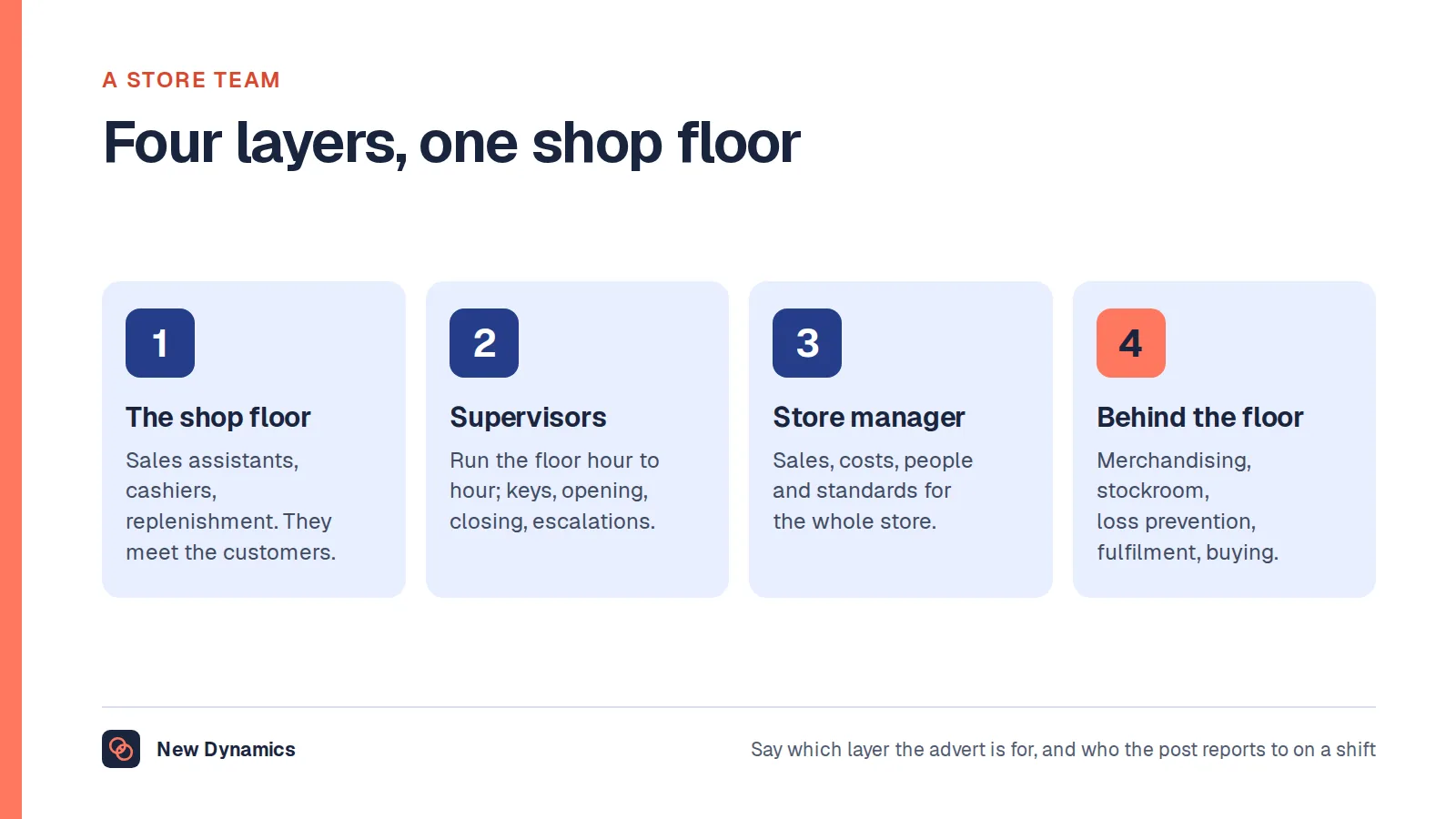
Everything above compresses into eight lines most till adverts leave out. Our guide to retail job descriptions covers the wider store team; this is the till-specific list.
- The shift pattern, with the earliest start, the latest finish and how far ahead the rota is published.
- Whether the role includes cashing up, holding keys, or being the last person out.
- Whether it includes self checkout supervision, and roughly how much of the time.
- That the role carries age-restricted sales responsibility, which products, and that refresher training is provided.
- The policy on till differences, including what triggers a conversation.
- Whether the role is ever worked alone, and what support exists when it is.
- Break arrangements on a long till shift, which affect accuracy as much as comfort.
- The pay, the premiums and the discount, as figures rather than adjectives.
An advert that says these eight things attracts fewer applicants and loses far fewer in week three. For why a short essential list beats a long one, see our note on job requirements, and for the adjacent shop floor role, our sales associate job description.
Frequently asked questions
What are the duties of a cashier?
Cashier duties fall into four groups: handling the money (counting the opening float, giving correct change, keeping the drawer in order and cashing up), completing the transaction (scanning, taking payment, voids and refunds), meeting the legal duties (checking age on restricted products and refusing the sale when the check fails), and dealing with people (keeping the queue moving and handling complaints).
What are the main cashier duties and responsibilities on a shift?
In order, a shift usually runs: count and sign for the float, check the card terminal and receipt roll, serve customers and take payment, drop surplus cash to the safe before the drawer goes over its limit, process refunds and voids within the authorisation rules, complete every age check, then cash up, count the drawer, reconcile it against the till report and report any difference.
Is a cashier legally responsible for an underage sale?
In England and Wales, section 146 of the Licensing Act 2003 provides that "A person commits an offence if he sells alcohol to an individual aged under 18", so the offence is framed around the individual who makes the sale. Scotland has its own provision in section 102 of the Licensing (Scotland) Act 2005. The statutory defences turn on the steps the seller took. This is general information, not legal advice.
Can an employer make a cashier pay for a till shortage?
Only within limits, in Great Britain. Section 13 of the Employment Rights Act 1996 means there must first be a lawful basis for any deduction, such as a contractual term or prior written agreement. Where there is one, section 18 caps a deduction for cash shortages in retail employment at one-tenth of gross wages payable on that pay day. Northern Ireland has an equivalent Order. This is general information, not legal advice.
What are the duties of a cashier in a restaurant?
A restaurant cashier usually takes the order as well as the payment, which makes order accuracy part of the duty, and is the person customers ask about allergens, so they need to know where that information is rather than answer from memory. Hygiene procedures apply where the same person handles cash and food, the pace comes in short bursts, and licensing duties apply wherever alcohol is served.
Do cashier duties change at a self checkout?
Substantially. The duty becomes monitoring several transactions at once rather than completing one, approving a high volume of age-restricted sales, clearing errors and cash from machines, helping reluctant customers and watching for non-scanning. Age check training matters more here than at a staffed till, so adverts should say whether the role includes it.
Your next step
- If you are hiring for a till: check the eight-line list above against your advert. Most fail on the rota, on self checkout and on the age-restricted sales responsibility.
- If you manage cashiers: check two documents this week. Your deductions policy against sections 13 and 18 of the Employment Rights Act 1996, and your age-restricted sales training against the tobacco date of birth rule that applies from 1 January 2027.
- If you work a till: count the float in and sign for it. It is the only thing that makes the count at the end fair to you.
- If you are applying: ask whether the role includes cashing up, self checkout and lone working. All three change the job considerably.
For getting the first weeks right, including the training these duties depend on, read and download our employee onboarding guide. The guide is free to read, and the PDF uses our short download form.
Want the shift procedures, the training refreshers and the sign-offs visible rather than assumed? Book a New Dynamics demo and bring the process you run today. You can also email contact@new-dynamics.com.