TL;DR
- Most survey questions fail before anyone answers them. The five common faults are double-barrelled wording, leading wording, asking about things you will not change, scales with unlabelled points, and saying satisfaction when you mean something specific.
- Satisfaction, engagement and experience are three different measurements. Pick one, write questions that match it, and state the response scale on the page.
- Promise only the anonymity you can deliver. The NHS Staff Survey reports findings to employers "in anonymised form for groups of 10 or more people to prevent Identification", and says so to staff before they answer.
A survey question is a measuring instrument. If it is badly made, no amount of analysis afterwards will rescue the reading. The most common reason an employee survey produces nothing useful is not low response rates or weak follow-up. It is that the questions were written in an afternoon, by committee, and several of them could not have produced an actionable answer no matter who replied.
This article is about the wording. You will find the five faults that spoil most question sets, with a before and after rewrite for each, the difference between satisfaction, engagement and experience, a 22-question set written out with its response scale, and how to talk about anonymity without promising something you cannot deliver. If you want the questions to lead somewhere, pair them with continuous feedback in New Dynamics, so that what people say in the survey keeps being said in between.
Satisfaction, engagement and experience are not the same measurement
These three words get used as synonyms in search terms and in internal briefs, and they measure different things. Choosing between them is the first design decision, because it determines every question that follows.
Satisfaction is contentment with the deal: the pay, the hours, the commute, the equipment, the manager, the job itself. It is a reasonable thing to measure, and it is the honest subject of most "staff satisfaction survey questions" searches. Its limit is that a satisfied person is not necessarily a contributing one. Someone comfortable, unstretched and quietly looking elsewhere can score high.
Engagement is a narrower construct about commitment and effort. The Civil Service People Survey builds its engagement index from five statements "measuring pride, inspiration, attachment, advocacy, and motivation", reported as "a weighted average of the responses to the five employee engagement questions ... and ranges from 0% to 100%" (Civil Service People Survey 2025 results highlights, GOV.UK). If that is what you want, our workplace engagement survey post has a 40-question bank built for it.
Experience is wider than both. It covers everything that happens to a person from application to exit, including the systems, the onboarding, the rota, the kit and the leaving. Experience questions are usually tied to a moment rather than to a mood.
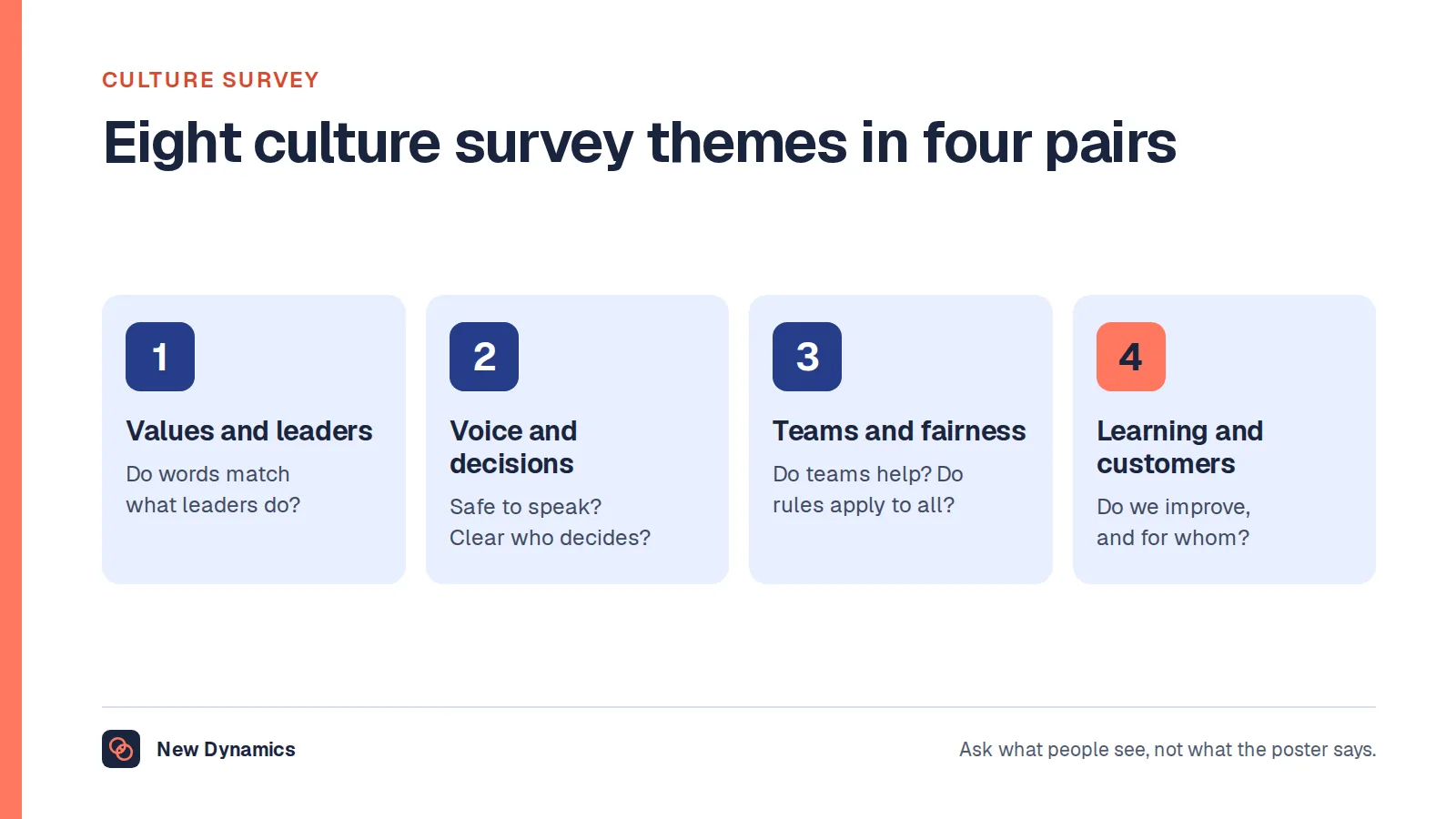
There is a fourth thing people sometimes mean by a staff survey, which is culture: how work actually gets done and which behaviours get rewarded. That needs its own wording, covered in our culture survey questions.

Mixing all three in one survey is common and usually harmless, as long as you do not then report a single average and call it any of the three. If you need to compare your result with a published figure, read our note on the employee engagement benchmark first, because the instrument defines the number.
Five ways a survey question fails

These are faults of wording, not of topic, and they appear in otherwise sensible question sets. For the general mechanics of question formats and scales, see our note on what a questionnaire is.
1. Double-barrelled questions
A double-barrelled question asks about two things and accepts one answer. When the answer is low you cannot tell which half caused it, and the people who feel differently about each half cannot answer honestly at all.
-
Before: "I am satisfied with my pay and benefits."
-
After: "My pay is fair for the work I do." and "The benefits on offer are useful to me."
-
Before: "My manager sets clear direction and gives me useful feedback."
-
After: "I know what my manager expects of me this quarter." and "The feedback I get from my manager helps me do better work."
The tell is the word "and" in the middle of a statement. Split it, every time, even though it lengthens the survey. Two clean items beat one that cannot be acted on.
2. Leading questions
A leading question tells the respondent which answer the organisation wants. People read that signal, and either give you the answer or resent being asked.
-
Before: "How much do you enjoy our new flexible working policy?"
-
After: "The flexible working policy works for my role." followed by an open question: "What would make it work better for you?"
-
Before: "Do you agree that our new values are a positive step for the organisation?"
-
After: "I see our stated values reflected in how decisions get made here."
Watch for possessive pride ("our new"), for adjectives inside the question ("improved", "exciting"), and for any item where disagreeing feels like disloyalty.
3. Questions about things you will not change
This is the most expensive fault, because it damages trust rather than just data. Asking whether people would like a four-day week, when nobody has any intention of considering one, is not listening. It is a promise you have not noticed yourself making.
-
Before: "Would you like the option of a four-day working week?"
-
After: Only ask this if a decision is genuinely open. Otherwise ask about the controllable part: "I can arrange my working hours around my commitments when I need to."
-
Before: "How satisfied are you with your salary?" in an organisation whose pay is set by a national framework.
-
After: "I understand how my pay is set." and "I was told clearly what this year's pay award meant for me."
The test to apply to every item: if this came back badly, who could do something about it, and would they? If you cannot name the person, cut the question or rewrite it until you can.
4. Agreement scales with undefined anchors
An unlabelled scale is not a scale. "Rate your manager from 1 to 5" produces a number whose meaning differs by respondent, by team and by year. So does a frequency scale with no reference period: "often", "sometimes" and "rarely" mean different things to a night-shift technician and a head office analyst.
- Before: "How often does your manager give you feedback? Often / Sometimes / Rarely / Never"
- After: "In the last three months, how many times has your manager spoken with you about your work? None / Once / Two or three times / Four or more times"
Label every point of your agreement scale and keep the same direction on every item. The Civil Service People Survey uses a five-point agreement scale with the points named: strongly agree, agree, neither agree nor disagree, disagree, strongly disagree. Its index then scores them as strongly disagree equals 0, disagree 25, neither 50, agree 75 and strongly agree 100, and averages across the five questions (Civil Service People Survey technical guide, GOV.UK). The arithmetic is only defensible because the points are defined.
Avoid reversing the polarity of items to "catch" inattentive respondents. It mostly catches tired ones, and it makes every chart harder to read.
5. Asking about satisfaction when you mean something specific
"How satisfied are you with communication here?" is a question about a word, not about anything that happens. Nobody can act on a 52% satisfaction score for communication. Decide what behaviour you actually care about, then ask about that.
-
Before: "How satisfied are you with internal communication?"
-
After: "I hear about decisions that affect my work before they take effect." and "I know who to ask when I need a decision made."
-
Before: "Are you satisfied with your development opportunities?"
-
After: "I have had a conversation about my development in the last six months." and "I have been able to take up training I asked for."
The pattern is the same each time: replace an attitude towards an abstraction with an observation about a thing that either happened or did not.
What published question design looks like
Two large UK employers publish their instruments, which makes them the cheapest design review available.
The Civil Service People Survey engagement index is built from five statements, published as:
- "I am proud when I tell others I am part of [my organisation]"
- "I would recommend [my organisation] as a great place to work"
- "I feel a strong personal attachment to [my organisation]"
- "[My organisation] inspires me to do the best in my job"
- "[My organisation] motivates me to help it achieve its objectives"
Note what they have in common. Each is a single statement, in the first person, about one thing, with no adjectives doing persuasive work, and each is answered on the same labelled five-point scale. The published summary describes them as covering "how proud staff feel working for their organisation, whether they would recommend their organisation as a great place to work, whether they feel a strong personal attachment to it, and whether they feel their organisation inspires and motivates them to do the best in their job and achieve their organisation's objectives".
The NHS Staff Survey publishes its full core questionnaire and its technical guide, stating plainly that "the NSS core questionnaire can be downloaded from the link below" (NHS Staff Survey documents). Its summary indicators are scored "on a scale that ranges from 0 to 10, where a higher score always equates to a more positive outcome", with "don't know" typically excluded.
Copy two habits from both. Publish your own question set internally before fieldwork opens, so people can see what they are being asked and nobody discovers a loaded item halfway through. And state the scale and the scoring, so a reported number can be traced back to the sentences that produced it.
A 22-question employee satisfaction set
Written for a five-point agreement scale: strongly agree, agree, neither agree nor disagree, disagree, strongly disagree, with a separate "not applicable" where it genuinely applies. Every item is a single statement in the first person. Twenty-two closed questions plus two open ones takes most people six to eight minutes.
My job
- I know what is expected of me at work.
- My job makes good use of what I am good at.
- I have the equipment and systems I need to do my job properly.
- I have enough time in a normal week to do my work to a standard I am happy with.
Pay, hours and conditions
- My pay is fair for the work I do.
- I understand how my pay is decided.
- The benefits available to me are useful in practice.
- My working hours suit my life outside work.
- I get enough notice of changes to my hours or shifts.
My manager
- My manager is available when I need them.
- My manager deals with problems I raise.
- My manager treats everyone in the team consistently.
Being heard
- I can disagree with a decision here without it counting against me.
- When I raise something, I find out what happened to it.
- I hear about decisions that affect my work before they take effect.
Development
- I have had a conversation about my development in the last six months.
- I have been able to take up training I asked for.
- I can see a realistic next step for me here.
Health and workload
- My workload over the last month has been manageable.
- I can take leave when I need it without difficulty.
Overall
- Taking everything together, I am satisfied working here.
- I expect action to follow from this survey.
Two open questions
- What is the one thing that would most improve your working week?
- What should we stop doing?
Question 22 is the diagnostic one. If agreement there is low, read nothing else until you have fixed it, because a workforce that expects nothing to happen answers every other item defensively. Question 21 is your single headline, and it is a satisfaction measure, not an engagement index. Do not label it as one.
For a ready-made annual instrument with sector variants, see our annual engagement survey question set. For manufacturing and other shift-based sites, keep items 3, 8 and 9 and add two about safety reporting and handover.
Anonymity, promised honestly
Most organisations say "this survey is anonymous" because it increases response rates. Say it only if it is true, because the first time one person is identified from a result, you lose both the promise and the data.
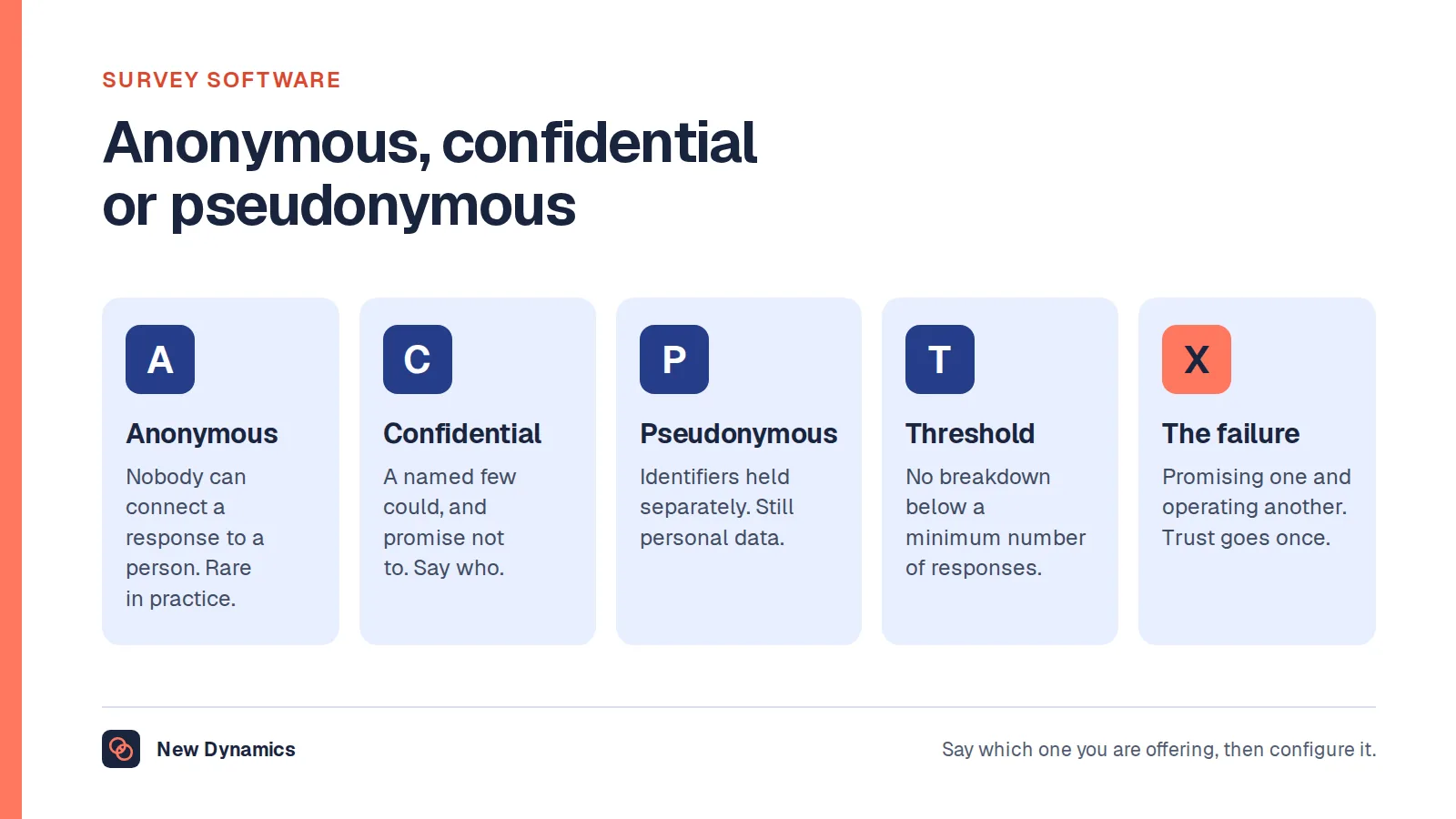
Three honest positions exist, and you must pick one in the invitation:
- Anonymous. Nobody can connect a response to a person, including you and including the provider. This usually means giving up the ability to chase non-responders or to break results down finely.
- Confidential. Responses can be connected to a person, but a named, small group undertakes not to do it, and says who they are.
- Pseudonymous. Identifiers are separated or replaced, and could be rejoined by whoever holds the key.
The practical threat to anonymity is not a leak. It is small numbers. A team of four, a demographic filter and an average are enough to identify someone, and stacking two filters can get there from a much larger group. Set a reporting threshold and enforce it on every view, export and comment list. The NHS Staff Survey publishes exactly this commitment to staff: "All findings will be reported to your organisation in anonymised form for groups of 10 or more people to prevent Identification", alongside "Identifiable data will not be supplied to your organisation under any circumstances" and a request that people "do not include any identifiable personal details in your comments and free text responses in case you can be identified from them" (NHS Staff Survey confidentiality guidance).
Data protection pushes in the same direction. The Information Commissioner's Office guidance on keeping employment records sets the data minimisation test as "the personal information you hold is adequate, relevant, and limited to what you need for your purposes", and is direct about the consequence: "You must identify the minimum amount of personal information you need to hold about your workers, and not hold more information than that", adding that "once you no longer need the information, you should erase it or, if possible, anonymise it" (ICO, collecting and keeping employment records). Applied to a survey, that means collecting fewer demographic fields than you think you need, not more, and deciding before fieldwork which breakdowns you will actually publish.
Say all of this up front, in the invitation, in four sentences: which of the three promises this is, who can see raw responses, the minimum group size for any reported breakdown, and when identifying data is deleted. Choosing the tool that can hold those promises is a separate job, covered in our note on employee survey software.
Reaching people without a work email
If the survey arrives only by work email, and a quarter of your workforce has no work email, your results describe your office. The NHS Staff Survey, one of the largest workforce surveys in the world, still does not assume a desk: "Staff were sent either an email containing a link to the online survey or a paper questionnaire along with a letter containing a QR code for the online survey." In 2025 that produced 729,423 online responses and 36,862 paper ones, from 766,285 staff in total, with the briefing noting that "more than nine in ten staff who took part completed the survey online" and that the paper count "has decreased by 14% this year" (2025 NHS Staff Survey national results briefing).
Paper is a shrinking minority of a very large number, and it is still tens of thousands of people. At your scale, the equivalents are a QR code on a break-room poster, a short link people can type on a personal phone, paper where hands are wet or gloved, and paid time inside the shift to answer. Translate the questionnaire if people work in a second language, or you are measuring reading comprehension.
Response rates and what a falling one means

Treat the response rate as a result in its own right, and read it by group before you read a single score. The 2025 NHS Staff Survey reported a "49% response rate (down from 51% in 2024)". A fall of that kind is not a data problem to be weighted away. It is usually one of three things: people saw nothing happen last time, the questions did not feel answerable, or a group of staff was never reachable in the first place.
So look at the rate per site, shift and occupational group. A department at 80% and a department at 22% do not average into a meaningful 51%: the second department's experience is simply missing, and it is normally the one you most needed to hear from.
What goes wrong afterwards
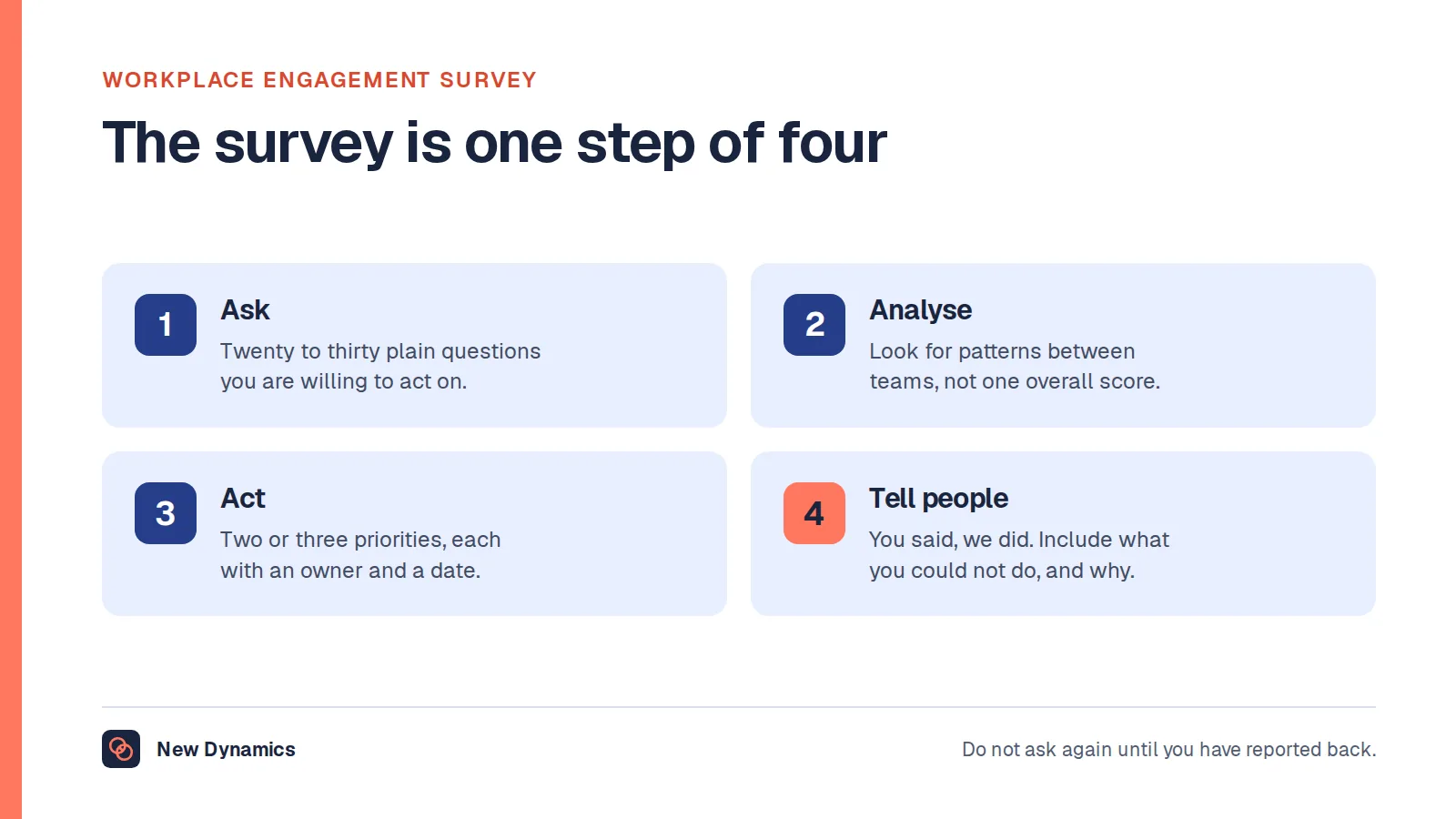
Surveying again before acting on the last one. This is the single fastest way to lose a response rate, and it costs years to recover. Publish what changed before the next invitation goes out. Our employee engagement programme post sets out the cadence that keeps the gap short.
Changing the questions every year. Each rewrite resets your trend, and a trend is most of the value. Freeze a core set and put the year's topical interest in a handful of rotating items or in the open questions. The Civil Service and NHS instruments both flag when a wording change breaks comparability, because a changed question is a new question.
Reporting a mean with no distribution. A 3.4 average hides the difference between a team that mildly agrees and a team split between strong agreement and strong disagreement. Those need opposite responses. Report the percentage who agree, the percentage who disagree, and the shape, not just the midpoint.
Collecting demographics you will never publish. If a breakdown would fall below your reporting threshold, the field only adds re-identification risk. Decide the cuts first, then ask for the fields those cuts need.
Holding managers to the score. A manager accountable for a number will manage the number. Hold them accountable for the conversation and the actions instead, which they control.
Frequently asked questions
What questions should an employee satisfaction survey ask?
Ask about the parts of the deal people can describe: the job, pay and conditions, hours and notice, the manager, being heard, development, workload, and one overall satisfaction item. The 22-question set above is written for a five-point agreement scale and takes six to eight minutes with two open questions added.
How many questions should an employee survey have?
Twenty to thirty closed items plus two or three open ones works for an annual survey, and eight to twelve for a pulse. The real limit is not length but capacity to respond: cut any question whose bad answer nobody would act on.
What is the difference between employee satisfaction and employee engagement?
Satisfaction measures contentment with the job and conditions. Engagement measures commitment and effort, and published indices define it narrowly. The Civil Service People Survey index, for example, is built from five statements covering pride, inspiration, attachment, advocacy and motivation. The two can move in opposite directions.
Are anonymous questionnaires really anonymous?
Often not. Most tools are confidential or pseudonymous, because something has to prevent duplicate responses. Promise only what the configuration delivers, and protect small groups with a reporting threshold. The NHS Staff Survey, for example, reports findings to employers only for groups of 10 or more people.
How do you write a good survey question?
One statement, one subject, first person, no adjectives that signal the wanted answer, and a labelled scale. Then apply the action test: name the person who would act if this came back badly. If there is nobody, rewrite it or remove it.
Should employee survey questions change each year?
Keep a core set identical so the trend survives, and rotate a small number of topical items. A wording change creates a new question, which is why both the Civil Service and NHS publications mark items that are no longer comparable with earlier years.
Your next step: draft the set, then test it on six people
- Decide which of satisfaction, engagement or experience you are measuring, and write it at the top of the draft.
- Draft the items, then run the three tests on each: is it one thing, is it neutral, and can somebody act on a bad answer.
- Fix the scale, label every point, and keep one direction throughout.
- Write the anonymity paragraph before the questions, including the minimum group size.
- Read it aloud with six people from different parts of the workforce, including someone with no work email, and cut whatever they have to re-read.
For a ready-made annual instrument you can adapt rather than start from scratch, see our annual engagement survey question set, and our employee feedback guide for the conversation that has to follow the results.
Want the feedback to continue between survey rounds, instead of waiting a year for the next one? Book a New Dynamics demo and bring your current question set. You can also email contact@new-dynamics.com.