TL;DR
- Acas guidance says an investigation report should set out which facts were established, which facts were not established, and whether there were any mitigating circumstances that also need considering, and that if any information is left out, it could make the investigation unfair.
- The investigator does not pick the sanction. Acas guidance limits any recommendation to formal action, informal action or no further action, and only where that was agreed in the investigation plan. It adds that the investigator should not discuss what the sanctions might be, and that at a hearing they are there to give facts, not to present the case against the worker.
- The Acas statutory Code says that where there is a case to answer the employee should be notified in writing with sufficient information to prepare, and that it would normally be appropriate to provide copies of any written evidence, which may include any witness statements, with the notification.
The report is where most disciplinary cases are won or lost, and almost nobody treats it that way. It is written late, often in a hurry, by someone who has formed a view, and it ends with a sentence the writer had no business writing.
This article sets out what a disciplinary investigation report should contain, how to structure it, how to handle witnesses who will not speak or will not be named, what to attach, and what the employee must be given before any hearing. It describes the position in Great Britain and is general information rather than legal advice.
One reason reports arrive late and incomplete is that nobody owns the next step. See how New Dynamics workflows give each stage an owner and a due date, so the handover from investigator to decision maker is a dated event rather than an intention.
The one line the report must not cross
Start with the sentence that does the damage: "I recommend that the employee be dismissed."
An investigator who writes that has stopped finding facts and started deciding the case. The decision maker is then handed a conclusion instead of evidence, and whatever they do next looks like ratification. If they agree, they adopted someone else's verdict. If they disagree, they have to explain why they overruled their own investigator. Neither position is comfortable at a tribunal.
Acas's guidance on what happens after an investigation draws the line precisely. A recommendation is allowed, but only if "this was agreed in the investigation plan", and only one of three:
- "formal action"
- "informal action"
- "no further action"
Formal action, in Acas's own list, means "to start a disciplinary hearing", "changes to an organisation's policy or procedure" or "further investigation into other matters that were found". It does not mean a sanction. Acas then says so outright about the conversation after the report: "The focus of discussion should only be to decide whether any further steps are necessary. The investigator should not discuss what the sanctions might be if disciplinary action is decided upon."
The same boundary holds at the hearing itself. If the investigator attends, Acas says "they should only be there to give facts. They should not be there to give their opinion or present the case against the worker."
So the honest last line of a report is a question answered, not a penalty proposed: on these facts, is there a case to answer. Nothing beyond that belongs to the investigator.
Why the structural point is a legal one
The statutory test for unfair dismissal does not ask whether the misconduct happened. Section 98(4) of the Employment Rights Act 1996, at legislation.gov.uk, says the question "whether the dismissal is fair or unfair (having regard to the reason shown by the employer)" "depends on whether in the circumstances (including the size and administrative resources of the employer's undertaking) the employer acted reasonably or unreasonably in treating it as a sufficient reason for dismissing the employee, and shall be determined in accordance with equity and the substantial merits of the case."
"The employer acted reasonably" is a question about the process, and the report is the written record of most of it.
The Acas statutory Code of Practice on disciplinary and grievance procedures is where the process standards sit. Be accurate about its force. The Code itself says: "A failure to follow the Code does not, in itself, make a person or organisation liable to proceedings. However, employment tribunals will take the Code into account when considering relevant cases."
That mirrors the statute. Section 207 of the Trade Union and Labour Relations (Consolidation) Act 1992 provides that "A failure on the part of any person to observe any provision of a Code of Practice issued under this Chapter shall not of itself render him liable to any proceedings", and that any relevant provision "shall be taken into account in determining that question". Section 207A adds the money: where a claim concerns a matter the Code applies to, the employer has failed to comply, "and that failure was unreasonable", a tribunal "may, if it considers it just and equitable in all the circumstances to do so, increase any award it makes to the employee by no more than 25%." The same section allows a reduction of up to 25% where it is the employee who unreasonably failed to comply.
On roles, the Code is brief and conditional: "In misconduct cases, where practicable, different people should carry out the investigation and disciplinary hearing." Acas's guidance on preparing for an investigation goes further, asking for three people across "the investigation", "the disciplinary hearing and outcome" and "the appeal hearing (if an appeal is raised)", and for the investigator to be "somebody who's not involved in the case", "to make sure there is no conflict of interest".

The remit, written down before you start
Acas guidance calls this the investigator's "terms of reference", and says they should cover "what needs to be investigated", "whether they are expected to give recommendations at the end of the investigation", "how their findings should be set out" and "who their findings should be reported to".
Settle all four in writing before the first interview. The second one is the whole argument above, resolved in advance rather than in the final paragraph. The third decides the shape of the report. The fourth stops it circulating to people who have no role in the case.
Who should not do it: anyone who witnessed the incident, anyone who reported it, the employee's own manager where the complaint is about the relationship, anyone who will chair the hearing or hear an appeal, and anyone who has already said out loud what they think happened. Acas notes that for cases involving "potential gross misconduct, discrimination or bullying" it "might be best to appoint someone more senior or experienced", and that "in exceptional circumstances" an external consultant "can be more detached from the matter and bring an independent view", although "this can cost more and take longer."
Proportionate means proportionate
The Code's starting instruction is short: "It is important to carry out necessary investigations of potential disciplinary matters without unreasonable delay to establish the facts of the case." It also accepts that scale differs: "Employment tribunals will take the size and resources of an employer into account when deciding on relevant cases and it may sometimes not be practicable for all employers to take all of the steps set out in this Code."
Depth should match seriousness. Acas's guidance on carrying out an investigation gives the range in plain terms: "a simple case might only take a day to gather enough information. A more complicated case could take several weeks." Where more time is needed it "should be allowed", and the handling is specific: "They should explain any delay to anyone involved and write it in the investigation report."
Delay belongs in the report. An unexplained gap of five weeks reads, later, as either indifference or a search for something better.
Interviewing the employee, and the witnesses
Acas suggests going to the employee early. In a potential disciplinary matter, "an investigator should consider interviewing any workers under investigation at an early stage. Doing this can help to establish which facts are disputed, so the investigator can focus the rest of the investigation on these areas."
That is good discipline for the report too, because it tells you which findings actually need evidence behind them. Acas adds that if the worker "admits the allegations against them are correct, it might not be necessary to investigate the matter as fully as planned", though "their explanation of why the incident occurred might still need to be investigated".
On the meeting itself, Acas asks the investigator to "ask questions in a neutral, non-confrontational way", to "record replies and any refusals to reply", and to "look for evidence that supports the information provided". Notice the second one. A refusal to answer is a fact about the investigation and should appear in the report as what it is, not be quietly omitted.
Be accurate about accompaniment. The statutory right under section 10 of the Employment Relations Act 1999 applies where a worker "is required or invited by his employer to attend a disciplinary or grievance hearing" and "reasonably requests to be accompanied at the hearing". Section 13(4) defines a disciplinary hearing as one "which could result in" "the administration of a formal warning", "the taking of some other action" or "the confirmation of a warning issued or some other action taken". An investigation meeting is not that. The Code says the same: "Although there is no statutory right for an employee to be accompanied at a formal investigatory meeting, such a right may be allowed under an employer's own procedure." Acas guidance puts it as practice: "In a disciplinary investigation meeting, there is no legal right to be accompanied. But it's good practice for employers to allow it."
Witness statements have a defined form. Acas says a statement "is usually a signed copy of the notes from an investigation meeting", the witness "should be given an opportunity to check their statement", and should then "sign the statement to confirm it is accurate". Where a witness amends a statement they "should sign any changes they make", and if the investigator "believes the changes contradict what was first said, they might note this. They could also include both statements in their report."
If a witness will not sign, the answer is not to drop the evidence. Acas: "an investigator should still include the statement in their report. But they should state that the witness refused to confirm it accurately reflected the meeting."
Where many people saw the same thing, you do not need all of them. Acas says the investigator should "talk to some of the witnesses" and "check whether they're broadly saying the same thing", and does not have to speak to all of them unless "they feel they're not getting enough information" or "there are significant differences in what the witnesses say".
Reluctant and anonymous witnesses
For a reluctant witness, Acas asks the investigator to "explore the reason a witness is reluctant to give evidence", "provide reassurance" and "try to resolve any concerns they have".
Anonymity is the harder case, and Acas's position is a presumption against it with a stated reason: "Where possible, investigators should avoid anonymous witness statements. This is so the person under investigation can fairly question any evidence against them." It is allowed "only in exceptional circumstances. For example, if a witness genuinely fears revenge action." Two practical points follow in the guidance. The investigator "should explain that employers might have to share witness names if there are legal proceedings", so anonymity can never be promised absolutely. And where it is agreed, "the investigator should carry out the interview and take notes as usual. They should then remove any details that could identify the person."
In the report, say that a statement has been anonymised, why, and what weight you placed on it. An anonymous account that cannot be tested should rarely carry a finding on its own.
How to structure the report
Acas prescribes the substance. An investigation report "should include":
- "which facts were established"
- "which facts were not established"
- "whether there were any mitigating circumstances that also need considering"
And then the warning: "If any information is left out, it could make the investigation unfair." Acas also insists the thinking is the investigator's own: "The report should reflect the investigator's own conclusions. An investigator might get advice from HR, but the conclusions should be their own."
Its writing advice is five words long each: the report should "be objective", "avoid jargon and explain any acronyms", "stick to the facts", "be concise" and "include all evidence collected". Acas publishes an investigation report template that employers can use. No official source sets a length, a format or a required number of sections, so treat the order below as a working structure rather than a rule.
- Remit. The terms of reference, who appointed you, the date, and whether recommendations were requested.
- Process. Who you interviewed and when, what you asked for and did not get, what you could not obtain and why, and any delay with its explanation.
- The allegations. Each one stated separately and specifically, in the words the employee was given.
- Findings of fact against each allegation. Established, not established, or unable to determine. Three outcomes, not two.
- The evidence for each finding. Pointed at a numbered exhibit, not summarised from memory.
- Conflicts in the evidence and how they were resolved. Where two accounts differ, say so, say which you preferred and say why: contemporaneous record, corroboration, consistency, proximity to the event. This is the section most reports skip, and it is the one that shows an open mind.
- Case to answer. Whether, on the established facts, there is a case for the decision maker to hear. Then stop.
Mitigation sits alongside the findings rather than inside them. It is not a finding about what happened; it is context the decision maker is required to consider.

What to attach, and what to hand the employee
Attach the evidence rather than describing it: signed witness statements, interview notes, the emails, rotas, records, screenshots or footage you relied on, the relevant extracts of policy as they stood on the date of the conduct, and the investigation plan. Number every exhibit and reference the number in each finding.
Then the part employers get wrong. Acas says that once the investigation is finished, "the investigator should have a written report. The employer should share this report with the worker."
The Code sets the same requirement for the hearing invitation. Where "it is decided that there is a disciplinary case to answer, the employee should be notified of this in writing", and "this notification should contain sufficient information about the alleged misconduct or poor performance and its possible consequences to enable the employee to prepare to answer the case at a disciplinary meeting." On the evidence itself: "It would normally be appropriate to provide copies of any written evidence, which may include any witness statements, with the notification."
The Code also says the notification "should also give details of the time and venue for the disciplinary meeting and advise the employee of their right to be accompanied at the meeting", and that the meeting "should be held without unreasonable delay whilst allowing the employee reasonable time to prepare their case". Handing over a 40 page report the evening before a hearing satisfies the letter of that and nothing else.
At the hearing, the Code expects the employee to be "given a reasonable opportunity to ask questions, present evidence and call relevant witnesses", and to be "given an opportunity to raise points about any information provided by witnesses". A report that conceals the basis of a finding makes that impossible.
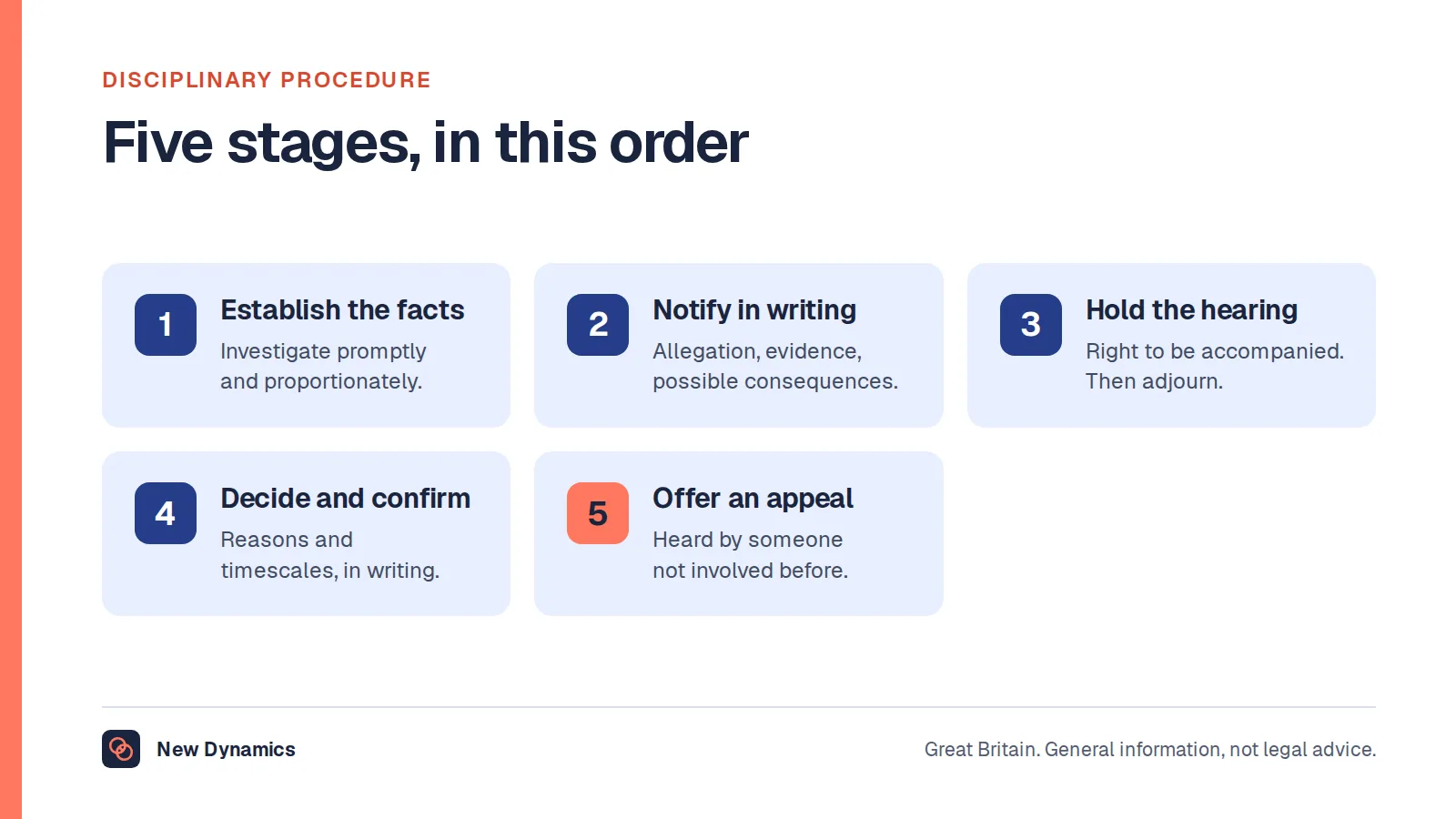
Our guides to the disciplinary procedure and to workplace investigations cover the stages either side of the report, and the incident statement covers the craft of separating what a witness saw from what they concluded.
Data protection: witness evidence and retention
A report is a pile of other people's personal information, so the UK GDPR applies to it.
The Information Commissioner's Office, in its guidance on collecting and keeping employment records, states the limiting principle: "The data minimisation principle says you must make sure the personal information you hold is adequate, relevant, and limited to what you need for your purposes." That is an argument against the sweep-everything report. Material with no bearing on an allegation does not belong in it.
On accuracy, the ICO says that where "you are using the information to make decisions that might significantly affect the worker concerned or others, you should put more effort into ensuring its accuracy", and that "if someone challenges the accuracy of an opinion, you could add a note recording the challenge and the reasons behind it." That is exactly how a disputed witness account should be handled on the page.
On retention there is no number to quote, and the ICO says so: "Data protection law does not set specific time limits for how long you can keep your workers' personal information. This is up to you, and will depend on how long you need the information for your particular purposes." It asks for a retention policy or schedule listing "the types of record or information you hold", "what you use it for" and "how long you intend to keep it", warns against a "one-size-fits-all" approach, and says that "once you no longer need the information, you should erase it or, if possible, anonymise it."
Acas's guidance aligns with that for reports specifically: the employer "should keep investigation reports, in case there are any questions in the future", should "store it securely" and "only allow access when necessary", and "should securely dispose of the report once it's no longer needed or is out of date."
On sharing, Acas says an employer "can refuse to share a witness statement if it could identify a third party", for example a customer, unless "the third party agrees for it to be shared" or "it would be reasonable to share it in the circumstances", but "should look at alternative ways to share the witness statement. For example, removing names or redacting information." Anyone named in a report "has the right to see any parts that" "have information about them" or "depended on information they gave", while private information about other people stays out. Redaction, not refusal, is usually the answer.
Where reports go wrong
- It recommends a sanction. The investigator has decided the case and the hearing becomes a formality.
- Two outcomes instead of three. Every allegation is marked proved or disproved, with nothing recorded as unable to determine.
- Conflicts smoothed over. Two incompatible accounts are both quoted and neither is weighed.
- Evidence described, not attached. The reader cannot check a single finding.
- Opinion dressed as fact. "The employee was clearly being obstructive" is a conclusion, not an observation.
- Favourable material left out. Acas's warning covers this: leaving information out could make the investigation unfair.
- The whole file as the report. Everything collected, nothing assessed, and personal information included that no allegation needed.
- Delivered the night before. Technically disclosed, practically useless.
Frequently asked questions
What should a disciplinary investigation report include?
Acas guidance says an investigation report should include which facts were established, which facts were not established, and whether there were any mitigating circumstances that also need considering. It warns that if any information is left out, it could make the investigation unfair, and says the conclusions should be the investigator's own even where HR has advised.
Can an investigation report recommend dismissal?
No. Acas guidance limits a recommendation to formal action, informal action or no further action, and only where giving recommendations was agreed in the investigation plan. Formal action means starting a disciplinary hearing, changing a policy or investigating further. Acas adds that the investigator should not discuss what the sanctions might be if disciplinary action is decided upon.
Does the employee get a copy of the investigation report?
Acas guidance says the employer should share the report with the worker once the investigation is finished. The Acas Code adds that where there is a case to answer the employee should be notified in writing with enough information to prepare, and that it would normally be appropriate to provide copies of any written evidence, including witness statements, with that notification. Sensitive personal information may be redacted where there is good reason.
Can a witness statement be anonymous?
Only in exceptional circumstances, such as where a witness genuinely fears revenge action. Acas says investigators should avoid anonymous statements where possible, so that the person under investigation can fairly question the evidence against them, and that the investigator should explain that employers might have to share witness names if there are legal proceedings. Where anonymity is agreed, identifying details are removed from the notes.
Does an employee have the right to be accompanied at an investigation meeting?
Not as a statutory right. Section 10 of the Employment Relations Act 1999 attaches the right to a disciplinary or grievance hearing, and section 13(4) defines a disciplinary hearing as one that could result in a formal warning, some other action, or the confirmation of either. The Acas Code says there is no statutory right to be accompanied at a formal investigatory meeting, though an employer's own procedure may allow it, and Acas calls allowing it good practice.
Is there a required template or length for an investigation report?
No official source sets a length, a format or a number of sections. Acas publishes an investigation report template that employers can use, and asks that the report be objective, avoid jargon, stick to the facts, be concise and include all evidence collected. Terms of reference should say how the findings are to be set out.
How long should an investigation report be kept?
There is no fixed period. The ICO says data protection law does not set specific time limits, that it depends on how long you need the information for your purposes, and that you should set a retention policy or schedule. Acas says employers should keep investigation reports in case there are questions later, store them securely, limit access, and dispose of them securely once no longer needed.
Your next step: fix the last line first
- Open your most recent investigation report and read only its final paragraph. If it names an outcome, that is the habit to change.
- Write terms of reference for the next case before the first interview, settling whether recommendations are wanted and how findings should be set out.
- Add a conflicts section to your report format, with a line for how each conflict was resolved.
- Mark every allegation established, not established, or unable to determine, and keep the third option available.
- Check that the report, the numbered exhibits and the hearing invitation go to the employee together, with time to read them.
For the data protection side of witness evidence, access requests and retention, read and download our employee data protection guide. The guide is free to read, and the PDF uses our short download form.
Want the handover from investigator to decision maker to have an owner and a date rather than a hope? Book a New Dynamics demo and bring your current report format. You can also email contact@new-dynamics.com.