TL;DR
- Statutory minimum notice is set by section 86 of the Employment Rights Act 1996 and builds with service: not less than one week under two years, one week for each year between two and twelve years, and not less than twelve weeks at twelve years or more. A contract can give more, and section 86(3) makes a shorter term take effect subject to that floor.
- Pay in lieu of notice is not automatic. GOV.UK states: “You can only get payment in lieu if it's in your contract or you agree to it. If you do not agree to it, you can work out your notice period.” GOV.UK treats it as taxable earnings, not part of the first combined £30,000 that is usually tax free.
- Lawful as to notice and fair are separate questions. Section 86(6) preserves the right to treat a contract as terminable without notice because of the other party's conduct, but the Acas Code says “a fair disciplinary process should always be followed”, and a tribunal can adjust an award by up to 25 per cent for an unreasonable failure to follow it.
Three different situations get called the same thing. An employee walked off site the same afternoon. An employee told to clear their desk and paid eight weeks in cash. An employee whose employer simply stopped paying them a month early. All three get described as dismissal without notice, and only one of them is usually lawful.
This article separates them, and stays on one question: what is owed. It covers the statutory minimum notice periods, what a contract can do to them, when notice can lawfully be withheld, what pay in lieu of notice needs and how it is taxed, and what happens to accrued holiday.
It describes the law of England, Wales and Scotland, where the Employment Rights Act 1996 applies. Northern Ireland has parallel legislation and different figures, flagged below. This is general information and not legal advice.
A dismissal is only as defensible as the record behind it. See how New Dynamics workflows let you define stages, participants and approvals, so the order things happened in is recorded as it happens rather than reconstructed later.
The three things "dismissal without notice" means
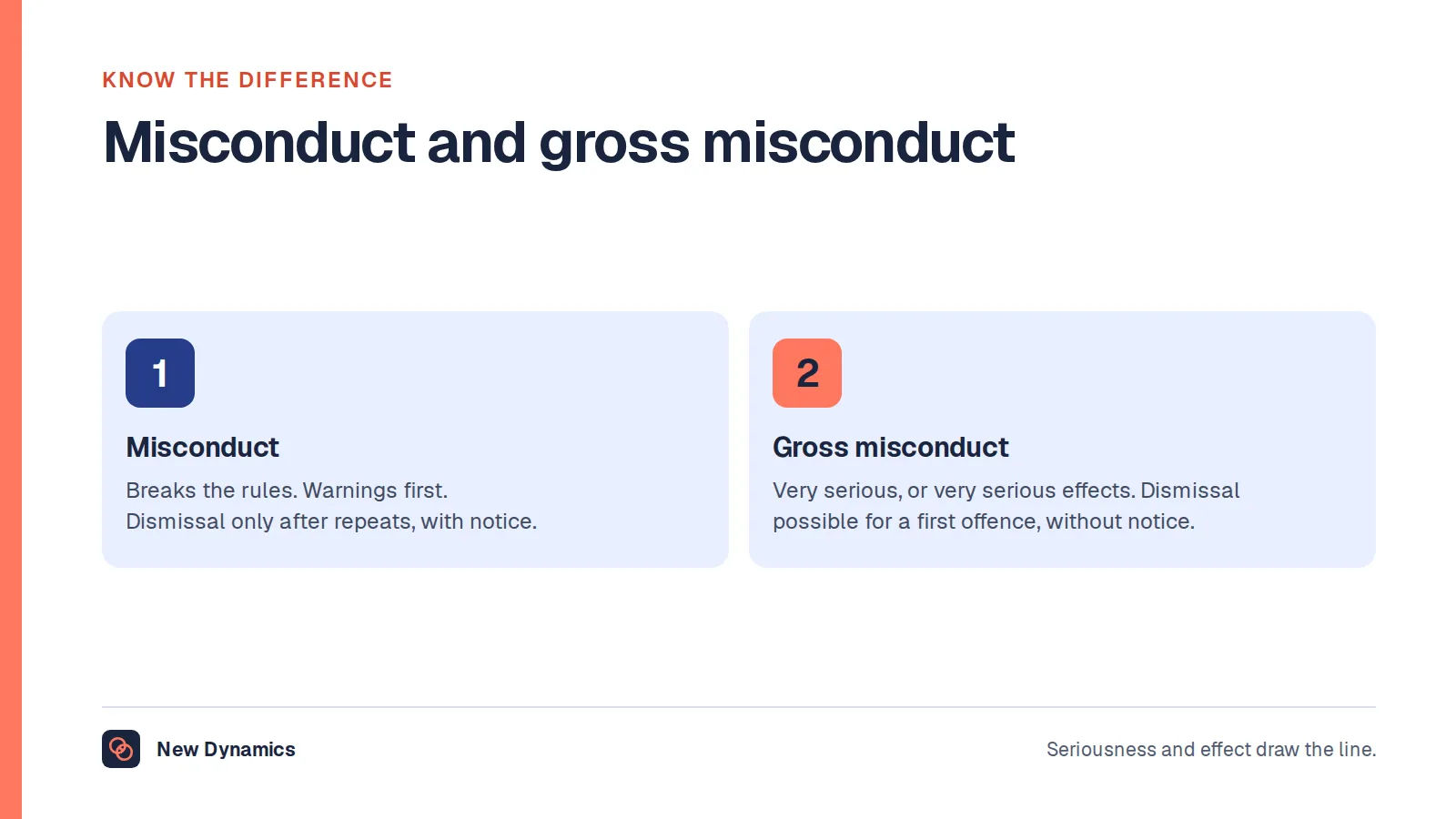
Summary dismissal. The contract ends at once for the employee's conduct, with nothing paid for notice. GOV.UK's employer guide defines it as "when you dismiss someone instantly without notice or pay in lieu of notice, usually because of gross misconduct (for example theft, fraud, violence)."
Pay in lieu of notice. Employment ends at once, but the notice is bought out in cash. Often shortened to PILON.
Wrongful dismissal. Notice was owed and not given. GOV.UK calls it "where you break the terms of an employee's contract in the dismissal process, for example dismissing someone without giving them proper notice", and adds that "Wrongful dismissal is not the same as unfair dismissal."
The first is a right the employer may have. The second is a term the employer needs. The third is a breach of contract.

Statutory minimum notice, and how it builds with service
Minimum notice comes from section 86 of the Employment Rights Act 1996, which applies after one month of continuous employment. The Act words the employer's obligation in three limbs:
"(a) is not less than one week's notice if his period of continuous employment is less than two years,
(b) is not less than one week's notice for each year of continuous employment if his period of continuous employment is two years or more but less than twelve years, and
(c) is not less than twelve weeks' notice if his period of continuous employment is twelve years or more."
Two details matter. It steps up by whole years, so six years and ten months earns six weeks and not seven. And limb (c) caps it at twelve weeks however long the service. The employee's side is shorter: section 86(2) requires "not less than one week".
Section 86 is recorded at legislation.gov.uk as up to date with all changes known to be in force on or before 7 November 2026.

What the contract can and cannot do
A contract can give more notice, never less. Section 86(3) provides that any shorter term "has effect subject to subsections (1) and (2)". The term is not struck out; it yields to the floor. GOV.UK puts it in a line: "You must be given at least the notice stated in your contract or the statutory minimum notice period, whichever is longer."
The same subsection adds that "this section does not prevent either party from waiving his right to notice on any occasion or from accepting a payment in lieu of notice."
Sections 88 to 91 then guarantee pay through the notice period, including where the employee is willing to work but given none, is off sick, is on family leave, or is on holiday. Section 87(4) switches that off where the employer's contractual notice "must be at least one week more than the notice required by section 86(1)", so a generous contract moves the argument out of the statute and into the contract.
When notice can lawfully be withheld
The right to dismiss without notice does not come from the notice rules. It survives them. Section 86(6) states: "This section does not affect any right of either party to a contract of employment to treat the contract as terminable without notice by reason of the conduct of the other party."
That is a contractual right, triggered by a fundamental breach by the employee. GOV.UK gives the everyday version: "There are some situations where you can be dismissed immediately - for example, for violence."
So the notice question is whether the conduct let the employer treat the contract as at an end. Fairness is a separate question about the reason and the process, and an employer can be right on the first and wrong on the second. GOV.UK says so: "Tribunals may rule a summary dismissal as 'procedurally unfair'", and "you must still follow a fair procedure as you would do for any other disciplinary matter." Our guide to gross misconduct covers that fairness test in full.
One warning sits alongside it: "you can only suspend someone without pay if their contract says you can do this. If it does not, you should suspend the employee on full pay and investigate the circumstances."
Pay in lieu of notice, and how it is taxed
A PILON clause is permission to end employment at once and pay the notice as a lump sum. Without it, paying instead of giving notice is still a breach, even though the money removes most of the loss. GOV.UK is direct: "You can only get payment in lieu if it's in your contract or you agree to it. If you do not agree to it, you can work out your notice period."
Garden leave reaches a similar result differently: the employee stays employed and off work, and GOV.UK says "You'll get the same pay and contractual benefits". Employment continues, so restrictive covenants continue with it.
On tax, GOV.UK's guidance on tax on termination payments, last updated on 8 November 2024, lists among the items you pay tax and National Insurance on "any payments you receive instead of working during your notice period - this may be payment in lieu of notice (PILON) or be part of any severance pay". Notice pay is earnings. It is not sheltered by the exemption covering "the first combined £30,000 of" statutory redundancy pay, additional severance or enhanced redundancy payments, and non-cash benefits.
The same page covers post-employment notice pay. Where a notice period is not worked, "You'll pay tax and National Insurance on the part of your termination payment equivalent to what you'd have earned if you were working", which it applies to lump sum PILON, to pay given on gardening leave, and to the part of severance or non-cash benefits "known as Post-Employment Notice Pay (PENP)". Relabelling notice pay as compensation does not move it inside the £30,000 band.
Accrued holiday still has to be paid
Untaken statutory holiday cannot be forfeited for misconduct. GOV.UK's holiday entitlement guidance says statutory leave can only be paid instead of taken on leaving a job, and then: "Employers must pay for untaken statutory leave, even if the worker is dismissed for gross misconduct."
The mechanism is regulation 14 of the Working Time Regulations 1998: where employment ends mid leave year and "the proportion of leave taken by the worker is less than the proportion of the leave year which has expired, his employer shall make him a payment in lieu of leave". Over-taken leave runs the other way only with paperwork, and GOV.UK says an employer "must not take money from their final pay unless it's been agreed beforehand in writing".
Wrongful dismissal: notice owed and not given
Wrongful dismissal is a contract claim, and the measure is what the notice was worth. There is no qualifying period of service, because the right comes from the contract rather than from Part 10 of the 1996 Act.
A dismissal can therefore be fair and still wrongful, where the reason was sound but notice was withheld without justification. It can be lawful as to notice and still unfair, where the conduct justified summary dismissal but the process did not. The cheap mistake is withholding notice on a view of the facts the investigation has not yet established. If the gross misconduct finding does not hold, the unpaid notice is simply a debt.
The Acas Code, and what ignoring it costs
Be precise about the Code's status, because it is often overstated. The Acas statutory Code of Practice on discipline and grievance procedures is issued under section 199 of the Trade Union and Labour Relations (Consolidation) Act 1992 and came into effect on 11 March 2015.
Failing to follow it is not itself unlawful. Its foreword says: "A failure to follow the Code does not, in itself, make a person or organisation liable to proceedings. However, employment tribunals will take the Code into account when considering relevant cases." That mirrors section 207 of the 1992 Act, under which a failure "shall not of itself render him liable to any proceedings" while any relevant provision "shall be taken into account".
The money sits in section 207A. Where the employer has failed to comply and that failure was unreasonable, "the employment tribunal may, if it considers it just and equitable in all the circumstances to do so, increase any award it makes to the employee by no more than 25%". Subsection (3) is the mirror image for an employee. Schedule A2 lists the jurisdictions, covering unfair dismissal under section 111 of the 1996 Act and the 1994 Orders on breach of employment contract and termination.
On notice itself, paragraph 22 expects the dismissal letter to state the reasons, "the date on which the employment contract will end, the appropriate period of notice and their right of appeal". Paragraph 23 sets the limit: gross misconduct "may call for dismissal without notice for a first offence. But a fair disciplinary process should always be followed". In Northern Ireland, GOV.UK directs employers to the Labour Relations Agency Code instead.
The qualifying period, and what changes on 1 January 2027
Published guidance ages badly here, so check the date on anything you read.
Today, section 108(1) of the 1996 Act still requires an employee to have "been continuously employed for a period of not less than two years ending with the effective date of termination" to claim ordinary unfair dismissal. GOV.UK agrees: "This is usually 2 years."
Section 25 of the Employment Rights Act 2025 changes that figure to "six months". It is not day one, which is a common misreading. Section 25 was not in force at Royal Assent, and has since been commenced: the Employment Rights Act 2025 (Commencement No. 4 and Transitional and Saving Provisions) Regulations 2026 bring it into force "on 1st January 2027, subject to the transitional and saving provisions in regulation 4". Regulation 4 keys it to the effective date of termination, so the amendments "do not have effect in any case where the effective date of termination falls before 1st January 2027". Section 25 also removes section 124, the cap on the compensatory award, from the same date.
GOV.UK's employer page reflects this: "From 1 January 2027, most employees will be able to claim unfair dismissal after 6 months. In Northern Ireland, the qualifying period is still usually 1 year." Its employee-facing page still reads "normally 2 years" without mentioning the change.
None of this touches notice. Section 86 is unchanged, and wrongful dismissal never had a qualifying period.
The practical sequence when you suspect gross misconduct

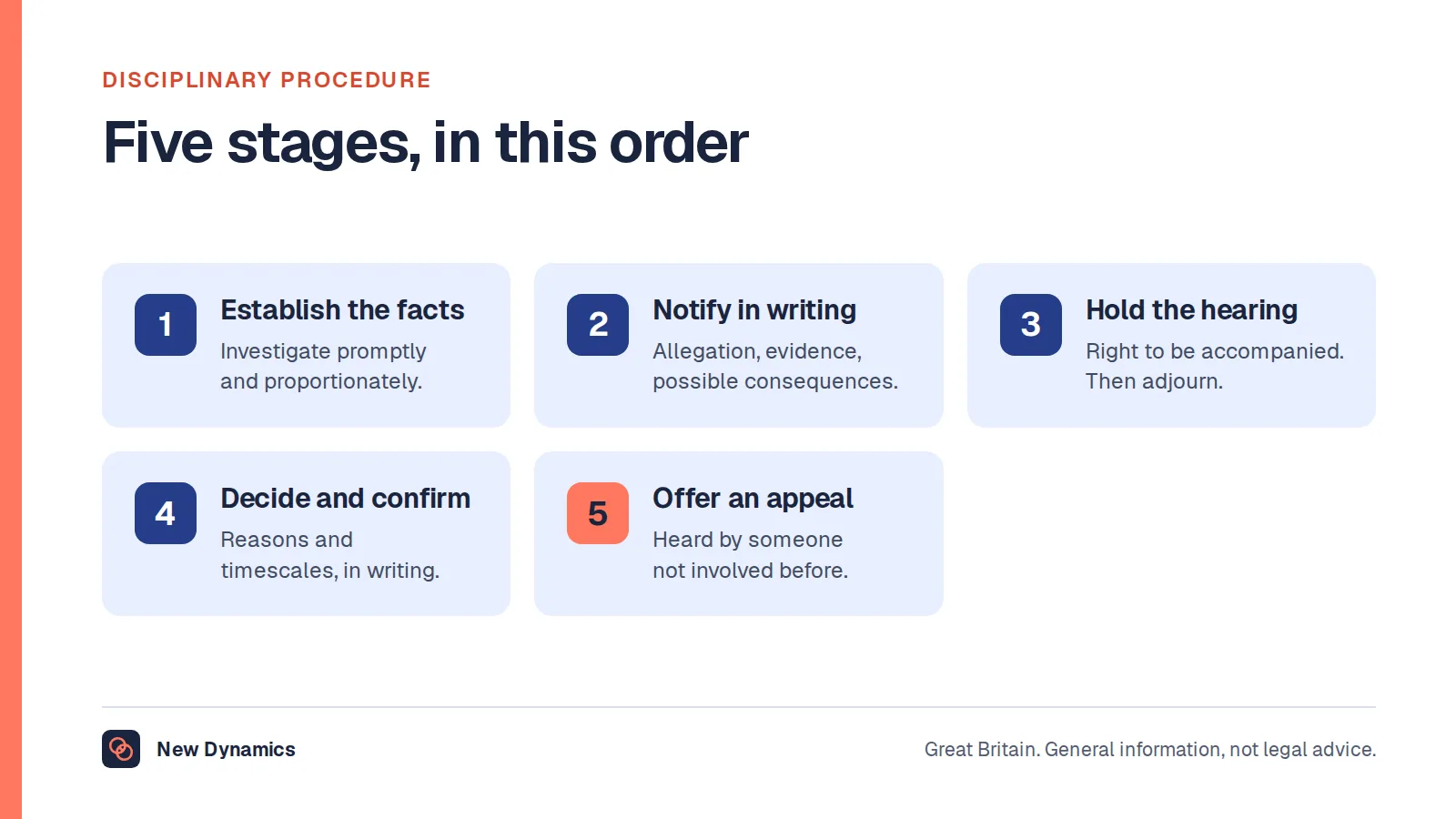
- Suspend only if you need to, and on full pay unless the contract clearly allows otherwise.
- Investigate before deciding anything about notice. Withholding notice depends on findings you do not yet have.
- Put the allegation, the evidence and the possible outcome in writing, including that dismissal without notice is possible, and confirm the right to be accompanied.
- Hold the hearing, and let the answer change your mind if it should.
- Decide, and write down the notice position: the reasons, the end date, the notice period and the right of appeal.
- Pay what is still owed, including accrued untaken statutory holiday, whatever the finding on notice.
- Offer and hear an appeal, wherever possible before someone not involved in the decision.
If the facts turn out thinner than they looked, the safer landing is notice paid, not a withheld notice period defended after the event. Writing these rules down in advance is part of what our employee handbook guide is for.
Frequently asked questions
Can an employer dismiss without notice?
Yes, in one situation. Section 86(6) of the Employment Rights Act 1996 preserves the right of either party to treat the contract as terminable without notice because of the other party's conduct. In practice that means gross misconduct amounting to a fundamental breach. Outside that, notice is owed.
How much statutory notice must an employer give?
Section 86(1) sets not less than one week under two years of continuous employment, not less than one week for each year between two and twelve years, and not less than twelve weeks at twelve years or more. GOV.UK says you get the contractual or statutory period, whichever is longer.
Does pay in lieu of notice have to be in the contract?
To be a right, yes. GOV.UK states that you can only get payment in lieu if it is in your contract or you agree to it, and that otherwise you can work out your notice period. Without a clause or agreement, paying instead of giving notice is still a breach of contract.
Is pay in lieu of notice taxable?
Yes. GOV.UK lists payments received instead of working a notice period, including PILON, among the items you pay tax and National Insurance on. It is earnings, not part of the first combined £30,000 that is usually tax free. Post-employment notice pay taxes the notice element whatever the payment is called.
Do you still get holiday pay if dismissed for gross misconduct?
Yes, for untaken statutory holiday. GOV.UK says employers must pay for untaken statutory leave even if the worker is dismissed for gross misconduct, and regulation 14 of the Working Time Regulations 1998 requires a payment in lieu of leave on termination.
What is the difference between wrongful and unfair dismissal?
Wrongful dismissal is a breach of contract, usually a failure to give proper notice, and GOV.UK confirms it "is not the same as unfair dismissal". Unfair dismissal is a statutory claim about the reason and the process, and it has a qualifying period: two years now, six months where the effective date of termination is on or after 1 January 2027.
Your next step
If you are an employer, do one thing this week: open your contract template and check whether it contains a PILON clause and a right to suspend without pay. Many contain neither, and both only matter on the day you need them. If you have been dismissed without notice, ask for the reason and the notice position in writing, work out your statutory minimum from your start date, and check your final payslip for untaken holiday.
For these rules written down in one place, read and download our employee handbook guide. The guide is free to read, and the PDF uses our short download form.
Want the disciplinary and leaver steps recorded as they happen, with dates and approvals attached? Book a New Dynamics demo and bring your current process. You can also email contact@new-dynamics.com.