TL;DR
- Misconduct in the workplace is behaviour that breaks the organisation's rules. Acas defines it as unacceptable or inappropriate behaviour, and says misconduct is when an employee's inappropriate behaviour or action breaks the organisation's rules. GOV.UK gives persistent lateness and unauthorised absence as examples.
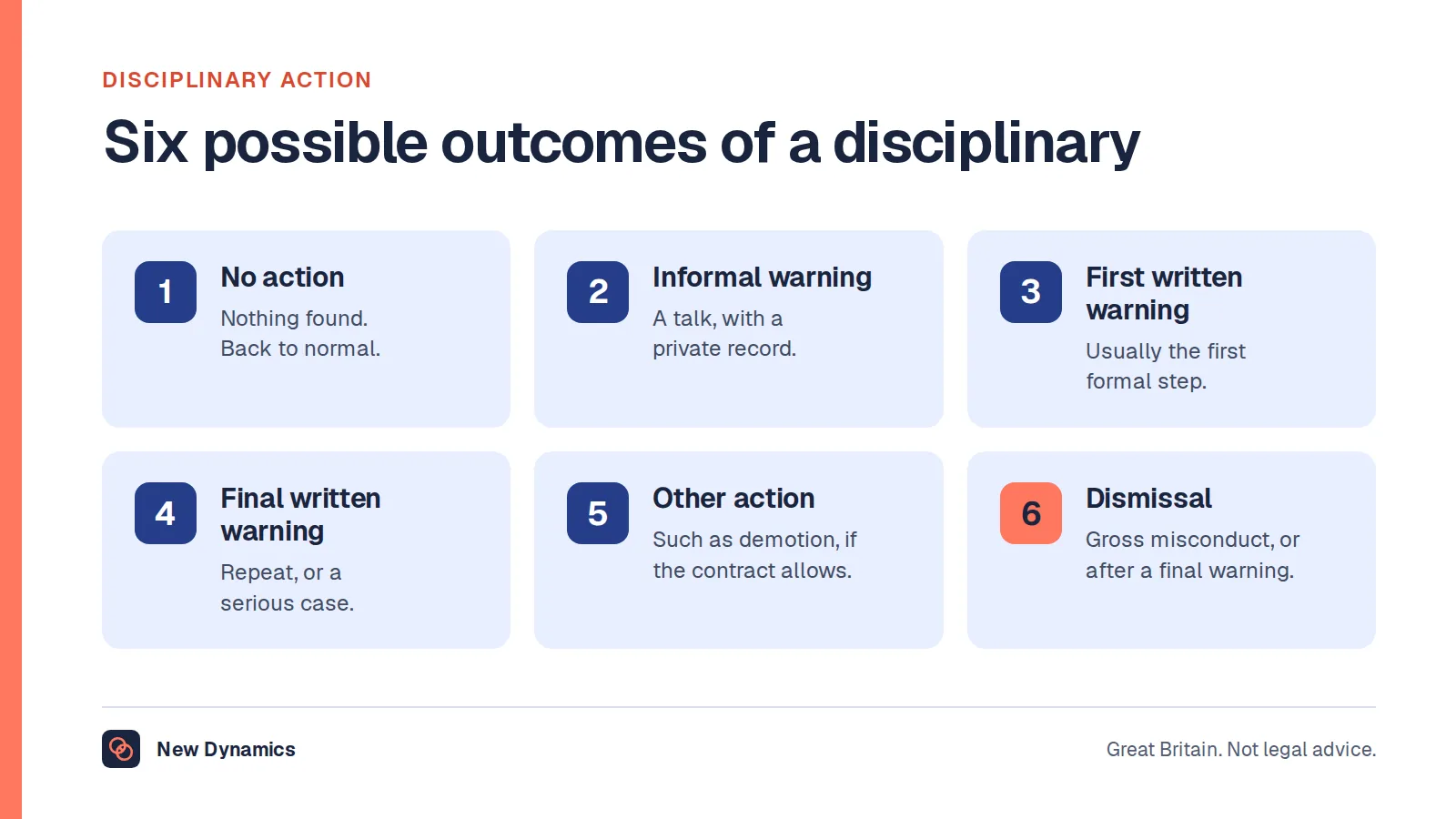
- Almost all misconduct sits below the gross threshold, and is handled by a ladder: an informal word, a first written warning, a final written warning, and dismissal only if nothing changes. The Acas Code says the employee should be told how long each warning will remain current.
- The error that destroys an otherwise sound case is calling a capability problem misconduct. In Great Britain, conduct and capability are separate fair reasons for dismissal under the Employment Rights Act 1996, and capability is assessed by reference to skill, aptitude, health or other physical or mental quality. This is general information, not legal advice.
Search for misconduct at work and you will find page after page about gross misconduct: the theft, the violence, the dismissal on the day. Those cases are rare. The ones that fill a manager's week are ordinary. The person late three mornings in a row. The colleague whose tone in meetings has started to cost the team something. The engineer who keeps skipping the sign-off step because the old way is quicker.
That ordinary band is where most disciplinary work happens, and almost nobody writes about it. This article sets out the definition of misconduct in the workplace, the types it falls into, how conduct differs from capability and why confusing the two wrecks a case, what a conduct policy has to contain, how the warning ladder works and how long a warning lives, when a pattern matters more than a single incident, when behaviour outside work becomes the employer's business, and what fairness requires at each step.
Nearly every formal case starts with a standard that was never written down and a conversation nobody recorded. See how New Dynamics continuous feedback keeps the specific example, its impact and the agreed next step in one place, so a hearing is never the first time the subject has been raised.
Where law is mentioned, this article describes the position in Great Britain, which means England, Wales and Scotland. Northern Ireland has its own employment legislation and its own statutory procedures, noted below. This is general information and not legal advice.
What is misconduct in the workplace?
Acas, the public body that advises on workplace relations, gives the plainest definition in its step-by-step guide to the disciplinary procedure. A disciplinary procedure, it says, is a formal way for an employer to deal with an employee's misconduct, defined as “unacceptable or inappropriate behaviour”, or their capability, defined as “the ability to perform the job properly”.
Further down the same page Acas tightens that into one sentence worth memorising: “Misconduct is when an employee's inappropriate behaviour or action breaks the organisation's rules.”
Read it carefully, because it contains three separate ideas.
- Behaviour or action. Misconduct is something a person does, or chooses not to do. It is not a personality, an attitude or a feeling about someone.
- Inappropriate. It falls below a standard of behaviour the workplace expects.
- Breaks the organisation's rules. There has to be a rule. The organisation supplies the content of the standard, which is why two employers can treat the same act differently and both be acting fairly.
Acas gives four examples on that page: bullying, harassment, insubordination, for example refusing to do work, and “being absent without permission”. It adds the sentence most policy writers skip: “But your organisation might have its own examples.”
GOV.UK's guide for employers on dismissals for conduct or performance reasons is more mundane and more useful. Its examples of the ordinary band are the ones managers actually meet: “Misconduct can include things like persistent lateness or unauthorised absence from work.”
So a workable definition of misconduct at work has two parts. There is conduct the employer has said is unacceptable, and there is the employee doing it anyway. Neither part works without the other. Conduct nobody warned anybody about is a policy failure rather than a disciplinary case, and a rule nobody has broken is just a document.
The band below gross: where ordinary misconduct sits
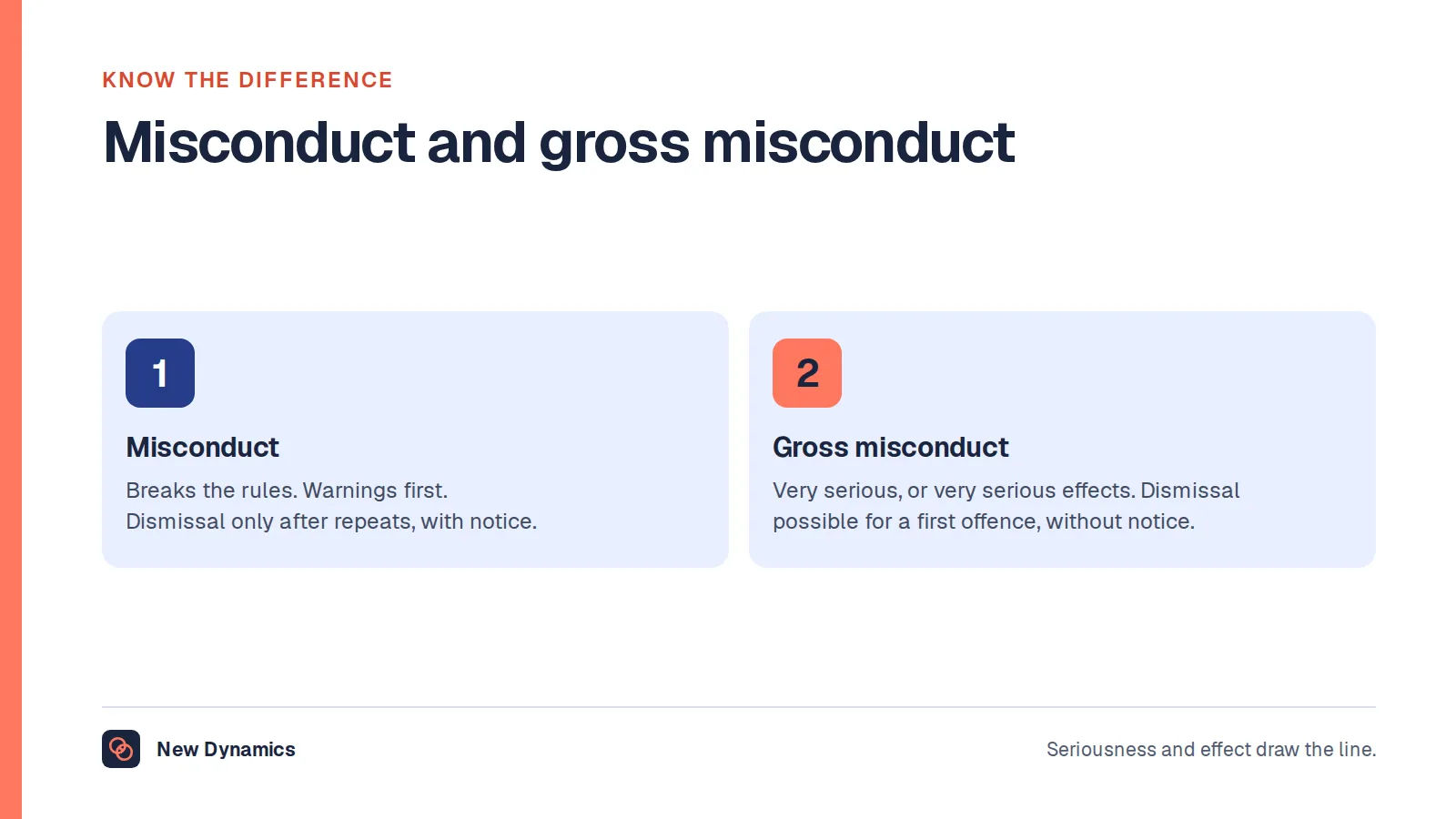
Misconduct is a spectrum, not a switch. The Acas Code of Practice on disciplinary and grievance procedures marks only the top of it, saying in the Code itself that some acts, “termed gross misconduct, are so serious in themselves or have such serious consequences that they may call for dismissal without notice for a first offence”.
Everything else is ordinary misconduct, and the Code's answer to it is a warning rather than a dismissal: “Where misconduct is confirmed or the employee is found to be performing unsatisfactorily it is usual to give the employee a written warning.”
Between those two sits a middle rung that policies rarely name. GOV.UK calls it serious misconduct, and describes the shortcut it allows: “You can issue a single ‘first and final’ written warning if the misconduct or underperformance is serious enough.” The test is about consequences rather than labels: “‘Serious enough’ includes if it's likely to or has caused serious harm to the organisation itself.” The Code agrees, saying a move “directly to a final written warning” may be appropriate where “the employee's actions have had, or are liable to have, a serious or harmful impact on the organisation”.
Three bands, then, with three normal outcomes. Ordinary misconduct, answered with a first written warning. Serious misconduct, which can skip a rung. Gross misconduct, which can end the contract without notice and is covered in full in our guide to gross misconduct.
The practical warning is this. Employers get into trouble far more often by pushing an ordinary case up a band than by misjudging a genuinely serious one. A policy that labels minor lateness gross misconduct has not given itself a stronger hand. It has given away the word it needs when something really does happen.
Types of misconduct at work
There is no official taxonomy of misconduct, and any list a post gives you is a prompt rather than an authority. What follows groups the examples Acas and GOV.UK actually publish into four families, because rules written family by family are easier to apply consistently than a long alphabetical list.

Attendance and timekeeping
GOV.UK's examples of the ordinary band are “persistent lateness or unauthorised absence from work”, and Acas lists “being absent without permission”. Note the word persistent. One late morning is a conversation. A pattern is a case, and the pattern only exists if somebody wrote it down.
Behaviour towards other people
Acas lists bullying and harassment as examples of misconduct. Both can also be very serious, which is why the Code suggests organisations “may wish to consider dealing with issues involving bullying, harassment or whistleblowing under a separate procedure”. Treat the conduct policy as the floor here, not the ceiling, and check whether a separate procedure or a legal duty applies first.
Instructions, policies and rules
Acas lists insubordination, with “refusing to do work” as its example. The ordinary version is the quiet workaround: the step skipped, the approval not sought, the process followed in theory and ignored in practice. Our post on the disciplinary procedure covers insubordination as a term in more detail, including why refusing an unlawful or unsafe instruction is not misconduct at all.
Care, property and honesty in small things
This family covers careless work, misuse of equipment or systems, and the minor untruths that are not fraud but are not nothing either. The Code's gross misconduct examples sit at the far end of it, including “theft or fraud” and “gross negligence”. The ordinary end is where most of it lives, and where the right response is usually a stated expectation and a date to review it.
Two cautions apply to all four families. A list in a policy is not a verdict, because the facts still have to be established. And a type is not a sanction: the family tells you which rule is in play, not what the outcome should be.
Conduct or capability: the distinction that decides the case
This is the section that matters most, and the one managers skip.
In Great Britain, the Employment Rights Act 1996 lists the reasons that can make a dismissal fair. Section 98 treats conduct and capability as two separate reasons. One “relates to the capability or qualifications of the employee for performing work of the kind which he was employed by the employer to do”. The other “relates to the conduct of the employee”.
The Act then defines capability, more broadly than most managers expect. Capability “means his capability assessed by reference to skill, aptitude, health or any other physical or mental quality”. Skill. Aptitude. Health. Any other physical or mental quality. If the real cause is any of those four, you are not in a conduct case, whatever the letter says.
GOV.UK puts the same distinction in one line each. An employer can dismiss someone if “they're incapable of doing their job to the required standard”, if “they're capable, but unwilling to do their job properly”, or if “they've committed some form of misconduct”.
So the question that sorts conduct from capability is short. Will not, or cannot?
- Will not is conduct. The person could meet the standard and chose not to. The remedy is a stated expectation, a consequence and a record.
- Cannot is capability. The person is trying and falling short. The remedy is support, training, time and a review date. Acas lists mentoring, coaching and training, and says employers “should try these things first before starting a formal disciplinary procedure”.

Why does mislabelling wreck a case? Because the fairness test is applied to the reason the employer actually relied on. Issue a conduct warning for what is in substance a skills gap and three things follow. The warning asks for a change the employee cannot make, so it will be breached. No support was offered, because conduct procedures do not require any. And at the end of the ladder the employer dismisses for conduct on evidence that describes capability, which is the gap an employee's representative walks straight through.
Health makes this sharper still. GOV.UK advises that “if a capability issue is linked to someone's health, you should try as many ways as possible to help them do their job before dismissing them”. Where a health condition is involved there may also be duties under equality law that sit outside the conduct policy entirely. Take advice before treating that kind of case as misconduct.
Acas allows both routes. Some employers use a separate capability procedure rather than a disciplinary one, and the Code accepts this so long as “the basic principles of fairness set out in this Code should still be followed”, adapted as necessary. Our post on disciplinary action sets out the six possible outcomes of either route, and what a written warning has to say.
What belongs in a conduct policy
A conduct policy does one job: it tells people in advance what is expected and what happens if they fall short. UK guidance is specific about the content.
GOV.UK's guide to taking disciplinary action against an employee sets the baseline: “You should have written disciplinary rules and procedures to deal with employee performance and conduct and you must tell your staff about them.” Then comes the sentence most policies fail: “Your rules must say what is acceptable and unacceptable behaviour in the workplace and what action you will take if the rules are broken.”
Two halves. What is unacceptable, and what you will do about it. A policy with the first half and not the second leaves every manager to invent the consequence, which is how inconsistency starts.
GOV.UK adds a requirement on the examples themselves: “You should include examples of what you consider to be misconduct in your disciplinary rules.” The Code says the same for the top band, asking that “disciplinary rules should give examples of acts which the employer regards as acts of gross misconduct”, and noting those “may vary according to the nature of the organisation and what it does”.
The Code then sets the standard for how the whole thing is written. Rules and procedures “should be set down in writing, be specific and clear”. Employees “and, where appropriate, their representatives should be involved in the development of rules and procedures”. And a point forgotten the moment a policy is approved: “It is also important to help employees and managers understand what the rules and procedures are, where they can be found and how they are to be used.”
There is a statutory floor underneath all of this. Section 3 of the Employment Rights Act 1996 requires the written statement of employment particulars to include a note “specifying any disciplinary rules applicable to” the worker, or referring them to a document setting out those rules that is “reasonably accessible”. The note must also name a person the worker can apply to if they are dissatisfied with a disciplinary decision. A conduct policy that cannot be found by the people it governs does not satisfy that.
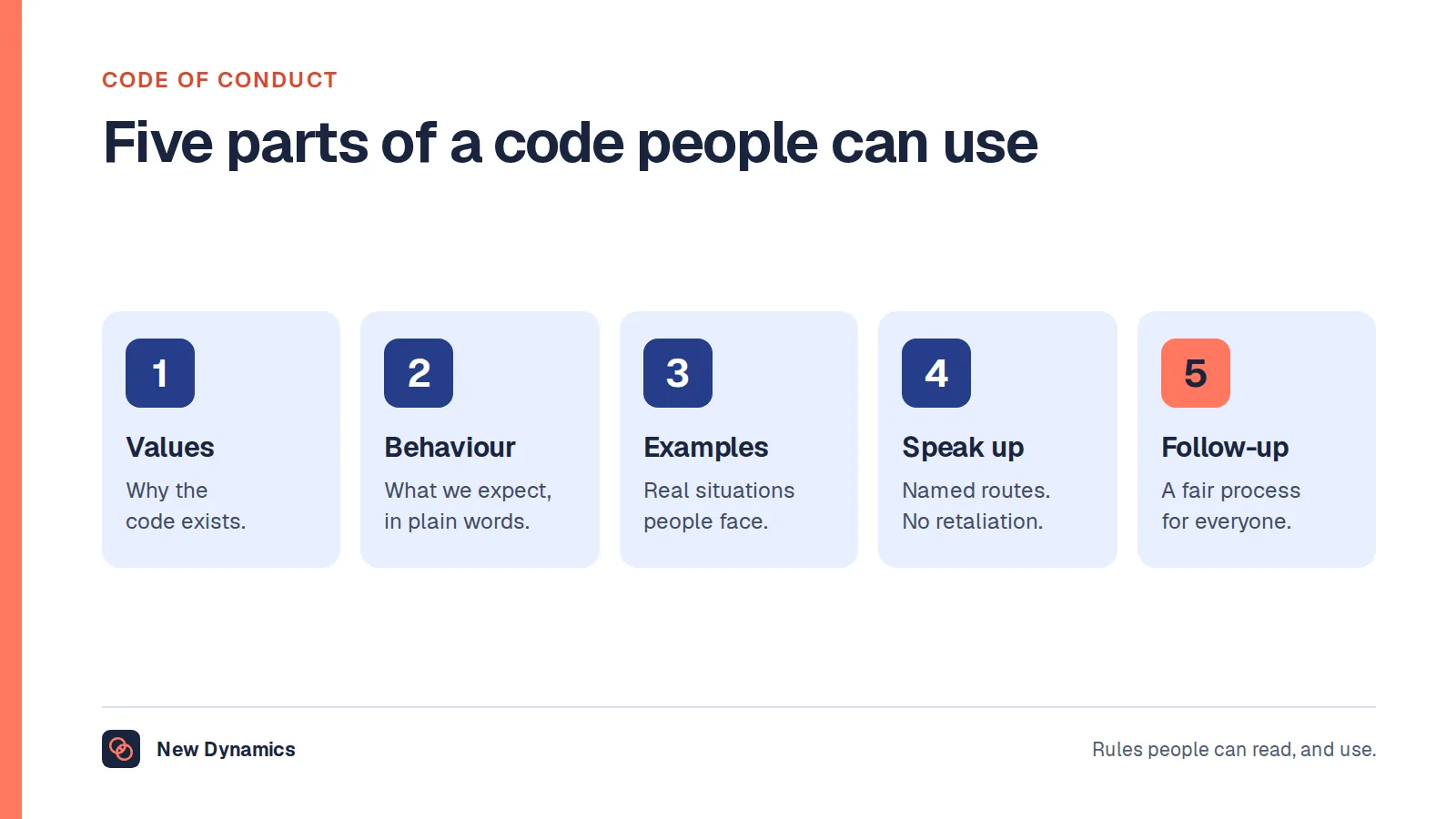
So a usable conduct policy contains, at a minimum: the standards expected, in plain language; examples of what the organisation treats as misconduct and as gross misconduct; the outcomes available and who can decide each one; how long each level of warning stays in place; who investigates, who decides and who hears appeals; and where to find the document. Our code of conduct examples show how to word the standards themselves.
The warning ladder, and how long a warning lives
The ladder for ordinary misconduct is set out in the Acas Code, and GOV.UK describes the same sequence as a series of meetings.
The Code's version runs in three sentences. First: “Where misconduct is confirmed or the employee is found to be performing unsatisfactorily it is usual to give the employee a written warning.” Then: “A further act of misconduct or failure to improve performance within a set period would normally result in a final written warning.” And the shortcut: “If an employee's first misconduct or unsatisfactory performance is sufficiently serious, it may be appropriate to move directly to a final written warning.”
GOV.UK turns that into three meetings for misconduct that is not serious or gross. At the first, the employer gives the employee a chance to explain and issues a first written warning if it is not satisfied with their reasons, telling them “how you expect them to improve and over what period”. At the second, held if behaviour has not improved by the deadline, a final written warning can follow, with the action plan revised. At the third, the employer warns that dismissal is now possible, and afterwards decides “whether to give the employee a further chance to improve, or dismiss them”. GOV.UK adds: “You must tell the employee of your final decision, whatever it is.”
Acas describes the same loop from the other end. “If the employee's conduct or performance has not improved in the timeframe set, the employer should repeat the disciplinary procedure.” It should keep repeating it until either improvements are made or “dismissal is the only fair and reasonable option”.

How long warnings last
This is the question employers get wrong most often, and the answer is not a number.
The Code does not set a duration. It sets a duty to state one: “The employee should be told how long the warning will remain current.” It also requires the warning to set out “the nature of the misconduct or poor performance and the change in behaviour or improvement in performance required (with timescale)”, and the employee to be told the consequences of further misconduct “within the set period following a final warning”.
So the lifespan of a warning comes from the organisation's own policy and the letter itself, not from legislation. Three consequences follow.
- State the period in the letter, every time. A warning with no end date is not a warning. It is an open file.
- Do not rely on an expired warning. If the policy says a first written warning is current for twelve months, a case in month fourteen starts at the bottom of the ladder again, however frustrating that feels.
- Keep the record, but stop using it. The Code advises that employers “would be well advised to keep a written record of any disciplinary or grievances cases they deal with”. How long to keep it is a data protection question, covered in our post on the disciplinary procedure.
Acas asks for a note even where nothing formal happens. Where the issue “was found to be small and not serious”, the employer might just have an informal talk, but “should still keep a confidential written record of informal or verbal warnings for future reference”. That record is the difference between an isolated incident and a pattern you can demonstrate.
A pattern or a single incident?
Ordinary misconduct is mostly about patterns, and the guidance says so.
GOV.UK is explicit that a one-off usually does not need the formal machinery: “An informal discussion may be enough to resolve the issue if the misconduct or underperformance was a one-off and the employee has a good disciplinary record.” Acas agrees, advising employers to “first see whether the problem can be resolved in an informal way”, because “this can often be the quickest and easiest solution”.
That changes what a manager has to collect. For a single incident, the question is what happened and how serious it was. For a pattern, it is a different question: what was said the last three times, what was agreed, and what has changed since. If the answer to all three is nothing on paper, the pattern exists only in the manager's head, and the first formal step will look like an ambush.
Two habits fix most of this.
- Write the short note on the day. Three lines: what happened, what was said, what was agreed. Acas asks for exactly this record for informal warnings.
- Name the standard out loud. If the expectation has never been stated, the first conversation states it rather than sanctioning the breach of it.
Consistency is where patterns and single incidents meet. The Code's fairness requirements include four blunt words: “Employers and employees should act consistently.” Two people doing the same thing in the same month should not end up on different rungs for reasons nobody can explain.
Conduct outside work, and when it is the employer's business
Behaviour away from the workplace can be misconduct, but not automatically, and the test is the effect on the business rather than the employer's disapproval.
Acas says an employee “could face disciplinary action for misconduct outside work”, giving the example of behaviour in front of external clients at the work Christmas party that “reflects badly on the company”. It sets the test: “It depends on how serious the misconduct is and whether it could affect business.” And it puts the burden on the employer: “It's important the employer carries out a thorough investigation and can show the effect on the business.”
That last sentence is the one to hold on to. Outside-work cases turn on evidence of effect. If the employer cannot describe the effect on customers, colleagues, safety or the organisation's standing, it has an opinion rather than a case.
Criminal matters are treated more cautiously still. The Code says: “If an employee is charged with, or convicted of a criminal offence this is not normally in itself reason for disciplinary action.” What matters instead is the employment consequence: “Consideration needs to be given to what effect the charge or conviction has on the employee's suitability to do the job and their relationship with their employer, work colleagues and customers.”
So a charge is not a finding, and a conviction is not a dismissal. The employer's question is never whether the courts will convict, but whether the person can still do this job, with these colleagues, for these customers.
Social media and out-of-hours messaging sit in the same place. The analysis does not change: how serious, what effect on the business, what the investigation can show.
What fairness requires at each step
Even a clearly proved case of misconduct can produce an unfair dismissal. The reason and the process are judged separately.
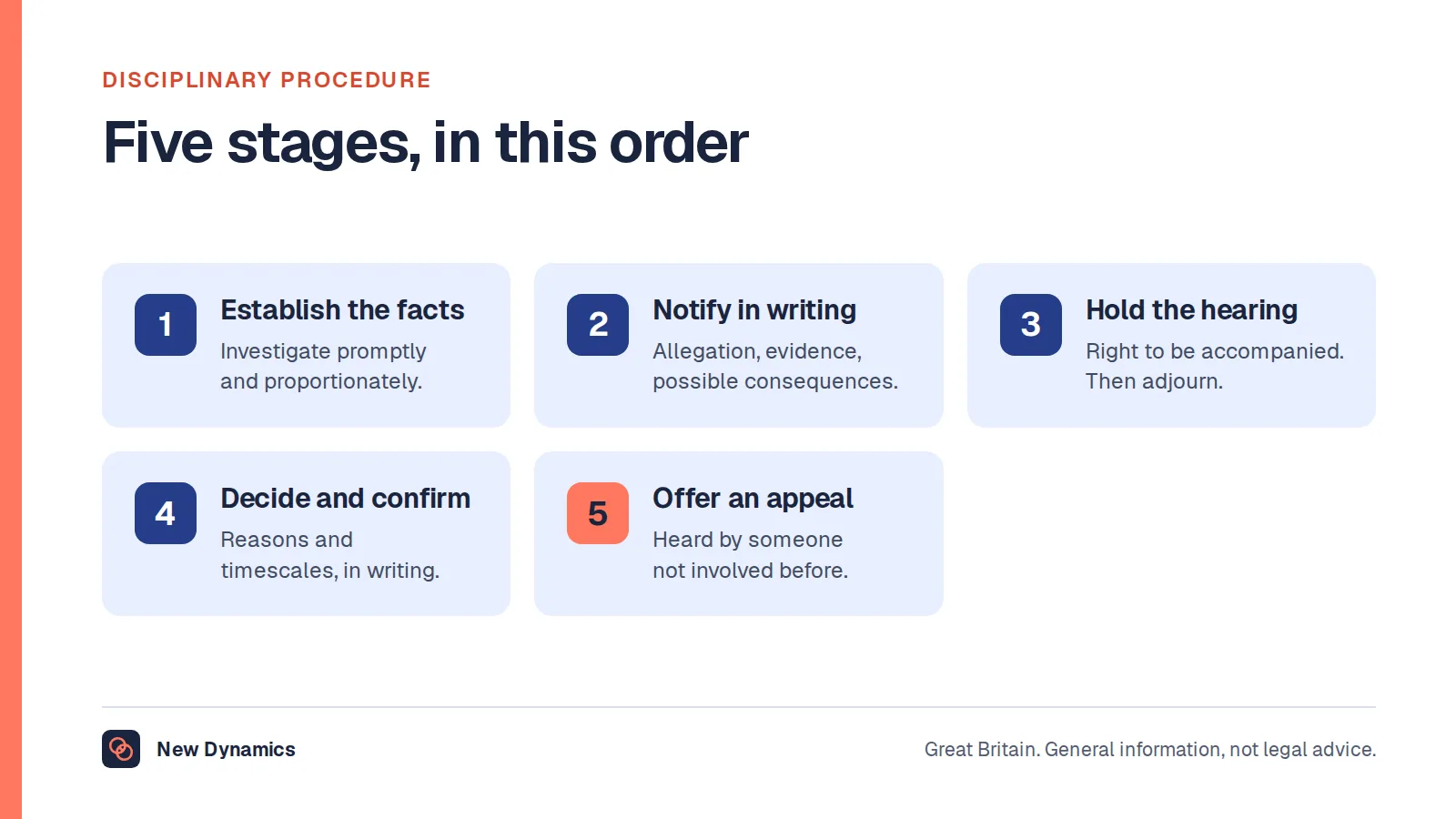
GOV.UK's guide to fair dismissals puts it in one sentence: “Even if you have a fair reason, the dismissal is only fair if you also act reasonably during the dismissal and disciplinary process.” It concedes that reasonableness has no fixed meaning, saying “There's no legal definition of ‘reasonableness’”, and lists what a tribunal would consider: whether the employer genuinely believed the reason was fair, carried out proper investigations where appropriate, followed the relevant procedures, told the employee why they were being considered for dismissal and listened to their views, allowed them to be accompanied, and gave them the chance to appeal.
One item in that list is a direct Northern Ireland difference, and GOV.UK flags it in the text itself: on telling the employee why they were being considered for dismissal and listening to their views, it notes “in Northern Ireland, the employer must do this in writing”. Northern Ireland also has its own legislation rather than the Employment Rights Act 1996: the equivalent of section 98 is article 130 of the Employment Rights (Northern Ireland) Order 1996, which lists conduct and capability in the same terms. Employers in Northern Ireland should work from Northern Ireland guidance and take local advice.
One more sentence in that passage applies squarely to ordinary misconduct: “Reasonableness might also depend on whether the employee could be expected to understand the consequences of their behaviour.” That is the argument for stating the standard and the consequence in writing before anything formal starts.
The statute adds two qualifiers. Section 98 asks whether the employer “acted reasonably or unreasonably in treating it as a sufficient reason for dismissing the employee”, taking into account “the size and administrative resources of the employer's undertaking”, and says the question “shall be determined in accordance with equity and the substantial merits of the case”. The Code echoes the first point, noting that it “may sometimes not be practicable for all employers to take all of the steps set out in this Code”. A small employer is not held to a large employer's HR function. It is held to fairness.
None of this is cost-free when it goes wrong. The Ministry of Justice's Tribunal Statistics Quarterly for April to June 2026 reports that “There were 70,000 single claim cases in the open caseload at the end of June”, covering the quarter from April to June 2026. A case joining that queue is measured in many months, whichever side is right. The wider picture is in our hr statistics hub and our post on employee relations statistics.
Again, and deliberately: this is general information about the position in Great Britain, not legal advice on any particular case. Take advice before dismissing anyone.
Where employers get ordinary misconduct wrong
- Calling capability a conduct problem. The most expensive mistake available, for the reasons set out above.
- A standard nobody stated. You cannot sanction a breach of an expectation that lived only in a manager's head.
- A warning with no end date. The employee cannot put it behind them and the employer cannot rely on it.
- Relying on an expired warning. If the policy says it lapsed, it lapsed.
- No note on the day. Three undocumented conversations are, in evidence, zero conversations.
- Jumping a band. Ordinary misconduct labelled gross because the manager is angry, not because the consequences were serious.
- Inconsistency. The same behaviour treated two ways in one team, for no explicable reason.
- No support where the cause was health or skill. GOV.UK asks employers to try as many ways as possible to help first.
- Deciding before the meeting. Our post on workplace investigations covers establishing the facts first.
- Treating suspension as a default. The Code wants it considered, kept brief and reviewed. See suspension from work.
Frequently asked questions
What is misconduct in the workplace?
Acas defines misconduct as unacceptable or inappropriate behaviour, and says misconduct is when an employee's inappropriate behaviour or action breaks the organisation's rules. GOV.UK gives persistent lateness and unauthorised absence from work as examples. There has to be a rule and there has to be behaviour that breaks it, so the organisation's own policy supplies most of the content.
What are the types of misconduct at work?
There is no official list. The published examples group into four families: attendance and timekeeping, such as lateness and unauthorised absence; behaviour towards other people, such as bullying and harassment; instructions, policies and rules, such as refusing to do work; and care, property and honesty, such as careless work or misuse of equipment. Each organisation adds its own examples.
What is the difference between misconduct and capability?
Conduct is about choice and capability is about ability. The Employment Rights Act 1996 treats them as separate fair reasons for dismissal in Great Britain, and defines capability as capability assessed by reference to skill, aptitude, health or any other physical or mental quality. GOV.UK distinguishes someone who is incapable of doing the job to the required standard from someone who is capable but unwilling. The test is whether the person will not, or cannot.
How long does a written warning last?
There is no statutory period. The Acas Code requires only that the employee be told how long the warning will remain current, so the duration comes from the organisation's policy and the warning letter. Many policies set six or twelve months for a first written warning and longer for a final one. An expired warning should not be relied on in a later case.
Can you be disciplined for something you did outside work?
Yes, in some circumstances. Acas says an employee could face disciplinary action for misconduct outside work, giving behaviour in front of external clients at a work party that reflects badly on the company as an example. It depends on how serious the misconduct is and whether it could affect business, and the employer has to investigate thoroughly and be able to show the effect on the business.
Does a single incident count as misconduct?
It can, but the usual response is informal. GOV.UK says an informal discussion may be enough if the misconduct or underperformance was a one-off and the employee has a good disciplinary record. Acas also asks employers to see whether the problem can be resolved informally first. Formal action is normally for a repeated pattern or for conduct serious enough in itself.
Your next step: read your own conduct policy
- Find your disciplinary rules and check an employee could find them too. The written statement has to specify them or point to a reasonably accessible document.
- Check the rules say both halves: what is unacceptable, and what action you will take.
- Check every level of warning has a stated duration, and that nobody is relying on an expired one.
- Pick one open case and answer one question: will not, or cannot? If the answer is cannot, move it to support and a plan.
- Name, in advance, who investigates, who decides and who hears appeals.
To get your conduct rules, procedures and standards into one document people actually read, read and download our employee handbook guide. The guide is free to read, and the PDF uses our short download form.
Want expectations, examples and agreed next steps recorded through the year, so the ordinary band never becomes a formal case? Book a New Dynamics demo and bring your current approach. You can also email contact@new-dynamics.com.