TL;DR
- A disregarded entity is a business the IRS treats as not separate from its single owner for income tax. Form 8832 defines it as "an eligible entity that is treated as an entity not separate from its single owner for income tax purposes". The commonest example is a single member LLC that has not elected to be taxed as a corporation.
- It is not disregarded for payroll. The IRS states that a single member LLC disregarded for income tax "is treated as a separate entity for purposes of employment tax and certain excise taxes", and that for wages paid after 1 January 2009 it "is required to use its name and employer identification number (EIN) for reporting and payment of employment taxes".
- That split is the error to look for. A W-9 for a disregarded entity carries the owner's number, while the employment tax return carries the LLC's own EIN. Add a second member and the default flips to partnership. Jurisdiction: United States. General information, not legal or tax advice.
A single member LLC with four people on payroll gets told by somebody in finance that it is a "disregarded entity", a term from United States federal tax law. The phrase does its damage at once. The next employment tax return goes in under the owner's Social Security number, because the entity is supposedly invisible. Then the deposits sit against the wrong taxpayer, the wage statements do not reconcile, and a year of filings has to be unpicked.
Jurisdiction: United States. "Disregarded entity" is a classification used by the Internal Revenue Service. It describes how an entity is taxed, not what it is under state law, and the word is narrower than it sounds. It applies to income tax. It does not apply to payroll.
Entity setup and payroll registration are a sequence of dated tasks with owners. See how New Dynamics workflows keep each step visible rather than living in one person's inbox.
This is general information, not legal or tax advice. Every quotation comes from the IRS page or form that publishes it, read on 6 November 2026, with its review date or revision named.
What a disregarded entity is

The cleanest definition sits in the instructions printed on Form 8832, Entity Classification Election, revision 12-2013, which the IRS About Form 8832 page, last reviewed on 20 October 2026, lists as the current revision with no recent developments.
"A disregarded entity is an eligible entity that is treated as an entity not separate from its single owner for income tax purposes."
The last four words carry the subject. The entity exists: it was formed under state law, it has a name, and it can employ people. The classification only decides whose income tax return its profit lands on, and the answer is the owner's.
The same note names the exceptions in the next breath. A disregarded entity "is treated as separate from its owner for: Employment tax purposes, effective for wages paid on or after January 1, 2009; and Excise taxes reported on Forms 720, 730, 2290, 11-C, or 8849, effective for excise taxes reported and paid after December 31, 2007."
So the word describes one tax, with two carve-outs. What goes wrong in practice comes from reading it as a statement about all taxes.
The commonest example: a single member LLC that has not elected otherwise
The IRS page on single member limited liability companies, last reviewed on 27 July 2026, states the default: "For income tax purposes, an LLC with only one member is treated as an entity disregarded as separate from its owner, unless it files Form 8832 and affirmatively elects to be treated as a corporation."
Most disregarded entities therefore became disregarded by doing nothing. Form 8832 puts the domestic default rule in two lines: a domestic eligible entity is "A partnership if it has two or more members" and "Disregarded as an entity separate from its owner if it has a single owner". The instructions add that "A new eligible entity should not file Form 8832 if it will be using its default classification."
A one-member LLC that filed nothing is therefore a disregarded entity. Nobody chose the label, and usually nobody writes it down until a bank form, a Form W-9 or a payroll provider asks.
Disregarded for income tax, separate for employment tax
This is the part that matters to an HR or payroll reader, and the IRS makes it twice on the same page.
In the opening summary: "However, for purposes of employment tax and certain excise taxes, an LLC with only one member is still considered a separate entity."
And in full: "A single-member LLC that is classified as a disregarded entity for income tax purposes is treated as a separate entity for purposes of employment tax and certain excise taxes. For wages paid after January 1, 2009, the single-member LLC is required to use its name and employer identification number (EIN) for reporting and payment of employment taxes."
The dates come from final regulations issued in August 2007 (T.D. 9356), which required "disregarded LLCs to be treated as the taxpayer for certain excise taxes accruing on or after January 1, 2008 and employment taxes accruing on or after January 1, 2009", while such LLCs "will continue to be disregarded for other federal tax purposes".
For payroll, then, the entity is the taxpayer. It employs its own staff and it reports and pays employment taxes in its own name, under its own EIN. Treating it as though it did not exist for payroll files the right money against the wrong taxpayer.
Which number goes on which form

A disregarded entity with employees uses two identifying numbers for two purposes.
For income tax reporting, the owner's number. A disregarded single member LLC "generally must use the owner's social security number (SSN) or employer identification number (EIN) for all information returns and reporting related to income tax". The example the IRS gives is the one people get wrong: where such an LLC owned by an individual has to provide a Form W-9, "the W-9 should provide the owner's SSN or EIN, not the LLC's EIN."
For employment and excise tax, the entity's own number: "the EIN of the LLC must be used. An LLC will need an EIN if it has any employees".
An entity with no employees and no excise tax liability "does not need an EIN" and uses "the name and TIN of the single member owner". Hiring changes that. The IRS do you need a new EIN page, last reviewed on 21 July 2026, says to get a new EIN if you "Own a single-member LLC and have to file excise or employment taxes."
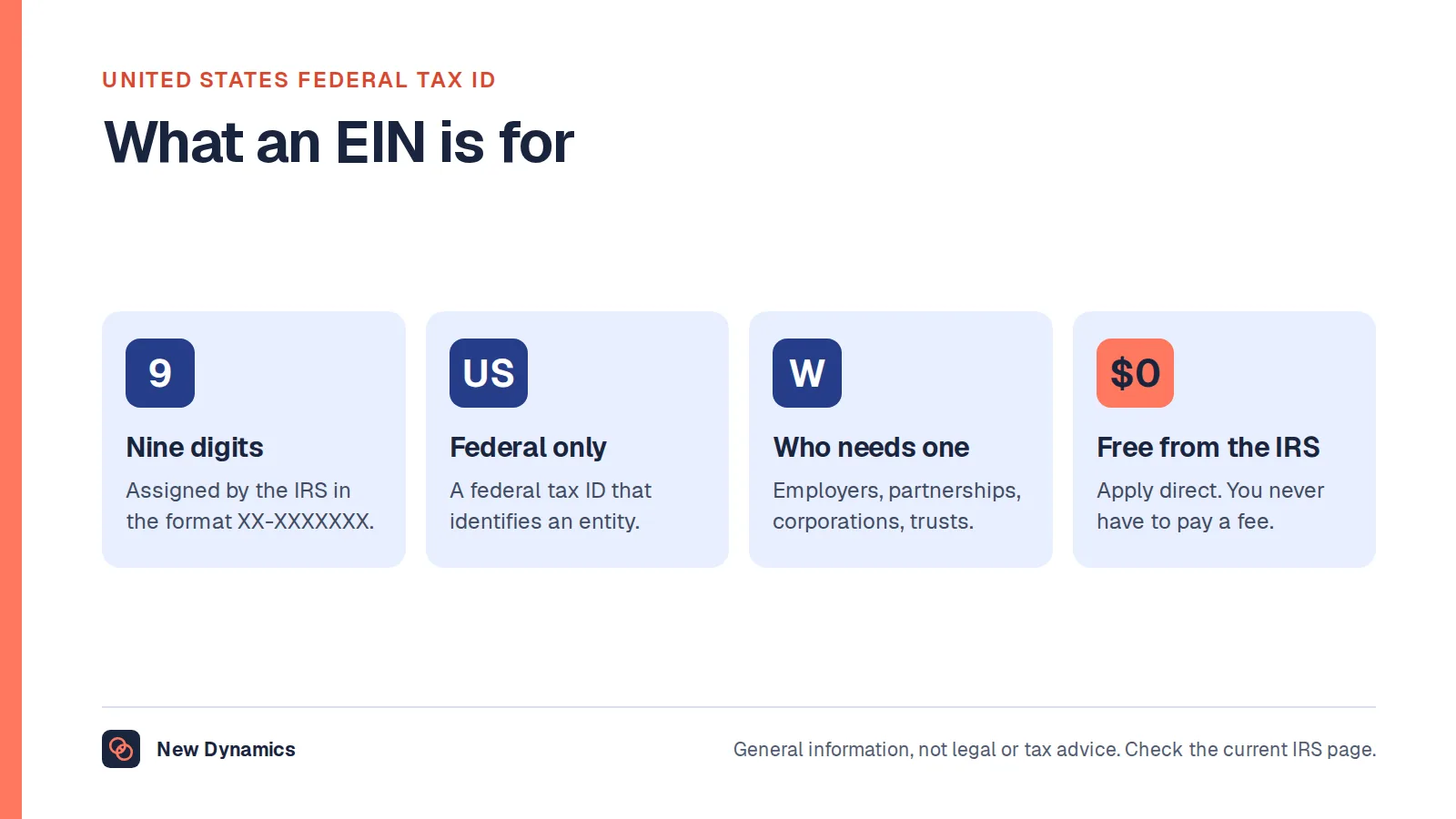
How the number is issued and evidenced is covered in our post on the employer identification number. The question here is whose number belongs on which return.
What the owner reports, and where
If the entity is disregarded, its activity appears on the owner's return. Where the owner is an individual, the IRS names the destinations: Form 1040 or 1040-SR Schedule C, Profit or Loss from Business (Sole Proprietorship), Schedule E for supplemental income and loss, or Schedule F for farming. Self employment tax follows, because the owner "is subject to the tax on net earnings from self employment in the same manner as a sole proprietorship".
That is why the owner is not on the entity's payroll. The owner's earnings are not wages. The employees' pay is, reported by the entity under the entity's EIN. Our post on Form W-2 covers the statement each employee receives, and IRS information returns the wider family of filings that carry a taxpayer number.
Where the single member is itself a company, the LLC "should be reflected on its owner's federal tax return as a division of the corporation or partnership". A division for income tax, and still a separate employer for payroll.
Form 8832, and electing to be classified otherwise
A disregarded entity is a default, not a sentence. The About Form 8832 page gives three choices: "An eligible entity uses Form 8832 to elect how it will be classified for federal tax purposes, as: A corporation. A partnership. An entity disregarded as separate from its owner."
Three details from the instructions decide whether an election is worth making.
- Timing. An election "cannot take effect more than 75 days prior to the date the election is filed, nor can it take effect later than 12 months after the date the election is filed". A date outside that window is pulled back to the limit rather than rejected.
- The 60 month lock. An entity that elects to change its classification "generally cannot change its classification by election again during the 60 months after the effective date of the election", though that does not apply where "the previous election was made by a newly formed eligible entity and was effective on the date of formation".
- The EIN does not change. "Any entity that has an EIN will retain that EIN even if its federal tax classification changes under Regulations section 301.7701-3." And the form cannot be processed without one, because "An election will not be accepted if the eligible entity does not provide an EIN."
Electing corporate treatment ends the disregarded status for income tax. It changes nothing about who the employer is for payroll, because the entity was already the employer there.
What happens when a second member is added

This is the quiet one. Nobody files anything and the classification changes anyway. Form 8832 says it in one sentence: "an eligible entity classified as a partnership will become a disregarded entity when the entity's membership is reduced to one member and a disregarded entity will be classified as a partnership when the entity has more than one member."
Admitting a second member therefore turns a disregarded entity into a partnership for federal income tax by default, unless Form 8832 is filed to elect corporate treatment. The IRS page on LLC filing as a corporation or partnership, last reviewed on 22 August 2026, gives the consequence: the LLC "should file a Form 1065, U.S. Return of Partnership Income."
The number follows the same pattern. Where "a disregarded entity's classification changes so that it becomes recognized as a partnership or association for federal tax purposes", and the entity had an EIN, "the entity must continue to use that EIN. If the entity did not already have its own EIN, then the entity must apply for an EIN and not use the identifying number of the single owner."
A married couple is the exception to watch. Under Revenue Procedure 2002-69, where a qualified entity "solely owned by husband and wife as community property under laws of a state" is treated as disregarded, the IRS "will accept the position that the entity is disregarded for federal tax purposes". Outside a community property state, the same page notes, "the LLC should file as a partnership".
Frequently asked questions
What is a disregarded entity?
It is a business entity the IRS treats as not separate from its single owner for income tax. Form 8832 defines it as "an eligible entity that is treated as an entity not separate from its single owner for income tax purposes". It still exists under state law and can employ people.
Is a single member LLC a disregarded entity?
By default, yes. The IRS says that "an LLC with only one member is treated as an entity disregarded as separate from its owner, unless it files Form 8832 and affirmatively elects to be treated as a corporation." No filing is needed to get that treatment, because it is the default.
Does a disregarded entity need its own EIN for payroll?
Yes, once it has employees. The IRS states that a single member LLC disregarded for income tax "is treated as a separate entity for purposes of employment tax and certain excise taxes", and that for wages paid after 1 January 2009 it "is required to use its name and employer identification number (EIN) for reporting and payment of employment taxes". Running payroll under the owner's number credits the deposits to the wrong taxpayer.
How is a disregarded entity taxed?
Its activity goes on the owner's federal return: for an individual owner, generally Form 1040 or 1040-SR Schedule C, Schedule E or Schedule F. The owner "is subject to the tax on net earnings from self employment in the same manner as a sole proprietorship". Where the owner is a company, the entity is reflected on the owner's return "as a division of the corporation or partnership".
Which number goes on a Form W-9 for a disregarded entity?
The owner's. Where a disregarded entity LLC owned by an individual has to provide a Form W-9, the IRS says "the W-9 should provide the owner's SSN or EIN, not the LLC's EIN". That is the opposite of the employment tax rule, which is why the two get mixed up.
What happens if a disregarded entity takes on a second member?
Its default classification changes. Form 8832 states that "a disregarded entity will be classified as a partnership when the entity has more than one member", so a Form 1065 partnership return becomes due unless corporate treatment is elected. If the entity already had an EIN it keeps it. If not, it must apply for one rather than use the single owner's number.
Your next step: match the payroll EIN to the entity that employs the people
Jurisdiction: United States. General information, not legal or tax advice.
- Find the EIN the payroll files under, and confirm it is the employing entity's own number and name, not the owner's.
- Reconcile it against the wage statements for the same period. The error shows up as a mismatch long before anyone calls it a classification problem.
- Keep the Form W-9 answer separate from the payroll answer. Two numbers, two purposes, both correct at once.
- Treat an ownership change as a tax event. A second member joining changes the default classification even though nobody filed anything.
- Take tax advice before electing. The 60 month limitation makes a Form 8832 election hard to reverse.
For the policy groundwork behind pay, employment terms and who sits on which payroll, read and download our compensation policy guide. The guide is free to read, and the PDF uses our short download form.
Want every registration, filing and ownership change to carry an owner, a due date and a visible status? Book a New Dynamics demo and bring your current entity list. You can also email contact@new-dynamics.com.