TL;DR
- Most engagement programmes are a survey plus some events. They fail because nothing visible changes between one survey and the next, so the next round gets fewer and angrier answers.
- Five components make a programme: a measure that stays the same, ownership by the line manager rather than central HR, a short list of things that will change, visible follow-through, and recognition of the work people actually do.
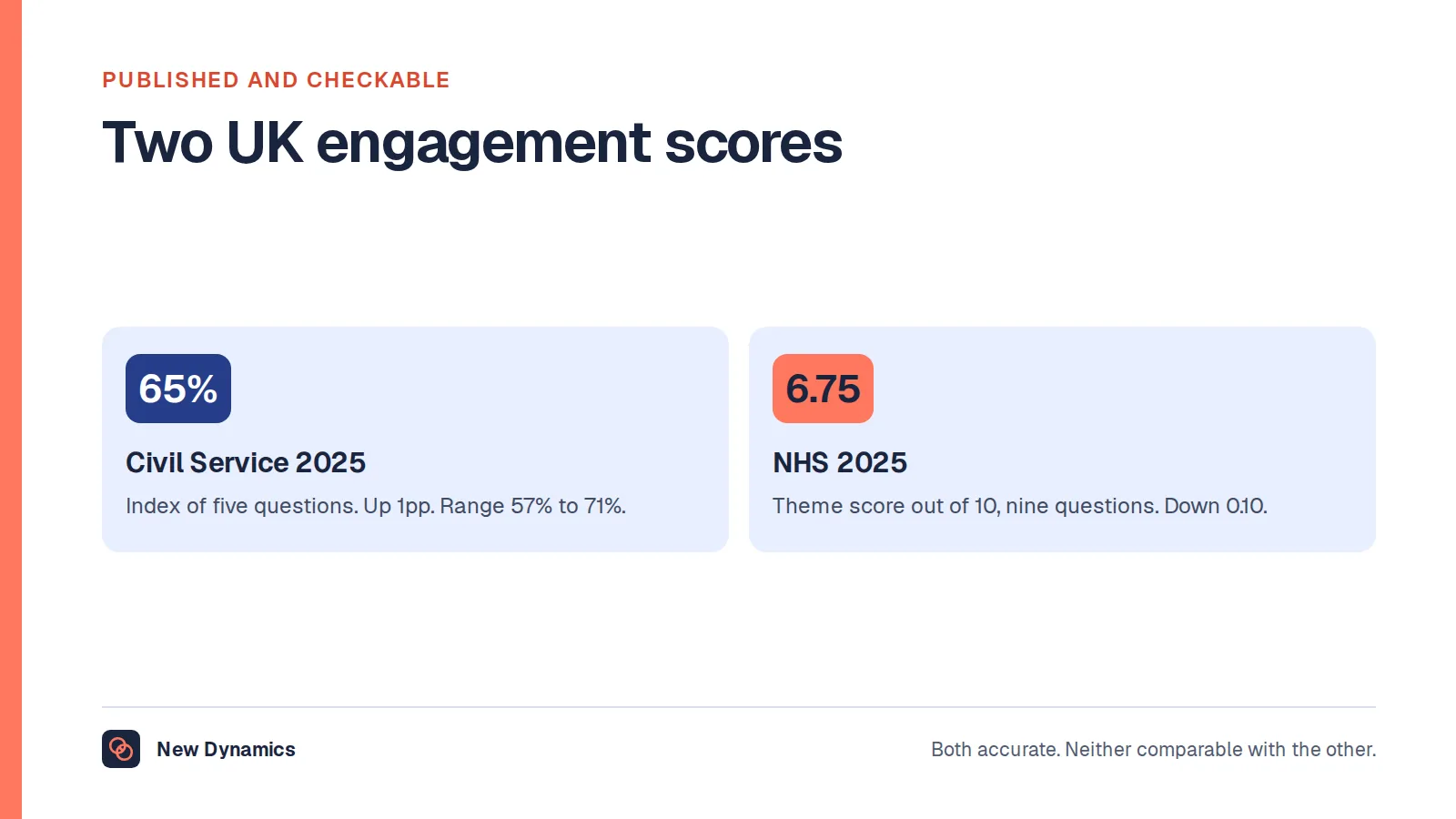
- Two engagement models are published and checkable. The Civil Service engagement index was 65% in 2025, built from five questions. The NHS Staff Engagement theme score was 6.75 out of 10 in 2025. A vendor's own model is a vocabulary, not evidence.
Most engagement programmes are a survey and some events. A questionnaire in the autumn, a set of slides in the winter, a fruit bowl, a quiz night, a wellbeing week. Then another survey, and a quiet surprise when the score has not moved.
The reason is not the survey. It is the gap between surveys, where nothing visible changes. This article covers what a real employee engagement programme contains, who owns it, what happens each quarter, and what to do when a third of your workforce has no work email address.
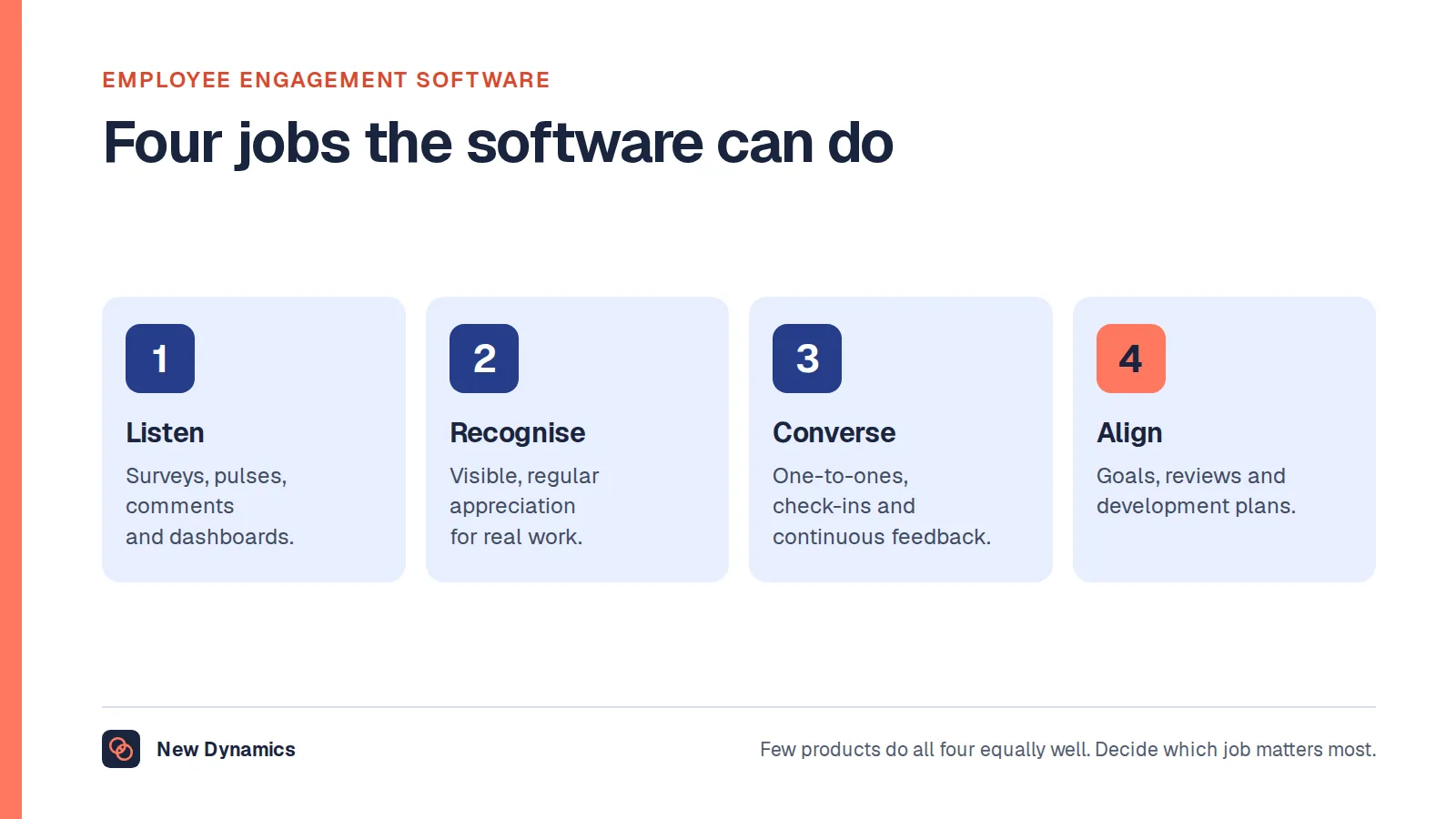
Engagement work lives or dies in everyday conversations rather than in the annual questionnaire, which is why New Dynamics continuous feedback is where most of our customers start.
Three related articles cover ground this one deliberately does not repeat. If you are writing the questionnaire, see workplace engagement survey for 40 sample questions and the design rules. If someone has asked whether your score is good, see employee engagement benchmarks for the two published UK scores and why they do not compare. If you are choosing a tool, see our employee engagement software buyer's guide.
Why engagement programmes fail
The failure is predictable and it has a shape.
An organisation runs a survey. The results come back three months later as a deck. Two of the lowest-scoring themes become a corporate action plan with eleven workstreams, owned by a working group that meets monthly. Nothing reaches the person who answered the questions. Eleven months later they are asked again.
That person draws the only reasonable conclusion: answering is a waste of their time. The response rate falls. The people who stop answering are rarely the contented ones, so the score can rise while the organisation gets worse.
Events do not fix this, because events are not what people were complaining about. Nobody scored their workload at two out of five because there was no quiz night. The list of complaints is usually unglamorous: a rota published too late to plan around, a piece of kit that has been broken for a year, a manager who cancels one-to-ones, a promotion decision nobody could explain.
A programme is the machinery that gets those things fixed and makes the fixing visible. Everything else is decoration.

The five components of an engagement programme
1. A measure that stays the same
Pick a small set of questions and freeze them. If the wording changes, the trend is gone, and the trend is the only comparison that is genuinely yours. Five to ten outcome questions, asked identically every year, surrounded by questions about working conditions that you can vary.
Freezing the measure is unpopular, because every new leader wants to redesign the survey. Write the frozen set into the programme document so that changing it is a decision rather than a drafting accident.
2. Local ownership, not central ownership
The single most common design fault is a programme owned by HR. HR can own the instrument, the timetable, the confidentiality rules and the reporting. HR cannot own the result, because almost everything that drives the result sits inside a team: the work, the rota, the kit, the manager.
So the unit of action is the team, and the owner of the action is the person who manages it. Central HR's job is to make that easy: results a manager can read without a stats degree, a one-page action template, a conversation guide, and someone to call when the numbers look bad.
3. A short list of things that will change
Two or three priorities per team. Not eleven. A team that tries to fix everything fixes nothing, and a list of eleven items is a way of avoiding the choice.
The test of a good priority is that a member of the team would notice if it happened. "Improve communication" fails the test. "Publish the rota three weeks ahead instead of ten days" passes it.
4. Visible follow-through
Follow-through has to be seen, not reported. The useful format is blunt: here is what you told us, here is what we changed, here is what we are not changing and why.
The second half matters more than the first. People accept a no with a reason. They do not accept silence, and they correctly read silence as a no with no reason. Acas, writing about consulting employees, lists among the benefits that it can "find better or alternative solutions that had not been thought of already" and "improve employee engagement and job satisfaction", and notes that consultation "is when an employer talks and listens about organisational issues and changes which affect employees or workers" (Acas, consulting employees and representatives). Talking and listening is the whole of it. A programme that only talks is a newsletter.
5. Recognition of the work people actually do
Recognition belongs in the programme because it is the cheapest component and the one most often spent on the wrong thing. Awards for heroics teach people that ordinary good work is invisible. Recognition that names a specific thing somebody did, soon after they did it, from someone who saw it, does the opposite.
Our employee recognition ideas cover the practical formats. The programme's only job here is to make recognition normal rather than ceremonial.
Engagement models: what they are for, and what they are not
An engagement model is two things: a shared vocabulary, so that everyone in your organisation means the same thing by engagement, and a set of drivers, so that you know what to ask about. That is genuinely useful. A team cannot discuss a score it cannot define.
What a model is not is evidence. A consultancy's proprietary model, with its own named drivers and its own index, is a product. It may be sensible and it may be well constructed, but you usually cannot see the questions, the weighting or the validation, and you cannot check its benchmark against anything. Treat an unpublished model as a vocabulary you are renting, and ask one question before you adopt it: can I read the questions and the method?
Two models pass that test, because both publish their questions, their construction and their results.
The Civil Service People Survey engagement index
The Civil Service People Survey publishes an engagement index built from five questions. The survey's own definition is that "employee engagement is a workplace approach designed to ensure that employees are committed to their organisation's goals and values, motivated to contribute to organisational success, and are able at the same time to enhance their own sense of well-being".
The index is described as "a summary of five questions in the survey (B47 to B51) relating to engagement which cover: how proud staff feel working for their organisation, whether they would recommend their organisation as a great place to work, whether they feel a strong personal attachment to it, and whether they feel their organisation inspires and motivates them to do the best in their job and achieve their organisation's objectives". The five statements measure pride, advocacy, attachment, inspiration and motivation, and the index is "a weighted average of the responses to the five employee engagement questions ... and ranges from 0% to 100%".
In the 2025 results, published on 28 May 2026, "the employee engagement index for the Civil Service was up compared to 2024 at 65%". Fieldwork "opened on 23 September 2025 and was closed on 21 October 2025", and "a total of 584,718 people were invited to take part in the 2025 survey and 343,961 participated, a response rate of 59%" (Civil Service People Survey 2025 results, GOV.UK).
That is a model worth copying in shape: five outcome questions that never change, reported as one index, surrounded by driver questions that can.
The NHS Staff Survey People Promise and theme scores
The NHS Staff Survey takes a different approach, and publishes it just as fully. Since 2021 its questions have been aligned to the NHS People Promise, "which sets out in the words of NHS staff the things that would most improve their working experience". Reporting is "designed to track progress against the seven People Promise elements, and against two theme scores reported in previous years".
The seven elements are: we are compassionate and inclusive, we are recognised and rewarded, we each have a voice that counts, we are safe and healthy, we are always learning, we work flexibly, and we are a team. The two themes are Staff Engagement and Morale. In total the published model runs to "7 People Promise elements and 2 themes", "21 sub-scores" and "85 questions", where "the score for each People Promise element and theme is based on between two and four sub-scores, with each sub-score calculated from the responses to between one and eight aligned questions".
Staff Engagement is built from three sub-scores: motivation, involvement and advocacy. In the 2025 results the theme score was 6.75 out of 10, against 6.85 in 2024, and the briefing states plainly that "the Staff Engagement score has decreased by 0.10 since 2024". The response rate was "49%", "down from 51% in 2024", from 766,285 staff (2025 NHS Staff Survey national results briefing, published March 2026).
Two details in that model are worth stealing. The first is that engagement is reported next to morale rather than instead of it, so a rise in enthusiasm cannot hide a rise in people thinking about leaving. The second is that every headline score decomposes into sub-scores and then into individual questions, so a manager looking at a bad number can get to the sentence that caused it.
For the published scores themselves, and the reasons they cannot be compared with each other or with yours, see our post on employee engagement benchmarks. Wider UK workforce figures sit on our HR statistics hub.
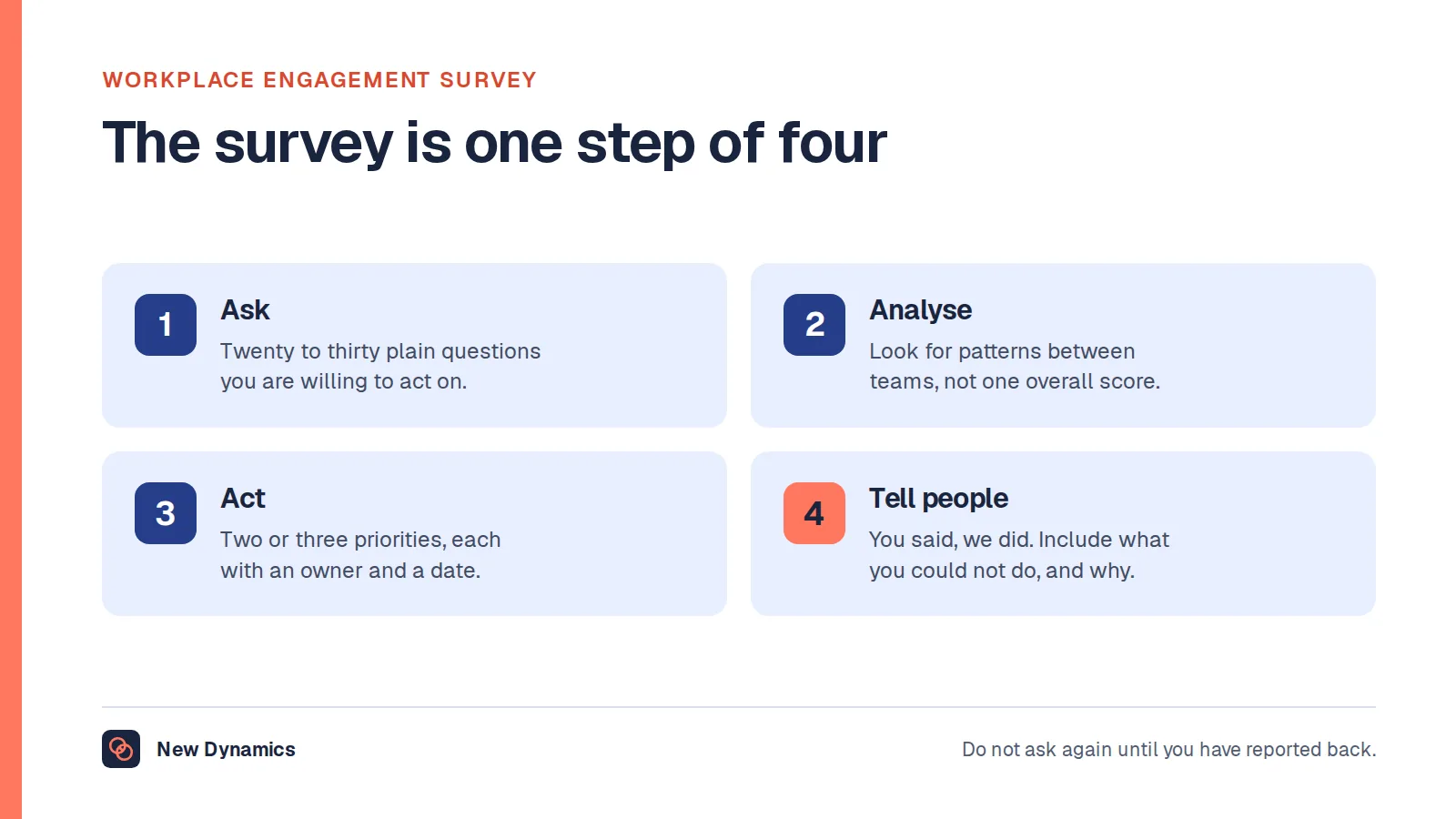
A twelve month engagement programme cadence
A cadence is what turns intention into a programme. The pattern below assumes one full survey a year and a short pulse in between. Adjust the order to your own calendar, but keep the sequence: ask, act, show, check.

Quarter one: ask
The full survey opens and closes inside three weeks. HR owns the instrument, the confidentiality threshold and the communications. Managers own the response rate in their own team, which means telling people what happened with the last round before this one opens.
Results go to managers within four weeks of close, not three months. A slower turnaround is the single clearest signal that the programme is for the centre rather than for the team.
Quarter two: act
Every manager holds one results conversation with their team. The structure is three questions: what do we recognise here, what one or two things shall we change, and what is outside our control and needs escalating.
The output is a one-page team plan: two or three actions, each with a named owner and a date. Escalations go up in a single list rather than as a complaint per manager, so the centre sees the pattern.
Quarter three: show
This is the quarter most programmes skip. Each team publishes what changed. The centre publishes what it did with the escalations, including the ones it rejected and why.
A short pulse goes out, asking only about the chosen priority topics and one question on whether people have seen action. If that last question is low, nothing else in the pulse matters.
Quarter four: check and prepare
Review the year honestly: how many team actions were actually completed, which escalations moved, where the response rate fell. Carry unfinished actions forward with the same owner rather than quietly retiring them.
Then confirm the frozen question set for next year and change nothing else about the instrument.
What the manager is accountable for
Be specific, because a vague accountability is the same as none. A manager in this programme is accountable for four things:
- Holding the results conversation with their team, and recording that it happened.
- Agreeing two or three actions with named owners and dates.
- Completing their own actions, or saying plainly that they could not and why.
- Escalating what they cannot fix, once, with the detail needed to act on it.
Notice what is absent. The manager is not accountable for the score. A manager held to a number will manage the number, by coaching the team on how to answer, by discouraging the discontented from responding, or by splitting the team. Hold them to the conversation and the actions, which they control, and report the score as information.
Managers need the time and the skill to do this. Our manager one-to-one guide covers the conversation itself, and our post on what an engaged workforce is gives the definition to use when a team asks what the word means.
Reaching shift and frontline staff
This is where programmes quietly exclude a large part of the workforce. If the survey arrives by work email, and a third of your people do not have one, your engagement data describes your office staff. Every conclusion drawn from it is a conclusion about head office.
The NHS model is instructive here because it does not assume a desk. Staff were "sent either an email containing a link to the online survey or a paper questionnaire along with a letter containing a QR code for the online survey", and in 2025 that still produced 36,862 paper responses alongside 729,423 online ones. Paper is falling, but a model that had dropped it would have lost tens of thousands of voices.
Practical measures that work:
- Offer a route that needs no work account. A QR code on a poster in the break room, a short link people can type on a personal phone, or paper where the work is wet, dirty or hands-free.
- Give people paid time to answer. Fifteen minutes inside the shift, on the rota. Asking people to answer in their own time is asking the committed and excusing everyone else.
- Translate, and say who translated. If people work in a second language, a survey in English measures reading comprehension as much as engagement.
- Run the results conversation at handover. Not in a two-hour workshop at ten in the morning, which no one on nights will ever attend.
- Report by shift and site, not just by department. Nights and weekends usually score differently from days. If you cannot split them, you cannot see the problem.
- Check the response rate by group first. Before reading a single score, compare response rates across sites, shifts and occupational groups. A gap there tells you whose experience is missing.
What goes wrong, and the fix for each

Surveying again before acting. Asking a second time with nothing to show from the first is the fastest way to lose a response rate, and the damage lasts years. Fix: no survey opens until the previous round's "you said, we did" has been published.
Central ownership with no manager accountability. A corporate action plan with eleven workstreams and a steering group is a way of looking busy without changing a team's week. Fix: team-level plans, named owners, and a count of completed actions reported alongside the score.
Action plans with no owner or date. "We will look at workload" is not an action. It cannot be completed, so it never is. Fix: every action names one person and one date, and is reviewed like any other goal.
Measuring activity instead of change. Counting surveys sent, webinars held, posters printed and wellbeing weeks run tells you how busy the programme was, not whether work got better. Fix: measure completed actions, the proportion of teams that held the conversation, and the one survey question asking whether people have seen anything change.
Buying a new model instead of finishing the old plan. A fresh framework is more exciting than last year's unfinished list. It is also a way of starting again without ever delivering. Fix: before adopting a model, close out the actions you already agreed.
Treating engagement as a communications problem. Posters and slogans answer a complaint about workload with a message about resilience. People notice. Fix: fix the thing.
Frequently asked questions
What is an employee engagement programme?
An employee engagement programme is the standing arrangement an organisation uses to find out how people experience their work and to change what gets in the way. It contains a fixed measure, team-level ownership, a short list of agreed actions, visible follow-through and recognition of everyday work.
What should an employee engagement programme include?
Five components: a question set that stays the same year to year, ownership by line managers rather than central HR, two or three priorities per team, published follow-through that names what did not change and why, and recognition tied to specific work. Events are optional and never a substitute.
Who should own the engagement programme?
HR owns the instrument, the timetable, confidentiality and reporting. Line managers own the result for their team, because the work, the rota, the equipment and the day-to-day experience sit there. Senior leaders own the escalations that no single manager can fix.
What is an employee engagement model?
A model is a shared definition of engagement plus the drivers you will ask about. The Civil Service People Survey engagement index is a published example: five questions covering pride, advocacy, attachment, inspiration and motivation, reported as a weighted average from 0% to 100%, which stood at 65% in 2025.
Are proprietary engagement models worth using?
They can give you a usable vocabulary, but a model is not evidence on its own. Before you adopt one, ask to see the questions, the weighting, the validation and the method behind any benchmark. If you cannot see them, treat the benchmark as marketing and track your own trend instead.
How do you increase staff engagement on a frontline or shift team?
Reach them first: a route that needs no work email, paid time inside the shift to answer, and results conversations held at handover. Then report by shift and site so that the specific problem is visible, and fix one or two concrete things, such as rota notice or broken equipment.
How often should an engagement programme survey people?
One full survey a year, with a short pulse on the chosen priorities in between, suits most organisations. The real limit is your capacity to respond. If you have not published what changed since the last round, you are not ready to ask again.
Your next step: write the one-page programme
- Choose and freeze the question set. Five to ten outcome questions, plus drivers you can vary.
- Name the owner at each level: the instrument, the team plan, the escalations.
- Put the four quarters in the calendar, including the quarter where you publish what changed.
- Decide the no-email route to your frontline staff, and the paid time they get to answer.
- Agree what you will report: completed actions and conversations held, with the score as information.
For a worksheet that takes you from listening to action, read and download our employee engagement guide. The guide is free to read, and the PDF uses our short download form.
Want feedback, recognition and one-to-ones to carry the programme between surveys? Book a New Dynamics demo and bring last year's action plan. You can also email contact@new-dynamics.com.