TL;DR
- A training plan is a document, not a shopping list. Every line needs a gap, a named population, an objective somebody could assess, a format, dates, an owner, the hours it will take and the person who checks the work afterwards.
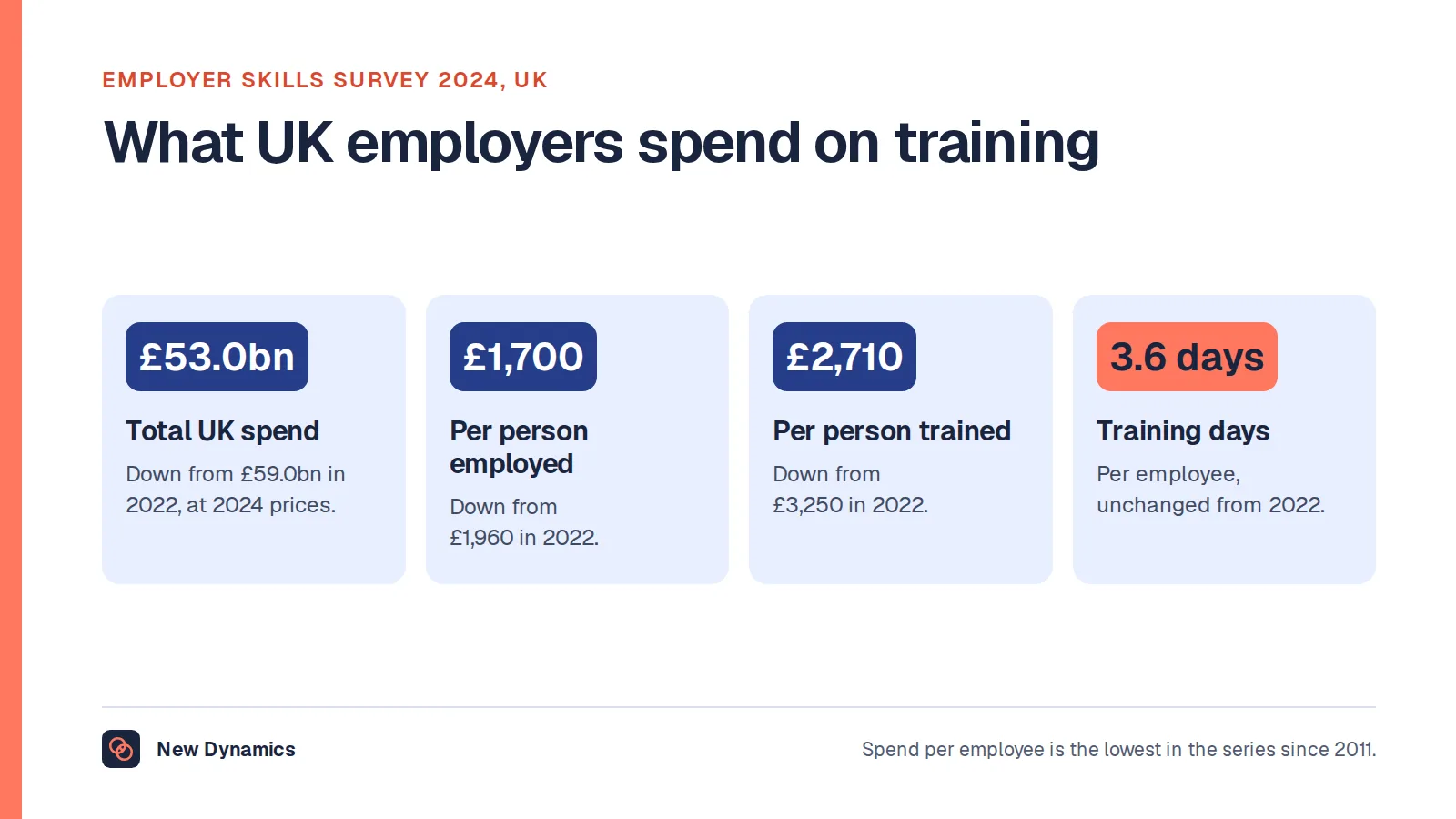
- Budget the hours, not just the fees. The UK Employer Skills Survey 2024 reports 111 million training days over the previous 12 months, equivalent to 3.6 days per employee, and spend split almost evenly between off-the-job and on-the-job training.
- There is no general legal duty on a UK employer to train staff in their job skills. The duties attach to health and safety and to particular activities, and they are specific about working hours and comprehension. This is general information and not legal advice.
Somebody has asked you for a training plan. The request usually arrives in one of four shapes: an audit found a gap, a new system goes live in six weeks, a team has grown faster than anybody taught it anything, or the budget year is closing with the training line untouched.
What comes back is normally a list of courses with dates against them. That is a catalogue. It cannot be assessed, it does not say who owns the time, and nobody can tell afterwards whether it worked, because nothing was written down that could fail.
This article is about the document and the process behind it, from the gap to the template, including the statutory training a United Kingdom employer must provide. It names no products or providers.
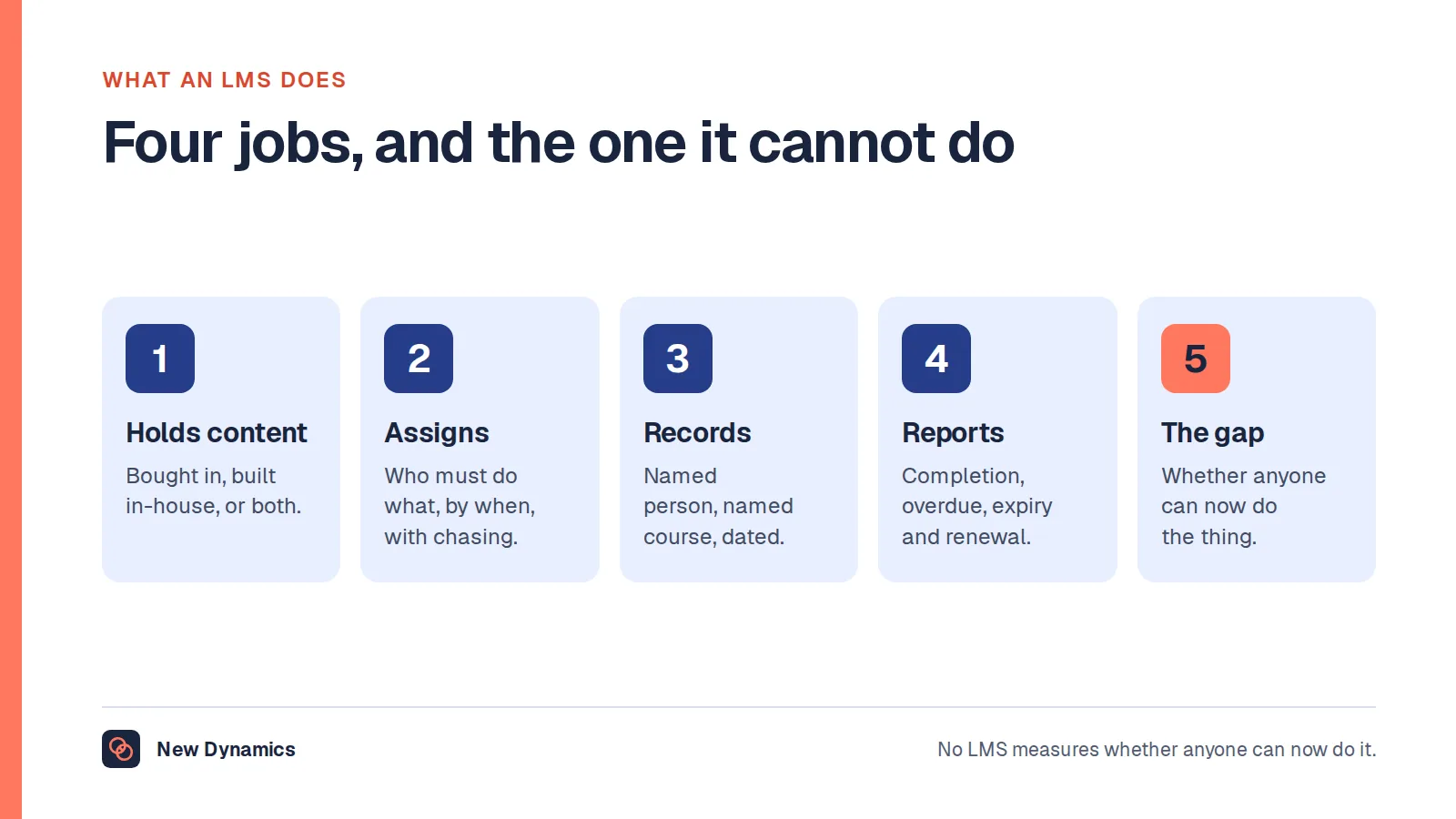
A plan only works if the follow-up lives where the work does. See how New Dynamics goals and OKRs hold the objective and the review date, so what somebody was trained to do appears in their next check-in rather than a completion report. New Dynamics is a performance management platform for goals, feedback, recognition, reviews and onboarding, not a learning management system.
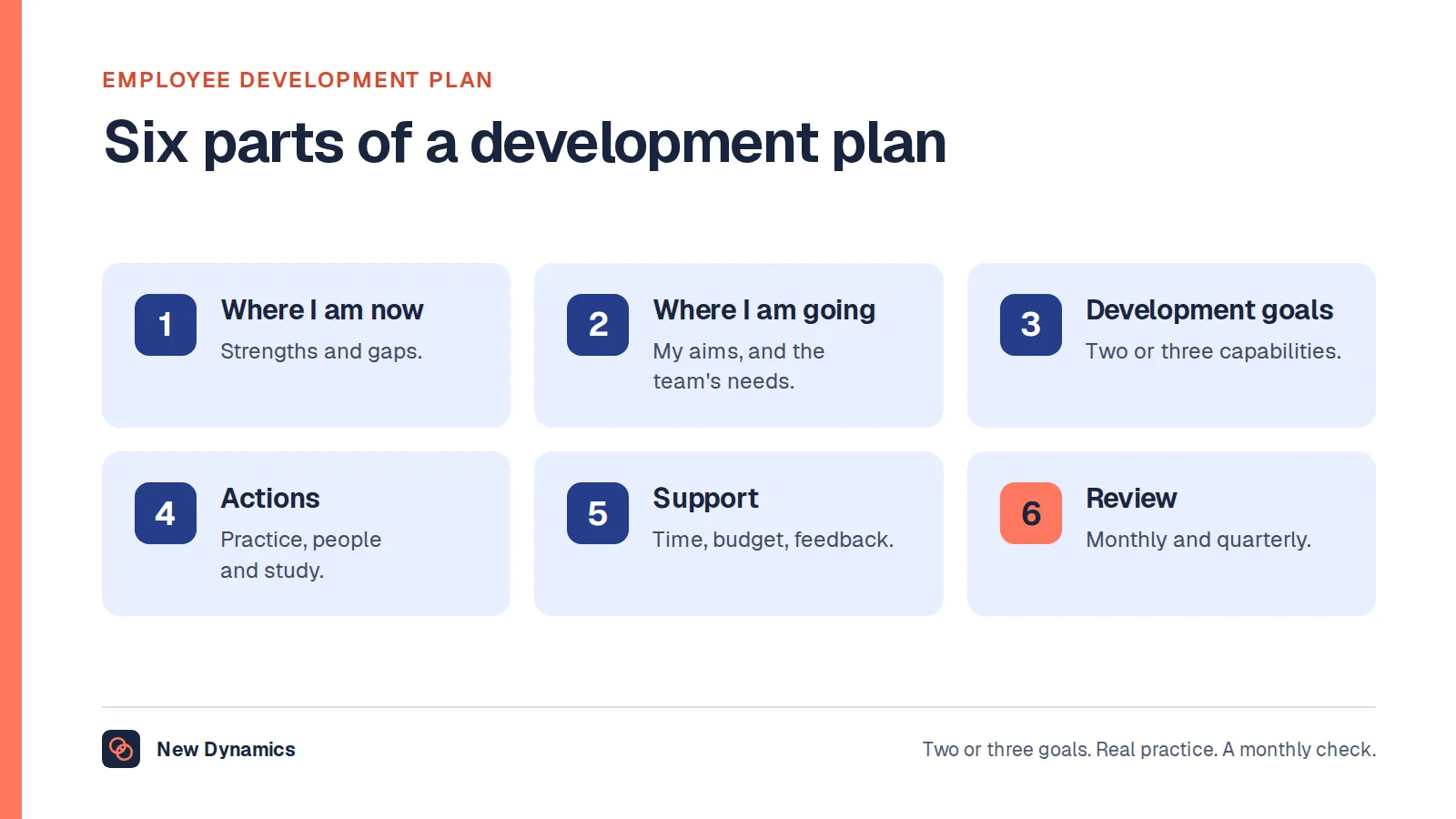
Two neighbours cover ground this one leaves alone. For programme types and the four-level evaluation model, read employee training and development programs. For one named person and their career, you want an employee development plan.
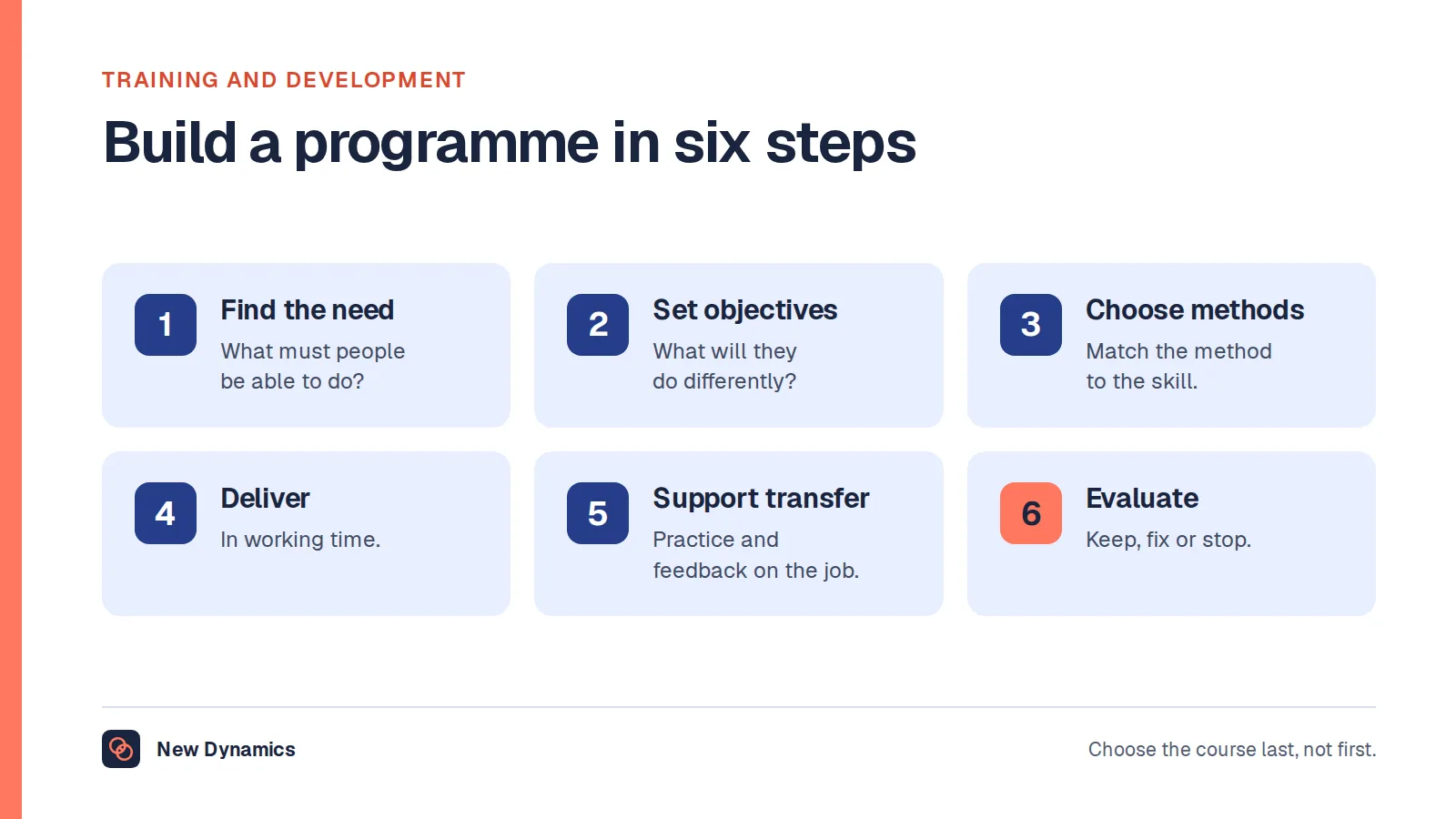
Start from the gap, not the course catalogue

Every weak plan has the same tell: you can read it and not know what is currently going wrong. A plan that can be assessed lists gaps, and the activity hangs off them.
A gap is the distance between what somebody has to be able to do and what they can do today. Written properly it is specific, attributable and uncomfortable to read. "Improve customer service skills" is not a gap. "Four of the six people on the evening shift cannot process a refund without calling the duty manager, who is not always on site" is a gap, and it tells you most of what the plan should say.
The Health and Safety Executive, which regulates Great Britain, sets out the same order of operations in its brief guide to health and safety training, published as INDG345(rev1). Its first step is to "Decide what training your organisation needs", and the method is to "Identify the skills and knowledge needed for people to do their job in a safe and healthy way. Compare these against people's current skills and knowledge and identify the gaps."
That is a safety guide, but the discipline transfers, and the evidence is already in your hands. It usually sits in one of four places: work that comes back, meaning rework, returns and the same complaint twice; questions that keep arriving, because if the same one reaches the service desk weekly then somebody has a gap nobody has written down; the things only one person can do, which are gaps with a holiday booking attached; and something changing, a new system, regulation or piece of equipment, the only kind of gap you can get ahead of.
Write each gap as a sentence before anything else. If nobody in the room can produce it, whatever you book will be judged on whether people enjoyed it. For a method covering a whole function, see our skills gap analysis guide.
Decide who the plan is for
"Training plan" covers four different documents, and most of the confusion comes from writing one while the person who asked wanted another.
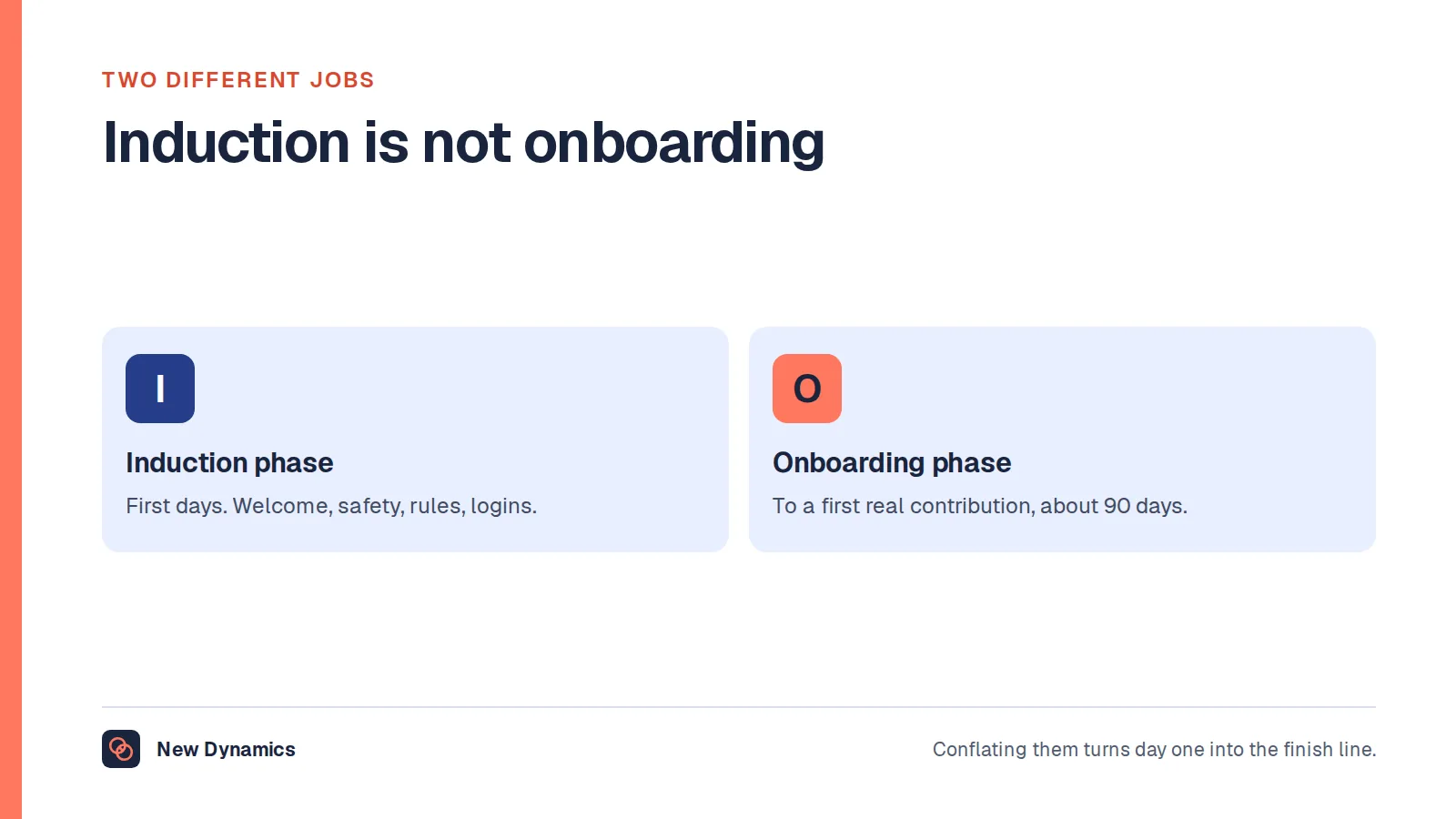
One person. A new starter, somebody promoted, somebody moving into unfamiliar work. Short, dated, owned by their manager, and usually sitting inside induction or a development plan.
A team. One manager, one set of shared work, a gap or two. The most common real request and the likeliest to happen, because one person owns both the delivery and the diary.
A whole role. Everybody in this job should be able to do these things, whether they joined last week or eleven years ago. A standard rather than a schedule, worth writing once, because it also tells you what induction and refreshers must cover.
A compliance population. Everybody who handles food, drives, works at height or processes personal data. Here the plan is a register: who is in scope, what they have had, when it expires, who chases it. The administration is the whole job, and this is the part with external consequences.
One document can hold all four if the columns are honest about which is which, but it must not average them. "All staff: data protection training, Q2" tells you nothing about whether the twelve people who handle sensitive casework got more than the all-staff module.
Write an objective that can be assessed
This step decides whether the plan is a plan. An objective says what somebody will do differently, to what standard, and how you will know.
Acas, whose guidance covers Great Britain, applies the same test to objectives in its guidance on performance management, advising that objectives be "specific", which Acas explains as "being clear about what the employee will actually do", and "measurable", so that, in its words, "you know whether they've been achieved". For training, add one thing: say who will check, and how.
Compare two lines from a plan.
Attend the two-day supervisor course. Q2.
That is an activity with a deadline, completed by sitting in a room.
By 31 July, each of the four evening shift leads can process a refund, a part-refund and a goodwill credit unaided, following the current till procedure, verified by the duty manager watching one of each.
That is an objective: the people, the tasks, the standard, the evidence, the verifier and the date. It can fail, which is the point, and it tells you what format to use, which is why the format decision comes afterwards.
Three rules make the difference. Use a verb somebody could watch: process, escalate, log, fit, record, hand over, and not understand, be aware of or be familiar with, which are states of mind, so you end up measuring attendance. Write the pass line: unaided or with the procedure open, within the shift or by Friday, first time or after one correction. Without it two managers will assess the same person differently, both in good faith. One objective per line, because a line with three is marked complete when the easiest is done. See our SMART goals guide for the mechanics.
Choose the format honestly

Most plans choose the format first, because the format has a price list. Chosen last, from the objective, the options narrow and usually get cheaper.
HSE's brief guide is plain about what counts. Training, it says, "means helping people to learn how to do something, telling people what they should or should not do, or simply giving them information", and then: "Training isn't just about formal 'classroom' courses." It adds that "much effective training can be done 'in-house'."
Four formats cover nearly everything in a workplace, each with an honest failure mode.
Someone shows you. Fastest and cheapest, right for a task with a correct method, and it transmits whatever the demonstrator actually does, shortcuts included. Write the standard down first and have them work to it.
A course. Right when the content is new to everybody at once, benefits from discussion, or an external standard requires a syllabus. Its failure mode is being an event, so nothing after it gets planned. Put the follow-up on the same line.
A written procedure. Underrated. Where the answer is fixed, rarely needed and looked up rather than remembered, one page where the work happens beats any amount of teaching. Its failure mode is that nobody can find it, so check that somebody can inside thirty seconds.
Practice with feedback. The only format that teaches judgement: a difficult conversation, a clinical decision, a negotiation. Somebody has to attempt it badly in front of a person who will interrupt and say why. It is expensive in the right person's time, so it gets replaced with a module about it. Our post on communication skills training covers what it looks like.
One caution. A popular rule of thumb splits development into roughly seventy per cent on the job, twenty from others and ten formal. We could not find a primary research source for those proportions, so we are not repeating them as a finding. The point needs no numbers: most capability is built doing the work, so a plan whose every line is a course has probably mislabelled the gap. This article also uses no attention-span figures, learning-styles advice or forgetting-curve percentages, because we could not find primary sources for any of them.
Sequence it, and leave the gaps on purpose
Twelve items with no order will happen in whatever order they were booked. Two sequencing decisions do real work.
Order by dependency and by harm. Some things come first because the next makes no sense without them, and some because getting them wrong hurts somebody. HSE's guide puts priority on "those where lack of information and/or training might result in serious harm", "those that benefit the largest numbers of staff", "new recruits or those new to the working environment" and "people changing jobs, working practices or taking on new responsibilities". A workable order for any plan, not only a safety one.
Leave deliberate gaps, then come back. This is what distinguishes a plan from a timetable, and it has evidence behind it. The practice guide Organizing Instruction and Study to Improve Student Learning, published in September 2007 by the Institute of Education Sciences at the US Department of Education as NCER 2007-2004, with a panel chaired by Harold Pashler, makes spacing its first recommendation: teachers should "arrange for students to be exposed to key course concepts on at least two occasions", "separated by a period of several weeks to several months". The panel rates that "Level of evidence: Moderate", and its rule of thumb is that the interval should be "not less than about 5 percent of the interval during which the information has to be retained". So if somebody must still do this in a year, the second exposure belongs weeks later, not the following afternoon.
It is as clear about what that exposure should be. Recommendation 5b recommends "closed-book" quizzes "as one method for re-exposing students to key course content", notes that questions requiring people to "actively recall specific information" in "fill-in-the-blank or short-answer formats, as opposed to multiple-choice items" do more, and rates that "Level of evidence: Strong". One condition most workplace refreshers fail: "correct-answer feedback should be provided."
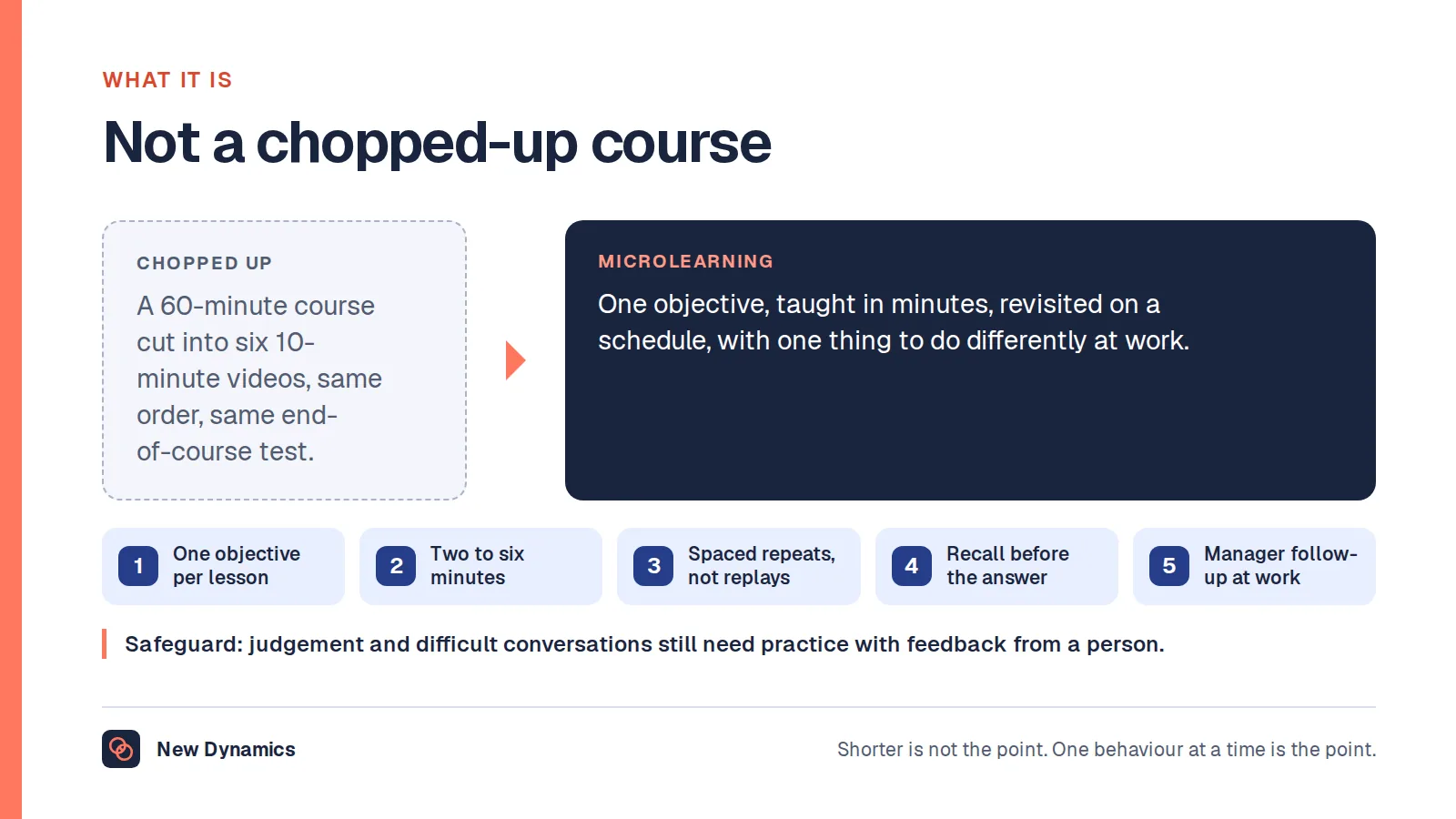
So a line that teaches something once in week two with nothing after it has designed in the forgetting. Asking for it from memory in week six costs ten extra minutes. Our post on microlearning goes further into that sequence.
Acas makes the practical version of this point in its guidance on planning an induction programme, advising employers to "spread out activities so the worker is not overwhelmed" and to consider "how to fit any induction tasks or training around other work activities and shift patterns".
Who owns delivery, and who owns the time
Every line needs two owners, usually different people. The delivery owner makes the learning happen: the colleague demonstrating, the manager running the session, the external trainer, whoever writes the procedure. Name a person, not a department. The time owner can release the hours, nearly always the line manager. That is where plans die, because one not agreed with the person who writes the rota is a wish list.
For health and safety the law settles it. HSE states plainly that "Health and safety training should take place during working hours and must be free for employees", and its brief guide adds that "Special arrangements may be needed for part-timers or shift workers". For training generally there is no equivalent duty, which is why the time has to be negotiated and written down rather than assumed.
Three things to settle per line, in writing: who delivers, named, with a fallback if they leave; who releases the time, named, and what cover looks like, because "half a day, cover from the Tuesday team" is a plan and "half a day" is a hope; and who verifies it afterwards. The verifier is the most useful column in the document, because it is the only one that turns a completion into evidence.
Then the part nobody writes down: what the manager does next. A manager who cannot say in one sentence what their team is being taught this month will not reinforce it, and one who thinks it a waste of time will undo it. Keeping the objective and the follow-up alongside goals and one-to-ones stops this becoming a report nobody opens. See how New Dynamics feedback holds that conversation.
The budget, and the cost nobody counts
Most training budgets record fees and nothing else, which makes cheap training look free. The real cost of a line has four parts: the fee, the learner's hours, the deliverer's hours (the scarcest resource in the building, almost never costed), and the cover, meaning agency, overtime or a backlog next week. The last three are why in-house training is cheaper than it looks on the fee line and dearer everywhere else.
The published UK figures give the scale. The Employer Skills Survey 2024, an official statistics release covering a telephone survey of 22,712 UK employers with fieldwork between June 2024 and January 2025, reports that "Employers had provided 111 million training days over the last 12 months, equivalent to 5.7 days per year per person trained ('per trainee'), and 3.6 days per employee". The same release reports that "The total UK training expenditure in 2024 was £53.0bn", that "This equated to a spend of £1,700 per employee, down from £1,960 in 2022", and that "Spend was relatively evenly divided between off-the-job training and on-the-job training (£26.9bn and £26.1bn respectively)".
Two things follow. Half of recorded national training spend sits in on-the-job training, the part no invoice arrives for. And the unit that matters is days: if your plan asks thirty people for a day each, you have asked for thirty days of work that will not happen, and somebody senior should agree to that rather than discover it in a rota. So state the hours as a number. "Fourteen staff, half a day each, seven days released across May and June, cover from part-time hours" is a sentence a finance director can answer. For the wider picture, see our UK learning and development statistics post and the HR statistics hub.
Statutory training in the United Kingdom
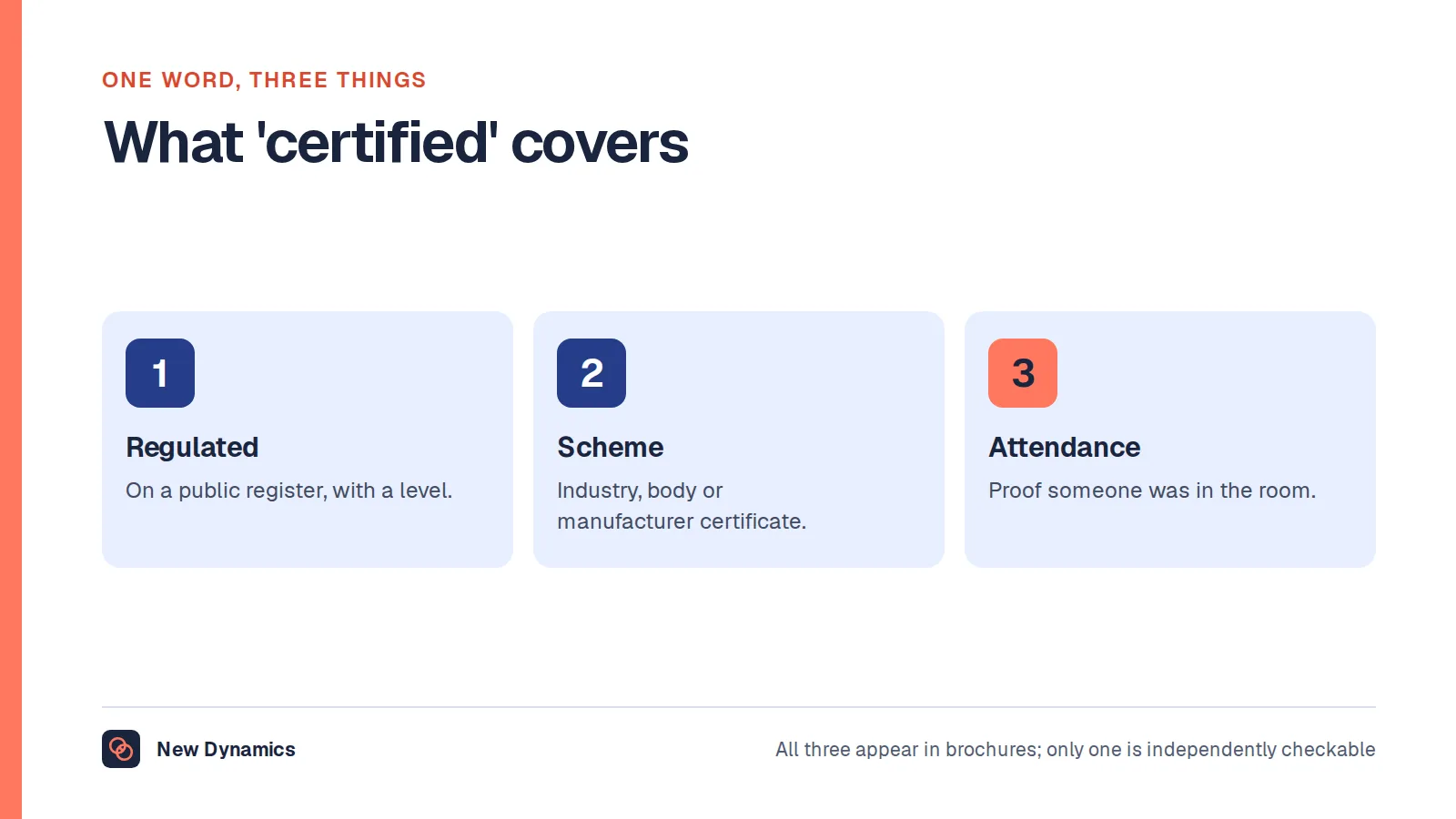
This section describes the position in the United Kingdom, names which nations each duty covers, and is general information rather than legal advice. Start with what is not true: there is no general statutory duty on a UK employer to train employees in their job skills. The duties attach to health and safety, to particular activities and equipment, and to regulated sectors. A plan claiming "the law requires annual training for all staff" is overclaiming, and that is how a register fills with modules protecting nobody.
The general duty. Section 2(2)(c) of the Health and Safety at Work etc. Act 1974 includes within the employer's general duty "the provision of such information, instruction, training and supervision as is necessary to ensure, so far as is reasonably practicable, the health and safety at work of his employees". Section 84(1) provides that the Act, with narrow exceptions, "does not extend to Northern Ireland", so that covers England, Wales and Scotland. Article 4(2)(c) of the Health and Safety at Work (Northern Ireland) Order 1978 is worded identically for Northern Ireland.
When it is required, Great Britain. Regulation 13(2) of the Management of Health and Safety at Work Regulations 1999 provides that "Every employer shall ensure that his employees are provided with adequate health and safety training" both "on their being recruited into the employer's undertaking" and on exposure to new or increased risks from a change of responsibilities, new work equipment, new technology or a new system of work. Regulation 13(3) adds that it shall "be repeated periodically where appropriate" and "take place during working hours". Those triggers are rows in a plan.
Specific duties attach to specific activities, and a plan has to check which apply. Three examples, all covering England, Wales and Scotland:
- Work equipment. Regulation 9 of the Provision and Use of Work Equipment Regulations 1998 requires that "all persons who use work equipment have received adequate training for purposes of health and safety". Regulation 9(2) applies the same requirement to anyone who "supervises or manages the use of work equipment", so supervisors are a separate line.
- Personal protective equipment. Regulation 9 of the Personal Protective Equipment at Work Regulations 1992 requires information, instruction and training on the risks, use and upkeep of the equipment, and adds a test that applies far wider than PPE: it "shall not be adequate and appropriate unless it is comprehensible to the persons to whom it is provided".
- Manual handling. Regulation 4 of the Manual Handling Operations Regulations 1992 is often called a training duty and is not quite one: where handling cannot reasonably be avoided, the employer must assess it, reduce the risk, and provide "general indications and, where it is reasonably practicable to do so, precise information on" the weight of each load and the heaviest side of an off-centre one. If your register says "manual handling training, annual, all staff" and your loads are not labelled, you have bought the wrong thing.
Two more are worth checking. Regulation 5 of the Work at Height Regulations 2005 demands competence rather than attendance, "including organisation, planning and supervision". And regulation 3(2) of the Health and Safety (First-Aid) Regulations 1981 is the clearest case of a named qualification being required: "a person shall not be suitable unless he has undergone" training and holds a qualification "as the Health and Safety Executive may approve". Regulated sectors add more, which belongs in the compliance half of the register with the regulator named beside each line. HSE says why that half is an expiry-date problem: "You should monitor training records so that refresher training can be given when needed."
Apprenticeships, England. The Department for Education's apprenticeship off-the-job training guidance, version 6 of August 2026, applies to England and is blunt: "Legally, off-the-job training must take place within the apprentice's normal working hours. There must be no expectation that the apprentice will undertake any training in their own time in order to complete the apprenticeship." For apprenticeships starting from 1 August 2025, a minimum volume of hours is published for each standard, and "No programme must require less than 187 hours of off-the-job training".
Asking for time to train, England, Wales and Scotland. Some employees can ask. GOV.UK's guide to training and study at work says "staff must be classed as an employee", "they must have worked for their employer for at least 26 weeks", the training "must help staff do their job better" and "at least 250 people must work in the organisation", and that "Time off is usually unpaid unless the employer agrees to pay it". The right sits in section 63D of the Employment Rights Act 1996, which section 244(1) says "extends to England and Wales and Scotland but not to Northern Ireland".
How to tell whether it worked
Completion records attendance, which is why it tells you least. HSE's brief guide asks better questions at its fifth step: "Are they actually working as they have been trained to?", "What feedback are you getting from line managers and the people who have been trained?" and "Has there been a change in behaviour and practice?" Four checks turn those into something you can run.
- The thing you counted at the start. Count it again: refunds escalated, handover notes missing a field, the near-miss rate, the repeat-question rate. If the gap was not countable the plan was not measurable, which is a design problem rather than a reporting one.
- A delayed check, not the end-of-course quiz. Ask for the knowledge from memory six weeks later, then give the correct answer. That is the retrieval practice the IES guide rates as strong evidence, and it doubles as the measurement.
- One observation at work, recorded in a line. The named verifier watches the task once and writes a sentence about what they saw. This converts a completion into evidence, and it is the step that gets skipped.
- Whether the workaround came back. If people have quietly returned to the old method, the training was not the problem. Find what the new method is slower at and fix that.
Two things not to report as outcomes: satisfaction with the session, which measures the session, and hours consumed, which will be gamed the moment it becomes a target.
A training plan template you can adapt

One line per gap. Copy these columns into a spreadsheet and resist adding one nobody will fill in.
| Column | What goes in it | Example |
|---|---|---|
| Gap | What people cannot do today, in a sentence | Evening shift leads cannot process refunds unaided |
| Who it covers | Named people, a role, or a population | 4 evening shift leads (Hall, Osei, Brar, Lindqvist) |
| Objective | Observable action, standard, pass line | Process a refund, part-refund and credit unaided |
| Format | Demonstration, course, procedure, practice | Demonstration plus one supervised attempt of each |
| Delivery owner | The named person who makes it happen | Duty manager (Okonkwo) |
| Time owner | Who releases the hours, and the cover | Store manager; 2 hours each, from daytime overlap |
| Hours and cost | Learner hours, deliverer hours, fee, cover | 8 learner hours, 3 deliverer hours, no fee |
| Dates | First session, and the spaced follow-up | First week of June; recall check first week of July |
| Verifier and check | Who confirms it, and how | Duty manager observes one of each transaction |
| Status and expiry | Where it has got to, and when it lapses | Verified 06/07; no expiry, repeated at induction |
Three notes. Compliance rows need two more columns, the named requirement and the renewal date, sorted by renewal date rather than subject, because the only question that half answers at short notice is what has lapsed. Every example above is illustrative, not a benchmark. Keep it to one page per team, and write the review date on the document itself.
A worked example: a new system goes live
Gap: a stock system replaces the current one in eight weeks and nobody outside the project team has used it. Population: 38 staff across three sites, split into daily users, occasional users and approvers. Objectives, in that order: complete a goods-in, a transfer and an adjustment unaided; complete a goods-in with the procedure open; approve and reject a transfer. Formats, same order: a demonstration on the live system, a one-page procedure, a thirty-minute session. Time owner: each site manager, two hours per daily user in writing. Spacing: taught in week six, recall check in week ten, when the questions that matter have arrived.
What usually goes wrong
Four failures account for most of it. The plan is a catalogue, so nothing in it can fail. Nobody owns the time, so it competes with the work and loses. Every line has one exposure and no second, which designs the forgetting in. And the register overclaims, citing a general duty to train that does not exist while the specific duty that applies to your equipment goes unmet. A fifth deserves naming separately: training sent to fix something else. Unclear goals, bad tools and too much work do not respond to training, and our post on job performance covers how to tell them apart.
Frequently asked questions
What is a training plan?
A training plan records, for each capability gap, who it applies to, what people will be able to do afterwards and to what standard, the format and dates, who delivers it, who releases the time, the cost in hours as well as fees, and who verifies it. A list of courses with dates is a catalogue, because nothing in it can fail.
How do you create a training plan?
Start from the gap rather than the catalogue. Write what people cannot currently do, in one sentence, using evidence you already hold: rework, repeat questions, single points of failure and anything about to change. Then decide who the plan covers, write an objective somebody could assess, choose the format from the objective, sequence it with a deliberate gap before a second exposure, name the delivery and time owners, cost the hours, and say who checks afterwards.
What should a staff training plan include?
Ten columns: the gap, who it covers, the objective with its pass line, the format, the delivery owner, the time owner and the cover, hours and cost, dates including the spaced follow-up, the verifier and how they will check, and status with any expiry. Compliance lines need two more, the named requirement and the renewal date.
What training is an employer legally required to provide in the UK?
There is no general legal duty to train staff in their job skills. The duties attach to health and safety and to particular activities. In Great Britain, section 2(2)(c) of the Health and Safety at Work etc. Act 1974 covers information, instruction, training and supervision so far as is reasonably practicable, and regulation 13 of the Management of Health and Safety at Work Regulations 1999 requires adequate health and safety training on recruitment and on exposure to new or increased risks, during working hours. Northern Ireland has an equivalent duty in article 4(2)(c) of the Health and Safety at Work (Northern Ireland) Order 1978. Specific duties cover work equipment, protective equipment, first aid and work at height. This is general information, not legal advice.
How do you measure whether a training plan worked?
Count the thing you counted when you wrote the gap, run a delayed recall check several weeks later with the correct answer given afterwards, have the named verifier observe the task once and record a line about it, and check whether the old workaround has returned. Do not report completion, satisfaction or hours as outcomes.
Your next step: write one line properly
- Pick the gap costing you most this month and write it as one sentence naming what people cannot do.
- Write the objective underneath, with an observable verb and a pass line, and say who will verify it.
- Choose the format last: someone shows them, a course, a written procedure, or practice with feedback.
- Put the hours in writing and get the person who owns the rota to agree them before booking anything.
- Add a second date, several weeks later, where somebody produces the knowledge from memory.
Still deciding which gaps deserve a line? Read and download our skills gap analysis guide. The guide is free to read, and the PDF uses our short download form.
Want the objective, the review date and the follow-up in the same place as goals and one-to-ones, rather than a completion report nobody opens? Book a New Dynamics demo and bring the training plan you are working on. You can also email contact@new-dynamics.com.