TL;DR
- Morale, satisfaction and engagement are outcomes. You cannot raise them directly. What you can change is workload, clarity of role, fairness, manager quality and job security, and the work itself is where the employer's legal duty sits.
- In Great Britain the Health and Safety Executive is clear that employers have a legal duty to protect workers from stress at work by doing a risk assessment and acting on it, assessed in the same way as any other health and safety risk.
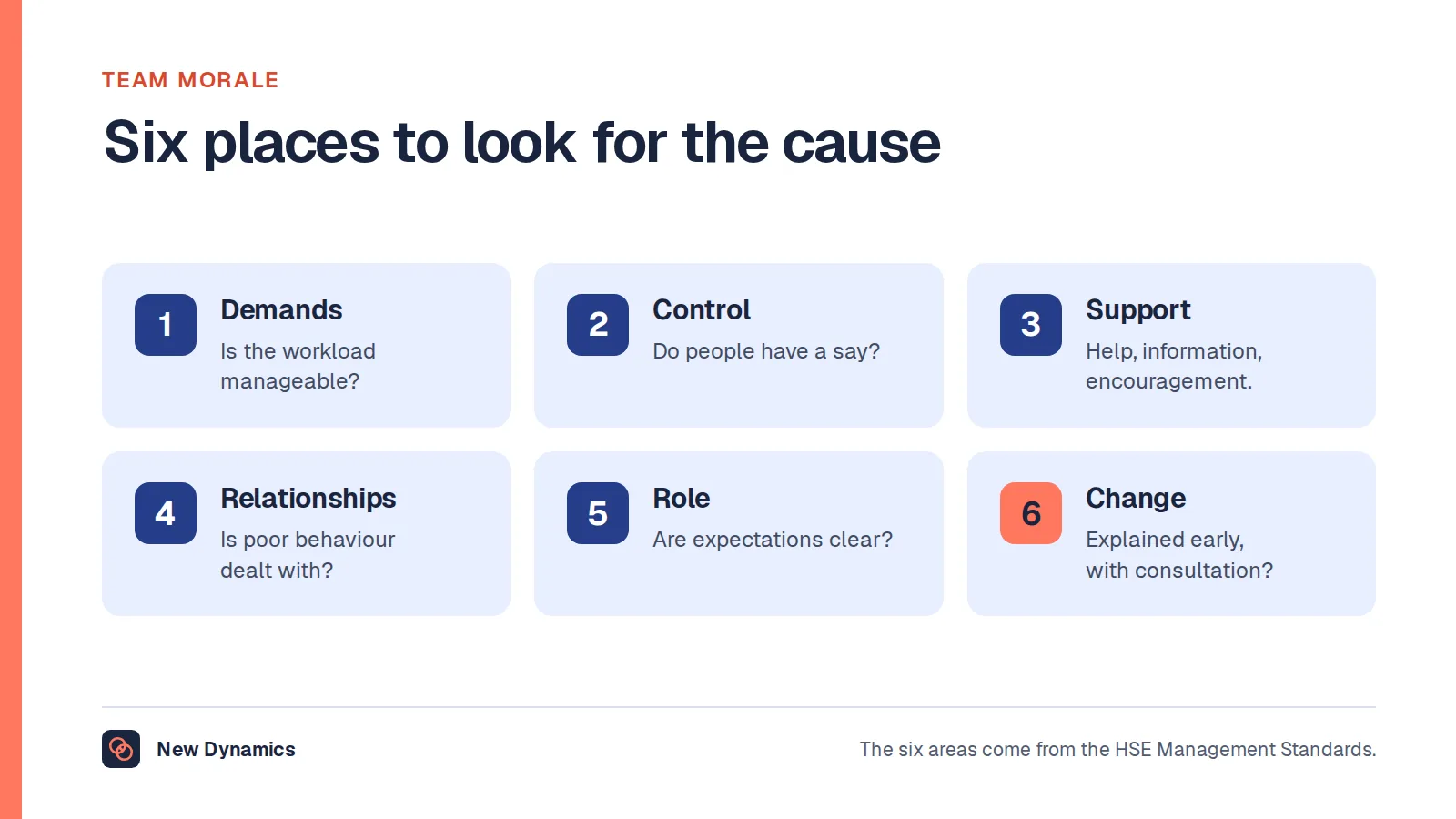
- The six HSE Management Standards areas, which are demands, control, support, relationships, role and change, give you a list of things to change rather than a list of morale boosters. This article is general information, not legal or medical advice.
Somebody has noticed that morale is low. A survey score has dropped, two good people have resigned in a month, or a director walked through the office and felt it. The instruction that follows is almost always the same: do something about morale.
That instruction cannot be carried out. Morale is not a thing you can reach. It is the reading on a dial that other things move, and the same is true of job satisfaction, employee satisfaction and engagement. You can change workload, clarity, fairness, the quality of the immediate manager and how secure the job feels. The reading then follows, or it does not, and either way you have learned something.
This article sets out what an employer in Great Britain is actually required to do about the work itself, using the Health and Safety Executive's own wording, and what to change under each of the six areas it names. It is general information rather than legal or medical advice.
Most of this lives in ordinary conversations between a manager and their team, not in a campaign. See how New Dynamics continuous feedback supports the check-ins where workload and support get raised while they are still fixable.
Morale and satisfaction are outcomes, not inputs

It is worth being precise, because the vocabulary hides the problem.
- Employee satisfaction, or job satisfaction, is how content a person is with their job. It is a judgement they make about the work, the pay, the people and the prospects.
- Employee dissatisfaction is the same judgement in the other direction. Worker dissatisfaction and workplace dissatisfaction describe the same thing at larger scale.
- Morale belongs to a group. It is shared mood and confidence, and our post on team morale covers the warning signs in a single team.
- Occupational stressors are the features of the work that produce the reaction. These are the inputs.
Only the last item on that list is something an employer can reach directly. Everything else is a result. A programme aimed at a result rather than a cause tends to produce activity, a communications plan and no change, because nothing in the work was altered.
The useful question is therefore not "how do we improve staff morale" but "which of the stressors in this workplace are we willing to change, and by when".
The duty: stress is a health and safety matter
This is the part most often missed, and it changes who owns the problem. Work-related stress in Great Britain is not only an HR topic or a wellbeing initiative. It is a health and safety risk with a legal duty attached.
The HSE's guidance on work-related stress states that "Employers have a legal duty to protect workers from stress at work by doing a risk assessment and acting on it", and that "This is the same duty you have to protect people from other health and safety risks". It defines stress as "the adverse reaction people have to excessive pressures or other types of demand placed on them".
The HSE's page on the stress risk assessment is equally direct: "You should assess the risk of stress, and its impact on mental and physical ill-health, in the same way as you assess other work-related health and safety risks." On recording it, the same page notes that "If you have fewer than five workers, you don't have to write anything down", and that at five or more workers the assessment must be written down. More generally, HSE's risk management guidance puts the obligation plainly: "As an employer, you're required by law to protect your employees, and others, from harm."
Acas frames the same ground in employment terms. Its guidance on supporting mental health at work says that "Employers have a 'duty of care'. This means they must do all they reasonably can to support workers' health, safety and wellbeing", and that "Employers must treat mental and physical health as equally important".

Read those together and the shape of the obligation is clear. The duty is not to run a survey, buy an app or hold an awareness week. It is to assess a risk, record the assessment, act on what it shows and review it. If a workload is making people ill, that is a hazard, and the response expected of you is the same as for any other hazard: remove or reduce it.
Note the jurisdiction. The HSE regulates Great Britain, which is England, Scotland and Wales. Northern Ireland has its own regulator in HSENI, and employers elsewhere should check their own national framework.
How large the problem is
HSE publishes annual figures, and they are worth quoting as worded rather than rounded into a slogan. Its statistical release on work-related stress, depression or anxiety, with data up to March 2025, reports "964,000 workers suffering from work-related stress, depression or anxiety (new and long-standing) in 2024/25" and "22.1 million working days lost due to work-related stress, depression or anxiety in 2024/25". The same release states that this "represents 2,770 per 100,000 workers", and that in 2024/25 stress, depression or anxiety "accounted for 52% of all work-related ill health and 62% of all working days lost due to work-related ill health (22.9 days lost per case)".
HSE's figures on working days lost put that in context: of the 40.1 million working days lost to work-related ill health and non-fatal injuries in 2024/25, "Stress, depression or anxiety and musculoskeletal disorders accounted for the majority of days lost due to work-related ill health in 2024/25, 22.1 million and 7.1 million respectively".
The release also names the causes. The main work factors cited by respondents were "workload pressures (including tight deadlines and too much responsibility) and a lack of managerial support", on an average estimate over 2009/10 to 2011/12. Those two findings are worth holding on to, because they are workload and management, not a shortage of perks. For the wider picture across HR, see our HR statistics hub.
The six areas, and what you actually change under each
The HSE's Management Standards are the practical part. They "represent a set of conditions that, if present: demonstrate good practice through a step-by-step risk assessment approach", and they cover "six key areas of work design that, if not properly managed, are associated with poor health, lower productivity and increased accident and sickness absence rates".
This is the list to work from. It is a list of things an employer can change, which is exactly what a list of morale boosters is not.
Demands
HSE describes demands as "workload, work patterns and the work environment". The standard is that "employees indicate that they are able to cope with the demands of their jobs", and among the states to be achieved are that "The organisation provides employees with adequate and achievable demands in relation to the agreed hours of work" and that "Jobs are designed to be within the capabilities of employees".
What you change: the volume of work, the deadlines, the headcount or the scope. In practice that means cancelling or deferring work when a team is short, agreeing what will not be done this quarter, and fixing rota patterns that leave no recovery time. Note the phrase "in relation to the agreed hours of work". A workload that only fits if people work unpaid extra hours does not meet this standard, however willingly they do it.
Control
Control is "how much say the person has in the way they do their work". The standard looks for states including "Where possible, employees have control over their pace of work", "Employees have a say over when breaks can be taken" and "Employees are consulted over their work patterns".
What you change: how tightly the method is prescribed, who decides sequence and pace, break and shift scheduling, and whether people are consulted before a rota changes. Control is often the cheapest of the six to improve and the one most casually removed by new monitoring or approval steps.
Support
Support is "the encouragement, sponsorship and resources provided by the organisation, line management and colleagues". The standard includes "Systems are in place to enable and encourage managers to support their staff", "Employees know what support is available and how and when to access it" and "Employees receive regular and constructive feedback".
What you change: whether managers have the time and training to support people, whether the resources to do the job are actually available, and whether feedback happens regularly rather than annually. Our employee feedback guide covers how to make that routine.
Relationships
Relationships covers "promoting positive working to avoid conflict and dealing with unacceptable behaviour". The standard is that "Employees indicate that they are not subjected to unacceptable behaviours, eg bullying at work", with states including "The organisation promotes positive behaviours at work to avoid conflict and ensure fairness" and "Systems are in place to enable and encourage managers to deal with unacceptable behaviour".
What you change: whether poor behaviour is addressed or absorbed. This is the area where a single unaddressed individual can hold down the score of an entire department, and where "we are working on culture" most often substitutes for a decision.
Role
Role is "whether people understand their role within the organisation and whether the organisation ensures that they do not have conflicting roles". The standard includes "The organisation ensures that, as far as possible, the different requirements it places upon employees are compatible" and "Systems are in place to enable employees to raise concerns about any uncertainties or conflicts they have in their role and responsibilities".
What you change: priorities, reporting lines and the number of people entitled to set someone's work. Role conflict is a design fault, not a personal failing, and it is common wherever matrix reporting has grown without anyone deciding who arbitrates.
Change
Change is "how organisational change (large or small) is managed and communicated in the organisation". The standard includes "The organisation provides employees with timely information to enable them to understand the reasons for proposed changes", "The organisation ensures adequate employee consultation on changes and provides opportunities for employees to influence proposals" and "Employees are aware of timetables for changes".
What you change: when you tell people, whether consultation can still alter the proposal, and whether there is a published timetable. Job insecurity does most of its damage in the gap between a rumour and an announcement, and that gap is entirely within your control.
What to measure instead of morale

A single morale or satisfaction score tells you that something is wrong and nothing about where. Measure the six areas separately instead, and split the result.
HSE's guidance on surveying employees is careful about what a survey is for. "Individual perceptions play an important role in predicting stress related ill health", it says, but "A survey is only the start of the risk assessment process and a broad indicator of the situation in an organisation", and it should be used not in isolation but with other sources of information. It also advises keeping "managers, staff representatives, trade unions and employees fully consulted and informed throughout the survey process so that the figures do not come as a shock".
Four things worth watching:
- A score for each of the six areas, so the answer to a bad result is a specific change rather than a general campaign.
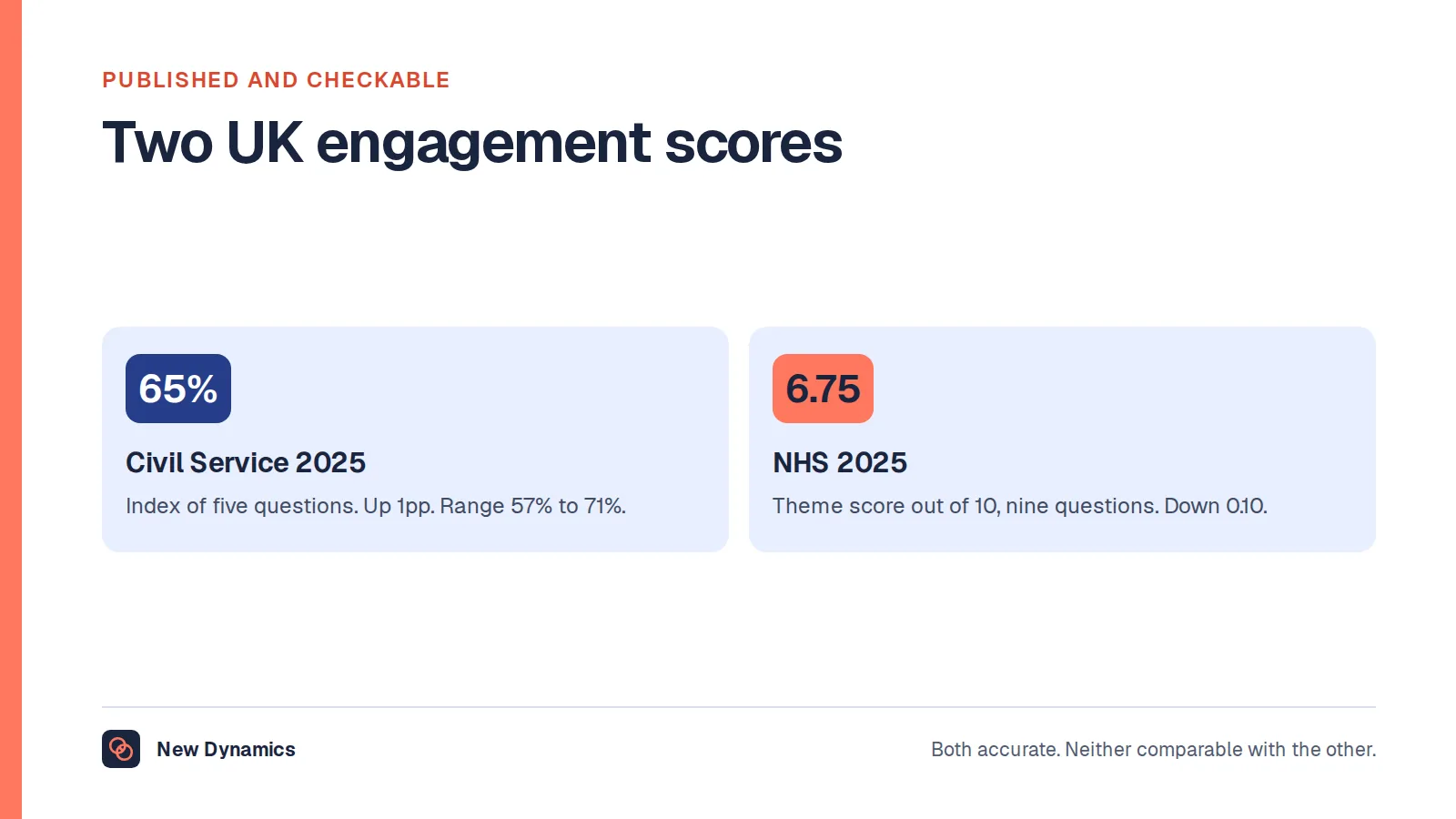
- The same scores split by team, shift, site and length of service. Organisation-wide averages conceal exactly the groups you need to find. On how to read a number against anything meaningful, see our post on the employee engagement benchmark.
- Hard data you already hold: sickness absence, turnover by team, overtime, unused annual leave, grievances and exit interviews. These are not opinions and they are usually unflattering.
- Whether the last promised change happened. This is the most predictive measure in the list and almost nobody collects it.
Write the questions so that each one points at something changeable. Our post on employee survey questions covers the wording.
Why pizza and a wellbeing app do not move any of the six areas
Hold the usual morale interventions against the list above and the problem is obvious.
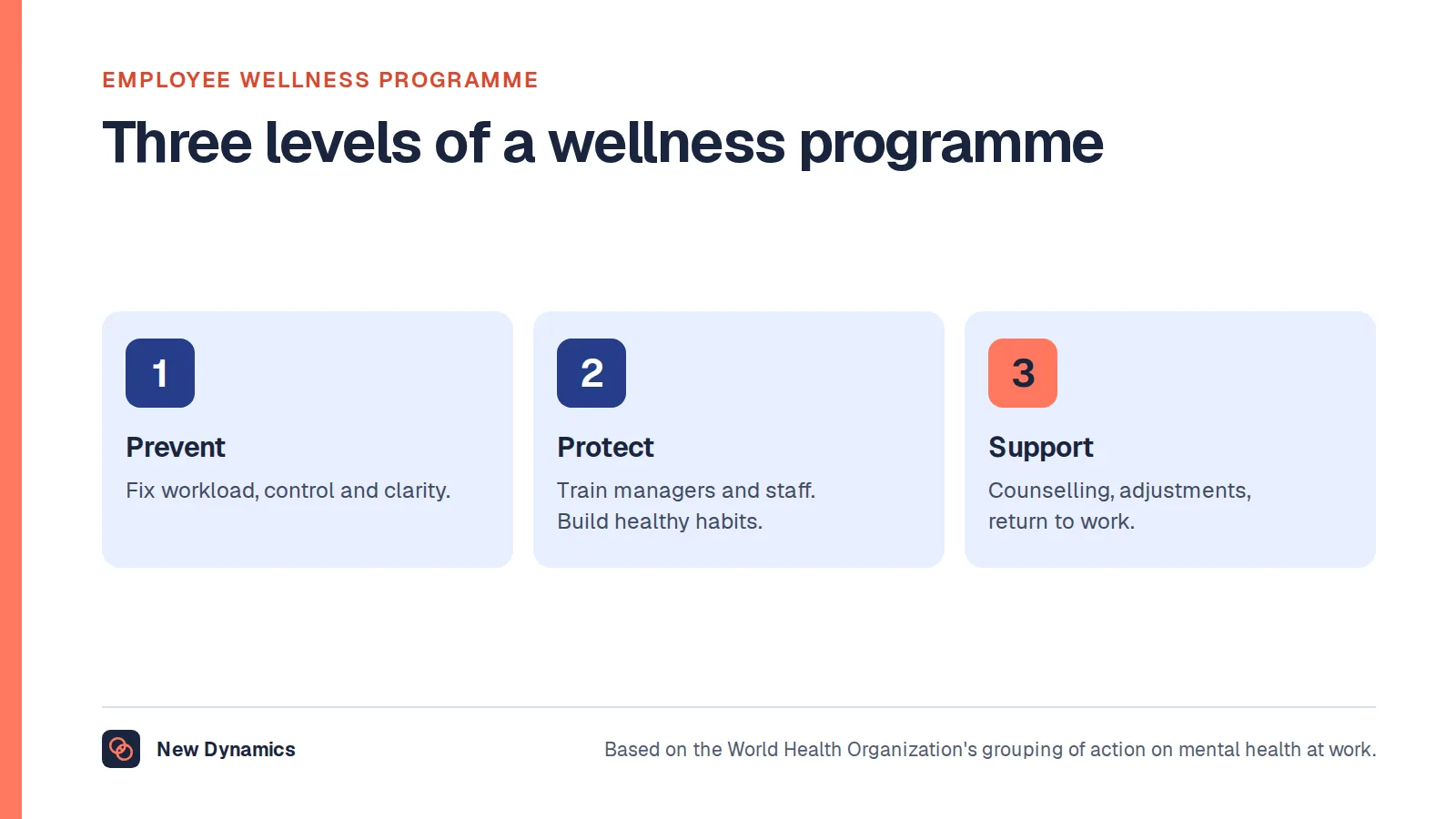
Pizza on a Friday does not alter demands, control, support, relationships, role or change. A fruit bowl does not either. An away day can briefly help relationships and usually does not survive the return to the same rota. A mindfulness course for the workplace, or an app, aims at the individual's reaction to a stressor, not at the stressor. Some people find that genuinely valuable, and it should be available, but it is the third kind of action, not the first.
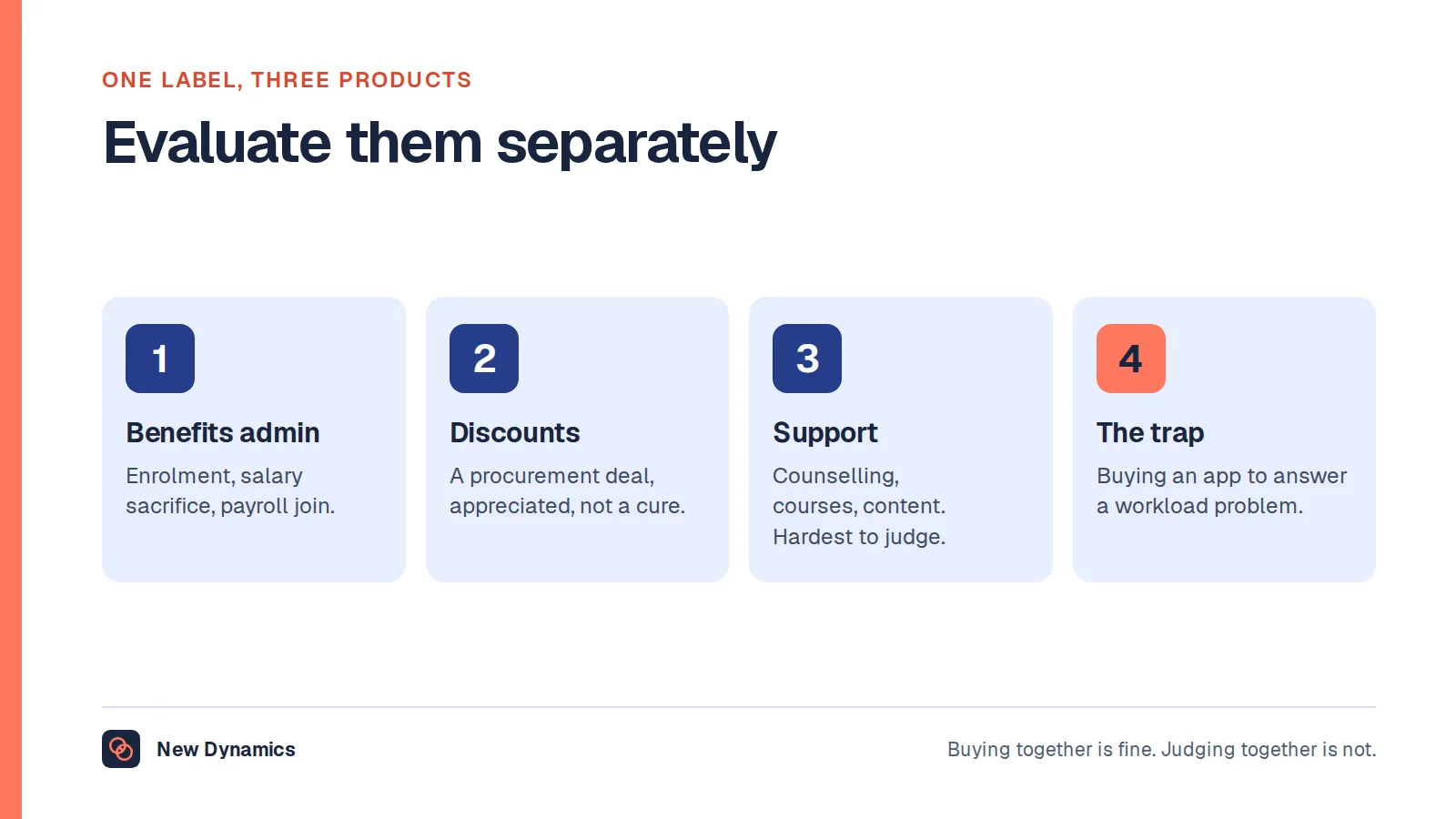
Our posts on employee wellbeing and benefits platforms and on employee wellness programme ideas go into how to buy and design those things well. The point here is narrower: none of them discharge the duty. A usage dashboard is not a risk assessment, and a resilience course offered to a team that is two people short reads as an instruction to cope.
There is a fairness dimension too. Perks tend to reach the office rather than the night shift, so a programme of treats can widen the very gap the scores are telling you about.
The manager's part
For most organisations the relationship with the immediate manager is the single largest lever available, and it appears in the HSE list repeatedly: support, relationships, control and demands all run through the person who allocates the work.
Three things a manager genuinely controls:
- What lands on the team. Managers are the valve between demand and capacity. A manager who passes on everything is not being loyal; they are removing the only protection the team has.
- Whether a concern leads anywhere. The standards ask for systems that let employees raise concerns, and the first test of that system is what happened to the last one raised.
- Whether good work is noticed. Regular, constructive feedback is written into the support standard, and it costs nothing but attention.
Three things a manager does not control, and should not be held to: pay structures, headcount, and whether the organisation tells people the truth about change. Holding managers responsible for outcomes they cannot influence produces the same low morale one level up, and Acas notes that the sooner an employer becomes aware of a problem, the sooner support can be provided, which only happens where managers have somewhere to escalate to.
Practically this means giving managers teams small enough for real one-to-ones, the training to spot pressure early, and permission to change the work rather than simply report on it.
What usually goes wrong
Surveying repeatedly without changing anything. This is the most common and most damaging error. Each round teaches people that reporting a problem has no consequence, and response rates and candour both fall. If you cannot act on an area, do not ask about it, and say why.
Treating a workload problem as a resilience problem. When demands are the cause, training in coping skills relocates the fault to the person who reported it. It also leaves the hazard in place, which is the part a regulator would be interested in.
Averaging the organisation. One healthy division can conceal one failing department entirely.
Owning it in HR alone. If work-related stress sits only with HR, it is a wellbeing initiative. Sitting with health and safety as well, it is a risk with an assessment, an owner and a review date.
Confusing access with action. Offering counselling is support. It is not a change to demands, control, role or change.
Reorganising quietly. Silence during a restructure is read as bad news, and the change standard asks for timely information and a published timetable precisely because of that.
No feedback loop. Telling people what you found, what you will change and what you will not change is the step that makes the next round of listening worth doing.
Frequently asked questions
What is employee satisfaction?
Employee satisfaction, or job satisfaction, is how content a person is with their job overall, taking in the work, the pay, the people and their prospects. It is a judgement people make, which means it is an outcome of their working conditions rather than something an employer can set directly.
What causes low morale in the workplace?
Usually one of six things that the Health and Safety Executive names as work design areas: demands, control, support, relationships, role and change. HSE's statistical release records that the main work factors people cite for work-related stress are workload pressures, including tight deadlines and too much responsibility, and a lack of managerial support.
Is an employer legally required to deal with work-related stress?
In Great Britain, yes. HSE states that employers have a legal duty to protect workers from stress at work by doing a risk assessment and acting on it, and that this is the same duty owed for other health and safety risks. Northern Ireland has its own regulator. This article is general information, not legal advice.
How do you improve staff morale?
Indirectly. Pick the area that your own data points at, change something concrete within it, tell people what changed, then measure again. Workload, clarity of role, fairness, manager quality and job security are the levers. Treats and awareness weeks move none of them.
What should we measure instead of a morale score?
Score the six Management Standards areas separately, split every result by team, shift and site, read it alongside absence, turnover, overtime and unused leave, and track whether the change you promised after the last survey actually happened.
Does a wellbeing app help with low morale?
It can help an individual cope and should be available to anyone who wants it. It does not alter demands, control, support, relationships, role or how change is handled, so it will not move scores driven by those things, and it does not satisfy the employer's duty to assess and act on the risk.
Your next step: one area, one change, one date
- Pick the single area of the six that your absence, turnover and survey data point at most clearly.
- Write down one change you are prepared to make inside it, with an owner and a date.
- Write down one thing you are not going to change, and the reason, so that the answer is honest rather than silent.
- Tell the affected teams both of those things, then re-measure that area in three months.
The manager's one-to-one is where most of this either happens or does not. Read and download our manager one-to-one guide for the structure, including how to raise workload before it becomes absence. The guide is free to read, and the PDF uses our short download form.
Want workload, support and role clarity to be part of every manager's regular check-in rather than an annual survey question? Book a New Dynamics demo and bring your last set of scores. You can also email contact@new-dynamics.com.