TL;DR
- Writing someone up is American usage. In the UK the equivalent is a formal written warning issued at the end of a disciplinary procedure that follows the Acas Code of Practice, and a tribunal can increase an award by up to 25 per cent for an unreasonable failure to follow that Code.
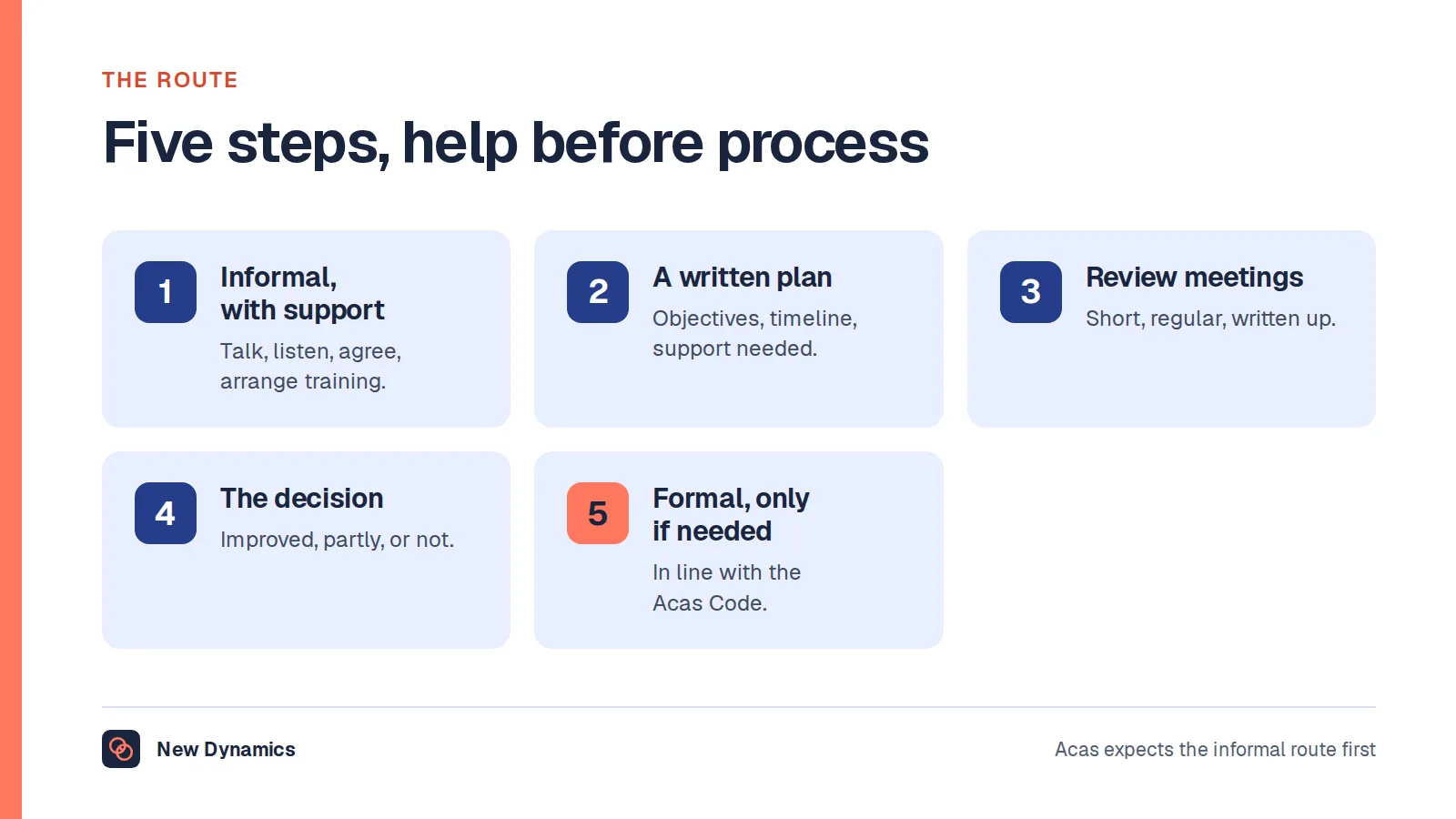
- The warning is the last step, not the first. The Acas Code puts an investigation, a written notification, a meeting with the statutory right to be accompanied, a decision in writing and an appeal in front of it.
- No statute sets how long a warning stays live. The Code says only that the employee should be told how long it will remain current, so the period comes from your own policy and the letter itself.
A manager searches for a write-up form, finds one, fills it in, hands it over and considers the matter dealt with. In the United States that is roughly how it works. In the United Kingdom the manager has just created a document with no procedure behind it, and that gap is what an employment tribunal looks at first.
This article explains what "writing someone up" translates to in the UK, what a written warning actually is, the steps that must happen before one is issued, what the letter should contain, how long a warning should stay live, and how a conduct problem differs from a capability one. It includes a sample written warning you can edit for your own case. It describes the position in Great Britain and is general information, not legal advice. Take advice before any formal step.
Most of these cases are lost on the record rather than on the facts. See how New Dynamics continuous feedback keeps one-to-ones and concerns written down as they happen, so the history exists before anybody needs it.
"Writing someone up" is American. Say so before you copy the advice
The phrase "write up an employee" comes from American workplace practice, where most private-sector employment is at will and a written warning is largely an internal document: a form, a file note, a step on a progressive discipline ladder the employer designed for itself.
There is no UK equivalent of that form, and no UK statute mentions a write-up. The nearest thing is a formal written warning, and it is the outcome of a procedure rather than a form you fill in. The procedure is set by your own policy, and your own policy is measured against the Acas Code of Practice on disciplinary and grievance procedures.
This matters in money. The Code is issued under section 199 of the Trade Union and Labour Relations (Consolidation) Act 1992, and section 207(2) of the same Act says that any provision of an Acas Code which "appears to the tribunal or Committee to be relevant to any question arising in the proceedings shall be taken into account in determining that question". Section 207A, inserted in 2009, goes further: where an employer has unreasonably failed to comply with the Code, the tribunal "may, if it considers it just and equitable in all the circumstances to do so, increase any award it makes to the employee by no more than 25%". The same power works in reverse against an employee.
So treating a write-up as a quick administrative act is the single most expensive import a UK manager can make. A warning issued without the steps in front of it is evidence of an unreasonable failure to follow the Code, sitting in the employee's own file in your handwriting.

What a written warning is, and when it is appropriate
Acas describes a written warning as "a formal warning that the employer can give the employee at the end of the disciplinary procedure" on its guidance about deciding the disciplinary outcome, last updated 4 December 2025. Two words in that sentence do the work: "formal", and "end".
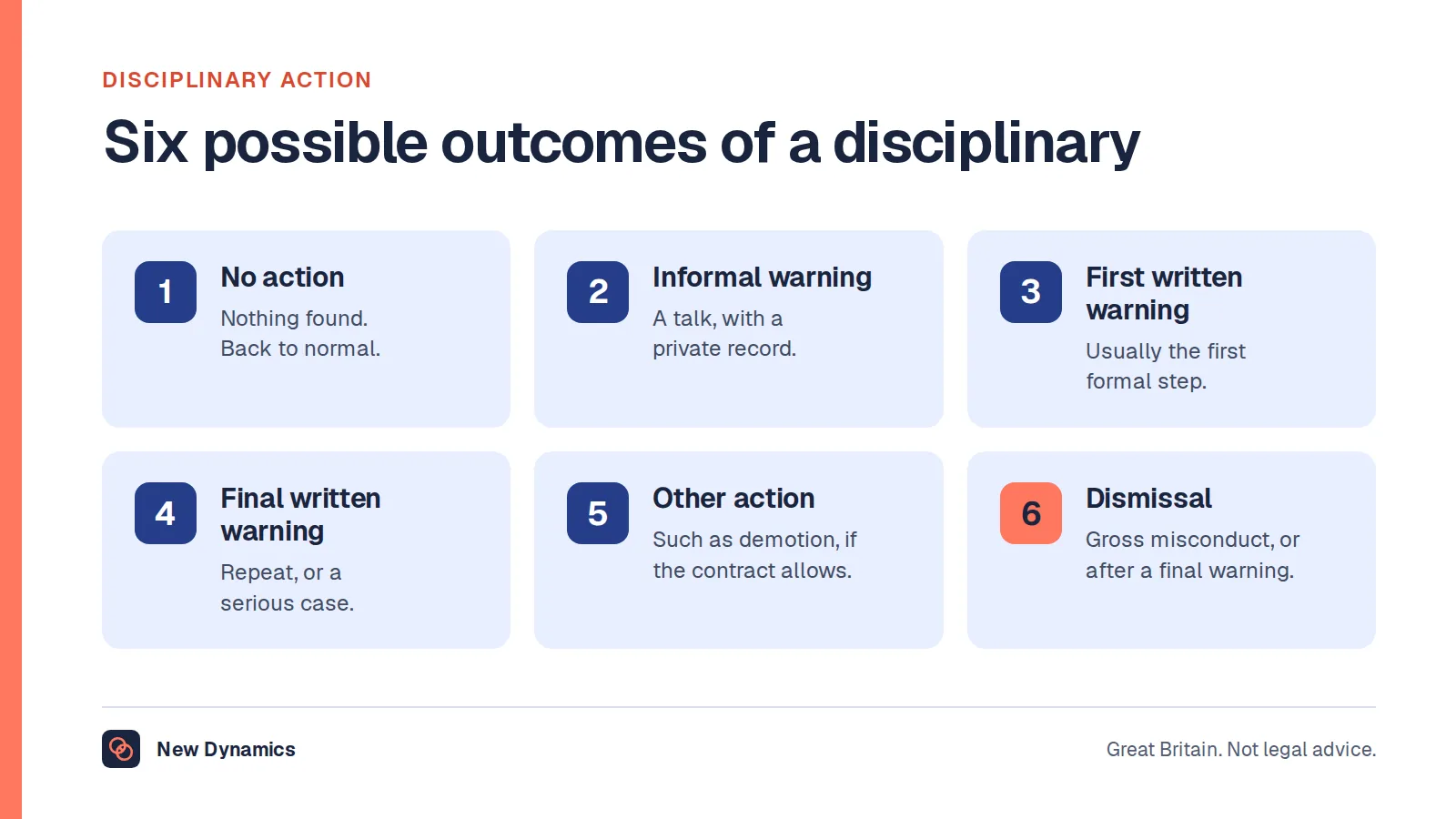
The Code sets out the ladder in paragraphs 19 and 20. Where misconduct is confirmed or performance is found to be unsatisfactory, "it is usual to give the employee a written warning", and a further act or a continued failure to improve "would normally result in a final written warning". Where a first offence is serious enough, paragraph 20 allows going straight to a final written warning, and gives the test: where the employee's actions "have had, or are liable to have, a serious or harmful impact on the organisation".
A written warning is appropriate when three things are true at once. The problem is established on evidence rather than suspected. It is more than the sort of thing a quiet word would fix, and the Code's foreword is blunt that "many potential disciplinary or grievance issues can be resolved informally. A quiet word is often all that is required to resolve an issue." And the employee has had the chance to answer the case before anybody decided. If any of those three is missing, the warning is premature.
For the wider ladder of outcomes, from no action through to dismissal, see our post on disciplinary action.
Reasons to write up an employee, in the UK sense
People search for a list, so here is the honest version: there is no official list, because the reason has to survive scrutiny against your own rules, applied the way you applied them last time. Acas is explicit on that last point. Employers "must follow the procedure and policy in the same way for each disciplinary case".
What the law gives is the category. Section 98(2) of the Employment Rights Act 1996 lists the potentially fair reasons for dismissal, and two of them produce warnings: a reason that "relates to the capability or qualifications of the employee for performing work of the kind which he was employed by the employer to do", and a reason that "relates to the conduct of the employee". Everything called a write-up falls into one of those two, and the route you take depends on which.
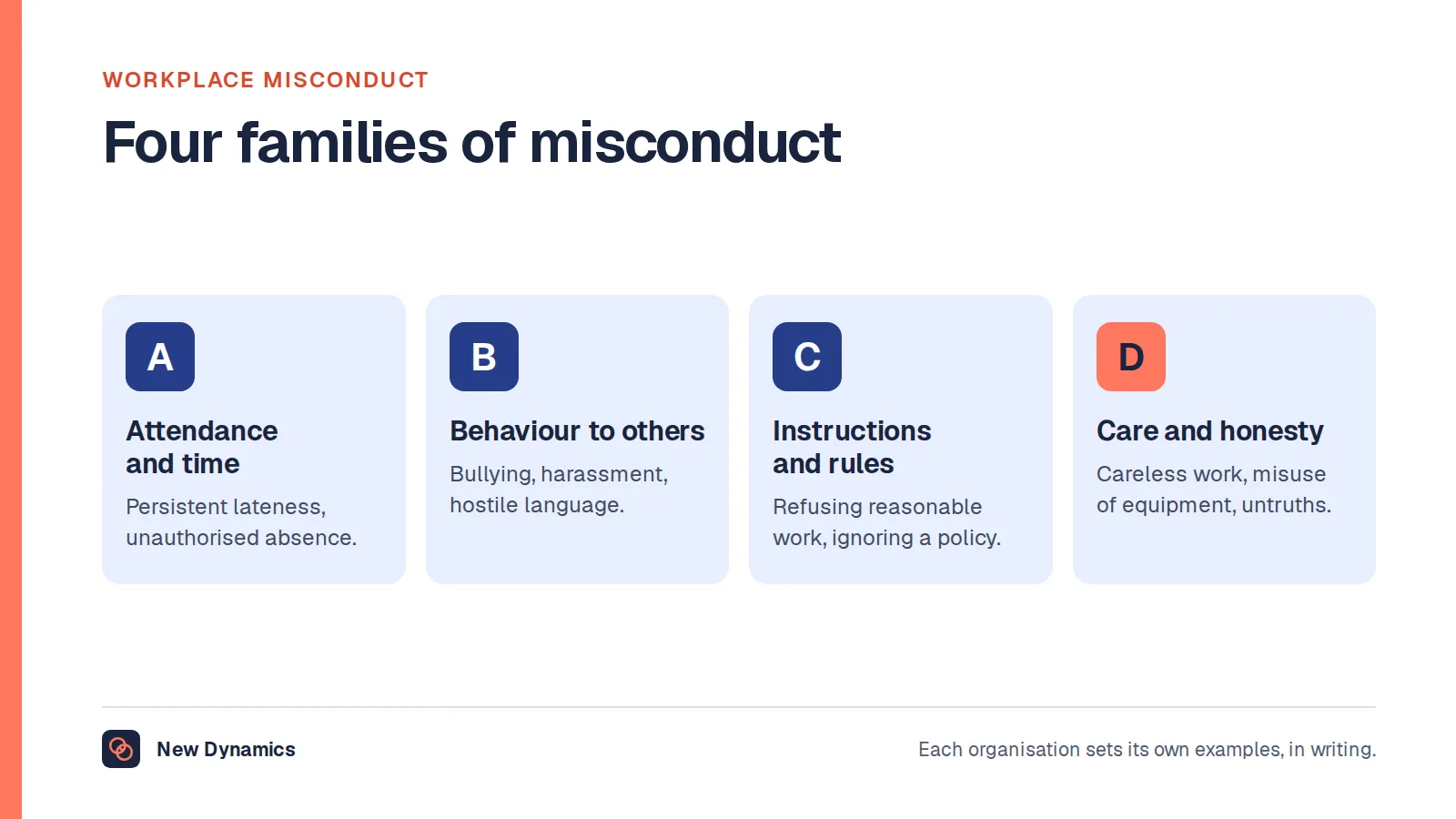
Acas gives conduct examples on its disciplinary procedure guidance: bullying, harassment, insubordination such as refusing to do work, and being absent without permission. It adds that your organisation "might have its own examples", which is the point. Our post on workplace misconduct covers the families of conduct in detail.
The steps that must come first
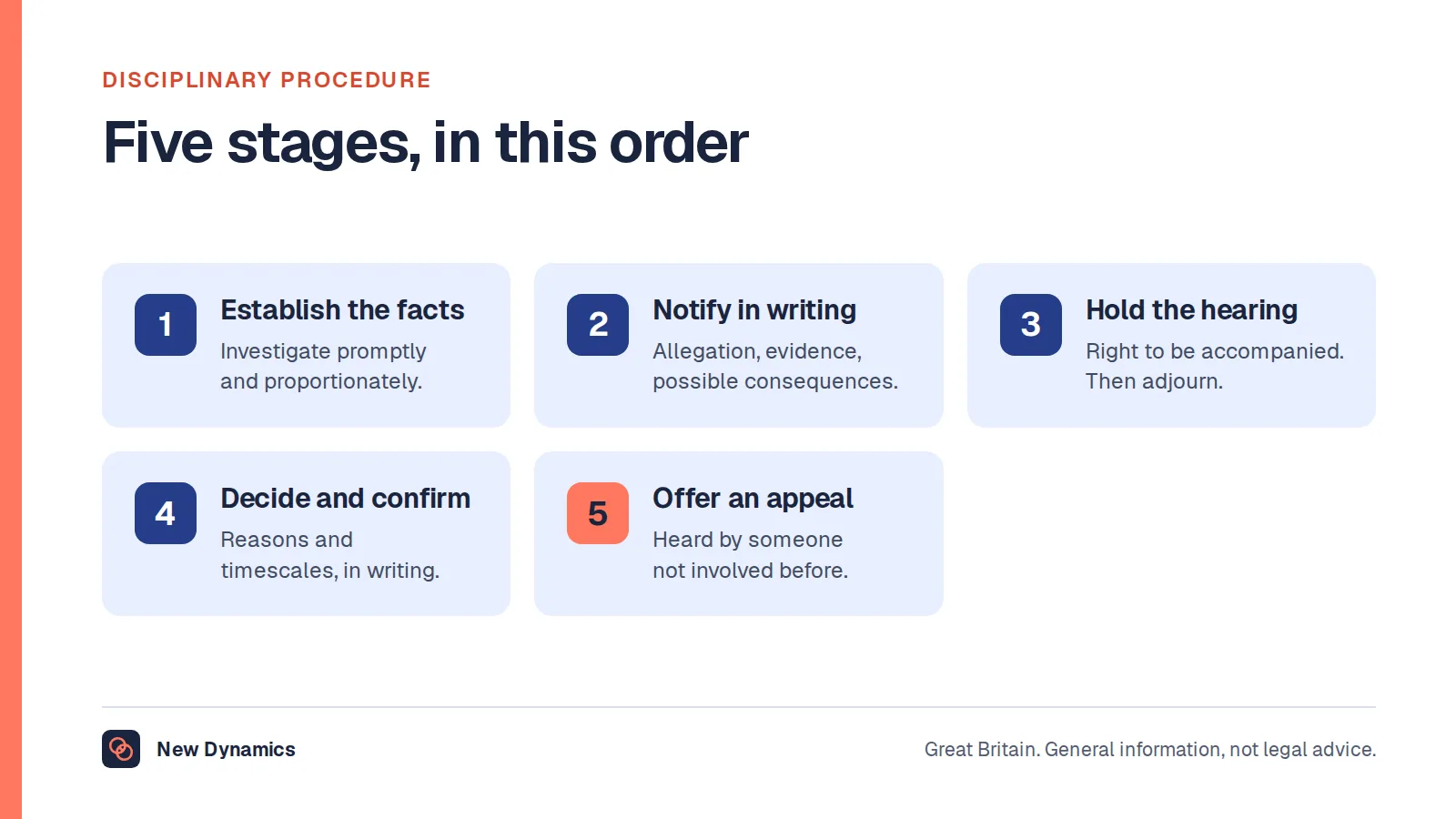
1. Investigate
Code paragraph 5: carry out necessary investigations "without unreasonable delay to establish the facts of the case". Paragraph 6 adds that in misconduct cases, where practicable, different people should carry out the investigation and the hearing. Paragraph 7 is the one managers forget: an investigatory meeting "should not by itself result in any disciplinary action".
2. Notify in writing
Code paragraph 9: if there is a case to answer, "the employee should be notified of this in writing", with enough information about the alleged misconduct or poor performance and its possible consequences for them to prepare to answer it. Normally that includes copies of the written evidence, witness statements included. Paragraph 10 adds the time and venue and notice of the right to be accompanied.
3. Hold a meeting, with the right to be accompanied
The right to be accompanied is statutory, not a courtesy. Section 10 of the Employment Relations Act 1999 applies where a worker "is required or invited by his employer to attend a disciplinary or grievance hearing" and "reasonably requests to be accompanied". The employer "must permit the worker to be accompanied at the hearing by one companion" chosen by the worker from a fellow worker, a trade union official, or a certified union representative. If that companion is not available, section 10(4) says the employer "must postpone the hearing" to a reasonable alternative time the worker proposes, provided it falls within five working days of the first working day after the day the employer proposed.
At the meeting, Code paragraph 12 requires the employer to explain the complaint and go through the evidence, and the employee to be allowed to set out their case, answer the allegations, ask questions, present evidence and call relevant witnesses.
4. Decide, and put it in writing
Code paragraph 18: after the meeting, decide whether action is justified "and inform the employee accordingly in writing". Acas adds that the outcome should be given "as soon as possible and in writing", and that for any outcome short of dismissal the employer should set specific goals and timeframes for improvement.
5. Offer an appeal
Code paragraph 26 says appeals should be heard without unreasonable delay, and paragraph 27 that the appeal "should be dealt with impartially and, wherever possible, by a manager who has not previously been involved in the case". Paragraph 28 confirms the right to be accompanied applies at the appeal too.
Our post on the disciplinary procedure walks through all of this stage by stage, including suspension and record keeping.
What the written warning should contain
Code paragraph 21 is the list, and it is short. A first or final written warning should set out:
- the nature of the misconduct or poor performance
- the change in behaviour or improvement in performance required, with a timescale
- how long the warning will remain current
- the consequences of further misconduct or a failure to improve within the set period, for example dismissal or another contractual penalty such as demotion or loss of seniority
Acas's own outcome guidance adds a fifth item for performance cases: any support or training the employer will provide. And since the warning is a formal decision, it should name the right of appeal and say how to exercise it.

A sample written warning to adapt
This is a template to edit, not a document to send as it stands, and not legal advice. Check it against your own disciplinary policy, your contracts and the facts of your case before it leaves the building. The square brackets are the parts only you can fill in.
Private and confidential. First written warning.
Dear [employee name],
I am writing to confirm the outcome of the disciplinary meeting held on [date] at [location], which you attended with [companion name and whether a colleague or a trade union representative] / which you attended unaccompanied, having been told of your right to be accompanied in my letter of [date].
The allegation put to you was that [state the conduct or performance concern in one or two factual sentences, with dates and specifics, and not as a character judgement]. The evidence considered was [list it: documents, witness statements, records, each of which was sent to you on (date)].
You said in response that [summarise the employee's account fairly, including anything that was accepted]. Having considered your response, my decision is that [state the finding and the reason for it in plain terms]. I have therefore decided to issue you with a first written warning.
The improvement required is that [state exactly what must change, in observable terms], and I expect this from [date] onwards. We will review progress at [frequency and dates]. The support the organisation will provide is [training, supervision, adjusted workload, a named point of contact, or state plainly that none is needed because this is a conduct matter rather than a capability one].
This warning will remain current until [date], which is [number] months from today, in line with paragraph [number] of our disciplinary policy. It will be kept on your personnel file and will be disregarded for disciplinary purposes after that date.
If there is further [misconduct of this kind / failure to meet the required standard] while this warning is current, it is likely to result in a final written warning, and continued failure after that may result in dismissal.
You have the right to appeal against this decision. If you wish to appeal, please write to [name and role of the appeal manager, who should not have been involved so far] by [date, commonly five or ten working days], setting out the grounds of your appeal. You have the right to be accompanied at any appeal hearing.
Yours sincerely,
[name, role]
Keep the signed copy, the meeting notes and the evidence together. Acas advises keeping a written record of all disciplinary cases, including those where no action is needed, and reminds employers that under data protection law those records must be confidential and kept only for as long as necessary.
How long a warning should stay live
No statute sets the period. The Code requires only that "the employee should be told how long the warning will remain current", which pushes the decision into your policy and then into the letter. No official source publishes a standard duration, so any figure you see quoted as the legal norm is somebody's policy rather than a rule.
In practice, policies commonly set six or twelve months for a first written warning and longer for a final one. Two things matter more than the number. First, the letter has to state it, because a warning with no stated expiry invites an argument later about whether it was live. Second, once it expires it should be disregarded for disciplinary purposes rather than quietly relied on in the next case.
Conduct or capability: pick the route before you write anything
Acas separates them at the very start of its disciplinary guidance. A disciplinary procedure deals with misconduct, "unacceptable or inappropriate behaviour", and with capability, "the ability to perform the job properly". Section 98(3)(a) of the Employment Rights Act 1996 defines capability as "capability assessed by reference to skill, aptitude, health or any other physical or mental quality".
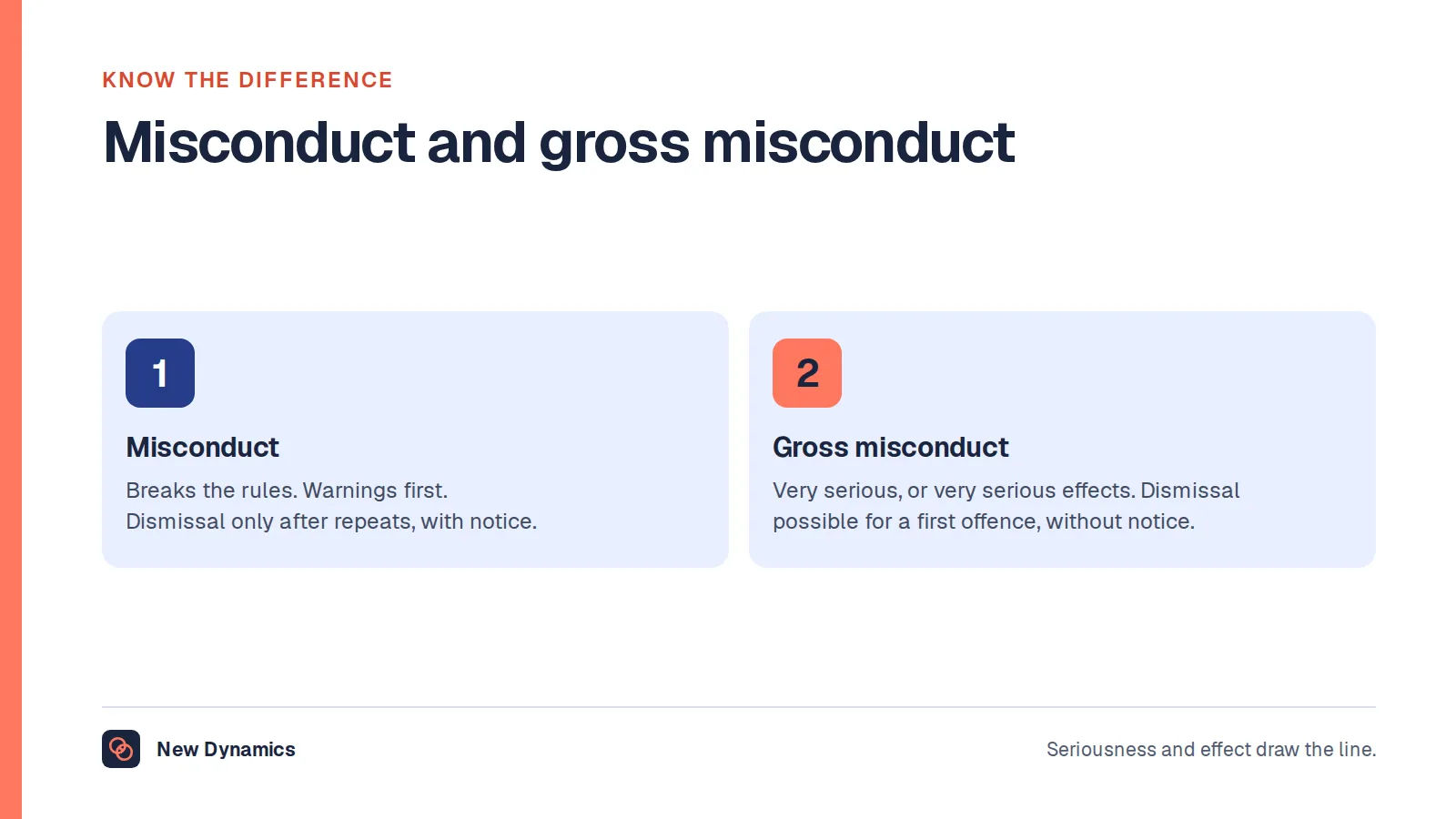
The practical difference is what the employer owes first. For capability, Acas says employers should try mentoring, coaching or training "first before starting a formal disciplinary procedure", and notes that some employers use a separate capability procedure, which "must still be in line with the Acas Code of Practice". For conduct, the question is whether a rule was broken, not whether support was offered.
Getting this wrong in the letter is a real risk. A warning that says someone is not capable, when the actual complaint is that they ignored an instruction, hands the employee the inconsistency. Our post on capability procedure steps covers the performance route, and gross misconduct covers the band where dismissal without notice becomes possible.
The Code is being rewritten, and the cost is the reason
Acas opened a consultation on a draft updated Code, issued 30 July 2026 and closed on 23 September 2026, and is now reviewing responses. The published foreword gives the reason in figures: "formal disciplinary and grievance procedures cost UK employers an estimated £2.36 billion a year", and new Acas research "showed 44% of working-age adults in Great Britain experienced conflict at work in the last 12 months".
The current Code, published 11 March 2015, still governs until an updated one is approved and laid before Parliament. The draft leans towards earlier and more informal resolution, which is worth knowing before you reach for a formal warning in a case a conversation would settle. For the wider picture, see our HR statistics hub.
Frequently asked questions
Is an employee write-up the same as a written warning in the UK?
Not quite. Writing someone up is American usage for an internal disciplinary record. The UK equivalent is a formal written warning, which Acas describes as a warning given at the end of a disciplinary procedure. The difference is that the UK version requires an investigation, a written notification, a meeting with the right to be accompanied and an appeal before it can be issued.
Can you give an employee a written warning without a meeting?
You should not. The Acas Code says the employee should be notified of the case in writing and given an opportunity to put their case in response before any decision is made. A tribunal takes the Code into account and can increase an award by up to 25 per cent for an unreasonable failure to follow it, so skipping the meeting is the step most likely to cost money.
What are the reasons to write up an employee?
There is no official list. The legal categories are conduct and capability, which section 98(2) of the Employment Rights Act 1996 names among the potentially fair reasons for dismissal. Acas gives conduct examples including bullying, harassment, insubordination and unauthorised absence, and says organisations may have their own. The reason must match your own rules and be applied consistently with earlier cases.
What must a written warning letter say?
Code paragraph 21 requires the nature of the misconduct or poor performance, the change or improvement required with a timescale, how long the warning will remain current, and the consequences of further misconduct or a failure to improve. Acas adds any support or training for performance cases. In practice the letter should also name the right of appeal.
How long does a written warning stay on record?
No statute sets a period. The Acas Code says only that the employee should be told how long the warning will remain current, so the duration comes from the employer's policy and from the letter. Policies commonly use six or twelve months for a first written warning. An expired warning should not be relied on in a later case.
Does an employee have the right to bring someone to a disciplinary meeting?
Yes. Section 10 of the Employment Relations Act 1999 gives a worker who reasonably requests it the right to be accompanied by one companion of their choice: a fellow worker, a trade union official, or a certified union representative. If the companion is not available, the employer must postpone the hearing to a reasonable time the worker proposes within five working days.
Your next step: check one real letter against the Code
- Take the last written warning your organisation issued and lay it beside Code paragraph 21. Does it name the issue, the change required, the timescale, how long it stays current and the consequences?
- Check whether the file holds the notification letter sent before the meeting. If the first document is the warning itself, the procedure started in the wrong place.
- Confirm that the right to be accompanied was offered in writing, not just mentioned, and that the companion's name is recorded.
- Check who heard the appeal. If it was the same manager who decided, fix the policy before the next case.
- Decide, in your policy rather than case by case, how long a first and a final warning stay current, write the period into the letter template, and delete any write-up form in circulation that produces a warning without the steps in front of it.
To get your conduct rules, procedures and standards into one document people actually read, read and download our employee handbook guide. The guide is free to read, and the PDF uses our short download form.
Want the record of conversations, concerns and goals to exist before a formal step is needed rather than after? Book a New Dynamics demo and bring your current disciplinary policy. You can also email contact@new-dynamics.com.