TL;DR
- No statutory provision sets a date by which final pay must be paid. Acas guidance states that a worker should get their final pay on the date they are normally paid, and the enforceable duty comes from the contractual payday plus section 13 of the Employment Rights Act 1996, which treats a shortfall on a payday as a deduction.
- Accrued untaken statutory holiday is the one entitlement that converts to cash on leaving. Regulation 14 of the Working Time Regulations 1998 requires a payment in lieu of leave, and GOV.UK states that employers must pay for untaken statutory leave even where the worker is dismissed for gross misconduct.
- Overtaken holiday can only be recovered where a relevant agreement already provides for it, and the claim limit for an unlawful deduction from final pay rose from three months to six on 1 October 2026 for matters arising on or after that date.
Most writing on final pay asserts a rule that does not exist: that an employer has so many days to pay a leaver. You will be told seven days, or fourteen, or the last working day. None of it comes from a statute, and a leaver who insists on a deadline nobody set tends to lose the argument and then the money. This answers the question properly for the United Kingdom. It is general information rather than legal or tax advice.
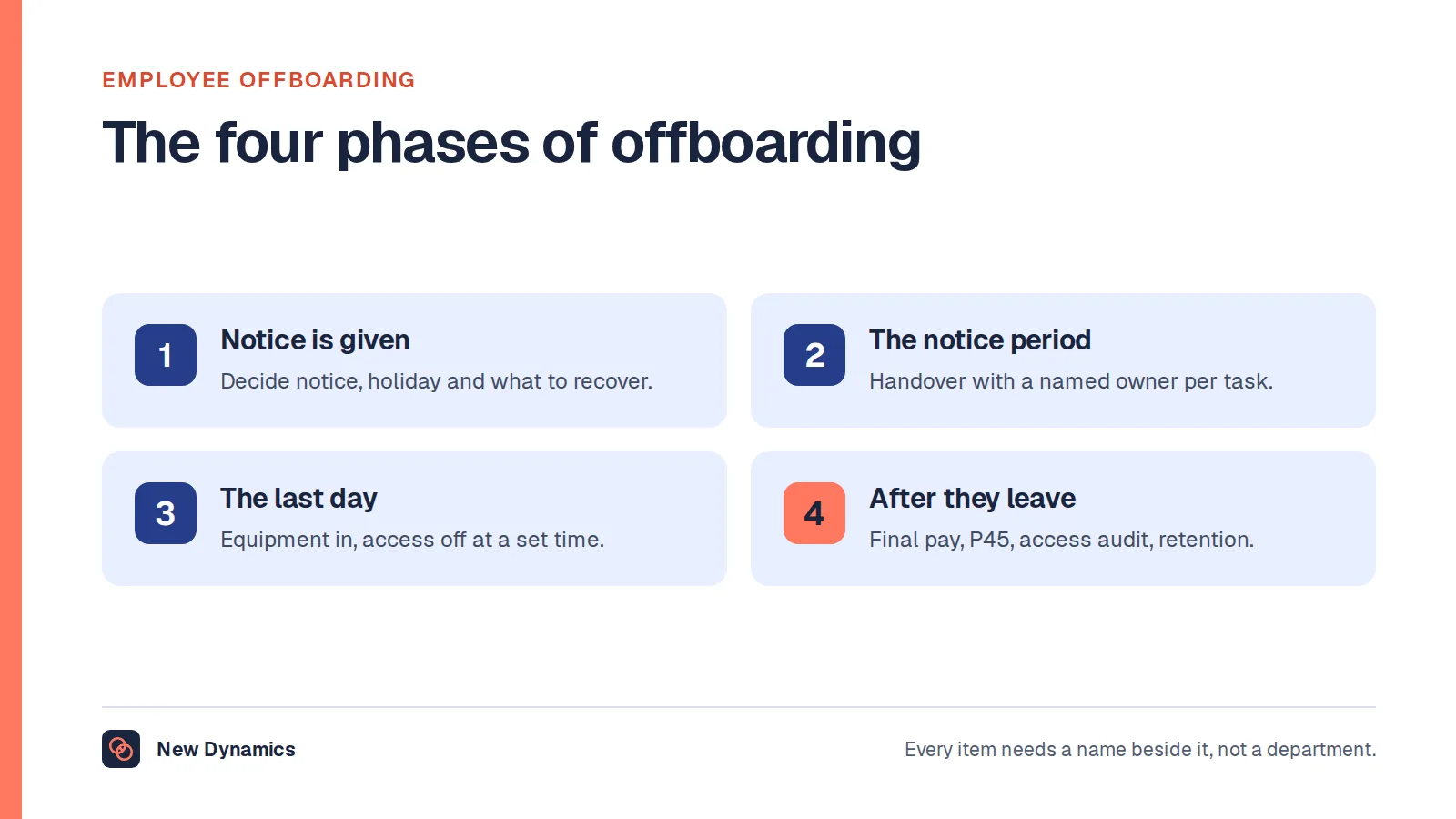
Final pay goes wrong because the facts that decide it are set months earlier, in the leave record and the contract, and nobody reads them until the last payroll run. See how New Dynamics workflows keep a leaver process on one visible path with an owner against each step, so the holiday figure and the deduction authority exist before payroll needs them.
Is there a legal deadline for final pay?
No. No provision of UK employment law sets a date by which an employer must pay a leaver, and no official source we could open publishes one. Two things fix the date instead.
The first is the contract, through the ordinary payday. Acas guidance on final pay when someone leaves a job, last updated 19 May 2026, puts it as an expectation rather than a statutory deadline: "A worker should get their final pay on the date they are normally paid." Someone paid monthly who leaves mid month "will probably get their final pay at the end of the month."
The second is section 13 of the Employment Rights Act 1996, which makes that payday enforceable without naming it. Where wages paid on an occasion are less than "the wages properly payable", section 13(3) treats the deficiency as a deduction. Paying nothing on the normal payday is a deduction of everything, and that is the thing with a remedy attached. GOV.UK states the baseline the same way on deductions from your pay: "Normally you're entitled to be paid everything you've earned up to the point you finish."
So: on your normal payday. If it does not arrive, what starts is the clock on a claim, not a clock on the employer.
What must be in final pay

Salary earned up to the last day, including a part month. Acas lists "only working part of the week or month" among the reasons final pay differs from a normal month, which is why the gross figure often looks wrong before anything is wrong.
Accrued untaken statutory holiday, paid in cash. GOV.UK guidance on taking holiday before leaving a job states: "The only time someone can get paid in place of taking statutory leave (known as 'payment in lieu') is when they leave their job. Employers must pay for untaken statutory leave, even if the worker is dismissed for gross misconduct."
Pay for the notice period. Acas states that "Anyone with the legal status of employee must be paid as normal for any time they work during their notice period", with payment in lieu of notice instead where the contract provides for it or it has been agreed.
Contractual entitlements. HMRC's manual at EIM12850 treats "A payment received under the terms and conditions of service" as earnings taxable in full, and those terms "may be in the main contract document or elsewhere, for example in a staff handbook or letter of appointment".
The provision behind the holiday payment
Regulation 14 of the Working Time Regulations 1998 is the source. Where employment ends part way through a leave year and the worker has taken less leave than the elapsed proportion of it, regulation 14(2) provides that "his employer shall make him a payment in lieu of leave".
Two details get missed. The statutory formula in 14(3)(b) applies only "where there are no provisions of a relevant agreement which apply", so an agreement can set the sum instead. And regulation 14(6), inserted on 1 January 2024, requires a payment in lieu for leave carried over from an earlier year too.
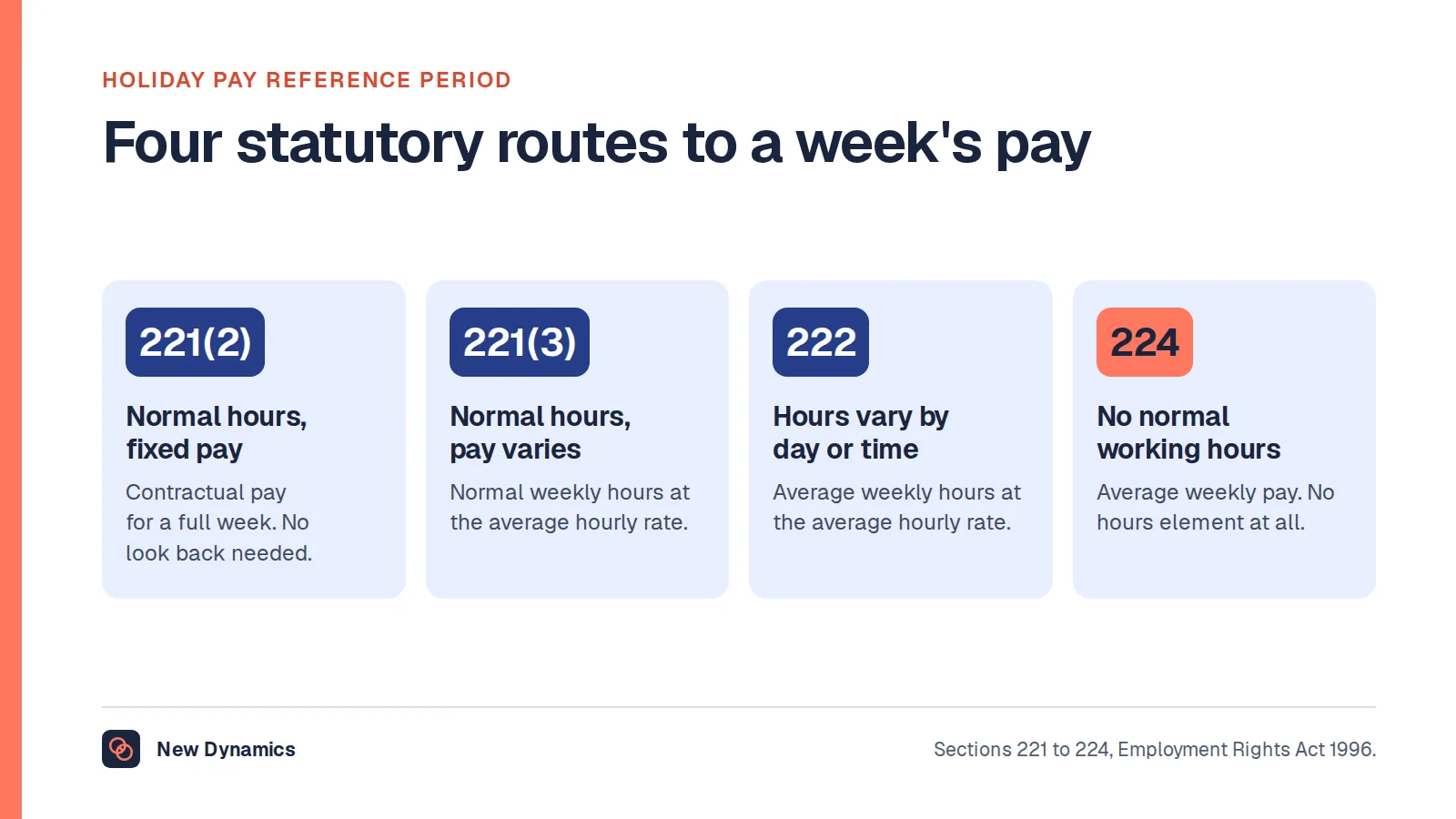
Regulation 16 sets the rate, applying sections 221 to 224 of the Employment Rights Act 1996 with modifications. That calculation is its own subject: our post on the holiday pay reference period covers the 52 weeks, which weeks drop out and the 104 week limit on looking back.
What an employer may deduct from final pay
Deductions from final pay are not a special category. The same closed list applies on the way out as every month. Section 13(1) permits a deduction only where it is "required or authorised to be made by virtue of a statutory provision or a relevant provision of the worker's contract", or the worker "has previously signified in writing his agreement or consent". Our post on payroll deductions covers the grounds, the minimum wage floor and the retail cap in full.

Two points belong specifically to a leaver. The word "previously" does real work: section 13(5) adds that a term introduced by a variation does not authorise a deduction "on account of any conduct of the worker, or any other event occurring, before the variation took effect". The authority has to exist before the event, so it cannot be created in the exit conversation. Acas applies the same logic to training costs, where the agreement "must be in writing before the training course starts".
One caution for retail employers: GOV.UK's 10% cap on recovering till shortfalls each pay period comes with an exception at the end, because "If you leave your job, they can take the full amount owed from your final pay."
Overtaken holiday: can an employer claw it back?
Only where the authority already exists, and the default is that it does not. Regulation 14(4) is permissive: "A relevant agreement may provide that, where the proportion of leave taken by the worker exceeds the proportion of the leave year which has expired, he shall compensate his employer". May provide. Absent that agreement, the regulation creates no debt.
GOV.UK puts it as a prohibition: "If a worker has taken more leave than they're entitled to, their employer must not take money from their final pay unless it's been agreed beforehand in writing." Put section 13(5) beside that and the rule is blunt. If the clause was not already in place when the leave was taken, overtaken holiday is a loss the employer absorbs.
The P45, and a payment made after it
GOV.UK guidance on what to do when an employee leaves states: "You must give your employee a P45 when they leave." It sets no deadline in days, and we found no official source that does. GOV.UK ties it to the payroll run instead: put the leaving date on the payroll record "when you last pay them".
A payment made after the P45 has its own treatment, which is where a late holiday figure lands. GOV.UK says to use "tax code 0T on a 'week 1' or 'month 1' basis", deduct National Insurance and any student loan repayments as normal, and treat an irregular payment "like accrued holiday pay or an unexpected bonus" as a weekly payment. Report it "in your next FPS, using the employee's original 'Date of leaving' and payroll ID", set the payment after leaving indicator, and give the leaver written confirmation of the gross amount and deductions. The same page is explicit: "You must not give the employee another P45." Warn the leaver that 0T carries no personal allowance, so such a payment is usually overtaxed at source and reconciled later.
Tax on a termination payment, and what the £30,000 does not cover
The £30,000 figure is real and almost always misapplied. It comes from section 403(1) of the Income Tax (Earnings and Pensions) Act 2003: a payment to which the section applies counts as employment income "if and to the extent that it exceeds the £30,000 threshold".
Its scope is narrow, and the statute says why. Section 401(3) provides that "This Chapter does not apply to any payment or other benefit chargeable to income tax apart from this Chapter." HMRC puts the consequence first in its manual at EIM13000, updated 3 November 2026: "Payments and other benefits are only chargeable under the special rules in section 401 ITEPA 2003 if they cannot be charged to income tax in any other way."
That is the whole point. GOV.UK notes on tax and National Insurance after redundancy that a termination payment "could include" statutory redundancy pay, holiday pay, unpaid wages and company benefits, and that "Statutory redundancy pay under £30,000 is not taxable." The wages and the holiday pay in that list are earnings taxed in the ordinary way, so the threshold never reaches them.
Two further restrictions. HMRC guidance at EIM13874 states that since 6 April 2018 "some termination payments and benefits are chargeable to income tax as general earnings and no longer benefit from the £30,000 threshold", the carved out element being post-employment notice pay. And section 403(4) aggregates the threshold across qualifying payments rather than applying it to each. So the question about a settlement figure is not whether it is under £30,000, but which parts of it are earnings. This is not tax advice.
Pension and student loan in the final payslip
Neither stops because someone is leaving, and no official source sets a special leaver rule for either.
Pension. The contribution in the final pay period is worked out as in any other, on qualifying earnings in that pay reference period. Section 13(3) of the Pensions Act 2008 defines earnings for this purpose as a closed list, "salary, wages, commission, bonuses and overtime" plus the named statutory payments, and a redundancy payment is not in it. For the 2026 to 2027 tax year, The Pensions Regulator's published earnings thresholds put the lower level of qualifying earnings at £6,240 a year (£520 a month) and the upper level at £50,270 a year. Beyond that the scheme rules govern.
Student loan. Deductions continue through the final payslip and past it. HMRC's guidance for employers, last updated 6 April 2026, is direct: "When an employee leaves, check if you're making student loan or postgraduate loan deductions." Where they should continue, the employer should "fill in P45 with 'Y' in box 5", and do so "even if your employee has not earned enough to make student loan or postgraduate loan repayments". For money paid after the leaving date, work out the deductions "on the same amount, and for the same earnings period, as for employer's secondary Class 1 National Insurance contributions".
Thresholds decide whether anything comes out. For 2026 to 2027, GOV.UK's rates and thresholds for employers sets the employee earnings threshold at £26,900 a year for Plan 1 and £25,000 for Plan 5, with deductions at 9%, and £21,000 with deductions at 6% for a postgraduate loan. A part month final payslip can fall under the monthly threshold and produce no deduction at all, which is correct rather than an error. More pay figures are on our HR statistics hub.
If final pay is wrong, late or missing
Raise it with the employer first. Acas is plain: "If you think your final pay is wrong, you should raise this with your employer. It's usually best to raise the problem informally first."
The formal route is an unlawful deduction from wages. Section 23(1)(a) lets a worker complain to a tribunal that the employer "has made a deduction from his wages in contravention of section 13", and section 13(3) is what turns an unpaid final payslip into a deduction. Holiday pay is covered, because section 27(1)(a) includes "any fee, bonus, commission, holiday pay or other emolument referable to his employment" in the meaning of wages.
The time limit changed on 1 October 2026. Section 23(2) now reads six months, substituted on that date by the Employment Rights Act 2025 through commencement regulations made on 1 September 2026. Their explanatory note records that the provisions "extend time limits for instituting claims to employment tribunals from three to six months". Regulation 4(1) is the part to check before relying on six months: "The amendments made by Schedule 12 to the 2025 Act do not apply in any case where the relevant date occurs before 1st October 2026." For a deduction from wages the schedule sets that relevant date as "The date of payment of the wages from which the deduction in contravention of section 13 of the 1996 Act was made", so a final payday that fell earlier still runs on three months.
Two limits sit behind it. Section 23(4A) stops a tribunal considering any part of a complaint where the payday was more than two years before the claim. And section 27(2)(d) excludes "any payment referable to the worker's redundancy" from the meaning of wages, so an unpaid redundancy payment is not an unlawful deduction claim and must be pursued another way, which catches people who assume one claim covers the whole final payslip.
Next steps
The fix is almost never in payroll. It is whether the leave balance and the deduction authority exist in writing before the last payroll run.
- Write the holiday figure when notice is given, and check for leave carried forward under regulation 14(6).
- Audit the deduction clauses you rely on, remembering that section 13(5) rules out adding one afterwards.
- Tell the leaver in writing which payday their final pay falls on and what will be in it.
Our compensation policy guide covers how to write the pay rules a final payslip is read against, including deduction authority and what has to be in writing. If the leaver record, the holiday balance and the payroll instruction live in three places, that is the thing to fix. Book a New Dynamics demo and we will walk through how a leaver process holds one record with an owner on every step.
Frequently asked questions
When should I receive my final pay after leaving a job?
On your normal payday. Acas guidance states that a worker should get their final pay on the date they are normally paid. No UK statute sets a separate deadline, so the enforceable date is the contractual payday. This covers the United Kingdom and is general information rather than legal advice.
Does my employer have to pay me for holiday I have not taken?
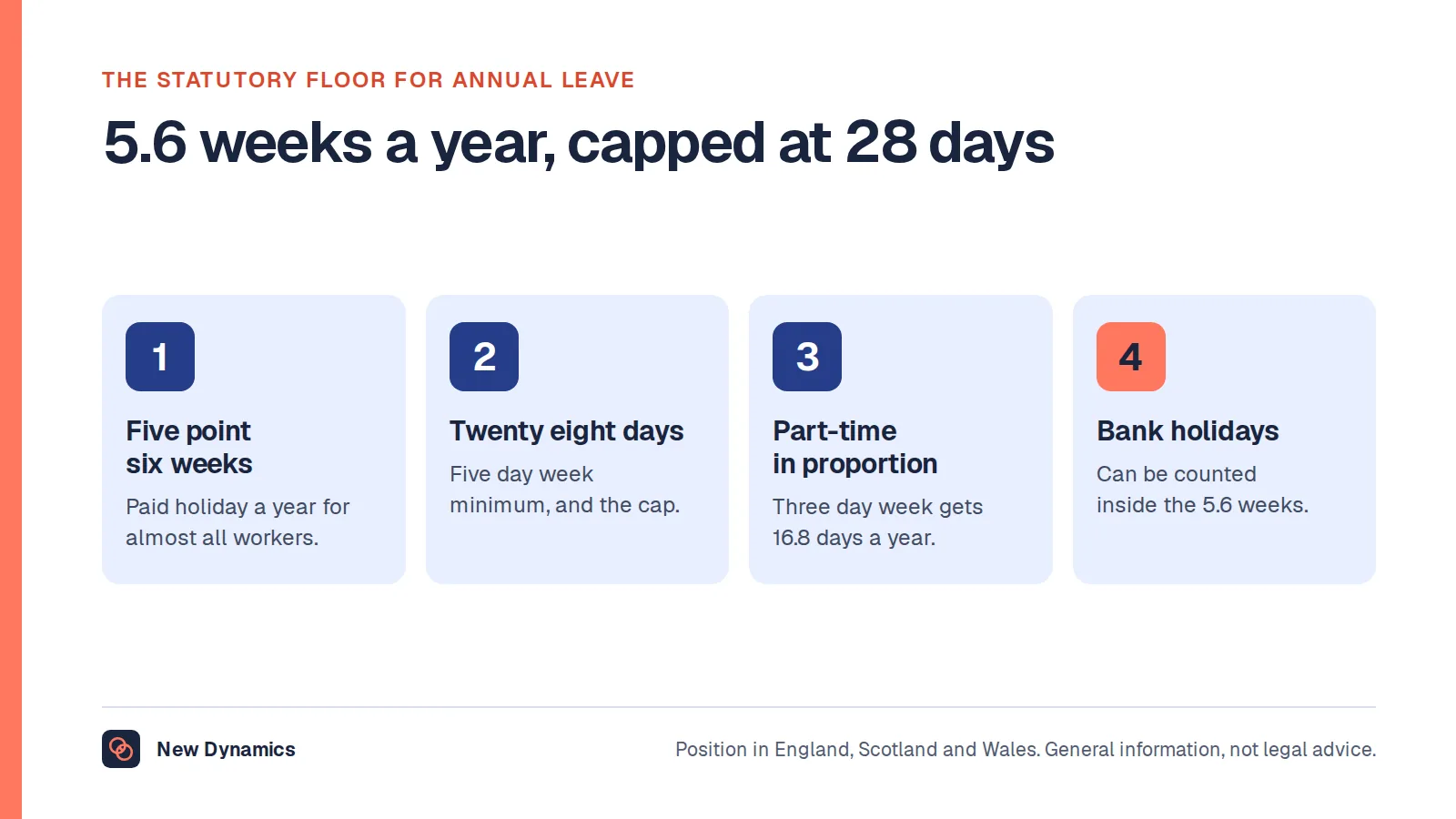
Yes, for statutory leave. Regulation 14(2) of the Working Time Regulations 1998 requires a payment in lieu where the worker has taken less of their leave than the proportion of the leave year that has expired, and GOV.UK adds that employers must pay for untaken statutory leave even if the worker is dismissed for gross misconduct. Leave above the statutory 5.6 weeks is contractual, so check the contract.
Can my employer deduct money for holiday I had already taken?
Only if that was agreed before the leave was taken. Regulation 14(4) says a relevant agreement may provide for the worker to compensate the employer, so the authority has to already exist. GOV.UK states that an employer must not take money from final pay for overtaken leave unless agreed beforehand in writing, and section 13(5) of the Employment Rights Act 1996 blocks a later variation from authorising it.
When must an employer issue a P45?
GOV.UK guidance states that you must give your employee a P45 when they leave, and tells employers to put the leaving date on the payroll record when the employee is last paid. No official source we could open sets a deadline in days, so treat it as part of the final payroll run rather than a separate countdown.
What happens if I am paid something after my P45?
The employer uses tax code 0T on a week 1 or month 1 basis, deducts National Insurance and student loan repayments as normal, and treats an irregular payment such as accrued holiday pay as a weekly payment. It goes on the next Full Payment Submission with the original leaving date and the payment after leaving indicator set, and you should get written confirmation of the gross amount and deductions. You must not be given a second P45, and because 0T carries no personal allowance the payment is often overtaxed and reconciled later.
How long do I have to claim unpaid final pay?
Six months, if the relevant date falls on or after 1 October 2026. Section 23(2) of the Employment Rights Act 1996 was amended to six months on that date by the Employment Rights Act 2025, and the commencement regulations state that the change does not apply where the relevant date occurs before 1 October 2026. For a deduction from wages that date is the payday the deduction was made from, so an earlier final payday still runs on three months.
Is the first £30,000 of my final pay tax free?
No. The £30,000 threshold in section 403 of the Income Tax (Earnings and Pensions) Act 2003 applies only to a termination award that is not chargeable to income tax under any other provision, which HMRC states plainly in its Employment Income Manual. Wages, accrued holiday pay and post-employment notice pay are earnings and taxed in full, and the threshold is aggregated across qualifying payments rather than applied to each. This is not tax advice.