TL;DR
- The 52 weeks is not in the Employment Rights Act 1996. Sections 221 to 224 say twelve weeks. Regulation 16(3)(e) of the Working Time Regulations 1998 substitutes 52 for twelve when the calculation is holiday pay, so payroll reads a figure the Act never states.
- Weeks with no pay, and any week containing sick leave or statutory leave, are excluded. Earlier paid weeks replace them, but regulation 16(3ZG) stops the search at 104 weeks. GOV.UK puts it plainly: if an employer has counted back over 104 weeks and found only 40 weeks of pay data, it should use those 40 weeks.
- Rolled up holiday pay is lawful again, but only for irregular hours and part-year workers, only from a leave year beginning on or after 1 April 2024, and only if it is shown on the payslip. For a leave year running from 1 January, that first lawful year began on 1 January 2025, not in April 2024.
Payroll has a week of leave to pay and one person whose hours never repeat. The entitlement side is settled. The pay side is not, because the question is not what the worker earns but what the worker earned, and over which weeks.
That window is the holiday pay reference period. It is 52 weeks long, it skips some of those weeks, it may reach back two years to fill the gaps, and since 2024 it can be replaced altogether for one group of workers by a percentage added to every payslip. This article takes each of those rules from the instrument or the government page that states it, names the version in force, and says where two official sources do not match. It covers the United Kingdom, specifically England, Wales and Scotland, where the Working Time Regulations 1998 apply. It is general information and not legal advice.
Most of the damage here is administrative rather than legal: nobody records which weeks were excluded, so no one can reproduce the figure a year later. See how New Dynamics workflows keep a decision, its inputs and its approval on one record.
Where the 52 weeks comes from, and why the Act says twelve
The entitlement to be paid is in regulation 16(1) of the Working Time Regulations 1998: a worker is entitled to be paid "at the rate of a week's pay in respect of each week of leave". Regulation 16(2) then says that "Sections 221 to 224 of the 1996 Act shall apply for the purpose of determining the amount of a week's pay", subject to modifications.
Open those sections of the Employment Rights Act 1996 and the number 52 is not there. Section 221(3) uses "the period of twelve weeks ending" with the last complete week before the calculation date. So does section 222(4). So does section 224(2).
The 52 arrives by substitution. Regulation 16(3)(e) applies those sections "as if in sections 221(3), 222(3) and (4), 223(2) and 224(2) and (3) references to twelve were references to" either "the number of complete weeks for which the worker has been employed", where that is under 52, or "in any other case, 52". That wording was inserted on 6 April 2020 by the Employment Rights (Employment Particulars and Paid Annual Leave) (Amendment) Regulations 2018. The reference period for holiday pay is therefore a modified version of a twelve week statutory formula. Reading the Act alone gives the wrong answer, and so does assuming that every calculation built on a week's pay uses the same window.
Regulation 16(3)(c) fixes the start of the count: the calculation date is "the first day of the period of leave in question". Not the start of the month, not the payroll cut-off. Each absence has its own reference period.

Which workers are on the reference period, and which are not
Two separate questions get merged here. How much leave someone accrues is one rule. What a week of it costs is another.
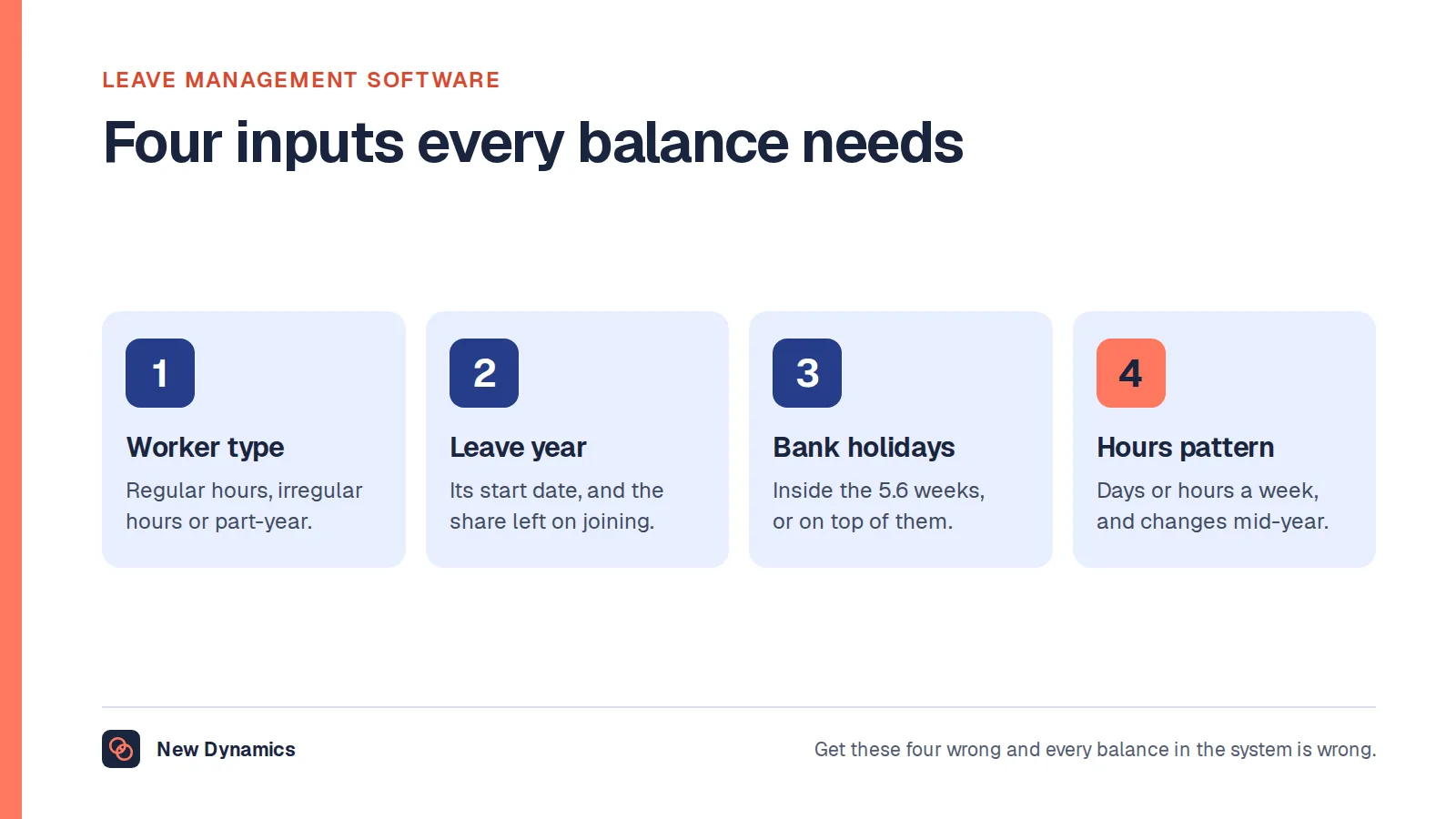
Accrual splits by worker type. Regulation 15B, inserted on 1 January 2024, applies to irregular hours workers and part-year workers "in respect of any leave years beginning on or after 1st April 2024", and gives them 12.07% of hours worked in each pay period. Both terms are defined in regulation 15F(1), by contract rather than by practice: hours that are "wholly or mostly variable" under the contract, or a contract requiring work in only part of the year with unpaid gaps "of at least a week". Everyone else stays on regulation 13 and 13A. Our post on holiday entitlement works through that accrual and the normal pay test in detail, so this article leaves both alone.
Pay splits differently, by how someone is paid rather than by which accrual rule they sit under. GOV.UK's holiday pay guidance gives three working patterns. For "Regular hours and fixed pay (full- or part-time)" a week's pay is simply "A worker's pay for a week". For "Shift work with regular hours" it is "The average number of weekly fixed hours a worker has worked in the previous 52 weeks, at their average hourly rate". For "Irregular-hours and part-year work" it is "A worker's average pay from the previous 52 weeks (only counting weeks in which they were paid)".
The statute has four routes rather than three. Section 221(2) covers normal working hours where pay does not vary with work done, and needs no look back at all. Section 221(3) covers normal working hours where pay does vary, and averages the hourly rate. Section 222 covers the case where the days or times of work differ from week to week, and averages both the hours and the rate. Section 224 covers employment with no normal working hours, and averages weekly pay. A salaried colleague on fixed hours never enters a reference period. A shift worker on fixed weekly hours enters it for the rate only. A zero hours worker enters it for everything.
Building the 52 weeks: which weeks drop out, and how far back you may go
Five provisions do the work, all inserted on 1 January 2024 by the Employment Rights (Amendment, Revocation and Transitional Provision) Regulations 2023.
Regulation 16(3ZD) sets the window for someone with at least 52 complete weeks of service: "the period of 52 weeks ending" with the calculation week, or otherwise "with the last complete week before the calculation date". Regulation 16(3ZC) shortens it for anyone with less service to "the number of complete weeks for which the worker has been employed".
Regulation 16(3ZE) then removes weeks. No account is taken of any week in which "no remuneration was payable to the worker" or in which the worker "was, for any amount of time, on sick leave or statutory leave". Note "for any amount of time". One day of certified sickness removes the whole week from the average.
Regulation 16(3ZF) refills the gap: "earlier weeks shall be taken into account so as to bring the number of weeks to 52 (or as close to 52 as possible)". The bracket is the point. Fifty two is a target, not a guarantee.
Regulation 16(3ZG) is the backstop. No account is taken of remuneration in weeks preceding "the period of 104 weeks ending" with the calculation week. Regulation 16(3)(f)(i) imposes the same 104 week limit on the older top up in sections 223(2) and 224(3). GOV.UK states the consequence without hedging: "If an employer has counted back over 104 weeks and has only found 40 weeks of pay data for a worker, then the employer should use these 40 weeks of pay data." Acas puts the same limit as a rule of practice on its page for irregular hours and part-year workers, last updated 22 April 2026: an employer "should only count back as far as needed to get 52 weeks of a worker's usual pay. If necessary, they can look at the pay the worker got over the previous 104 weeks, but no further."
A week is defined too. Regulation 16(3B) says a week ends with Saturday, unless the worker's remuneration "is calculated weekly by a week ending with a day other than Saturday", in which case it ends with that day. GOV.UK gives the worked version: a worker paid by a week ending on a Wednesday has weeks running Thursday to Wednesday.

When there is no usable week at all
A new starter who books leave in week one leaves payroll with nothing to average. Regulation 16(3A), in force since 6 April 2020, answers that case directly. Where the modified sections give "no weeks of which account is taken", a week's pay "is the amount which fairly represents a week's pay having regard to the considerations specified in section 228(3)".
GOV.UK translates those considerations into three things an employer should take into account: "the worker's pay for the job", "the pay already received by the worker (if any)", and "what other workers doing a comparable role for the employer (or for other employers) are paid". That is a judgement with a statutory shape, so write down which of the three you used and what figure it produced. It is the one holiday pay calculation that cannot be rebuilt from a payroll extract later.
A week's pay when there are no normal working hours
For a worker with no normal working hours, section 224(2) makes a week's pay "the amount of the employee's average weekly remuneration" over the reference period, and section 224(3) excludes "a week in which no remuneration was payable". There is no hours calculation at all, because there are no normal hours to count.
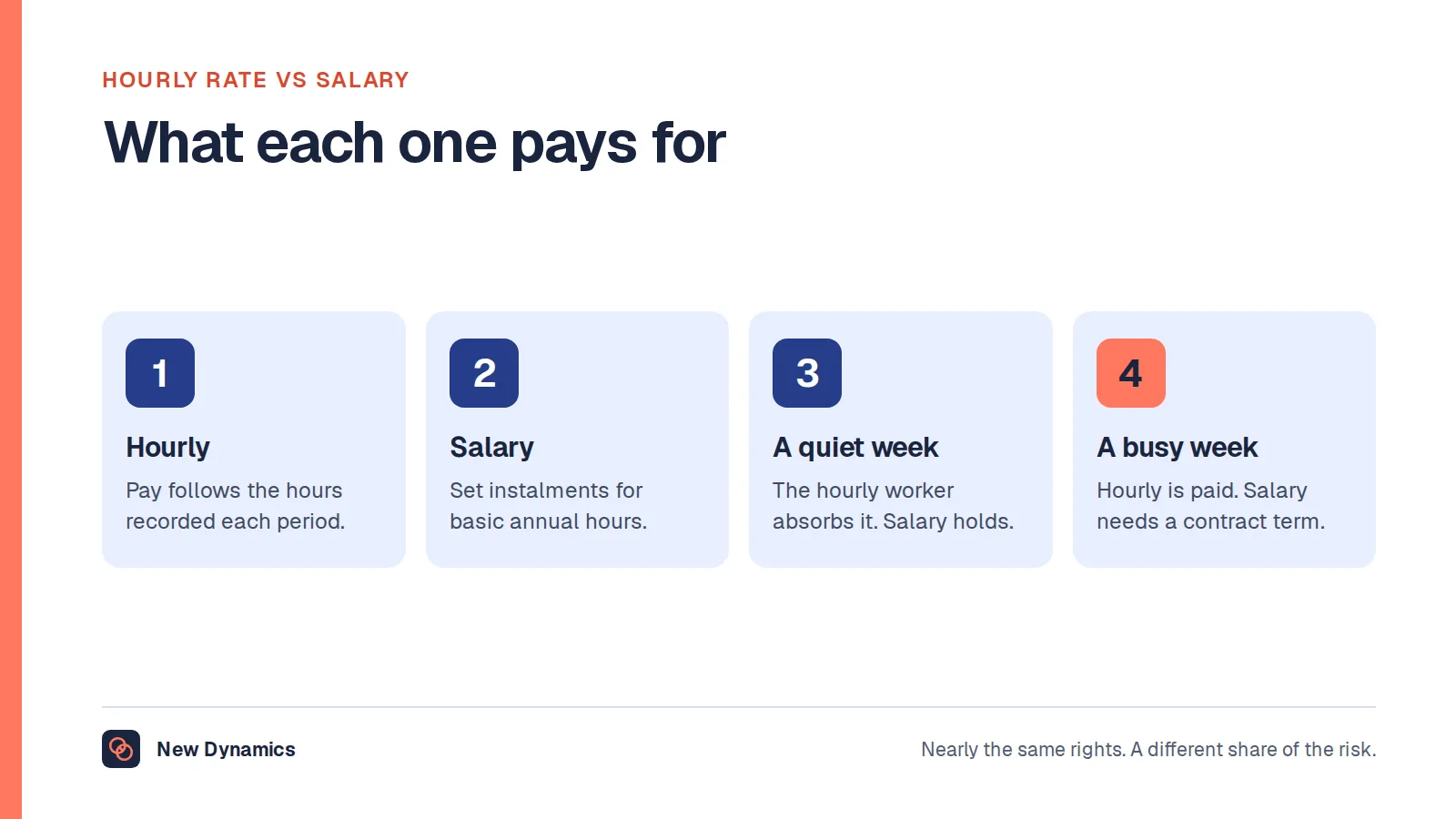
On top of that sits the content rule. Regulation 16(3ZA) requires three kinds of payment to be included for regulation 13 and regulation 15B leave: payments "intrinsically linked to the performance of tasks which a worker is obliged to carry out under the terms of their contract", including commission; payments for "length of service, seniority or professional qualifications"; and "other payments, such as overtime payments, which have been regularly paid to a worker in the 52 weeks preceding the calculation date". Regulation 16(3ZB) explains the mechanism where those payments are not already caught: average them over the relevant period and add the result to the week's pay from the Act. Our post on overtime pay covers the regularity test, and hourly rate versus salary covers why the salaried version of this calculation is so much quieter.
One subtlety worth marking in a payroll specification: regulation 16(3)(da) disapplies section 223(3) and section 234 for regulation 13 and regulation 15B leave. Section 223(3) is the provision that would otherwise strip overtime back down to the basic rate.
Rolled up holiday pay: who may use it, from when, and at what rate
Rolled up holiday pay is the alternative to the reference period: instead of paying for leave when leave is taken, the employer adds an amount to every pay packet.
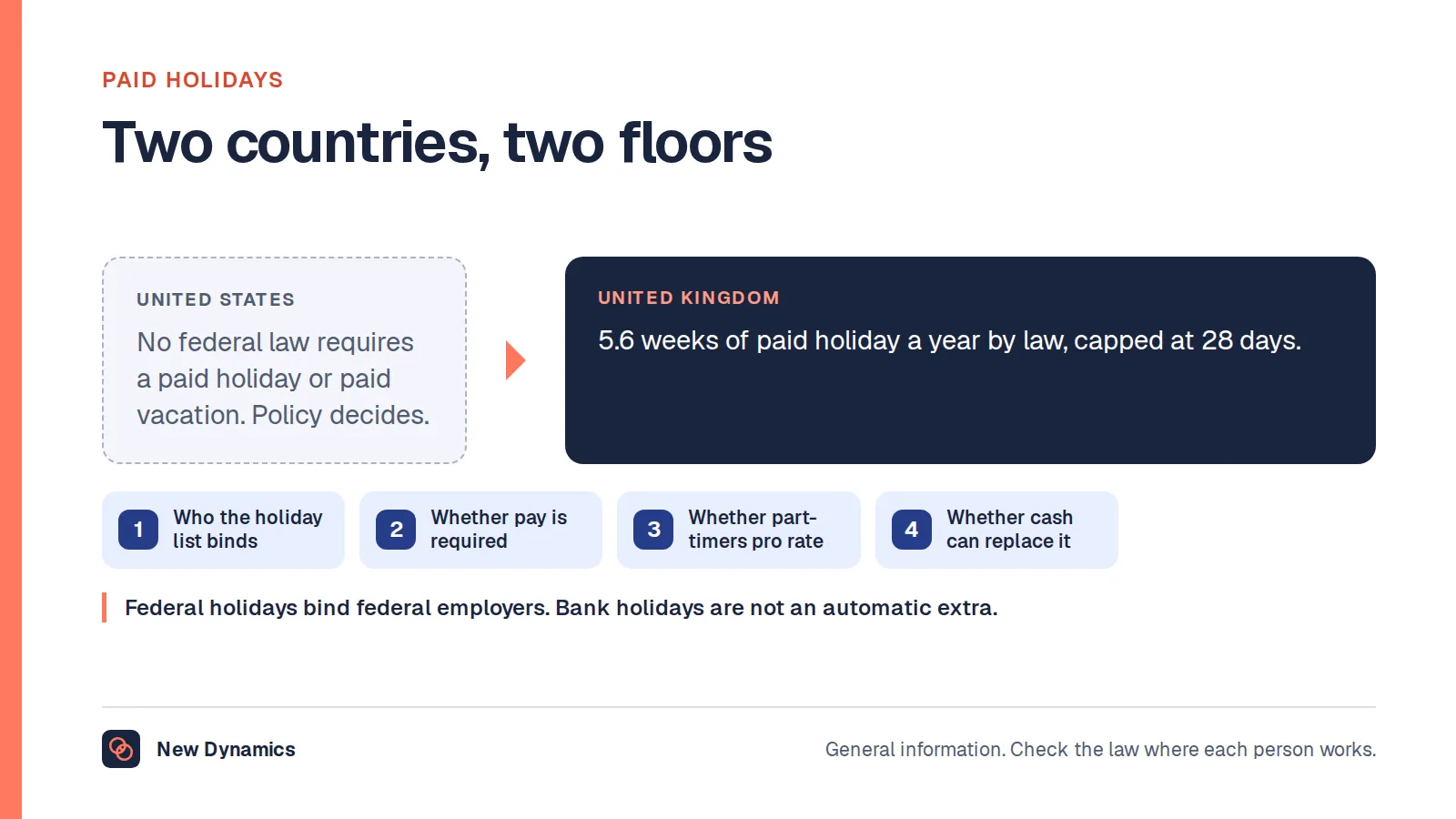
For most workers this remains prohibited. GOV.UK states it in one line: "an employer cannot include an amount for holiday pay in the hourly rate (known as 'rolled-up holiday pay')" for regular hours workers. The Security Industry Authority's guidance for approved contractors, updated on 24 June 2026, says the same thing from the enforcement side: "You will be breaking the law if you use rolled-up holiday pay for anyone who does not fall into these categories."
The categories are irregular hours workers and part-year workers, and the provision that permits it is regulation 16A, inserted on 1 January 2024 by the Employment Rights (Amendment, Revocation and Transitional Provision) Regulations 2023. Several of its paragraphs matter in practice.
Regulation 16A(1) limits it to pay due in respect of leave "to which the worker is entitled under regulation 15B". That single cross-reference is where the commencement date actually lives. Regulation 16A came into force on 1 January 2024, but regulation 15B applies only "in respect of any leave years beginning on or after 1st April 2024". So rolled up holiday pay did not become available to every employer in April 2024. It became available at the start of each employer's own first leave year beginning on or after that date. An employer with a leave year running from 1 January could not use it lawfully until 1 January 2025. GOV.UK encodes the same test from the other end: "Employers can use rolled-up holiday pay for irregular-hours and part-year workers, unless their leave year began on or before 31 March 2024."
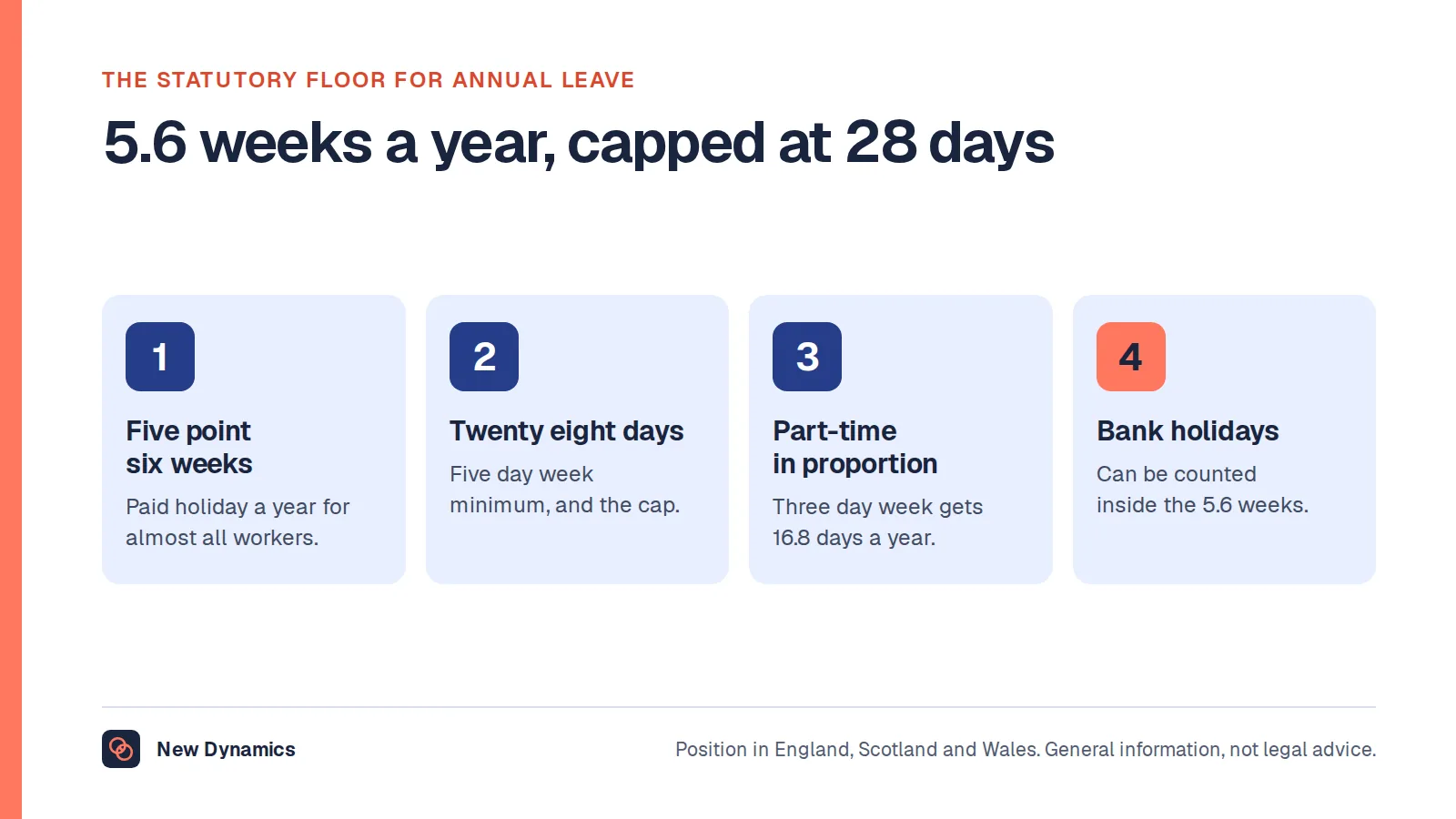
Regulation 16A(2) sets the rate: holiday pay "may be paid by way of a 12.07% uplift to the worker's remuneration for work done". GOV.UK's reforms guidance explains where 12.07% comes from: "a worker's total working weeks in a year is 46.4 (52 weeks in a year minus 5.6 weeks of leave). 12.07% of 46.4 is 5.6."
Regulation 16A(9) defines what the uplift applies to, and it is wider than basic pay. The reference to remuneration "is a reference to all types of payments that are to be included when determining the amount of a week's pay for the purposes of regulation 16", which pulls in the regulation 16(3ZA) list.
Regulation 16A(3) requires it to be "paid at the same time as the worker's remuneration for work done". Regulation 16A(7) requires that "any itemised pay statement provided by the employer to the worker must indicate the amount of holiday pay that has been paid for the period to which the statement relates", and 16A(10) ties that to section 8 of the Employment Rights Act 1996. A 12.07% uplift folded invisibly into an hourly rate does not satisfy regulation 16A(7).
Regulations 16A(4) to (6) close the obvious gap. A worker who was on rolled up holiday pay and then goes on sick leave or statutory leave must still be paid, each pay period, "the average amount of holiday pay that the worker was paid for each pay period during the relevant period", and the relevant period is the 52 weeks ending the day before the leave started, or the shorter period for which the worker has been paid this way.

How many workers this affects is not published. No official UK source counts irregular hours workers or part-year workers as the regulations define them, because the definitions turn on contract wording rather than on anything a survey asks. The nearest published proxy is the Office for National Statistics series on zero hours contracts. In EMP17: People in employment on zero hours contracts, released on 18 August 2026, table 1 puts people aged 16 and over on a zero hours contract in their main job at 3.6% of people in employment for April to June 2026, on a UK basis and not seasonally adjusted. A zero hours contract is not the same thing as regulation 15F(1)(a), which makes someone an irregular hours worker only if their paid hours in each pay period are "wholly or mostly variable" under the terms of their contract, so treat that percentage as scale rather than as a count. Our HR statistics hub collects the wider working time series with their reference periods.
Where the official sources diverge
Two differences are worth knowing before someone quotes one page at you.
On the rate, regulation 16A(2) says holiday pay "may be paid by way of a 12.07% uplift". Acas's page on rolled up holiday pay says employers using it must "calculate it at a rate of at least 12.07% of the worker's total pay in a 'pay period'". The regulation states a figure; Acas states a floor. Both are consistent once you see what 12.07% is for: it reproduces the statutory 5.6 weeks and nothing beyond it, because regulation 16A applies only to leave under regulation 15B. An employer who gives more leave by contract and wants to roll that up too needs a higher percentage, which is the case Acas's "at least" covers.
On the leave year, Acas says the 52 week average for irregular hours and part-year workers "applies regardless of when the worker's leave year starts". That is right for the reference period, which has applied to these workers since 6 April 2020 and has no leave year test. It is not a statement about rolled up holiday pay, which is gated on the leave year through regulation 15B. Two rules on adjacent pages, two different start dates.
For the systems side of all this, including who owns the record of which weeks were excluded, see our post on leave management software. One further record keeping duty now applies on top: GOV.UK states that "From 6 April 2026, employers must keep detailed records of annual leave and holiday pay for a minimum of 6 years from the date they were made."
Frequently asked questions
What is the holiday pay reference period?
It is the window of past pay used to work out a week's pay for a period of annual leave. Regulation 16 of the Working Time Regulations 1998 applies sections 221 to 224 of the Employment Rights Act 1996, and regulation 16(3)(e) substitutes 52 for the twelve weeks those sections use. The window ends with the last complete week before the first day of the leave.
How far back can the holiday pay reference period go?
Up to 104 weeks. Regulation 16(3ZG) says no account is to be taken of remuneration in weeks preceding the 104 weeks ending with the calculation week, and regulation 16(3)(f)(i) applies the same limit to the older provisions. GOV.UK states that an employer who has counted back over 104 weeks and found only 40 weeks of pay data should use those 40 weeks. An employer should not search beyond 104 weeks even if 52 paid weeks have not been found.
Which weeks are excluded from the 52 weeks?
Regulation 16(3ZE) excludes any week in which no remuneration was payable to the worker, and any week in which the worker was, for any amount of time, on sick leave or statutory leave. Part of a week counts, so a single day of sickness removes the whole week. Earlier paid weeks are then added under regulation 16(3ZF) to bring the total to 52 or as close to 52 as possible.
Is rolled up holiday pay legal in the UK?
It is lawful for irregular hours workers and part-year workers, under regulation 16A, and unlawful for anyone else. GOV.UK states that an employer cannot include an amount for holiday pay in the hourly rate for regular hours workers. The Security Industry Authority's guidance says an employer will be breaking the law if it uses rolled up holiday pay for anyone outside those two categories.
When did rolled up holiday pay become lawful again?
Regulation 16A came into force on 1 January 2024, but it only applies to leave under regulation 15B, which applies in respect of leave years beginning on or after 1 April 2024. The first lawful leave year is therefore each employer's own, not a single national date. A leave year running from 1 January first qualified on 1 January 2025. GOV.UK frames the same test as an exclusion: employers cannot use it where the leave year began on or before 31 March 2024.
Does rolled up holiday pay have to appear on the payslip?
Yes. Regulation 16A(7) requires any itemised pay statement to indicate the amount of holiday pay paid for the period the statement covers, and regulation 16A(10) links that to the itemised pay statement under section 8 of the Employment Rights Act 1996. Acas says the same, that employers must show it as a separate payment on the worker's payslip.
What is a week's pay for someone with no normal working hours?
Section 224(2) of the Employment Rights Act 1996 makes it the average weekly remuneration over the reference period, with weeks in which no remuneration was payable excluded by section 224(3). There is no hours element, because there are no normal hours. Regulation 16(3ZA) then requires commission, status related payments and regularly paid overtime to be included.
What if a worker takes leave in their first week?
Regulation 16(3A) applies. Where the modified sections give no weeks to take into account, a week's pay is the amount that fairly represents a week's pay having regard to section 228(3). GOV.UK lists three considerations: the worker's pay for the job, any pay already received, and what comparable workers are paid.
Your next step: make the figure reproducible
- Take one recent holiday payment for a variable hours worker and rebuild it. Write down the calculation date, the 52 weeks you used, every week you excluded and why, and how far back you went. If you cannot rebuild it, the process is the problem rather than the number.
- Check the exclusion logic in your payroll system against regulation 16(3ZE). The common defect is excluding weeks with no pay but keeping weeks that contained a day of sick leave.
- Check the stop condition. The search ends at 104 weeks, with whatever paid weeks it found, and not at 52 weeks come what may.
- If you use rolled up holiday pay, write down which leave year you started in and confirm it began on or after 1 April 2024. Then check a payslip shows the holiday pay as its own line.
- Decide who owns the record. Under the duty that applies from 6 April 2026 these calculations have to survive six years, and the inputs live in two systems.
For the policy that sits behind the calculation, read and download our compensation policy guide. The guide is free to read, and the PDF uses our short download form.
Want leave, pay and the approval behind each decision to sit on one record you can reopen two years later? Book a New Dynamics demo and bring one holiday payment you had to rebuild by hand. You can also email contact@new-dynamics.com.