TL;DR
- Offboarding is everything an employer does between the moment someone gives notice and the moment their record, access and obligations are properly closed. It is the mirror image of onboarding and it is run with a fraction of the attention.
- The checklist below is written out in full in four phases, the moment notice is given, the notice period, the last day and after, and every item names an owner, because the failure mode is that everyone assumes someone else did it.
- Five UK duties sit underneath it: notice, final pay including accrued untaken holiday, the P45, references and data. Each one is sourced from GOV.UK, Acas or the ICO below. This is general information rather than legal advice.
Onboarding gets a project plan, a buddy, a thirty-day check-in and a slide at the leadership meeting. Offboarding gets an email that says "let me know when you've handed back the laptop". Then, four months later, somebody notices that a former employee still has a live login to the finance system, and nobody can say whose job it was to close it.
This article defines offboarding plainly, gives you the whole checklist in four phases with an owner against every line, sets out the five UK duties you cannot get wrong with each one quoted from its source, and then covers the part most employers skip: what offboarding is actually for, beyond the admin. Nothing here is behind a download.
If you want the leaver tasks, the owners and the access steps running on one visible path instead of in four inboxes, see how New Dynamics workflows handle a process with handoffs in it.
Offboarding: definition and meaning
Offboarding is everything an employer does between the moment an employee's departure is known and the moment their employment, access, records and obligations are properly closed. Written as two words, "off boarding" means the same thing. Someone who has been through the process has been offboarded.
It is the mirror image of onboarding. Onboarding brings a person, their access, their knowledge and their obligations into the organisation. Offboarding takes all four back out again, in the right order, with the law observed on the way through.
It covers more than a resignation. Offboarding is the shared process underneath every kind of exit: resignation, the end of a fixed-term contract, retirement, redundancy and dismissal. The admin spine is common to all of them. What differs, and differs a great deal, is the decision that led to the exit and the procedure that decision required. More on that below.
Why offboarding is the most neglected process in HR
Two reasons, and both are structural rather than lazy.
Nobody owns it. Onboarding has an obvious customer who is standing in reception asking questions. Offboarding has no customer. HR assumes IT closes the accounts. IT assumes HR tells them when to. The manager assumes payroll has the holiday figure. Payroll assumes the manager confirmed the leaving date. Every single item on an offboarding list is something that at least two functions touch and at least two functions believe the other one is handling. The result is not a process that runs badly, it is a process that runs in fragments.
The person is leaving anyway. Attention follows consequence, and the consequence of a bad offboarding lands later and lands somewhere else: on the security team when an account is still live, on the next recruiter when a former employee tells people not to apply, on the manager six weeks on who cannot find the file. Nothing goes wrong on the day, so nothing feels urgent on the day.
There is a third, quieter reason. Resignations are mildly embarrassing, and a process that reminds everyone someone chose to leave does not get championed. So it gets delegated to whoever is free, which is why it is so often run by the person being left.
There is no official figure for how many employers close leaver access on time, and we are not going to invent one. If you want one number worth having, produce it yourself: pick ten people who left in the last year and check, today, how many still have a live account somewhere.

The employee offboarding checklist, phase by phase
Here is the offboarding process in full, in four phases. Every item names an owner. Where several people are involved, the owner is the one accountable for it being done, not everyone who touches it.
Phase 1: the moment notice is given
This phase is almost entirely about decisions, and it is the phase that gets replaced by a vague fortnight of nobody doing anything.
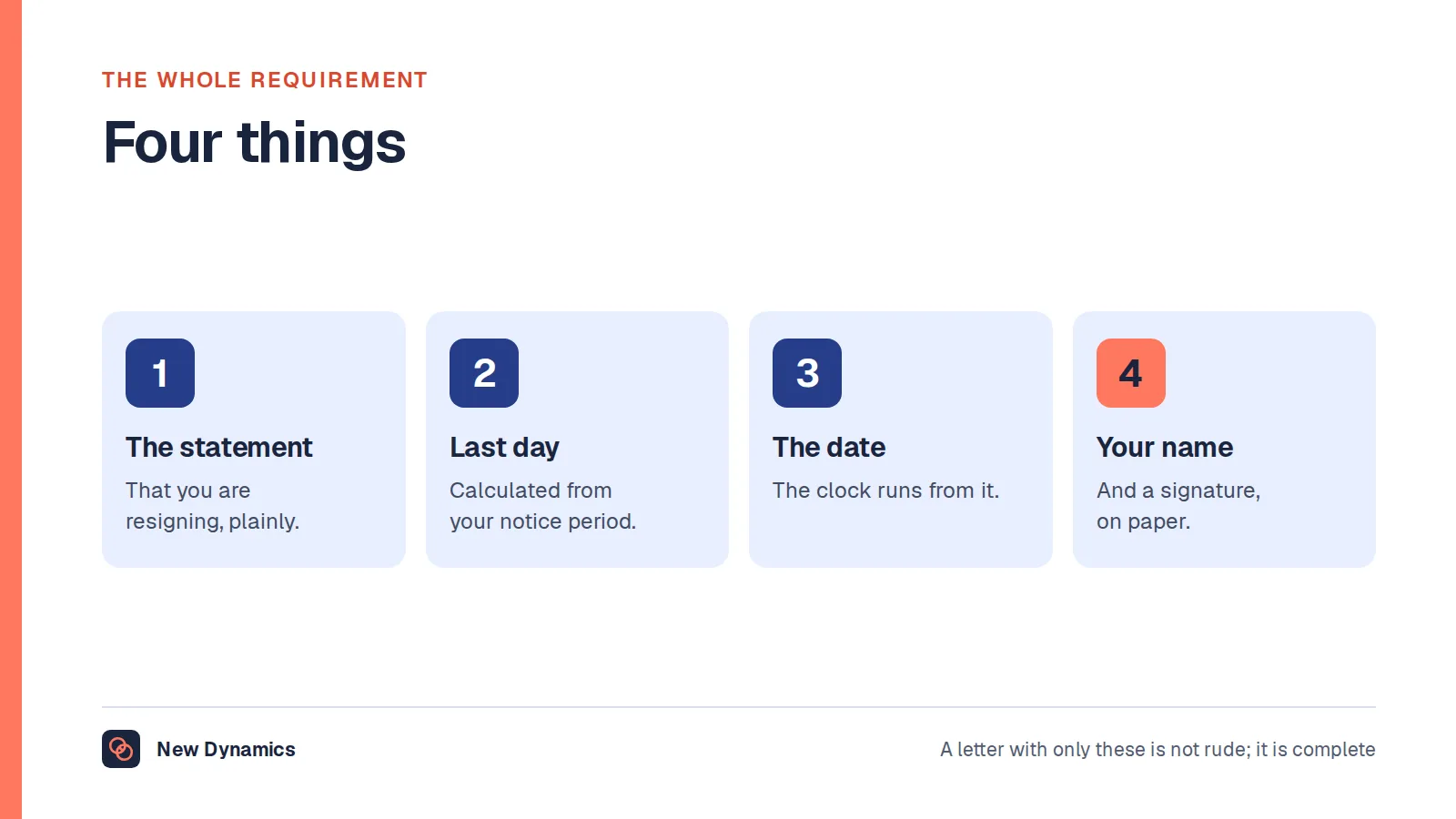
- Acknowledge the resignation in writing, stating the agreed last working day. Owner: HR. Our post on the resignation letter covers what a valid resignation looks like from the other side.
- Check the contract for the notice owed, and whether it is longer than the statutory minimum. Owner: HR.
- Tell the line manager before anybody else hears it. Owner: HR.
- Agree what the team, the wider business and any customers are told, by whom, and when. Owner: manager.
- Decide whether the person works their notice, is put on garden leave, or is paid in lieu, and write down the reason. Owner: manager with HR.
- Open the leaver record: leaving date, reason for leaving, final pay items, reference arrangement. Owner: HR.
- Calculate accrued untaken holiday now, while there is time to agree it. Owner: payroll.
- List everything to be recovered: systems, buildings, equipment, and anything held in the person's own name, such as supplier accounts, software licences, domains, social accounts and keys. Owner: IT, with the manager naming the role-specific items.
- Book the exit conversation, with someone who is not the person's line manager. Owner: HR.
- Decide who takes the work, in principle, before the handover is written. Owner: manager.
Phase 2: the notice period
The notice period is the only window in which knowledge can actually move. It is routinely spent waiting.
- Handover document started in the first week of notice, not the last. Owner: the leaver, reviewed by the manager.
- A named person against every responsibility, not a document with no owner. Owner: manager.
- Working sessions, not a write-up: the successor or interim owner does the task with the leaver watching, at least once. Owner: manager.
- Key internal and external contacts introduced to their new point of contact, by the leaver, by name. Owner: manager.
- Files moved out of personal drives and personal folders into shared locations, and findable by someone who did not create them. Owner: the leaver, verified by IT.
- Recurring meetings, approvals, rotas, on-call and inbox duties reassigned with a date. Owner: manager.
- Signatories, authorisation limits, bank mandates and admin rights on financial systems changed. Owner: finance.
- Remaining holiday discussed and booked, or confirmed as payable. Owner: manager with payroll.
- The reference position agreed and told to the leaver, so they know what a future employer will get. Owner: HR.
- Exit conversation held, at least a week before the last day. Owner: HR.
- Replacement decision made and written down, including a decision not to replace. Owner: manager.
- Payroll instructed with the leaving date and the final pay items. Owner: HR.
Phase 3: the last day
The last day is a closing checklist, not a party. Have both, in that order.
- Final handover check against one list, read through together, with gaps named out loud. Owner: manager.
- Equipment returned and logged item by item, including chargers, monitors, headsets, phones and anything at home. Owner: IT.
- Keys, passes, fobs, uniform, tools, vehicle, fuel card and company card returned. Owner: facilities, with finance on the cards.
- System access revoked at the end of the last working day, at a scheduled time rather than when somebody remembers. Owner: IT.
- Mailbox and files dealt with deliberately: delegated or forwarded to a named person for an agreed period, then closed. Owner: IT with the manager.
- Company data removed from personal devices, and the person's own data removed from company devices before they are wiped. Owner: IT.
- Phone, inbox and shared channels redirected to a named human, not to a dead address. Owner: IT.
- Final pay date and P45 timing confirmed to the leaver in writing. Owner: HR.
- Anything of theirs handed back, including personal items left in the office. Owner: manager.
- A proper goodbye, organised by the manager rather than by the leaver. Owner: manager.
Phase 4: after they have left
This is the phase that does not exist in most organisations, which is why most of the damage happens here.
- Final pay, including accrued untaken holiday, paid on the agreed date. Owner: payroll.
- P45 issued and the leaving date reported to HMRC. Owner: payroll.
- Any payment made after leaving reported correctly, using the original leaving date. Owner: payroll.
- The person removed from directories, the org chart, internal lists, external web pages, distribution lists, shared mailboxes and every third-party tool bought outside IT. Owner: HR and IT together, from one list.
- An access audit two weeks later that proves the accounts are closed, rather than assuming it. Owner: IT.
- Benefits ended, pension provider notified, salary sacrifice and any loan or season ticket arrangement unwound. Owner: HR.
- Reference route set up: one named owner, the agreed wording, and a note of it on the leaver record. Owner: HR.
- Retention review: what must be kept, for how long, and what should now be deleted. Owner: HR.
- Exit findings written down somewhere a decision-maker reads, with one named action and a date. Owner: HR.
- Alumni contact kept where the person agreed to it, because some of them will come back. Owner: manager.
The UK duties underneath the offboarding process
Most of a checklist is your choice. The following items are not. This applies to the United Kingdom, and it is general information rather than legal advice. Take advice on your own circumstances.
Notice periods: contractual and statutory minimum
The rule is that the contract and the statutory floor are both live, and the longer one wins. GOV.UK guidance on dismissal states: "You must be given at least the notice stated in your contract or the statutory minimum notice period, whichever is longer."
The statutory minimum the employer must give is set by length of service. GOV.UK sets it out as "at least one week's notice if employed between one month and 2 years", "one week's notice for each year if employed between 2 and 12 years" and "12 weeks' notice if employed for 12 years or more". The same page adds: "Check your contract. Your employer may give you more than the statutory minimum, but they cannot give you less."
Notice from the employee is a different and much shorter floor. GOV.UK guidance on handing in your notice states: "You must give at least a week's notice if you've been in your job for more than a month." In practice the contract usually asks for more, which is why the first item in phase one is to read it.
Final pay, accrued untaken holiday and the P45
Untaken statutory holiday is paid out on leaving, and this is the one moment when it can be. GOV.UK guidance states: "The only time someone can get paid in place of taking statutory leave (known as 'payment in lieu') is when they leave their job. Employers must pay for untaken statutory leave, even if the worker is dismissed for gross misconduct." The same page notes that "During their notice period the worker may be able to take whatever is left of their statutory annual leave."
Read that gross misconduct sentence twice, because it is the single most commonly misunderstood line in the whole process.
The P45 is not optional either. GOV.UK guidance for employers states: "You must give your employee a P45 when they leave." The same guidance tells employers: "You need to tell HM Revenue and Customs (HMRC) when one of your employees leaves or retires", and that if you have to pay someone after they leave you should "report the payment and deductions in your next FPS, using the employee's original 'Date of leaving' and payroll ID". The form itself "tells you your: leaving date total pay and tax from 6 April until the date you left tax code", and where it is on paper, "If you have a paper P45, you only need to give your new employer Parts 2 and 3. Keep Part 1a."
Keep the payroll record itself in order too. Our post on payroll records sets out what has to be retained and for how long.
Returning equipment, and the limits on deducting its value
Unreturned equipment is where well-run offboarding most often turns into a dispute, because the instinct is to take the value out of the final payslip. That instinct is constrained.
GOV.UK guidance on pay deductions states: "Your employer is not allowed to make deductions unless: it's required or allowed by law, for example National Insurance, income tax or student loan repayments", or "you agree in writing", or "your contract says they can". It also states that "A deduction cannot normally reduce your pay below the National Minimum Wage even if you agree to it".
So in practice: if you want the option of recovering the cost of unreturned property from final pay, the authority for it has to exist in the contract or in a written agreement before you need it, and the amount still has to respect the minimum wage floor. Deciding on the last day that you will simply hold back a few hundred pounds is not a plan, it is a claim waiting to happen. The better control is the one in phase three: log the equipment out item by item when it is issued, and log it back in item by item on the way out.
References: what an employer must and must not do
This is the question leavers and managers ask most, and the answer surprises both of them.
There is usually no duty to give one at all. Acas guidance states that an employer "does not have to give a reference by law unless it's: in writing that the employer will provide one", or for certain financial services roles, or where it has been agreed otherwise.
If you do give one, the standard is clear. Acas states: "If an employer gives a reference it must be accurate and fair." It adds that "All details about the person, their role or performance must be fair and accurate." and that references "must not: be misleading" or "include irrelevant personal information." Where a view is expressed rather than a fact, "If opinions are provided, there should be evidence to support the opinion."
A written policy is permitted and is a good idea. Acas notes that where an employer has a reference policy, it can restrict "how much they include in a reference" and "who can give a reference on the employer's behalf." The practical point for offboarding is that the policy must be known. A policy that lives in one person's head produces a dates-only reference from HR and a glowing paragraph from a manager on a personal account, for the same leaver, in the same week.
Access and data: closing accounts, and what happens to the records
Two separate jobs that get muddled together. Access is removed quickly. Records are kept deliberately, and some of them must be kept for years.
Removing access is a same-day task with a named owner, because an open account belonging to someone who no longer works for you is the clearest avoidable risk in this entire process. Schedule it for the end of the last working day and verify it a fortnight later.
Retention is the opposite: it does not end when employment does. ICO guidance on collecting and keeping employment records states: "The storage limitation principle says you can only keep personal information for as long as you need it." It is explicit that there is no single answer: "Data protection law does not set specific time limits for how long you can keep your workers' personal information." It is equally explicit that former staff are in scope: "You need to consider how long you need to keep workers' personal information, as well as the information of former workers." And some of it you have no choice about: "Certain legislation may require you to keep the information for a specified period."
The ICO's answer to the obvious question is a schedule rather than a rule of thumb. You "should set up a retention policy or schedule that lists: the types of record or information you hold; what you use it for; and how long you intend to keep it." Our employee data protection guide goes through how to build one.

What offboarding is for, beyond the admin
Everything above is hygiene. None of it is the reason to run offboarding well.
The exit conversation is late evidence
An exit conversation is the one moment when someone will tell you the truth and has nothing left to lose by it. That makes it valuable and also makes it late: whatever they tell you has usually been true for a year, and the people still in the building are living with it now.
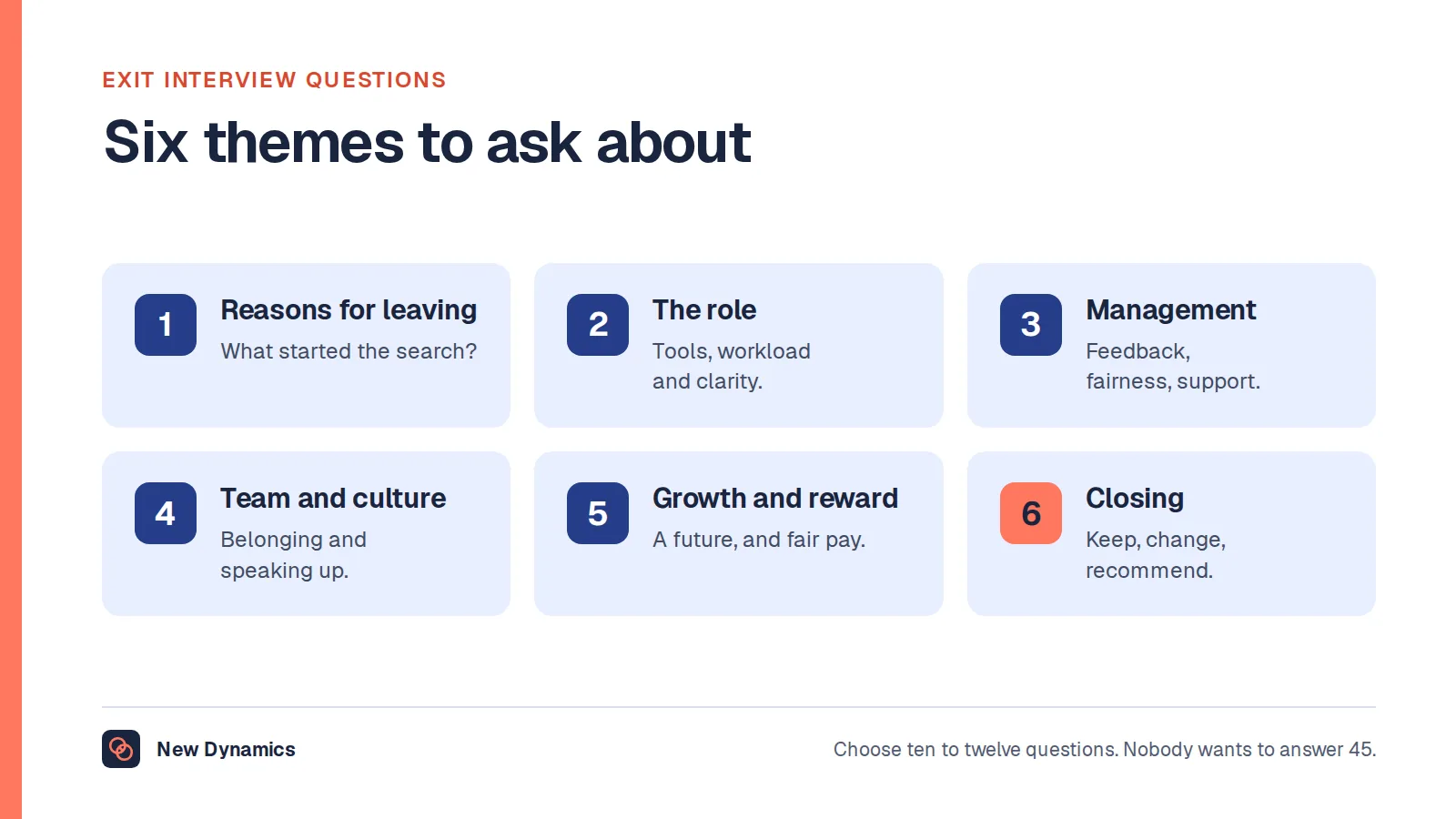
Treat it as evidence rather than as a courtesy. Two rules make the difference. Hold it with someone outside the reporting line, because an employee will not describe a management problem to the manager who caused it. And aggregate the answers, because one leaver's account is a story and ten leavers' accounts are a finding. Our post on exit interview questions has the questions, the template and how to turn the answers into something that gets acted on, so we will not repeat it here.
Read the exit conversation alongside the numbers. Our post on the UK employee turnover rate covers what is actually published and what you have to measure yourself.
Knowledge handover that transfers something
Most handovers produce a document that nobody opens. A handover has worked when a named person can do the task without the leaver, and the only way to know that is to have them do it while the leaver is still there.
So: a named owner per responsibility, not a document. At least one supervised run of anything that happens monthly or less often, because annual tasks are where institutional memory goes to die. Files in shared locations, findable by someone who did not create them. Introductions made by name, by the leaver, to every contact who will otherwise ring a dead number. And the quiet things written down: which supplier is difficult, which report is wrong every quarter and why, which approval always takes three weeks.
Start it in week one of the notice period. A handover begun in the final week is a list of things that were not handed over.
Leaving well, because a leaver is not gone
A former employee becomes three things, all of them consequential. A future rehire, and returning colleagues are among the best hires available because they need no onboarding and arrive with outside experience. A referrer, because good people know good people and they recommend places they left well. And a reviewer, in public, permanently, where every candidate you want next year will read it.
The last two weeks set all three. A leaver who is frozen out of meetings, stripped of access early, and sent off without a thank you tells the story of those two weeks for years, and it overwrites everything good that came before. This costs nothing to get right: a manager who says thank you specifically, a handover that treats their knowledge as valuable, final pay that is correct and on time, and a reference position they know in advance.

Redundancy and dismissal are different exits
A resignation and a dismissal share a checklist. They do not share a process, and blurring them is how employers end up in a tribunal with an excellent equipment log.
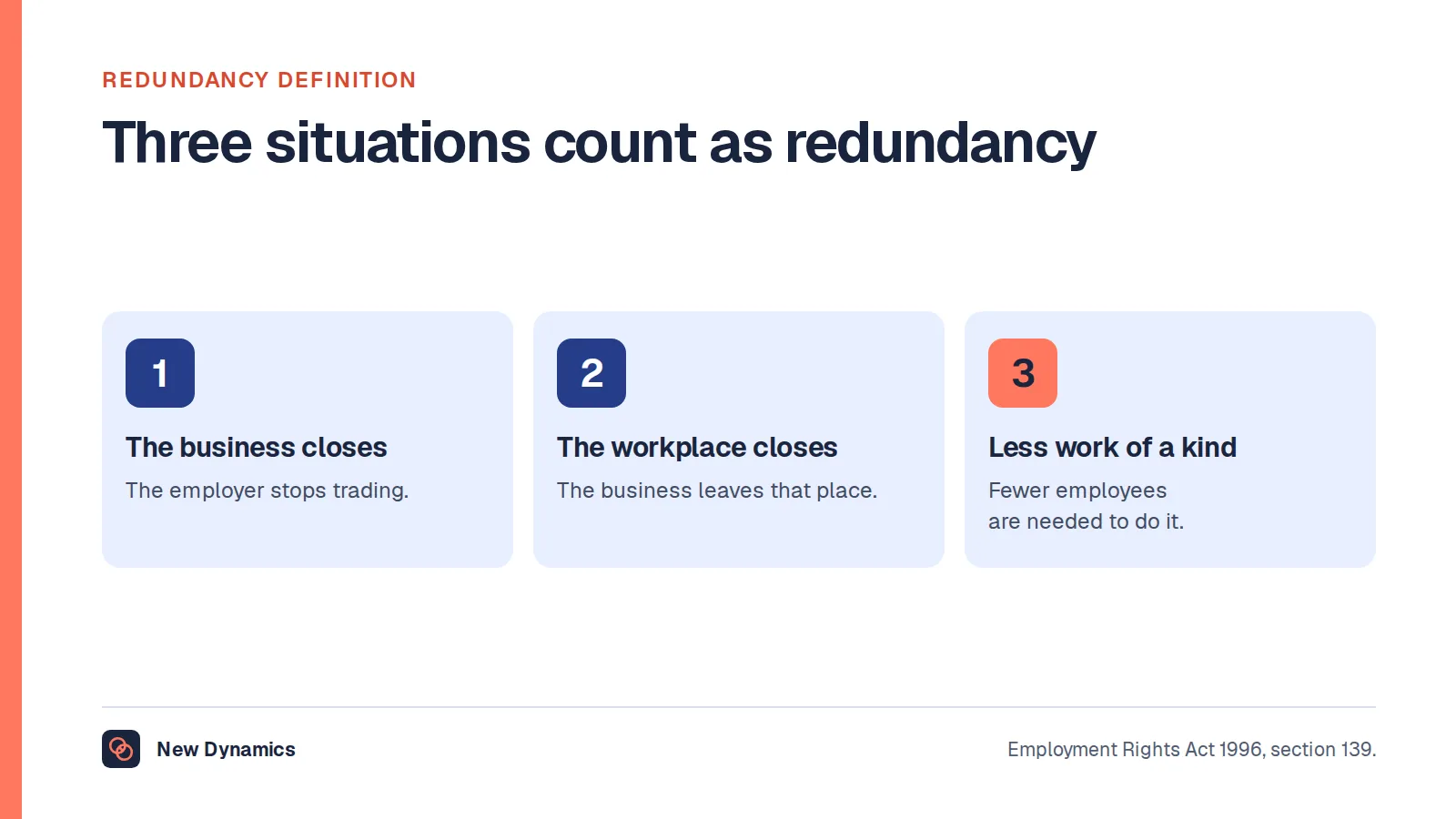
Redundancy is a specific legal situation with its own definition, its own consultation requirements, selection that must be fair and objective, and statutory redundancy pay. It is not a polite word for ending employment. Our post on the definition of redundancy sets out what does and does not count, and our redundancy and workforce change guide covers running one properly.
Dismissal requires a fair reason and a fair procedure, and procedure is where most cases turn. Our post on disciplinary action covers the steps and what a warning has to say.
The offboarding checklist in this article sits underneath both of those, and after them. Do not use it as a substitute for either.
What goes wrong
- Access is left live for months. Nobody owned the revocation, so it was never scheduled. The account is found during an audit, or worse, after it is used.
- There is no handover. The leaver wrote a document in their last three days, nobody has opened it, and the work surfaces as a crisis in week five.
- The exit conversation is held by the person being left. The leaver says the job was great and the commute was long, and a real reason for leaving goes unrecorded.
- The reference policy is a mystery. Two different answers go out for the same leaver, and neither the manager nor the leaver knew what the policy was.
- Holiday is forgotten until the final payslip. It is disputed after the person has gone, when goodwill and the payroll run have both closed.
- Equipment value is deducted on a hunch. No contractual authority, no written agreement, and a claim arrives a month later.
- The last impression undoes years of good work. Someone who gave five good years is managed out of the building in a fortnight of awkwardness, and that fortnight is what they describe to every person who asks.
- Nothing is learned. Ten people leave for the same reason and no document anywhere records that this is happening.
- Onboarding and offboarding do not share a list. Nothing issued on arrival is tracked, so nothing can be recovered on departure. Our employee onboarding checklist is the other half of the same register.
Frequently asked questions
What is offboarding?
Offboarding is everything an employer does between the moment someone's departure is known and the moment their employment, access, records and obligations are properly closed. It covers notice, handover, final pay, the return of equipment, removing system access, references and record retention. It is the mirror image of onboarding, and it applies to resignations, fixed-term endings, retirements, redundancies and dismissals alike.
What does offboarded mean?
It means a person has been taken through the offboarding process: their notice has been handled, their work handed over, their equipment returned, their access removed, their final pay and P45 issued, and their records closed and retained correctly. In practice people say it loosely to mean "has left", which hides the fact that half the process often has not happened.
What should an employee offboarding checklist include?
Four phases, each item with a named owner. When notice is given: acknowledge it in writing, check the notice owed, decide on garden leave or payment in lieu, open the leaver record, calculate accrued holiday and list everything to recover. During the notice period: handover with named owners, files moved to shared locations, contacts introduced, signatories changed and the exit conversation held. On the last day: equipment logged back in, access revoked at a scheduled time, mailbox redirected and final pay confirmed. After: final pay and the P45, removal from every system and list, an access audit, a retention review and the exit findings acted on.
Who owns the offboarding process?
In most organisations the honest answer is nobody, which is the root cause of almost everything that goes wrong. Make HR accountable for the process, the record and the duties that must be identical for everyone, and make the line manager accountable for the handover, the team and the leaver's experience. IT owns access and equipment. Payroll owns final pay and the P45. Write the names on the list rather than the functions.
Does an employer have to give a reference in the UK?
Usually not. Acas guidance says an employer does not have to give a reference by law unless it is in writing that the employer will provide one, for example in an employment contract, or for certain financial services roles, or where it has been agreed otherwise. If a reference is given, Acas says it must be accurate and fair, and it must not be misleading or include irrelevant personal information. This is general information rather than legal advice.
Does unused holiday have to be paid when someone leaves?
Yes for untaken statutory leave. GOV.UK guidance states that the only time someone can get paid in place of taking statutory leave, known as payment in lieu, is when they leave their job, and that employers must pay for untaken statutory leave even if the worker is dismissed for gross misconduct. Work the figure out when notice is given rather than on the final payslip. This applies to the United Kingdom and is general information rather than legal advice.
Your next step: give every line an owner
- Take the four phases above and write a real name against every item for the next person who leaves, not a department.
- Check the five duties are genuinely in your process with a date and a record: notice, final pay including accrued untaken holiday, the P45, the reference position and access removal.
- Write the reference policy down and tell managers what it is, so the same leaver cannot get two different answers.
- Run the audit that tells you whether any of this works: take ten people who left in the last year and check today whether every account of theirs is closed.
- Agree who reads the exit findings and what they are expected to do about them, because an unread finding is the same as no conversation.
For the retention schedule that decides what you keep after someone leaves and for how long, read our employee data protection guide.
Want the leaver tasks, the owners, the access steps and the exit conversation on one visible path, with nothing waiting on somebody remembering? Book a New Dynamics demo and bring your current leaver process. You can also email contact@new-dynamics.com.