TL;DR
- Expiry without renewal is a dismissal. Section 95(1)(b) of the Employment Rights Act 1996, substituted on 1 October 2002, treats a limited-term contract that ends by its limiting event without renewal as a dismissal, and section 136(1)(b) does the same for redundancy pay.
- The four year rule is regulation 8 of the Fixed-term Employees (Prevention of Less Favourable Treatment) Regulations 2002. Four years of continuous employment on successive fixed-term contracts makes the employee permanent unless the latest contract or renewal was objectively justified, and continuity before 10 July 2002 is disregarded.
- A redundancy waiver clause stopped working on 1 October 2002, when section 197 of the Employment Rights Act 1996 ceased to have effect and the exception at section 203(2)(d) was removed. Guidance still describing a valid waiver is out of date.
A fixed term contract looks like the simplest arrangement in employment law. There is an end date, the date arrives, the work stops. That is exactly where employers get caught. In law, the expiry of a fixed term contract without renewal is a dismissal, and a fourth consecutive year of fixed-term work can convert the contract to permanent without anyone signing anything.
This article covers what a fixed term contract is in UK law, the rights attached to it, how the four year rule is counted, what notice is owed and when, what expiry means for unfair dismissal and redundancy, why a redundancy waiver clause no longer works, and one point where the official guidance and the statute disagree. It is general information about the law in Great Britain and not legal advice.
Fixed-term work fails on dates rather than on principle: the renewal nobody scheduled, the written request nobody answered, the fourth year nobody counted. See how New Dynamics workflows put a dated step with a named owner behind each of those.
The scale is not marginal. The Office for National Statistics dataset EMP07: Temporary employees, published on 18 August 2026 from the Labour Force Survey and not seasonally adjusted, records 705,619 temporary employees in the United Kingdom who said their job was a fixed period contract in April to June 2026, out of 1,594,865 temporary employees in total, so roughly 44 per cent (ONS, EMP07: Temporary employees). ONS advises users to focus on long term movements rather than short-term changes, because estimates from January to March 2025 include the full effect of changes to Labour Force Survey collection and sampling. For the wider picture, see our HR statistics hub.
What a fixed term contract is in law
Regulation 1(2) of the Fixed-term Employees (Prevention of Less Favourable Treatment) Regulations 2002, in force since 1 October 2002, defines a "fixed-term contract" as a contract of employment that, in the normal course, will terminate "(a) on the expiry of a specific term, (b) on the completion of a particular task, or (c) on the occurrence or non-occurrence of any other specific event" other than reaching a normal retiring age (the 2002 Regulations, regulation 1).
So no calendar date is required. A contract ending when a project completes, or when a named colleague returns from leave, is fixed term.
GOV.UK puts the test plainly: employees are on a fixed-term contract if "they have an employment contract with the organisation they work for" and "their contract ends on a particular date, or on completion of a specific task, like a project". It excludes people contracted to an agency rather than the business, students or trainees on work-experience placements, people under a contract of apprenticeship, and members of the armed forces (GOV.UK, fixed-term employment contracts).
The agency exclusion matters. If the contract is with the agency, the person is an agency worker with a different set of rights, so the first question is always who the counterparty is. Our post on employment status works through that, and the same question decides what applies to casual work on a zero hours contract.
Fixed term contract rights: the equal treatment duty
Regulation 3(1) gives a fixed-term employee "the right not to be treated by his employer less favourably than the employer treats a comparable permanent employee" as regards contract terms, or by being subjected to any other detriment. Regulation 3(2) extends that to "any period of service qualification relating to any particular condition of service", "the opportunity to receive training" and "the opportunity to secure any permanent position in the establishment".
The comparison is internal. Regulation 2(1) defines a comparable permanent employee as one employed by the same employer, "engaged in the same or broadly similar work having regard, where relevant, to whether they have a similar level of qualification and skills", and based at the same establishment, or a different one if there is no comparator at the same site. Someone whose employment has ceased is not a comparator.
Regulation 3(5) applies the pro rata principle "unless it is inappropriate". Regulation 3(6) adds a free-standing right: "the employee has the right to be informed by his employer of available vacancies in the establishment". Regulation 3(7) sets the standard. The employee is informed only if the vacancy appears in an advertisement they have "a reasonable opportunity of reading in the course of his employment", or they get reasonable notification some other way. A vacancy board that fixed-term staff never see does not count.

GOV.UK states the duty operationally: employers must not treat fixed-term staff less favourably than permanent employees doing the same or largely the same job "unless the employer can show that there is a good business reason to do so", and must give them "the same pay and conditions as permanent staff", "the same or equivalent benefits package", "information about permanent vacancies in the organisation" and "protection against redundancy or dismissal".
The objective justification defence
The right applies only where the treatment is on the ground that the employee is fixed term and "the treatment is not justified on objective grounds" (regulation 3(3)). Regulation 4 gives that defence a specific shape for contract terms: less favourable treatment on a term is justified "if the terms of the fixed-term employee's contract of employment, taken as a whole, are at least as favourable as the terms of the comparable permanent employee's contract".
That is a package test, not a term by term test, which is why a higher rate in exchange for no company car can stand up. Regulation 4(2) preserves the wider justification route alongside it. The usual failure is not the reasoning but the record: nobody wrote the business reason down at the time.
Regulation 5 is the employee's tool for that. An employee who requests in writing a statement of the reasons for the treatment "is entitled to be provided with such a statement within twenty-one days of his request". Ignoring the request is the worse option: regulation 5(3) lets a tribunal draw any just and equitable inference, "including an inference that the employer has infringed the right in question", where the employer deliberately omitted a statement without reasonable excuse or the statement is "evasive or equivocal".
The four year rule for fixed term contracts
Regulation 8 converts status, and it is the provision most often described loosely. It applies where the current fixed-term contract has previously been renewed, or followed an earlier fixed-term contract. Where it applies, "the provision of the contract ... that restricts the duration of the contract shall be of no effect, and the employee shall be a permanent employee" if the employee has been continuously employed "for a period of four years or more" and the fixed-term employment "was not justified on objective grounds" at the last renewal, or when the contract was entered into if it has not been renewed (the 2002 Regulations, regulation 8).
Three counting details decide real cases.

First, when it bites. Regulation 8(3) sets the date as whichever is later of the date the contract was entered into or last renewed, and the date four years' continuous employment was acquired. A renewal signed in year five is the trigger date, not the fourth anniversary.
Second, how continuity is measured. Regulation 8(4) applies Chapter 1 of Part 14 of the Employment Rights Act 1996, and "any period of continuous employment falling before the 10th July 2002 shall be disregarded". That is the statutory continuity test, not a tally of days worked, so short gaps may not break it. "Renewal" includes extension, so rolling a contract on by three months is a renewal.
Third, objective justification is tested at a moment. A reason that was good in year one and is no longer true in year four will not save the duration clause.
Regulation 9 lets the employee settle it. Someone who considers they are now permanent can request a written statement and is entitled within twenty-one days to either that confirmation or "a statement giving reasons why his contract remains fixed-term", with the objective grounds set out if they are asserted. If the employer fails to provide a statement or gives reasons, the employee may apply to a tribunal for a declaration, provided they are still employed.
What a collective agreement can and cannot do
GOV.UK says an employer and unions or a staff association "may make a collective agreement that removes the automatic right to become a permanent employee". That wording is looser than the instrument. Regulation 8(5) allows a collective or workforce agreement to substitute different provisions "which, in order to prevent abuse arising from the use of successive fixed-term contracts, specify one or more of the following": a maximum total period of continuous fixed-term employment, a maximum number of successive contracts and renewals, or objective grounds justifying renewal. The threshold can be varied and replaced. A clause that simply deletes the protection and puts nothing in its place is not what regulation 8(5) offers.
Fixed term contract renewal notice: what notice is owed
GOV.UK is direct about expiry: "Fixed-term contracts will normally end automatically when they reach the agreed end date. The employer does not have to give any notice." Three qualifications follow.
Ending early is different. Where the contract says nothing about early termination, GOV.UK says "the employer may be in breach of contract". The statutory floor is section 86(1) of the Employment Rights Act 1996: after one month of continuous employment, not less than one week's notice below two years' service, one week per year from two to twelve years, and twelve weeks at twelve years or more. Section 86(5), which used to exclude certain fixed-term contracts, was omitted on 1 October 2002 by the 2002 Regulations.
Working past the end date changes the position. GOV.UK says that if someone keeps working without formal renewal, "there's an 'implied agreement' by the employer that the end date has changed", and notice is then needed to dismiss.
Renewing on worse terms carries dismissal risk. GOV.UK's position is that if the contract ends without agreement on new terms, the employee "may be able to claim unfair dismissal".
The useful discipline is therefore not statutory notice. It is a renewal decision made and communicated in writing, with a date, well before expiry.
Expiry without renewal is a dismissal
Section 95(1)(b) of the Employment Rights Act 1996, substituted on 1 October 2002 by regulation 11 and Schedule 2 of the 2002 Regulations, provides that an employee is dismissed where "he is employed under a limited-term contract and that contract terminates by virtue of the limiting event without being renewed under the same contract" (section 95). Section 235(2A) defines a limited-term contract as one where the employment "is not intended to be permanent" with provision for it to end by a limiting event, and section 235(2B) defines that event as expiry of the term, performance of the task, or the occurrence or non-occurrence of the specified event.
GOV.UK says the same in one line: if a contract is not renewed, "This is considered to be a dismissal." Where the employee has two years' service the employer "needs to show that there's a 'fair' reason for not renewing the contract". That two years is the qualifying period in section 108(1), which requires continuous employment of not less than two years ending with the effective date of termination. GOV.UK notes it is one year for employees in employment before 6 April 2012.
So non-renewal of someone with two years' service needs a fair reason and a fair procedure, documented, with the employee told in time to respond.
Fixed term contract redundancy, and the waiver clause that stopped working
A fixed-term employee can be made redundant, and expiry can itself be a redundancy. Section 136(1)(b), also substituted on 1 October 2002, treats expiry of a limited-term contract by its limiting event without renewal as a dismissal for redundancy payment purposes. Section 155 requires continuous employment "of not less than two years ending with the relevant date" before any right to a statutory payment arises. GOV.UK matches that: "Anyone who's worked continually for the same employer for 2 years or more has the same redundancy rights as a permanent employee."
Now the part where stale guidance circulates. Contracts of two years or more once carried a clause waiving any right to a redundancy payment on expiry. That worked because section 197 allowed it and section 203(2)(d) exempted it from the rule voiding contracting out.
Both props are gone. Schedule 2, Part 1, paragraph 3(15) of the 2002 Regulations provides that "Sections 197 ... shall cease to have effect", and paragraph 3(17) omits section 203(2)(d). Legislation.gov.uk records section 197 as having "ceased to have effect (1.10.2002)" (section 197). A waiver now falls under section 203(1), which voids any provision purporting "to exclude or limit the operation of any provision of this Act" or to preclude tribunal proceedings.

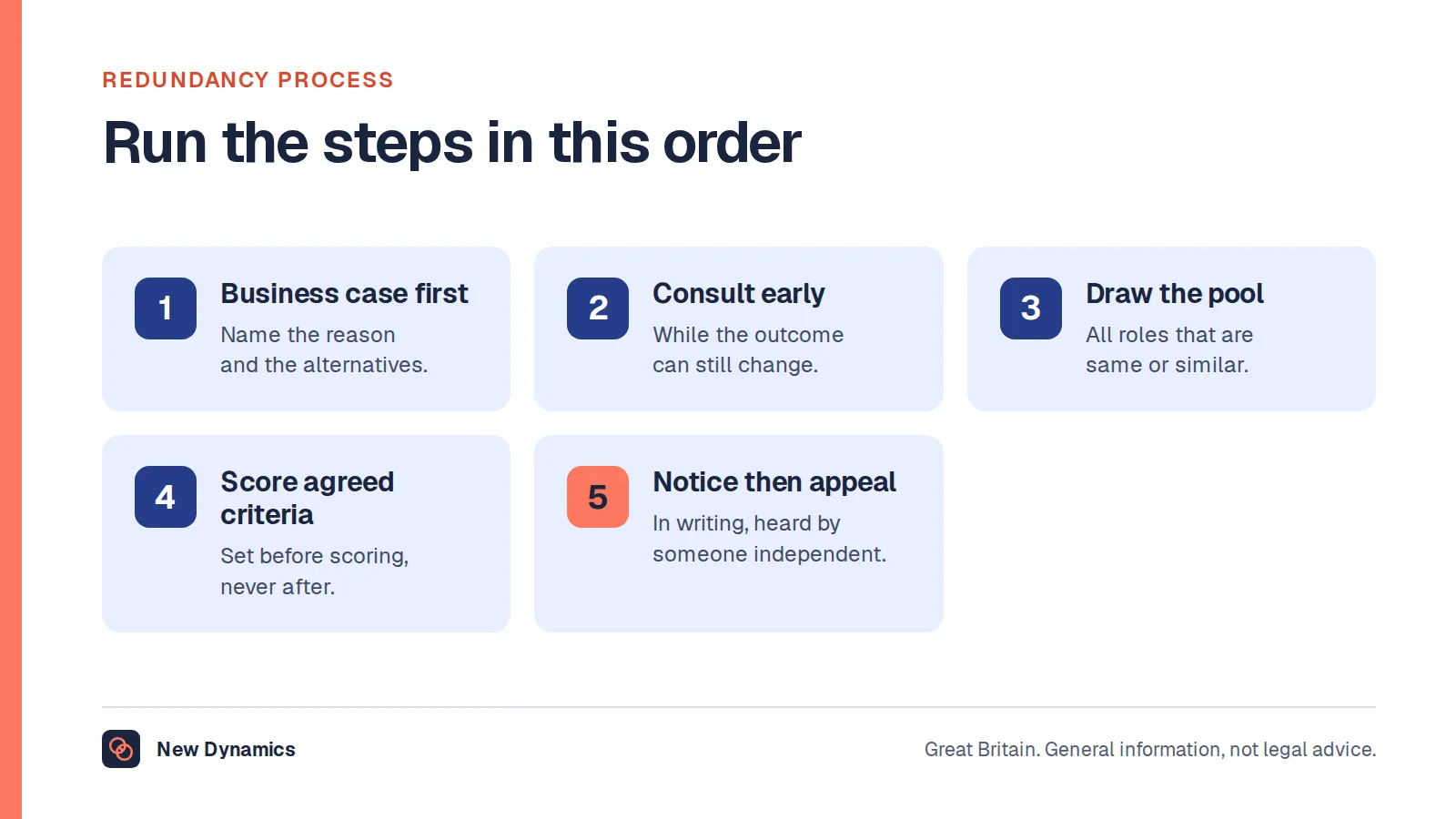
The transitional window is historic. Schedule 2, Part 2, paragraph 5 preserved a waiver only where the contract or its most recent renewal was agreed before 1 October 2002 and the waiver "was entered into and took effect before 1st October 2002". No live contract meets that. If your template still carries the clause, it is void and it should come out. Our post on the redundancy process covers the consultation and records that apply when non-renewal really is redundancy.
Where GOV.UK and the statute no longer agree
On non-renewal, GOV.UK says workers have the right "to a written statement of reasons for not renewing the contract - after one year's service". That page's last recorded update is 23 May 2016.
The statute says two years. Section 92(3) of the Employment Rights Act 1996 provides that an employee is not entitled to a written statement "unless on the effective date of termination he has been, or will have been, continuously employed for a period of not less than two years ending with that date". The words "two years" were substituted on 6 April 2012 by the Unfair Dismissal and Statement of Reasons for Dismissal (Variation of Qualifying Period) Order 2012 (section 92). Section 92(2) also sets fourteen days for providing the statement, not twenty-one.
The statute governs: the one year figure reflects the position before 6 April 2012. The safe operating rule is simpler than either. Answer a written request for reasons, in writing, within fourteen days, whatever the service length. Section 92(1)(c) covers the limited-term case expressly, so non-renewal engages the duty.
Time limits, and a change made on 1 October 2026
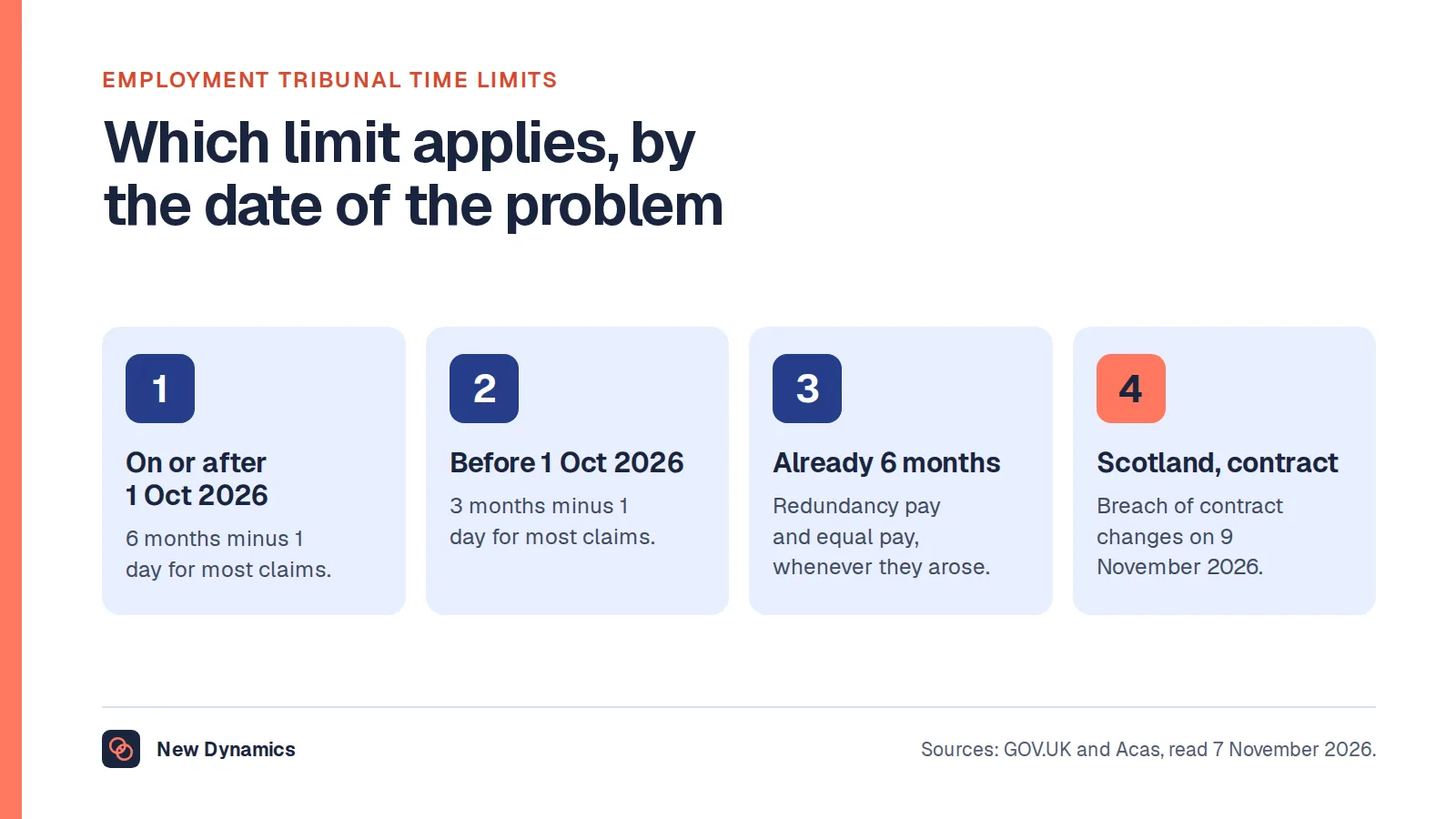
Complaints under the 2002 Regulations go to a tribunal under regulation 7, and the limit has just been extended. Regulation 7(2) now requires the complaint to be presented "before the end of the period of six months beginning" with the date of the treatment or detriment, or the last of a series of similar acts. For the vacancies right, it runs from the last date on which other individuals were informed of the vacancy. The word "six" was substituted on 1 October 2026 by the Employment Tribunal (Extension of Time Limits) (Miscellaneous Amendments and Transitional Provisions) Regulations 2026, which came into force that day and extend to England and Wales and Scotland.
The transitional rule matters for older events. Regulation 10(1) of the 2026 Regulations states the amendments "do not apply to cases where the relevant date occurs before 1st October 2026", so the previous three month limit still governs anything earlier. Regulation 7(3) allows a late complaint where it is just and equitable, and regulation 7(2A) brings in the Acas early conciliation extension. Our post on employment tribunal time limits sets out how those clocks interact. Note regulation 7(6): where an employee complains of less favourable treatment, "it is for the employer to identify the ground". If the reason was never recorded, that is a hard sentence to answer.
Running fixed term contracts well
- Put the renewal decision on a calendar. Review far enough before expiry that a fair non-renewal process, or a renewal on agreed terms, can happen.
- Count the four years every quarter. Track start dates, every renewal, and the objective grounds recorded at the latest renewal. Regulation 8 needs no application to operate.
- Record the objective justification when you decide. Both the regulation 3(3)(b) defence and the regulation 8(2)(b) test are judged by what was true then.
- Make vacancies genuinely visible. Regulation 3(6) is a standing duty and regulation 3(7) sets the test for whether someone was actually informed.
- Give the same review, feedback and training access as permanent staff. Regulation 3(2)(b) names training explicitly.
- Route written requests under regulations 5 and 9 and section 92 to a tracked owner. The clocks are fourteen and twenty-one days, and silence invites an adverse inference.
On jurisdiction: the provisions quoted here apply in Great Britain, and the 2026 time limit regulations extend to England and Wales and Scotland. Northern Ireland has its own instrument, the Fixed-term Employees (Prevention of Less Favourable Treatment) Regulations (Northern Ireland) 2002, in operation since 1 October 2002 and sitting alongside the Employment Rights (Northern Ireland) Order 1996, so check Northern Ireland sources rather than assuming the position is identical. This article is general information rather than legal advice. Check the current legislation.gov.uk text before you act, and take advice on a specific case.
Frequently asked questions
What is a fixed term contract?
Regulation 1(2) of the Fixed-term Employees (Prevention of Less Favourable Treatment) Regulations 2002 defines it as a contract of employment that, in the normal course, will terminate on the expiry of a specific term, on the completion of a particular task, or on the occurrence or non-occurrence of a specific event. GOV.UK adds that the contract must be with the organisation the person works for, so someone engaged through an agency is an agency worker rather than a fixed-term employee. This covers Great Britain and is general information, not legal advice.
What rights does a fixed term employee have?
The core right is regulation 3(1): not to be treated less favourably than a comparable permanent employee as regards contract terms, or by any other detriment, unless the treatment is justified on objective grounds. Regulation 3(2) extends it to service qualifications, training opportunities and the opportunity to secure a permanent position. Regulation 3(5) applies the pro rata principle, regulation 3(6) gives the right to be informed of available vacancies, and regulation 5 gives the right to a written statement of reasons within twenty-one days of a written request.
When does a fixed term contract become permanent?
Under regulation 8, where a fixed-term contract has been renewed or followed an earlier one, the duration restriction is of no effect and the employee becomes permanent once they have four years or more of continuous employment, unless the fixed-term employment was justified on objective grounds at the last renewal or, if there was none, when the contract was entered into. Continuity is measured under Chapter 1 of Part 14 of the Employment Rights Act 1996, and any continuous employment before 10 July 2002 is disregarded.
Does an employer have to give notice at the end of a fixed term contract?
GOV.UK states that fixed-term contracts "will normally end automatically when they reach the agreed end date" and that the employer does not have to give notice. That applies to expiry. Ending early is different: the minimum notice in section 86(1) of the Employment Rights Act 1996 applies after one month of continuous employment, and terminating early where the contract does not allow it may be a breach of contract. If the employee keeps working past the end date, GOV.UK treats the end date as changed by implied agreement and notice is needed to dismiss.
Can a fixed term employee be made redundant?
Yes. Section 136(1)(b) of the Employment Rights Act 1996 treats expiry of a limited-term contract by its limiting event without renewal as a dismissal for redundancy payment purposes, so non-renewal for redundancy reasons is a redundancy dismissal. Section 155 requires two years of continuous employment ending with the relevant date before any right to a statutory redundancy payment arises, and GOV.UK says fixed-term employees with two years or more have the same redundancy rights as permanent employees.
Is a redundancy waiver clause in a fixed term contract still valid?
No. Schedule 2, Part 1, paragraph 3(15) of the 2002 Regulations provided that section 197 of the Employment Rights Act 1996 "shall cease to have effect" from 1 October 2002, and paragraph 3(17) removed the exception at section 203(2)(d). Without that exception a waiver is caught by section 203(1), which voids any agreement purporting to exclude or limit the Act or to preclude tribunal proceedings. A narrow transitional rule preserved only waivers entered into and taking effect before 1 October 2002, which no live contract meets.
How long is the time limit for a claim under the fixed-term regulations?
Regulation 7(2) now gives six months beginning with the date of the less favourable treatment or detriment, or the last of a series of similar acts. That extension took effect on 1 October 2026 under the Employment Tribunal (Extension of Time Limits) (Miscellaneous Amendments and Transitional Provisions) Regulations 2026. Regulation 10 of those regulations provides that the change does not apply where the relevant date occurs before 1 October 2026, so the previous three month limit still governs earlier events. A tribunal may allow a late complaint where it is just and equitable.
Your next step: audit the dates
- Pull every live fixed-term contract into one list with the start date, every renewal date, the current end date and the four year anniversary. Anything already past four years is the urgent column.
- For each renewal in the last two years, find the written record of the objective grounds. Where there is none, write the reason down now while it is still true.
- Set a renewal review date on every contract with a named owner, far enough ahead that a fair decision is possible.
- Check the vacancy channel reaches fixed-term staff, and that the review, feedback and training lists include them. Verify next cycle whether they actually appeared.
- Take the redundancy waiver clause out of the template, clarify the early termination clause, and check that any collective or workforce agreement you rely on really substitutes compliant provisions under regulation 8(5).
For the policy wording behind all of this, including how to explain fixed-term terms, renewal and vacancy notification in language staff can read, use our employee handbook guide.
Want renewal dates, four year anniversaries, objective-grounds records and written requests on one visible path instead of in six spreadsheets? Book a New Dynamics demo and bring your current fixed-term contract list. You can also email contact@new-dynamics.com.