TL;DR
- Workplace relationships are the working connections between colleagues, managers, teams and customers. They decide how quickly information moves and how well problems get solved.
- Good working relationships rest on a few habits: keep small promises, share information early, give credit, say difficult things directly and assume there is a reason behind behaviour you dislike.
- Managers set the tone. Promote positive behaviour, deal with unacceptable behaviour quickly, give people a safe route to raise concerns and sort out disagreements early.
Ask people why they left a job and many will name a person. Ask why they stayed, and the answer is often the same. Skills and strategy matter, but most work gets done, or fails to get done, through workplace relationships.
This article explains the kinds of working relationship that matter, the signs of healthy and unhealthy ones, eight habits anyone can practise, what managers should do, and how to repair a relationship that has gone wrong.
Relationships grow through regular, honest conversation. See how New Dynamics continuous feedback makes that part of everyday work.
What are workplace relationships?
Workplace relationships are the working connections between the people in and around an organisation. Five kinds matter most:
- With your manager. Direction, feedback, support and trust flow both ways.
- With your peers. The colleagues you work beside, rely on and learn from.
- With the people you manage. If you lead others, these shape their working lives more than anything else.
- With other teams. The handovers and shared projects where work most often gets stuck.
- With customers, suppliers and partners. The relationships that carry the organisation's reputation.
You may also meet the term employee relations. That usually means something more formal. The CIPD's employee relations factsheet defines it as “the relationship between employers and employees - both individually and collectively”, covering employee voice, consultation and the handling of conflict. This article is mostly about the everyday relationships between people, which the formal system exists to support.

Why relationships at work matter
Information moves through relationships. People share early warnings, half-formed ideas and honest feedback with colleagues they trust. Where trust is low, bad news travels slowly.
Problems get solved faster. A quick call to someone who knows you settles in minutes what an email chain drags out for days.
They affect health. The UK Health and Safety Executive treats relationships as one of its six Management Standards for tackling work-related stress. Its Relationships standard is about promoting positive working to avoid conflict, and dealing with unacceptable behaviour such as bullying.
They decide whether people stay. A good relationship with a manager and a few trusted colleagues makes a hard job bearable. A bad one makes an easy job miserable.
Signs of healthy and unhealthy working relationships
| Healthy | Unhealthy |
|---|---|
| People disagree openly and stay on good terms | Disagreement happens in corridors, after the meeting |
| Help is asked for and offered freely | People hoard information to protect themselves |
| Mistakes are admitted quickly | Mistakes are hidden, or blamed on others |
| Credit is shared accurately | Credit is claimed by the loudest person |
| Feedback is direct and kind | Feedback is avoided, or delivered as gossip |
| New people are welcomed and included | Cliques form, and some people are left out |
| Concerns about behaviour are raised and acted on | Poor behaviour is tolerated from high performers |
If the right-hand column sounds familiar, the habits and practices below are where to start.
Eight habits that build good working relationships
- Keep small promises. Reply when you said you would. Turn up on time. Reliability is the base everything else stands on.
- Share information early. Do not make colleagues discover things they needed to know.
- Ask, and listen to the answer. Show interest in what others are working on and what is getting in their way.
- Give credit by name. Say who did the work, in front of others.
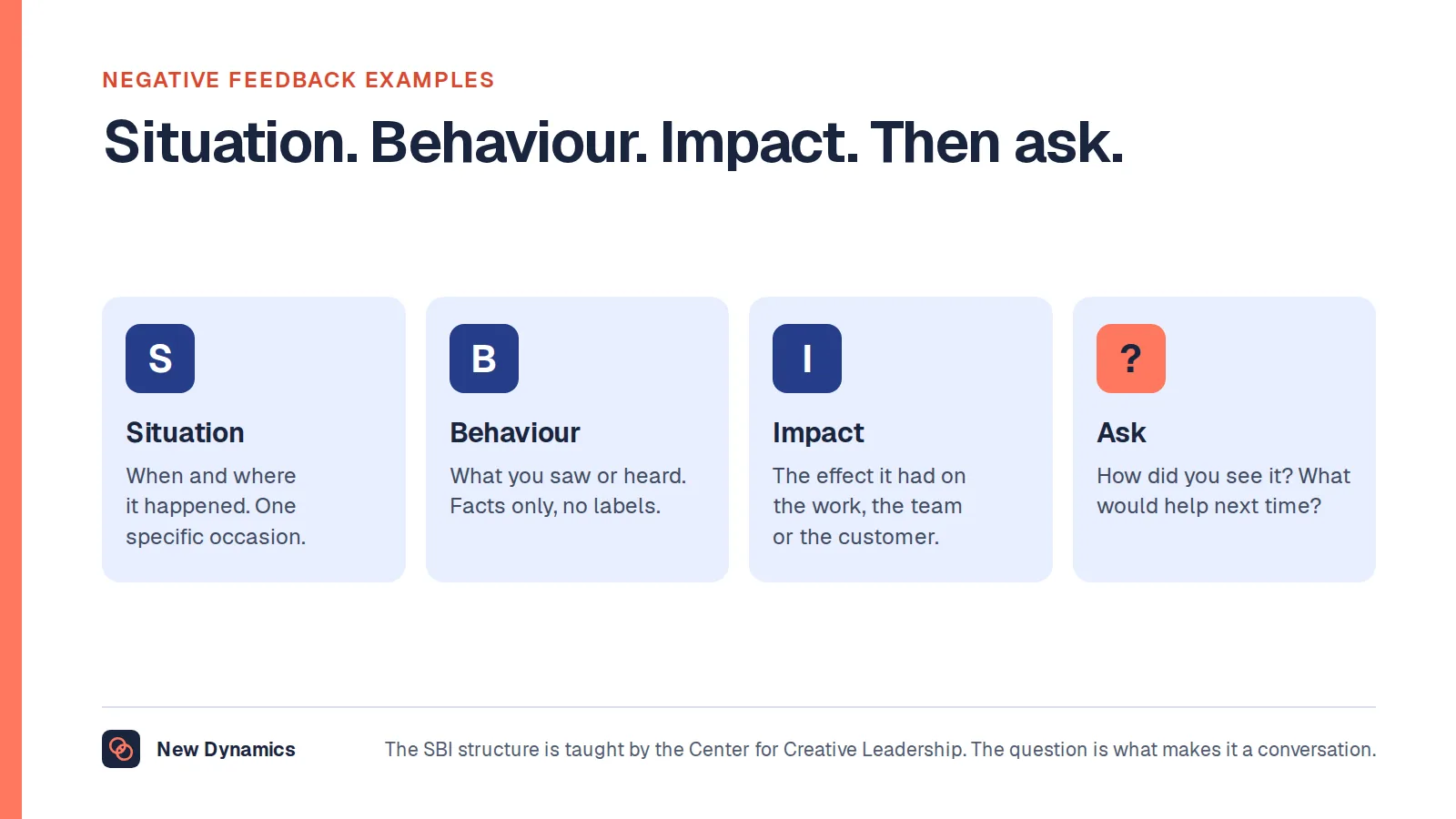
- Say difficult things directly. Raise a concern with the person concerned, privately and soon. Our negative feedback examples show how to word it.
- Look for the reason. When someone's behaviour annoys you, ask what pressure or misunderstanding might explain it before you judge.
- Be the same with everyone. People notice if you are charming to seniors and curt with juniors.
- Repair quickly. If you were short with someone, say so the same day. Small repairs prevent large rifts.
None of these needs a budget or a workshop. They need attention.
Managing employee relationships: what managers should do
Managers shape relationships through what they do, what they notice and what they tolerate. The HSE's Relationships standard lists what should be happening in a healthy organisation:
- the organisation promotes positive behaviours at work to avoid conflict and ensure fairness;
- employees share information relevant to their work;
- the organisation has agreed policies and procedures to prevent or resolve unacceptable behaviour;
- systems are in place to enable and encourage managers to deal with unacceptable behaviour;
- systems are in place to enable and encourage employees to report unacceptable behaviour.
In day-to-day management, that means:
- Hold regular one-to-ones and use some of the time to ask how working relationships are going. Our one-to-one meeting guide has prompts.
- Agree how the team works together. Settle response times, meeting behaviour and how decisions are made. Write it down.
- Deal with poor behaviour at once, whoever it comes from. Tolerating it from a high performer tells everyone what you really value.
- Be fair and be seen to be fair. Share interesting work, recognition and your own time evenly.
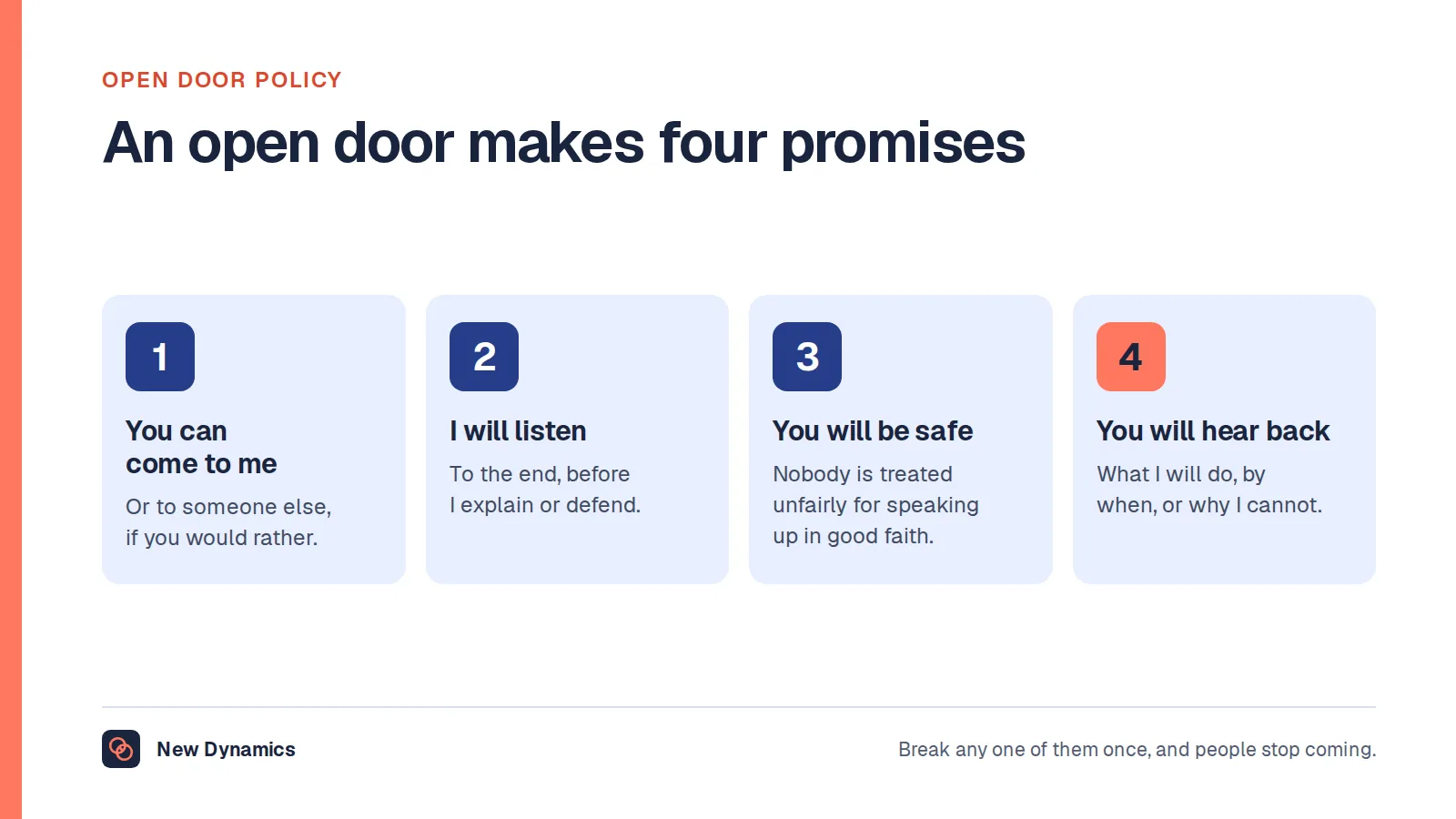
- Make it safe to raise concerns, with more than one route. See how to make an open door policy real.
- Help new people connect. Introduce them, pair them with a buddy and include them deliberately. A 30-60-90 day plan should name the people they need to meet.
- Build links between teams. Joint projects, shared goals and the occasional swap reduce the “us and them” that slows work down.
- Model it. Admit your own mistakes, give credit and ask for feedback.
The CIPD adds that line managers need the confidence to “resolve disagreements at an early stage as part of a problem-solving approach”. Early is the important word.

How to repair a difficult working relationship
- Decide that it is worth repairing. If you work together often, it nearly always is.
- Look at your own part first. What have you done, or left undone, that contributed?
- Ask for a private conversation. “I think we have got off on the wrong foot, and I would like to fix that.”
- Describe, do not accuse. Say what happened and the effect on you, without labelling the other person.
- Ask for their view, and listen. You will usually learn something you did not know.
- Agree one or two changes on each side, and keep them small and specific.
- Follow up after a couple of weeks.
If that does not work, or the behaviour is serious, involve your manager or HR. Acas advises that it is usually a good idea to raise a problem informally first, and that a formal grievance is appropriate when the informal route has not worked or the issue is very serious.
Bullying, harassment and discrimination are different from ordinary friction. They need a formal route and prompt action. Our guide to the definition of discrimination at work explains the terms.
Friendships, family and romance at work
Personal relationships at work are normal, and they bring risks that are worth managing openly.
- Friendships make work enjoyable. Watch for cliques that leave others out, and for friends reviewing each other's work or pay.
- Family members and partners working together can create real or perceived conflicts of interest. A simple rule helps: nobody manages, appraises, hires or sets the pay of a relative or partner.
- Romantic relationships between colleagues are a private matter until they create a conflict of interest or a power imbalance. Some organisations ask people to disclose a relationship with someone in their reporting line, so that reporting lines can be changed.
Write the rules down, apply them consistently and keep them proportionate.
Relationships in remote and hybrid teams
Distance removes the accidental contact that builds familiarity, so it has to be replaced on purpose.
- Start meetings with a few minutes that are not about tasks.
- Use video for difficult or nuanced conversations. Text strips out tone.
- Make sure remote colleagues hear news at the same time as those in the office.
- Schedule occasional time together in person, and use it for relationship building more than for status updates.
- Notice who has gone quiet, and check in.
How to tell whether relationships are healthy
- People raise problems early, and with the person who can fix them.
- Meetings include real disagreement, and decisions still get made.
- New starters say they felt welcome and knew whom to ask.
- Complaints about behaviour are rare, and they are handled quickly when they arise.
- Survey questions about respect, inclusion and speaking up score well. See our workplace engagement survey questions.

Frequently asked questions
What are workplace relationships?
Workplace relationships are the working connections between people in and around an organisation: with your manager, your peers, the people you manage, other teams and customers or suppliers. They shape how information moves, how problems are solved and how people feel about work.
Why are good relationships at work important?
Good working relationships help information travel quickly, make problems easier to solve and make people more likely to stay. Poor ones slow work down and harm health. The UK Health and Safety Executive treats relationships as one of six key areas for managing work-related stress.
How do you build good relationships with colleagues?
Keep small promises, share information early, show interest in others' work, give credit by name, raise concerns directly and privately, look for the reason behind behaviour you dislike, treat everyone the same and repair small rifts quickly.
How should managers manage employee relationships?
Managers should hold regular one-to-ones, agree how the team works together, deal with poor behaviour at once, share work and recognition fairly, make it safe to raise concerns, help new people connect and build links between teams. They should also model the behaviour they expect.
What is the difference between employee relationships and employee relations?
Employee relationships are the everyday working connections between people. Employee relations is a more formal term. The CIPD defines it as the relationship between employers and employees, both individually and collectively, including voice, consultation and conflict handling.
How do you deal with a difficult colleague?
Start with a private conversation. Describe what happened and its effect without labelling the person, ask for their view and agree one or two small changes. If that fails, or the behaviour is serious, involve your manager or HR and use the formal procedure.
Your next step: invest in one relationship
- Pick one working relationship that matters and is not as good as it should be.
- Choose one habit from the list of eight to practise with that person this week.
- If there is an unresolved issue, ask for a private conversation.
- Review how it feels in a month.
For conversation prompts and an agenda, read and download our one-to-one meeting guide. The guide is free to read, and the PDF uses our short download form.
Want feedback, recognition and check-ins to strengthen relationships across your teams? Book a New Dynamics demo and bring your current approach. You can also email contact@new-dynamics.com.