TL;DR
- In the United Kingdom neither is a legal status. GOV.UK classes work paid according to hours at work as “time work”, and states that most people paid an annual salary are doing “salaried hours work”. Both are measured against the same hourly minimum.
- Dividing a salary by 2,080 is an American convention, 40 hours multiplied by 52 weeks. GOV.UK's method is to take the basic annual hours from the contract, divide by the number of payments in the year, then divide the pay packet by that figure, and be able to show where the annual hours came from.
- Holiday, sick pay and pension have the same statutory floors either way. The real differences are predictability and who absorbs a quiet week: GOV.UK puts statutory guarantee pay at £41 a day, for five days in any three month period.
Two people do the same work in the same building. One is paid £25 an hour. The other is paid £52,000 a year. On a normal week the money is almost identical. On a quiet week, a busy week, a week off sick and a week of annual leave it is not, and nothing in either contract explains why.
The hourly rate against salary question gets answered badly because it is usually answered with American rules, where being salaried is tangled up with being exempt from overtime. In the United Kingdom there is no exempt category, the statutory protections are nearly identical either way, and the differences that matter are predictability, administration and who carries the cost of a week with less work in it.
This article is general information about the position in the United Kingdom rather than legal advice.
Hours go wrong at the record, not the rate. An extra shift gets agreed in a corridor, approved by message and disputed at the payslip three months later. See how New Dynamics workflows keep a request, its approval and its record on one visible path.
Hourly rate and salary: two units of pay, one hourly floor
For the American floor and what it comes to over a year, which the Department of Labor does not itself publish, see the US minimum wage annually.
An hourly rate is a price per hour worked. Pay in any period is the rate multiplied by the hours that period contained, so the amount moves with the work. That is what an hourly rate means, and it is the whole of the deal before any contractual premium.
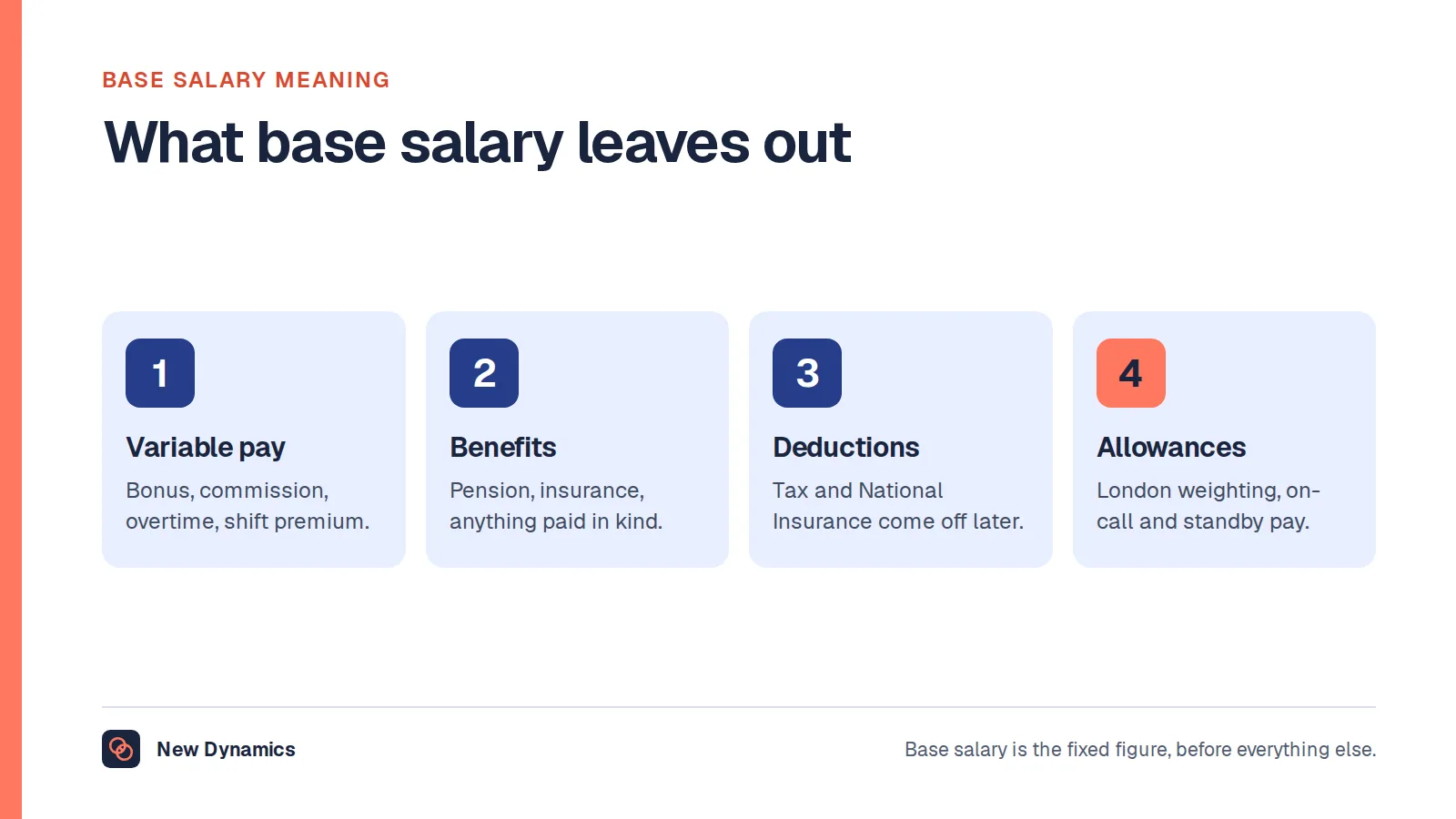
A salary is a fixed annual amount paid in equal instalments for a set number of contractual hours. Pay in any period is the instalment, whatever the period contained. Our post on base salary covers what the base figure excludes and what being salaried means in UK law.
Both answer to the same rule. GOV.UK's overview of the minimum wage for different types of work opens with the sentence the subject rests on: "The National Minimum Wage is worked out at an hourly rate, but it applies to all eligible workers even if they're not paid by the hour."
There is no salaried category in the United Kingdom that switches anything off. Of the four minimum wage categories, two matter here: work paid by the hour is "time work", and an annual salary against a contractual number of hours a year is "salaried hours work". They decide how you check the floor, not whether it applies.
The legal definition of hourly work is short. The National Minimum Wage Regulations 2015, regulation 30, provide that "Time work is work, other than salaried hours work, in respect of which a worker is entitled under their contract to be paid" by reference to the time worked. Note the order: GOV.UK's manual on calculating the minimum wage says HMRC "first 'test' for salaried hours work. If that does not fit, then they move to time work."

One line in that manual settles the "either or" question: "One worker can be performing more than one type of work under the same contract", with basic hours paid as a monthly salary and overtime "paid on an hourly basis". A salaried employee with a paid overtime clause is both at once, so the comparison is between two ways of pricing a block of hours, not two kinds of person.
What an hourly rate pays for, and which hours count
An hourly rate pays for hours at work. GOV.UK's guidance on being paid by the hour states it plainly: "Workers paid according to the number of hours they are at work are classed as doing 'time work'", and "the average hourly pay has to be at least the National Minimum Wage, worked out over the period each pay packet covers."
Its example makes the arithmetic visible. A call centre worker aged 20 is "eligible for the National Minimum Wage rate of £10.85" and "works a total of 140 hours during the month of January", so "he must be paid at least £1,519 for this month's work". One month, one division, one answer.
That simplicity is the hourly rate's advantage, and the cost behind it is that the hours which count are not only the hours on the rota. GOV.UK's overview of different types of work says to include time spent:
- "at work and required to be working, or on standby near the workplace (but do not include rest breaks that are taken)"
- "waiting to collect goods, meet someone for work or start a job"
- "travelling in connection with work, including travelling from one work assignment to another"
- "training or travelling to training"
Excluded, among other things, is "travelling between home and work".
The travel rule is the one that produces arrears. In GOV.UK's own example, a care worker with two morning appointments and no breaks "must be paid at least the minimum wage for the time he spends at the appointments, plus the travel time between appointments".
Being paid hourly also says nothing about how many hours anyone is promised. Our post on zero hours contracts covers the arrangement most often confused with hourly pay, and our post on piece rates covers pay tied to output.
What a salary pays for, and what it does not buy
A salary pays for a number of hours across a year, not for unlimited availability. GOV.UK's page on being paid an annual salary makes the contract do the work: "To find out if they are getting the minimum wage you must work out how many basic hours they work in return for their salary." Such a contract "might not state the total number of basic hours", but "you must be able to work this out from the contract".
Three things a salary does not buy.
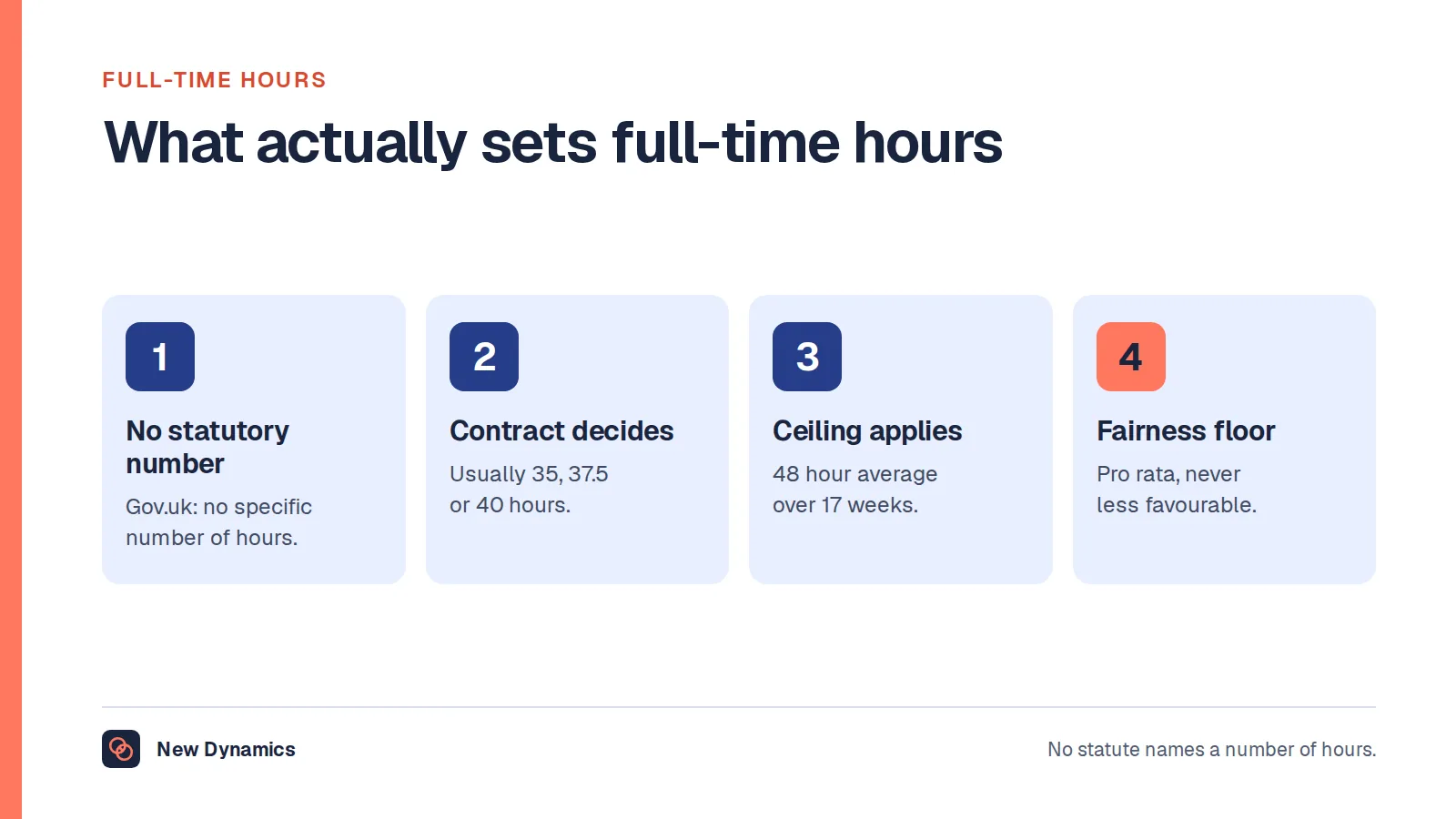
Unlimited hours. The 48 hour average week applies to salaried staff exactly as it does to hourly staff, unless the individual has signed a voluntary written opt out. Our post on full-time hours covers what sets normal hours in the first place.
Extra hours for nothing. GOV.UK is direct on the annual salary page: "Employers must pay at least the minimum wage for any hours worked in addition to what's agreed in the worker's contract."
Exemption from anything. There is no United Kingdom equivalent of the American exempt and non-exempt split. Our post on exempt and non-exempt employees explains that system; the short version is that importing it here produces unlawful policies.
What a salary does buy, and what rarely appears in a comparison, is administrative stillness. The payroll figure is known twelve months ahead, holiday pay needs no reference period, and a short week costs nothing to process.
Turning a salary into an hourly rate the way GOV.UK does it
Most published comparisons go wrong here, because they use an American divisor and present it as arithmetic.
The 2,080 convention. Divide an annual salary by 2,080 and you have an hourly rate. The 2,080 is 40 hours multiplied by 52 weeks. It is an American convention, built on a standard week that United Kingdom law does not set. No GOV.UK page tells a British employer to divide by 2,080, and plenty of British contracts are 35, 37.5 or 39 hours.
The United Kingdom equivalent is the three step method on GOV.UK's annual salary page. Find the basic annual hours in the worker's contract. Divide them by the number of times the worker gets paid each year, which, in GOV.UK's words, "gives you the average number of hours covered by each pay packet". Then "divide the amount they get in each pay packet by this number (average hours)".
GOV.UK's example runs it: a worker aged 20 whose "contract says she must work 2,040 hours each year", paid monthly, has pay packets covering "an average of 170 hours (2,040 divided by 12)", so at £10.85 "she must be paid at least £1,844.50 a month" for her basic hours.
Notice what is doing the work: the contract, not a convention. Where a contract gives weekly hours instead, GOV.UK's manual allows "some form of weekly multiplier, such as 52, 52.14 or 52.18", but "the important thing is the employer must be able to demonstrate how the basic hours for a year have been ascertained."
At 40 hours a week those three multipliers give 2,080, 2,085.6 and 2,087.2 basic annual hours, because a year is a little more than 52 weeks. Pick one and write it in the contract and you can answer an HMRC officer. Pick one in a spreadsheet afterwards and you cannot.

Hours paid, or hours worked
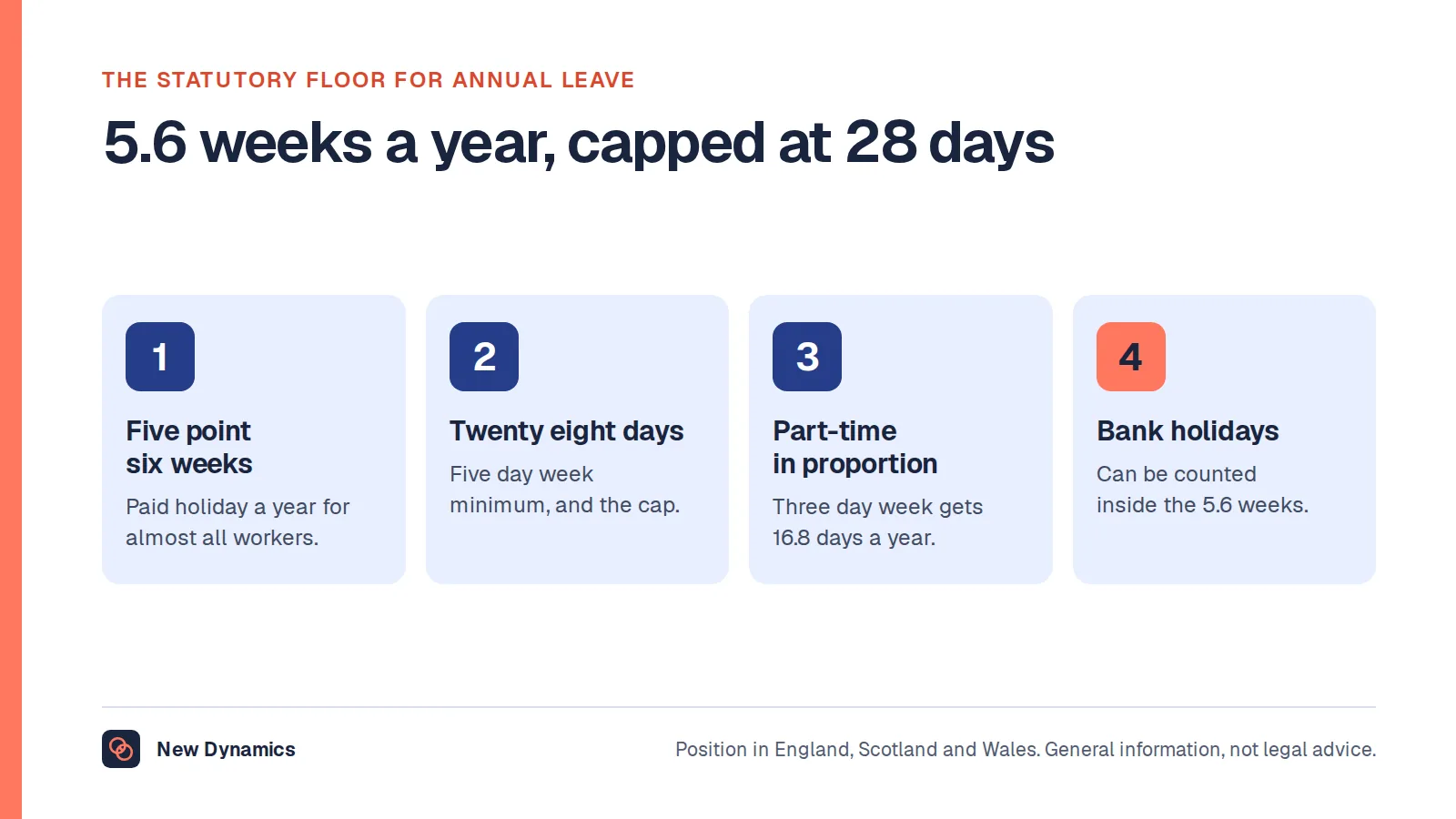
A second question hides in the divisor. A salaried worker's 2,080 hours include their paid holiday. Statutory leave is 5.6 weeks, so a 52 week year holds 46.4 working weeks. The government's guidance on holiday pay and entitlement reforms explains the familiar percentage: "a worker's total working weeks in a year is 46.4 (52 weeks in a year minus 5.6 weeks of leave). 12.07% of 46.4 is 5.6."
So on a 40 hour week, 1,856 hours are worked and 224 are paid holiday. Divide a salary by 2,080 and you get the cost of an hour of the year. Divide by 1,856 and you get the cost of an hour of work. The answers differ by about 12%, and comparisons that mix them are why an hourly quote and a salary quote never line up.
The Office for National Statistics will not make that comparison at all. In Employee earnings in the UK: 2026, released on 22 October 2026, it reports that "median hourly earnings (excluding overtime) for full-time employees were £20.81 in April 2026, compared with £19.68 in April 2025, a 5.7% increase", and warns that "ASHE annual figures are not directly comparable to weekly or hourly pay figures". Those estimates are provisional and relate to the pay period that includes 22 April 2026, and the median is economy-wide, not a rate for any job. See our HR statistics hub.
Turning an hourly rate into an annual figure, with worked examples
The arithmetic below is arithmetic only. Not market rates, not benchmarks, not a recommendation for any role, and each names its assumption.
An hourly rate to a yearly salary
£25 an hour, 40 hour week. At 52 weeks that is 2,080 hours and £52,000. At 52.14 weeks, £52,140. At 52.18 weeks, £52,180. Three defensible answers from one rate, which is why the multiplier belongs in the contract.
£25 an hour, 37.5 hour week. 1,950 hours at 52 weeks, so £48,750. Same rate, same weeks, £3,250 less, purely because the week is shorter. An hourly to annual conversion without the weekly hours is incomplete.
£31.25 an hour, 40 hour week. 2,080 hours, so £65,000. On a 37.5 hour week the same rate gives £60,937.50.
Then the caveat. Those figures assume every one of the hours is paid. An hourly worker paid only for hours worked, with no holiday pay, would be paid for 1,856 hours, which at £25 is £46,400. The missing £5,600 is the 5.6 weeks of statutory leave.
A yearly salary to an hourly rate
£100,000 a year. Divided by 2,080 hours, £48.08 an hour. By 1,950 hours, which is a 37.5 hour week, £51.28. By 1,856 hours worked rather than paid, £53.88. By 1,740, a 37.5 hour week net of statutory leave, £57.47. Four correct answers to "what is the hourly rate for a £100,000 salary", and the only way to choose is to say which hours you mean.
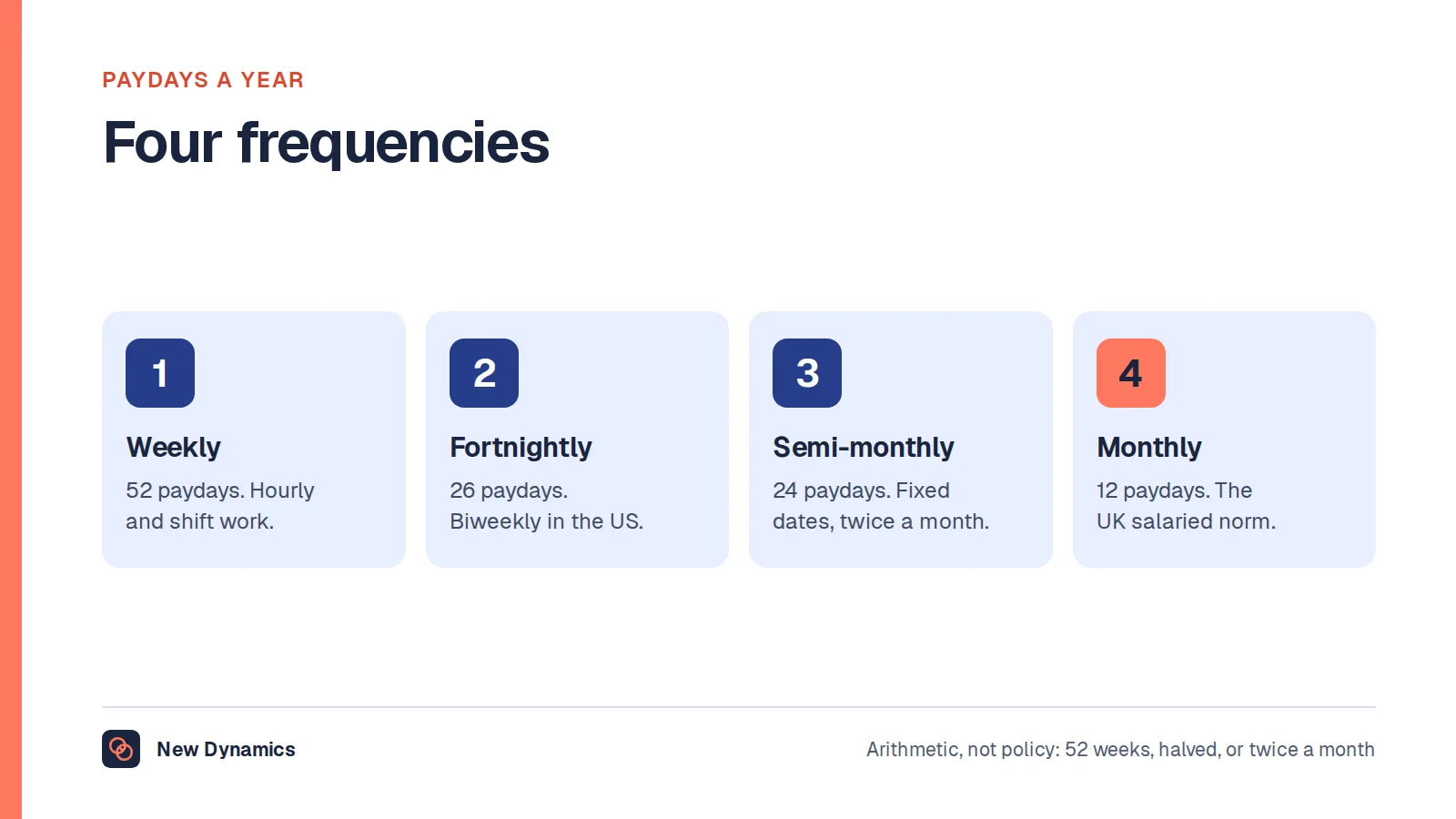
A calculator cannot settle that. It applies whatever divisor you give it, which is why GOV.UK's requirement to show how the basic annual hours were ascertained is the most useful sentence in the topic. Our post on the full-time equivalent covers the related trap, and our post on pay frequency covers the instalment.
Overtime, holiday pay, sick pay and pension: what actually changes
On the statutory floors the two are far closer than people expect. What differs is how the calculation is done, and that is where money goes missing.
Overtime
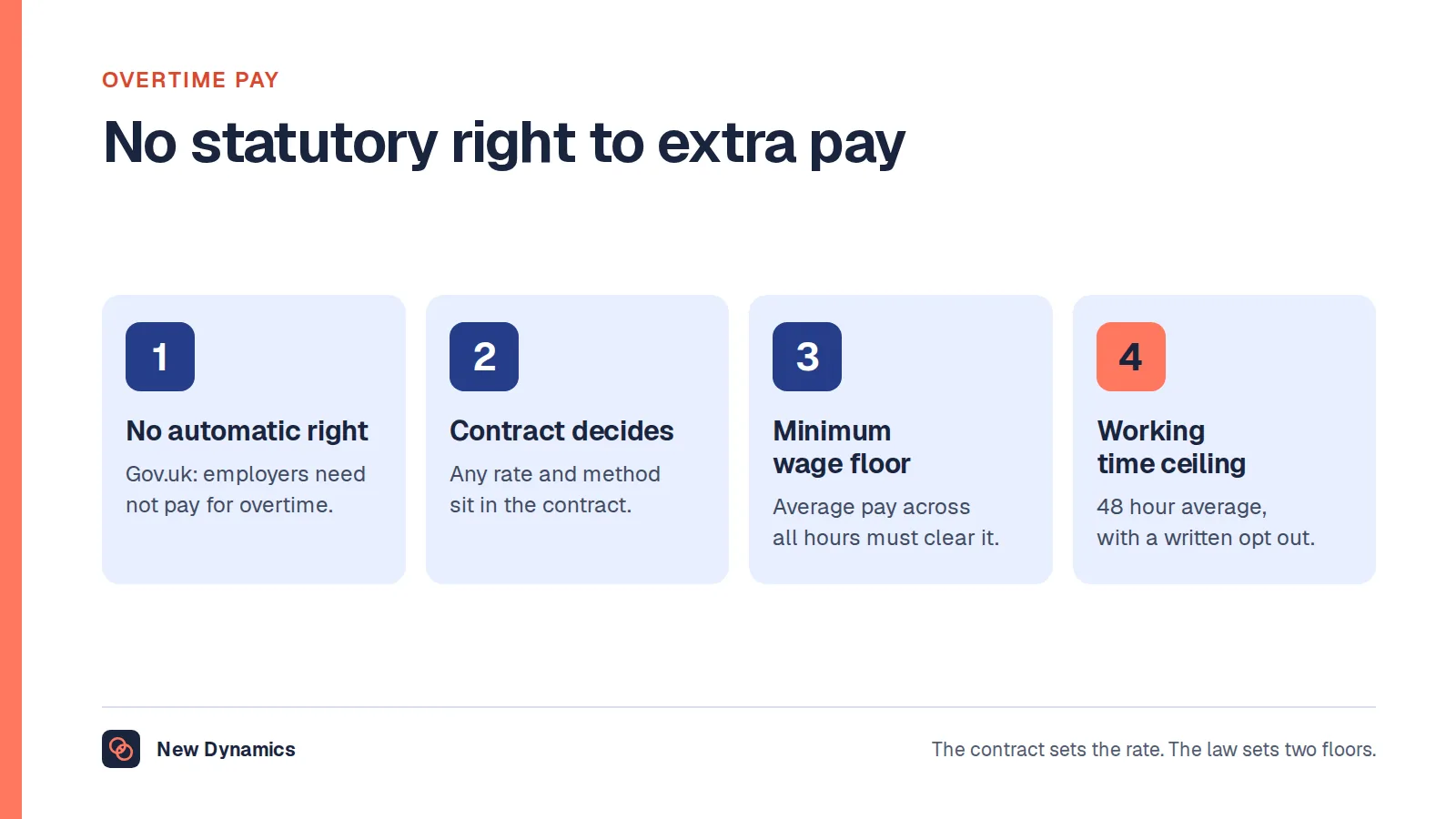
There is no statutory right to extra pay for overtime in the United Kingdom at all, whichever way someone is paid. Our post on overtime pay covers the position in full, including the two floors that apply whatever the contract says.
The difference is the question each arrangement raises. For an hourly worker, overtime is a rate question: does the contract uplift the rate beyond a threshold, and from which hour? For a salaried worker it is a scope question: how many basic annual hours did the salary buy, and what happens past them? Acas adds a rule often missed for part-timers, on its guidance for part-time workers: they "are not entitled by law to get overtime pay until they've worked more than the normal hours of a full-time worker."
Holiday pay
The entitlement is the same. GOV.UK's guidance on holiday entitlement states that "Almost all people classed as workers are legally entitled to 5.6 weeks' paid holiday a year", including workers with irregular hours and part-year workers. Our post on how holiday accrues covers the entitlement itself.
The calculation diverges sharply. Acas, on calculating holiday pay, sets out three patterns:
- Fixed hours. "If a worker's working hours and pay do not vary, their holiday pay will be calculated using their usual pay rate." A worker on 37 hours a week paid £500 a week "must get paid £500" for a week's holiday.
- Fixed hours, variable pay. Holiday pay is "based on their average hourly rate", using "the worker's average pay over the previous 52 weeks", excluding holiday pay inside that period.
- Irregular hours and part-year workers. Again the 52 week average, but here "Any holiday pay during the 52-week reference period should be included in the calculation."
So a salaried week of leave is the instalment, while an hourly week of leave is a 52 week look back with its own inclusion rules, repeated for every absence. The reforms guidance adds that entitlement for irregular hours and part-year workers "will be calculated as 12.07% of actual hours worked in a pay period", and allows rolled up holiday pay "for irregular hour and part-year workers only", so rolling it into a salaried instalment makes an unlawful arrangement out of a convenience. Regular overtime raises holiday pay either way, because Acas requires overtime payments to be included where a worker has regularly been paid them during the last year.
Sick pay
Statutory Sick Pay is where the two are closest on paper and furthest apart in effect. GOV.UK's guidance on what you'll get states that an eligible employee "can get £123.25 a week Statutory Sick Pay" or "80% of your normal weekly earnings", whichever of the two is lower, "for up to 28 weeks". The conditions on its eligibility page do not mention pay structure at all. But the 80% limb comes from normal weekly earnings, so where the weeks vary the amount varies too.
Above that floor the difference is contractual. Occupational sick pay, which pays normal salary for a defined period, is far more often attached to salaried roles. That is an employer's choice rather than a rule, and it is where the comparison becomes a real difference in what a month off costs a household.
Pension
Automatic enrolment applies on earnings, not on the shape of the pay. GOV.UK's guidance on joining a workplace pension requires an employer to enrol a worker "aged between 22 and State Pension age" who earns "at least £10,000 per year", and says an employer "does not have to contribute to your pension if you earn these amounts or less: £520 a month, £120 a week, £480 over 4 weeks".
For a salaried worker those thresholds are one yes or no for the year. For an hourly worker with variable weeks they are a monthly assessment that can flip, so somebody paid hourly can move in and out of employer contributions without any change in their job. GOV.UK adds, in what you, your employer and the government pay, that contributions are usually "based on your total earnings between £6,240 and £50,270 a year before tax".
Predictability, and who absorbs a quiet week
Strip out the mythology and this is the difference that remains. A salary moves the risk of a thin week to the employer. An hourly rate leaves it with the worker.
The statutory position when work dries up is the evidence. GOV.UK's guidance on lay-offs and short-time working says that "Your employer can ask you to stay at home or take unpaid leave if there's not enough work for you", then the pay rule: "You should get your full pay unless your contract allows unpaid or reduced pay lay-offs." Where pay is withheld the backstop is small. On guarantee pay: "The maximum you can get is £41 a day for 5 days in any 3-month period", totalled as "a maximum of £205".
So a salaried employee whose work goes quiet is paid in full unless the contract says otherwise, while an hourly worker sent home is paid for the hours worked plus a floor measured in pounds a day. The employer's exposure is the mirror image: a salaried employee who works fifty hours costs the same as one who works thirty five. Neither arrangement is generous. They allocate uncertainty differently, and the question for anyone weighing an offer is "in a quiet month, whose problem is it".
The minimum wage trap on a salary
A salaried worker can be paid below the hourly minimum without anybody deciding to underpay them, because the salary never moves while the hours it has to cover do.
Start with the floor. GOV.UK's page on National Minimum Wage and National Living Wage rates states that "The rates change on 1 April every year", and the rates listed under April 2026 are £12.71 for workers aged 21 and over, £10.85 for 18 to 20 year olds, and £8 for under 18s and for apprentices. The April 2027 column gives £13.21, £11.27, £8.31 and £8.31.
Now the arithmetic, which is arithmetic only and not a market figure. At £12.71 an hour, a contract of 2,080 basic annual hours meets the floor at an annual salary of £26,436.80, or £2,203.07 a month against 173.33 hours. A salary of £26,500 on that contract is £12.74 an hour, three pence clear, and that margin lasts exactly as long as the hours stay inside the contract.

Work 300 hours beyond the basic hours in the year and the same salary has to cover 2,380 hours, which is £11.13. GOV.UK's checklist for employers names this among the common causes of underpayment: "Excess hours worked by salaried-hours workers, beyond their basic set hours, causing underpayment of minimum wage typically in the last pay reference period." Our post on base salary works through the calculation year.
The hourly worker's version of the same failure is smaller and louder. Because time work is tested in each pay reference period, an unpaid hour shows up in that month's division at once. The salaried version is quiet, cumulative and lands in one period, often the last of the year. And it is not a routine adjustment: GOV.UK's guidance for employers and the minimum wage states that arrears "have to be paid back immediately. There will also be a fine and offenders might be named by the government."
Two GOV.UK pages, two rates
A caution about sources. The rates page gives £12.71 and £10.85 from April 2026, and GOV.UK's paid by the hour page uses £10.85 for a 20 year old. Its manual page on working hours for which the minimum wage must be paid, updated on 23 October 2026, still runs examples on last year's rates: "A 19 year old worker earns the 18-20 year old NMW rate of £10 per hour."
Both are live GOV.UK pages, and on the 18 to 20 rate they disagree, £10.85 against £10. Take the method from the manual and the rate from the rates page, which carries the dated table.
When an hourly rate suits a role, and when a salary does
Neither is better. Each fits a shape of work, and most disputes come from using one where the other belongs.
An hourly rate usually suits a role where demand genuinely varies week to week, hours are recorded anyway, the work is shift based and countable, or extra hours are normal rather than exceptional. It also suits any role where the employer wants extra hours to carry a visible cost.
A salary usually suits a role where output is not measured in hours, the volume is steady, the person decides how to spend their time, or recruitment competes on an annual figure.
Signals you have chosen wrong. Salaried staff whose actual hours sit far above the contract, with no record of it: the minimum wage division is a risk, the 48 hour average is unevidenced, and the cost of the extra work is invisible. The reverse signal is an hourly workforce whose hours never vary, where timesheets and 52 week averages describe a constant.
Two things make the choice safe either way. Write the hours down in a form from which an annual total follows, and record actual hours for both groups, because the employer has to produce the evidence. Our posts on time and attendance software and time off in lieu cover the record and the banked balance.
Moving someone from hourly to salaried, or back
Not a payroll change. A contract change. Acas, on changes to employment contracts, states it in one line: "Any changes must be agreed by both the worker and employer." It also says employers should "avoid 'fire and rehire'" and "must consult before dismissal". Six things to settle in writing before the switch.
- The hours. The new basic hours, weekly and annually, and the multiplier connecting them.
- The rate equivalence. Which divisor you used, and whether it counts hours paid or hours worked.
- Extra hours. What happens beyond the basic hours, and who authorises them.
- Holiday pay. Which method now applies, and whether a rolled up arrangement has to stop.
- Sick pay. Whether an occupational scheme starts or ends, and from when.
- Pension. Whether the change moves anybody across the enrolment thresholds.
Answer those six and the switch is an administrative change. Answer none and it is a grievance with a date on it.
Which jurisdiction you are in
The GOV.UK and Acas guidance quoted here applies in Great Britain, which is England, Scotland and Wales. Acas does not cover Northern Ireland, which has its own separately made working time and employment legislation, so a Belfast handbook should cite the Northern Ireland regulations and point to nidirect. The minimum wage is set United Kingdom wide, so the rates above apply there too.
If you employ people here and in the United States, write the rule twice and name the country on each. This article is general information about published United Kingdom guidance rather than legal advice, and rates and thresholds change, so take advice before you write a policy or change a contract.
Frequently asked questions
What is an hourly rate?
An hourly rate is the amount a worker is paid for each hour worked, so the total in any pay period is the rate multiplied by the hours that period contained. In the United Kingdom, work paid according to the hours someone is at work is classed by GOV.UK as "time work", and average hourly pay must be at least the National Minimum Wage over the period each pay packet covers.
What is the difference between an hourly rate and a salary in the UK?
An hourly rate prices each hour. A salary is a fixed annual amount paid in equal instalments for a contractual number of hours a year. Neither is a legal status and the statutory protections are nearly the same either way. The real differences are predictability, how holiday pay is calculated, and who absorbs a quiet week.
How do you work out an annual salary from an hourly rate?
Multiply the hourly rate by the contractual weekly hours, then by a stated number of weeks. At 40 hours a week, £25 an hour gives £52,000 using 52 weeks, or £52,140 using 52.14. At 37.5 hours the same rate gives £48,750. GOV.UK requires an employer to show how the basic annual hours were arrived at, so write both assumptions down.
How do you work out an hourly rate from an annual salary?
GOV.UK's method is to find the basic annual hours in the contract, divide them by the number of payments made each year, then divide the pay packet by that figure. Dividing by 2,080 is an American convention, being 40 hours multiplied by 52 weeks, and it is wrong for any contract that is not a 40 hour week.
Is it better to be paid hourly or on a salary?
It depends which risk you would rather carry. An hourly rate pays for every hour, including extra ones, but a quiet week is the worker's loss. A salary is predictable and continues through a quiet week, but extra hours are paid only where the contract provides for them.
Can a salaried worker end up below the minimum wage?
Yes, and usually without anyone intending it. The salary stays the same while the hours it has to cover grow, so the effective hourly rate falls. GOV.UK lists excess hours worked by salaried hours workers beyond their basic set hours among the common causes of underpayment, typically in the last pay reference period.
Your next step: name the hours, then do the division
- Take one hourly contract and one salaried contract for comparable work. Write down the weekly hours, the annual hours and the multiplier that connects them. If the annual total does not follow from the contract, fix that first.
- Run the division both ways. Pay packet divided by the hours in that pay reference period, against the rate for that person's age.
- Decide which divisor your adverts and offers use, hours paid or hours worked, and use the same one everywhere.
- Check one holiday payslip for an hourly worker with variable hours. If it pays bare basic pay while regular overtime has been paid all year, the calculation is wrong.
- Check your enrolment and sick pay positions for anyone whose hours vary.
To put rates, hours, overtime and the holiday pay method in one document people can read, read and download our compensation policy guide. The guide is free to read, and the PDF uses our short download form.
Want extra hours requested, approved and recorded in one place instead of three inboxes and a paper timesheet? Book a New Dynamics demo and bring your current process. You can also email contact@new-dynamics.com.