TL;DR
- Director of housekeeping, executive housekeeper and head housekeeper are the same job at different sizes of property. The National Careers Service files head housekeeper under its hotel housekeeper profile, and the apprenticeship route treats housekeeping manager as a specialism of the Level 4 hospitality manager standard.
- The duties are legal, not generic. COSHH 2002 regulation 6 requires a suitable and sufficient assessment before the work starts, regulation 12 requires training, and regulation 12(4) extends that to agency staff who are not your employees. The Manual Handling Operations Regulations 1992 regulation 4 covers the linen.
- RIDDOR draws two different lines on the same injury: regulation 12 requires a record once a worker is incapacitated for more than three consecutive days, and regulation 4(2) requires a report to the enforcing authority once it passes seven, within 15 days of the accident.
In a large hotel, housekeeping is usually the department with the most people in it, and it is where the cleaning chemicals, the lifting and the agency hours are concentrated. One person is accountable for all three, including for the agency room attendants who are not on the payroll.
This director of housekeeping job description sets out the senior departmental role rather than the cleaning role beneath it: how the titles relate, what the job is accountable for, the legal duties that make this department different, the team structure and the rota, the qualifications and routes in, who the role reports to and how its performance is actually measured. It covers the position in the United Kingdom and is general information, not legal advice.
A housekeeping department is a shape before it is a rota: supervisors, floors, linen, public areas and the night team. See how New Dynamics org charts hold that structure, reporting lines and vacancies in one place that managers can read.
What a director of housekeeping is accountable for
The role owns the condition of every bedroom and every public area, the people who produce that condition, and the cost of producing it. Two things make it harder than the headcount suggests.
The deadline is set by someone else. Arrivals, departures, early check-ins and late check-outs are decided by reception and revenue. Housekeeping absorbs the variance, which is why the role lives or dies on the relationship with the front desk. Our article on the hotel reception role covers the other side of that handover.
The labour is the cost. Almost the entire departmental budget is hours. A change in the minutes allowed per room moves the labour line immediately, and it moves the inspection failure rate a week later.
Director of housekeeping, executive housekeeper, head housekeeper
These are the same job at different sizes of property, and the title tells you more about the owner than about the work.
- Head housekeeper is the standard British title. The National Careers Service lists it among the alternative titles for its hotel housekeeper profile, alongside "Hotel room attendant, housekeeping room attendant, head housekeeper", which is a fair description of how loosely the word is used in adverts.
- Executive housekeeper is the usual title in four and five star hotels and in international groups. The holder runs the department, holds the budget and sits in the hotel's management meeting.
- Director of housekeeping is most often seen in North American brands operating here, in very large properties and in multi site roles. It usually signals either more than one building or a seat alongside the other directors rather than below them.
- Housekeeping manager and accommodation services manager appear where the department covers linen contracts, laundry and the supply chain as well as cleaning.
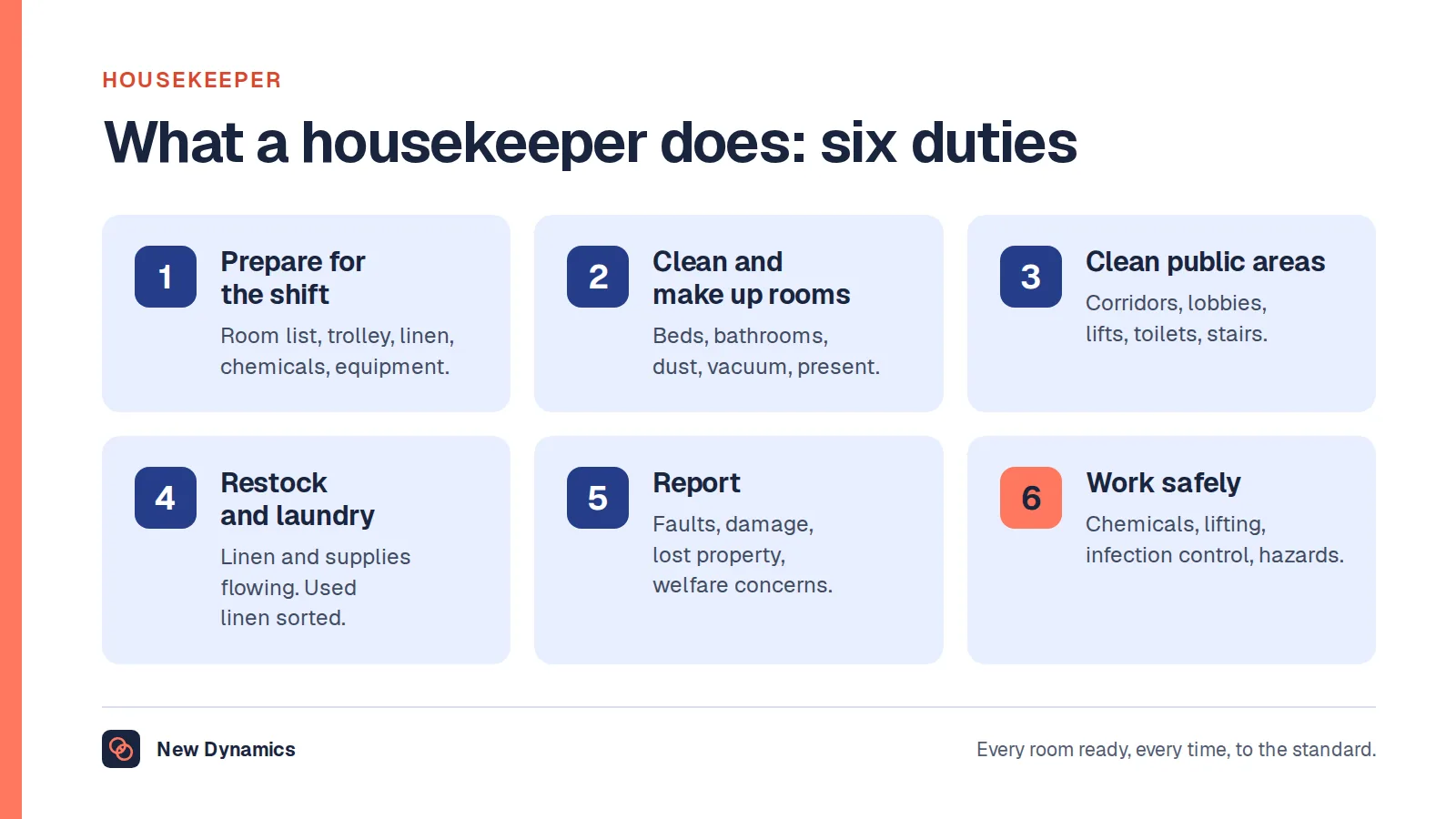
Below all of these sit the housekeeping supervisors and the room attendants. The retired Hospitality supervisor standard describes that layer precisely: housekeeping supervisors "coordinate the work of cleaners, laundry services and room attendants to ensure customers' experience is in line with the business standards". The floor role itself is covered in our housekeeper job description, and that is the document to use for room attendants rather than this one.

The responsibilities, grouped
A usable job description puts them in six groups rather than twenty bullets.
- Standards. Define what a clean room is, write it down as a checklist, train to it, inspect against it and deal with the gap. Deep cleaning cycles, mattress and curtain rotations and public area schedules sit here.
- The rota and the labour cost. Forecast the rooms from the occupancy forecast, convert them into hours, build the rota, authorise overtime and agency cover, and explain the variance.
- People. Recruit, induct, train, appraise, discipline and keep. Turnover in this department is usually high enough that the induction is not a formality.
- Safety and compliance. The duties in the next section, which are the ones most adverts leave out entirely.
- Stock and equipment. Linen par levels, laundry contracts, amenities, chemicals, trolleys and machines, plus the lost property process.
- Working across departments. Reception, maintenance, food and beverage and security, every day.
The legal duties that make this department different
Most management job descriptions get away with "ensure compliance with health and safety policy". A housekeeping department cannot, because the duties attach to things it does hourly. All of the following apply in Great Britain.
COSHH. Cleaning chemicals are substances hazardous to health, so the Control of Substances Hazardous to Health Regulations 2002 apply in full. Regulation 6 says an employer "shall not carry out work which is liable to expose any employees to any substance hazardous to health" unless he has "made a suitable and sufficient assessment of the risk created by that work to the health of those employees and of the steps that need to be taken to meet the requirements of these Regulations" and has "implemented the steps". Where the employer has five or more employees, regulation 6(4) requires the significant findings of that assessment to be recorded. Regulation 7 puts substitution first: the employer "shall avoid, so far as is reasonably practicable, the use of a substance hazardous to health at the workplace by replacing it with a substance or process" that eliminates or reduces the risk. Regulation 12 requires "suitable and sufficient information, instruction and training", including the names of the substances, the risk they present, access to the safety data sheet and the significant findings of the assessment.
The agency point inside COSHH. Regulation 12(4) is the paragraph that catches hotels out. It says every employer "shall ensure that any person (whether or not his employee) who carries out work in connection with the employer's duties under these Regulations has suitable and sufficient information, instruction and training". An agency room attendant on their first shift is covered by that sentence. The HSE's COSHH basics pages set out the assessment, substitution, control and training steps in plain terms.
Manual handling. Stripped linen, mattress turns, trolleys and vacuum cleaners are the classic source of injury here. Regulation 4 of the Manual Handling Operations Regulations 1992 sets a hierarchy. First, "so far as is reasonably practicable, avoid the need for his employees to undertake any manual handling operations at work which involve a risk of their being injured". Where that is not reasonably practicable, the employer must "make a suitable and sufficient assessment", must "take appropriate steps to reduce the risk of injury" to those employees "to the lowest level reasonably practicable", and must provide "general indications and, where it is reasonably practicable to do so, precise information on" the weight of each load and the heaviest side of a load whose centre of gravity is off centre. Regulation 4(3) lists what to have regard to, and the list includes "the physical suitability of the employee to carry out the operations" and "his knowledge and training".
The training duty itself. Section 2(2)(c) of the Health and Safety at Work etc. Act 1974 requires "the provision of such information, instruction, training and supervision as is necessary to ensure, so far as is reasonably practicable, the health and safety at work of his employees". In a department where new starters arrive every month and the first shift involves chemicals and lifting, that duty is a rota item, not a policy statement.
RIDDOR. The Reporting of Injuries, Diseases and Dangerous Occurrences Regulations 2013 draw two different lines on the same injury, and this is the part that gets missed. Regulation 12 requires a record of an injury "incapacitating that person for routine work for more than three consecutive days (excluding the day of the accident)", kept "for at least three years from the date on which it was made". Regulation 4(2) requires a report to the enforcing authority once a worker "is incapacitated for routine work for more than seven consecutive days (excluding the day of the accident)", sent "as soon as practicable and in any event within 15 days of the accident". Specified injuries, which include a bone fracture other than to a finger, thumb or toe, must be notified "by the quickest practicable means without delay" with a report within 10 days, under Schedule 1.

The employment side: agency labour, right to work and pay records
Housekeeping is where agency hours, split shifts and minimum wage compliance concentrate, so the job description should say who owns each of these.
Right to work checks. GOV.UK is direct on checking a job applicant's right to work: "You must check that a job applicant is allowed to work for you in the UK before you employ them." The guidance says to make and keep copies, "keep copies during the applicant's employment and for 2 years after they stop working for you", and to "record the date the check was made". Getting it wrong is expensive: GOV.UK states that an employer who has not carried out a correct check "might have to pay a civil penalty (fine) of up to £60,000 for each illegal worker".
Minimum wage records. Regulation 59 of the National Minimum Wage Regulations 2015 requires records "sufficient to establish that the employer is remunerating the worker at a rate at least equal to the national minimum wage", in a form that can be produced "in a single document" for a pay reference period. Regulation 59(8) requires those records to be kept for "six years", a period substituted with effect from 1 April 2021. The rate matters because so much of the department sits on it: GOV.UK's National Minimum Wage and National Living Wage rates table gives £12.71 for workers aged 21 and over from April 2026, with the note that "The rates change on 1 April every year".
Agency workers. Where the department tops up with agency staff, the twelve week clock runs. Regulation 7 of the Agency Workers Regulations 2010 says that to complete the qualifying period "the agency worker must work in the same role with the same hirer for 12 continuous calendar weeks, during one or more assignments", after which regulation 5 gives the same basic working and employment conditions as a directly recruited worker. A department that has used the same agency attendants since the spring has already passed that point.
Team structure, rotas and hours
The usual shape is four layers: room attendants and house porters, floor supervisors, a deputy or assistant head housekeeper, and the executive housekeeper or director at the top. Linen, laundry and public areas are often separate sub teams with their own supervisor, and the night cleaning team reports in separately again.
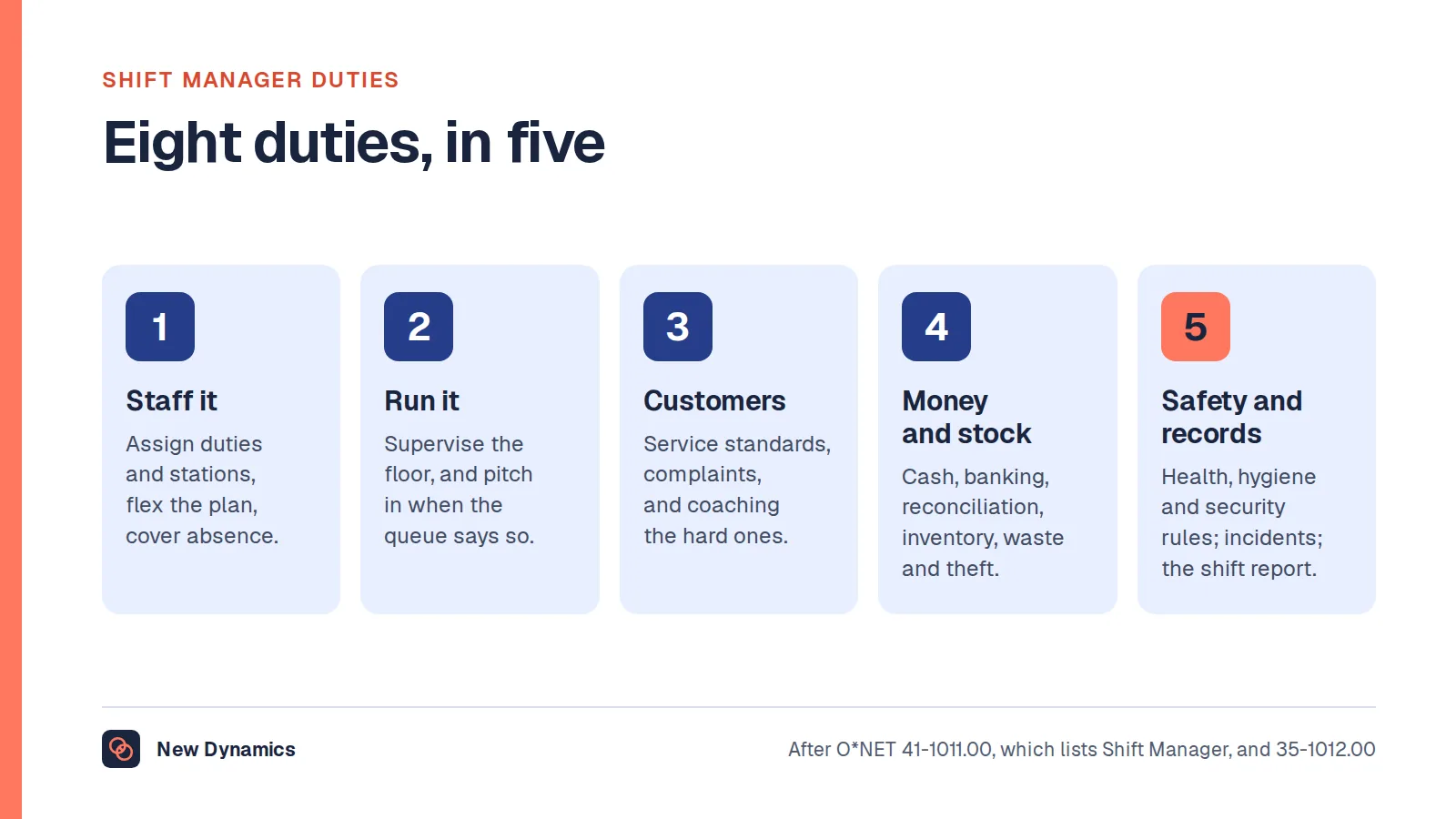
The National Careers Service hotel housekeeper profile, checked on 6 November 2026, gives "Typical hours (a week)" of "37 to 40 a week" and says you could work "days / nights / weekends on shifts". For the senior role the pattern is different: an early start to see the board allocated, a late finish on changeover days, and a weekend presence that cannot be delegated every week. Our shift manager job description covers rota design in more depth.
Write the allocation rule into the job description, because it is the biggest source of friction in the department: how minutes per room are set, who may vary them, and what happens on a day when the rooms do not fit the hours.
Qualifications and routes in
There is no licence or mandatory qualification for this role in the UK. The routes in are practical.
Promotion from the floor. The common path. The National Careers Service says of the hotel housekeeper role that "With experience and training, you could progress to roles like head housekeeper or accommodation services manager".
The apprenticeship route. The Hospitality manager standard published by Skills England is set at level 4, has a typical duration of 18 months and lists "House Keeping Management" among its options. The standard describes the specialism in one sentence: "Housekeeping managers manage the delivery of business standards for the presentation of establishments such as hotels and other overnight accommodation including hostels, serviced apartments and conference venues, making sure that they are clean, fresh and tidy in public areas and guest accommodation." Its maximum funding is listed as £6,000.
Hospitality management degrees and diplomas, which arrive from the other direction and usually need a season on the floor before the rota makes sense.
What employers test at interview is narrower: can you build a rota from an occupancy forecast, can you explain a labour variance, have you run a COSHH assessment, and what did you do the last time an attendant was injured.
Reporting lines
In a single hotel the role reports to the general manager or the operations manager and sits in the heads of department meeting beside front office and food and beverage. The National Careers Service hotel manager profile describes that person as responsible for "running operations like guest services, housekeeping, bar and restaurant facilities, and conferencing and events". In a group, a regional or area role may sit between the two.
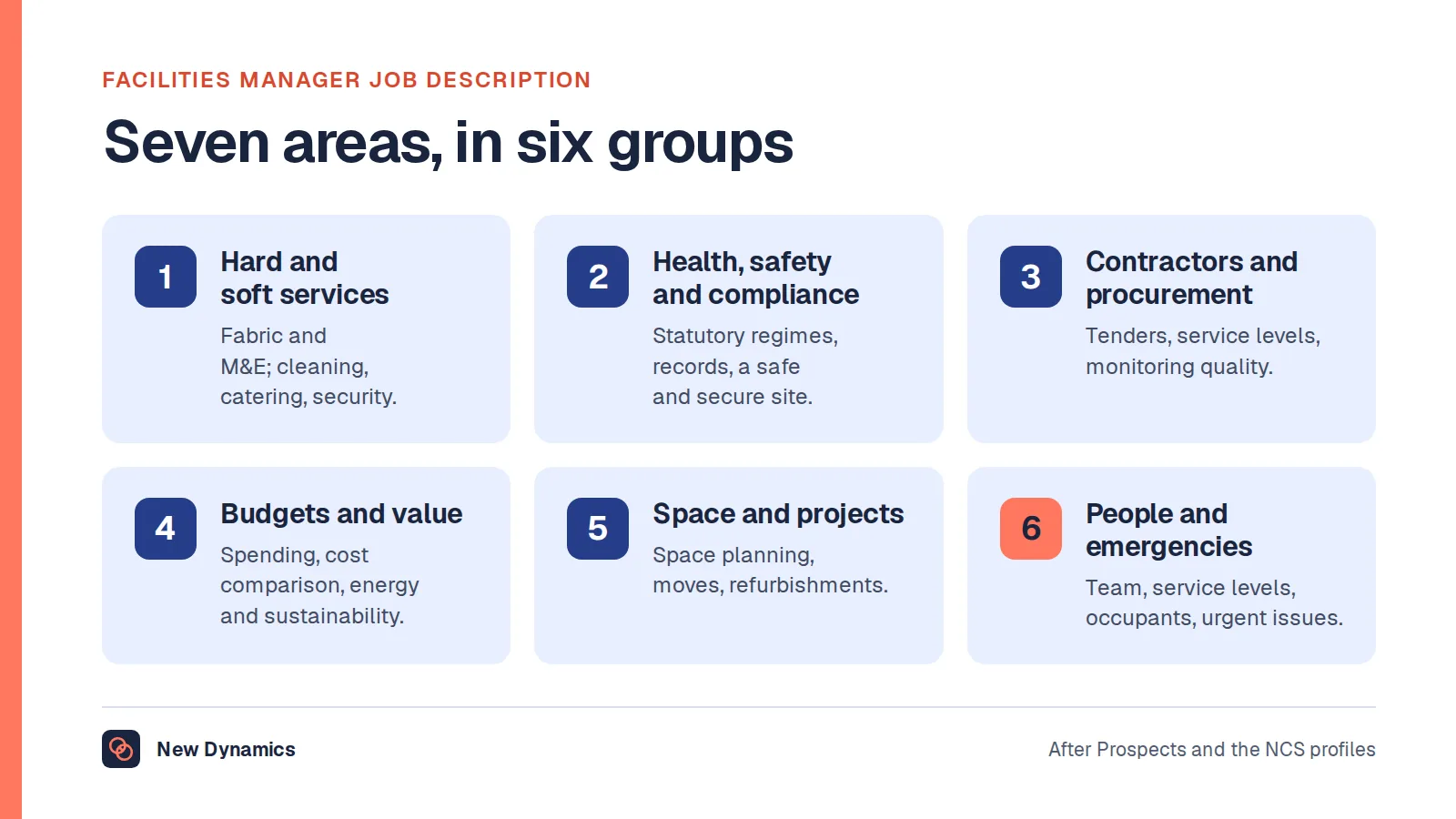
The lateral lines matter more day to day: reception for arrivals and the room status board, and maintenance for the faults the department finds first. In mixed use buildings the boundary with the facilities manager needs writing down, because plant rooms, waste and contractor access fall between the two roles.
Pay: what is published, and what is not
No official UK source publishes a salary for a director of housekeeping. The Office for National Statistics codes jobs to the Standard Occupational Classification and publishes earnings by occupation group rather than by hotel job title, so there is no ONS figure for this role, and the National Careers Service does not run a separate profile for it. A precise national average for the title comes from a job board, not a statistician.
Two published figures give context rather than a target.
- The National Careers Service hotel housekeeper profile, which lists head housekeeper among its alternative titles, gave an "Average salary (a year)" of "£21,000 Starter" to "£28,000 Experienced" when it was checked on 6 November 2026. That band plainly describes the floor and supervisory end of the department rather than a director of a large property.
- The Office for National Statistics release Employee earnings in the UK: 2026, published on 22 October 2026, reports that "median gross annual earnings for full-time employees who had been in their job for at least a year were £40,911 in April 2026, compared with £39,157 in April 2025, a 4.5% increase". The same release notes that "All estimates for 2026 are provisional". More earnings context sits on our HR statistics hub.
If you are writing the advert, give the range you will actually pay. If you are applying, ask for the room count and the headcount before you discuss a number, because a two hundred room property and a six hundred room property are different jobs with the same title.
How the role is measured
A good job description names the measures, and the ones that survive contact with a real department are these.
- Inspection pass rate. The share of inspected rooms that pass first time, by attendant and by floor. This is the standard, expressed as a number.
- Rooms ready by the committed time. On a full changeover day, the proportion of arriving rooms ready when reception needed them.
- Cleanliness in guest feedback. From the hotel's own survey and the brand audit, read as a trend rather than a score.
- Labour hours per occupied room. The productivity measure, and the one the finance meeting asks about.
- Agency hours as a share of total hours. A direct read on recruitment and retention, and the number that quietly drives both cost and standards.
- Turnover and time to fill. Leavers and vacant shifts are what agency hours are covering, so read the two together.
- Reportable injuries and days lost. Tracked against the RIDDOR thresholds above, with the three day record and the seven day report counted separately.

A template you can adapt
Job title: Director of Housekeeping (Executive Housekeeper)
Reports to: General Manager
Responsible for: Assistant head housekeeper, housekeeping supervisors, room attendants, house porters, linen and laundry, public area team, agency cover
Purpose of the role: To deliver every bedroom and public area to our standard, every day, safely and within the agreed labour cost.
Main accountabilities:
- Own the room and public area standard, the inspection regime and the deep cleaning cycle
- Build the rota from the occupancy forecast, control labour hours per occupied room and explain variance monthly
- Recruit, induct, train and retain the department, including agency staff
- Hold the COSHH assessments and training records, the manual handling assessments and the RIDDOR records for the department
- Manage linen par levels, laundry contracts, amenities, equipment and lost property
- Work daily with reception, maintenance and food and beverage on room status, faults and events
Requirements:
- Experience running or deputising for a housekeeping department of [number] rooms
- Able to build and cost a rota against a forecast
- Practical knowledge of COSHH, manual handling and accident reporting
- Comfortable with inspection, feedback and difficult conversations
We provide: [salary range], [hours and the weekend pattern], training, and a named route to [the next role]
Our job description template explains the structure if you are writing the whole set.
Frequently asked questions
What does a director of housekeeping do?
A director of housekeeping is accountable for the condition of every bedroom and public area, the team that produces it and the cost of producing it. The work splits into standards and inspection, the rota and labour cost, recruiting and training the team, safety and compliance, stock and equipment, and working daily with reception and maintenance.
Is a director of housekeeping the same as an executive housekeeper?
In practice, yes. Director of housekeeping, executive housekeeper and head housekeeper are the same job at different sizes of property. Head housekeeper is the standard British title, executive housekeeper is usual in four and five star hotels and international groups, and director of housekeeping tends to appear in North American brands, very large properties and multi site roles.
What qualifications do you need to be a director of housekeeping?
None are mandatory in the UK. Most holders are promoted from supervisor or deputy roles. The apprenticeship route is the Hospitality manager standard at level 4, with a typical duration of 18 months and House Keeping Management among its options. Hospitality management degrees and diplomas are a second route in.
What is the salary for a director of housekeeping in the UK?
No official source publishes one. The Office for National Statistics publishes earnings by occupation group rather than by hotel job title, and the National Careers Service has no separate profile for the role. Its hotel housekeeper profile, which includes head housekeeper among its alternative titles, gives an average salary of £21,000 for a starter to £28,000 for someone experienced, and that band describes the floor and supervisory end of the department.
Who does a director of housekeeping report to?
In a single hotel, the general manager or the operations manager, sitting in the heads of department meeting beside front office and food and beverage. In a group there may be a regional or area role in between. The working relationships that matter most day to day are reception and maintenance.
What health and safety duties does a housekeeping department carry in the UK?
Four stand out. COSHH 2002 requires an assessment before the work starts, substitution where reasonably practicable, controls and training, and regulation 12(4) extends the training duty to people who are not your employees. The Manual Handling Operations Regulations 1992 regulation 4 requires avoidance, assessment, risk reduction and load weight information. Section 2(2)(c) of the Health and Safety at Work etc. Act 1974 carries the general training and supervision duty. RIDDOR 2013 requires a record at more than three days of incapacity and a report at more than seven.
Your next step
If you are hiring, do one thing before you post the advert: write the room count, the headcount, the hours pattern and the pay range into the first paragraph. Every candidate worth having will ask for all four anyway. If you are rewriting an existing job description, add the compliance line, because a department that holds its own COSHH, manual handling and RIDDOR records needs that accountability named.
For a plan that turns a new head of department's first week into a confident first month, read and download our onboarding guide. The guide is free to read, and the PDF uses our short download form.
Want the structure, the reporting lines and the training records for a department this size in one place? Book a New Dynamics demo and bring your current housekeeping job descriptions. You can also email contact@new-dynamics.com.