TL;DR
- No official UK statistic measures HRIS adoption. The nearest published figures are for business software in general: the ONS found specialised software adopted by 61% of UK firms and cloud-based computing by 69% in 2023.
- Payroll software is the one people system with a published number. The UK Innovation Survey reports it as the second most used management technology, by 70% of broader innovators and 65% of non-broader innovators who used any management technologies in 2024.
- No official source measures how much time HR spends on admin. That number has to come from your own team, and two weeks of honest logging produces a better figure than any survey average you could quote.
Somebody in a board paper wants a line that reads "x% of organisations now use an HR system". It sounds like the kind of figure that must be sitting in a government release. It is not. What exists is a set of broader measures of business software adoption, one published figure for payroll software, and a great deal of vendor research with no visible sample.
This article sets out what the United Kingdom genuinely publishes, what each figure covers, and which of these numbers you can only get by measuring your own organisation.
Adoption is not the same as use, and a licence nobody logs into changes nothing. See how New Dynamics workflows carry a people process end to end so the system does the chasing instead of a person.
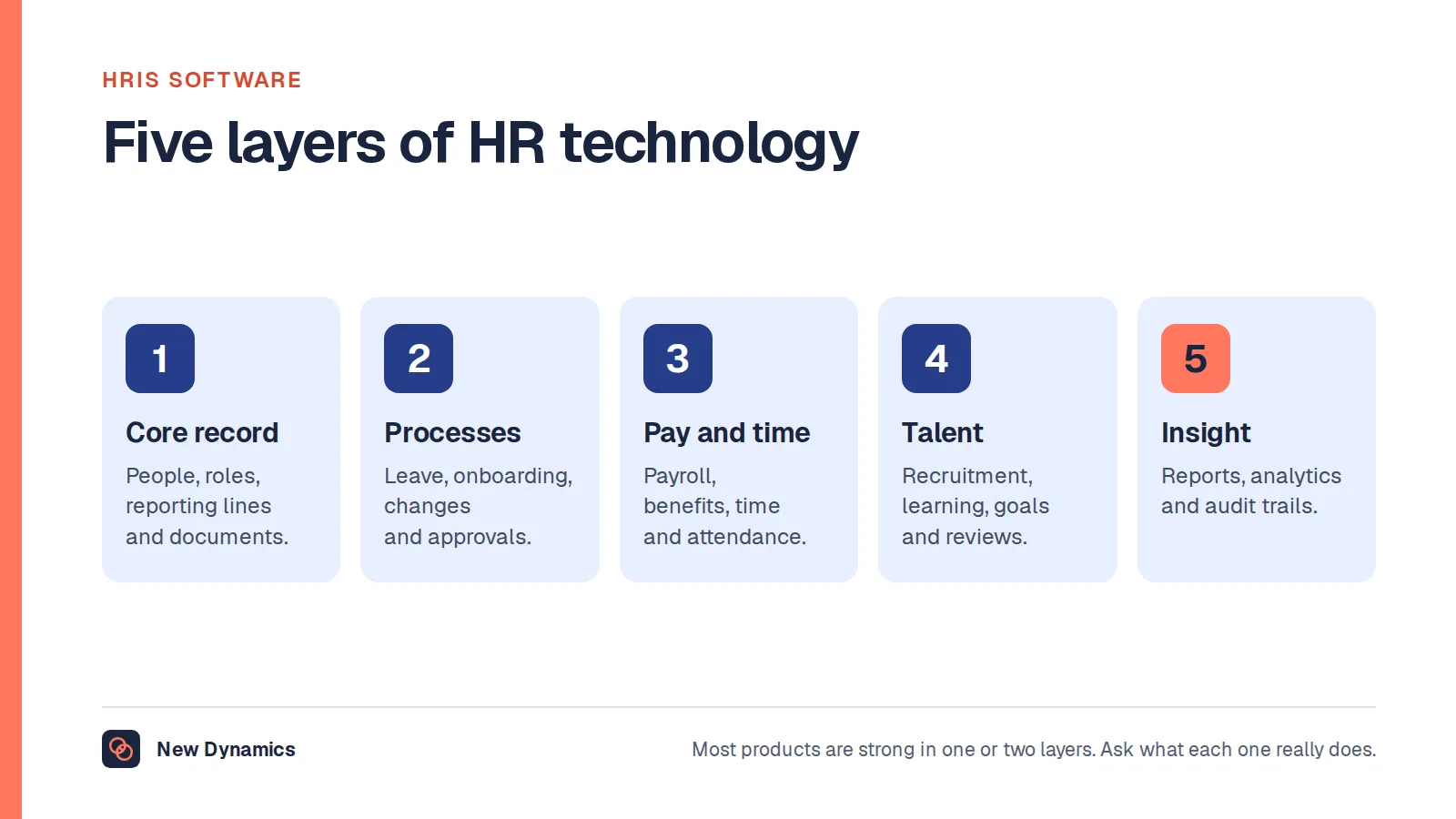
For the system category itself, our post on HRIS software explains what sits inside one.
There is no official HRIS adoption rate
No official United Kingdom statistic counts how many employers use an HR information system. The Office for National Statistics does not publish one. The Department for Science, Innovation and Technology does not publish one. No accredited release names HRIS, HR software or people systems as a category and gives a percentage.
That matters, because the figures circulating in the market are mostly supplier research, usually drawn from a panel of that supplier's own customers or newsletter readers. A panel describes the panel. If the publisher does not state who was asked and how many answered, the number cannot be checked and should not be quoted in a business case.
The honest position is more useful than a borrowed statistic. Official statistics do measure business software adoption, at a level above HR, and those figures are checkable.
What the UK actually measures: business software adoption

The strongest source is the ONS article Management practices and the adoption of technology and artificial intelligence in UK firms: 2023, released on 24 March 2025 as official statistics in development. It draws on the Management and Expectations Survey, and the ONS records that it "conducted the third wave of the Management and Expectations Survey (MES) between November 2023 and March 2024, sampling approximately 55,000 businesses".
On adoption, it reports: "In 2023, the adoption rate was high for cloud-based computing systems and applications, and specialised software (at 69% and 61%, respectively), moderate for specialised equipment (36%) and low for artificial intelligence (AI) and robotics (at 9% and 4%, respectively)".
Two caveats travel with those numbers, and both are in the release. The survey "covers businesses in production and services industries with employment of at least 10, in the UK", excluding agriculture, forestry and fishing and financial and insurance activities. And specialised software is a broad category. The ONS glossary defines it as "custom or packaged software dedicated to performing a particular business function, excluding artificial intelligence", with examples given as "software applications for accounting, sales, marketing, customer service and billing, logistics, health care delivery, telemedicine, computer-aided design (CAD), computer-aided engineering (CAE), or inventory management".
Read that list again. HR is not in it. An HR system plainly fits the definition of software dedicated to a particular business function, so it is almost certainly inside that 61%, but the release does not name it and the survey does not break it out. So 61% is the right number to quote for business software adoption, and the wrong number to present as an HRIS adoption rate.
The same release connects management quality to technology: "While 88% of firms in the top decile of management practice scores adopted at least one of AI, cloud-based computing systems and applications, robotics, specialised software or specialised equipment, only 51% of firms in the bottom decile did so."
That comparison is worth more to an HR audience than any adoption percentage, because of how the ONS scores management. To reach the top of the scale, "to score 1, firms need to continuously review their processes with the aim to minimise future challenges, carry out regular performance reviews, train employees, and base hiring and promotion decisions on merit". The practices being measured are HR practices. The firms doing them well are the firms buying the software.
Payroll software: the one people system with a number
The UK Innovation Survey 2025: report, published on 4 June 2026, asked businesses which management technologies they use. It states: "Payroll software was the second most used management technology (by businesses that used any management technologies), used by 70% of broader innovators and 65% of non-broader innovators."
First place went to finance. "Accountancy software was by far the most used management technology, by 94% of broader innovators and 93% of non-broader innovators who used any of the management technologies."
Note the base carefully, because it is easy to misread. These percentages are of businesses that used any of the management technologies, for 2024, not of all United Kingdom businesses. The survey sampled 31,150 businesses and received 14,075 responses, a 45.2% response rate.
The gap between 94% for accountancy and 70% for payroll is the closest thing to a published statement about how far people systems trail finance systems. Payroll is also the easiest people process to digitise, because it has a legal deadline and an external filing. Everything else HR does has neither, which is exactly why it ends up in spreadsheets.
There is a related official figure on employee records. The UK Business Data Survey 2026, published by DSIT on 18 June 2026 from fieldwork between October 2025 and January 2026 with 4,450 UK businesses, reports: "In 2025 to 2026, among businesses with employees, 79% said that they handled personal or non-personal data about their employees, compared with 93% that handled any type of digitised data (including non-employee data)." It adds that "Nearly all businesses with 10 or more employees (98%) handled personal employee data, with little variation by sector."
Almost every employer of any size holds digitised employee data. That is a long way from saying they hold it in a system designed for the job.
HR automation statistics: what the AI figures say

Automation in HR is now mostly discussed as AI, and here the official picture is better than it was. The ONS article Artificial intelligence in UK businesses: 2023 to 2026, released on 20 July 2026, reports: "The self-reported use of artificial intelligence (AI) in UK businesses with 10 or more employees has increased from around 12% to around 35% since late 2023, with larger firms more likely to have adopted AI."
The release is unusually frank about depth. It finds that "AI adoption to date has been relatively shallow among UK businesses with 10 or more employees, with the average number of AI technologies used per adopting business rising only modestly, from around 1.4 to around 1.6 since late 2023".
It also records a gap between employers and the people who work for them: "Over half of employees (55%) report using AI for work or education, compared with around a third (35%) of businesses reporting use of at least one AI technology."
On where the effects land, the closest thing to an HR admin figure is this: "businesses using machine learning data processing most commonly report impacts on administrative or clerical roles (41%) and data analysis roles (39%)". By technology type, "large language models were the most widely used among businesses (with 10 or more employees) in June 2026 (18%); this is followed by visual content creation (16%), data processing using machine learning (12%), and image processing using machine learning (6%)". The figures come from the Business Insights and Conditions Survey, Wave 159, run from 5 June to 28 June 2026, in which "BICS achieved a response rate of 26.7%, with 38,637 businesses responding to the survey".
None of that is an HR automation statistic. It is a business automation statistic, and the administrative and clerical line is the part most likely to describe HR work. Our post on AI HR tools covers what these tools actually do inside a people process.
How much time HR spends on admin
No official source measures it. There is no ONS series, no gov.uk release and no accredited survey that reports what share of an HR team's week goes on administration rather than advice, casework or improvement. Any percentage you find for this is somebody's panel, and most of the panels belong to companies selling software to save you the time.
The nearest official parallel shows what a real measurement of staff time looks like. The UK Business Data Survey asked specifically about one compliance activity, and found that "56% of businesses that employ staff and handled digitised personal data (either of employees or others) said they had someone whose role includes leading on data protection compliance", rising to 92% of large businesses. On dedicated capacity, "46% of businesses that handled digitised personal data (either of employees or others) had at least 1 FTE member of staff whose primary role was to undertake activities related to complying with UK data protection laws", while "44% said they did not have any FTE staff whose primary role was to undertake activities related to complying with UK data laws".
That is one narrow slice of one obligation, measured carefully, with a stated base. It took a government survey of 4,450 businesses to produce it. Nobody has done the equivalent for HR administration, which is why the only credible figure is your own.
How to measure your own HR admin time

This is a two-week exercise, not a project, and it produces a number you can defend in a board paper.
- List the repeating tasks. Write down the ten things your team does every month regardless of who asks: contract changes, absence records, reference requests, chasing a review cycle, onboarding paperwork, payroll data entry, report requests. Name them as tasks, not as systems.
- Log minutes against tasks, not people. For two ordinary weeks, every member of the team records time against that task list, in minutes, with one line for anything that does not fit. Logging by task rather than by person keeps it a process measurement instead of a performance one, which is the difference between useful data and a team that quietly stops filling it in.
- Sort the total into four buckets. Administration, casework, advice to managers, and improvement work. The ratio between those four is your real answer, and it is more persuasive than a single admin percentage.
- Price the top three. Take the three tasks with the largest totals and multiply by a loaded hourly cost for the people doing them. That is the number a finance director will read.
- Repeat the same two weeks next quarter. Same task list, same definitions. One measurement is an anecdote. Two are a trend, and a trend survives a change of HR director.
For the wider set of people measures worth tracking alongside it, our post on HR metrics sets them out, and the HR statistics hub collects the published United Kingdom figures with the publisher and period attached.
What usually goes wrong
- Quoting an HRIS adoption rate as though it were official. No official source publishes one, so the figure came from a panel you cannot inspect.
- Presenting the 61% specialised software figure as an HR number. It covers software for a particular business function across the whole economy, and the release does not name HR among its examples.
- Ignoring the base on the payroll figure. Seventy per cent is of businesses that used any management technologies, not of all employers.
- Confusing adoption with use. A purchased licence, a configured system and a process people actually run are three different things, and only the third changes a week of work.
- Buying to remove admin without measuring the admin first. Two weeks of logging costs almost nothing and makes the business case real. Our post on workflow examples shows what the automated version of those tasks looks like.
- Measuring once. Without a repeat on the same definitions, you have no evidence the system did anything.
Frequently asked questions
What percentage of companies use HR software?
No official United Kingdom statistic says. The nearest published figures measure business software in general: the ONS found specialised software was adopted by 61% of UK firms in 2023 and cloud-based computing systems and applications by 69%, covering businesses in production and services industries with employment of at least 10. Neither figure breaks out HR.
Is there an official HRIS adoption rate for the UK?
No. Neither the ONS nor DSIT publishes an adoption rate for HR information systems. Percentages in circulation almost always come from vendor or membership surveys of self-selecting respondents, and most do not state who was asked or how many answered.
What is the closest official figure to HR software adoption?
Payroll software. The UK Innovation Survey 2025 reports it as the second most used management technology, used by 70% of broader innovators and 65% of non-broader innovators among businesses that used any management technologies in 2024. Accountancy software led on 94% and 93% respectively.
How many UK businesses hold digitised employee data?
The UK Business Data Survey 2026 reports that among businesses with employees, 79% said they handled personal or non-personal data about their employees in 2025 to 2026, and that nearly all businesses with 10 or more employees, at 98%, handled personal employee data. Holding the data is not the same as holding it in a people system.
What do the statistics say about HR automation and AI?
The ONS reports that self-reported use of AI in UK businesses with 10 or more employees rose from around 12% to around 35% between late 2023 and June 2026, and that adoption is shallow, with the average adopter using around 1.6 AI technologies. Among businesses using machine learning data processing, 41% report impacts on administrative or clerical roles, which is the figure closest to HR admin.
How much time does HR spend on admin?
No official source measures it, so any single percentage you find is a vendor panel rather than a statistic. Log your own for two ordinary weeks against a fixed list of repeating tasks, split the total into administration, casework, advice and improvement, then repeat the same exercise next quarter on the same definitions.
Your next step: produce the number nobody publishes
- Write the ten repeating tasks your team cannot avoid, in plain words, before you look at any software.
- Log two ordinary weeks against that list, in minutes, by task rather than by person.
- Split the total into administration, casework, advice and improvement, and price the three largest tasks.
- Pick one task to automate first, and agree what you expect the next measurement to show.
When you are ready to compare systems against that evidence, read and download our HRIS selection guide. The guide is free to read, and the PDF uses our short download form. Our post on HR tools covers the wider category.
Want the admin to run itself rather than sit in somebody's inbox? Book a New Dynamics demo and bring your two weeks of logs. You can also email contact@new-dynamics.com.