TL;DR
- The 50 per cent turnout threshold is still in force. The Code of Practice on industrial action ballots, revised in March 2026, states that section 68 of the Employment Rights Act 2025 would remove it but that until that provision is commenced "the 50% turnout threshold remains in force".
- The extra 40 per cent support threshold for important public services was repealed on 18 February 2026, along with the twelve week limit on protection from dismissal and the requirement to appoint a picket supervisor. The ballot mandate rose from six months to 12, and notice of action fell from 14 days to ten.
- There is no statutory right to be paid for work not done during a strike. Section 14(5) of the Employment Rights Act 1996 takes a deduction made because the worker took part in a strike outside the protection of wages rules, and Acas states that "Employers do not need to pay anyone who is on strike".
A strike does not start with a walkout. It starts with a vote, and with a short series of notices whose deadlines are counted in days and fixed by statute. Miss one and the action loses its legal protection, which changes both what an employer may lawfully do and what the people taking part are risking.
This article covers the trade dispute test, what makes the ballot valid, which thresholds apply now, the notices on either side of the vote, how long a mandate lasts, whether anyone has to be paid, and what the picketing rules say. Several of these rules changed on 18 February 2026, and one widely reported change has been passed by Parliament but never switched on. The law described is that of Great Britain, meaning England, Wales and Scotland; Northern Ireland has its own separate industrial relations legislation. This is general information and not legal advice.
Two of the notices are built from categories of employee and from workplaces rather than names, so an employer that cannot describe its own structure quickly is behind from the first day. See how New Dynamics org charts keep reporting lines, project teams and locations in one current picture. For wider figures, the Office for National Statistics series on working days lost due to strike action in the UK, published in thousands and last released on 20 October 2026, records 2,660 for calendar year 2023 and 740 for 2025. More sit in our HR statistics hub.
What counts as a trade dispute
None of the ballot rules matter unless there is a trade dispute, because the protection for organising industrial action only covers acts done in contemplation or furtherance of one. Section 244 of the Trade Union and Labour Relations (Consolidation) Act 1992 defines it as "a dispute between workers and their employer which relates wholly or mainly to one or more of the following", then lists seven subjects: terms and conditions or physical working conditions; engagement, non-engagement, termination or suspension; allocation of work; matters of discipline; union membership or non-membership; facilities for union officials; and the machinery for negotiation or consultation, including recognition.
Two phrases carry the weight. "Wholly or mainly" puts a substantially political dispute outside the definition. "Between workers and their employer" is why a dispute with somebody else's employer does not qualify, which is the root of the rule against secondary action.
What makes an industrial action ballot valid
Section 226 states the requirement: an act by a union inducing a person to take part in industrial action "is not protected unless the industrial action has the support of a ballot". The conditions sit in the sections after it.
Entitlement to vote must, under section 227(1), be given equally to all members the union reasonably believes will be induced to take part "and to no others". The ballots Code suggests a union may want to invite the employer's opinion that its conclusion on entitlement complies with the statute, and that an employer which doubts it should raise the point promptly. The voting paper, under section 229, must name the independent scrutineer, carry a unique number, say who is authorised to call the action, warn that taking part may breach the contract of employment, and ask whether the voter will take part in a strike, in action short of a strike, or both.
Since 25 August 2026 a statutory ballot need not be postal. The Trade Unions (Permissible Means of Voting) and Employment Rights (Unfair Dismissal) (Amendment) Order 2026 (S.I. 2026/881), made on 28 July 2026, inserted new balloting provisions into the 1992 Act, and GOV.UK's guidance on holding a ballot lists the permitted methods as postal, electronic, hybrid and workplace voting. Afterwards, section 231 requires the union to tell everyone entitled to vote the number entitled, the votes cast, the yes and no totals, the spoiled papers, and whether turnout reached at least 50 per cent. Section 231A requires the employer to be told too.
The turnout and support thresholds, and which one survived
Two thresholds were introduced by the Trade Union Act 2016 and they are easily run together, so they need separating.
The 50 per cent turnout threshold is still in force. It sits in section 226(2)(a)(iia), inserted by section 2 of the Trade Union Act 2016 and in force since 1 March 2017 by S.I. 2017/139. The Code of Practice on industrial action ballots and notice to employers, revised in March 2026 for the Employment Rights Act 2025, says at paragraph 26: "In all ballots for industrial action, at least 50% of the trade union members entitled to vote must do so in order for the ballot to be valid."
The Employment Rights Act 2025 does remove that threshold, but the provision has not been commenced. Paragraph 27 of the same Code says section 68 of the Act "removes the requirement for trade unions to meet the 50% turnout threshold for industrial action ballots", and then that until the provision is commenced "the 50% turnout threshold remains in force". The Act agrees: section 68 appears in neither commencement subsection of section 159, so it needs regulations, and legislation.gov.uk records plainly that "S. 68 not in force at Royal Assent". The Act was passed on 18 December 2025.
Parliament attached conditions as well. Section 159(5) requires that, in deciding whether and when to commence section 68, the Secretary of State "must have regard to what effect any provision made after this Act is passed for industrial action ballots to be conducted otherwise than by post has had, or is expected to have, on the proportion of those eligible to vote in such ballots doing so". Section 159(6) blocks commencement until a statement about that is laid before Parliament. The repeal was tied, deliberately, to what electronic and workplace balloting does to turnout.
The 40 per cent support threshold for important public services has gone. The old section 226(2A) to (2F) required, in specified important public services, that at least 40 per cent of those entitled to vote had voted in favour. Those subsections were omitted on 18 February 2026 by section 69 of the Employment Rights Act 2025. GOV.UK's guidance on the transition to the Employment Rights Act 2025 states that "the threshold is no longer required to be met for ballots opening on, or after, the date that section 69 came into force on 18 February 2026", and that "opening" means the first day a voting paper is sent to anyone entitled to vote.
So the test now has two limbs, not three: at least 50 per cent of those entitled to vote must vote, and a majority of those voting must vote yes.
Notice before the ballot, and notice before the action
There are two separate notices on two separate clocks.
Before the ballot, section 226A requires the union to take the steps reasonably necessary to ensure every employer it reasonably believes will employ voters receives, "not later than the seventh day before the opening day of the ballot", a written notice stating that it intends to ballot, the expected opening day, lists of the categories of employee and the workplaces involved, and the total number of employees concerned. Sample voting materials follow "not later than the third day before the opening day". Section 226A(2G) is explicit that the union need not supply names.
Before the action, section 234A requires a further written notice, saying whether the action is continuous or discontinuous and giving the dates. The period now ends, in the words substituted on 18 February 2026, "with the tenth day before the day, or before the first of the days, specified in the relevant notice". That replaced the 14 days (or seven by agreement) introduced in 2016. Acas puts it plainly on its page on strikes: a union must "give an employer at least 10 days' notice in writing".

How long a ballot mandate lasts
Section 234 now gives the union a "period of 12 months beginning with the date of the ballot", substituted on 18 February 2026 by section 72 of the Employment Rights Act 2025. Before that it was six months, or nine where the employer agreed. GOV.UK's transition guidance explains that the 12 month mandate "only applies to ballots opened on or after the date that section 72 came into force on 18 February 2026", that earlier six month mandates were not automatically extended, and that the date of the ballot here means the last day on which votes may be cast.
Protection from dismissal, and how long it lasts
Section 238A makes a dismissal automatically unfair where the reason, or principal reason, is that the employee took protected industrial action. The change that matters is that the protection no longer runs out. Subsections (3) to (7D), which carried the protected period of roughly the first twelve weeks, were omitted on 18 February 2026 by section 77 of the Act, commenced by S.I. 2026/3. GOV.UK's transition guidance states that this "means that this protection applies irrespective of the length of the industrial action", and that employees whose action began earlier keep only the old protected period.
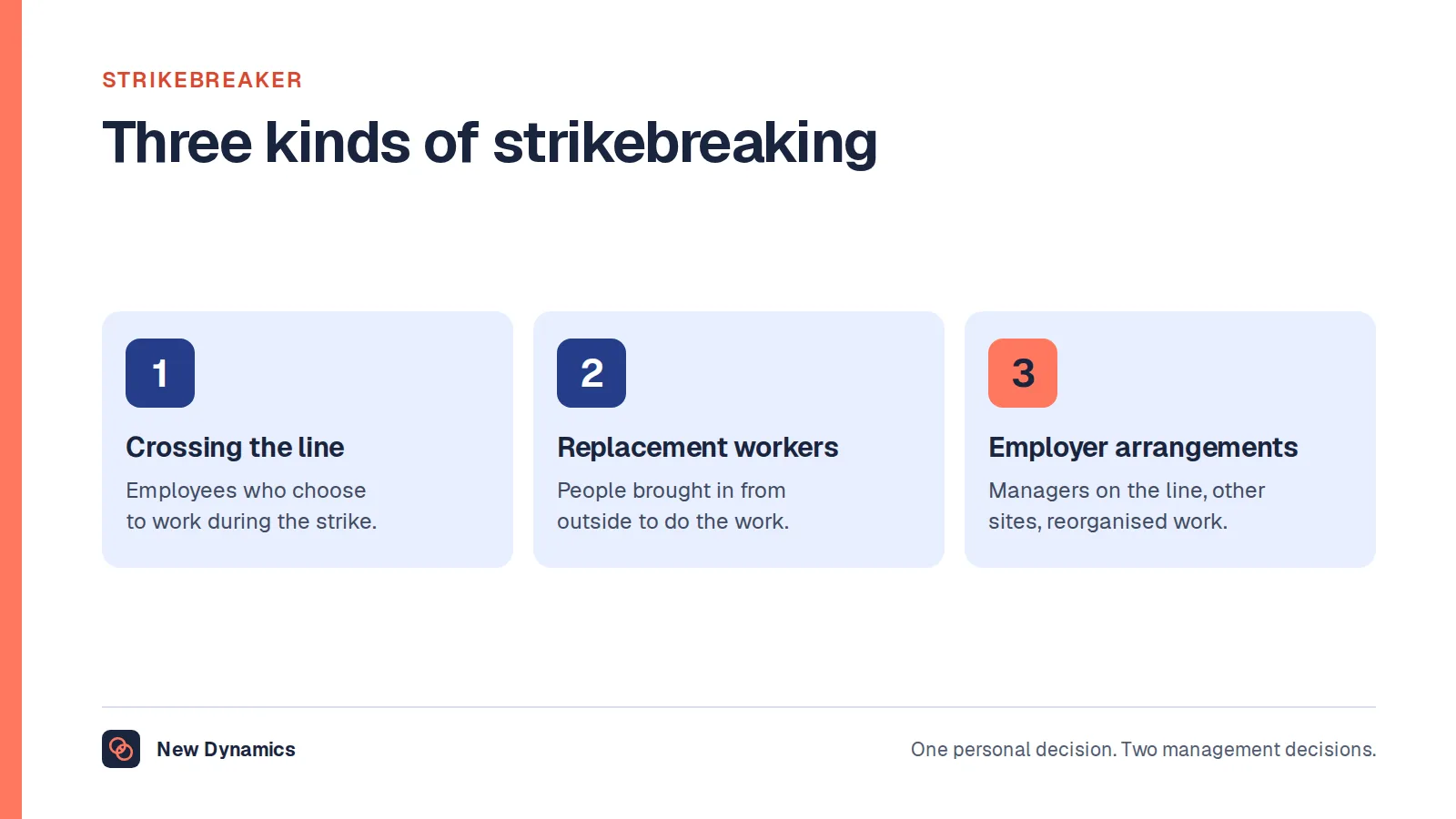
The protection depends on the rest of the rules. GOV.UK's page on employment rights during industrial action lists the conditions: the action is called as a result of a properly organised ballot, it concerns a trade dispute between workers and their employer, and the legally required detailed notice "has been given to the employer at least 10 days before it begins". Action taken without a lawful ballot is not protected at all. An employer must also not subject someone to a detriment where its sole or main purpose is to penalise them for taking part. For people who keep working through a dispute, see our post on the meaning of strikebreaker.
Does an employer have to pay someone taking industrial action
No, and the reason is contract law plus one short subsection. A worker who withdraws labour is not performing the contract, so no wages fall due for work not done. The statutory point is that the usual protection against deductions does not apply. Section 14(5) of the Employment Rights Act 1996 provides that the general prohibition on deductions "does not apply to a deduction from a worker's wages made by his employer where the worker has taken part in a strike or other industrial action and the deduction is made by the employer on account of the worker's having taken part in that strike or other action". Acas states the result directly: "Employers do not need to pay anyone who is on strike."
Three points are easy to miss. Strike pay comes from the union at a rate the union sets, and is not wages. Annual leave and sick leave are paid normally, because labour is not being withdrawn on those days. And GOV.UK confirms that industrial action does not break continuous employment but does reduce length of service by the number of days on strike or locked out, which matters for statutory redundancy pay and pensions. Pay during action short of a strike turns on what the contract requires and what was actually withheld, so it needs advice on the facts.
Picketing: what the Act requires and what the Code adds
Section 220 makes it lawful for a person, in contemplation or furtherance of a trade dispute, to attend at or near their own place of work, or, if they are a union official, at or near the workplace of a member they are accompanying and represent, "for the purpose only of peacefully obtaining or communicating information, or peacefully persuading any person to work or abstain from working". Section 220(2) supplies a workplace for people who work at no single place. Those limits are why flying pickets are generally unlawful: the protection is tied to your own place of work.
Section 220A, which required a union to appoint a picket supervisor, was repealed on 18 February 2026 by section 75 of the Employment Rights Act 2025. The Code of Practice on picketing was revised on 5 March 2026 to match, superseding the 2024 edition. The Code has no legal force of its own. It "imposes no legal obligations and failure to observe it does not by itself render anyone liable to proceedings", but its provisions "are to be admissible in evidence and taken into account in proceedings before any court, employment tribunal or Central Arbitration Committee where they consider them relevant".
On numbers the Code is more careful than it is often made out to be. Paragraph 47 says "The law does not impose a specific limit on the number of people who may picket at any one place". Paragraph 51 then advises that "pickets and their organisers should ensure that in general the number of pickets does not exceed six at any entrance to, or exit from, a workplace; frequently a smaller number will be appropriate". Six is guidance a court may take into account, not a statutory cap. Pickets may ask people not to work, but may not stop anyone who wants to work.

What this means for an employer's records
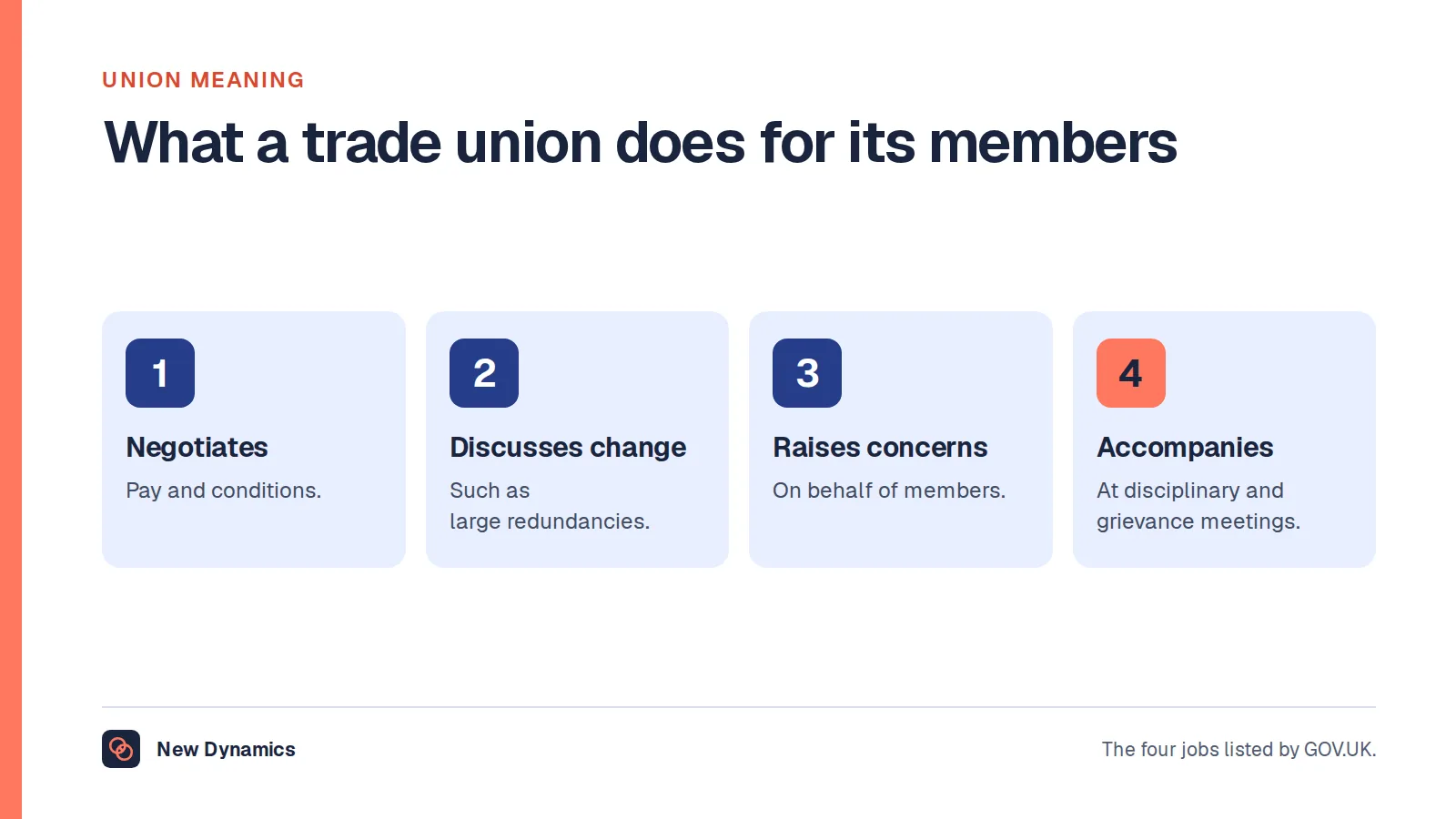
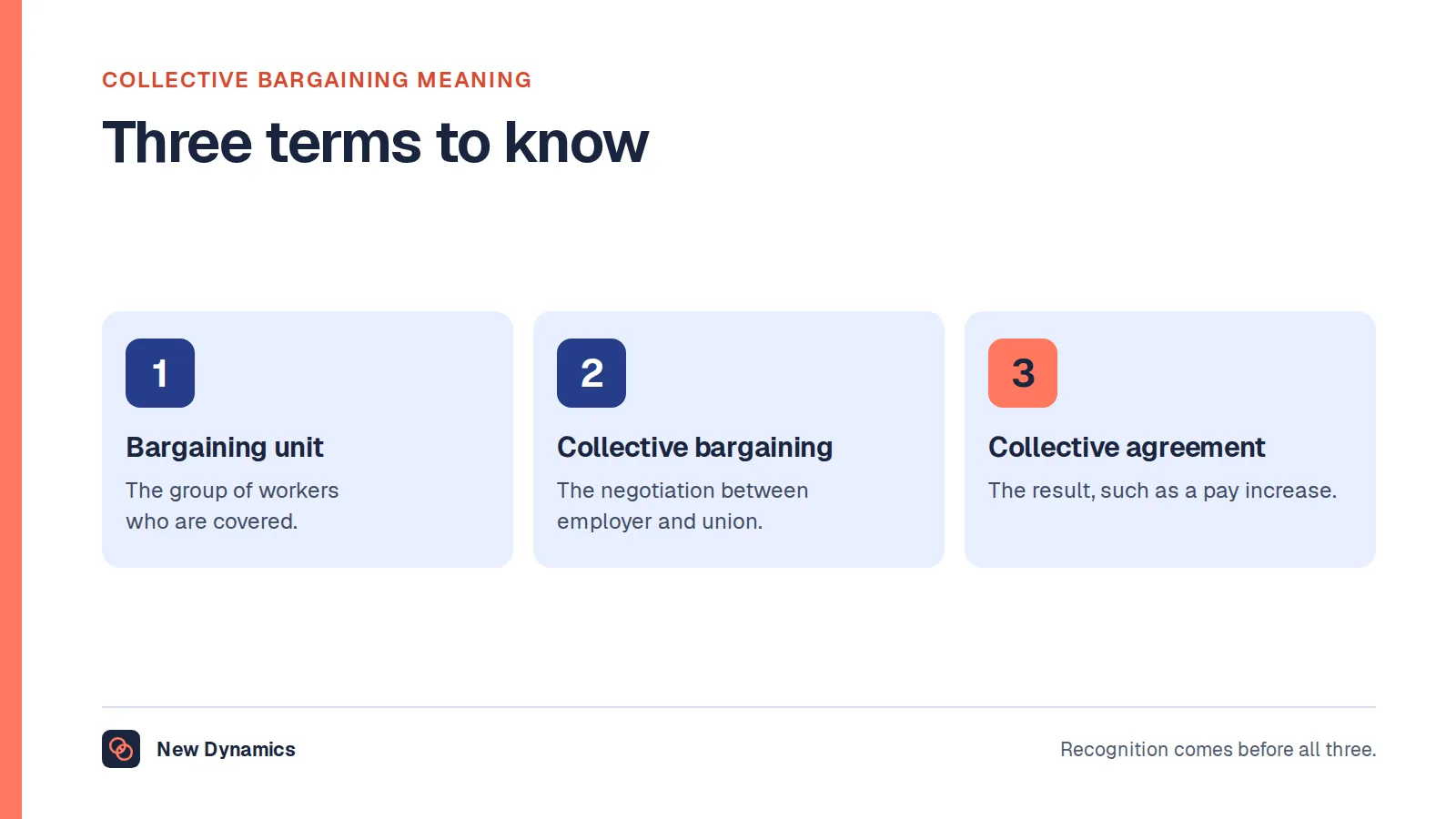
Both notices are built from categories of employee, workplaces and headcounts, so an employer that can check them against its own records on the day one arrives can raise a discrepancy early. The ballots Code encourages exactly that, saying it is in the interests of good industrial relations to raise a concern about entitlement to vote with the union promptly rather than going straight to court. The same picture is what makes a collective bargaining conversation workable; for what a union is and does, see our post on the meaning of union.
Frequently asked questions
Is the 50 per cent turnout threshold still in force?
Yes. Section 226(2)(a)(iia) of the 1992 Act still requires at least 50 per cent of those entitled to vote to do so. Section 68 of the Employment Rights Act 2025 would remove it, but legislation.gov.uk records that section 68 was not in force at Royal Assent, and the Code of Practice revised in March 2026 says the threshold remains in force until the provision is commenced.
Does the 40 per cent support threshold for important public services still apply?
No. Sections 226(2A) to (2F) were omitted on 18 February 2026 by section 69 of the Employment Rights Act 2025. GOV.UK's transition guidance states the threshold no longer has to be met for ballots opening on or after that date. A ballot opened before it stays under the old rule.
How much notice must a union give before industrial action starts?
Ten days. Section 234A(4)(b), as substituted on 18 February 2026, runs the period up to the tenth day before the first day specified in the notice. The separate notice of the ballot is due no later than the seventh day before it opens, with sample voting materials no later than the third day before.
How long does a ballot mandate last?
Twelve months. Section 234(1) gives a period of 12 months beginning with the date of the ballot, which here means the last day on which votes may be cast. The previous period was six months, and mandates from ballots opened before 18 February 2026 were not automatically extended.
Can someone be dismissed for taking part in a strike?
Not where the action is protected. Section 238A makes such a dismissal automatically unfair, and the twelve week limit on that protection was removed on 18 February 2026. The protection depends on a properly organised ballot, a genuine trade dispute and the required notice. Unofficial or unballoted action is not protected.
Is six the legal limit on the number of pickets?
No. The Code of Practice on picketing says the law imposes no specific limit, then advises that in general the number should not exceed six at any entrance to or exit from a workplace. That is guidance a court or tribunal may take into account, and the police have separate powers to limit numbers where they fear disorder.
Next steps
Three things are worth having in order before the first notice arrives: an accurate list of the categories of employee and workplaces involved, a record of what has been negotiated and when, and a decision about who checks a statutory notice against the facts.
If changes to jobs or structure are part of the dispute, read and download our redundancy and workforce change guide. The guide is free to read, and the PDF uses our short download form.
Want the record of feedback, goals and one to ones to hold up when a formal dispute starts? Book a New Dynamics demo and bring your current approach. You can also email contact@new-dynamics.com.