TL;DR
- At-will employment is an American doctrine. It does not exist in the United Kingdom. The North Carolina Department of Labor states that at-will means an employer can discharge an employee 'for any reason or no reason at all', but only 'unless there is a specific law to protect employees or there is an employment contract providing otherwise'.
- Those two carve-outs are most of the subject. Courts in most states recognise a public policy exception and an implied contract exception, a minority read in a covenant of good faith, and federal statutes on discrimination, retaliation, leave and union activity override at-will outright.
- In Great Britain a contract exists from the moment a job offer is accepted, notice periods are statutory minimums, and the employer has to show the reason for a dismissal. GOV.UK states the unfair dismissal qualifying period is 'usually 2 years' and that 'From 1 January 2027, most employees will be able to claim unfair dismissal after 6 months'.
At-will employment is an American doctrine. It is the default rule in the employment law of the United States, and it does not exist in the United Kingdom: there is no at-will employment in England, Wales, Scotland or Northern Ireland, and a British manager handed an American policy describing it is reading about a system they are not subject to. Most writing on it is one or the other, which is why so many people arrive holding exactly half of what they need.
This article covers both, and names the jurisdiction in every section, because the expensive mistake is acting on the correct answer from the wrong country. It is general information rather than legal advice, and employment law differs by state and by country.
The practical defence in both systems is the same unglamorous thing: a dated record of what was decided, why, and on what evidence. See how New Dynamics workflows hold approvals, ownership and sign-off dates against the person rather than scattered through email.
What at-will employment means in the United States
Jurisdiction: United States.
The clearest plain-English statement we could open on a government site comes from a state labour department. The North Carolina Department of Labor says:
"The term 'employment-at-will' simply means that unless there is a specific law to protect employees or there is an employment contract providing otherwise, then an employer can treat its employees as it sees fit (including the assignment of demeaning tasks) and the employer can discharge an employee at the will of the employer for any reason or no reason at all."
Read it in order. It opens with two conditions and only then gives the rule. That structure is the whole subject, and most coverage skips the first half.
The federal Department of Labor says the same. Its page on termination states that where the reason is not discrimination, whistleblower status or a complaint under a law the Department enforces, "the termination is subject only to any private contract between the employer and employee or a labor contract".
So at-will is not a power granted to employers. It is what is left when no statute and no contract says otherwise. The Bureau of Labor Statistics' Monthly Labor Review article "The employment-at-will doctrine: three major exceptions", from January 2001, puts it in the terms courts use: "the employer can terminate the employee for good cause, bad cause, or no cause at all."
It cuts both ways. An at-will employee can resign at any moment, without notice: there is no American equivalent of a notice period an employee must work.
For scale, the Bureau of Labor Statistics' Job Openings and Labor Turnover Summary, released on 3 November 2026 for September 2026, reports that "the number and rate of layoffs and discharges changed little at 1.6 million and 1.0 percent, respectively", and defines the category as "involuntary separations initiated by the employer". Our HR statistics hub collects figures like this.
What at-will employment does not mean
Jurisdiction: United States.
At-will is not a licence to dismiss for any reason at all. It is a default that gives way whenever a statute or a contract applies, and a great many statutes apply.
It does not mean the reason is irrelevant: if it is a protected one, the dismissal is unlawful whatever the relationship was called. It does not mean documentation is pointless, because the recorded reason is what rebuts the allegation that the real reason was protected. It does not mean a handbook is harmless, as the implied contract exception below shows. And it does not mean the employer owes nothing on the way out, because separate rules govern final pay, health coverage and unemployment insurance.
It also does not mean the same in every state, because the exceptions below are creations of state courts. General information, not legal advice: your state may differ.

The exceptions that swallow much of the rule
Jurisdiction: United States, state common law.
This is the big omission in most coverage, and the reason the doctrine is weaker in practice than the phrase suggests. The article cited above says the doctrine "has been significantly eroded by statutory and common-law protections against wrongful discharge."
One caution: that article is dated January 2001, with its state table current to 1 October 2000, so the counts below are as of that date. Check your own state with a lawyer there.
The public policy exception
The first and most widely accepted exception protects an employee dismissed for doing something the state's own law or policy supports:
"Under the public-policy exception to employment at will, an employee is wrongfully discharged when the termination is against an explicit, well-established public policy of the State."
The examples are the ones managers meet: "an employer cannot terminate an employee for filing a workers' compensation claim after being injured on the job, or for refusing to break the law at the request of the employer." The article records it as "recognized in 43 of the 50 States", and says public policy "may be found in either a State constitution, statute, or administrative rule", with variation either way.
The implied contract exception
The second exception catches employers out because they create it themselves, usually in writing, usually in a handbook. It applies "when an implied contract is formed between an employer and employee, even though no express, written instrument regarding the employment relationship exists."
The article is specific about what does the damage: "The typical situation involves handbook provisions which state that employees will be disciplined or terminated only for 'just cause' or under other specified circumstances, or provisions which indicate that an employer will follow specific procedures before disciplining or terminating an employee." Spoken assurances count too. Reach, at its date: "recognized in 38 of the 50 States".
The standard defence is a disclaimer. An employer "can prevent the contract from being created by including in its policies and provisions a clear and unambiguous disclaimer stating that its policies and guidelines do not create contractual rights." That is why American handbooks carry at-will disclaimers, and why British readers find them baffling: the clause is doing a specific job in a specific doctrine. See our article on the employee handbook.
The implied covenant of good faith and fair dealing
The third exception is the narrowest and most variable. The article calls it the one that "represents the most significant departure from the traditional employment-at-will doctrine", records it as "Recognized by only 11 States" at the time, and says it has been read to mean "either that employer personnel decisions are subject to a 'just cause' standard or that terminations made in bad faith or motivated by malice are prohibited."
Statutory protections that override at-will entirely
Jurisdiction: United States, federal law. State statutes add more, and they differ by state.
The common-law exceptions soften at-will. Statutes override it. Where a federal statute prohibits a dismissal, the default is beside the point. One note: nlrb.gov did not load while this was written, so the labour-relations points come from the statute rather than the Board's guidance.
Discrimination and retaliation. Title VII of the Civil Rights Act of 1964, at 42 U.S.C. 2000e-2(a), makes it an unlawful employment practice for an employer "to fail or refuse to hire or to discharge any individual, or otherwise to discriminate against any individual with respect to his compensation, terms, conditions, or privileges of employment, because of such individual's race, color, religion, sex, or national origin". The EEOC, on prohibited practices, says an employer "may not take into account" those characteristics, or age, disability or genetic information, "when making decisions about discipline or discharge". On retaliation it adds that "The EEO laws prohibit punishing job applicants or employees for asserting their rights to be free from employment discrimination including harassment", and is careful about the limit: "Engaging in EEO activity, however, does not shield an employee from all discipline or discharge. Employers are free to discipline or terminate workers if motivated by non-retaliatory and non-discriminatory reasons." Coverage has thresholds, recorded there as "15 or more employees under Title VII and ADA" and "20 or more employees under ADEA". See also what discrimination means.
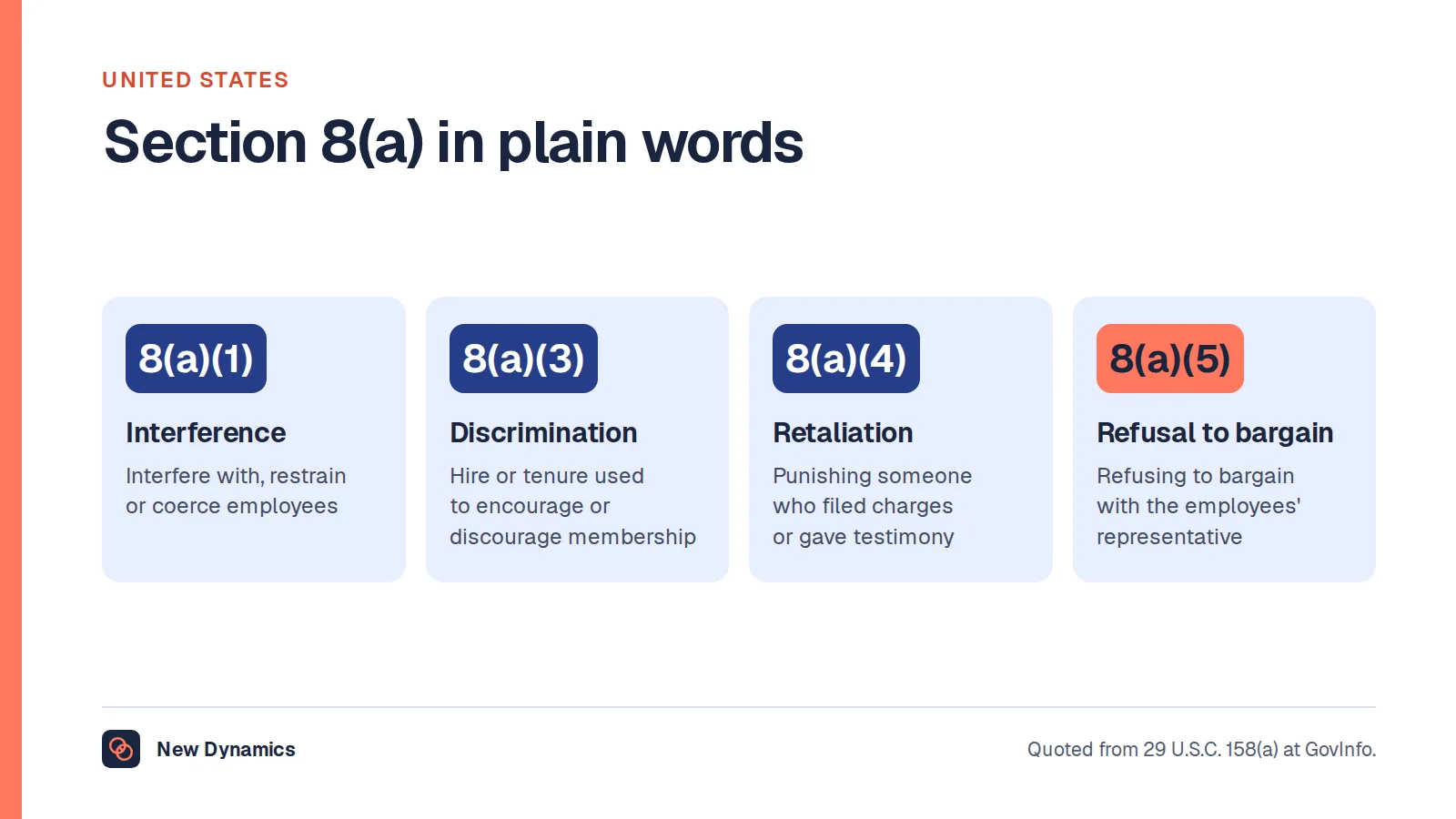
Protected concerted activity. Section 7 of the National Labor Relations Act, at 29 U.S.C. 157, gives employees the right to organise, to bargain collectively "and to engage in other concerted activities for the purpose of collective bargaining or other mutual aid or protection", and also "the right to refrain from any or all of such activities". Section 8(a), at 29 U.S.C. 158(a), makes it an unfair labor practice for an employer "to interfere with, restrain, or coerce employees in the exercise of the rights guaranteed in section 157 of this title". Note "other concerted activities": it reaches beyond unions, so employees acting together about their conditions can be protected where no union exists. Our article on the unfair labor practice covers the section 8 lists.
Family and medical leave. The FMLA's prohibited acts, at 29 U.S.C. 2615, make it "unlawful for any employer to interfere with, restrain, or deny the exercise of or the attempt to exercise, any right provided under this subchapter". The regulation at 29 CFR 825.220 draws the line wide: interference "would include, for example, not only refusing to authorize FMLA leave, but discouraging an employee from using such leave." Eligibility, per the Department of Labor's FMLA page, needs 12 months with a covered employer, 1,250 hours of service, and "at least 50 employees within 75 miles."
Whistleblowing and safety complaints. Section 11(c) of the Occupational Safety and Health Act, at 29 U.S.C. 660(c), provides that "No person shall discharge or in any manner discriminate against any employee because such employee has filed any complaint or instituted or caused to be instituted any proceeding under or related to this chapter". The clock is short: a complaint must be filed "within thirty days after such violation occurs". OSHA runs this and many other statutes through its Whistleblower Protection Program. See what a whistleblower is for the British position.
Put the list together and the picture inverts. At-will remains the default, but the statutes cover so much ground that dismissing without a recorded reason is an unmeasured risk.
Montana, the one state where the default is different
Jurisdiction: Montana, United States.
Montana is widely described as the only state that is not at-will by default. We could not open an official statement of that national comparison, so treat the "only state" framing as the commonly stated position rather than a sourced fact. The statute itself is sourceable.
The Wrongful Discharge From Employment Act, in the Montana Code Annotated 2025, sets out when a dismissal is wrongful. Section 39-2-904 provides that "A discharge is wrongful only if", among other grounds, "the discharge was not for good cause and the employee had completed the employer's probationary period of employment". After probation, then, Montana requires good cause, and "good cause" is defined as "any reasonable job-related grounds for an employee's dismissal" based on poor performance, disruption of the employer's operation, violation of written policy, or "other legitimate business reasons".
Two details are routinely missed. During probation the at-will rule still applies: section 39-2-904(2) says "the employment may be terminated at the will of either the employer or the employee on notice to the other for any reason or for no reason." And the probationary period has a statutory default: section 39-2-910 provides that where an employer sets none, "there is a probationary period of 12 months commencing on the date the employee begins work", extendable but not beyond 18 months in total.
The Act is also narrower than it looks. Section 39-2-912 exempts a discharge "that is subject to any other state or federal statute that provides a procedure or remedy for contesting the dispute", and one of an employee under a collective bargaining agreement or a fixed-term contract. None of this is legal advice, and Montana practice turns on decided cases this article does not summarise.
At-will employment against a contract: what a contract changes
Jurisdiction: United States.
Searches for "at will vs contract employment" are asking what you get if there is a contract. It replaces the default with whatever it says, and the parts that matter are the parts most people skim.
A contract for a specific term removes the default for that term, so ending it early is a breach unless the contract allows it. A cause standard is the real prize: a clause saying employment may be ended only for cause, with cause defined, converts "no reason needed" into "a reason you can evidence". A notice or severance clause creates an entitlement at-will does not provide, and matters because there is no general federal notice period. A procedure clause binds the employer to its own process, which is where express contracts and the implied contract exception meet. A collective bargaining agreement does all of this for a group, which is why the Department of Labor names a labor contract alongside private ones.
What a contract cannot do is displace statute. No clause can authorise a discriminatory or retaliatory dismissal.
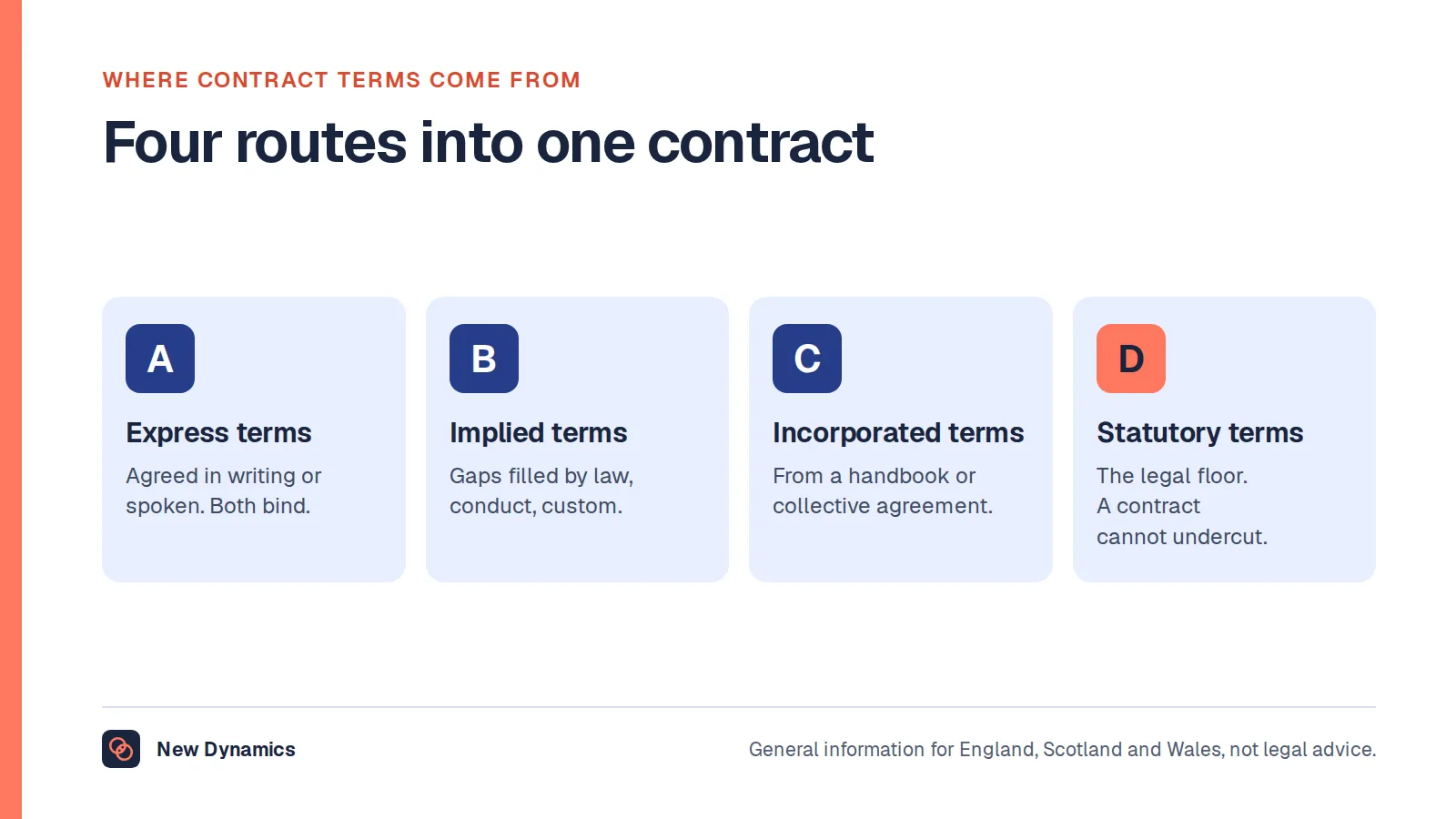
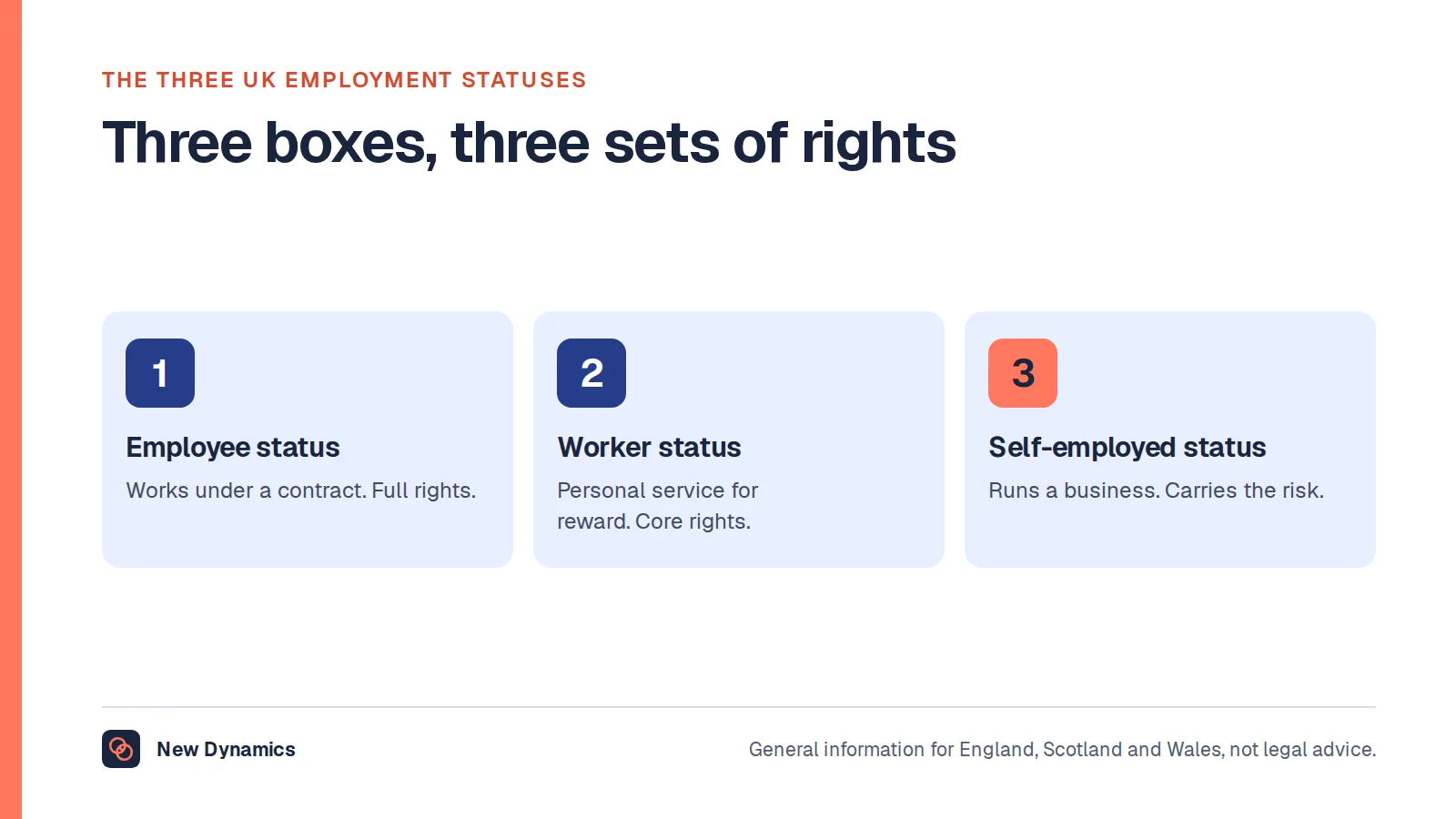
In American usage an at-will employee is an ordinary employee with no fixed term and no cause standard, and a contract employee is someone engaged under a written agreement. Both are employees, and neither phrase is a statutory category. That is where the trouble starts, because "contract employee" is also used loosely to mean an independent contractor, who is not an employee at all and sits outside most protections above. So when somebody asks about at will vs contract employee, establish which of three they mean: an employee on a fixed-term or for-cause contract, an agency worker, or a self-employed contractor. Our articles on employment status and the employment contract set out the categories.

The British position: there is no at-will employment
Jurisdiction: Great Britain, meaning England, Wales and Scotland, except where a GOV.UK note about Northern Ireland is quoted. Northern Ireland has separate employment legislation and its own qualifying period.
British law has no at-will doctrine, and the reason starts earlier than dismissal. A contract exists from the beginning, whether or not anyone wrote one.
GOV.UK, on employment contracts, is unambiguous: "All employees have an employment contract with their employer." On timing: "As soon as someone accepts a job offer they have a contract with their employer. An employment contract does not have to be written down." Acas, on employment contracts and the law, adds that contracts can be agreed "verbally", "in writing" or "through conduct", and that "An employment contract begins when someone starts work."
That alone ends the comparison. An at-will relationship is defined by the absence of a contract. In Great Britain the absence of a written contract does not produce one, because a contract exists anyway.
On top of the contract sits a statutory document. GOV.UK, on the written statement of employment particulars, states that "An employer must give employees and workers a document stating the main conditions of employment when they start work", that it "is not an employment contract", and that "The employer must provide the principal statement on the first day of employment and the wider written statement within 2 months of the start of employment." The statute is slightly wider: section 1 of the Employment Rights Act 1996, extent England, Wales and Scotland, requires that "the statement must be given not later than the beginning of the employment", so on or before the first day. It must cover pay, hours, holiday, place of work and "how long any probation period is and what its conditions are".
A British probation period is therefore nothing like a Montana probationary period. It is a contractual arrangement described in a statutory document, not a window with protection switched off.
Notice periods in Great Britain are statutory minimums
Jurisdiction: Great Britain. General information, not legal advice.
Where an American at-will employer can usually end the relationship today, a British employer owes notice, and the floor is statutory.
Section 86 of the Employment Rights Act 1996, extent England, Wales and Scotland, sets the employer's minimum for anyone "continuously employed for one month or more": one week under two years, "not less than one week's notice for each year of continuous employment" from two to twelve years, and "not less than twelve weeks' notice if his period of continuous employment is twelve years or more". Acas states the same ladder on notice when being dismissed or made redundant, and adds the commercial point: "The employer may give more notice than the statutory minimum, but they cannot give the employee less."
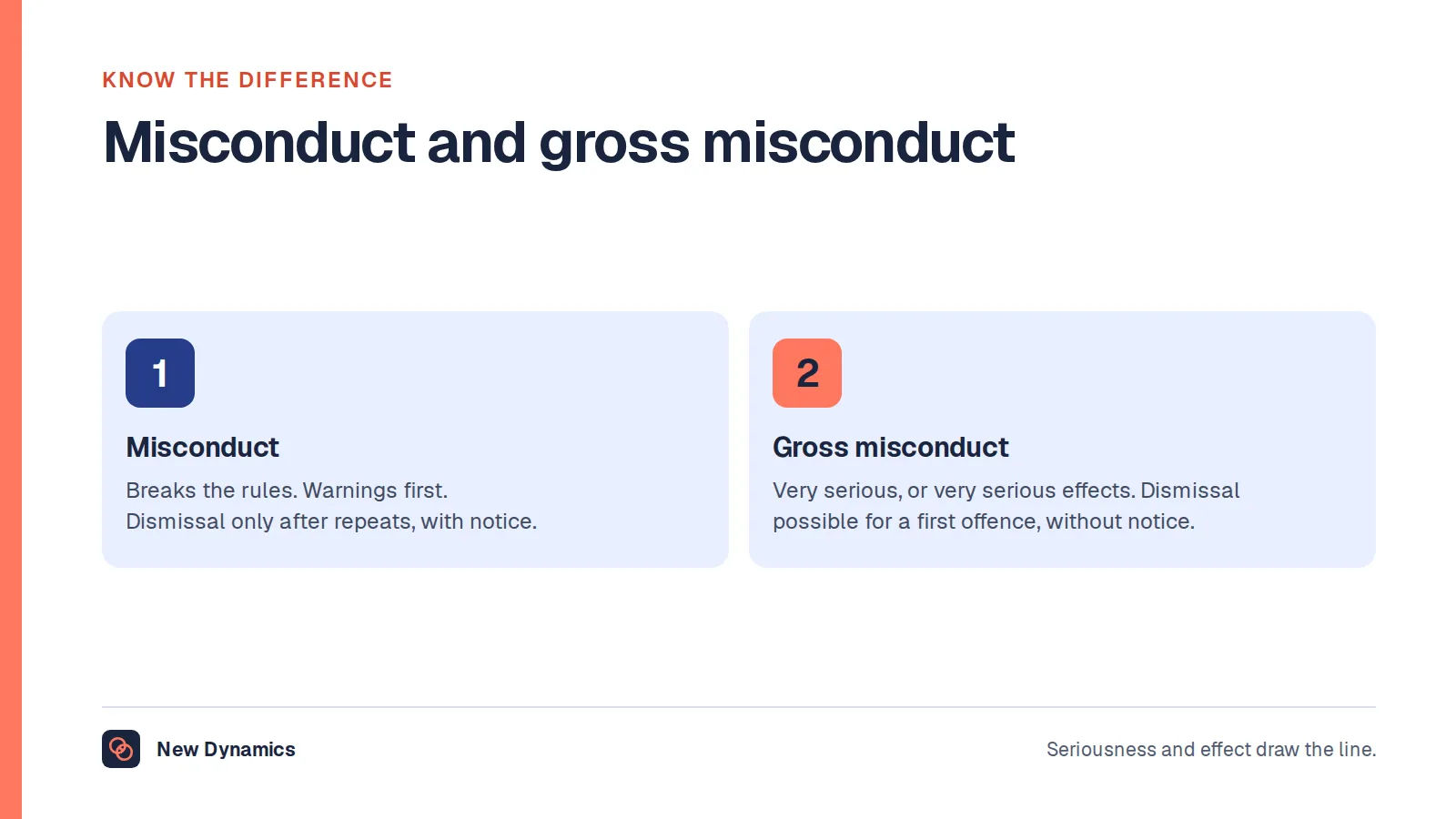
Section 86(3) makes the floor stick: any provision for shorter notice "has effect subject to subsections (1) and (2)". Section 86(6) preserves the right to treat the contract as terminable without notice "by reason of the conduct of the other party", the statutory root of summary dismissal for gross misconduct.
Notice runs the other way too. GOV.UK, on giving notice, tells employees: "You must give at least a week's notice if you've been in your job for more than a month." An at-will employee owes no statutory notice at all.
Unfair dismissal and the qualifying period, now and from January 2027
Jurisdiction: Great Britain, with the Northern Ireland position as GOV.UK states it.
The deepest difference is not notice. It is that a British employer must show why.
Section 94 gives the right in one line: "An employee has the right not to be unfairly dismissed by his employer." Section 98 then puts the burden where no at-will system puts it: "it is for the employer to show" the reason, or principal reason, for the dismissal, and that it is a listed reason "or some other substantial reason of a kind such as to justify the dismissal". The listed reasons are capability or qualifications, conduct, redundancy, and that continued employment would contravene a statutory duty. Even with a good reason, section 98(4) asks "whether in the circumstances (including the size and administrative resources of the employer's undertaking) the employer acted reasonably or unreasonably". Our article on disciplinary procedure covers the process that answers that.
Now the qualifying period, where the position is in motion. GOV.UK states both the present rule and a future change on one page, eligibility to claim unfair dismissal.
The present rule: "Employees can usually only claim unfair dismissal if they've worked for a qualifying period. This is usually 2 years." It adds that "In some cases, the qualifying period is shorter or does not apply", and that "In Northern Ireland, the qualifying period is still usually 1 year."
The future change, from the same page: "From 1 January 2027, most employees will be able to claim unfair dismissal after 6 months."
Which one is in force. As at the date on this article, the two-year period applies and the six-month period does not. Section 108, extent England, Wales and Scotland, still reads: "Section 94 does not apply to the dismissal of an employee unless he has been continuously employed for a period of not less than two years ending with the effective date of termination." That page lists, under changes yet to be applied, "s. 108(1) words substituted by 2025 c. 36 s. 25(2)(a)", which is the Employment Rights Act 2025, and the substitution has not been applied to the text. Acas says the same on unfair dismissal: "Protection from unfair dismissal will become a right after 6 months of being in a job. This is part of the government's Employment Rights Act 2025. This change will happen in January 2027 and is not yet law."
So quote both, and be clear which applies on the day you act. If you are reading this after 1 January 2027, check GOV.UK again.
One more point. A list of automatically unfair reasons carries no qualifying period at all, and GOV.UK's list on unfair dismissals runs from pregnancy and maternity to "reporting certain types of wrongdoing". The claim clock is short, too: Acas says "Someone might only have 3 months minus 1 day from the date their employment ended."
What an American manager on a British team gets wrong, and the reverse
Jurisdiction: both. General information, not legal advice, and the law differs by state and by country.
Most of the damage in cross-border teams is done by a competent manager applying a habit that was correct where they learned it. One thing is identical in both countries: you will be asked what the reason was, when you decided it, and whether the same standard applied to everyone else.
Five habits an American manager has to drop on a British team
- Stop assuming you can end it today. Notice is statutory and the contract cannot go below the floor in section 86. Plan the dismissal around the notice period rather than discovering it afterwards.
- Stop treating the absence of a signed contract as freedom. A contract exists as soon as the offer is accepted. The missing document is your problem, not your protection.
- Expect to produce the reason, to a standard. Section 98 puts the burden on the employer. "It was not working out" is not a defence.
- Run the process even when you are sure. Acas says a dismissal might be unfair where "the employer did not follow a fair procedure", separately from the reason.
- Stop writing at-will disclaimers into British documents. The clause has no work to do here, and a British reader will assume their employer does not know the law that applies to them.
Five habits a British manager has to drop on an American team
- Stop looking for the qualifying period. There is no American equivalent of the two-year clock. Protection against a discriminatory or retaliatory dismissal applies from day one, subject to the employer-size thresholds the EEOC publishes.
- Stop assuming a statutory notice period exists. There is no general federal notice entitlement, so notice and severance come from the contract, the policy, or nothing.
- Be much more careful with the handbook. In many states an unqualified promise of just cause or of a procedure can create an implied contract that removes the default you were relying on.
- Ask which state, every time. The exceptions above are state law, and so are whistleblowing statutes, final-pay rules and restrictive covenants. "American law" is not one answer.
- Watch the clocks, because they are shorter. Thirty calendar days for an OSH Act retaliation complaint is not the three months minus one day a British manager has internalised.

Frequently asked questions
What is at-will employment?
At-will employment is the default rule in the employment law of the United States. The North Carolina Department of Labor states that an employer can discharge an employee "for any reason or no reason at all", but only "unless there is a specific law to protect employees or there is an employment contract providing otherwise". It works both ways, so an at-will employee can resign without notice. It is American, and has no equivalent in the UK.
Does at-will employment mean an employer can fire someone for any reason?
No. The default gives way whenever a statute or a contract applies, and many do. Federal law prohibits dismissal for discriminatory reasons, for retaliation over a discrimination complaint, for protected concerted activity under the National Labor Relations Act, for exercising Family and Medical Leave Act rights, and for safety complaints under the Occupational Safety and Health Act. State courts add more.
What are the exceptions to at-will employment?
Three come from state courts. The public policy exception protects an employee dismissed for an act the state's own policy supports, such as filing a workers' compensation claim or refusing to break the law. The implied contract exception applies where a handbook or a spoken assurance promised just cause or a procedure. A minority of states read in a covenant of good faith. Statutes on discrimination, retaliation, leave, union activity and whistleblowing override at-will.
Is Montana the only state that is not at-will?
Montana is widely described that way. We could not open an official statement of that comparison, so treat the claim with care. The statute is clear: Montana Code Annotated section 39-2-904 makes a discharge wrongful where "the discharge was not for good cause and the employee had completed the employer's probationary period of employment". During probation the at-will rule still applies, and section 39-2-910 sets a default probation of 12 months.
What is the difference between at-will and contract employment?
At-will is the default where there is no fixed term and no cause standard, so no reason is needed. A contract replaces that default with its own terms: a specific term, a definition of cause, a notice or severance entitlement, or a procedure the employer must follow. A collective bargaining agreement does the same for a group. No contract can displace statute.
Does at-will employment exist in the UK?
No. GOV.UK states that "All employees have an employment contract with their employer" and that a contract exists as soon as a job offer is accepted, written down or not. The written statement of particulars is due no later than the beginning of the employment, notice periods are statutory minimums under section 86 of the Employment Rights Act 1996, and section 98 requires the employer to show the reason for a dismissal. GOV.UK gives the qualifying period as usually 2 years, and says most employees can claim after 6 months from January 2027.
Your next step: one record that answers both systems
Take the habit rather than the citations, because it is the same in both countries. Decide, record and date.
- For every team, write down which country's and which state's law applies to each person, before you need it.
- Read your handbook with American eyes once. In many states an unqualified promise of just cause can create an implied contract.
- Keep the decision, the evidence and the date in one place, against the person, so you can show the reason and that the same standard applied to everyone else.
- Before any British dismissal, check the section 86 notice ladder and the current qualifying period on GOV.UK, not a summary.
- Take advice from an employment lawyer in the relevant country, and the relevant state.
For setting a written standard that holds up when challenged, read and download our employee handbook guide. The guide is free to read, and the PDF uses our short download form.
Want decisions, approvals and ratings held against each person with the dates intact, across teams in more than one country? Book a New Dynamics demo and bring the process you run today, or email contact@new-dynamics.com.
For the surrounding vocabulary, read our articles on the employment contract, employment status and the unfair labor practice. General information, not legal advice: employment law differs by state and by country.