TL;DR
- A logistics coordinator is an execution role, not a management one. The day is scheduling, booking carriers, raising and checking documentation, working exceptions and telling customers the truth early. The manager owns the network, the rates, the budget and the team; the coordinator owns today.
- The role changes more by context than by title. Warehouse and distribution coordinators work to dock slots and labour; freight forwarding coordinators live in documents and quotes; manufacturing inbound coordinators protect a production line; retail coordinators work to a store calendar and a promotion plan.
- Judge the post holder on what they control. On-time delivery is shared with carriers, suppliers and weather, so booking accuracy, exception handling time and documentation error rates are the honest measures. This is general information about Great Britain and the UK rules named, not legal advice.
Most logistics adverts are written for the manager and then handed to the coordinator. The result is a document that promises network design and supplier strategy to someone whose actual week is dock slots, booking references and a customer who wants to know where their pallet is.
That mismatch is expensive twice. It attracts candidates who leave when they find out what the job is, and it leaves the person who stays with no agreed definition of doing it well.
This article sets out the logistics coordinator role as an employer needs it: what the job does day to day, how it differs from the logistics manager role, a job description written out in full, the four variants of the role by context, the compliance edges the coordinator supports without owning, health and safety in a warehouse or yard, and how to measure the post honestly.
A coordinator's work is mostly made of small commitments that either land or do not, which makes it unusually easy to set goals against once the accountabilities are written as outcomes. See how New Dynamics Goals & OKRs keeps objectives, owners and progress in one place, so the job description and the review conversation are talking about the same job.
Where law and regulation are mentioned, the health and safety sources quoted describe Great Britain, which means England, Scotland and Wales, and the drivers' hours and working time sources describe the UK rules as published on GOV.UK. Northern Ireland has its own arrangements in some areas. This is general information rather than legal advice, and it is not a compliance checklist for your operation.
What a logistics coordinator actually does
Strip the job to its load-bearing parts and five things are left. They repeat every day, they interrupt each other, and the order changes by lunchtime.
Scheduling
The coordinator turns demand into a plan for a specific day: which orders ship, in what sequence, on which vehicle, through which dock slot, with which labour. This is where most of the thinking happens, and it is also the part that gets undone most often. A late inbound, a failed vehicle or a picking shortfall means the schedule is rebuilt rather than adjusted.
Carrier booking
Booking is the act that commits the business. The coordinator raises the booking with a carrier, forwarder or own-fleet planner, states the collection window, the goods, the weight and dimensions, the delivery requirements and anything unusual about the site at either end. Most delivery failures that look like carrier failures started as a booking that was wrong, incomplete or late.
Documentation
Delivery notes, consignment notes, packing lists, proofs of delivery, booking references, temperature or batch records where the goods need them, and, on an international move, the commercial documents the forwarder or broker needs. The coordinator raises some of these, checks others and chases the rest.
Exceptions
An exception is any movement that has stopped behaving like the plan. A missed collection, a damaged pallet, a refused delivery, a shortage, a vehicle breakdown, a customs hold. Working exceptions is the part of the job that distinguishes a strong coordinator from an adequate one, because it is judgement under time pressure with incomplete information.
Customer communication
Telling the customer, the store, the site or the internal account manager what is happening, before they ask, and in terms they can act on. "Delayed" is not communication. "On the vehicle, now booked for Thursday 08:00, here is the reference" is.

Coordinator or manager? The line that matters
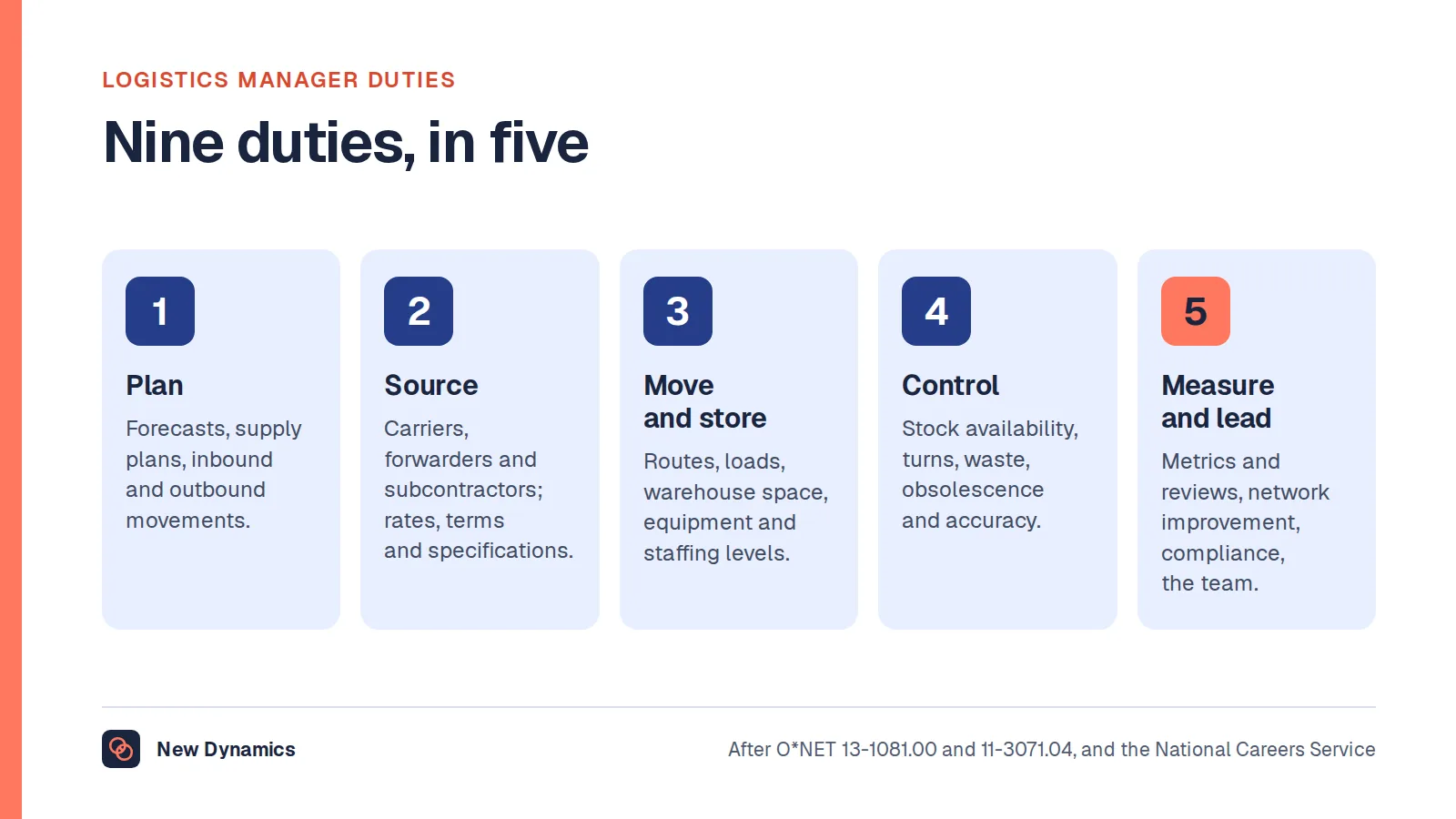
Our logistics manager job description covers the senior role in detail: network planning, carrier selection and rate negotiation, warehouse strategy, inventory policy, the function's measures, compliance ownership and managing the team. The coordinator role is a different job, and three tests separate them cleanly.
Who chooses the carrier? The manager selects and contracts carriers and agrees rates. The coordinator books within that arrangement. A coordinator who is negotiating rates is doing a manager's work without a manager's authority.
Who owns the budget? The manager holds or influences a transport and warehousing budget and is answerable for cost per order or per case. The coordinator spends within rules: approved carriers, approved service levels, and an escalation point for anything that costs more.
Who manages people? The manager recruits, schedules, trains and appraises. A coordinator may well direct the work of warehouse operatives for a shift, or be the senior coordinator others ask, but line management is not in the job.
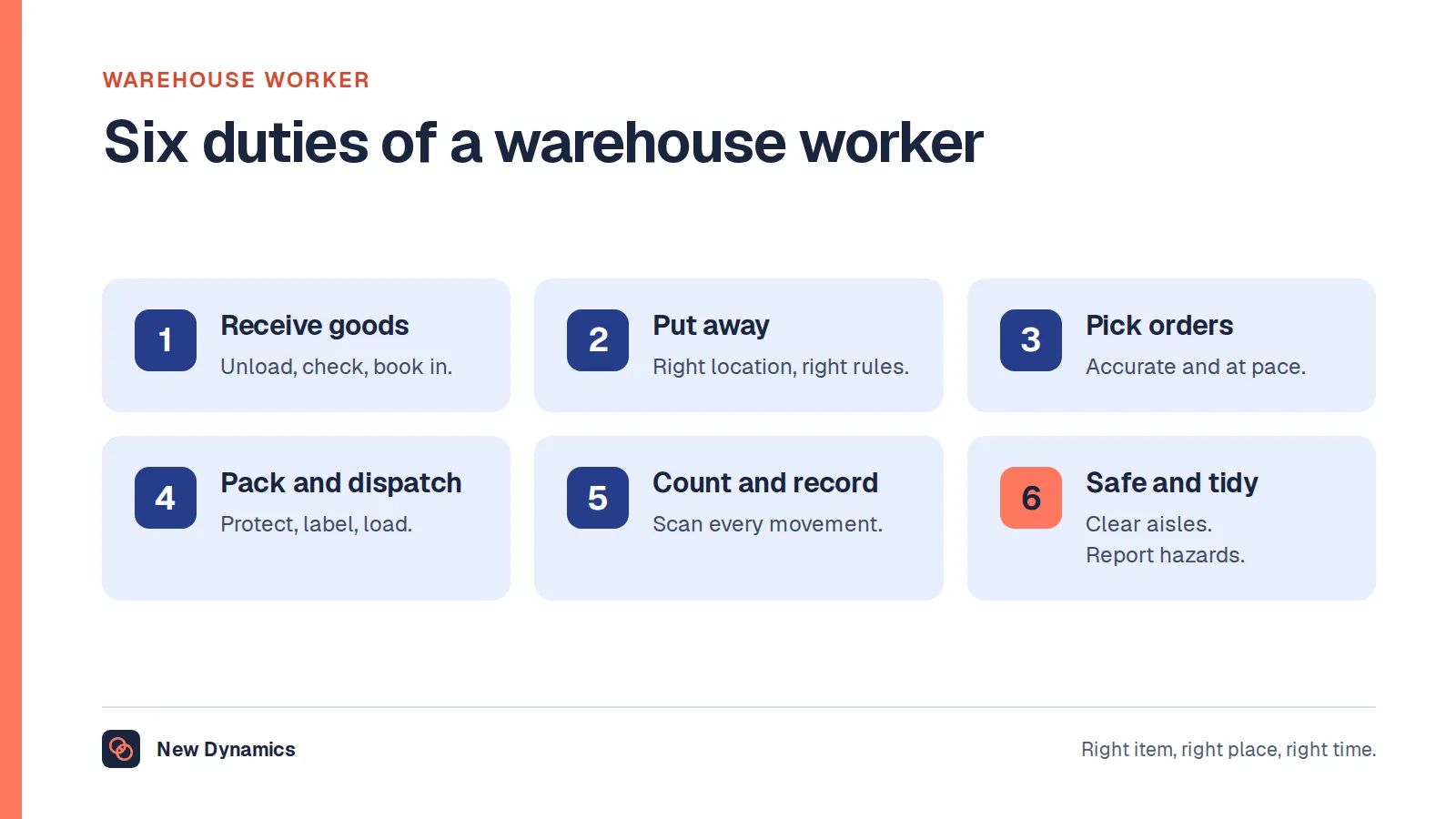
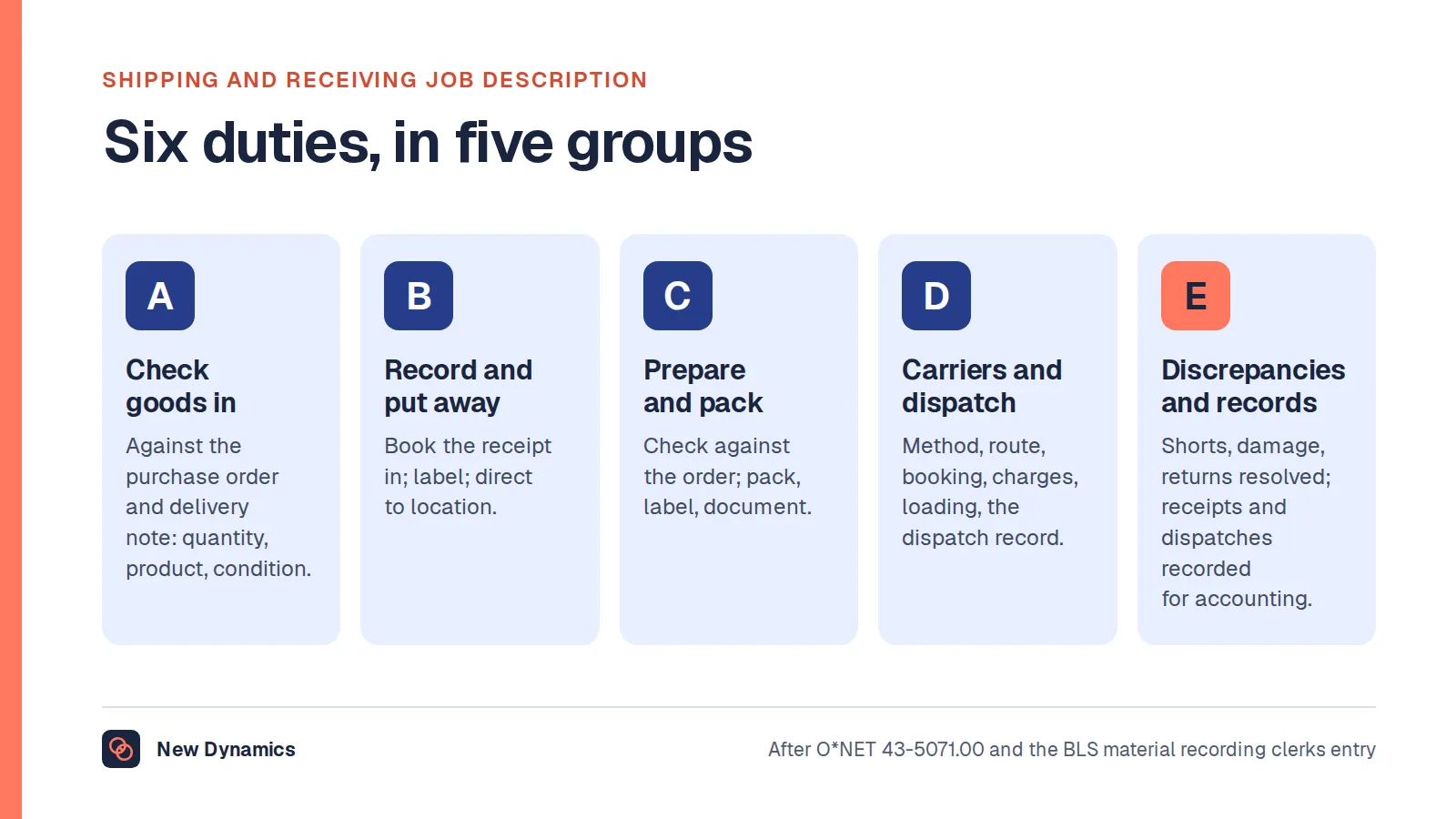
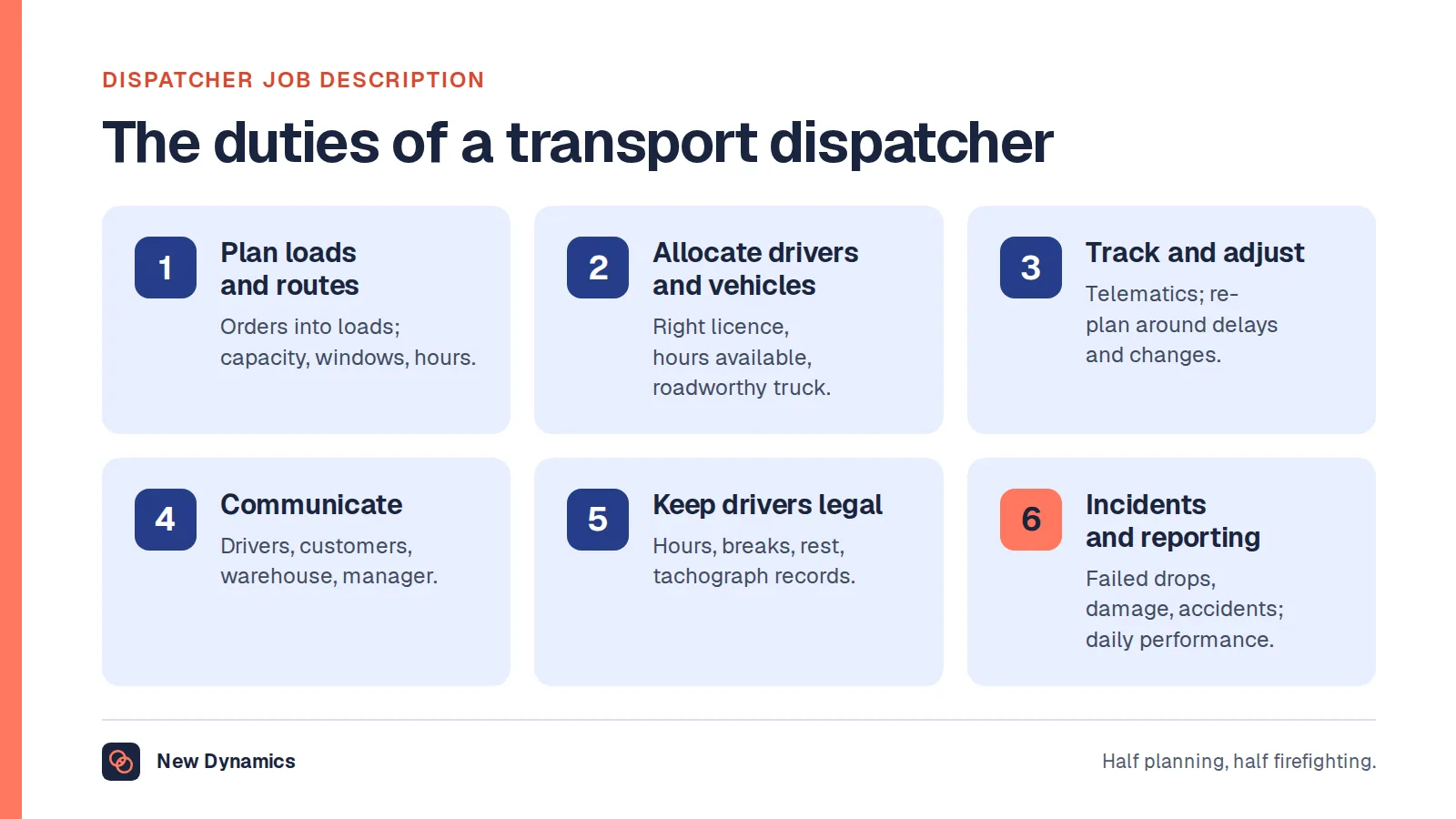
A useful one-line version for an advert: the manager decides how goods move, and the coordinator makes today's movements happen. Adjacent roles sit close by, and the boundary is worth naming in the document. A dispatcher is usually closer to the vehicles and the drivers; a shipping and receiving role is usually closer to the dock; a warehouse worker handles the goods themselves.
A logistics coordinator job description you can use
Copy the structure. Replace everything in square brackets. Keep the accountabilities as outcomes rather than turning them back into a task list, which is the single change that makes the document useful at review time; our post on how to write a job description explains the method.
Purpose
This post exists so that agreed movements of goods happen on the planned day, with correct paperwork, and so that when a movement fails the right people know early enough to do something about it.
One sentence, and it already tells a candidate what the job is for. Note what it does not claim: it does not promise that everything arrives on time, because the post holder cannot promise that.
Accountabilities as outcomes
Daily schedule. A workable movement plan exists for every operating day before the cut-off, reflecting real labour, dock and vehicle availability rather than ideal conditions.
Booking accuracy. Bookings are raised correctly first time, with the collection window, goods detail, delivery requirements and site constraints complete, so that carriers can execute without coming back for information.
Documentation. Every consignment travels with the documents it needs, and records are filed so that a query six weeks later can be answered from the file rather than from memory.
Exception handling. Problem movements are identified, resolved or escalated within the agreed response time, with the cause recorded rather than only the fix.
Customer and internal communication. Affected parties are told what has happened, what will happen next and by when, before they chase, and the message is specific enough to act on.
Cost discipline. Movements are booked on the agreed service level, and any premium freight is authorised in advance and explained afterwards.
Continuous improvement. Recurring causes of exceptions are reported upward with evidence, rather than absorbed quietly week after week.
Seven accountabilities. Each one can be done well or badly, which is the test. The response times and cut-offs are illustrative placeholders: set your own from what your operation can actually sustain before they go in a document.
Person specification
Essential
- Organised under interruption, with a reliable method for tracking open items.
- Accurate with detail, because a transposed weight or a wrong postcode becomes a failed delivery.
- Clear written communication, including bad news.
- Confident with a transport, warehouse or ERP system and with spreadsheets.
- Willing to work [shift pattern, peak season, weekend cover] and to escalate rather than conceal.
Desirable
- Experience in [sector], or with [temperature-controlled, hazardous, international, palletised] goods.
- Familiarity with [carrier portals or systems used].
- Awareness of [customs, dangerous goods, drivers' hours] requirements as they affect planning.
Every requirement above should have a reason beside it in your internal copy. If the reason is "the last person had it", delete it.
Note what is absent: a degree, and a fixed number of years. Both are usually proxies for things you can assess directly in a well-designed interview.
What good looks like after six months
Write this into the document. It is the clearest thing you can give a new coordinator, and it makes the probation conversation straightforward.
- Plans the day without being told the sequence, and flags a shortfall before the cut-off rather than after it.
- Raises bookings that carriers execute without querying, and knows which carrier suits which lane and constraint.
- Holds a clean document file, so audits and customer queries are answered from records.
- Handles routine exceptions independently, and escalates the right ones early with a recommendation attached.
- Is trusted by customers and internal colleagues to give an accurate picture, including when the news is bad.
- Has named at least one recurring problem and brought evidence for fixing it.
Four variants of the role
The title is stable and the job underneath it is not. Four contexts dominate, and the differences matter enough to change the advert, the person specification and the interview.

Warehouse and distribution
The coordinator works inside a site's physical constraints: dock doors, slots, labour on shift, pick waves, trailer availability, yard space. Success looks like a day that loads in the planned sequence without the yard jamming. The dominant pressure is same-day and the dominant skill is sequencing. Collaboration with shift supervisors is constant, and the coordinator is often the person who notices that the plan and the pick face disagree.
What changes in the advert: say the shift pattern, say whether the role covers weekends and peak, and say whether the coordinator directs operatives during a shift.
Freight forwarding
Here the job is documents, quotes and milestones. The coordinator builds and tracks files, raises and checks commercial documentation, liaises with overseas agents, hauliers, airlines, shipping lines and customs brokers, and manages a customer expectation measured in days rather than hours. Accuracy beats speed, because an error in a document creates a hold rather than a delay.
What changes: name the modes (road, sea, air, rail), say whether the role is export, import or both, and be honest that the learning curve is steep and document-heavy.
Manufacturing inbound
The coordinator's job is to keep a production line fed. Inbound call-offs, supplier collections, goods-in booking windows, line-side delivery, and the difference between a stockout that costs a few hours and one that stops a line. Planning horizons are longer than in distribution, and the relationship with production planning and purchasing is the centre of the week.
What changes: name the production environment and the consequence of a stop, and say whether the role includes supplier chasing, which is a different skill from carrier booking.
Retail
The coordinator works to a store calendar: replenishment windows, delivery curfews, store back-door capacity, promotion and seasonal launch dates that cannot move. Volumes spike to a plan rather than at random. The coordinator spends more time on allocation and sequencing across many destinations than on individual consignments, and more time talking to store and merchandising colleagues than to carriers.
What changes: name the number of destinations, say whether the role covers returns and reverse logistics, and say how the promotional calendar affects working patterns.
The compliance edges a coordinator sits next to
This is the section most coordinator adverts get wrong, in both directions. Some ignore regulation entirely and leave a new starter to discover it. Others imply the coordinator is responsible for compliance that sits elsewhere, which is unfair to the post holder and inaccurate about where accountability lies.
The honest framing is this: a coordinator's decisions have compliance consequences, so the coordinator must understand the rules well enough to plan within them and to escalate when a plan would break them. The duties themselves fall on the operator, the employer, the transport manager, the consignor or the declarant, depending on the rule. The coordinator supports, and does not own.
Drivers' hours and working time for mobile workers
If the coordinator plans collections, deliveries or own-fleet work, the schedule they build has to be legally drivable. The limits are published and specific.
GOV.UK's guidance on drivers' hours states that "Assimilated rules (previously called EU rules) apply if the maximum weight of your vehicle or vehicle combination is more than 3.5 tonnes". Within those rules, a driver must not drive more than "9 hours in a day - this can be extended to 10 hours twice a week", must take "a break or breaks totalling at least 45 minutes after no more than 4 hours 30 minutes driving", must have "at least 11 hours rest every day - you can reduce this to 9 hours rest 3 times between any 2 weekly rest periods", and must have "an unbroken rest period of 45 hours every week - you can reduce this to 24 hours every other week".
Separately, GOV.UK's working time rules for mobile workers define a mobile worker as "any worker forming part of the travelling staff (including trainees and apprentice) who is in the service of an undertaking which operates transport services for goods or passengers by road for hire or reward or on its own account". Under those rules, "Weekly working time must not exceed an average of 48 hours per week over the reference period, which can only be 17 or 26 weeks", while "A maximum working time of 60 hours can be performed in any single week providing the average 48-hour limit is not exceeded". The guidance adds that "If night work is performed, working time must not exceed 10 hours in any 24-hour period", and that "Mobile workers must not work more than 6 consecutive hours without taking a break". It also defines waiting time precisely: "A period of availability (POA) is waiting time, the duration of which must be known in advance."
The practical point for the job description is narrow and important. Compliance with drivers' hours and working time rests with the operator and, where the operator holds a standard licence, with the named transport manager. The coordinator's accountability is to plan and book in a way that does not require a driver to breach those limits, and to escalate the moment the plan would. That last point belongs in the document, because a coordinator under pressure who believes the job is to make the delivery happen is the person most likely to build an undrivable schedule.
Dangerous goods documentation
Where consignments include dangerous goods, classification, packaging, marking, labelling, documentation and driver training requirements apply, and the duties fall on specific parties such as the consignor and the carrier. The Health and Safety Executive's carriage of dangerous goods pages are the starting point for the detail, including its carriage manual and guidance notes.
A coordinator in this setting typically completes or checks transport documentation and refuses movements that are not properly prepared. They do not decide classification, and they are not the dangerous goods safety adviser. Say so in the job description, name who does hold those roles, and put the training the post holder will receive in the conditions and development section.
Customs paperwork
On international movements the coordinator is usually the person who gathers and passes on information rather than the person who declares. GOV.UK's guidance on exporting goods sets out the steps, including that "You need an EORI number that starts with GB to export goods from England, Wales or Scotland", that "You must find the right commodity code to classify the goods you're exporting", and the requirement to "Make an export declaration and get your goods cleared by UK customs".
In most organisations a customs broker, forwarder or an in-house declarant submits the declaration. The coordinator supplies commercial invoices, packing lists, values, weights and commodity information, and so the quality of the coordinator's data determines whether the declaration is right. Write the accountability as data accuracy and timeliness, not as customs compliance.
Health and safety in a warehouse or yard
A coordinator is often the only person who knows that a 44-tonne vehicle is about to arrive in a yard where people are walking. That makes the role relevant to workplace transport safety even though the duty sits with the employer.
The Health and Safety Executive's pages on workplace transport put it plainly: "Every year, there are accidents involving transport in the workplace, some of which result in people being killed." HSE describes how they happen, with people "knocked down, run over, or crushed against fixed parts by vehicles (eg HGVs, lift trucks and tractors), plant and trailers", and notes that people also fall from vehicles, "whether getting on or off, working at height, or when loading or unloading". It states that "Your risk assessment must consider all workplace transport activities such as loading and unloading", and advises employers to consider delivery drivers "as they are particularly vulnerable".
Manual handling is the other everyday risk in the same space. HSE explains that "Manual handling means transporting or supporting a load by hand or bodily force. It includes lifting, putting down, pushing, pulling, carrying or moving loads", and sets out the employer's duties in its manual handling guidance: "avoid hazardous manual handling, so far as reasonably practicable", "assess the risk of injury from any hazardous manual handling operations that cannot be avoided", and "reduce the risk of injury from hazardous manual handling to as low as reasonably practicable".
Three lines in a coordinator job description do most of the useful work here. First, that the post holder follows site traffic rules and site induction requirements and ensures visiting drivers are told them. Second, that they plan arrivals and loading to avoid congestion and unsafe pressure on the yard. Third, that they report near misses and unsafe practice rather than treat them as the cost of a busy day. None of those makes the coordinator responsible for the risk assessment, and all of them are things the post holder genuinely controls.
Measuring the role honestly
Here is the trap. Every logistics scorecard leads with on-time, in-full delivery, so it gets copied into the coordinator's objectives. But on-time delivery is produced by carriers, suppliers, the warehouse, traffic, weather and customer availability. The coordinator contributes to it and does not control it. Measure a person on an outcome they do not control and one of two things happens: they learn to manage the number, or they stop believing the review process.
Keep the shared measures visible as context, and judge the post holder on what the post holder decides.

- Booking accuracy. The share of bookings that need no correction, re-raise or clarifying call. This is almost entirely within the coordinator's control, and it is the leading indicator of most delivery failures.
- Exception handling time. How long from an exception being visible to it being resolved or escalated with a recommendation. Not how long until the goods arrive, which depends on others.
- Documentation error rate. Missing, late or incorrect documents per hundred consignments, including the ones caught before they caused a problem.
- Communication timeliness. The share of affected movements where the customer or internal owner was told before they chased. Crude to collect, revealing when you do.
- Premium freight authorisation. Whether expedited movements were approved in advance and explained, rather than discovered on the invoice.
Then show the shared measures alongside, labelled as shared: on-time in-full, damages, cost per consignment, carrier performance. The point of showing them is diagnosis, not scoring. If on-time delivery is falling while booking accuracy holds, the problem is not the coordinator, and a scorecard built this way tells you that in one glance.
We are not aware of an official UK source that publishes booking accuracy or exception handling benchmarks for logistics coordinators, so we are not going to invent one. Set your own baseline from three months of your own data before you put a target in a document. The published figures we do use across people management are collected in our HR statistics hub.
Hiring: what to test at interview
A coordinator interview that only asks about experience will hire the person with the best vocabulary. Four exercises test the job itself.
- A scheduling problem. Give the candidate a day's worth of orders, two fewer vehicles than the orders need, a dock with limited slots and one customer with a hard curfew. Ask them to build the day and explain what they would drop or delay, and who they would tell. You are listening for sequencing, trade-offs and the instinct to communicate early.
- A deliberately incomplete booking. Hand over a booking request missing weight, a contact and a delivery constraint. Ask what they would do before raising it. Strong candidates spot the gaps and say who they would ask. Weaker ones raise the booking.
- A bad-news message. Ask them to write, in five lines, the message they would send a customer whose delivery has failed and will not now arrive until Thursday. Look for specificity, ownership and no hiding.
- An escalation judgement. Describe a plan that can only be delivered if a driver exceeds their hours, and ask what they do. The only acceptable answer involves not doing it and telling someone. This is the question that tells you whether a candidate will keep your operation out of trouble.
Then ask one question about the variant you are hiring for: the document set in forwarding, the line-stop consequence in manufacturing, the store curfew in retail, the yard in distribution.
From coordinator to manager
The route is well worn and it is not automatic, because the two jobs need different things. A coordinator is rewarded for personally resolving today's problem. A manager is rewarded for designing a week in which that problem does not recur, and for getting results through other people. The coordinators who do not progress are usually the ones who are excellent at the first and never practise the second.
Four steps make the transition real rather than aspirational, and they belong in the development section of the job description:
- Own a lane, a site or a carrier relationship, including its performance review, so the post holder learns to manage performance rather than incidents.
- Lead an improvement with evidence. Take one recurring exception cause, quantify it, propose a change, implement it and report what happened.
- Learn the commercial layer. Rate structures, surcharges, cost per consignment and the arithmetic of a service-level choice. Most coordinators have never seen the rate card they book against.
- Take supervisory responsibility in small doses. Rota cover, inducting a new starter, running the daily stand-up. This is where you find out whether the person wants the manager's job or only the manager's title.
Two senior destinations follow from there: the transport and warehousing line, which runs through transport planner, team leader and logistics manager, and the planning and forwarding line, which runs through senior coordinator, planner and operations or branch management. Write the honest version into the advert. "Progression to logistics manager within two years" is a promise most employers cannot keep; "a development path with named steps, reviewed every six months" is one you can.
Frequently asked questions
What does a logistics coordinator do?
A logistics coordinator makes agreed movements of goods happen on the planned day. The work is scheduling the day against real vehicle, dock and labour availability, raising and tracking carrier bookings, producing and checking documentation, resolving or escalating exceptions such as missed collections and refused deliveries, and keeping customers and internal colleagues informed before they chase. It is an execution role rather than a management one.
What is the difference between a logistics coordinator and a logistics manager?
Three tests separate them. The manager selects carriers and negotiates rates, while the coordinator books within those arrangements. The manager holds or influences the budget and is answerable for cost per order, while the coordinator spends within rules and escalates anything that costs more. The manager recruits, schedules, trains and appraises a team, while the coordinator may direct work for a shift but does not line-manage. In short, the manager decides how goods move and the coordinator makes today's movements happen.
What are a logistics coordinator's duties and responsibilities?
Seven outcomes cover most versions of the role: a workable daily movement plan before the cut-off, bookings raised correctly first time, complete documentation and a file that answers queries weeks later, exceptions resolved or escalated within an agreed response time, affected parties informed before they chase, movements booked at the agreed service level with premium freight authorised in advance, and recurring causes reported upward with evidence rather than absorbed.
Does a logistics coordinator need to know drivers' hours rules?
Yes, well enough to plan within them, though the duty does not sit with the post holder. GOV.UK states that under the assimilated rules a driver must not drive more than 9 hours in a day, extendable to 10 hours twice a week, and must take a break or breaks totalling at least 45 minutes after no more than 4 hours 30 minutes driving. Compliance rests with the operator and, on a standard licence, the named transport manager. The coordinator's accountability is to avoid building a schedule that requires a breach, and to escalate when the plan would. General information, not legal advice.
How should a logistics coordinator be measured?
On what the post holder controls. Booking accuracy, exception handling time, documentation error rate, communication timeliness and premium freight authorisation are all largely within the role. On-time, in-full delivery is shared with carriers, suppliers, the warehouse and the weather, so show it as context for diagnosis rather than as the post holder's score. Set baselines from your own data before putting any target in a document.
How do you become a logistics manager from a coordinator role?
By practising the parts of the manager's job that coordinating does not teach. Own a lane, site or carrier relationship including its performance review, lead one quantified improvement from cause to result, learn the commercial layer of rates, surcharges and cost per consignment, and take supervisory responsibility in small doses such as rota cover and inducting new starters. The shift is from resolving today's problem personally to designing a week in which it does not recur.
Your next step: write the coordinator job, not the manager job
- Write the purpose sentence first. If it promises network design, you are advertising the wrong role.
- Replace the duty list with seven accountabilities, each one a result that can be done well or badly.
- Pick your variant, warehouse, forwarding, manufacturing inbound or retail, and change the person specification to match it.
- Separate what the coordinator controls from what the function shares, and build the scorecard on the first list.
- Name the compliance edges, say who owns each duty, and state that escalation is expected rather than tolerated.
For the process around the document, from designing the role to scoring applications consistently, read our recruitment and selection guide. It is free to read, and the PDF uses our short download form.
Want accountabilities, objectives and six-month reviews to reference the same job rather than three different versions of it? Book a New Dynamics demo and bring one coordinator job description with you. You can also email contact@new-dynamics.com.