TL;DR
- For a general employer in Great Britain the legally required training is health and safety training. Section 2(2)(c) of the Health and Safety at Work etc. Act 1974 covers "information, instruction, training and supervision", and regulation 13 of the Management of Health and Safety at Work Regulations 1999 sets out when it must be given.
- The employer pays, and it happens on work time. HSE states that "You must provide training during working hours and not at the expense of your employees", and regulation 13(3)(c) requires that the training "take place during working hours".
- No official source we could open prescribes a general refresher interval. Regulation 13(3)(a) says only "repeated periodically where appropriate", and HSE answers "Is annual refresher training a mandatory requirement?" for first aid with "No."
Search for a mandatory training list and the same eight or ten courses come back everywhere, usually with an annual renewal beside each one. Most of those lists are not describing the law. They are describing one sector's requirements, an insurer's preference, or a habit.
This post separates training the law requires of every employer, training a particular rule requires of particular employers, and training that is only a good idea. Then it answers who pays and whether it has to happen in work time. It covers Great Britain unless stated otherwise, and it is general information rather than legal advice.
Induction is where most of this lands first, and the easiest part to lose. See how New Dynamics onboarding connects a person's first day to their first real contribution, so the safety briefing and the first goals sit in one record instead of two inboxes.
Mandatory, statutory and compulsory: the distinction that matters
None of those three words is a legal category. "Statutory training" usually means training a statute or regulation names. "Mandatory training" is normally the employer's own list, the statutory items plus whatever else the organisation has decided everyone must do. "Compulsory training at work" is the same list seen from the employee's side.
So the useful question is not which bucket a course sits in. It is which named rule requires this, of whom, and what that rule says about timing, cost and frequency. Every honest mandatory training matrix has that answer beside each line.

The general duties: what every employer must do
Two provisions do nearly all the work.
Section 2(2)(c) of the Health and Safety at Work etc. Act 1974. Every employer's duty under section 2(1) is "to ensure, so far as is reasonably practicable, the health, safety and welfare at work of all his employees". That duty extends, at section 2(2)(c), to "the provision of such information, instruction, training and supervision as is necessary to ensure, so far as is reasonably practicable, the health and safety at work of his employees". The page is up to date with all changes known to be in force on or before 7 November 2026, and Northern Ireland has the same wording at article 4(2)(c) of the Health and Safety at Work (Northern Ireland) Order 1978. It is a standard, not a course list and not an interval.
Regulation 13 of the Management of Health and Safety at Work Regulations 1999. This turns the standard into triggers. Regulation 13(2), in force since 29 December 1999 with no outstanding effects recorded, requires "adequate health and safety training" both "on their being recruited into the employer's undertaking" and "on their being exposed to new or increased risks" through a change of responsibilities, new or changed work equipment, new technology, or a new or changed system of work.
Regulation 13(3) sets three conditions. The training "shall be repeated periodically where appropriate", "be adapted to take account of any new or changed risks", and "take place during working hours".
Regulation 13(1) is the line most matrices forget: "Every employer shall, in entrusting tasks to his employees, take into account their capabilities as regards health and safety." A completion tick is not evidence of capability.
The specific rules that add their own training duty
Individual regulations attach training to particular activities. They apply when the activity does, not to everyone.
- Display screen equipment. Regulation 6 of the Health and Safety (Display Screen Equipment) Regulations 1992 requires "adequate health and safety training in the use of any workstation", and for someone about to become a user, "the training shall be provided before he becomes a user".
- First aid. Under regulation 3(2) of the Health and Safety (First-Aid) Regulations 1981, "a person shall not be suitable unless he has undergone such training and has such qualifications as may be appropriate in the circumstances of that case". The number of first aiders follows a needs assessment, not a ratio in the regulations.
- Fire safety. In England and Wales, article 21 of the Regulatory Reform (Fire Safety) Order 2005 requires "adequate safety training" when employees are first employed and on exposure to new or increased risks, and that it "take place during working hours".
- Manual handling. The Manual Handling Operations Regulations 1992 impose no standalone course. Regulation 4(3)(c) requires regard to the employee's "knowledge and training" when judging risk, so the duty runs back through regulation 13.
HSE adds that other regulations carry their own requirements, "eg asbestos, diving and first aid". For scale, its key figures for Great Britain 2024 to 2025 record "511,000 workers suffering from a work-related musculoskeletal disorder"; our HR statistics hub holds the wider set.
What is not legally required of a general employer
For an employer outside a regulated sector:
- No official source we could open requires an annual refresher of anything. Where a regulator addresses the annual convention directly, it declines to make it a rule. HSE's first aid FAQs ask "Is annual refresher training a mandatory requirement?" and answer: "No. It is strongly recommended to employers to help trained first aiders maintain their basic skills and keep up to date with any changes in first-aid procedures." The same page adds that "Health and safety legislation does not require you to have an automated external defibrillator (AED) in your workplace."
- Nothing requires every employer to run a data protection course. In the UK GDPR, staff training appears as a task of a data protection officer, at article 39(1)(b), covering "awareness-raising and training of staff involved in processing operations". Most employers are not required to appoint one.
- Equality training is not prescribed by the Equality Act 2010. Section 109 makes an employer liable for what employees do in the course of employment, with a defence where the employer "took all reasonable steps to prevent" it. Training is among the most obvious reasonable steps, which is a strong reason to run it. It is still not a course the Act names.
- Sector rules are where most lists come from. In health and social care, regulation 18(2)(a) of the Health and Social Care Act 2008 (Regulated Activities) Regulations 2014 requires that staff "receive such appropriate support, training, professional development, supervision and appraisal as is necessary to enable them to carry out the duties they are employed to perform". A list inherited from a care, finance, education or transport source carries that sector's duties with it.
Calling something mandatory when no rule requires it spends the hours you need for the risks your own assessment found, and makes the genuinely required items look like more of the same.
Who pays for mandatory training, and when

The employer pays. HSE's guide Health and safety training: A brief guide, INDG345(rev1), published November 2012, puts it in one line: "You must provide training during working hours and not at the expense of your employees. Special arrangements may be needed for part-timers or shift workers."
The time counts as paid hours. Under the National Minimum Wage Regulations 2015, regulation 33 provides that "The hours a worker spends training, when the worker would otherwise be doing time work, are treated as hours of time work", and regulation 19 defines training to include "receiving such training at the worker's normal place of work". GOV.UK's manual on working hours for which the minimum wage must be paid, updated 23 October 2026, counts a salaried hours worker as working when "training or travelling from a workplace to training", though "travel between the worker's home and the training venue does not generally count".
A charge for it reduces minimum wage pay. GOV.UK's guidance on calculating the minimum wage is direct: "If the training is a requirement of the employment or imposed by you, any charge made ... will always reduce a worker's pay for minimum wage purposes." The same applies to "any examination costs or assessments undertaken by the worker", and "It does not matter whether the deduction is made in the pay reference period where the training or examination took place". For when a deduction is lawful at all, see our post on payroll deductions rather than treating the minimum wage floor as the only test.
A clawback clause does not solve it. On recovering course costs from a leaver, GOV.UK's worked example is explicit: had the employer "funded training which was a requirement of the employment and deducted the costs of training from Tariq when he chose to leave work, the deduction would reduce NMW pay (regardless of whether a clause was included in Tariq's contract)". A training agreement changes the contract position; it creates no headroom under the minimum wage. The exception is a genuinely voluntary course, one "which is not a requirement of their employment, but something the worker wishes to undertake entirely voluntarily for their own development", where "provided any deductions are paid by you directly to the third party training provider, the worker's minimum wage pay will not be reduced".
Can an employer require training outside normal hours?
For health and safety training, no. Regulation 13(3)(c) requires that it "take place during working hours", and article 21(2)(e) of the fire safety order says the same.
Where other required training does fall outside normal hours, two things follow. Regulation 2 of the Working Time Regulations 1998 includes in working time "any period during which he is receiving relevant training", so it counts towards weekly limits and rest entitlements. Read "relevant training" carefully: it excludes training whose "immediate provider ... is an educational institution or a person whose main business is the provision of training" on "a course run by that institution or person", so an evening college course is treated differently from the same content delivered in house.
On minimum wage hours, GOV.UK excludes from a salaried worker's count only "hours training where the training is not required by the employer and does not take place at a time when the worker would otherwise be working". Both conditions have to hold, so if the employer requires it, the exclusion does not apply.
One source is often quoted in the wrong direction here. GOV.UK's page on training and study at work says "Time off is usually unpaid unless the employer agrees to pay it." That is about an employee's own request to study, open only to employees with 26 weeks' service where "at least 250 people must work in the organisation". It says nothing about training the employer requires.
Records, and how often to repeat it

The regulations prescribe neither a record nor an interval. HSE's expectation is a management one: "It can help you manage training if you keep records, even if it is in-house training. You should monitor training records so that refresher training can be given when needed."
On frequency, regulation 13(3)(a) says only that training "shall be repeated periodically where appropriate", and HSE puts the same thought as "some people's skills may need updating by refresher training". Neither names a number. The annual cycle is a planning convention, often adopted because an insurer, a client or an accreditation asks for it. Writing "annual, required by law" against a line you cannot trace to a rule is how a matrix loses its authority.
A defensible line holds the requirement it answers, who it covers, what the person must be able to do afterwards, when it was done, who verified it, and the next due date with its reason. Where the reason is your own policy, say so.
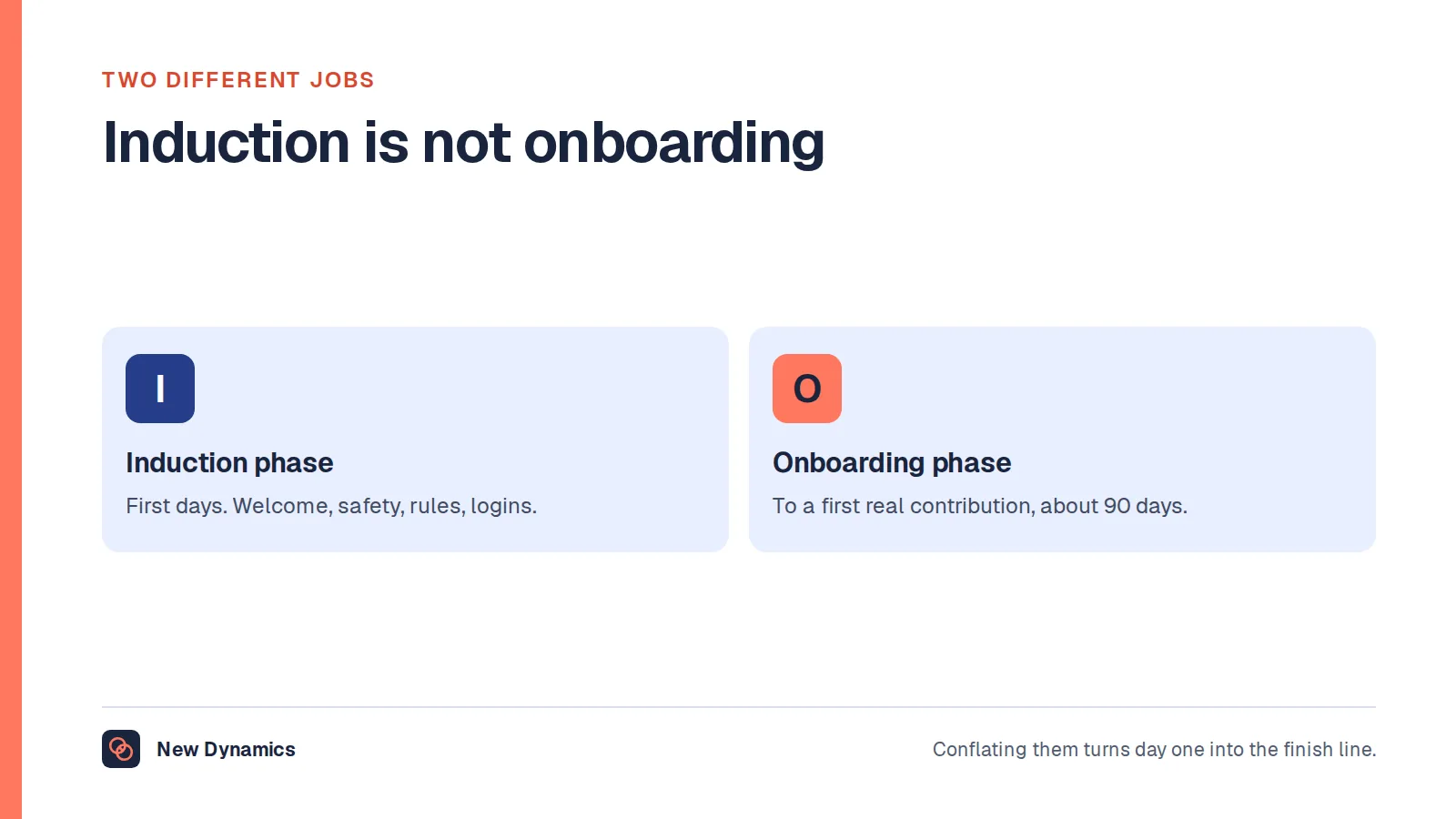
Induction training
Induction is where the general law is unambiguous. Regulation 13(2)(a) requires adequate health and safety training "on their being recruited into the employer's undertaking", and HSE is specific about the content: "new recruits need basic induction training into how to work safely, including arrangements for first aid, fire and evacuation". Article 21(1)(a) of the fire safety order requires it "at the time when they are first employed".
So the fire and evacuation briefing cannot wait for the next quarterly course. Everything else on a typical induction agenda is the employer's choice. Our employee onboarding checklist separates the two, and our post on the training plan covers writing an objective someone can verify.
Frequently asked questions
What training is mandatory for all UK employers?
Health and safety training, and in general terms nothing else. Section 2(2)(c) of the Health and Safety at Work etc. Act 1974 requires "information, instruction, training and supervision as is necessary to ensure, so far as is reasonably practicable, the health and safety at work of his employees", and regulation 13 of the Management of Health and Safety at Work Regulations 1999 sets out when it must be provided. Everything else on a typical list comes from a sector rule, a contract, an insurer or the employer's own judgement.
Who pays for mandatory training?
The employer. HSE states that "You must provide training during working hours and not at the expense of your employees". Where an employer charges for training it requires, GOV.UK's minimum wage guidance says "any charge made ... will always reduce a worker's pay for minimum wage purposes", which covers examination and assessment costs and applies even when the deduction comes out of final pay on leaving.
Is mandatory training paid?
Yes, where the employer requires it. Regulation 33 of the National Minimum Wage Regulations 2015 treats hours spent training as hours of time work when the worker would otherwise be doing time work, and regulation 13(3)(c) of the 1999 Regulations requires health and safety training to "take place during working hours".
Can my employer make me do mandatory training outside working hours?
Not for health and safety training. Regulation 13(3)(c) of the Management of Health and Safety at Work Regulations 1999 requires it to "take place during working hours", and article 21(2)(e) of the Regulatory Reform (Fire Safety) Order 2005 says the same for fire safety training in England and Wales. Other required training falling outside normal hours still counts as working time under the Working Time Regulations 1998 and as paid hours for minimum wage purposes.
How often does mandatory training need to be repeated?
No official source we could open sets a general interval. Regulation 13(3)(a) requires only that training be "repeated periodically where appropriate" and adapted to new or changed risks. HSE answers it directly for first aid: asked whether annual refresher training is a mandatory requirement, it says "No", while strongly recommending it. Set intervals from your own risk assessment and any sector requirement, and record which of the two each date comes from.
Your next step
- Write the named rule beside every line on your current mandatory training list. Delete nothing yet.
- Mark each line you cannot trace to a rule, a risk assessment finding, a contract or a sector requirement. Those are policy choices, and should be labelled as such.
- Check each remaining interval against its source, and replace "annual, required by law" with the real reason for the date.
- Confirm required training is scheduled in working hours and paid, and that nothing is recovered from pay in a way that touches the minimum wage.
- Fix induction first: fire, evacuation and first aid arrangements on day one, recorded against the person.
Not sure which capabilities deserve a line at all? Read and download our skills gap analysis guide. The guide is free to read, and the PDF uses our short download form.
Want the requirement, the verification and the next due date held against the person alongside their goals and reviews, rather than in a spreadsheet nobody reconciles? Book a New Dynamics demo and bring your current matrix. You can also email contact@new-dynamics.com.