TL;DR
- An apprenticeship needs two separate documents. The apprenticeship agreement is signed by the employer and the apprentice. The training plan is signed by the employer, the apprentice and the training provider. The 2026 to 2027 funding rules require them to be separate documents, and an incomplete or unsigned agreement means no funding.
- Off the job training is no longer a percentage. For starts from 1 August 2025, each apprenticeship standard publishes its own minimum volume of hours, the link to duration is gone, and the funding rules state that no programme must fall below 187 hours of evidenced delivery.
- Section A5 of the Apprenticeships, Skills, Children and Learning Act 2009 treats an approved English apprenticeship agreement as a contract of service and not a contract of apprenticeship. That is the provision that makes an apprentice dismissal work like any other dismissal in England. This is general information and not legal advice.
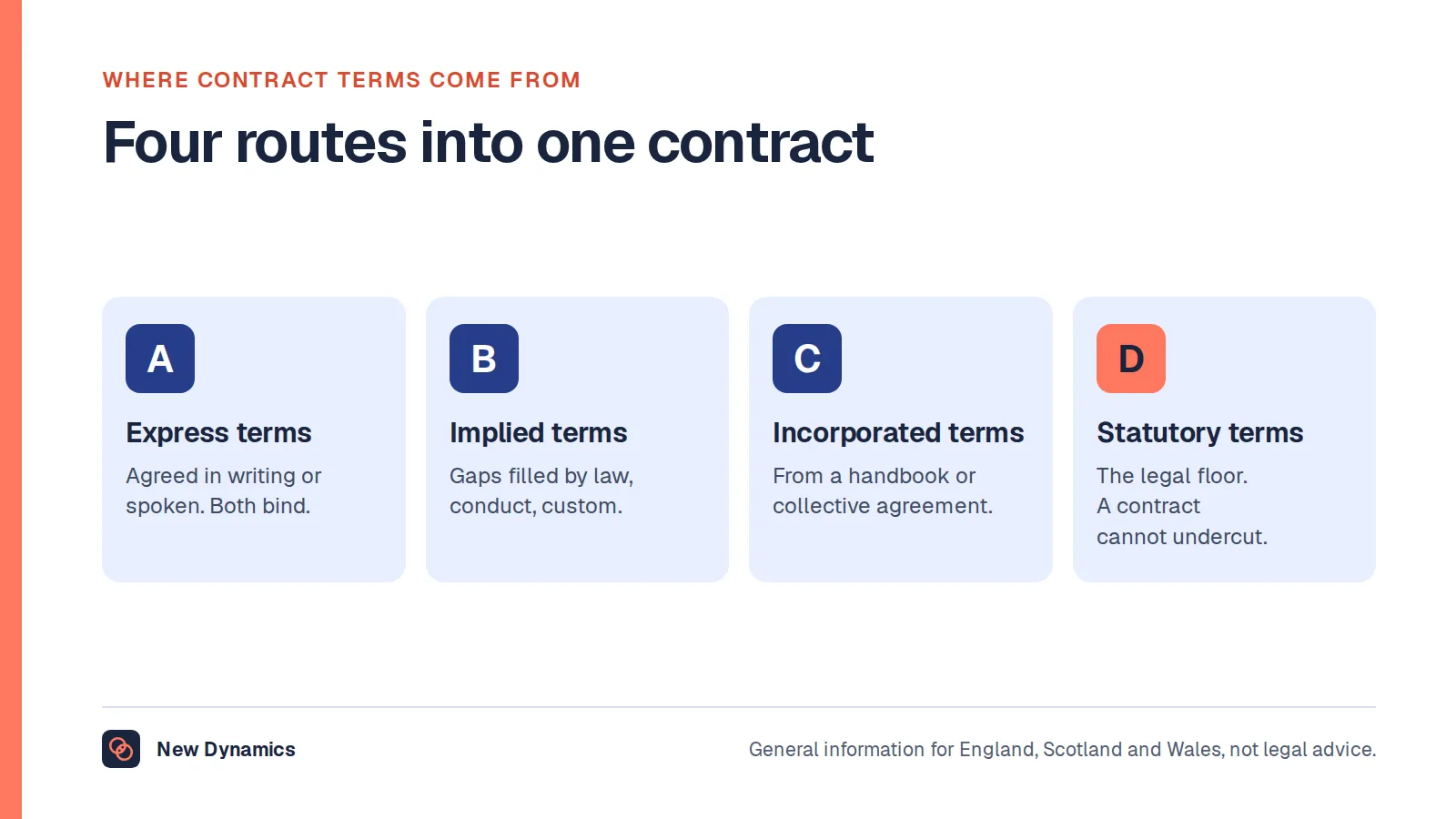
An apprenticeship runs on two documents, and employers routinely produce only one. The apprenticeship agreement is between the employer and the apprentice. The training plan is between the employer, the apprentice and the training provider. Get either wrong and the training funding stops. Write the agreement as a traditional contract of apprenticeship and ending it early can cost considerably more than an ordinary dismissal.
Most of what goes wrong is record keeping rather than law. See how New Dynamics onboarding holds a new starter's checklist, owner and completion dates in one place, which is the same shape of evidence an apprenticeship needs for three years.
This article covers the employment relationship: what an apprenticeship agreement is in statute, what it must contain, why its legal status matters for dismissal, what the training plan must cover, the current off the job training rule, the minimum duration, the apprentice rate of the National Minimum Wage, and what happens when an apprenticeship ends early. For the tax that pays for the training, the pay bill, the allowance and the funding account, see our separate post on the apprenticeship levy. Apprenticeship policy is devolved, so unless a section says otherwise, the rules below are the rules for England. This is general information and not legal advice.
What an apprenticeship agreement is, in statute
The operative definition is in section A1 of the Apprenticeships, Skills, Children and Learning Act 2009, inserted by the Deregulation Act 2015. Subsection (3) says an approved English apprenticeship agreement is an agreement which:
- "provides for a person ('the apprentice') to work for another person for reward in an occupation for which a standard has been published under section ZA11",
- "provides for the apprentice to receive training in order to assist the apprentice to achieve the published standard in the work done under the agreement", and
- "satisfies any other conditions specified in regulations made by the Secretary of State".
That is the whole statutory core: paid work in an occupation with a published standard, plus training towards that standard. Everything else sits in regulations and in the funding rules.
Two points catch people out. First, an older and differently worded provision still exists. Section 32 defines an "apprenticeship agreement" tied to a qualifying apprenticeship framework, and requires the agreement to be in a prescribed form, to state that it is governed by the law of England and Wales, and to state the framework it is entered into for. The English limb of that definition was removed in 2015, so section 32 now bites on "a recognised Welsh framework". Its prescribed form, under regulation 2 of the Apprenticeships (Form of Apprenticeship Agreement) Regulations 2012, is a section 1 written statement of particulars or a contract of employment or letter of engagement, and the agreement "must include a statement of the skill, trade or occupation for which the apprentice is being trained under the apprenticeship framework". If you are reading an old template that mentions frameworks and the law of England and Wales, that is where it came from.
Second, calling something an apprenticeship when it is not one is a criminal offence. Section A11 makes it an offence, in the course of business, to describe a course or training undertaken wholly or partly in England as an apprenticeship when it is not a statutory apprenticeship, enforced by local weights and measures authorities. There is a carve out where the training is provided under a contract of employment between the individual and the provider, so an in house scheme for your own staff is not caught, but an "apprenticeship" sold to the public is.
What the apprenticeship agreement must contain
Statute sets the character of the agreement. The funding rules set the content. Paragraph 72 of the apprenticeship funding rules for 2026 to 2027, which apply to apprenticeships starting between 1 August 2026 and 31 July 2027, is blunt about the consequence: "If the apprenticeship agreement is incomplete, or not signed, the individual will not have a valid agreement and the provider will therefore not be eligible to receive funding for them."

The agreement must include the apprentice's name and place of work, the apprenticeship standard and level, the start and end date of the apprenticeship including the end-point assessment, the start and end date of the practical period, the duration of the practical period, and the amount of time the apprentice will spend in off the job training.
Three practical rules sit alongside that list. The agreement must run "from the start of and for the actual duration of their apprenticeship", and must be extended if the programme is extended. The employer must give the provider a copy. And paragraph 71.1 prohibits one person signing "as both the apprentice and as the employer (even where a limited company, public services company, a partnership, or limited liability partnership has been created to act as a separate corporate entity)", with the provider required to check there is "a separate, identifiable line manager who is undertaking the role of the 'employer'". A director cannot apprentice themselves.
A free apprenticeship agreement template is published on GOV.UK, last updated 4 August 2026 and marked "Applies to England". Its own summary is one sentence: "An apprenticeship agreement must be signed at the start of the apprenticeship. It is used to confirm individual employment arrangements between the apprentice and the employer." Note that responsibility for this guidance moved to the Department for Work and Pensions on 1 April 2026, so the department named on the page is no longer the one you may expect.
The agreement is not a substitute for a contract of employment, and GOV.UK lists them as separate employer duties: "giving your apprentice their contract of employment", "paying your apprentice's wage" and "signing an apprenticeship agreement". In practice the written statement of particulars usually does double duty, which is exactly what the 2012 regulations contemplated. For the terms that belong in the contract itself, see our post on the employment contract.
Why it is a contract of service, not a contract of apprenticeship
This is the part that changes money when things go wrong, and it is one short section.
Section A5 says that "To the extent that it would otherwise be treated as being a contract of apprenticeship, an approved English apprenticeship agreement is to be treated as not being a contract of apprenticeship", and that "To the extent that it would not otherwise be treated as being a contract of service, an approved English apprenticeship agreement is to be treated as being a contract of service." Subsection (3) applies that "for the purposes of any enactment or rule of law". Section 35 does the same for the older framework agreements.
The explanatory notes to the Act put the purpose plainly. On section 35 they say the provision means an apprenticeship agreement "is not to be treated, for common law or statutory purposes, as being a contract of apprenticeship (as recognised at common law) but is instead to be treated as being a contract of service".
Why that matters: a common law contract of apprenticeship is primarily a contract to train, and the courts have long treated it as much harder to terminate early than an ordinary employment contract. Acas describes the live version of that problem in its guidance for apprentices. In England and Wales, employers "can usually dismiss apprentices before the end of the fixed term", provided they "have a clause in the apprenticeship agreement that allows for it to be ended early" and "follow a fair procedure". Where there is no such clause, "dismissing an apprentice before the fixed term ends could breach the contract" and the apprentice "could claim compensation".
In Scotland the position is different, because traditional apprenticeship contracts are still common there. Acas states that a Scottish employer "can only dismiss an apprentice for serious conduct or capability issues", cannot dismiss for general misconduct, and can only make an apprentice redundant if "the organisation is closing down" or "there is a major change in the organisation", with a contractual clause permitting it. Compensation for getting it wrong "could include loss of training, loss of wages, impact on future earnings".
So the drafting lesson is the same in both jurisdictions and it is a one line fix: if your agreement has no early termination clause, you have reintroduced the old risk by accident.
The training plan, and why the commitment statement has gone
The commitment statement was the old name. The 2026 to 2027 funding rules do not use the phrase at all. The document is now the training plan, and paragraph 99.4 is explicit that "The training plan and apprenticeship agreement must be separate documents", because "the provider is not a signatory to the apprenticeship agreement but they are a signatory to the training plan".
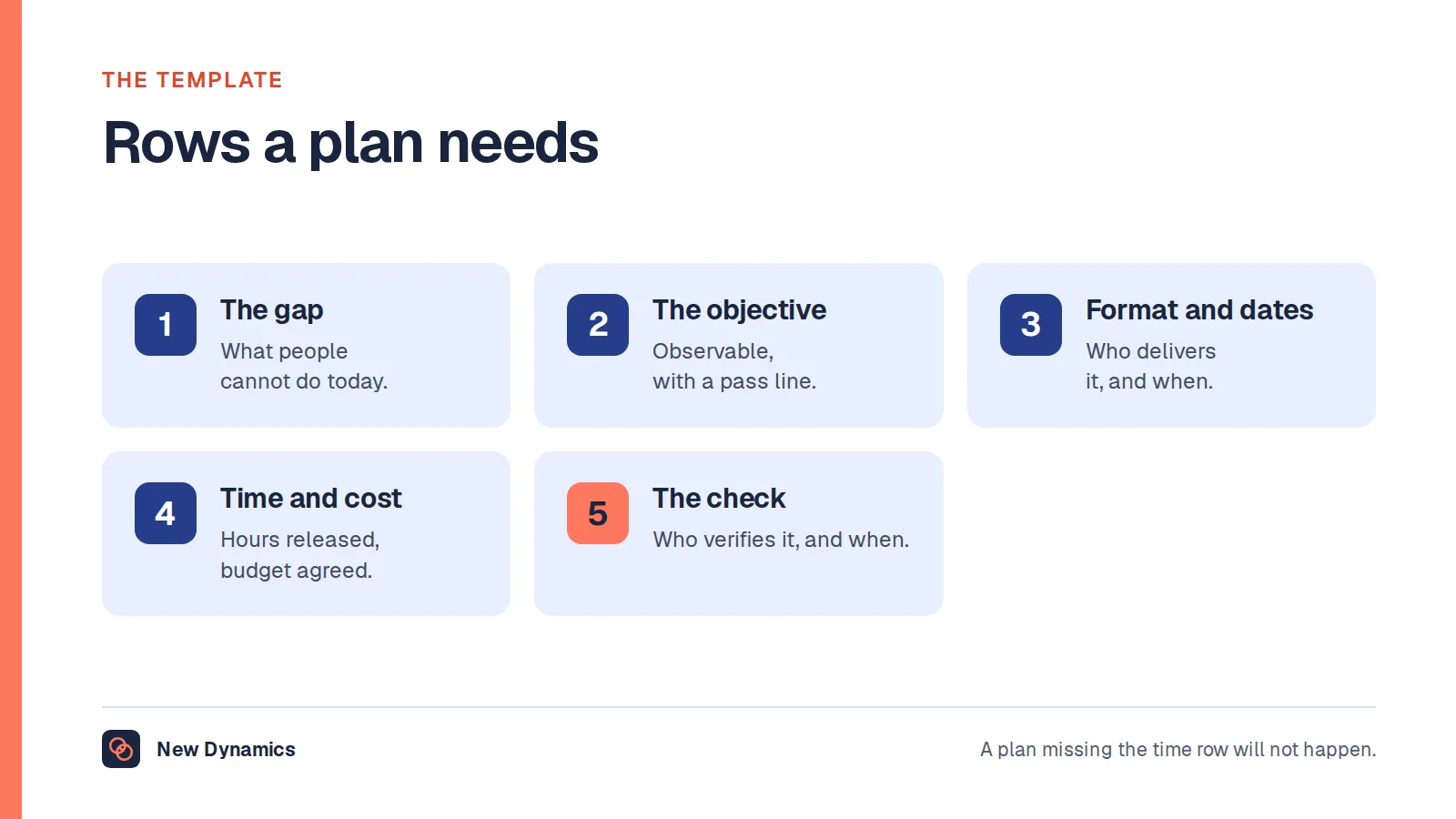
Paragraph 99 makes the provider responsible for developing and agreeing the plan with the apprentice and the employer, who "must be given the opportunity to contribute". The broad content must be agreed before any training is delivered, and where that initial agreement is by email the fully signed plan must be in place "by the end of the 42 day 'qualifying day' period".
Paragraph 100 lists what the plan must include. The parts an employer should read before signing are these:
- the apprentice's name, job role and normal working hours, meaning paid hours each week excluding overtime,
- the total volume of planned off the job training hours,
- a brief description of the delivery model, for example day release, block release or front loaded,
- details of when content will be delivered and who is responsible for each component,
- "Written confirmation from the employer that the apprentice will be allowed to undertake off-the-job training within their normal working hours, in addition to English and maths standalone qualifications if required", and
- the process for resolving queries or complaints, including the escalation route.
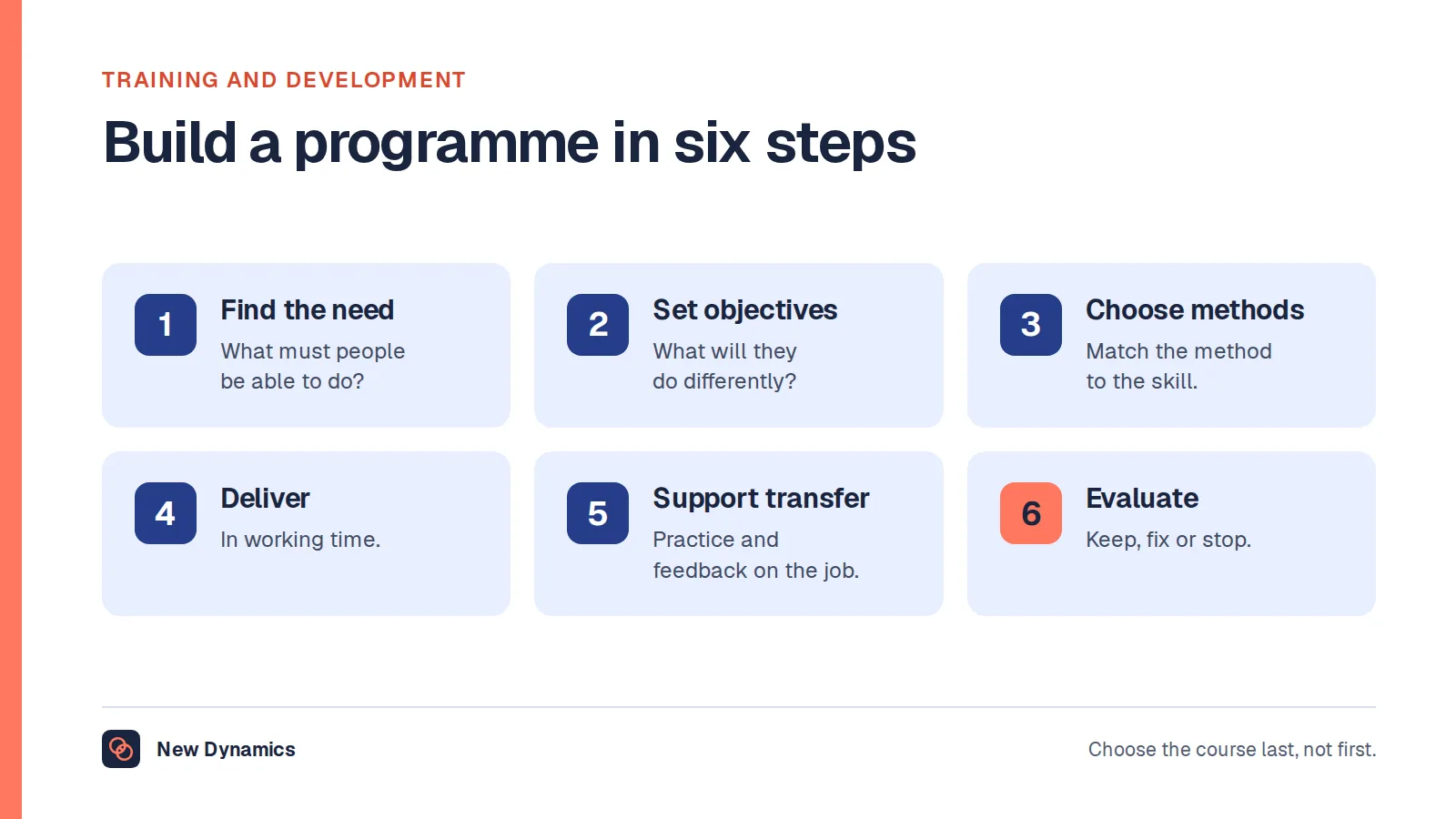
That penultimate item is a commitment of release time, in writing, signed by you. Treat the plan as a resourcing decision rather than paperwork. Progress reviews are also fixed: paragraph 102 requires them "at least every 3 calendar months", and where an alternative frequency is agreed in advance, reviews "must be no more than 6 months apart". For the wider discipline this belongs to, see our post on writing a training plan.
Off the job training: the rule is hours now, not a percentage
If you remember one number from the old regime, forget it. The 20 per cent rule is not the current rule.
The statutory requirement is thin and sits in regulation 3 of the Apprenticeships (Miscellaneous Provisions) Regulations 2017: it is a condition of an approved English apprenticeship "that the apprentice is to receive off-the-job training", and "Each approved English apprenticeship agreement must specify the amount of time the apprentice is to receive off-the-job training during the period of the agreement". The regulation defines off the job training as training which is not on-the-job training and is received "during the apprentice's normal working hours, for the purpose of achieving the published standard", with on-the-job training defined as training received "for the sole purpose of enabling the apprentice to perform the work".
The quantity comes from the funding rules. GOV.UK's off the job training guidance, updated 4 August 2026, sets out three changes for starts from 1 August 2025:
- "a minimum volume of off-the-job training hours has been published for each apprenticeship standard, which replaces the need for the provider to calculate the minimum requirement based on a percentage of the apprentice's duration",
- "the delivery link between off-the-job training and duration has been removed, giving providers the flexibility to deliver the required training hours over any duration, subject to meeting the minimum duration requirement of 8 months", and
- providers "no longer need to automatically extend the duration for part-time apprentices".
Paragraph 86.2 of the funding rules sets the floor: "No programme must fall below 187 hours of evidenced delivery." Prior learning can reduce the published figure for an individual, but not below that baseline. For context, the old policy produced 278 hours for a 12 month apprenticeship, and the guidance explains that carrying the percentage forward onto an 8 month minimum "would have lowered the minimum threshold from 278 hours to 187 hours", which was rejected because "the content and funding of the standard were not changing".
Two exclusions are worth knowing. English and maths standalone qualifications do not count towards the off the job hours and must be delivered in addition to them. And training outside normal working hours does not count: if it has to happen by exception, "the apprentice must agree and be compensated (e.g. time off in lieu or an additional payment)", and "The majority of the training must not be delivered in this way".
Where two official pages disagree
Acas's guidance for apprentices, last updated 11 June 2026, still says that "An apprentice should be learning or training for at least 20% of their normal working hours". The Department for Education's own guidance and the 2026 to 2027 funding rules no longer express the requirement as a percentage at all. Both pages are official. For funded apprenticeships in England the funding rules govern, because they are the conditions attached to the money and they are what a funding audit tests. Read the Acas figure as a rule of thumb about release time rather than the compliance test, and get the published hours for your standard from the standard itself.

Minimum duration, and the 30 hour assumption
The minimum duration changed recently, and the change is in the legislation, not just the guidance. Regulation 5(1) of the 2017 Regulations now reads "the practical period must not be less than 8 months". The figure was substituted for 12 months on 1 August 2025 by the Apprenticeships (Miscellaneous Provisions) (England) (Amendment) Regulations 2025.
Paragraph 77 of the funding rules works the same rule as a date: an apprentice who starts training on 1 August 2026 "must still be receiving training on 31 March 2027". The end-point assessment "can only be taken after the minimum duration has been met", so the duration is a gate on completion, not just a planning figure.
The eight months rests on an assumption that is easy to miss. Paragraph 77.3 says "The minimum duration of each apprenticeship is based on the apprentice working at least 30 hours per week, including any off-the-job training they undertake", and adds that working fewer than 30 hours or holding a zero hours contract "must not be a barrier to successfully completing an apprenticeship". Below 30 hours the provider must set a realistic longer duration with you. GOV.UK's employer guidance gives the honest range: "Apprenticeships can take from 8 months to 6 years to complete, depending on the type and level of the apprenticeship."
The apprentice rate of the National Minimum Wage
The apprentice rate is the most commonly overpaid and underpaid figure in this whole area, because it has an age test and a year test.
GOV.UK's National Minimum Wage rates give the apprentice rate as £8 an hour from April 2026, alongside £12.71 for 21 and over, £10.85 for 18 to 20 and £8 for under 18. The rates change on 1 April each year, and the published table shows £8.31 from April 2027.
Who gets it: apprentices are entitled to the apprentice rate if they are "aged under 19" or "aged 19 or over and in the first year of their apprenticeship". They move to the rate for their age when they are both "aged 19 or over" and have "completed the first year of their apprenticeship". GOV.UK's own example is the one to keep: "An apprentice aged 21 in the first year of their apprenticeship is entitled to a minimum hourly rate of £8", and the same apprentice after the first year is entitled to £12.71.
Two timing rules come from the funding rules rather than the wage rules. Paragraph 75.1 says the employer "must only use the apprentice rate of the national minimum wage from the apprenticeship start date and not before", so there is no apprentice rate for a candidate who is working but has not yet started the apprenticeship. Paragraph 75.2 says that where someone permanently withdraws and is no longer an apprentice, "the employer must not continue to use the apprentice rate", though a break in learning is different. And the enforcement is now sharp: if a provider is told the apprentice is not being paid in line with the National Minimum Wage Regulations, "they must withdraw the learner from the programme".
Paid time is wider than many employers assume. Acas states that employers must pay apprentices for any time spent on work related learning or training, "including learning or training outside their normal working hours or away from their usual workplace". Acas also notes that time spent on work related learning counts as working hours for working time purposes, and that apprentices continue to accrue holiday for time spent training.
If the apprenticeship ends early
Start from the employment position. GOV.UK states that "Apprentices have the same employment rights as your other employees", that you should follow the ordinary redundancy process for an apprentice, and, for anything else, "Get legal advice if you want to end the apprenticeship early for another reason". Acas adds that where an apprentice is simply not offered a job at the end of a fixed term, "this is classed as a dismissal" and a fair procedure applies. Our post on fixed-term contracts covers that mechanism.
The training side has its own rules, and they turn on how far through the apprentice was on the day of dismissal. Where the agreement is terminated by reason of redundancy and the apprentice is within six months of the final day of the practical period, or has completed at least 75 per cent of it, paragraph 312 of the funding rules allows the training to continue without an apprenticeship agreement and the government "will fund 100% of the remaining costs of the total price, up to the funding band maximum". Where less than 75 per cent is complete and six months or more of training remains, paragraph 314 funds "the remaining costs of the price previously negotiated for up to 12 weeks, while the apprentice seeks a new employer". In both cases the provider must record the change, stop payments from the apprenticeship service account on the termination date, and make reasonable efforts to find a new employer.
Redundancy also has an effect on the clock. Regulation 5(2) of the 2017 Regulations lets a new agreement keep the old final day where the previous agreement was terminated by reason of redundancy less than eight months before it, and the new agreement is for the same published standard. Without that, the eight month minimum would start again.
Scale, and why the paperwork volume is the real problem
This is not a niche document. The Department for Education's apprenticeships statistics release of 16 July 2026 reports that for the first three quarters of the 2025/26 academic year in England, August 2025 to April 2026, "Apprenticeship starts increased by 8.7% to 308,770 compared to 284,190 reported for the previous year", with participation of 735,500 and achievements of 146,210. Those figures are provisional. For the wider picture on pay, training and employment, see the statistics hub.
Every one of those starts needs a signed agreement, a signed training plan, a progress review at least every three months, and an agreed set of hours that match across the agreement, the plan and the provider's return. That is a records problem long before it is a legal one.
Frequently asked questions
What is an apprenticeship agreement?
It is the contract between an employer and an apprentice for an apprenticeship. Section A1(3) of the Apprenticeships, Skills, Children and Learning Act 2009 defines it as an agreement for the apprentice to work for another person for reward in an occupation for which a standard has been published, and to receive training to help them achieve that standard. The 2026 to 2027 funding rules require it to be signed by the employer and the apprentice at the start, and an incomplete or unsigned agreement means the training cannot be funded. General information for England, not legal advice.
What must an apprenticeship agreement contain?
Paragraph 72 of the apprenticeship funding rules for 2026 to 2027 lists the apprentice's name and place of work, the apprenticeship standard and level, the start and end date of the apprenticeship including the end-point assessment, the start and end date of the practical period, the duration of the practical period, and the amount of time the apprentice will spend in off the job training. One person cannot sign as both the apprentice and the employer.
Is an apprenticeship agreement the same as a training plan?
No, and the funding rules require them to be separate documents. The apprenticeship agreement is signed by the employer and the apprentice. The training plan is signed by the employer, the apprentice and the training provider, and sets out the planned content, schedule and hours, what each party offers, and how complaints are resolved. The training plan replaced what used to be called the commitment statement.
How much off the job training must an apprentice get?
For starts from 1 August 2025 it is a volume of hours published on each apprenticeship standard, not a percentage of working hours. Paragraph 86.2 of the 2026 to 2027 funding rules states that no programme must fall below 187 hours of evidenced delivery. Prior learning can reduce the published figure but not below that floor. Standalone English and maths qualifications must be delivered in addition to those hours. Acas still describes the requirement as 20 per cent of normal working hours, which was the policy to 31 July 2025.
What is the minimum length of an apprenticeship?
Regulation 5(1) of the Apprenticeships (Miscellaneous Provisions) Regulations 2017 says the practical period must not be less than eight months, reduced from 12 months on 1 August 2025. The end-point assessment can only be taken once the minimum duration is met, and the figure assumes the apprentice works at least 30 hours a week including off the job training. GOV.UK says apprenticeships take from 8 months to 6 years overall.
What is the apprentice minimum wage, and when does it stop?
GOV.UK gives the apprentice rate as £8 an hour from April 2026. It applies to apprentices aged under 19, and to apprentices aged 19 or over who are in the first year of their apprenticeship. Once an apprentice is 19 or over and has completed the first year, they move to the National Minimum Wage or National Living Wage for their age, which is £12.71 for 21 and over from April 2026. The apprentice rate cannot be used before the apprenticeship start date.
Can you dismiss an apprentice?
In England and Wales, yes, on the same basis as any other employee, because section A5 of the 2009 Act treats an approved English apprenticeship agreement as a contract of service and not a contract of apprenticeship. Acas says an employer can usually dismiss before the end of the fixed term provided the agreement contains a clause allowing early termination and a fair procedure is followed. Without that clause, early dismissal could breach the contract. Scotland is stricter. GOV.UK advises getting legal advice before ending an apprenticeship early for a reason other than redundancy.
Your next step: five checks on the agreement you already use
- Read your template against paragraph 72. Does it name the standard and level, both sets of dates, the practical period duration and the off the job hours? Missing fields are a funding risk, not a drafting preference.
- Find the early termination clause. If there is not one, that is the single highest value edit on this list, and it is the clause Acas points at.
- Check who signed what. The provider must be on the training plan and must not be on the agreement, and no individual may appear as both employer and apprentice.
- Reconcile the hours. The off the job figure should be the same number on the agreement, the training plan and the provider's return, and it should be the published figure for that standard rather than a percentage.
- Diary the reviews. At least every three calendar months, and never more than six months apart. Put the owner's name on each one.
Before you vary an agreement, read section A6. If a variation would stop the agreement being an approved English apprenticeship agreement, you must give the apprentice written notice explaining that first, and a variation made without it "has no effect".
For the structure a programme like this sits inside, read and download our career development guide. The guide is free to read, and the PDF uses our short download form.
Want signed agreements, review dates and release time to be a record you can produce rather than a search through inboxes? Book a New Dynamics demo and bring your current apprenticeship paperwork. You can also email contact@new-dynamics.com.