TL;DR
- Microlearning is one objective taught in a few minutes and then deliberately revisited. A long course cut into ten-minute videos is not microlearning, it is a long course with more loading screens.
- Two of its foundations are genuinely well evidenced. A US Department of Education practice guide rates spacing learning over time as moderate evidence and using quizzes to re-expose people to content as strong evidence. The popular claims about eight-second attention spans and learning styles are not evidence we could stand behind.
- It suits procedure, refreshers, tool training and an onboarding drip. It is wrong for judgement and difficult conversations. Measure the behaviour at work, not the completion rate, and give the manager something specific to look for.
Somebody in your organisation has suggested microlearning. Possibly because a long compliance course is being skipped, possibly because an induction takes a fortnight nobody has, possibly because a system changes next month and four hundred people need to know one new screen.
That instinct is often right. What usually happens next is not. An existing hour-long course gets cut into six ten-minute videos, the completion report looks healthier, and nothing anybody does at work changes.
This article explains what microlearning actually is, where the idea comes from, which of its popular claims survive contact with a source, the formats that work in a workplace, what it suits and what it is wrong for, how to build a sequence that uses spacing and retrieval, how to measure whether behaviour changed, and what the manager has to do for any of it to stick. It names no products and ranks no platforms.
Short lessons only change anything when somebody is expected to use them. See how New Dynamics onboarding sequences what a new starter has to learn in their first weeks, so the learning arrives attached to the work rather than as a library to get through.
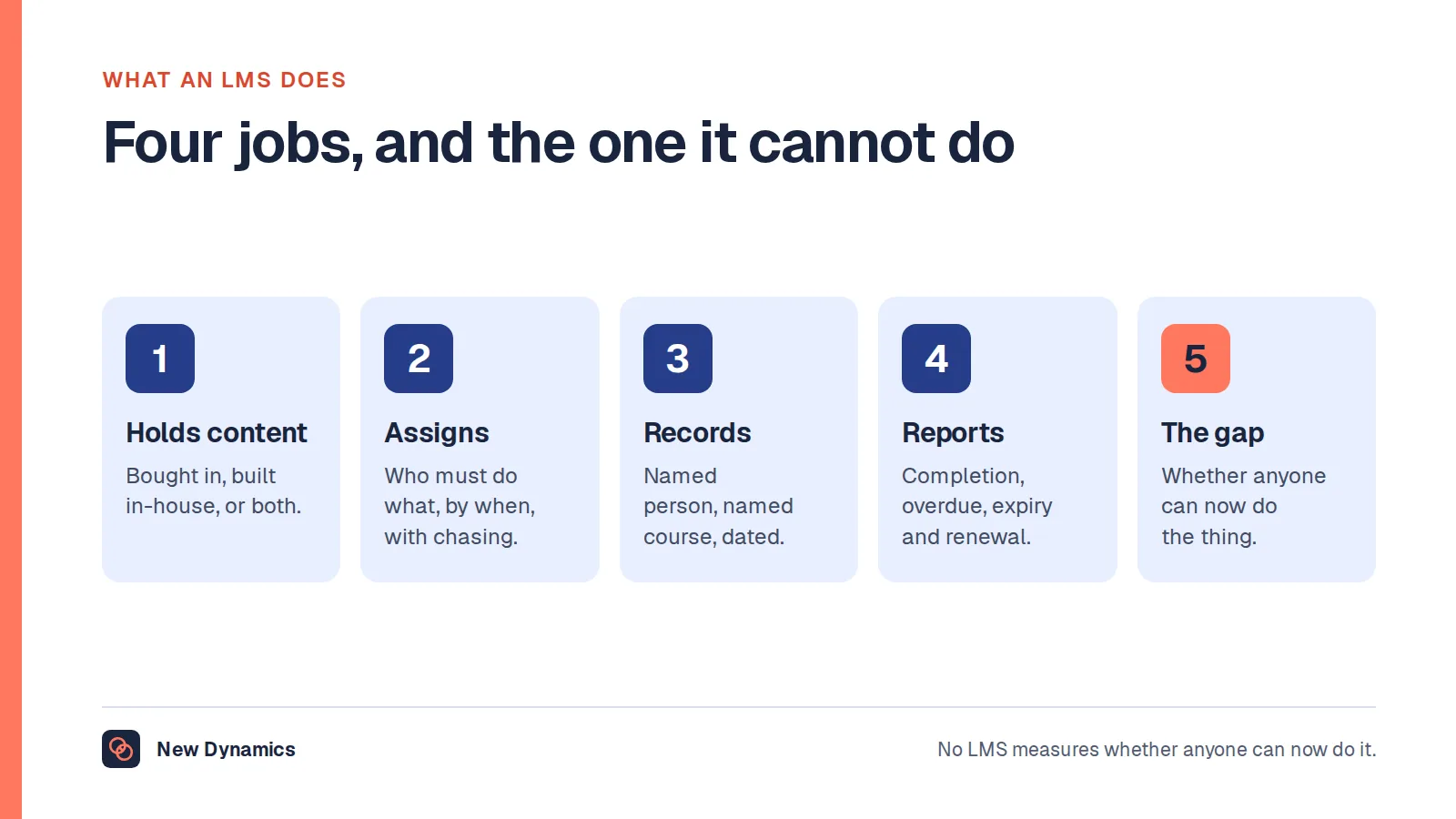
New Dynamics is a performance management platform for goals, feedback, recognition, reviews and onboarding. It is not a learning management system, and it does not host courses. If you need the system that holds and tracks content, our post on learning management system software covers that question separately.
What microlearning is, and what it is not

Microlearning is a design decision, not a duration. The defining feature is that one short piece of learning serves one objective, and that the objective is small enough to be stated as something a person will do differently.
In practice a microlearning item has four properties:
- One objective. Not a topic. "Log a near miss before you leave site" is an objective. "Health and safety awareness" is a topic.
- Short enough to finish in one sitting, which in most workplaces means two to six minutes, including whatever the person has to do at the end of it.
- Standalone. It makes sense on its own, in any order, which is what lets you re-send it six weeks later without re-sending the whole course.
- Part of a schedule. A single short item is a leaflet. Microlearning is a sequence of short items spaced across time, which is where the useful part lives.
That fourth property is the one that gets dropped, and it is the one carrying most of the evidence. Four things wear the label and should not.
- A chopped-up course. If the six parts have to be taken in order, in one week, with a single test at the end, you have a course with chapter breaks. Nothing about the learning has changed except the progress bar.
- A video library. Content that exists but is not assigned, scheduled or revisited is a resource, which is fine, but it is not a programme and it will not produce a change you can point at.
- A length rule. There is no evidence-based optimal number of minutes, and a precise figure quoted to you is marketing rather than a finding. Short is a consequence of one objective, not a target in itself.
- A substitute for practice. A four-minute module can tell you what a good question sounds like. It cannot hear you ask one badly and tell you why.
The phrase bite sized learning usually means the same thing as microlearning, though it is more often used to describe the content and less often the schedule. Micro learning written as two words is the same idea again. The labels matter less than whether a schedule exists.
Where the idea comes from, and what the evidence supports
Microlearning as a product category is recent. The learning science it borrows from is not, and the two should be kept apart, because the category makes claims the science does not. The useful parts come from two findings in memory research that have been replicated many times.
The first is spacing: the same total study time produces more durable memory when it is spread across separate occasions than when it is massed into one. The second is retrieval practice: being made to recall something, rather than being shown it again, is what strengthens the memory. The Noba open psychology textbook chapter on memory encoding, storage and retrieval, written by Kathleen McDermott and Henry Roediger, puts the second one plainly: "the act of retrieval itself (of a fact, concept, or event) makes the retrieved memory much more likely to be retrieved again, a phenomenon called the testing effect or the retrieval practice effect".
Neither finding is about short content. Both are about when and how content comes back. That distinction is the whole argument of this article: microlearning works to the extent that it is a delivery mechanism for spacing and retrieval, and fails to the extent that it is just shorter content.
The clearest public summary we could open is the practice guide Organizing Instruction and Study to Improve Student Learning, published in September 2007 by the Institute of Education Sciences at the US Department of Education as NCER 2007-2004, with a panel chaired by Harold Pashler. It is written for teachers rather than employers, and it grades its own recommendations, which is why it is worth quoting.
On spacing, Recommendation 1 says that "To help students remember key facts, concepts, and knowledge, we recommend that teachers arrange for students to be exposed to key course concepts on at least two occasions", "separated by a period of several weeks to several months". The guide rates this as "Level of evidence: Moderate".
It also gives a rule of thumb for the interval, which is unusually practical: students "typically remember much more when they have been exposed to information on two occasions, rather than one, and when the interval between these two occasions is not less than about 5 percent of the interval during which the information has to be retained".
On retrieval, Recommendation 5b says: "We recommend that teachers use closed-book quizzes or tests as one method for re-exposing students to key course content", and adds that "quizzes or tests that require students to actively recall specific information (e.g., questions that use fill-in-the-blank or short-answer formats, as opposed to multiple-choice items) directly promote learning and help students remember information longer". This one the panel rates as "Level of evidence: Strong". It also sets a condition that most workplace quizzes fail: "To use quizzes or tests to promote learning and retention of information, correct-answer feedback should be provided."
So the defensible claim is narrow and still useful. Spacing and retrieval improve how much people remember. Short, standalone items are a convenient vehicle for both, because they are cheap to re-send and cheap to answer.
The claim that short content is itself superior to long content, for the same material and the same total time, is not something we found a source for.
The claims to stop repeating
This field circulates confident numbers with no traceable origin, and repeating them costs you credibility with exactly the audience you need.
Attention spans
The claim that human attention spans have fallen to eight seconds, or that adults can concentrate for only ten or twenty minutes, is very widely quoted in training material. We could not find a primary source for it. There is no published study we were able to open that establishes an eight-second figure, and the ten or twenty minute concentration limit is usually presented without any citation at all. Treat it as folklore. You do not need it: the case for microlearning rests on spacing and retrieval, which are properly evidenced, not on a claim about attention that nobody can source.
Learning styles
Designing short modules around visual, auditory or kinaesthetic learners is not supported. The review commissioned by Psychological Science in the Public Interest, Learning Styles: Concepts and Evidence by Pashler, McDaniel, Rohrer and Bjork (volume 9, number 3, 2008), concluded: "there is no adequate evidence base to justify incorporating learning-styles assessments into general educational practice." The same review states: "the widespread use of learning-style measures in educational settings is unwise and a wasteful use of limited resources."
Use a video where a video is the clearest way to show something, and text where text is. That is a judgement about the content, not about the person.
Forgetting percentages
Forgetting over time is real and heavily documented in laboratory work, which is precisely why spacing helps. The specific percentages in circulation, the ones that claim a fixed share of a course is lost within twenty-four hours, are another matter. We could not find an official publisher for those figures, and the versions we traced appeared in vendor material. State the point qualitatively instead: people forget things they do not use, and a single exposure is the least durable way to teach anything.
Engagement figures
Any uplift quoted as a round percentage in a platform's own white paper tells you about that platform's marketing. It is not a benchmark and should not appear in your business case.
How much of this is already happening
Short digital training is now the normal case rather than the exception, which matters when you are deciding whether to buy something new or use what you have.
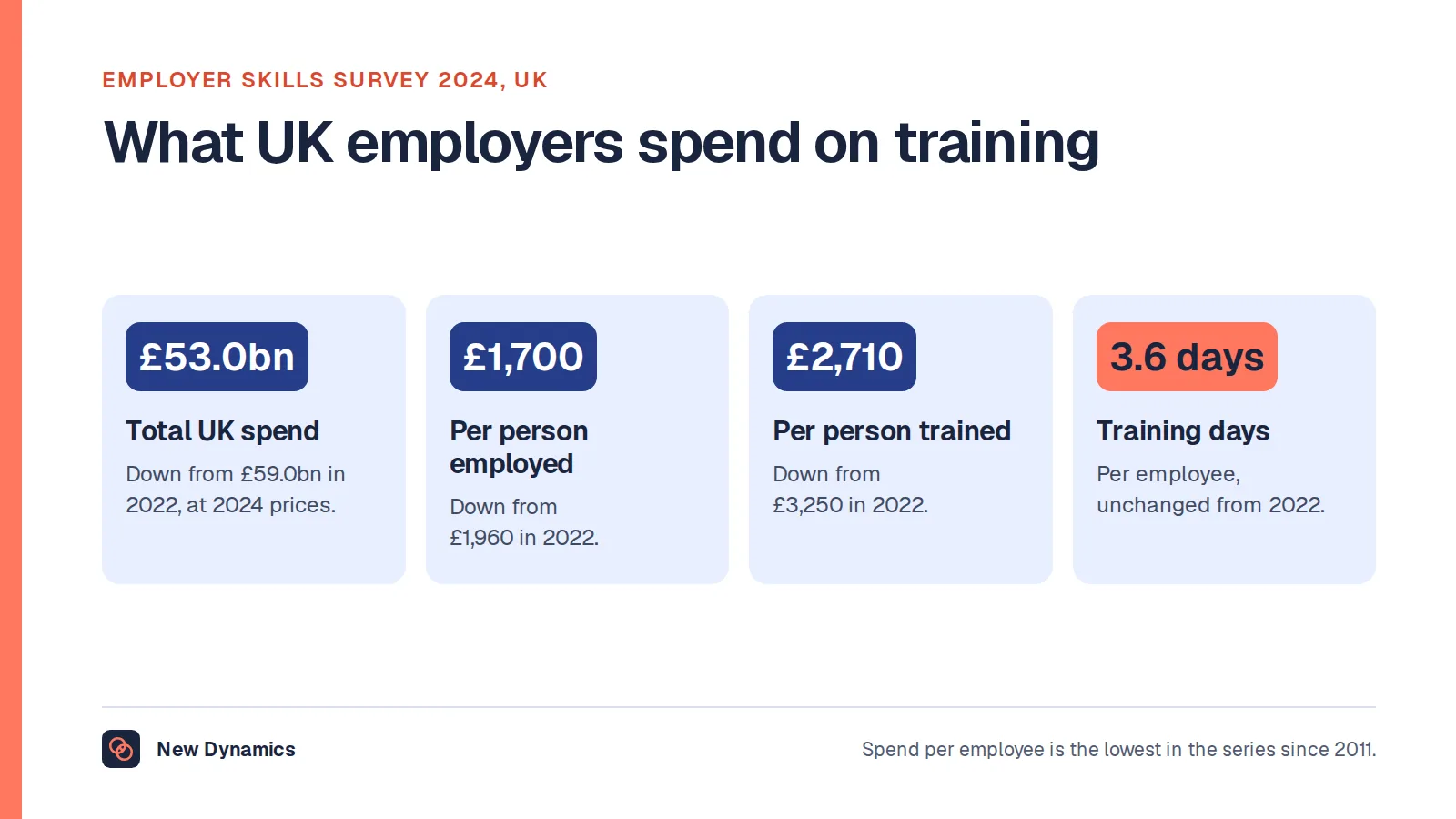
The UK government's Employer Skills Survey 2024, published as official statistics with fieldwork conducted between June 2024 and January 2025, reports that "Seven in ten (70%) employers that provided training had funded or arranged online training or e-learning for their staff in the previous 12 months, up from 67% in 2022 and 51% in 2017". The same release reports that "Just under three-fifths (59%) of employers had provided training for their staff in the last 12 months" and that "Overall, 63% of all employees received training in 2024".
It also records what this costs. "The total UK training expenditure in 2024 was £53.0bn", the release says, and "This equated to a spend of £1,700 per employee, down from £1,960 in 2022". That is the context for a microlearning proposal: most employers already deliver training online, most already spend meaningful money on it, and the per-employee figure is falling. The interesting question is not whether to put training on a screen. It is whether anything you put there comes back a second time.
For the wider picture, see our UK training statistics post and the HR statistics hub.
Microlearning examples that work at work

These are formats, not products. Each one is a few minutes long, serves one objective, and can be re-sent without re-sending anything else.
A single-step procedure correction
A ninety-second clip or a four-line text item covering the one step people get wrong, with the correct way shown once. Good where there is a right answer: the handover note, the tag on the equipment, the field on the form that everyone leaves blank.
A two-question retrieval check
Two short-answer questions on something taught three weeks ago, with the correct answer shown immediately afterwards. This is the format with the strongest evidence behind it, and it is the one organisations skip because it feels like testing people. Say plainly that it is not scored and not reported to anyone, and the objection usually goes away.
A refresher pulse before a known risk
One item, timed. Manual handling before the busy season. Lone working before the clocks change. Phishing before the finance period end. The point is the timing, not the content, and the content can be last year's content.
A tool walkthrough at the moment of use
Three steps, with a screenshot of each, published where the person will be when they need it rather than in a course catalogue. The test of this one is simple: can somebody find it in the thirty seconds before they give up and ask a colleague.
An onboarding drip
Rather than a two-day induction nobody retains, a short item on each of the first fifteen working days, each one about something the new starter will actually do that week. This is the use with the clearest return, because the alternative is not a long course, it is a new starter guessing.
A policy change in one paragraph
What changed, what it means for you, what to do differently, and where the full document sits. Sent once, repeated a month later.
A manager prompt before a conversation
Not training on difficult conversations, which cannot be done this way. One prompt, before a scheduled one-to-one, naming the two questions worth asking. Our post on communication skills training covers what has to happen in the room, which is practice rather than a prompt.
What microlearning suits, and what it is wrong for
The honest split runs along one line: is there a single correct answer or procedure, or does the person have to exercise judgement in a situation that varies.
It suits:
- Procedure, where there is a right way and people are doing it a different way.
- Compliance refreshers, where the content is known and the problem is decay between annual cycles.
- Tool and system training, where the need is specific, immediate and short-lived.
- Safety reminders, where timing matters and the message must be unmistakable.
- Onboarding drip, where the volume of new information is the problem.
- Vocabulary and facts, including product names, codes, thresholds and who to call.
It is wrong for:
- Judgement, which means anything where the right answer depends on circumstances the module cannot describe.
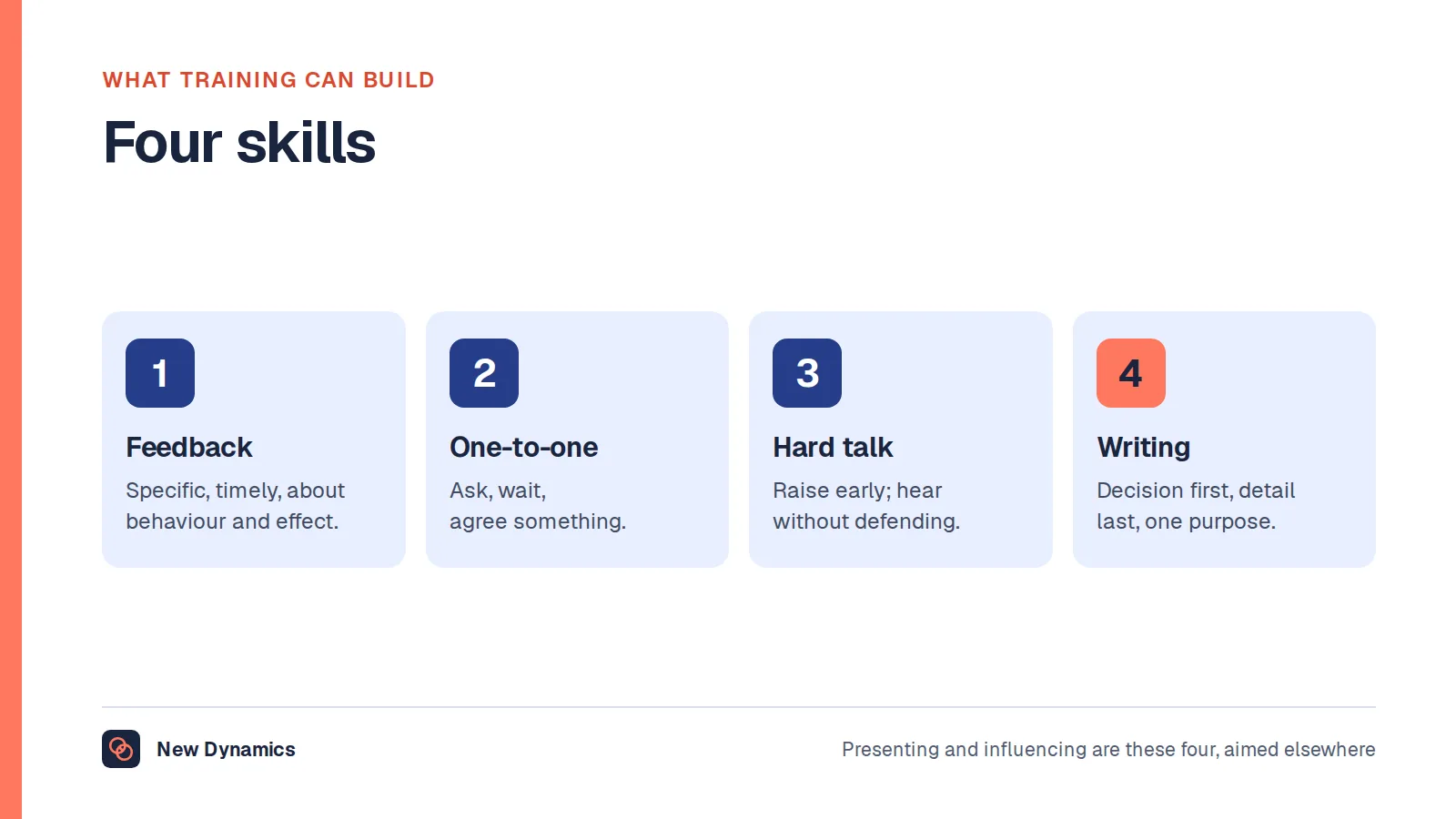
- Difficult conversations, including feedback, performance concerns, grievances and dismissals. These need rehearsal with a person who will interrupt you.
- Anything needing practice with feedback from a person, which includes most management skill, most clinical skill and most craft skill.
- Complex integrated knowledge, where the whole point is how the parts relate, and separating them into standalone items destroys the thing you were teaching.
- Culture and behaviour change, which is produced by what managers do and reward, not by what a module says.
A short module can support the wrong-for list by setting up a conversation or summarising what was agreed. It cannot do the work.
How to build a sequence

This is where a microlearning programme is won or lost, and it takes a planning session rather than a platform.
Name the behaviour first
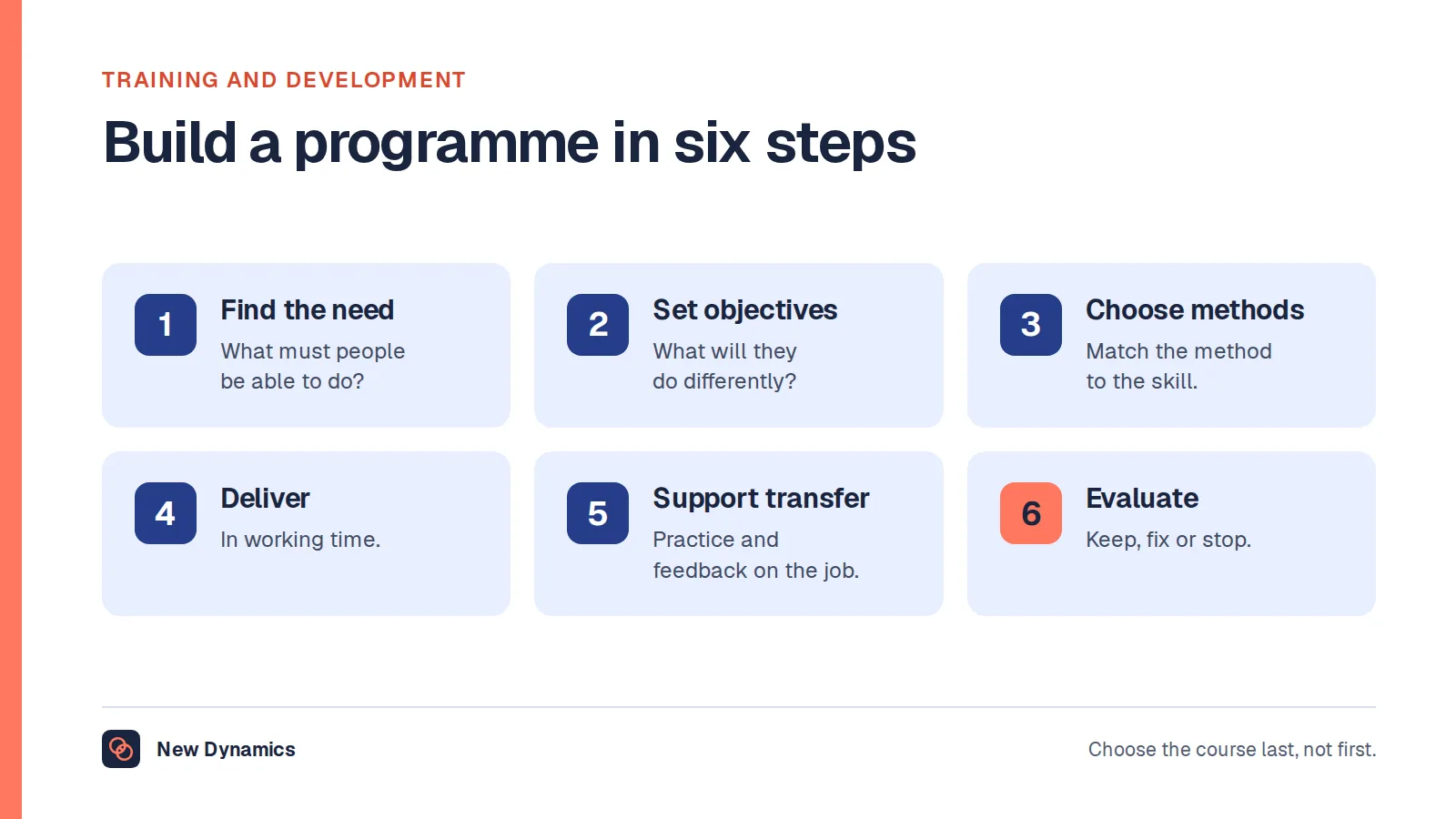
Write the sentence "after this, people will ... " and finish it with something observable. If you cannot finish it, you have a topic rather than an objective, and you should stop before commissioning content.
Teach it once, briefly
One objective, two to six minutes, one thing to do differently at the end. Resist the urge to add context. Context is what turns a four-minute item back into a course.
Space the repeats
Use the practice guide's rule of thumb as a starting point. If you need somebody to still know this in six months, the gap between the first and second exposure should be weeks rather than hours. A workable default sequence for a six-month horizon is: teach it, repeat after about a week, repeat again after about a month, then once more after about three months. Adjust towards shorter gaps for things that must be correct immediately and longer gaps for things that must simply not be forgotten.
Make the repeat a retrieval, not a replay
This is the single highest-value change available, and it costs nothing. Instead of re-sending the video, ask the question the video answered, let the person attempt it, then show the correct answer. The practice guide is explicit that short-answer formats do more than multiple choice, and that correct-answer feedback has to be provided.
Put one item in the real job
Somewhere in the sequence, the thing has to happen at work, with a manager or colleague seeing it happen. A sequence that lives entirely on a screen produces people who can answer questions about the procedure.
Write down when it stops
Every sequence needs an end date and an owner. Without both, microlearning becomes a slow drip of items that everybody has learned to dismiss, which is worse than no programme, because it trains people to ignore the channel.
Choosing a microlearning platform or application
This site does not publish vendor rankings, prices or comparisons, so this section is about what to evaluate rather than who to pick. The word "application" is doing double duty in this market: sometimes it means a phone app, and sometimes it means applying short learning to a real problem. Decide which one you are shopping for before you take a demo.
Things worth insisting on, live, in the demonstration:
- Scheduling across months, not days. Can you set up a sequence now that sends the third item in twelve weeks, without somebody remembering to press a button? If spacing is manual, it will not happen.
- Retrieval with correct-answer feedback, including short-answer formats rather than multiple choice only.
- Reach for the people who need it, which in most organisations means a phone, no corporate email address and no laptop. Ask to see that view specifically.
- Authoring you can actually use, meaning somebody in the team can build and edit an item without a project, because content nobody can update goes stale and gets ignored.
- Reporting that distinguishes opened, answered and correct, because a completion figure that merges all three tells you nothing.
- Export and ownership. What do you keep if you leave, in what format, and can you produce one named person's history as a file.
- Accessibility, demonstrated on a real item rather than asserted in a policy.
- Where the data sits and what the processing agreement says, which is the question that will arrive from your own information governance people later if you do not ask it now.
Two red flags. A sales conversation that leads with attention-span statistics has told you how carefully it treats evidence. A catalogue measured in thousands of items distracts from whether the product can schedule and retrieve, which is the part that does the work.
Our post on choosing a performance management system covers the evaluation discipline in more depth, and most of it transfers.
Measuring whether it changed behaviour
Completion is the measure every system reports and the measure that tells you least. Five alternatives, none of which needs a new purchase.
- The error rate the sequence was built to reduce. You named a behaviour at the start. Count it before and after. If the behaviour was not countable, the programme was not measurable, and that was a design problem rather than a reporting problem.
- Delayed retrieval scores. Not the quiz at the end of the item, which measures short-term memory of something read four seconds ago. The one six weeks later, which measures whether anything stuck. A score that drops between the immediate check and the delayed one is normal, and watching that gap narrow across a sequence is the most honest signal available.
- The repeat question rate. If the same questions keep reaching the service desk, the team lead or the inbox, the content has not landed, whatever the completion report says.
- Time to competence for a new starter, measured from start date to an agreed standard. This is the number an onboarding drip should move.
- A structured manager observation, once, four to six weeks after the sequence ends: did you see this happen, yes or no, and one line of detail.
Two things to avoid reporting as outcomes. Satisfaction with the content measures the content, and minutes of learning consumed measures nothing at all. The moment the second one becomes a target, people will consume minutes.
The manager's part, which is most of it
No short module changes what somebody does if their manager does not notice either way. This is the uncomfortable finding behind most training disappointment, and microlearning does not escape it.
What the manager actually has to do is small and specific:
- Know what the sequence is asking for, in one sentence, before it starts. If the manager cannot say what their team is being taught this month, nothing downstream will work.
- Mention it once in a one-to-one, as a question rather than a check: what did you do differently, what got in the way.
- Remove the obstacle, because the most common reason a procedure is not followed is that following it is slower, and only the manager can fix that.
- Observe it once, and record one line about what was seen. This is the step that converts a completion into evidence.
- Say when it is done. Recognition of the specific behaviour, named, closes the loop.
Keeping that in the same place as goals and one-to-ones is the difference between a programme and a set of notifications. See how New Dynamics feedback and goals and OKRs hold the follow-up, so what somebody is learning appears in the conversation about their work rather than in a separate report nobody opens.
Where the law touches this, in Great Britain
Some short training is not optional, and the format does not change the duty.
For health and safety, the Health and Safety Executive, which regulates Great Britain, states that "Everyone who works for you needs to know how to work safely and without risk to their health", that this "includes contractors and self-employed people", and that "You must give your workers clear instructions and information, as well as adequate training and supervision". On the practical detail, HSE says that "Health and safety training should take place during working hours and must be free for employees", that "The information and training should be easy to understand", and that "Keeping training records will help you decide if refresher training is needed".
HSE also names the trigger that microlearning is unusually good at serving: "Staff will need extra training if you get new equipment or your working practices change." A short, specific item sent the week a practice changes is a better answer to that than waiting for the annual course.
Two points on scope. Health and safety in Northern Ireland is regulated separately, by the Health and Safety Executive for Northern Ireland, and other jurisdictions have their own duties. And this is general information rather than legal advice, so check your own obligations, and your record-keeping and retention position, with someone qualified to advise on them.
What usually goes wrong
- The sequence has no second item. One short thing was sent, everyone agreed it was good, and the schedule was never built. This is the most common failure.
- The repeat is a replay. Re-sending the same video feels like spacing. It is not retrieval, and it is the weaker half of the pair.
- Everything is assigned to everyone, which teaches the whole organisation to dismiss the channel within a month.
- The content outlives the process it describes, because nobody owns updating it.
- It is used for the wrong things, usually management skill, where a module is standing in for practice nobody wants to schedule.
- Completion becomes the goal, at which point the programme optimises for clicking and stops telling you anything.
Frequently asked questions
What is microlearning?
Microlearning is short, standalone learning built around one objective, delivered as part of a schedule that brings the material back more than once. In most workplaces each item runs two to six minutes. The length is a consequence of having a single objective rather than a rule, and the schedule matters more than the length.
What are some microlearning examples?
A ninety-second clip correcting one procedural step, a two-question retrieval check on something taught three weeks ago, a timed refresher before a known seasonal risk, a three-step tool walkthrough published where the work happens, a daily onboarding item across a new starter's first fifteen days, and a one-paragraph policy change notice. Each serves one objective and can be re-sent alone.
Does microlearning work better than longer courses?
The evidence supports spacing and retrieval rather than shortness itself. A US Department of Education practice guide rates spacing learning over time as moderate evidence and using closed-book quizzes to re-expose people to content as strong evidence. We found no source showing that short content beats long content for the same material and the same total time. Short items are a convenient vehicle for spacing and retrieval, which is the real mechanism.
How long should a microlearning course be?
There is no evidenced optimal duration, and no official source publishes one. Two to six minutes per item is a practical working range because it fits around work, but the useful constraint is one objective per item. Microlearning courses that drift past ten minutes have usually acquired a second objective and should be split.
What is the best microlearning platform?
This site does not publish vendor rankings, comparisons or prices. Evaluate on whether the product can schedule a sequence across months without manual intervention, ask short-answer retrieval questions with correct-answer feedback, reach people who have a phone and no corporate email address, let your own team author and edit items, report opened, answered and correct separately, and export one person's full history as a file. A large content catalogue is not evidence that it can do any of that.
What should microlearning not be used for?
Judgement, difficult conversations, and anything needing practice with feedback from a person. Feedback conversations, performance concerns and grievances need rehearsal with someone who will interrupt and correct you. Culture change is produced by what managers do and reward, not by what a module says. Short items can set those things up, but they cannot replace them.
Your next step: build one sequence, properly
- Pick one behaviour that is going wrong and that you can count. Write the sentence "after this, people will ... " and finish it.
- Build four items, not one: teach it, then a retrieval check after about a week, another after about a month, and one more after about three months.
- Make every repeat a question with the answer shown afterwards, not a replay of the content.
- Give each manager one sentence about what to look for, and ask for one observation four to six weeks in.
- Report the error rate and the delayed retrieval score. Do not report completion as the outcome.
If you are still working out which gaps are worth a sequence at all, read and download our skills gap analysis guide. The guide is free to read, and the PDF uses our short download form.
Want what people are learning to show up in their goals, one-to-ones and reviews rather than in a separate completion report? Book a New Dynamics demo and bring your current onboarding plan. You can also email contact@new-dynamics.com.