TL;DR
- The pool is a decision, not a given. Acas says each pool should include "all roles that are the same or similar" and that you "should also consider including roles that have similar skills". Drawing the pool tightly around the people you already expect to lose is the commonest way a process fails.
- Criteria have to be capable of evidence. Acas is explicit that an attendance record used as a criterion "must be accurate and not include absences relating to disability, pregnancy or maternity", and that "You should have written evidence against each of the criteria".
- The numbers that bite are published. From 6 April 2026 a week's pay for a statutory redundancy payment is capped at £751 by section 227(1) of the Employment Rights Act 1996, and a protective award for failing to consult collectively can run to 180 days' pay under section 189(4) of TULRCA 1992.
A redundancy selection matrix looks like the objective part of the process. It is a grid, it has numbers in it, and the numbers produce an answer. That appearance is exactly why it gets challenged. Two decisions sit behind the grid, both of them judgements rather than measurements: who went into the pool being scored, and which criteria the pool is scored against. Get either wrong and the arithmetic is tidy but worthless.
This article is about those two decisions. It covers how a pool is drawn and why the pool itself is challengeable, which criteria can be evidenced and which are dangerous, who should score and how scores are moderated, whether to disclose them, and what has to follow. It is written for employers, HR teams and managers in Great Britain. It is general information and not legal advice, and you should take advice on your own facts.
Scoring only works if the evidence already exists. See how New Dynamics performance reviews keep each cycle's ratings, goals and feedback attached to the record, so a score can be read off something written at the time rather than recalled in a meeting.
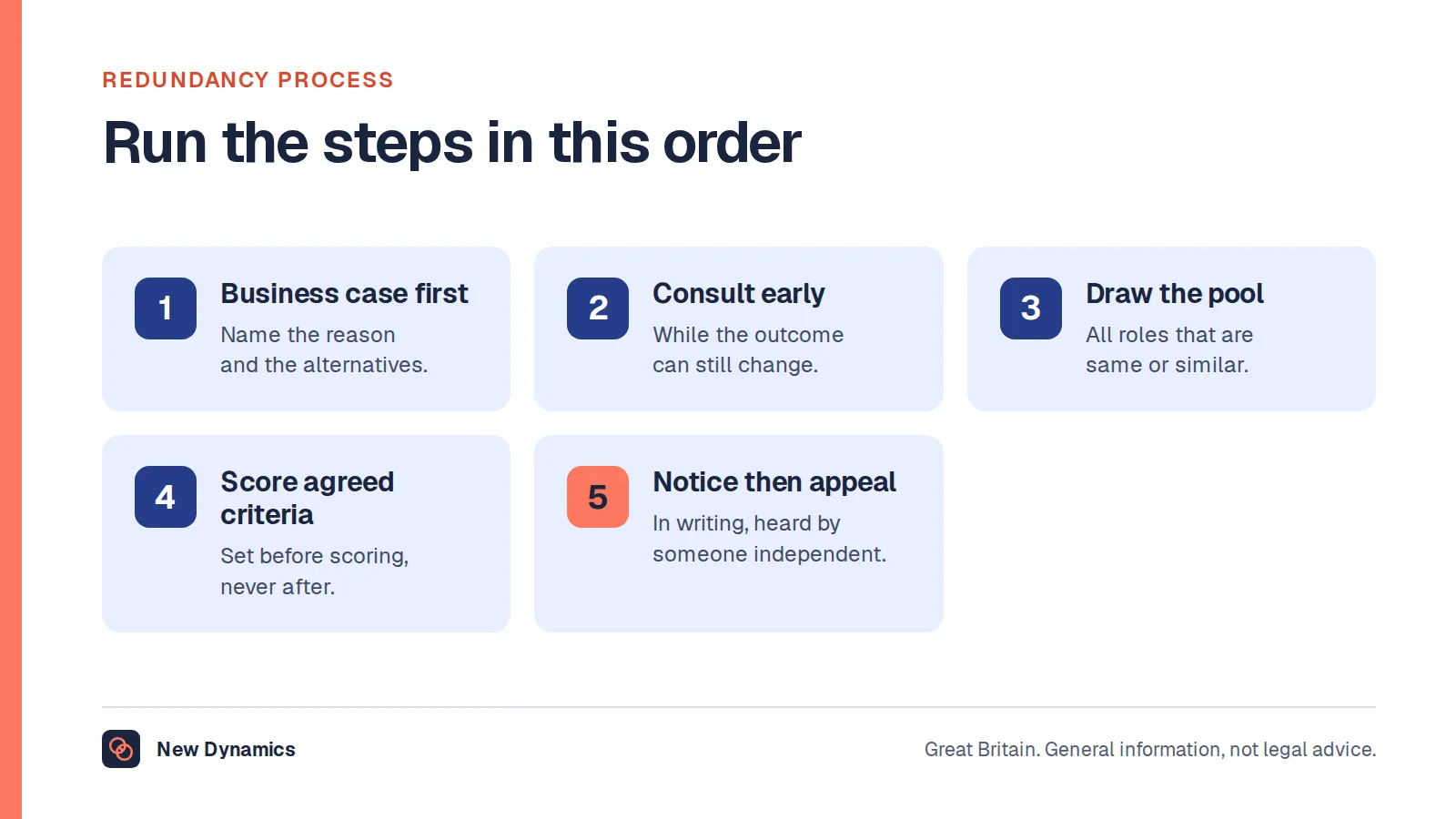
For the whole sequence a redundancy runs in, see our step by step guide to the redundancy process. This post stays on the pool and the scoring.
Two decisions sit before the first number
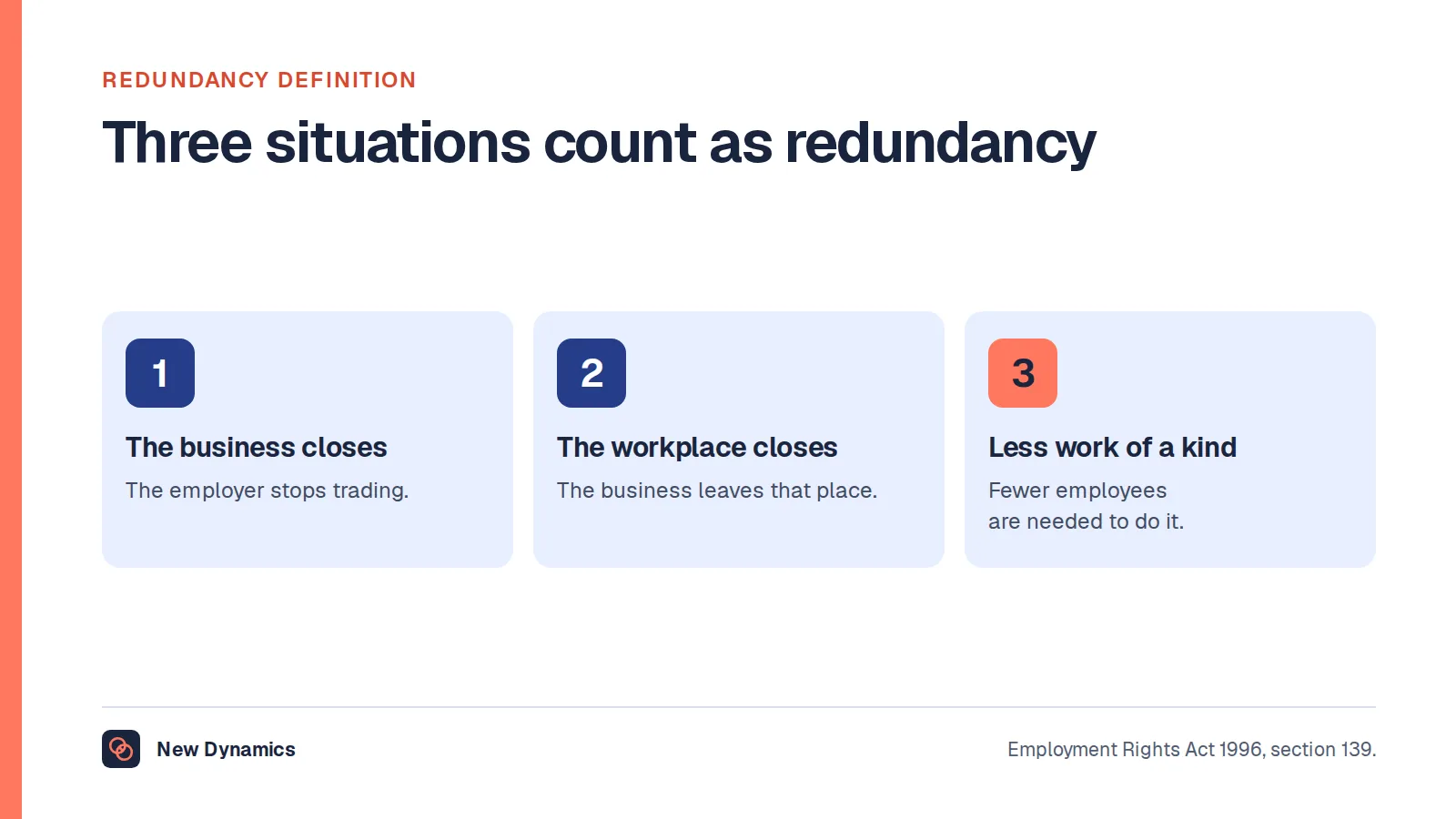
Section 139(1) of the Employment Rights Act 1996 defines redundancy by reference to the business, not the person. A dismissal is by reason of redundancy where it is wholly or mainly attributable to "the fact that the requirements of that business ... for employees to carry out work of a particular kind ... have ceased or diminished or are expected to cease or diminish".
That is the end of what the statute tells you. It says nothing about who gets selected. Fairness of selection is tested instead under section 98(4), which asks whether the dismissal "depends on whether in the circumstances (including the size and administrative resources of the employer's undertaking) the employer acted reasonably or unreasonably in treating it as a sufficient reason for dismissing the employee", and adds that it "shall be determined in accordance with equity and the substantial merits of the case".
So there is no statutory matrix, no prescribed criteria and no required weighting. There is a standard of reasonableness applied to whatever you did. GOV.UK puts the same point in one line on being selected for redundancy: "Your employer should use a fair and objective way of selecting you for redundancy."
Redundancy is not rare enough to improvise. The Office for National Statistics series LFS: ILO redundancy rate: UK: All: SA (series BEIR) put the rate at 3.6 per 1,000 employees in April to June 2026. Wider context sits on our HR statistics hub.

Drawing the pool, and why the pool is challengeable
The selection pool is the group of employees whose roles are considered together. Nothing in legislation defines it. Acas, in its guidance on selecting employees for redundancy, sets two instructions: you "should include in each pool all roles that are the same or similar", and you "should also consider including roles that have similar skills".
The second is the one employers skip. A pool built from job titles alone is usually too narrow. Acas gives its own example: all marketing roles are in a pool, and roles from a press and communications team could join it where the skills are similar to those needed for marketing.
The reason the pool matters so much is simple arithmetic. If three people do interchangeable work and you pool only two of them, you have decided the outcome for the third before any criterion is applied. A pool drawn tightly around the people an employer already expected to lose is the commonest way a redundancy process fails, because the selection decision was taken at the pooling stage and the matrix merely recorded it.
Three tests help:
- Interchangeability. Could these people cover each other's work now, or after short familiarisation rather than retraining? If yes, they probably belong together.
- Skill overlap, not title overlap. Two different titles doing substantially the same work belong in one pool. One title covering two unrelated jobs may need two.
- Consistency with what you have agreed. Acas says to check and follow any agreements with a recognised trade union, and, where there is no existing policy or agreement, to consider consulting a recognised union on how the pool should be set up.
Where no selection is needed at all, say so plainly. GOV.UK notes an employer can make someone redundant without a selection process where the job no longer exists, giving the examples of closing a whole operation and of being "the only employee in your part of the organisation".
Bumping, where the pool reaches past the roles at risk
Bumping is moving an employee whose role is disappearing into another role, and making the person currently in that role redundant instead. It widens the pool beyond the jobs being cut.
There is no duty to bump in every case, and no statutory rule requiring it. What matters is that a reasonable employer considers it where the facts invite it, and records the consideration. Our post on suitable alternative employment covers how bumping interacts with the offer provisions in sections 138 and 141 of the Employment Rights Act 1996. The practical point for the matrix is this: decide and minute whether the pool includes bumped roles before you score anything, because adding them afterwards means rescoring everyone.
Criteria that can be evidenced
Acas sets the standard for criteria bluntly: they "should be as objective and measurable as possible", meaning "they should be fair, be based on facts that can be measured and not be affected by personal opinions". It adds, in one sentence that decides most disputes: "You should have written evidence against each of the criteria."
Read that backwards. Do not start from a list of desirable criteria and then hunt for evidence. Start from the evidence you already hold, dated and written at the time, and build criteria from it. A criterion with no contemporaneous record behind it is a manager's opinion wearing a number.
GOV.UK lists the methods it describes as commonly used: "last in, first out (employees with the shortest length of service are selected first)", "asking for volunteers (self-selection)", "disciplinary records", and "staff appraisal markings, skills, qualifications and experience".
Weighting is yours to set. Acas describes allowing "different levels of points according to the importance of each criteria", and gives a worked case of scoring attendance out of 5 points and performance out of 15 where attendance is agreed to be less important. Weight before you score, never after, and write down the reason for each weight. A weighting changed once scores are visible is indistinguishable from a weighting changed to reach a chosen result.
If you intend to score skills, the structure needs to pre-date the redundancy. Our post on building a skills matrix covers how to hold that evidence in a form you can show.
Rewriting one criterion shows what the standard demands in practice. "Reliability" is an opinion. The same idea with a source, a fixed window, a scale and the protected absence removed is a criterion you can hand to an employee and defend.

The criteria that are discriminatory, or near enough to be dangerous

Four criteria do most of the damage.
Absence that includes protected absence. Acas words its own example of an attendance criterion with the limit built in: "attendance record, which must be accurate and not include absences relating to disability, pregnancy or maternity". Counting disability-related absence in a score engages section 15 of the Equality Act 2010, under which a person discriminates against a disabled person if "A treats B unfavourably because of something arising in consequence of B's disability" and cannot show the treatment to be a proportionate means of achieving a legitimate aim. It also engages the adjustment duty in section 20, whose first requirement applies "where a provision, criterion or practice of A's puts a disabled person at a substantial disadvantage" and calls for "such steps as it is reasonable to have to take to avoid the disadvantage". Discounting protected absence from the count is usually the obvious adjustment.
Part-time status and working pattern. GOV.UK lists "working pattern, for example part-time or fixed-term employees" among the reasons for which selection makes the dismissal unfair. Acas goes further on the indirect route, with an example worth quoting in full: "if you use flexible working as one of the criteria, this could be sex discrimination. This is because women are more likely to have caring responsibilities that can make it harder to change their working hours." That is section 19 in practice: a provision, criterion or practice that "puts, or would put, persons with whom B shares the characteristic at a particular disadvantage" is discriminatory unless the employer "cannot show it to be a proportionate means of achieving a legitimate aim".
Length of service as a sole criterion. Last in, first out used alone correlates directly with age. GOV.UK carries the warning next to the method itself: "If your employer uses 'last in, first out', make sure it's not discrimination, for example if it means only young people are made redundant." Direct age discrimination under section 13 can be justified, but you would have to run that argument, and relying on service as a tie-breaker inside a wider matrix is a far smaller exposure than relying on it alone.
Anything that proxies for family leave. Acas lists it as against employment law to select anyone because of "maternity leave, paternity leave, adoption leave, ordinary parental leave, shared parental leave, parental bereavement leave, time off for dependants and carer's leave". A criterion measuring hours worked, availability or recent output will pick up leave without naming it.
Scoring, moderation and consistency
Acas states the obligation as a requirement, not a suggestion: "You must apply the scoring criteria in the same way for all employees in the pool."
That is harder than it sounds across several scorers. Four practices make it defensible:
- Two scorers per person, independently, before they compare. One scorer per person makes a score an opinion. Two scores that diverge tell you where the definitions are vague.
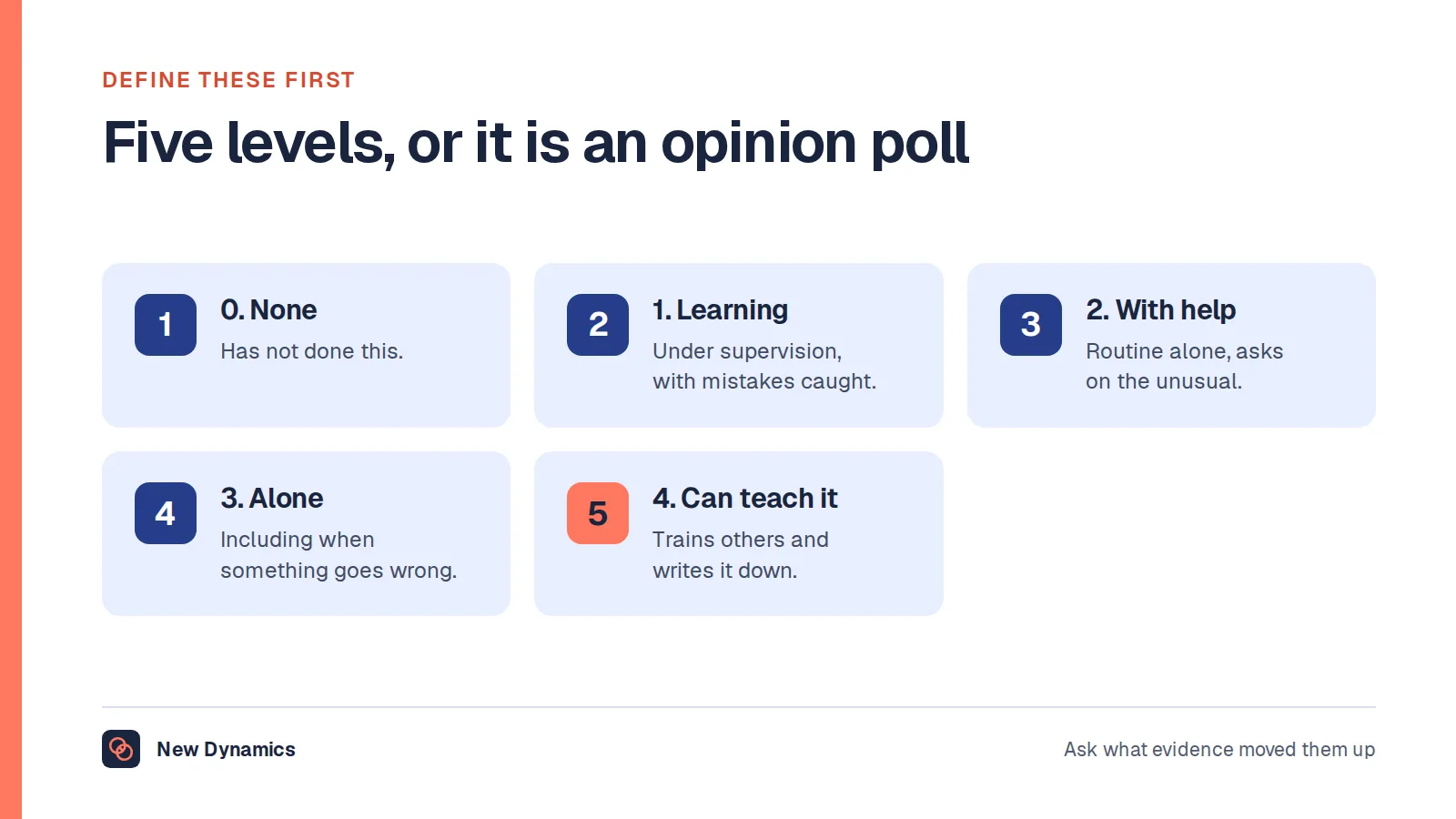
- A written definition of every point on every scale. Acas publishes an example set in which the top performance band is worth 15 points and is described as "consistently exceeds company standard", while the bottom band, at 3 points, reads "fails to meet objectives of the role". Bands with words attached can be argued about. Bands without them cannot be defended.
- A moderation session with a record. Compare distributions across scorers, not just individuals. If one manager's team averages three points higher on the same criterion, the problem is the scorer.
- Scorers who know the people. A manager scoring someone they have never worked with cannot evidence anything, and a score they cannot evidence is one you will have to withdraw.
Whether to disclose scores is a judgement, and no official source makes it compulsory. Acas lists among the benefits of an agreed scoring approach that "it can be easily explained to everyone" and that "employees feel they're being treated fairly". In practice, giving each person their own scores and the criteria definitions, without other people's scores, lets consultation be about the evidence rather than about secrecy. Withholding scores entirely tends to convert a selection dispute into an argument about process.
The individual consultation that has to follow
Scores are an input to consultation, not its conclusion. Acas says you "should meet each affected employee in private, at least once", that there "are no rules in legislation for how long individual consultation should last", and that consultation "must be meaningful", adding: "You should be able to show you have genuinely considered any suggestions or points made by each employee. This includes suggestions you do not accept."
Where 20 or more redundancies are proposed, collective consultation under section 188 of TULRCA 1992 also applies, and the selection method is one of the items you must disclose in writing to representatives: section 188(4)(d) names "the proposed method of selecting the employees who may be dismissed". The statutory trigger is "20 or more employees at one establishment within a period of 90 days or less", and section 188(1A) requires consultation to begin at least 45 days before the first dismissal takes effect where 100 or more are proposed, and at least 30 days otherwise.
Acas words the trigger as "20 or more redundancies in a 90 day period" and leaves out the establishment limb. The statute includes it, and the statute governs. A second route is being added: the Employment Rights Act 2025 inserted section 188(A1) and section 195A, which would also catch "at least the threshold number of employees" across the employer, but section 195A(1) makes that number one "determined in accordance with regulations made by the Secretary of State under this section", and section 195A(3) provides that the regulations "may not provide in any case for the threshold number of employees to be lower than 20". Until those regulations set a number, the second route has no number in it. Section 193 separately requires written notification to the Secretary of State before notice of dismissal is given to any affected employee, and at least 30 days before the first dismissal takes effect, rising to 45 days where 100 or more are proposed.
The cost of getting this wrong rose this year. Section 189(4) of TULRCA now provides that a protective award "shall not exceed 180 days", substituted with effect from 6 April 2026 by the Employment Rights Act 2025, section 30(2). Acas confirms the change in its guidance on redundancy consultations: "From 6 April 2026, you could be ordered to pay a protective award for up to 180 days' pay for each affected employee. Before 6 April 2026, the maximum protective award was 90 days' pay."
Alternative employment, the trial period and the family-leave priority
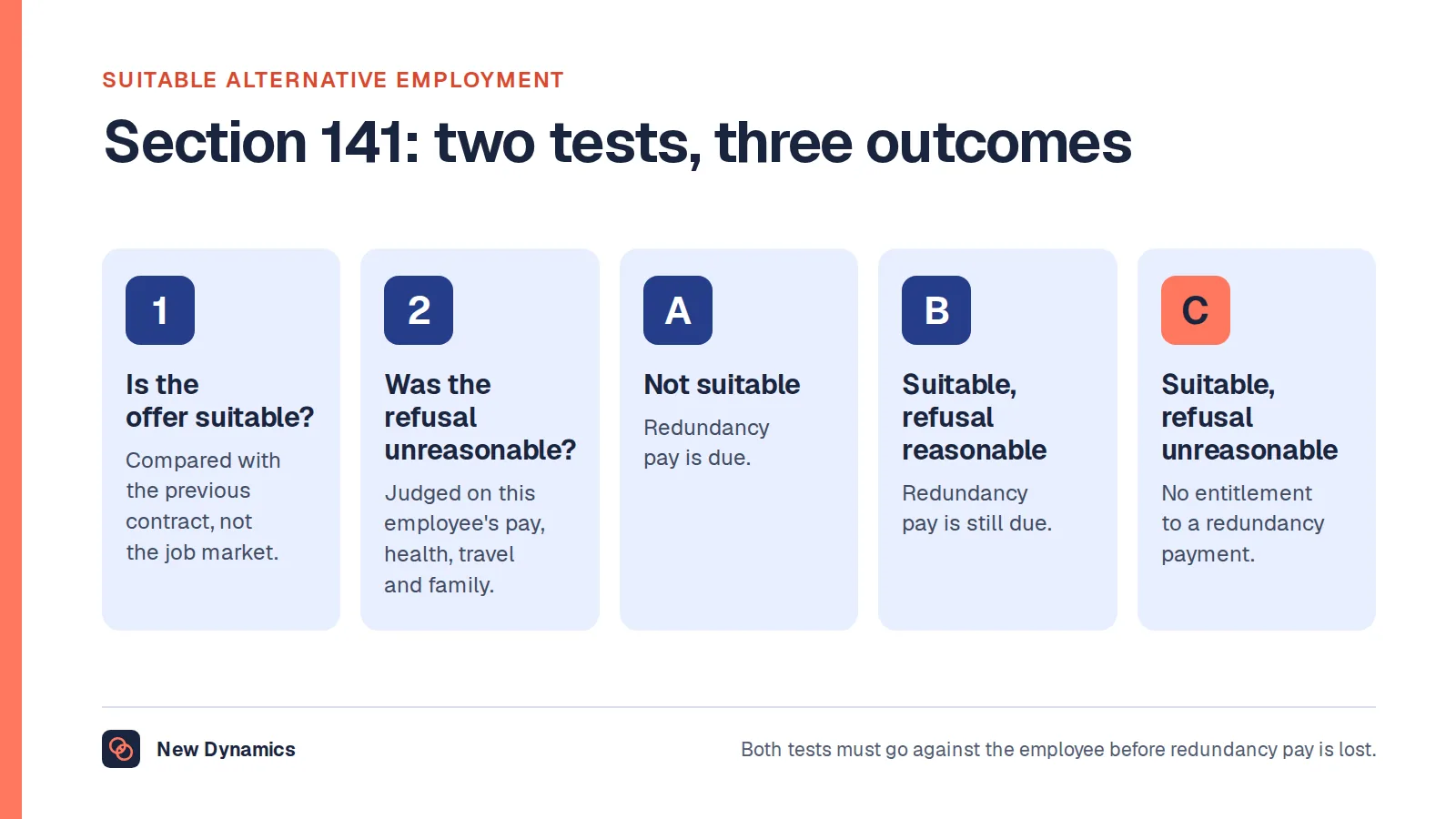
A score does not end the duty to look for other work. Section 138(3) of the Employment Rights Act 1996 gives a statutory trial period in a renewed or new contract running for "the period of four weeks beginning with the date on which the employee starts work under the renewed or new contract", extendable only by a written retraining agreement made before the employee starts that specifies the end date and the terms applying afterwards. Section 141 then asks separately whether the offer was suitable and whether a refusal was unreasonable.
Some employees sit outside the matrix for vacancies. Regulation 10 of the Maternity and Parental Leave etc. Regulations 1999 provides that "where there is a suitable available vacancy, the employee is entitled to be offered (before the end of her employment under her existing contract) alternative employment", on terms "not substantially less favourable to her than if she had continued to be employed under the previous contract". The Maternity Leave, Adoption Leave and Shared Parental Leave (Amendment) Regulations 2024 (S.I. 2024/264), made on 28 February 2024 and in force on 6 April 2024 under regulation 1(2), extended that protection to the protected period of pregnancy and to an additional protected period after leave. For maternity, the additional protected period ends immediately before "the day after a period of 18 months beginning with the first day of the expected week of childbirth", or 18 months from the date of birth where the employer has been notified of it. Adoption leave gets 18 months from placement under the equivalent change to regulation 23 of the Paternity and Adoption Leave Regulations 2002, and shared parental leave gets 18 months from birth or placement where six consecutive weeks of leave have been taken.
Paternity leave is the gap. The 2002 Regulations contain a redundancy provision for adoption leave (regulation 23) and none for paternity leave, so no official instrument gives a father or partner on paternity leave the same priority for a suitable available vacancy. Selecting someone because of paternity leave remains unlawful, but the priority offer right does not extend to it.
The records to keep
Keep the pool rationale, the criteria with their weights and the reason for each weight, the definitions of every scoring band, every individual score sheet with the evidence cited, the moderation notes, the consultation notes including suggestions you rejected and why, the vacancy list you checked, and the dates. Store them where they survive a reorganisation of the HR team, because a tribunal claim can arrive months later.
Statutory redundancy pay is the one part that is pure arithmetic. Section 162 gives one and a half weeks' pay for a year of employment in which the employee "was not below the age of forty-one", one week's pay for a year not below twenty-two, and half a week's pay for each earlier year, counting back no more than twenty years. Section 227(1) caps a week's pay at £751, substituted with effect from 6 April 2026 by the Employment Rights (Increase of Limits) Order 2026 (S.I. 2026/310). GOV.UK states it the same way on redundancy pay: "If you were made redundant on or after 6 April 2026, your weekly pay is capped at £751 and the maximum statutory redundancy pay you can get is £22,530."
Frequently asked questions
What is a redundancy selection matrix?
It is a grid that scores each employee in a selection pool against agreed criteria, usually with weights, to rank them. No legislation requires one or sets its contents. Section 98(4) of the Employment Rights Act 1996 asks only whether the employer acted reasonably, so a matrix is one way of evidencing that rather than a legal requirement in itself.
How is a redundancy pool decided?
By judgement, applied to the work rather than the job titles. Acas says each pool should include all roles that are the same or similar, and that you should also consider including roles with similar skills. Check any policy or agreement with a recognised trade union first, and consider consulting the union on how the pool is drawn where no agreement exists.
Can an employee challenge the selection pool itself?
Yes. The pool is a decision the employer made, so it can be argued at consultation, at appeal and at a tribunal. A pool drawn narrowly enough to decide the outcome before scoring begins is a common ground of challenge, which is why the rationale for including and excluding roles should be written down at the time.
Which redundancy selection criteria are discriminatory?
Criteria that count disability-related, pregnancy-related or maternity-related absence, that penalise part-time or fixed-term working, that proxy for family leave, or that rely on length of service alone. Acas states that an attendance criterion must not include absences relating to disability, pregnancy or maternity, and GOV.UK lists working pattern among the reasons that make a redundancy dismissal unfair.
Does an employer have to tell an employee their redundancy scores?
No official source makes disclosure compulsory. In practice, sharing an individual's own scores and the criteria definitions makes consultation about the evidence rather than about the process, and Acas notes that an agreed scoring approach helps because it can be easily explained to everyone.
How much is statutory redundancy pay in 2026?
Section 162 of the Employment Rights Act 1996 gives one and a half weeks' pay per year of employment from age 41, one week per year from 22, and half a week for earlier years, capped at 20 years. GOV.UK states that for redundancies on or after 6 April 2026 a week's pay is capped at £751 and the maximum statutory payment is £22,530.
Your next step: fix the pool before you score
Write the pool rationale first, in one page, naming every role you included and every similar role you excluded with the reason. Then set the criteria and the weights, check each one against the evidence you actually hold in writing, and only then score. That order is what you will be asked to show.
Our redundancy and workforce change guide sets out the templates and the sequence. For what happens around the matrix, see our posts on the redundancy process, on what counts as redundancy and on what pooling means at work.
Want selection scores to rest on evidence that already exists rather than being assembled under deadline? Book a New Dynamics demo and bring your current criteria list. You can also email contact@new-dynamics.com.