TL;DR
- Section 141 of the Employment Rights Act 1996 asks two separate questions, and both must go against the employee before redundancy pay is lost: was the offer one of suitable employment, and did the employee unreasonably refuse it. An offer can be suitable and the refusal still reasonable, in which case the payment is due.
- The statutory trial period runs four weeks beginning with the date the employee starts work under the new contract, not from the offer or the notice. Section 138(6) allows longer only for retraining, on a written agreement made before the employee starts that specifies the end date and the terms applying afterwards.
- Since 6 April 2024 the redundancy priority for new parents reaches well past the leave. Regulation 10 of the Maternity and Parental Leave etc. Regulations 1999 now runs to 18 months from the first day of the expected week of childbirth, with equivalents at 18 months from placement for adoption and from birth or placement for shared parental leave.
An employer finds a vacancy, offers it to someone at risk of redundancy, hears no, and treats the redundancy payment as forfeited. That answers one question when the statute asks two. An offer being suitable is not the same thing as the refusal being unreasonable, and an employee who turns down a genuinely suitable job for a good reason keeps the money.
This article sets out what suitable alternative employment means in Great Britain, quoted from the statute rather than paraphrased: the two tests, the trial period and how it can lawfully be extended, offers from an associated employer, the priority new parents hold, and where bumping sits. It is general information about the law of England, Wales and Scotland, and not legal advice.
Much of the difficulty here is not legal. It is that nobody can see, in one place, which roles exist and who could plausibly do them. See how New Dynamics org charts make structures and working relationships visible, so a redeployment search covers the whole organisation and not just the team in the room.
The two tests in section 141
Section 141 of the Employment Rights Act 1996 is the provision that takes redundancy pay away. It has been in force in this form since 22 August 1996 and is unamended. It applies where an offer is made before the end of employment to renew the contract or re-engage the employee, to take effect either immediately on, or after an interval of not more than four weeks after, the end of his employment.
Then the sentence that matters, section 141(2): "Where subsection (3) is satisfied, the employee is not entitled to a redundancy payment if he unreasonably refuses the offer."
Read the structure. Subsection (3) is satisfied either where the terms of the new contract "would not differ from the corresponding provisions of the previous contract", or where they differ "but the offer constitutes an offer of suitable employment in relation to the employee". That is the first test, and it is about the job. Subsection (2) adds a second: that the refusal was unreasonable. That one is about the person.

Both have to be satisfied, so there are three outcomes rather than two. Only where the offer was suitable and the refusal unreasonable is there no entitlement. Acas puts the burden where it belongs: "You'll need to be able to prove the employee's decision was unreasonable if they make a claim to an employment tribunal".
What makes an offer suitable
The statute does not define suitable. GOV.UK publishes the factors, in guidance last updated on 8 November 2024: whether a job is suitable depends on "how similar the work is to your current job", the terms of the job being offered, the employee's skills, abilities and circumstances in relation to the job, and the pay (including benefits), status, hours and location. The comparison is with the previous contract, not the labour market, so a role can be a perfectly good job and still not be suitable for this employee.
Two mechanical conditions sit alongside the content. Under sections 138(1) and 141(1) the offer must be made before the previous employment ends, and the new job must start immediately or within not more than four weeks after it ends. Section 146(2) softens the timing for weekend endings: re-engagement counts as immediate if it takes effect on or before the next Monday, and the four weeks are counted as if employment had ended on that Monday.
When a refusal is still reasonable
The second test is assessed against this employee's position, not an average employee's. Acas guidance, last updated on 7 April 2026, lists reasons that could make a refusal valid: that the job is on lower pay, that health issues stop the employee doing it, difficulty getting there "for example because of a longer journey, higher cost or lack of public transport", and disruption to family life.
One contractual term shifts the analysis. Acas notes that a mobility clause requiring the employee to work anywhere the employer asks "might mean that turning down a job because of its location could risk their right to redundancy pay". It does not settle the question, but it changes what the employee has already agreed to.
So keep the two tests apart in your records. An employer who wrote down only that the job was suitable has evidence for half of what it has to prove.
The trial period: four weeks from the first day
The trial period is created by section 138, not by the offer letter. Where the terms of the new contract differ from the old and either side ends it inside the statutory window, section 138(2) reopens the dismissal. Section 138(3) defines the window as ending with "the period of four weeks beginning with the date on which the employee starts work under the renewed or new contract", or a longer agreed retraining period.
Four weeks from the first day worked, then, and not from the offer, the acceptance or the start of notice. Acas recommends the trial start after the employee has worked their notice and the previous contract has ended, which avoids any argument about when the clock began.

Section 138(4) is worth knowing before you need it. If the trial ends the employment, the employee "shall be regarded as dismissed on the date on which his employment under the previous contract" ended, or the original contract where there has been more than one trial period, and for the reason that applied then. The dismissal date reverts and the payment is calculated as it would have been, so trying costs the employee nothing.
Extending the trial is narrower than the guidance suggests. An extension is available only "for the purpose of retraining the employee", and section 138(6) requires the agreement to be made between the employer and the employee or a representative before the employee starts work under the new contract, to be in writing, to specify the date the retraining period ends, and to specify the terms and conditions of employment which will apply after the end of that period. Acas says an extension "must be agreed in writing and have a clear end date", and GOV.UK that "Any extension must be agreed in writing before the trial period starts". Neither mentions that fourth element. The guidance is a summary and the statute governs, so an extension letter naming only an end date falls short of section 138(6).
Two traps at the other end. GOV.UK states that an employee loses the right to claim statutory redundancy pay "if you do not give notice within the 4-week trial period", and Acas that staying beyond four weeks loses the right unless a longer trial was agreed. Separately, section 141(4) removes the payment where the employee accepted a suitable role and then "unreasonably terminates the contract" during the trial. Leaving the trial protects the payment only when the reason stands up.
Offers from an associated employer
Section 146(1) extends both provisions outwards: in sections 138 and 141, "references to re-engagement are to re-engagement by the employer or an associated employer", and "references to an offer are to an offer made by the employer or an associated employer".
This cuts both ways, and groups routinely miss it. A vacancy in a sister company belongs in the redeployment search, and an offer from a sister company counts for section 141, so an unreasonable refusal of a suitable group role costs the employee the payment just as an in-house refusal would.
Priority for pregnancy, maternity, adoption and shared parental leave
This is a stronger right than the general duty, and it changed on 6 April 2024. Regulation 10 of the Maternity and Parental Leave etc. Regulations 1999, as substituted by the Maternity Leave, Adoption Leave and Shared Parental Leave (Amendment) Regulations 2024, applies during a protected period of pregnancy, the statutory maternity leave period, and an "additional protected period" after the leave ends.
That additional period runs from the day after statutory maternity leave ends until "the day after a period of 18 months beginning with the first day of the expected week of childbirth", or 18 months from the actual date of childbirth where the employer has been notified of that date before the end of the leave, or as soon as reasonably practicable afterwards.
The equivalents are drawn the same way. Regulation 23 of the Paternity and Adoption Leave Regulations 2002 runs to 18 months from the day the child is placed for adoption. Regulation 39 of the Shared Parental Leave Regulations 2014 applies where the employee has taken six consecutive weeks of shared parental leave and neither other regulation applies, and runs to 18 months from birth or placement. Regulation 3 of the 2024 Regulations broadly applies each extension where the relevant leave ends on or after 6 April 2024.
The standard is higher than suitability. Where there is a suitable available vacancy the employee "is entitled to be offered" it before the existing contract ends, on terms "not substantially less favourable" than the old ones. Acas states the consequence for a contested vacancy plainly: if more than one employee is interested in the same role, you must "offer the role to any employees on maternity leave, shared parental leave or adoption leave first".
Bumping, or transferred redundancy
Bumping is where the at risk employee takes a role that is not vacant. Acas describes it as moving an employee whose role is at risk into someone else's role, so that "the other person is made redundant instead", and notes it is also called transferred redundancy. It usually arises when a senior employee's job disappears and the organisation wants to keep them.
Is it compulsory? No duty to bump appears in the Employment Rights Act 1996, and Acas puts it no higher than this: "In some cases, it might be reasonable to look at whether a job could be made available by bumping another employee". It is an option to be able to show you considered where the facts invite it, not a step every process must take. Acas adds that a bumped employee must be treated fairly, exactly like any other employee at risk.
If the employee accepts
Section 138(1) does the work. Where the contract is renewed or the employee re-engaged under an offer made before the end of the previous employment, taking effect immediately or within not more than four weeks, "the employee shall not be regarded for the purposes of this Part as dismissed by his employer by reason of the ending of his employment under the previous contract".
Acceptance is therefore not a dismissal followed by a new job. No redundancy payment falls due, because there is no dismissal to trigger one, and a gap of up to four weeks does not break the position. So do not pay a redundancy payment and then redeploy, and confirm in writing on the day the trial ends whether the appointment is permanent. A trial that simply runs on is the commonest way an employer finds out that the four weeks expired and nobody said anything.
No official source publishes how often alternative employment is offered, accepted or refused in the UK, so there is no benchmark for your own redeployment rate. For the labour market figures that are published, see the HR statistics hub.
Frequently asked questions
What counts as suitable alternative employment?
There is no statutory definition. GOV.UK publishes the factors as how similar the work is to the current job, the terms offered, the employee's skills, abilities and circumstances in relation to the job, and the pay (including benefits), status, hours and location. The comparison is with the previous contract, not the wider job market.
Can an employee refuse a suitable role and keep their redundancy pay?
Yes, if the refusal is reasonable. Section 141 of the Employment Rights Act 1996 requires both that the offer was of suitable employment and that the employee unreasonably refused it before entitlement is lost. Acas lists lower pay, health, travel difficulty and disruption to family life among reasons that could make a refusal valid.
How long is the redundancy trial period, and how is it extended?
Four weeks, beginning with the date the employee starts work under the new contract, under section 138(3). It can be longer only for retraining, and section 138(6) sets four conditions: the agreement is made with the employee or a representative before the employee starts work, is in writing, specifies the date retraining ends, and specifies the terms that apply after that.
Does an offer from another company in the group count?
Yes. Section 146(1) provides that references to an offer and to re-engagement in sections 138 and 141 include an offer made by, or re-engagement by, an associated employer. Group vacancies therefore belong in the redeployment search.
Must an employer consider bumping?
No provision of the Employment Rights Act 1996 requires it. Acas says that in some cases it might be reasonable to look at whether a job could be made available by bumping another employee, and that anyone bumped must be treated fairly, like any other employee at risk of redundancy.
Your next steps
- List every vacancy across the organisation and every associated employer, with dates, before the first individual consultation meeting rather than after it.
- For each offer, record the two tests separately: why the role is suitable against the previous contract, and what the employee said about it.
- Put the trial dates in writing, counted from the first day in the new role, and check any retraining extension against all four conditions in section 138(6).
- Identify anyone inside a protected period under the 2024 Regulations at the outset, because their entitlement is to be offered the vacancy rather than considered for it.
- Take legal advice on your own facts before withholding a payment because of a refusal.
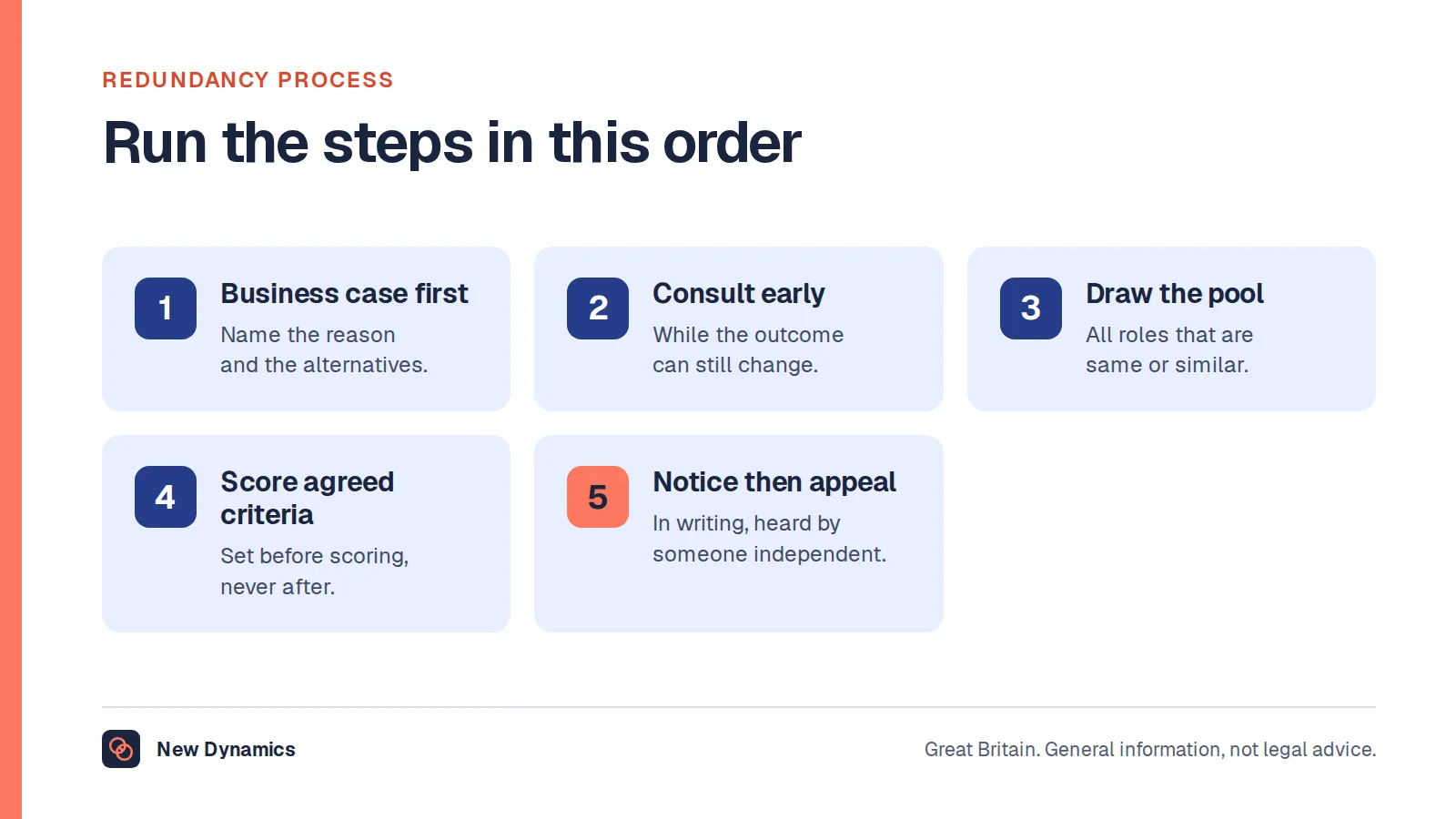
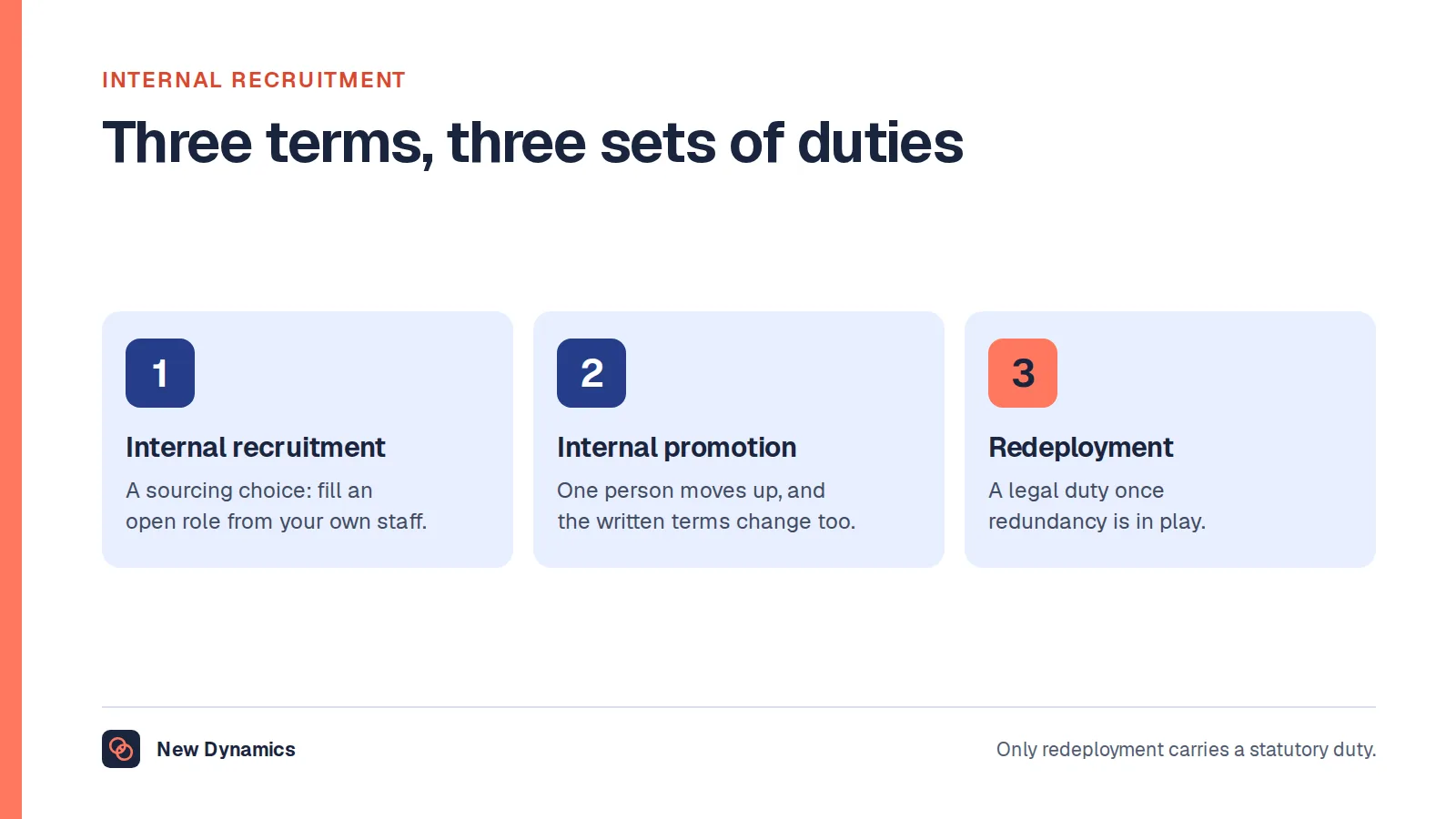
For the planning and consultation side of a reorganisation, read and download our redundancy and workforce change guide. The guide is free to read, and the PDF uses our short download form. Our post on the redundancy process sets out the sequence this sits inside, and internal recruitment covers filling roles from within.
Want the roles, reporting lines and skills in one place before you need to find a vacancy in a hurry? Book a New Dynamics demo and bring your current structure chart. You can also email contact@new-dynamics.com.