TL;DR
- A 9/80 schedule fits 80 hours into nine days across a fortnight, so an employee works eight longer days plus one shorter Friday and takes every other Friday off. The hours and the pay do not change.
- In the United States the arrangement turns on one payroll decision. Fact Sheet #23 from the Department of Labor says a workweek 'may begin on any day and at any hour of the day' and that 'Averaging of hours over two or more weeks is not permitted'. Leave the boundary on a calendar week and the pattern produces a 44 hour week every fortnight.
- In the United Kingdom there is no statutory workweek for overtime, so the questions are different: the Working Time Regulations limits, daily and weekly rest, holiday entitlement expressed in hours rather than days, and what the written statement says. General information, not legal advice.
Somebody has asked for every other Friday off without dropping to part time. That is a 9/80, and on paper it is the tidiest flexible pattern available: the same hours, the same pay, twenty-six long weekends a year. Then payroll looks at it, and in the United States it turns into a four-hour overtime bill every fortnight unless one setting is right.
New Dynamics sells neither payroll nor rota software. The part that is ours is routing a request like this to the right people with a record of the decision, which is what New Dynamics workflows do. Because this post crosses two legal systems, every section names its jurisdiction, and all of it is general information rather than legal advice. Anything specific to your contracts or a particular employee belongs with a professional adviser.
What a 9/80 schedule is

A 9/80 schedule spreads 80 hours of work over nine days in a fortnight instead of ten. The name is the arithmetic. The employee works eight longer days, usually nine hours each, plus one shorter day of eight hours, and takes the tenth day off. The free day is almost always a Friday, so the pattern is also called an alternating Friday schedule or a nine-day fortnight.
Three things it is not. Not part-time work: contracted hours, pay, pension and benefits are untouched, which is why it appeals to people who want the time but cannot lose the income. Not a four-day week: that reduces working time and holds output steady, while a 9/80 reduces days and keeps hours, and our post on four-day week benefits covers that different argument. Not a 4/10: that compresses 40 hours into four ten-hour days every week.
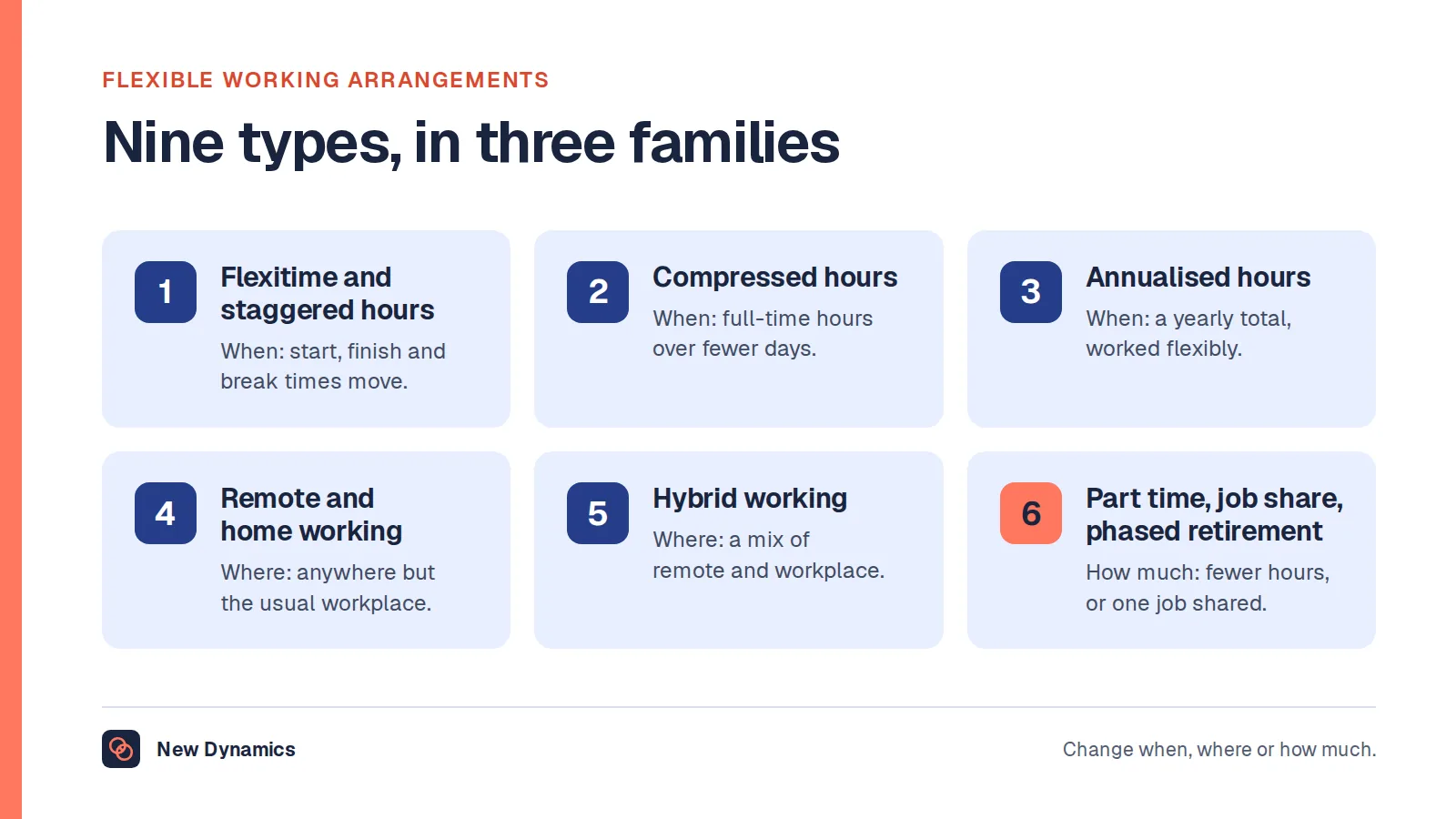
In the United Kingdom the pattern has an official name. GOV.UK lists it under types of flexible working as compressed hours: "Working full-time hours but over fewer days", with the example "a 9-day fortnight (an employee has a day off every other week and works longer hours on the other days)". Acas lists "9 days each fortnight, instead of 10" as the same thing.
A 9/80 work schedule example, hour by hour
Here is the standard American version, in paid working hours with unpaid meal breaks excluded.
| Day | Week one | Week two |
|---|---|---|
| Monday | 9 hours | 9 hours |
| Tuesday | 9 hours | 9 hours |
| Wednesday | 9 hours | 9 hours |
| Thursday | 9 hours | 9 hours |
| Friday | 8 hours | Off |
| Calendar totals | 44 | 36 |
Read the bottom row again, because that is the whole problem. On an ordinary Monday to Sunday week this is 44 hours followed by 36, for ever, and in the United States that first week holds four hours of overtime.
The fix is not to change the hours but to change where the week starts. Define the week as beginning in the middle of the worked Friday, and the short day is cut in two, with each half joining a different week:
| Workweek beginning midday Friday | Hours |
|---|---|
| Friday afternoon | 4 |
| Monday to Thursday | 36 |
| Next Friday, the day off | 0 |
| Total | 40 |
The next workweek begins at midday on the Friday that was taken off, so it starts at zero, picks up 36 from Monday to Thursday and closes with the four morning hours of the next worked Friday. Forty again, repeating. That is why a 9/80 is drawn with an eight-hour Friday rather than nine-hour days throughout: the short day exists so that it can be halved.
Where the 9/80 comes from, and why it is mostly an American pattern
No official source opened for this article dates the origin of the 9/80 or counts the employers running one, so this post claims no history for it. Why it is more common in the United States does follow from the rules.
American federal law caps nothing daily and everything weekly. The Department of Labor's Fact Sheet #23, revised October 2019, says employees covered by the Fair Labor Standards Act "must receive overtime pay for hours worked in excess of 40 in a workweek at a rate not less than time and one-half their regular rates of pay", and that "There is no limit in the Act on the number of hours employees aged 16 and older may work in any workweek". So a ninth hour is free, a forty-first hour is expensive, and the week is the only unit that matters. A 9/80 exists because that threshold does.
The United Kingdom has no equivalent threshold. Acas is blunt: "Although some employers offer overtime pay, there's no automatic legal right to it". No statutory premium switches on at 40 hours, so there is no boundary to move, and a British employer is solving a rest, leave and contract puzzle instead.
Federal law is only a floor. The Department of Labor's Fair Labor Standards Act advisor notes that "Some states also have enacted overtime laws" and that where both apply, "the employee is entitled to overtime according to the higher standard". Some states count hours by the day, which changes the answer for a nine-hour day.
The payroll trap that defines a 9/80 in the United States

This describes the United States federal position only, and is general information rather than legal advice.
Everything rests on one proposition worth quoting exactly. Fact Sheet #23 says "The Act applies on a workweek basis", then defines the unit: an employee's workweek is "a fixed and regularly recurring period of 168 hours" made of seven consecutive 24-hour periods, and crucially it "need not coincide with the calendar week, but may begin on any day and at any hour of the day". It adds that "Different workweeks may be established for different employees or groups of employees". That is the permission a 9/80 needs: the workweek is a setting, not a fact about calendars, and it can begin at noon on a Friday.
There is no second route. The same paragraph says that "Averaging of hours over two or more weeks is not permitted", so you cannot look at 44 and 36, call it 80 and move on. Nor can agreement paper over it: the fact sheet states that "The overtime requirement may not be waived by agreement between the employer and employees" and that "An agreement that only 8 hours a day or only 40 hours a week will be counted as working time also fails the test of FLSA compliance".
Note what the fact sheet does not say. It calls the workweek fixed and regularly recurring, but does not set out how an established workweek may be changed, and this article will not invent a rule for that. If you are moving an existing boundary, put that question to your payroll adviser first.
Four things that break a 9/80 in American payroll
A floating Friday. Once the boundary sits at noon, the start and finish times on the worked Friday are load-bearing. Someone who starts at six in the morning puts six hours before noon and two after, and the fortnight becomes 42 and 38. State the Friday times.
Swapping which Friday is off. Taking this Friday instead of next week's moves nine hours into a workweek that is already full. One week goes to 49, and averaging will not rescue it.
Working on the day off. The free Friday is attractive because it is free, which is why it becomes the day for the urgent favour. Four hours of that favour is four hours of overtime.
Absence plus make-up time. A nine-hour day lost to sickness and made up later in the same workweek is fine. Made up on the Friday that was meant to be off, it is not, because paid leave is not hours worked while the make-up time is. If overtime has become structural, our post on overtime pay covers what that costs.
The United Kingdom position: no statutory workweek, four other questions
This section describes England, Wales and Scotland. The Working Time Regulations 1998 provisions quoted below are shown on legislation.gov.uk with an extent of England, Wales and Scotland, and GOV.UK states separately that "Flexible working rules are different in Northern Ireland". General information, not legal advice.
There is no statutory workweek here, because there is no statutory weekly overtime premium for one to trigger. What a nine-day fortnight creates instead are four practical questions.
Working time limits (United Kingdom)
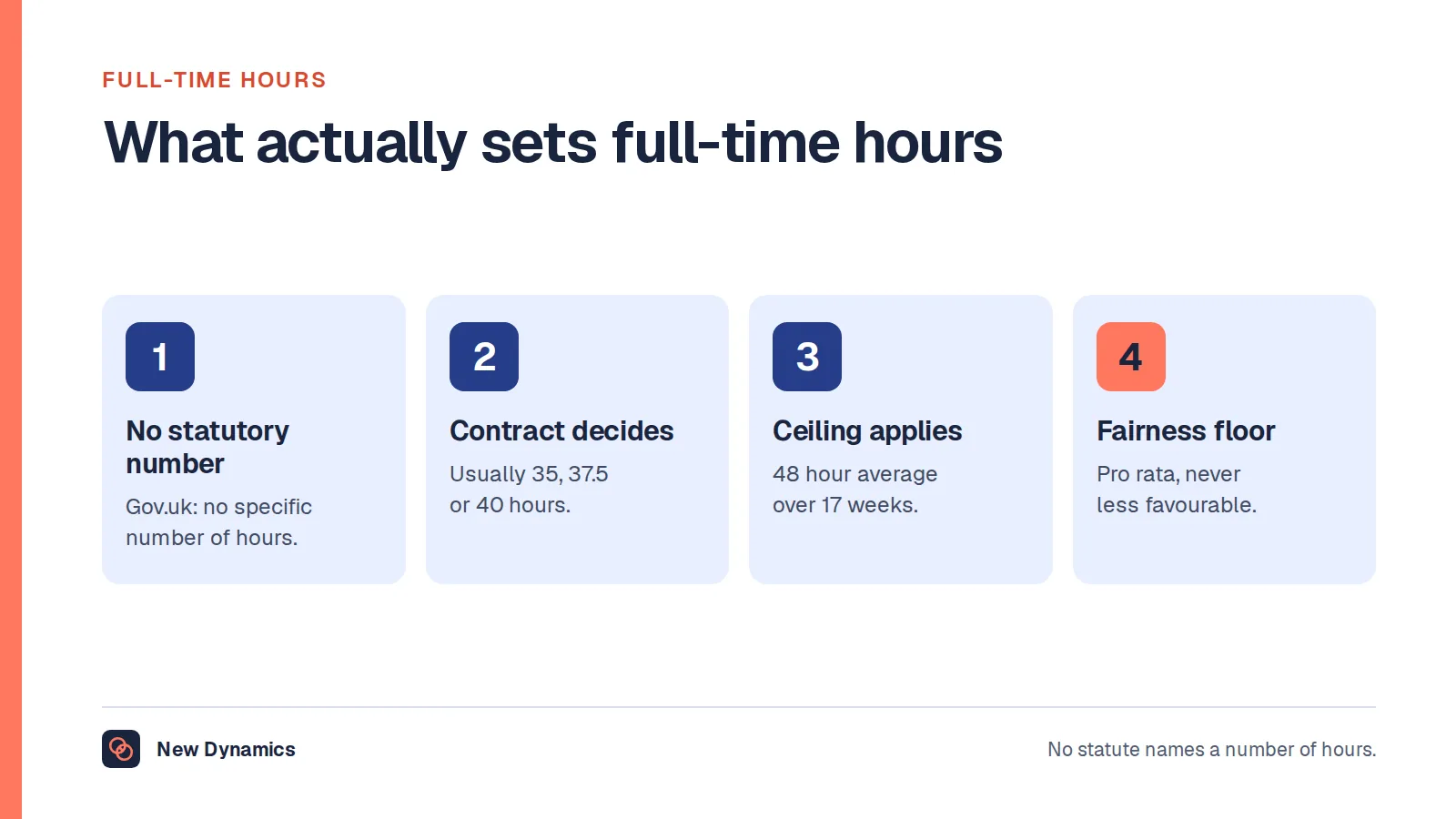
The ceiling is an average, not a weekly cap. Regulation 4(1) of the Working Time Regulations 1998 provides that a worker's working time, "including overtime, in any reference period which is applicable in his case shall not exceed an average of 48 hours for each seven days", with regulation 4(3)(b) setting the default reference period as "any period of 17 weeks in the course of his employment".
A nine-day fortnight on full-time hours is nowhere near that, so the limit is not the issue by itself. It becomes the issue when overtime is added, because Acas totals the hours in a 17 week period and divides by 17. An opt-out is not permanent headroom either, since a worker "can cancel an opt-out agreement at any time". Our post on full-time hours covers the limit against contracted hours.
Daily and weekly rest (United Kingdom)
Longer days eat the gap between them. Regulation 10(1) entitles a worker to "a rest period of not less than eleven consecutive hours in each 24-hour period during which he works for his employer", which GOV.UK restates as 11 hours of rest between working days. A nine-hour day with an hour for lunch spans ten hours of the clock, leaving fourteen. What fails the rule is that day extended by two hours of travel, finishing at nine at night before an eight o'clock start.
Breaks come under regulation 12: where daily working time is more than six hours a worker "is entitled to a rest break" of "not less than 20 minutes, and the worker is entitled to spend it away from his workstation if he has one". A longer day with the same twenty minutes in it is a worse day, so most employers lengthen the break rather than defend the minimum.
Weekly rest has its own fortnightly idea. Regulation 11(1) gives "an uninterrupted rest period of not less than 24 hours in each seven-day period", and regulation 11(2) lets the employer substitute "one uninterrupted rest period of not less than 48 hours in each such 14-day period". A nine-day fortnight with weekends off clears the weekly version anyway. Regulation 11(4)(a) even lets that period start at times set in a relevant agreement, with regulation 11(6) otherwise fixing that "a week starts at midnight between Sunday and Monday". So the United Kingdom does let you set when a week begins, but it has nothing to do with pay.
Holiday entitlement, expressed so that it still works (United Kingdom)
This is where compressed hours quietly go wrong, and it is arithmetic rather than law. GOV.UK states that "Almost all people classed as workers are legally entitled to 5.6 weeks' paid holiday a year" and that "Most workers who work a 5-day week must receive at least 28 days' paid annual leave a year", with the statutory entitlement capped at 28 days. Acas gives the method in days: "multiply the number of days they work each week by 5.6".
Apply that to a nine-day fortnight and the problem appears. The employee averages 4.5 days a week, so 4.5 multiplied by 5.6 is 25.2 days. Fewer days than a colleague on 28, which looks like a cut and is not, because the days are longer. Worse, the days differ in length, so a day of leave means two different amounts of time depending which day is booked.
Express it in hours and that goes away. Multiply 5.6 by the contracted weekly hours: on a 37.5 hour week, 210 hours a year. A nine-hour day off then costs nine hours, the shorter Friday its own length, and the Friday that is already free nothing.
Bank holidays need the same treatment, and GOV.UK says that "An employer can include bank holidays as part of statutory annual leave". Most fall on a Monday, which a nine-day fortnight always works, so a Friday day off loses nothing. Let people pick a Monday off instead and half of them get public holidays free while half spend leave on them. Convert the allowance to hours for everyone and that argument ends.
The shape need not be American either: with no boundary to hit, 75 hours over nine days can be an even eight hours and twenty minutes a day. Our post on holiday entitlement covers the calculation, and work schedule maker the grid.
What the contract has to say (United Kingdom)
A 9/80 changes when someone works, so it changes their terms. GOV.UK lists among the required contents of the written statement "hours and days of work and if and how they may vary (also if employees or workers will have to work on Sundays, during the 'night period' or take overtime)", provided on the first day of employment, with any change notified "within one month of making the change".
If the request arrives as a statutory one, GOV.UK is explicit about where it ends. Every employee has the right to request flexible working, the employer "makes a decision on it within 2 months" unless longer is agreed, and "If the employer agrees to the request, they must change the terms and conditions in the employee's contract" within 28 days of approval. A granted statutory request is therefore a permanent contractual change. Refusal is allowed but not freehand: an employer "can refuse an application if they have a good business reason for doing so", from a published list. Our guide to flexible working arrangements sets out the full process.
One more thing to write down in either country: whether overtime is payable, and from when. For the United Kingdom, Acas says employers must state in the written statement "what hours are classed as overtime" and "what the rate of pay is for overtime". On a nine-day fortnight, "after eight hours in a day" and "after 37.5 hours in a week" are very different promises, and the one in your handbook was written for a five-day week.
Who a 9/80 suits, and who it does not
This applies in both jurisdictions, and the deciding factor is rarely enthusiasm.
It tends to work where the work is project-shaped and judged on deliverables rather than presence, where handovers are already written down, where the commute is long enough that removing twenty-six round trips a year is a real gain, and where the job has a natural unit longer than a day.
It tends not to work where someone must be reachable every working day by name, where the work is safety-critical and the ninth hour is the tired one, where caring responsibilities fix the end of the day, or where the role is the only one of its kind.
Two groups need thought rather than a policy line. A longer day may be harder or easier for someone with a disability, and the answer is individual. Part-time colleagues will ask whether they can compress too, which they usually can: Acas states that United Kingdom employers "must not treat part-time workers and employees less favourably than full-time ones".
What a 9/80 does to cover and to meetings
Cover is where pilots fail, in either jurisdiction, and there are three options.
Split the population. Half the team takes the first Friday, half the second. Every Friday is covered at roughly half strength. The price is that the team is never complete on a Friday. Most organisations end up here.
Close the Friday. Everybody takes the same alternate Friday. Cover is nil on those days, so it works only where customers genuinely do not need you, and they have to be told rather than left to discover it.
Rotate by rota. Different weeks, different people. This collides hardest with American payroll, because a moving day off moves hours between workweeks, and in the United Kingdom it removes the predictability people wanted.
Then meetings, which quietly decide whether the pattern survives. Keep recurring ones off Fridays, because a fortnightly Friday meeting excludes the same people every time. Protect the midday band on the worked Friday, which in the United States is the hinge of the arrangement. And write decisions down rather than relying on being in the room.
A nine-hour day is not nine hours of output, so judge the pattern on agreed outcomes rather than on who looks busy on a Thursday afternoon. That is what goals and OKRs are for.
The fairness problem when only some roles can take it
This risk outlasts the pilot, applies in both jurisdictions, and is not primarily a legal one.
A 9/80 is available to people whose work absorbs a longer day and a fixed absence: usually desk-based, salaried roles. Head office more than the site, the engineer more than the receptionist. Introduce it without naming that and you have handed a visible benefit along lines everybody can already see.
Four things help.
Say which roles it is open to, and why, before anyone applies. A refusal that follows a published rule reads differently from one that follows an application. The United Kingdom's permitted reasons for refusal, such as "the business will not be able to meet customer demand", are reasons about the work, so give the reason about the work.
Offer the roles that cannot compress something real. Rotas published further ahead, guaranteed finishes, or a different flexibility that fits the job. Not a consolation email.
Watch who actually gets it. Count applications and outcomes by role, level and working pattern. If every approval sits in two departments, that is the finding, better found by you than at a grievance.
Review decisions with more than one manager present. Managers applying a vague rule individually is how two people in the same job get different answers, which is the case for a workflow with approvals rather than email.
No official source opened for this article publishes how many United Kingdom employers run a nine-day fortnight, so this post gives no figure. Where a number can be dated and attributed, we use one: see our HR statistics hub.
How to trial a 9/80 without promising it permanently

In the United Kingdom, approving a statutory request means you "must change the terms and conditions in the employee's contract". That is permanent, and withdrawing it later is a contractual variation you will have to negotiate, possibly with everyone at once.
So run the trial as something else. Acas's starting point is that "Employees and employers can agree any flexible working arrangement that meets both their needs", including a temporary one.
- Write down what the trial is for, in one sentence. Retention, recruitment, commuting cost or one person's circumstances. The purpose decides the measures.
- Agree it in writing as a temporary variation with an end date. Say what happens at the end, that it is not a permanent change to terms, and how either side ends it earlier. In the United Kingdom that keeps the statutory route untouched.
- Draw the actual fortnight, times included. The start, finish and unpaid break for each of the nine days, and which Friday is off. In the United States, set the boundary and the Friday times together.
- Run the checks before day one. United Kingdom: the 11 hour gap, the break on the longest day, the 17 week average, and leave restated in hours. United States: each workweek totalling 40, and a rule for working on the day off.
- Pick three measures and take a baseline now. Deadlines met, Friday response times and a short pulse question will do. Record them before the pattern changes, because afterwards you cannot.
- Review on the date, with the people affected and those who cover them. Then decide: make it permanent, extend, adjust, or stop and say why.
Trial it with a group rather than one person. One person tells you whether that person likes it. A team tells you what it does to cover, to meetings and to the colleagues who did not ask. General information in both jurisdictions, not legal advice.
Frequently asked questions
What is a 9/80 schedule?
A 9/80 schedule fits 80 hours of work into nine days across a fortnight instead of ten. The employee typically works eight nine-hour days plus one eight-hour day and takes the tenth day, usually a Friday, off. Contracted hours and pay do not change. In the United Kingdom it is compressed hours, which GOV.UK describes as working full-time hours over fewer days.
What does a 9/80 work schedule mean for overtime in the US?
The workweek boundary has to be set correctly. Department of Labor Fact Sheet #23 says the Act applies on a workweek basis, that a workweek may begin on any day and at any hour of the day, and that averaging over two or more weeks is not permitted. On a calendar week the pattern gives a 44 hour week and a 36 hour week, and the 44 is overtime. Setting the workweek to begin midway through the worked Friday splits it into two 40 hour weeks. State law may add more. General information, not legal advice.
Is a 9/80 schedule legal in the UK?
Nothing in United Kingdom law prohibits a nine-day fortnight, and GOV.UK gives one as its own example of compressed hours. There is no statutory workweek for overtime here, so the pattern creates no pay liability by itself. The Working Time Regulations 1998 apply instead, setting for England, Wales and Scotland a 48 hour average over normally 17 weeks, 11 hours of daily rest, weekly rest and a 20 minute break where daily working time is more than six hours. Rules differ in Northern Ireland. Not legal advice.
How does holiday work on a 9/80 schedule in the UK?
Express it in hours rather than days. GOV.UK states that almost all workers are entitled to 5.6 weeks' paid holiday a year, capped at 28 days, and Acas works out days by multiplying the days worked each week by 5.6. A nine-day fortnight averages 4.5 days a week, giving 25.2 days of differing lengths. Multiplying 5.6 by the contracted weekly hours gives a figure that does not drift: 210 hours on a 37.5 hour week. Treat bank holidays the same way.
What is the difference between a 9/80 and a 4/10 schedule?
Both are compressed hours, and the difference is how often the long weekend comes. A 4/10 fits 40 hours into four ten-hour days every week, so cover is short one day in five permanently. A 9/80 keeps a five-day week in one half of the fortnight, so the day is an hour shorter and the cover gap appears once a fortnight.
Your next step: draw the fortnight before you discuss it
- Draw the nine days with real start times, finish times and breaks, and mark which Friday is off. Most objections to a 9/80 are objections to a pattern nobody wrote down.
- Add up each week. In the United States, confirm both halves come to 40. In the United Kingdom, check the 11 hour gap, the break and the 17 week average.
- Restate annual leave in hours, and decide how bank holidays are handled.
- Name the roles it is open to and the roles it is not, with a reason about the work.
- Agree a temporary variation with an end date, three measures and a baseline.
For the routines that hold a flexible pattern together, read and download our remote work guide. It is free to read, and the PDF uses our short download form.
If the harder question is how you judge work when people are not in on the same days, that is the part we do. Book a New Dynamics demo and bring the review form you use today. You can also email contact@new-dynamics.com.