TL;DR
- A rota is only any good once it passes four tests at the same time: the demand is covered, every shift has the right skills, the hours fit what people told you they can do, and contracted hours, rest and working time limits all hold.
- The honest free answer is a spreadsheet, and it works. One tab per week, one row per person, one column per day, weekly hours totalled by formula and a rest gap you check by eye. Expect it to cost you around an hour a week once the template exists.
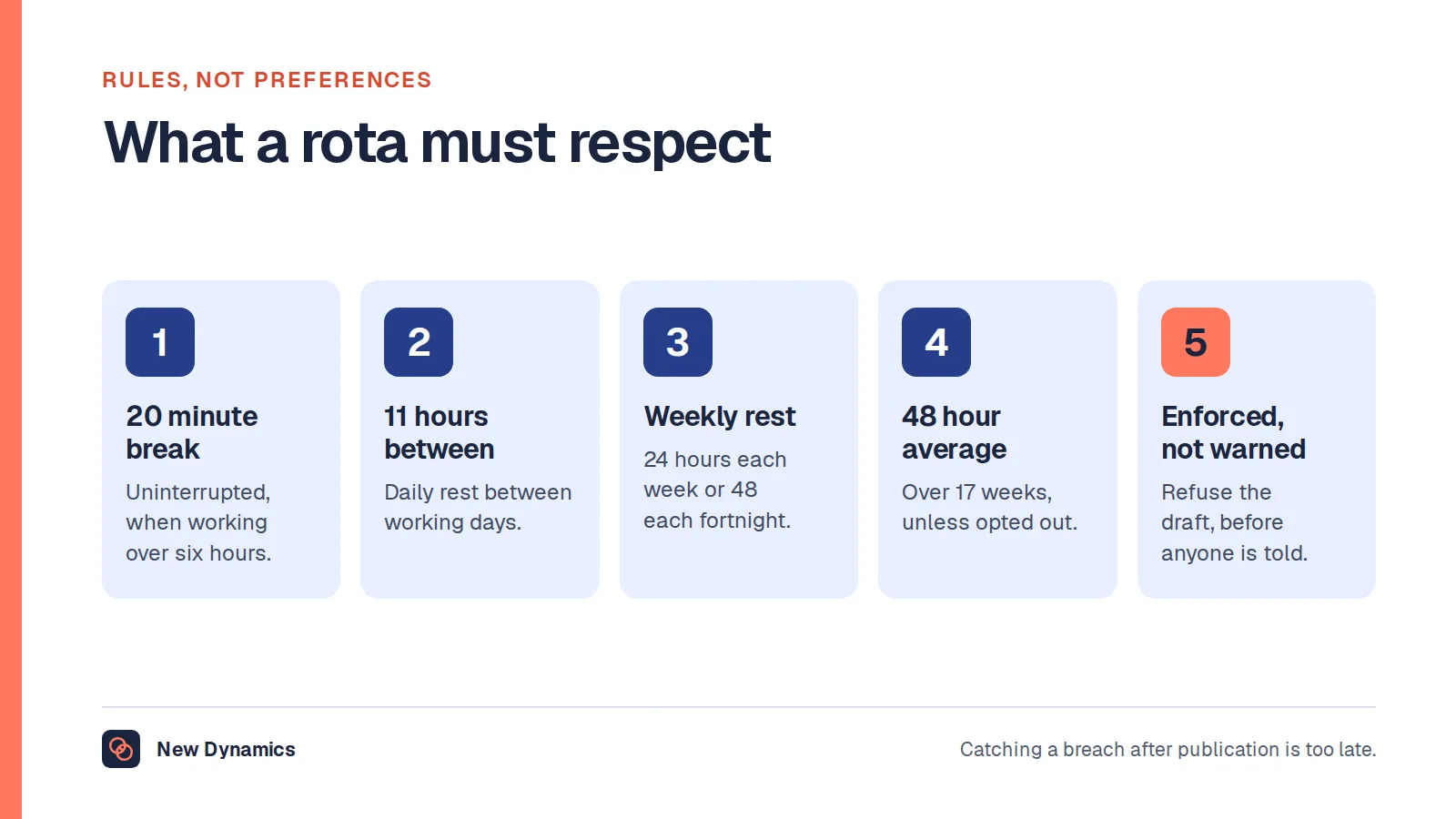
- In the United Kingdom a rota is constrained by the Working Time Regulations 1998: a 20 minute break when daily working time is more than six hours, 11 hours between working days, weekly rest, night limits averaged over 17 weeks, and records kept for two years. This is general information and not legal advice.
Someone has to decide who works Saturday. That decision usually gets made at the end of a shift, in a notebook or a spreadsheet, with three requests still unread on a phone. Then it is typed up, photographed, sent to a group chat, and a week later it happens again.
This article is about the act of making the schedule rather than about choosing a product. It covers what a rota has to satisfy before it is any good, how to build one step by step, the arithmetic of covering seven days out of the contracted hours you have, requests and swaps, how much notice is decent, what to do when somebody calls in sick, the rules that constrain any rota in the United Kingdom, the records you must keep, and what "free" really gets you. It names no products.
One thing to say plainly first. New Dynamics is a performance management platform for goals, feedback, recognition, reviews and onboarding. We do not sell rota building, so nothing here is a pitch for it. The closest thing we do is route a people process through stages and approvals, which is what New Dynamics workflows are for, and those run review cycles and onboarding rather than shifts. If your real question is which product to buy, employee scheduling software is the evaluation guide and time and attendance software covers recording the hours once worked. This post is about building the thing by hand.
What a schedule has to satisfy before it is any good

Rotas that cause trouble are usually drawn against one constraint while three others are quietly ignored. A finished schedule passes four tests at once.
Demand. Not opening hours, and not headcount. The hours the work actually arrives in. A shop open 09:00 to 17:00 does not need the same number of people at 09:30 as at 12:30. Write down, band by band, how many people you need and what they must be able to do. Everything else is arithmetic against that list.
Skills mix. Every shift needs the certificates, keys, seniority and languages it needs, not an average across the week. One first aider on site, one person who can cash up, one who can sign off the handover. Right on headcount and wrong on skills is the rota that fails at 06:00 on a Sunday.
Availability. What people have told you, in a form you can look at while you build. Availability that lives in a manager's memory is availability you will breach, and availability collected once in January is fiction by March.
Contracted hours, rest and limits. A part-time contract has a number in it and that number is a promise. Rest entitlements and working time limits are not preferences to be balanced against cover, they are the floor the rota sits on. The section on the rules that constrain any rota sets out the United Kingdom position with the sources.
A draft that satisfies three of the four is the dangerous kind, because it looks finished. Check all four before anyone sees it.
How to build a work schedule, step by step

The order matters more than the tool. Build in this sequence and you will rarely start again.
1. List the demand, day by day
Take a blank week and write the cover you need in each band of hours, using the bands your business actually changes in, which for most small employers means three or four a day rather than twenty-four rows. Total the hours. That number is your target, and the only one here that does not negotiate.
2. List the people, with their hours and skills
One line each: name, contracted hours a week, what they are qualified to do, days or times they cannot work, and anything agreed in writing. Agreed patterns belong in this list, not in your head. A flexible working arrangement sits here as a constraint rather than an exception.
3. Place the fixed shifts first
Nights, the one person who opens up, the agreed school-run pattern, approved holiday. Anything that cannot move goes on the grid before anything that can. Placing flexible people first and then finding a fixed constraint underneath them is why rotas get rebuilt three times.
4. Fill the gaps, then check
When the grid is full, stop and run four checks before you look at it as a rota again:
- Weekly hours per person against their contract, not against an average.
- The gap between the end of one shift and the start of the next, for every person, every day.
- Breaks, on every shift long enough to need one.
- Column totals against the demand list from step one, band by band.
Each catches a different mistake: an underused part-timer, a late finish before an early start, the Tuesday with four people on and two needed.
5. Publish it, and keep what you published
Publish in one place, on the same day of the week, every week. Keep a copy of exactly what you published, and record any later change with a date and a reason. That record is half the fairness story and most of the evidence story, and it takes seconds now and an afternoon to reconstruct later.
The arithmetic of covering seven days
Seven-day cover does not need seven fifths of the people. It needs more, and the gap is where overtime quietly lives. The numbers below are invented to show the method, so run it with your own.
A café opens 07:00 to 18:00, seven days a week, and needs two people from 07:00 to 10:00, three from 10:00 to 14:00 and two from 14:00 to 18:00. That is 6 plus 12 plus 8, so 26 hours of cover a day and 182 hours a week.
Now the people. Four full-timers at 37.5 hours is 150, and two part-timers at 16 hours is 32. Total: 182 hours. The rota balances exactly, and that is the problem.
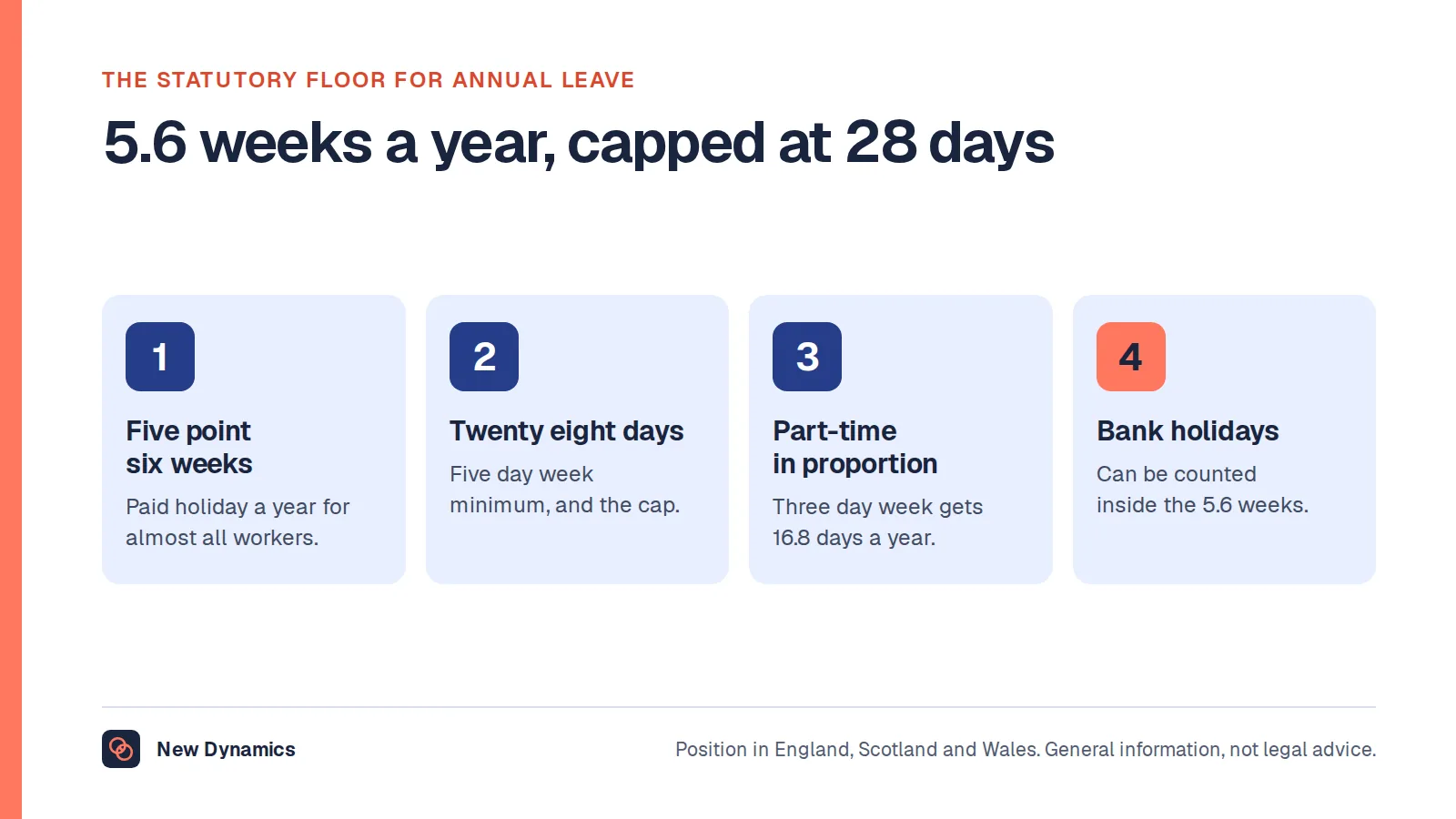
Holiday takes about a week in nine. GOV.UK states that "Almost all people classed as workers are legally entitled to 5.6 weeks' paid holiday a year", and that "Most workers who work a 5-day week must receive at least 28 days' paid annual leave a year". Spread 5.6 weeks across 52 and roughly eleven per cent of your contracted hours are unavailable on average, which on 182 hours is about 20 hours a week spoken for before anybody is ill.
Unpaid breaks are not cover. A nine-hour shift containing a 30 minute unpaid break delivers 8.5 hours of cover for 9 hours on the grid. Across a week of long shifts that is a shift in itself.
Training, sickness and the handover eat the rest, predictably in aggregate and unpredictably on the day.
So the honest planning number for 182 hours of cover is around 200 to 210 contracted hours, or 182 plus a standing budget line for overtime and agency cover. The arithmetic will not let you pick neither. Our post on overtime pay covers what the second option costs once it becomes routine.
Finally, 182 hours across six people averages about 30 hours each, well inside the weekly limit, but if one willing person absorbs every gap it is their average you watch.
Laying out a free rota in a spreadsheet, by hand

For a team of up to about twenty-five people, a spreadsheet is a real answer rather than a consolation prize. Almost nobody writes down how to lay one out, so here it is.
One file, one tab per week. Name each tab for the Monday it starts, as 2026-11-09, so they sort. Keep a Template tab at the front and copy it rather than editing last week's. Never edit a published tab: copy it, add a v2 to the name, and record what changed.
The grid. Row 1 holds the dates. Column A holds names, column B contracted hours, columns C to I Monday to Sunday. Put the shift in the cell as plain text in one format, such as 07:00-15:30 (30), where the bracketed number is the unpaid break in minutes. Be consistent: you will read hundreds of these cells.
The numeric mirror. Text shifts cannot be added up, and three columns per day turns a readable rota into a 21 column monster nobody will print. So build a second grid lower down the tab, same shape, holding only paid hours as a number: 07:00-15:30 with a 30 minute unpaid break is 8. Type it once, with the shift.
The totals. To the right of the numeric grid, sum each row for weekly hours per person and put the contract beside it. Under the grid, sum each column for hours rostered that day, put the hours you needed from step one in a row above, and subtract one from the other in a third row. Colour it so anything other than zero is obvious. That block is the whole cover check, and it updates itself.
The rest gap column. This is the one a spreadsheet does badly, so do not pretend otherwise. Add a column where you write that person's tightest turnaround that week, by eye, from last night's finish to this morning's start. To calculate it, store finishes and starts as real times in helper columns and compute the next start plus 24 hours minus the finish. Be careful with anything crossing midnight, because that is where spreadsheet rotas give a confident wrong answer.
A requests tab. Five columns: date requested, person, what they asked for, decided on, decision. Every request goes in, including the declined ones. It is the only defence you will have against a reasonable accusation of favouritism.
A published copy. When the rota goes out, export the week's tab to PDF into a folder named by date. That is your record of what you published, as distinct from what the live file says now.
What it costs you. For a team of ten, building the template takes an afternoon. After that, expect forty-five to ninety minutes a week to draw the rota and run the checks, plus the mid-week changes, which really take the time. That is the honest price of free, and for many small employers it is the right price.
What "free" actually gets you
A spreadsheet, a shared calendar or a printed grid on the wall gets you the schedule itself, which is most of the value. Be clear-eyed about five things it does not get you.
- Nothing stops a breach. A formula cannot see an eleven hour gap or a 17 week average. Every check is one you remember to run.
- No per-person view. Everyone sees the whole grid, or a photograph of it, which is how last week's version keeps circulating.
- No change log. A cell edited on Thursday looks exactly like a cell that was always that way.
- Availability gets retyped, which means retyped wrongly, and the mistake lands on the person who told you correctly.
- No cost before you publish. The week's wage bill is knowable, but only separately.
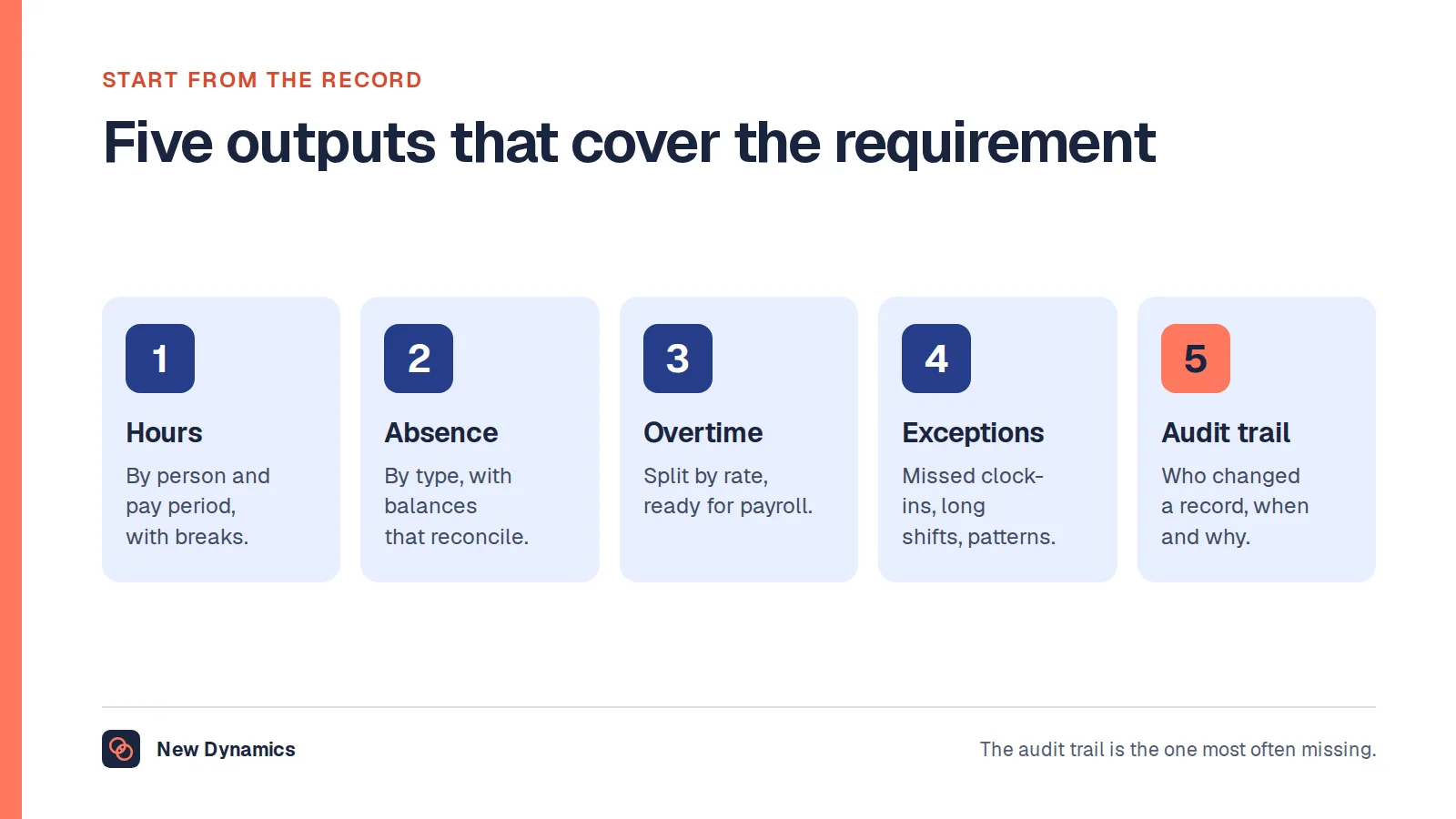
Paid tools, described in shape rather than by name, generally add a rules engine that refuses or warns on a breach, a per-person app, mechanics for swaps and open shifts, availability collected from the person rather than typed by the manager, a cost preview on the draft, an export to payroll, and an audit trail of every edit. Whether that is worth money depends on how many of those five gaps cost you something today.
This site does not publish vendor rankings, and will not name, rank, compare or price products in this category. The reasons are in why we do not publish a top 5 HRIS list: rankings can be shaped by commercial relationships a reader cannot see, and even an honest one cannot know your contract types, opening hours, skills requirements or whether half your team has a work email address.
Scheduling programme, job scheduling program, staff scheduling online
The same job has collected a lot of names, and the differences are mostly about where the file lives.
Scheduling programme or job scheduling program usually means software that assigns people to jobs or shifts. In an industrial or IT context it sometimes means a batch job scheduler, which runs computer tasks rather than people, so check which one is meant before shortlisting anything.
Staff scheduling online and cloud based employee scheduling mean the rota lives on a server rather than one laptop. The real benefit is not the cloud, it is that one current version exists and everybody is looking at it. A shared spreadsheet in a drive that syncs gets you most of that, which is why the free route survives.
Employee work schedule maker and create schedule for employees are usually typed by somebody who needs the rota done tonight, not a procurement decision by Friday. Use the five steps and the spreadsheet layout above, and come back to the software question when the rota is out.
Requests and swaps, handled fairly
Fairness in a rota is almost entirely procedural. People accept a decision that went against them if they can see the rule that produced it.
One route in. Requests arrive in one place, in writing, by a stated deadline. Not in the corridor, not to whoever is on shift. One made in the corridor gets written into the requests tab by the manager who heard it.
One rule for ties. Decide in advance how you choose when two people want the same Saturday off, write it down, and apply it. Rotation, first in or seniority are all defensible. Deciding afresh each time is what gets you a reputation.
Swaps go through the rota, not around it. Two people agreeing between themselves is fine, as long as the swap is reported, checked against skills and rest, and recorded. An unrecorded swap means your rota no longer says who was on site, which matters for pay and for safety.
Not everything can be swapped. Say so up front: a shift needing a specific certificate can only move to someone who holds it.
The Health and Safety Executive makes the same point from the safety side, advising employers to "Develop a policy that specifically addresses and sets limits on working hours, overtime and shift-swapping, and which guards against fatigue", and noting that "Problems with overtime and shift-swapping may indicate inadequate resource allocation and staffing levels". If swap volume is high, the rota is probably wrong rather than your team being awkward.
Publishing the rota, and how much notice is decent
None of the official United Kingdom sources opened for this article sets a minimum notice period for publishing a rota. The Working Time Regulations 1998 govern hours and rest, not how far ahead you tell people. Notice is therefore a matter for the contract and for decency, which means the standard is yours to set and yours to defend.
What is a legal requirement is being clear about hours in the first place. GOV.UK guidance on the written statement of employment particulars says the principal statement must include "hours and days of work and if and how they may vary (also if employees or workers will have to work on Sundays, during the 'night period' or take overtime)", provided "on the first day of employment". If your rota pattern does not match that statement, fix the statement rather than the rota.
Three habits do most of the work:
- A fixed publication day. Two or three weeks ahead is a reasonable aim, and consistency matters as much as distance. People can plan around a rota that always arrives on Wednesday.
- A stated cut-off for requests, far enough before publication that you can use them.
- A rule for changes after publication. Who can make one, what reason it needs, and that the person affected is told directly rather than finding out on the wall.
If you want one number to measure, count the proportion of shifts that change after publication. It is usually fixed by rota design rather than better software.
When someone calls in sick
The call comes at eleven at night or six in the morning. Decide the order of resort now.
- Check what the shift actually needs. Sometimes it needs two people and three are rostered, and the answer is nothing.
- Offer it to everyone eligible, at once. One message to the people with the right skills and the rest window, rather than individual calls that reward whoever answers first.
- Check rest before accepting an offer. The volunteer who finished at ten last night is the one most likely to breach daily rest, and willingness does not change the entitlement.
- Then consider shortening or merging the shift, reduced service, or agency, in the order that fits your business.
- Record what you did: who covered, who approved it, what it cost.
Two things to avoid. Do not let the same two or three reliable people absorb every gap, because that is how a 17 week average creeps up and how good people leave. And do not make covering feel compulsory in a way the contract does not support: once saying no becomes expensive, your availability data stops being true.
The rules that constrain any rota in the United Kingdom
This section describes the position in the United Kingdom. It is general information and not legal advice, and anything specific to your contracts, sector or a particular worker should be checked with a professional adviser.
Rest breaks during the day. Regulation 12(1) of the Working Time Regulations 1998 provides that "Where a worker's daily working time is more than six hours, he is entitled to a rest break", and regulation 12(3) sets it as "an uninterrupted period of not less than 20 minutes, and the worker is entitled to spend it away from his workstation if he has one". Acas adds two points a rota must respect: "a 12-hour shift does not mean they're entitled to a 40-minute break, but the employer should consider it", and the break should be "taken during the working day, not at the start or end of the day".
Daily rest. GOV.UK states that "Workers have the right to 11 hours rest between working days", and regulation 10(1) puts it as "a rest period of not less than eleven consecutive hours in each 24-hour period during which he works for his employer". This is the rule a late finish followed by an early start breaks, and the one a spreadsheet will never warn you about.
Weekly rest. GOV.UK gives the entitlement as either "an uninterrupted 24 hours without any work each week" or "an uninterrupted 48 hours without any work each fortnight". Regulation 11(1) words it as "an uninterrupted rest period of not less than 24 hours in each seven-day period", with 11(2) allowing the fortnightly alternative.
Maximum weekly hours. GOV.UK states that "You cannot work more than 48 hours a week on average", "normally averaged over 17 weeks", and that "You can choose to work more by opting out of the 48-hour week". The reference period is the part people forget: one heavy week is not a breach, five in a row might be.
Night work. GOV.UK defines the night period as "11pm to 6am, unless the worker and employer agree a different night period" and states that "Night workers must not work more than an average of 8 hours in a 24-hour period", with that average "usually calculated over 17 weeks, but it can be over a longer period of up to 52 weeks if the workers and the employer agree". Regular overtime counts towards it and occasional overtime does not, nobody can opt out of the night limit the way they can opt out of the 48 hour week, and night workers dealing with special hazards or work involving mental or physical strain "cannot work longer than 8 hours in any 24-hour period" rather than on average.
Young workers. GOV.UK states that "If you're under 18, you cannot work more than 8 hours a day or 40 hours a week", and the regulations set their rest higher than an adult's. Regulation 12(4) gives a young worker whose daily working time is more than four and a half hours a break of "at least 30 minutes, which shall be consecutive if possible", regulation 10(2) gives daily rest of "not less than twelve consecutive hours in each 24-hour period", and regulation 11(3) weekly rest of "not less than 48 hours in each seven-day period". On nights, staff aged 16 or 17 "cannot work between midnight and 4am" and usually cannot work between 10pm and 6am, with named exceptions including agriculture, hospitals, hotels and catering and retail. Build those into the template rather than remembering them each week.
Rules are a floor, not a safe rota. The Health and Safety Executive is explicit that "Compliance with the Working Time Regulations alone is insufficient to manage the risks of fatigue" and that "Changes to working hours need to be risk assessed". The same guidance, on a page dated 12 January 2026, states that "More than 3.5 million people are employed as shift workers in the UK". HSE names no reference period for that count, so treat it as its stated scale rather than a dated statistic. For figures we can date properly, see our HR statistics hub.
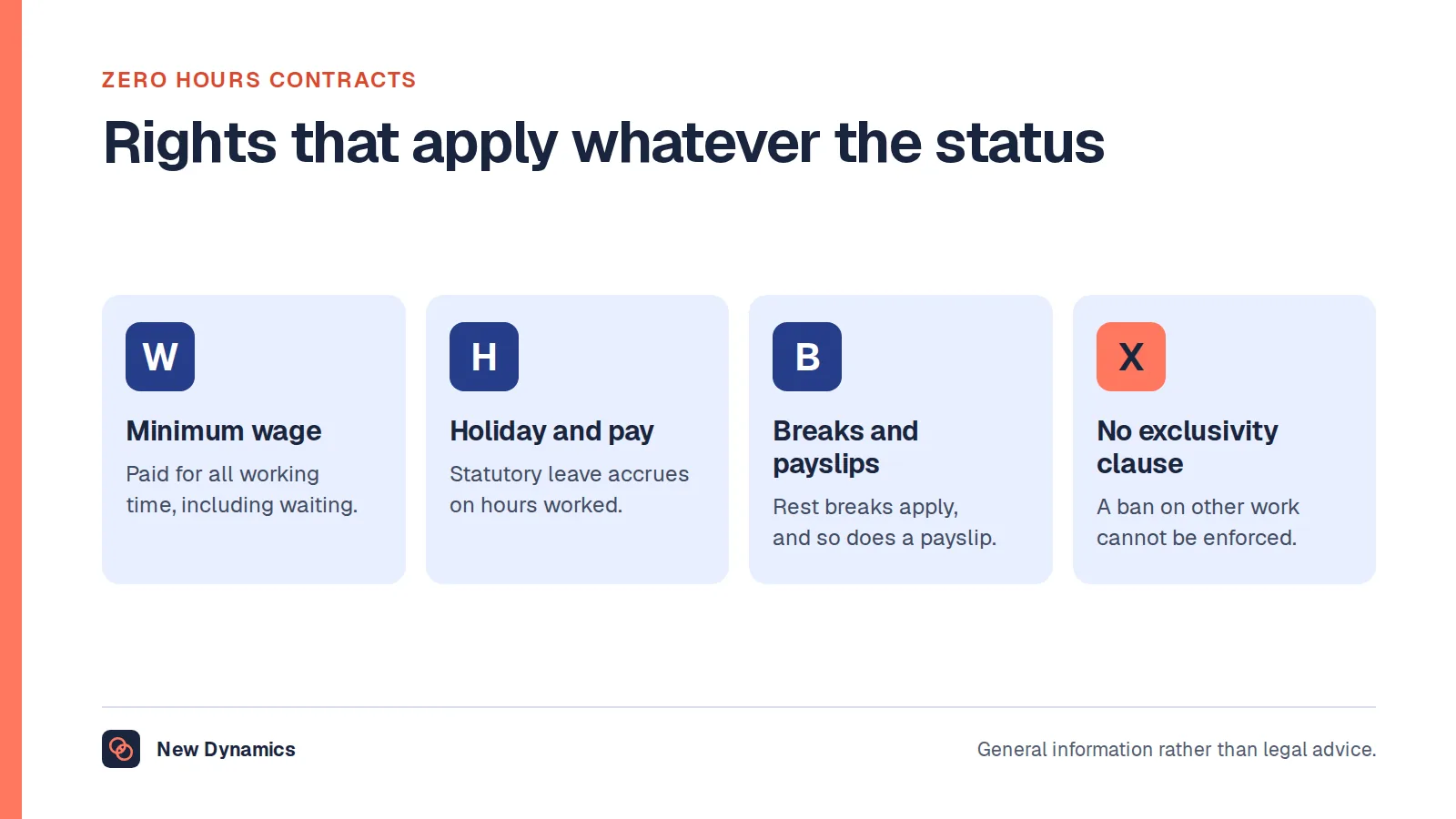
Some rota questions are really contract questions. If hours vary week to week, zero hours contracts covers what that means for both sides, and holiday entitlement covers how leave accrues on irregular hours.
The record you have to keep
The record is smaller than most people assume, and required for longer.
Regulation 9 of the Working Time Regulations 1998 requires an employer to "keep records which are adequate to show whether the employer has complied with the limits specified in regulations 4(1), 5A(1) and 6(1) and (7) and the requirements in regulations 6A and 7(1) and (2)", and to "retain such records for two years from the date on which they were made". Two further paragraphs matter for anyone keeping a rota by hand. Records "may be created, maintained and kept in such manner and format as the employer reasonably thinks fit", and "An employer need not record each worker's daily working hours in order to comply with paragraph (1) if the employer is able to demonstrate compliance without doing so".
Acas states the same duty in operational terms. An employer "does not need to keep records of all daily working hours", but must keep records proving that "workers are not working more than the 48-hour weekly maximum" unless they have an opt out agreement, that "they are not breaking limits for night working", that "they have offered regular health assessments for night workers" and that "young workers are not working during a restricted period", kept "for 2 years from the date they were made". For night workers, GOV.UK adds that records "must be kept for at least 2 years".
In practice the PDF of every published rota, the requests tab and a note of post-publication changes covers this, in a folder that costs nothing. Pay records are a separate obligation with a longer retention period, set out in our post on time and attendance software, and the record of hours actually worked is a different document from the rota you planned. For how those hours get captured, see the employee time clock.
Frequently asked questions
How do I make a work schedule online for free?
Use a spreadsheet in a drive that syncs, so everybody has one current version. Lay it out as one tab per week named for the Monday date, one row per person, one column per day, a numeric mirror of the grid lower down so hours can be totalled, weekly hours beside each contract, and daily totals against the cover you need.
What should a work schedule include?
Names, the date of each day, the start and finish of each shift, the unpaid break, the hours each person is rostered that week, their contracted hours for comparison, and the skills each shift requires. Alongside the grid, keep the requests with their decisions and a copy of what you published.
How many hours of cover do I need for seven days?
Add the hours in each band of the day, multiply by the people that band needs, then multiply by seven. Plan contracted hours above that total, not equal to it. Holiday alone is 5.6 weeks a year for almost all workers, roughly a week in nine, and an unpaid break means a rostered shift delivers less cover than its length suggests.
How much notice should staff get of their rota?
No official United Kingdom source opened for this article sets a minimum notice period for publishing a rota, so this is a matter for the contract and for decency rather than a statutory figure. Two or three weeks on a fixed publication day works for most small teams, and consistency helps more than distance. The contract does have to be clear about hours and days of work from day one.
What are the rest break rules for a UK rota?
Where daily working time is more than six hours a worker is entitled to an uninterrupted break of at least 20 minutes, away from their workstation, falling during the day rather than at either end. Workers also have 11 hours rest between working days and either 24 hours without work each week or 48 hours each fortnight. Young workers get more: 30 minutes after four and a half hours, 12 hours daily rest, 48 hours weekly rest. General information for the United Kingdom, not legal advice.
How long do I have to keep rota records?
Two years from the date the records were made, under regulation 9 of the Working Time Regulations 1998. They must be adequate to show the working time limits were respected, and you need not log every worker's daily hours if you can demonstrate compliance another way. Pay records carry a longer retention period of their own.
Your next step: build next week's rota in this order
- Write the cover you need, band by band, for one week. Total it.
- Add up the contracted hours you have, subtract about eleven per cent for holiday, and decide where the difference comes from.
- Build the template once: grid, numeric mirror, weekly totals, daily totals against demand, rest gap column, requests tab.
- Set a publication day and a request cut-off, and tell people both.
- Count how many shifts changed after publication last month. That is your real scheduling problem.
Rota stability is one of the clearest things a small employer controls that shows up in who stays. For the wider picture, read and download our employee retention guide. The guide is free to read, and the PDF uses our short download form.
If the conversation you want to fix is how the work is going rather than when it happens, that is the part we do. Book a New Dynamics demo and bring the review form you use today. You can also email contact@new-dynamics.com.