TL;DR
- SDI is State Disability Insurance, a state deduction, not a federal tax. The Department of Labor's own chapter on the subject says that "federal law does not provide for a federal-state TDI system".
- Only six programmes exist. The same chapter states: "Currently, six states operate TDI programs: California, Hawaii, New Jersey, New York, Puerto Rico, and Rhode Island."
- California removed its SDI wage ceiling. The Employment Development Department states that the 2026 withholding rate is 1.3 percent and that Senate Bill 951 "removes the taxable wage limit and maximum withholdings for each employee subject to SDI contributions" from 1 January 2024.
A deduction appears on a pay stub labelled SDI, or CASDI, or sometimes just DI, and nobody in the office can say what it funds or why a colleague in another state does not have it. The honest short answer is that it is a state deduction for a state insurance programme, and that most Americans never see it because most states do not run one.
Jurisdiction: United States. SDI stands for State Disability Insurance, and this article is about the state-level payroll deduction of that name. It is not a federal tax, it does not exist in most states, and it has no counterpart in the United Kingdom. If you are reading a UK payslip and looking for SDI, skip to the last section. Every figure below names the year it applies to and the page it came from. This is general information, not tax or legal advice.
Payroll questions like this one usually arrive at HR before they reach payroll, and they stall because nobody owns the answer. See how New Dynamics workflows give each step an owner and a due date so a query is closed rather than forwarded. New Dynamics does not run payroll, so this is background rather than product documentation.
SDI means State Disability Insurance, and it is not federal
SDI pays partial wages to a worker who cannot work because of illness, injury or pregnancy that did not happen at work. That last part matters: an injury at work is workers' compensation, a different system with a different funder.
The key structural fact is in the US Department of Labor's own treatment of the subject. Chapter 8 of the Department's Comparison of State Unemployment Insurance Laws, the 2023 edition, covers temporary disability insurance and says plainly that "the Temporary Disability Insurance (TDI) program is designed to complement a UI program by providing wage replacement to individuals who are unable to work due to illness or injury that occurs not in connection to the work", and that "although federal law does not provide for a federal-state TDI system, SSA and FUTA both authorize the payment of TDI from a state's unemployment fund".
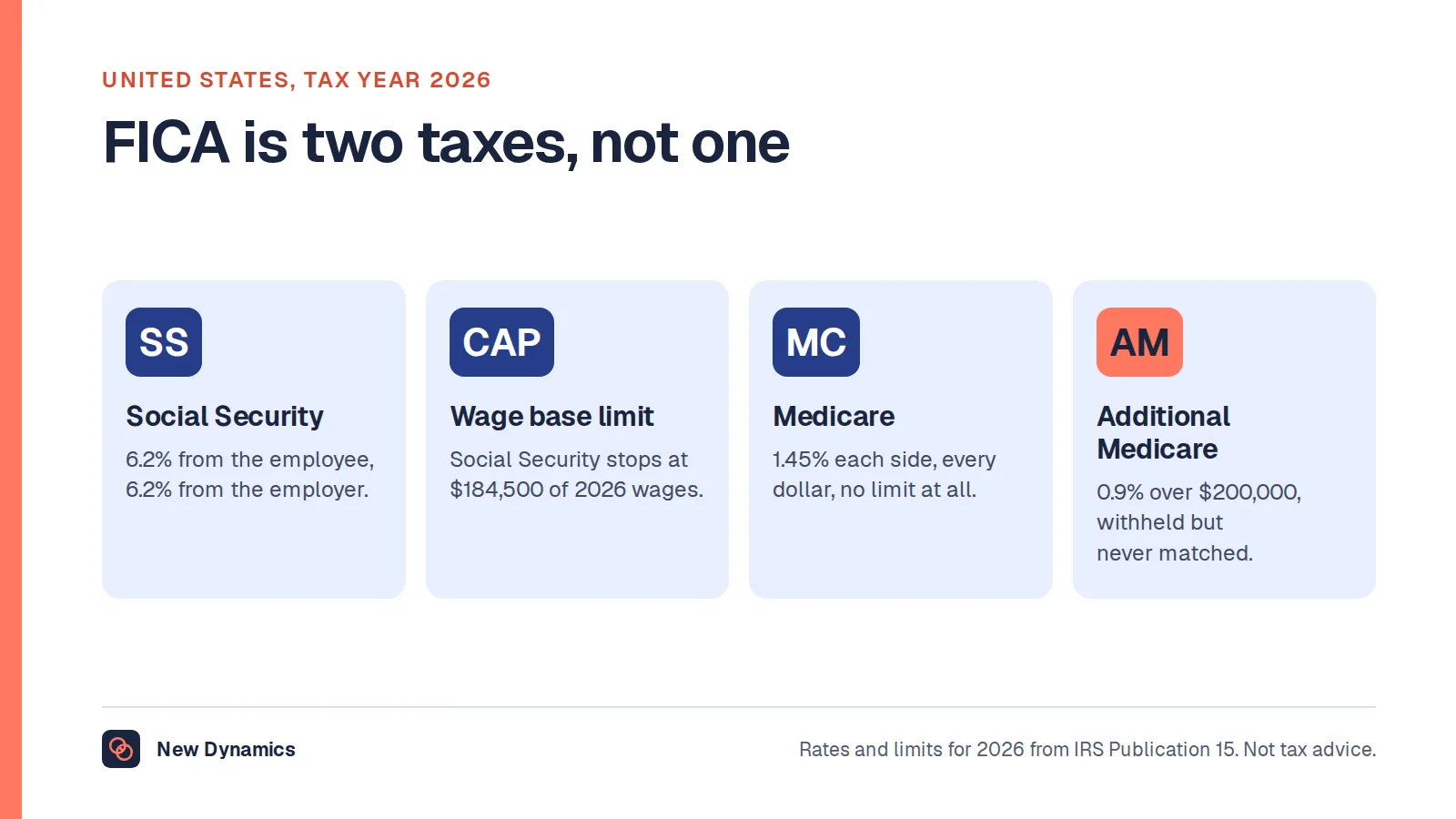
So there is no federal SDI. There is no IRS SDI rate. Anyone who tells you the federal SDI rate for this year is describing something that does not exist. The federal payroll deductions are Social Security and Medicare, which our post on calculating FICA tax covers, and they are a separate matter entirely.

Which states operate one, and why the list is so short
The same chapter states: "Currently, six states operate TDI programs: California, Hawaii, New Jersey, New York, Puerto Rico, and Rhode Island." The Department counts Puerto Rico in that sentence, so in plain terms it is five states plus Puerto Rico. The same chapter's historical note records that "Rhode Island passed the first TDI law in 1942, followed by California in 1946, New Jersey in 1948, New York in 1949, Puerto Rico in 1968, and Hawaii in 1969". Nothing has been added since.

That is the whole list. If your pay stub shows a deduction labelled SDI and you work outside those jurisdictions, something else is going on. The most common explanation is a newer paid family and medical leave programme travelling under a loose label. The Department of Labor's Women's Bureau page on paid leave sets out that wider picture, and confirms the gap SDI fills: "there is currently no federal law providing or guaranteeing access to paid family and medical leave for workers in the private sector". The same page records that "thirteen states and the District of Columbia have laws that create paid family and medical leave programs for eligible workers", and that Hawaii and Puerto Rico additionally have temporary disability leave laws.
Those thirteen paid leave programmes are not SDI. They are a newer family of state schemes with their own deduction codes, rates and wage bases, and treating them as the same thing is how a payroll gets a rate wrong.
Each programme has its own administrator. The Department of Labor chapter names two: "the Hawaii program is administered by the Disability Compensation Division of the Hawaii Department of Labor and Industrial Relations", and "the New York program is administered by the New York State Workers' Compensation Board". The rest sit with the state employment security agency, meaning the Employment Development Department in California, the Department of Labor and Workforce Development in New Jersey, and the Department of Labor and Training in Rhode Island.
Who pays: the employee in most, the employer in some
Here is the sentence that answers the question most readers actually have. The Department of Labor chapter, 2023 edition, states: "All six states require employees to pay contributions to finance TDI, while of the six, only four states require employers to pay TDI contributions."
So the employee pays something everywhere a programme exists. Whether the employer pays too, and how much, varies. Three worked examples, each taken from the state's own agency:
California: the employee, and only the employee. The Employment Development Department's overview of state payroll taxes says that "Unemployment Insurance (UI) and Employment Training Tax (ETT) are employer contributions" while "State Disability Insurance (SDI) and Personal Income Tax (PIT) are withheld from employees' wages". It repeats the point: "SDI is a deduction from employees' wages. Employers withhold a percentage for SDI on all subject wages."
Hawaii: the employer carries at least half. The Disability Compensation Division's page on temporary disability insurance states that "the employer may pay for the entire cost of providing TDI coverage, or the employer may share the cost equally with the employees eligible for coverage. However, the employee's contribution cannot exceed 0.5% of the employee's weekly wages, nor the maximum weekly deduction."
New York: the employer may deduct, but is not obliged to. The Workers' Compensation Board's page for employees on disability benefits is specific: "Your employer is allowed, but not required, to take a contribution from you to offset the cost of providing disability benefits. Your contribution is calculated at the rate of one half of one percent of your wages, but no more than 60 cents a week (WCL §209)." Where more than one job is involved, the page adds that "the combined contributions may not exceed 60 cents per week".
New Jersey charges both sides, and does something that catches payroll teams out: it applies two different wage bases to the same programme. The state's contribution rate information gives, for 1 January 2026 to 31 December 2026, a worker Disability Insurance rate of 0.0019 and a worker Family Leave Insurance rate of 0.0023. The page then lists the 2026 taxable wage base for worker disability and family leave contributions as $171,100, and the base that applies to employers for disability insurance as $44,800. Same programme, two ceilings, depending on which side is paying.
For the wider question of what an employer may lawfully take off pay, see our post on payroll deductions.
How SDI appears on a pay stub, and on a W-2
On a pay stub, the deduction is rarely spelled out. California stubs usually show CASDI or CA SDI, sometimes with an EE suffix for the employee share. New York stubs often show NY DBL, for disability benefits law. New Jersey stubs typically carry separate NJ DI and NJ FLI lines. Hawaii and Rhode Island stubs normally use TDI.

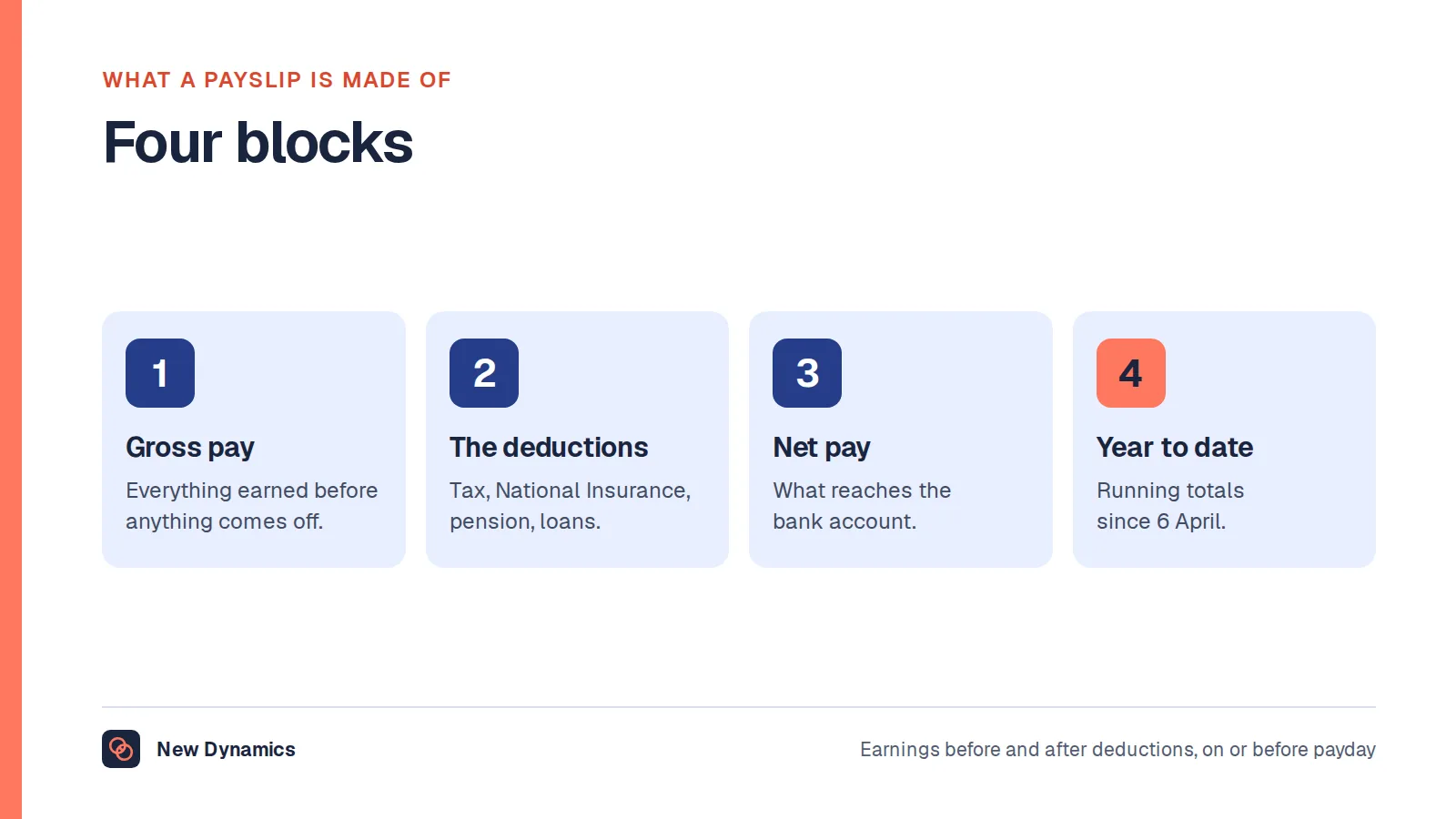
The practical rule: read the state prefix before the acronym, because the acronym alone does not tell you which programme, rate or wage base applies. Our post on reading a pay stub line by line walks through the rest of the page.
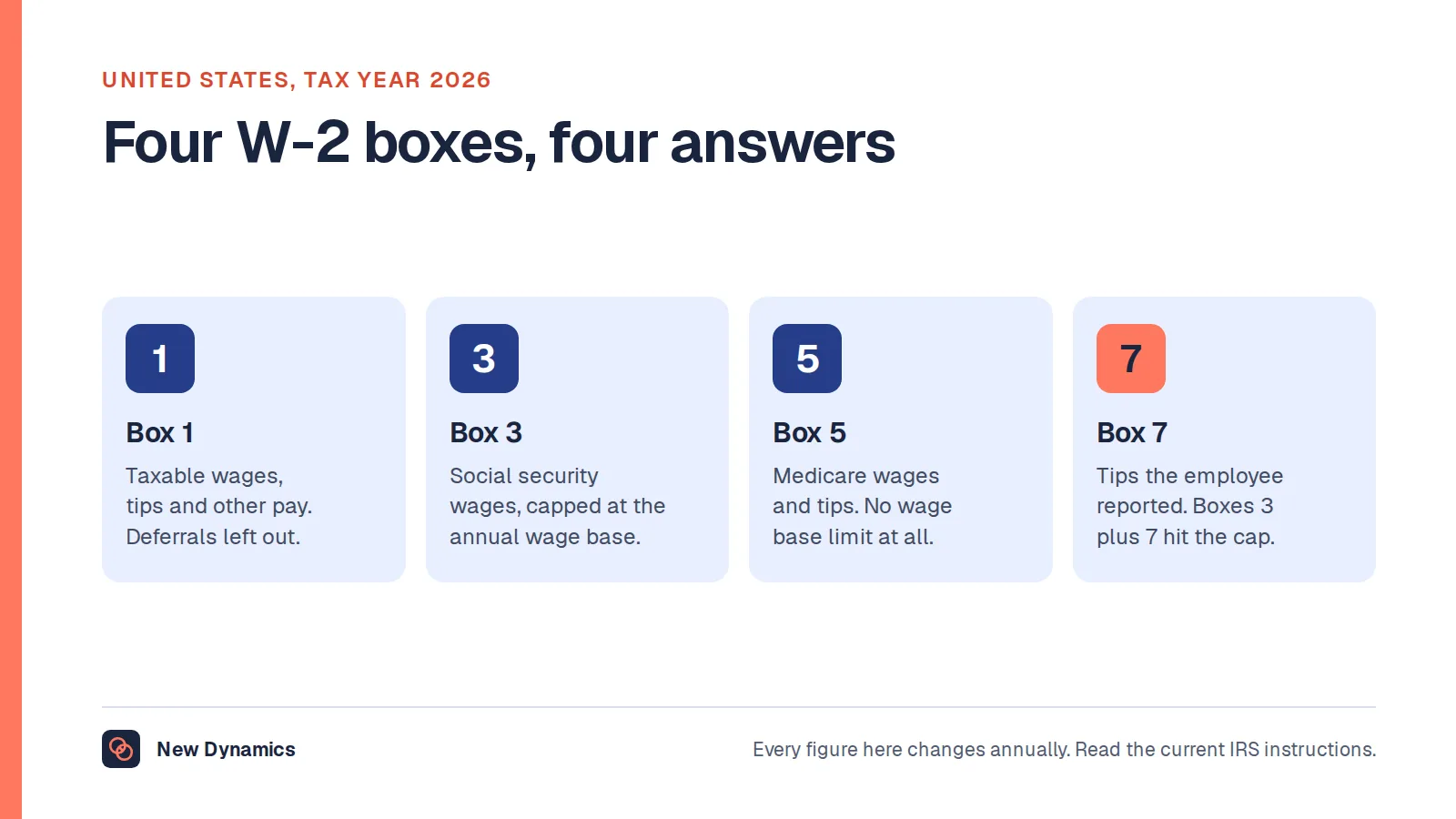
On the annual form, SDI does not get a numbered box of its own. The IRS General Instructions for Forms W-2 and W-3 put it in the free text box, and name the item explicitly: "You may also use this box for any other information that you want to give to your employee. Label each item. Examples include state disability insurance taxes withheld, union dues, uniform payments, health insurance premiums deducted, nontaxable income, educational assistance payments, or a minister's parsonage allowance and utilities."
One change is worth noting if you are reconciling a current form. The same instructions record that "box 14 on the 2026 Forms W-2, W-2AS, W-2GU, W-2VI, and W-2c has been revised", and that "box 14 has been split into box 14a and box 14b". The information previously reported in the box 14 Other field now goes in the box 14a Other field, so the SDI figure a payroll used to put in box 14 now belongs in box 14a. Our post on the W-2 form covers the rest of the layout.
Paid family leave often rides the same deduction
This is the part that produces the most confused queries, because in California there is no second deduction to point at.
The Employment Development Department's overview states: "The SDI program provides temporary benefit payments to workers for non-work-related illness, injury, or pregnancy. SDI tax also provides Paid Family Leave (PFL) benefits. PFL is a part of SDI and extends benefits to people who can't work because they need to" care for a seriously ill family member, bond with a new child, or deal with a qualifying event arising from a family member's military deployment.
One deduction, two sets of benefits. A California employee asking why there is no separate PFL line on the stub has the answer: there is not supposed to be one, because the SDI withholding funds both.
New Jersey does the opposite and splits them, which is why a New Jersey stub carries a DI line and an FLI line at different rates. Neither design is wrong, but a payroll configured for one state's labelling will mis-map the other's.
Rates and wage ceilings are set per state, per year
There is no single SDI rate, and any figure quoted without a state and a year attached to it is unusable. California is the clearest illustration, because both its rate and its ceiling have moved recently.
The Employment Development Department's page on rates and withholding gives the figures year by year. For 2026 it states: "The SDI withholding rate for 2026 is 1.3 percent. Effective January 1, 2024, Senate Bill 951 removes the taxable wage limit and maximum withholdings for each employee subject to SDI contributions." The same page shows 1.2 percent for 2025 and 1.1 percent for 2024, and it already publishes 2027: "The SDI withholding rate for 2027 is 1.4 percent. Effective January 1, 2024, all wages are subject to SDI contributions."
Read the second half of those sentences as carefully as the first. California has no SDI wage ceiling. It removed the taxable wage limit and the maximum withholding from 1 January 2024, so the rate applies to all subject wages with nothing to cap it. A high earner in California now pays 1.3 percent of everything in 2026, where before 2024 the deduction stopped once the wage limit was reached. On a monthly gross of $5,000 that is $65 a month, and the arithmetic does not change at the top of the pay scale.
This is also where a lot of published guidance is stale, including some official material. The Department of Labor's 2023 chapter still carries a table listing a California taxable wage base of $153,164 and a 2023 California rate of 0.9 percent. Both are out of date, and the Employment Development Department page governs: it is the administering agency, it is the newer publication, and it names Senate Bill 951 as the reason the limit went. Where a federal summary and a state agency disagree about a state's own rate, take the state agency.
For the other programmes, take the number from the agency and the year, not from an article. New Jersey publishes worker and employer rates and both wage bases on the contribution rate page linked above, on a calendar year basis for workers and a July to June fiscal year for employers. Hawaii's employee share is capped as a percentage of weekly wages and by a maximum weekly deduction that the Disability Compensation Division sets annually. New York's cap of 60 cents a week sits in the Workers' Compensation Law itself, which is why it has not moved for a long time. Rhode Island's Department of Labor and Training sets its rate and wage base annually, and the most recent Rhode Island figures we could verify are in the Department of Labor's 2023 chapter, which lists no employer contribution and an employee contribution of 1.1 percent of the taxable wage base. Treat that as a 2023 position and confirm the current year with the agency before you run payroll on it.
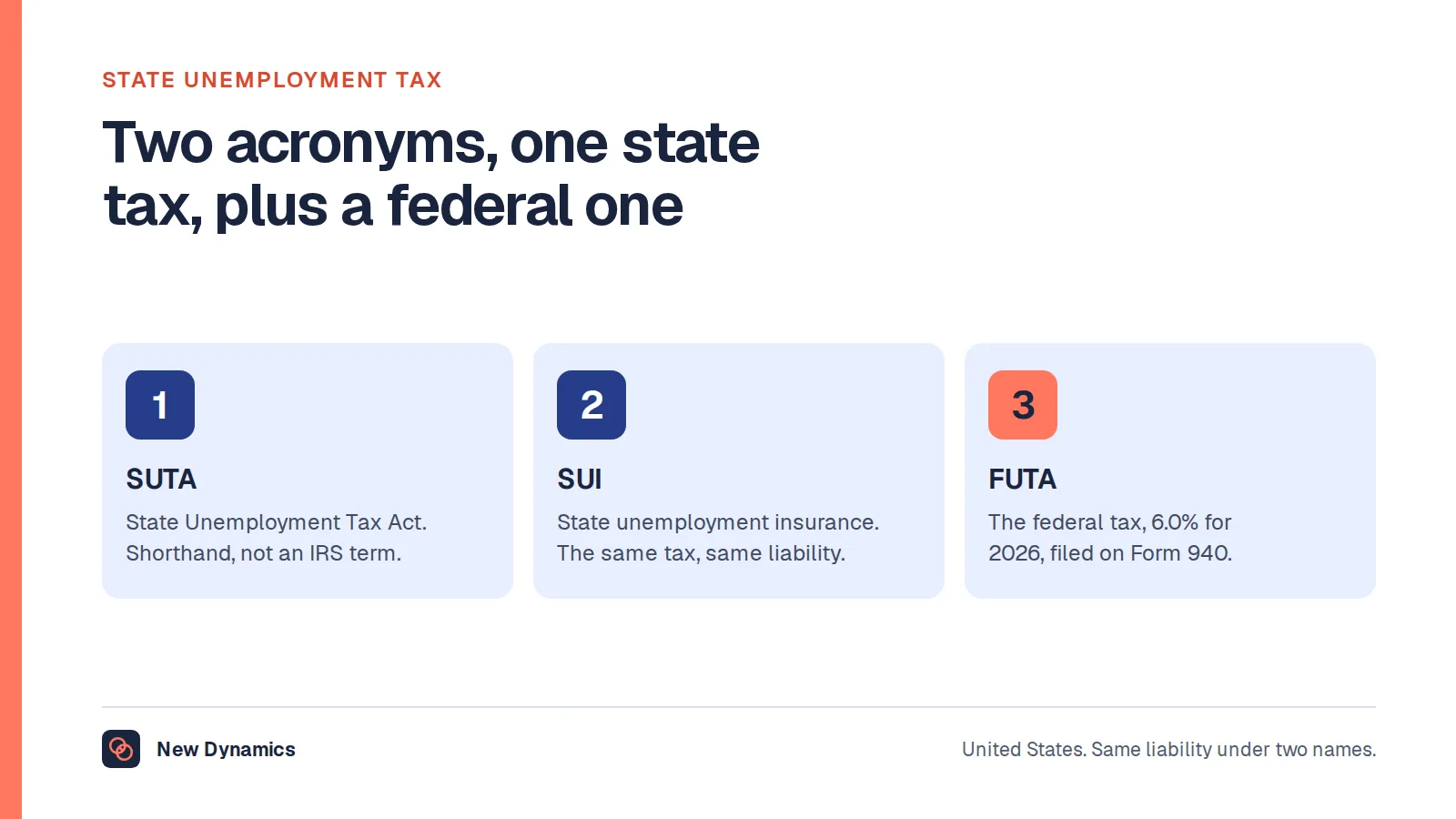
The same discipline applies to state unemployment tax, which sits beside SDI on the same stub and is usually an employer cost. Our post on SUTA and SUI sets out that one, and the wider figures we track live on the HR statistics hub.
If you are in the United Kingdom, there is no SDI
Say this clearly, because the search brings UK readers to American pages every day.
The United Kingdom has no equivalent deduction. There is no SDI line, no state disability insurance contribution, and nothing on a UK payslip that corresponds to one. A UK payslip shows income tax, National Insurance, pension contributions, student loan repayments and whatever has been agreed contractually. If you are looking at a line marked SDI, you are almost certainly looking at an American pay stub, most likely a Californian one.
The UK handles short-term sickness differently. It is not funded by a dedicated worker deduction at all; the employer pays it. GOV.UK's guidance on Statutory Sick Pay states: "You can get up to £123.25 per week Statutory Sick Pay (SSP) if you're too ill to work. It's paid by your employer for up to 28 weeks." The same page adds that "you cannot get less than the statutory amount" and that you can get more where a company sick pay scheme applies.
That is the real comparison. A Californian pays a percentage of every dollar into a state fund that pays the benefit. A British employee pays nothing specific, and the employer pays the benefit directly. For the policy side of that, see our post on writing a sick leave policy.
Frequently asked questions
What does SDI stand for on my paycheck?
State Disability Insurance. It is a state-level deduction that funds partial wage replacement when you cannot work because of an illness, injury or pregnancy that did not arise at work. An injury that happened at work goes through workers' compensation instead.
Is SDI a federal tax?
No. The Department of Labor's chapter on temporary disability insurance states that "federal law does not provide for a federal-state TDI system". There is no federal SDI rate and no IRS SDI box. The federal payroll deductions are Social Security and Medicare.
Which states have an SDI tax?
Six programmes exist. The Department of Labor's 2023 chapter says: "Currently, six states operate TDI programs: California, Hawaii, New Jersey, New York, Puerto Rico, and Rhode Island." No new programme has been added since Hawaii's in 1969.
What is the CA SDI rate for this year?
The Employment Development Department states that "the SDI withholding rate for 2026 is 1.3 percent", with 1.2 percent for 2025 and 1.4 percent already published for 2027. Confirm the year you are paying in on the agency's rates page, because it changes most years.
Is there still a California SDI wage limit?
No. The Employment Development Department says that "effective January 1, 2024, Senate Bill 951 removes the taxable wage limit and maximum withholdings for each employee subject to SDI contributions". The rate applies to all subject wages, so there is nothing to cap the deduction at the top of the pay scale.
Does the employee or the employer pay SDI?
Both, depending on the state. The Department of Labor's 2023 chapter states that "all six states require employees to pay contributions to finance TDI, while of the six, only four states require employers to pay TDI contributions". California withholds from the employee only. Hawaii requires the employer to meet at least half the cost. New York allows but does not require an employee contribution.
Where does SDI appear on a W-2?
In the free text box, labelled. The IRS instructions name "state disability insurance taxes withheld" as an example of what belongs there. For 2026 forms that box has been split, and the instructions say the information previously reported in box 14 now goes in box 14a.
Is SDI the same thing as paid family leave?
In California they share one deduction. The Employment Development Department states that "PFL is a part of SDI". In New Jersey they are separate lines with separate rates. Check the state before you assume either.
Does the UK have an SDI deduction?
No. The United Kingdom has no equivalent deduction and nothing on a UK payslip corresponds to one. Short-term sickness is covered by Statutory Sick Pay, which GOV.UK says is "paid by your employer for up to 28 weeks".
Your next step: three facts per state, per year
- For each state where you have employees, write down whether a disability insurance programme exists at all. In most states it does not, and a deduction labelled SDI there needs explaining.
- Where one does exist, record who contributes, the rate for the calendar year, and the wage base if there is one. California has no wage base for SDI any more. New Jersey has two.
- Record the deduction code you use on the pay stub, with the state prefix in it. CASDI, NY DBL and NJ DI are not interchangeable, and a shared code across states produces the wrong figure somewhere.
- Diarise the agency's rate announcement. California publishes the next year's SDI rate well before January, which is why 2027 is already on the page.
- Check the box 14a split before you file 2026 forms, because the instruction changed for that year.
For setting pay in a way you can explain to the people it applies to, read and download our compensation policy guide. The guide is free to read, and the PDF uses our short download form.
Want payroll and employment questions to have an owner and a date rather than a good intention? Book a New Dynamics demo and bring your current process. You can also email contact@new-dynamics.com.