TL;DR
- Validity is statutory, not a matter of drafting taste. Section 203(3) of the Employment Rights Act 1996 requires the agreement to be in writing, to relate to the particular proceedings, to name an insured relevant independent adviser who advised the employee, and to state that the conditions are satisfied.
- A protected conversation and a without prejudice conversation are different protections. Section 111A makes pre-termination negotiations inadmissible only in a complaint under section 111, which is unfair dismissal. Without prejudice needs an existing dispute but can cover any claim.
- The £30,000 tax threshold is narrower than its reputation. HMRC's Employment Income Manual states that the threshold in section 403 ITEPA 2003 "does not apply to post-employment notice pay", and employer Class 1A National Insurance is due above £30,000 at 15% for 2026 to 2027.
A settlement agreement is the only routine way an employee can validly give up the right to bring an employment claim. The law does not leave that to the drafting: it sets conditions, and an agreement that misses one does not bind the employee at all.
Two things go wrong most often. Employers treat "protected conversation" as a blanket, when the protection reaches one kind of claim. And both sides assume the first £30,000 is tax free, when the rule has been narrower since 2018. This article covers validity, the two confidentiality protections, which claims survive a signature and how the payment is taxed. It describes the position in England, Wales and Scotland and is general information, not legal advice. If an agreement has been put in front of you, take advice on that document, because signing ends claims you cannot get back.
Settlement conversations often start because nobody can evidence the performance story. See how New Dynamics performance reviews keep goals, feedback and ratings attached to the cycle, so the record exists before anyone needs it.
What a settlement agreement is
Acas, in its guidance on using settlement agreements (last updated 25 March 2026), defines it as "a document that sets out the terms and conditions for settling an employment dispute", and notes they "used to be called 'compromise agreements'". That renaming was statutory, made by the Enterprise and Regulatory Reform Act 2013 on 29 July 2013.
It need not end employment. Acas: "A settlement agreement can be used without ending an employment relationship." It can also be made with a former worker or a job applicant, because a discrimination claim can be brought by someone who never got the job.
The conditions for a valid settlement agreement
Start with section 203(1) of the Employment Rights Act 1996, which legislation.gov.uk records as up to date with all changes in force on or before 7 November 2026. Any provision in an agreement is void "in so far as it purports to exclude or limit the operation of any provision of this Act, or to preclude a person from bringing any proceedings under this Act before an employment tribunal". Those words cover the statutory redundancy payment and the right to claim unfair dismissal.
Contracting out is void by default, and a settlement agreement is one of the narrow exceptions. It works only if the six conditions in section 203(3) are met. The agreement must be in writing, must "relate to the particular proceedings", must "identify the adviser" and must state that the conditions are satisfied. The adviser's insurance must be in force "when the adviser gives the advice". And the employee or worker "must have received advice from a relevant independent adviser as to the terms and effect of the proposed agreement and, in particular, its effect on his ability to pursue his rights before an employment tribunal".

The second condition quietly invalidates agreements. The Acas statutory Code of Practice on settlement agreements, in effect by order of the Secretary of State on 29 July 2013, notes at paragraph 4: "Simply saying that the agreement is in 'full and final settlement of all claims' will not be sufficient to contract out of employment tribunal claims."
Who counts as a relevant independent adviser
Section 203(3A) lists a qualified lawyer, meaning under section 203(4) someone authorised under the Legal Services Act 2007 for a right of audience or the conduct of litigation, or in Scotland an advocate or a solicitor with a practising certificate; a trade union officer, official, employee or member "certified in writing by the trade union as competent to give advice and as authorised to do so"; an advice centre worker certified the same way; and anyone specified in an order by the Secretary of State. Section 203(3B) then disqualifies anyone who "is, is employed by or is acting in the matter for the employer or an associated employer", any union or advice centre that is itself the employer, and an advice centre worker the employee pays. Acas adds that the employer "should consider offering to pay the cost of any independent advice. They do not have to do this."
Section 111A, and what a protected conversation does not cover
"Protected conversation" is not a statutory phrase. The provision behind it is section 111A of the Employment Rights Act 1996, inserted on 29 July 2013 by sections 14 and 103(3) of the Enterprise and Regulatory Reform Act 2013 and up to date with all changes in force on or before 5 November 2026. The first subsection carries the whole limit: "Evidence of pre-termination negotiations is inadmissible in any proceedings on a complaint under section 111."
Section 111 is the complaint of unfair dismissal, and that is the entire reach. Subsection (2) defines pre-termination negotiations as "any offer made or discussions held, before the termination of the employment in question, with a view to it being terminated on terms agreed between the employer and the employee".
Paragraph 7 of the Acas Code names the gaps. "Claims that relate to an automatically unfair reason for dismissal such as whistleblowing, union membership or asserting a statutory right are not covered by the confidentiality provisions set out in section 111A. Neither are claims made on grounds other than unfair dismissal, such as claims of discrimination, harassment, victimisation or other behaviour prohibited by the Equality Act 2010, or claims relating to breach of contract or wrongful dismissal."
Subsection (4) adds the exception that costs employers the protection: where something said or done "was improper, or was connected with improper behaviour", subsection (1) "applies only to the extent that the tribunal considers just".
Without prejudice is a different protection with a different trigger
The Code sets the distinction out directly. Without prejudice is "a common law principle (i.e. non-statutory) which prevents statements (written or oral), made in a genuine attempt to settle an existing dispute, from being put before a court or tribunal as evidence". It needs a dispute to already exist. Section 111A does not, and "can apply where there is no existing employment dispute".
Scope runs the other way. Acas states that the without prejudice principle "can apply to any type of legal claim, for example: unfair dismissal, breach of contract, discrimination, wages". Paragraph 22 of the Code closes the loop: "In court or tribunal proceedings other than unfair dismissal claims, such as discrimination claims, section 111A does not apply."

The tests for losing each protection differ. Without prejudice falls away on "unambiguous impropriety", which Acas describes as serious wrongdoing such as blackmail, fraud, intimidation, physical violence or threats. Section 111A falls away on "improper behaviour", a wider test. Paragraph 21 draws the consequence: because unambiguous impropriety "is a narrower test than that of improper behaviour", a negotiation against an existing dispute is harder to drag into evidence than one held out of the blue.
What counts as improper behaviour
Paragraph 18 gives a non-exhaustive list: harassment, bullying and intimidation "including through the use of offensive words or aggressive behaviour"; physical assault or its threat; victimisation; discrimination on the protected grounds; and "putting undue pressure on a party". One example is specific enough to quote: "An employer saying before any form of disciplinary process has begun that if a settlement proposal is rejected then the employee will be dismissed."
Reasonable time has a number. Paragraph 12: "As a general rule, a minimum period of 10 calendar days should be allowed to consider the proposed formal written terms of a settlement agreement and to receive independent advice, unless the parties agree otherwise." Acas adds that employers "must make reasonable adjustments for someone who's disabled".
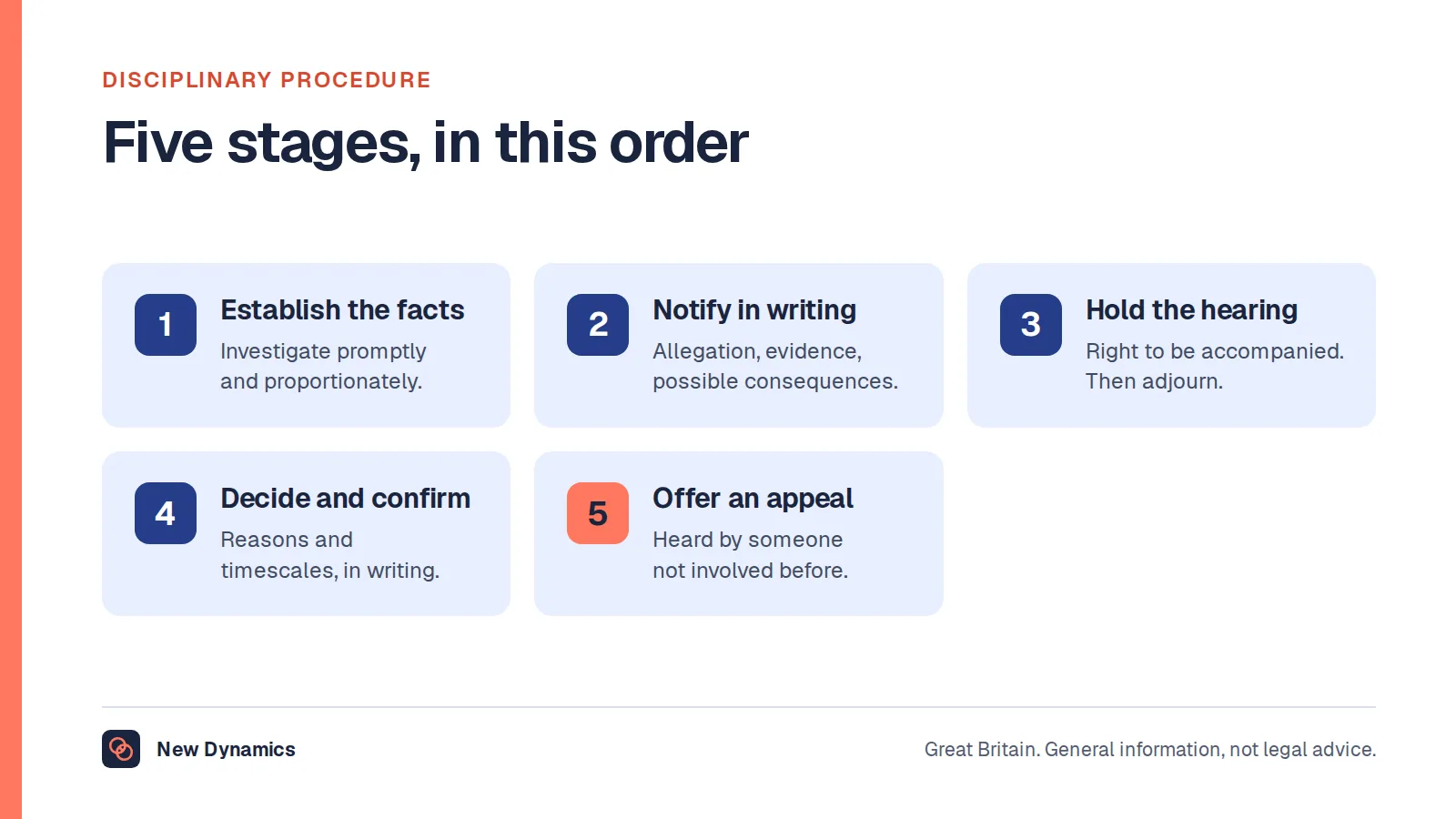
Paragraph 19 protects normal negotiation: nothing stops a party "setting out in a neutral manner the reasons that have led to the proposed settlement agreement, or factually stating the likely alternatives if an agreement is not reached". The line falls between stating the alternatives and announcing the outcome. For the process that must run if the offer is refused, see our post on the disciplinary procedure.
What a settlement agreement cannot sign away
Acas states that employers "cannot use a confidentiality clause to stop a worker" whistleblowing, reporting a crime to the police, or seeking advice and support as a victim of crime in England or Wales.
A newer restriction reaches further. Section 202A of the Employment Rights Act 1996, inserted for specified purposes on 6 January 2026 by section 24(2) of the Employment Rights Act 2025, voids any provision in an employer and worker agreement "in so far as it purports to preclude the worker from making an allegation of, or a disclosure of information relating to, relevant harassment or discrimination", or about the employer's response to it. Subsection (3) lets the Secretary of State set conditions by regulations for an "excepted agreement". No such regulations appear on legislation.gov.uk under that description at the time of writing, so treat the prohibition as the current position.
Acas records a connected change: "From 6 April 2026 sexual harassment is a 'qualifying disclosure' under whistleblowing law", so a dismissal for making that disclosure is automatically unfair, and automatically unfair dismissals sit outside section 111A.
Settlement against redundancy: not alternatives
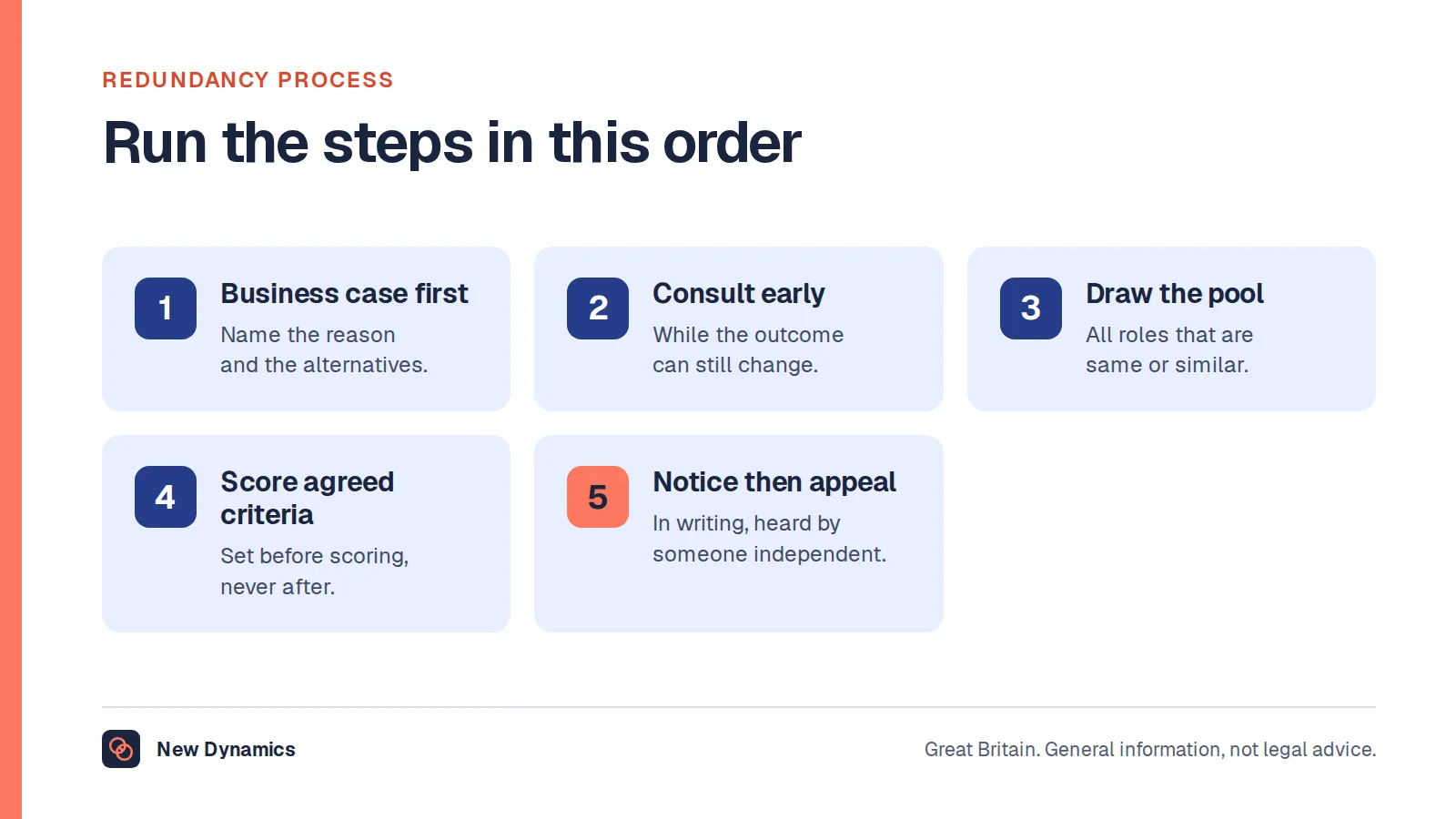
A settlement agreement is a contract. Redundancy is a reason for dismissal carrying statutory entitlements, and one does not replace the other. Acas is explicit: "If an employer offers someone voluntary redundancy and they sign a settlement agreement, this still counts as a redundancy", and "voluntary redundancies must be included when checking whether collective consultation is needed." Settling ten people quietly and dismissing twelve more is not a twelve-person exercise. Section 203(1) also voids any attempt to cut the statutory redundancy payment. Our post on the redundancy process covers the order of the steps, and severance pay covers what the leaving figure is made of.
How the payment is taxed
The official sources speak at different resolutions. Acas, writing for a general reader, says "You do not usually pay tax or National Insurance on the first combined £30,000 of" compensation for giving up the right to claim and redundancy pay, and that wages, bonuses, commission, holiday pay and payment in lieu of notice are usually taxed.
HMRC governs the question, and is more precise. Section 403(1) of the Income Tax (Earnings and Pensions) Act 2003, up to date with changes in force on or before 6 November 2026, provides that a payment counts as employment income "if and to the extent that it exceeds the £30,000 threshold". HMRC's Employment Income Manual at EIM13505, updated on 3 November 2026, states the limit folklore leaves out: "This threshold does not apply to post-employment notice pay."

Post-employment notice pay is calculated using the formula at section 402D ITEPA 2003, and HMRC's EIM13874 says an employer must run it "whether or not the employee, or former employee receives a contractual, or non-contractual PILON". Since 6 April 2018 that element is taxed as general earnings with no threshold. Statutory redundancy payments stay inside it.
Employer National Insurance is the half nobody budgets for. GOV.UK's rates and thresholds for employers 2026 to 2027, covering 6 April 2026 to 5 April 2027, states that "Class 1A National Insurance contributions are due on the amount of termination awards paid to employees which are over £30,000", at a Class 1A rate of 15%. No official source publishes how many UK terminations are settled this way; our HR statistics hub collects the figures that are published.
What happens to a tribunal claim once it is signed
Paragraph 10 of the Code states the effect in a line: "Where the parties sign a valid settlement agreement, the employee will be unable to bring an employment tribunal claim about any type of claim which is listed in the agreement." The word "listed" carries the weight, because claims the agreement does not name are not settled by it.
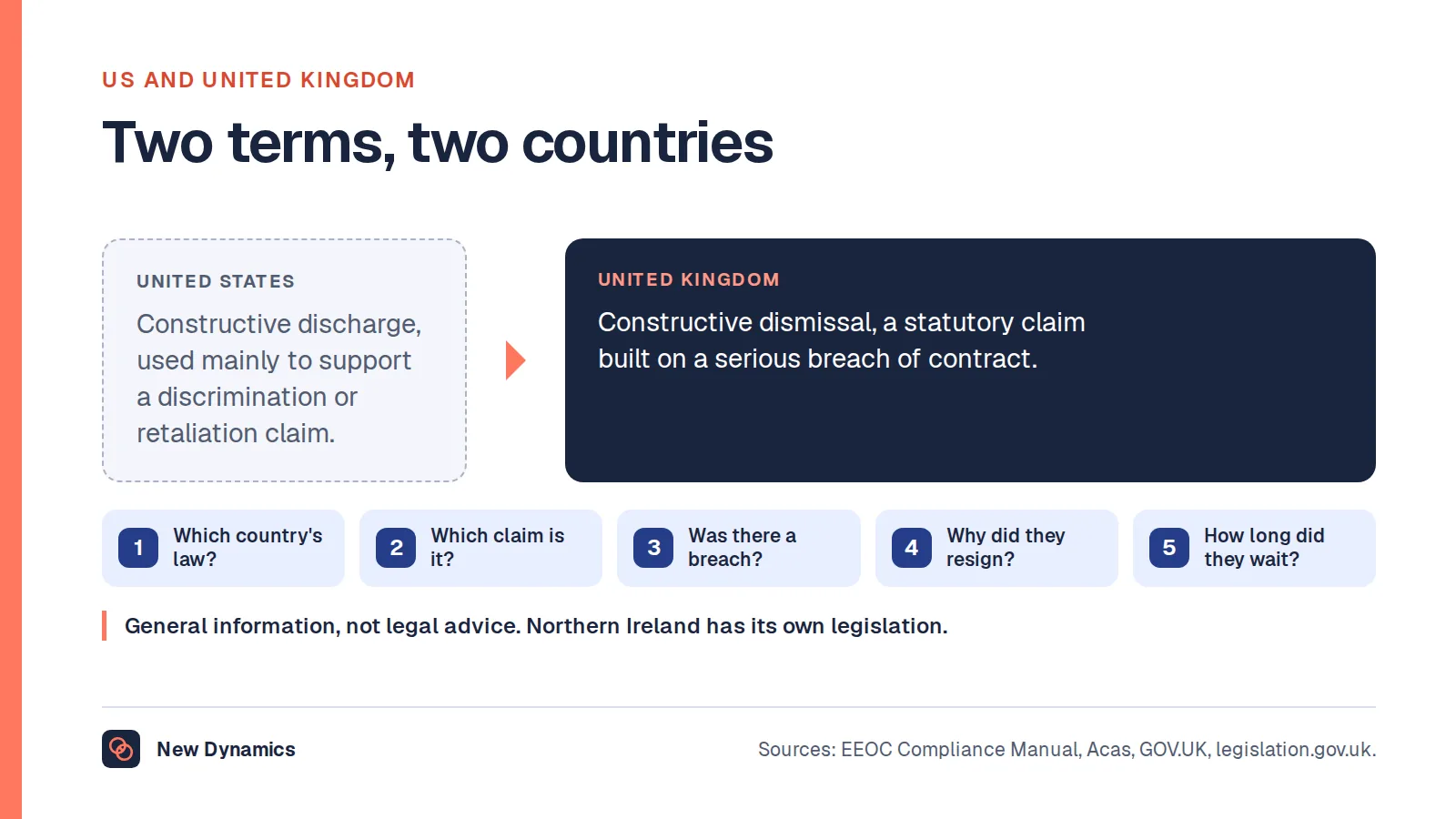
Enforcement afterwards is a contract matter rather than a tribunal one. Acas: "By law, if the terms of a settlement agreement are broken it's a breach of contract", and the claim goes to the county court in England and Wales or the sheriff court in Scotland. Where the agreement follows an exit the employee says was forced, our post on constructive discharge covers the sequencing that decides whether a claim exists at all.
Frequently asked questions
What is a settlement agreement?
Acas defines it as a document that sets out the terms and conditions for settling an employment dispute. It is a legally binding contract in which a worker gives up the right to bring the particular claims listed in it, usually for a payment.
Do I have to take legal advice before signing a settlement agreement?
Yes, for the agreement to be valid. Section 203(3)(c) of the Employment Rights Act 1996 requires advice from a relevant independent adviser on the terms and effect of the agreement and on the ability to pursue tribunal rights. The adviser must be insured and named in the agreement.
Is a protected conversation the same as a without prejudice conversation?
No. Without prejudice requires an existing dispute and can cover any type of claim. Section 111A of the Employment Rights Act 1996 needs no dispute but makes pre-termination negotiations inadmissible only in a complaint of unfair dismissal under section 111. Both can apply to one conversation.
Which claims are not covered by section 111A?
Automatically unfair dismissal claims, including whistleblowing, trade union activity and asserting a statutory right, and all claims on other grounds. The Acas Code names discrimination, harassment, victimisation and other conduct prohibited by the Equality Act 2010, plus breach of contract.
How long should I get to consider a settlement agreement?
The Acas Code says that as a general rule a minimum of 10 calendar days should be allowed to consider the formal written terms and receive independent advice, unless the parties agree otherwise. Not allowing a reasonable period is one of the Code's examples of improper behaviour.
Is the first £30,000 of a settlement payment tax free?
Only in part. Section 403 of the Income Tax (Earnings and Pensions) Act 2003 sets a £30,000 threshold, but HMRC states it does not apply to post-employment notice pay, taxed as general earnings since 6 April 2018. Employer Class 1A National Insurance is due above £30,000, at 15% for 2026 to 2027.
Can I still claim at a tribunal after signing a settlement agreement?
Not for any claim the agreement lists, if the agreement is valid. The Acas Code says a worker who signs a valid agreement cannot bring a tribunal claim about any type of claim listed in it. Claims it does not name are not settled.
Your next step: check the document, not the summary of it
- Read the claims clause and list what it names. An agreement settling "all claims" without naming them has not met section 203(3)(b).
- Check that the agreement identifies the adviser and states that the statutory conditions are satisfied.
- Ask for the payment split into notice, holiday, statutory redundancy pay and compensation, then check how post-employment notice pay was calculated.
- Count the days you were given. Fewer than 10 calendar days on the written terms is the Code's own example of undue pressure.
- Take advice on your own agreement from a relevant independent adviser. Nothing here is advice on your document.
For the process an employer must run when the alternative to settling is a reduction in roles, read and download our redundancy and workforce change guide. The guide is free to read, and the PDF uses our short download form.
Want the performance record to exist before the difficult conversation rather than after it? Book a New Dynamics demo and bring your current review form. You can also email contact@new-dynamics.com.