TL;DR
- The phrase does double duty. GOV.UK says a contract 'is an agreement that sets out an employee's' employment conditions, rights, responsibilities and duties, and that 'These are called the "terms" of the contract'. Those are the conditions that govern the job. A conditional offer sets a different kind: things that must be satisfied before the job starts at all.
- A condition only protects you if you wrote it down. Acas says a job offer letter should state 'whether it's a "conditional job offer"' and that 'You can withdraw the job offer if the applicant did not meet the offer's conditions'. Where no conditions were set, Acas warns, 'it's known as an unconditional job offer. Withdrawing it could be against the law'.
- The written statement deadline is tighter than most employers assume. Acas says 'You must provide this on or before the person's first day of work', and section 1 of the Employment Rights Act 1996 says 'the statement must be given not later than the beginning of the employment'.
Two people can ask what the conditions of employment are and mean entirely different things. A hiring manager means the checks standing between an accepted offer and a start date. The person who accepted means the hours, the pay, the holiday and the notice. Both are right, and most writing on the subject answers only one of them.
The distinction matters because the two behave differently in law. A condition satisfied before employment starts is something you can rely on to pull the offer, but only if you said so at the time. A condition that governs the job once it has started is a contractual term, and you cannot change it by sending a new document. Confuse the two and you get the commonest mistake here: treating a term as though it were still a condition.
This article covers both: wording a conditional offer, which pre-start conditions are compulsory, what to do when one fails after someone has started, the written statement deadline, statutory floors, the terms nobody wrote down, and varying conditions later.
The load falls on whoever runs the handover from offer to start date, because the checks and the paperwork have different owners and the same deadline. See how New Dynamics onboarding puts the offer conditions and the day one documents on one visible path.
This article covers employment in England, Scotland and Wales, where the GOV.UK, Acas and legislation.gov.uk material quoted below applies. Northern Ireland has its own employment legislation and guidance, so check the position there separately. It is general information rather than legal advice, and anything touching immigration status, criminal records, health or dismissal is worth a professional read first.
What "conditions of employment" actually means
Start with the official phrasing, because GOV.UK uses the term in a specific way. On employment contracts it says a contract "is an agreement that sets out an employee's" employment conditions, rights, responsibilities and duties, and then: "These are called the 'terms' of the contract."
So in the government's own vocabulary, employment conditions are one of four things a contract contains, and the whole set is called the terms. That is why "terms and conditions of employment" is not a redundancy: people use it to mean the lot, from pay to notice.
That is sense one. Sense two comes from contract law rather than employment guidance: a condition precedent, meaning something that must happen before an obligation takes effect. Applied to hiring, it is the mechanism behind every offer letter that says the job depends on a satisfactory reference.
The two senses sit on either side of the start date. Before it, a condition is a hurdle. After it, a promise. The practical test: ask whether it is something the person must prove, or something you must provide.

Both senses share one feature. The contract exists earlier than people expect, because GOV.UK says "As soon as someone accepts a job offer they have a contract with their employer." A conditional offer does not delay the contract. It creates one whose operation depends on the conditions being met. For where contractual terms come from, see our post on the employment contract.
Conditions precedent: what must be true before employment starts
This is the half that gets skipped. Here are the conditions employers set, and the rule behind each.
The right to work check, which is not optional
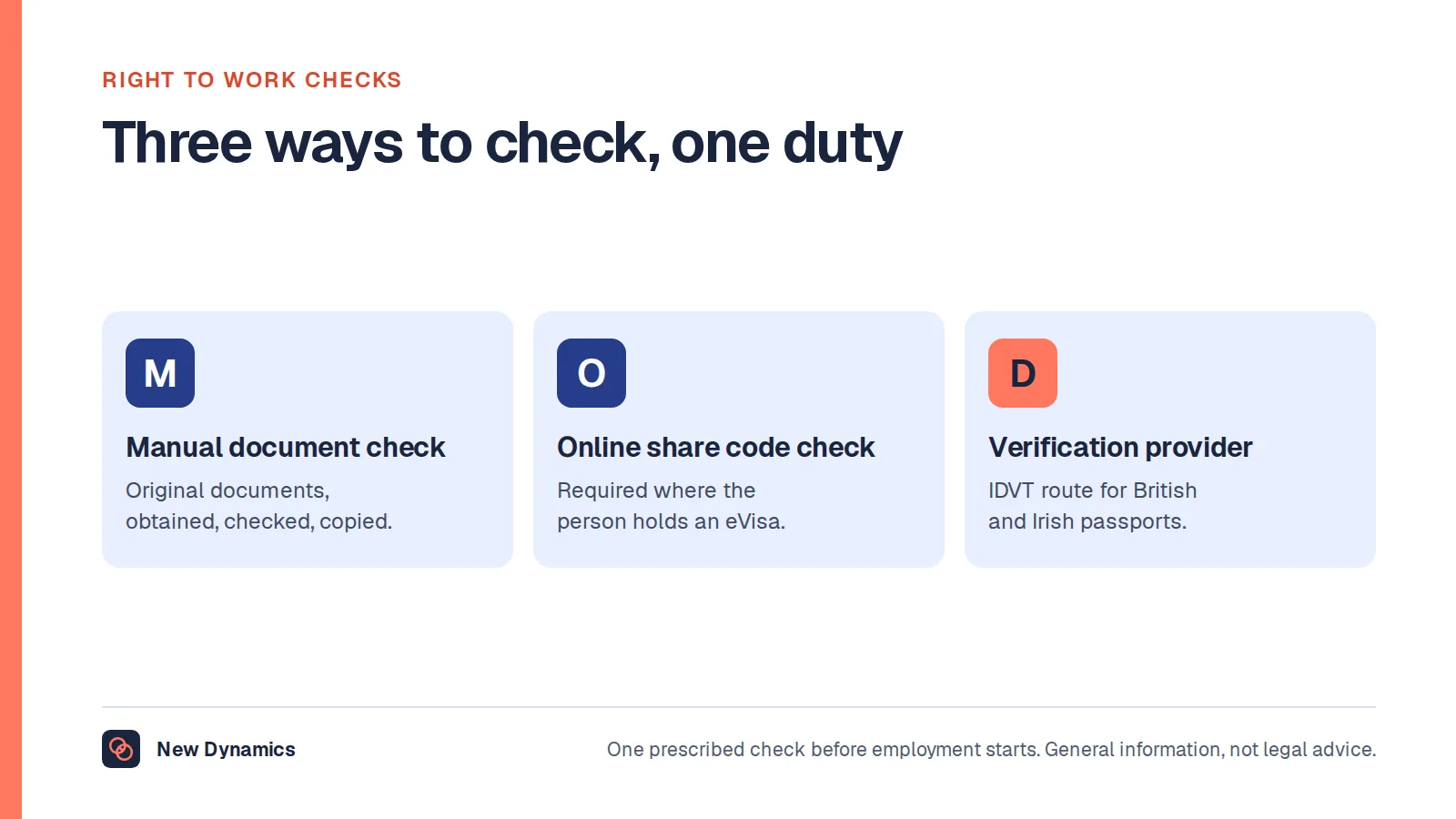
Only one pre-start condition is compulsory for every UK hire. GOV.UK, on checking a job applicant's right to work, states it in one line: "You must check that a job applicant is allowed to work for you in the UK before you employ them." Acas, on offering someone a job, puts the duty at the offer stage: "When you offer someone a job, you must ask for proof that they have the right to work in the UK", and "You could be fined if you do not check this."
The fine is a civil penalty and the amount is published. GOV.UK, on penalties for employing illegal workers, says that if you employ someone without the right to work and did not do the correct checks, "you might get a 'referral notice' to let you know your case is being considered and that you might have to pay a civil penalty (fine) of up to £60,000 for each illegal worker". The defence is the check itself: "You will not have to pay the civil penalty if you can show you made the correct right to work checks."
Two further points. GOV.UK says to "keep copies during the applicant's employment and for 2 years after they stop working for you", and a time-limited permission makes the condition recurring: "If your employee's right to work is time-limited, you'll need to check their documents again when it's due to expire." Our post on the share code right to work check covers the online route.
References, and why they come after the offer
A reference is the classic condition precedent, and the sequencing is what employers get wrong. Acas, on providing a job reference, says "It's best to ask for a reference at the final stage of the recruitment process when making a job offer", and that before approaching a current employer the recruiter should have "made a conditional job offer to the applicant" and have "permission from the applicant to request references".
Note what a reference is not. Acas says "An employer does not have to give a reference by law unless it's" one of a short list of cases, including where it is "in writing that the employer will provide one", certain regulated financial services roles, or an agreement such as a settlement agreement. So a condition requiring two references from named employers may be impossible to satisfy through no fault of the candidate's. Word it as a satisfactory reference you are able to obtain.
Criminal record checks, at the level the role allows
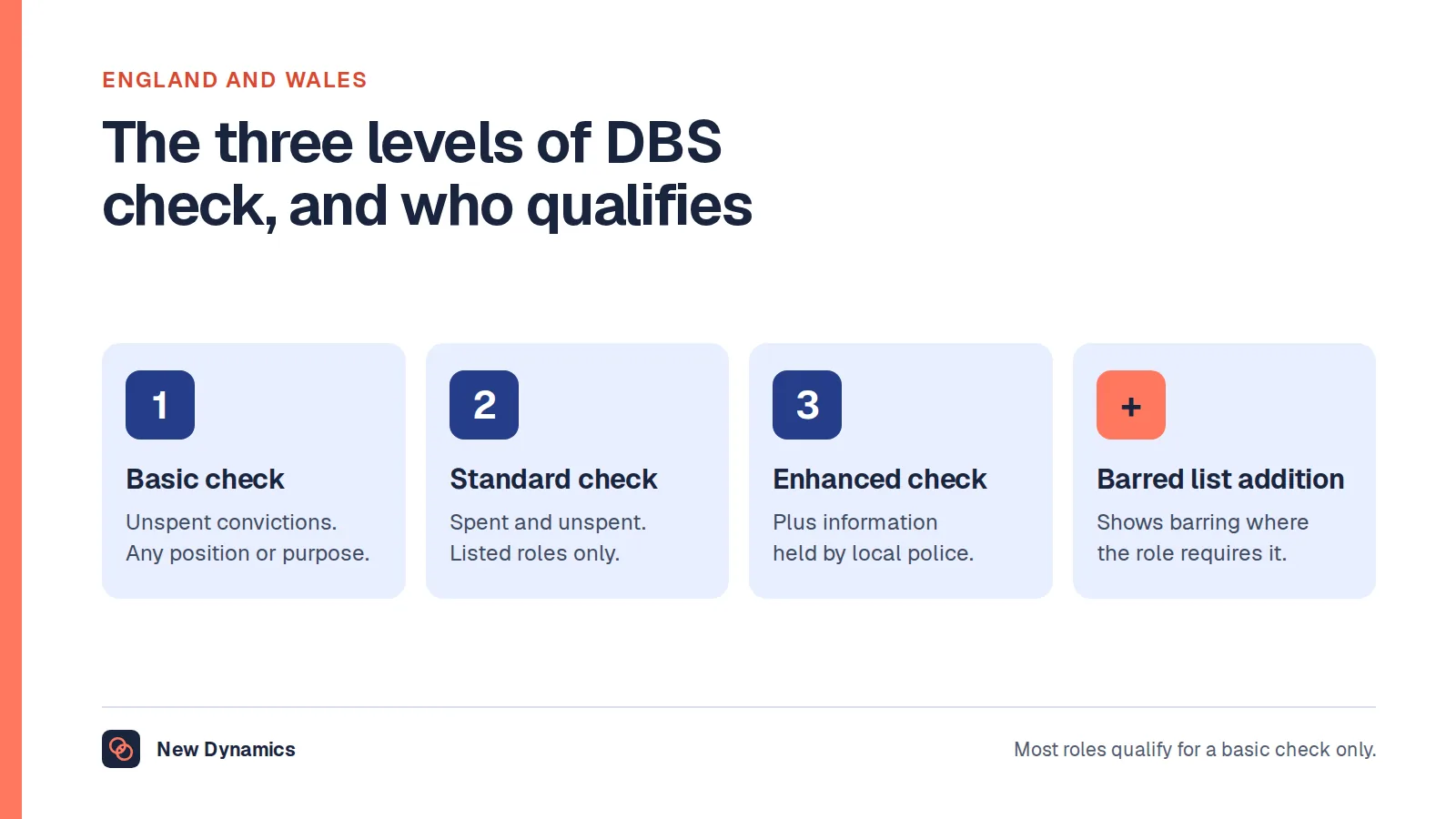
A criminal record check is a condition only where the role qualifies, and the level is not the employer's choice. GOV.UK, on checking someone's criminal record, sets out the ladder from "a basic check, which shows unspent convictions and conditional cautions" to an enhanced check with barred lists.
Two details belong in the offer wording. The check has no shelf life, because "A DBS check has no official expiry date", so a certificate is accurate as at its issue date and nothing more. And the policy is an obligation in itself: "If you carry out criminal records checks, you must have a policy on employing ex-offenders and show it to any applicant who asks for it."
Jurisdiction bites here too. GOV.UK notes "There are different rules for getting criminal record checks in Scotland and getting criminal record checks in Northern Ireland", so a UK-wide employer runs three regimes. Our post on background checks covers the levels.
Qualifications, registrations and licences
Where a job cannot lawfully be done without a qualification, that qualification is not merely a condition of the offer. It is a continuing condition of the employment, and it sits in the contract whether or not anybody typed it. GOV.UK, on contract terms, gives the example in its list of implied terms: "something necessary to do the job like a driver having a valid licence". Acas, on implied and imposed terms, uses the same case for terms that "are necessary to make the contract work", naming "a delivery driver needing a valid driving license".
So losing the qualification is not only an administrative problem. It goes to whether the person can do the job at all. Still write the condition down, with the registration body and the renewal date, because an implied term is harder to evidence than a sentence in a letter.
Health, medicals and the timing rule people breach by accident
Health is the condition most often handled unlawfully, and the error is one of sequence. Section 60 of the Equality Act 2010, at legislation.gov.uk, with extent England, Wales and Scotland, provides that "A person (A) to whom an application for work is made must not ask about the health of the applicant (B)" either "before offering work to B" or before including them in a pool of applicants from whom an offer will be made.
The word "offering" is where the conditional offer earns its place. Section 60(10) says "A reference to offering work is a reference to making a conditional or unconditional offer of work". So the conditional offer unlocks the health question: make the offer, state that it is conditional on a satisfactory health assessment, then ask.
The exceptions before that point are narrow. Section 60(6) allows a question so far as it is necessary for purposes including "establishing whether B will be able to carry out a function that is intrinsic to the work concerned". Section 60(13) treats disability as part of health: "whether or not a person has a disability is to be regarded as an aspect of that person's health." And a clean sequence is not a free hand, because section 60(3) warns that conduct "in reliance on information given in response may be a contravention of a relevant disability provision".
How to word a conditional offer
A condition exists because the offer letter says so. Nothing else creates one.
Acas sets out what a job offer letter should include, and the conditional element is explicit: "whether it's a 'conditional job offer'", with the gloss "if you have any conditions they must meet before you employ them, for example suitable references or a health check". The same list asks for the job title, confirmation of the offer, the terms "including salary, hours, benefits, pension arrangements, holiday entitlement and the location of work", the start date and any probationary period, and a named contact.
Then the consequence, which runs both ways. Acas says "You can withdraw the job offer if the applicant did not meet the offer's conditions", giving suitable references and criminal record checks as examples, and "You should tell them the reasons you're withdrawing the offer." Where nothing was stated: "If you did not include any conditions as part of the job offer, it's known as an unconditional job offer. Withdrawing it could be against the law."

Write the conditions as a short numbered list, not as a trailing clause about the usual checks. For each one, say what will be obtained, who supplies it, by when, and what happens if it is not satisfied. Say that the start date is provisional until the conditions are met, because a start date arriving before the checks do is how people end up working with a condition outstanding. And write the offer down, because Acas says it is "better in writing to avoid misunderstandings later on".
When a condition is not met after someone has already started
Here is the situation the guidance skips. The references came back thin in week three. The certificate was not the level the role needs. The registration lapsed in month seven. The person is already at a desk.
Withdrawing an offer and dismissing an employee are different acts. Once employment has begun, the question is no longer whether the condition was met but whether there is a fair reason to end or change the employment, and whether you followed a fair process to get there.
The statute names the reasons. Section 98 of the Employment Rights Act 1996, at legislation.gov.uk, extent England, Wales and Scotland, lists a reason that "relates to the capability or qualifications of the employee for performing work of the kind which he was employed by the employer to do", and separately a reason that "is that the employee could not continue to work in the position which he held without contravention (either on his part or on that of his employer) of a duty or restriction imposed by or under an enactment". Section 98(3)(b) defines qualifications here as "any degree, diploma or other academic, technical or professional qualification relevant to the position which he held".
A lapsed registration or a missing licence is usually a qualifications question. An expired right to work, or a bar making the role unlawful for this person, is the statutory restriction limb. Either way, section 98(4) still asks whether the employer "acted reasonably or unreasonably in treating it as a sufficient reason for dismissing the employee", which is where process does the work.

Timing has also changed, and the change is close. Acas, on the Employment Rights Act 2025, says that from 1 January 2027 "employees will have the right to claim unfair dismissal after 6 months of being in a job, instead of 2 years", and that "the limit on compensation for unfair dismissal will be removed". Acas adds the history: "Protection from unfair dismissal was expected to become a right from the first day of employment. The government changed this to a 6-month qualifying period." An employer relying on a long unprotected window to tidy up failed conditions is relying on something with an expiry date.
Three things before anybody is told anything. Read the offer wording and work out what you promised. Get the underlying document rather than a summary, because people lose jobs over misread certificates. Then decide whether the honest answer is dismissal, a move to a role the person is qualified for, a suspension while a registration is renewed, or a correction to your paperwork.
The written statement of employment particulars, and its real deadline
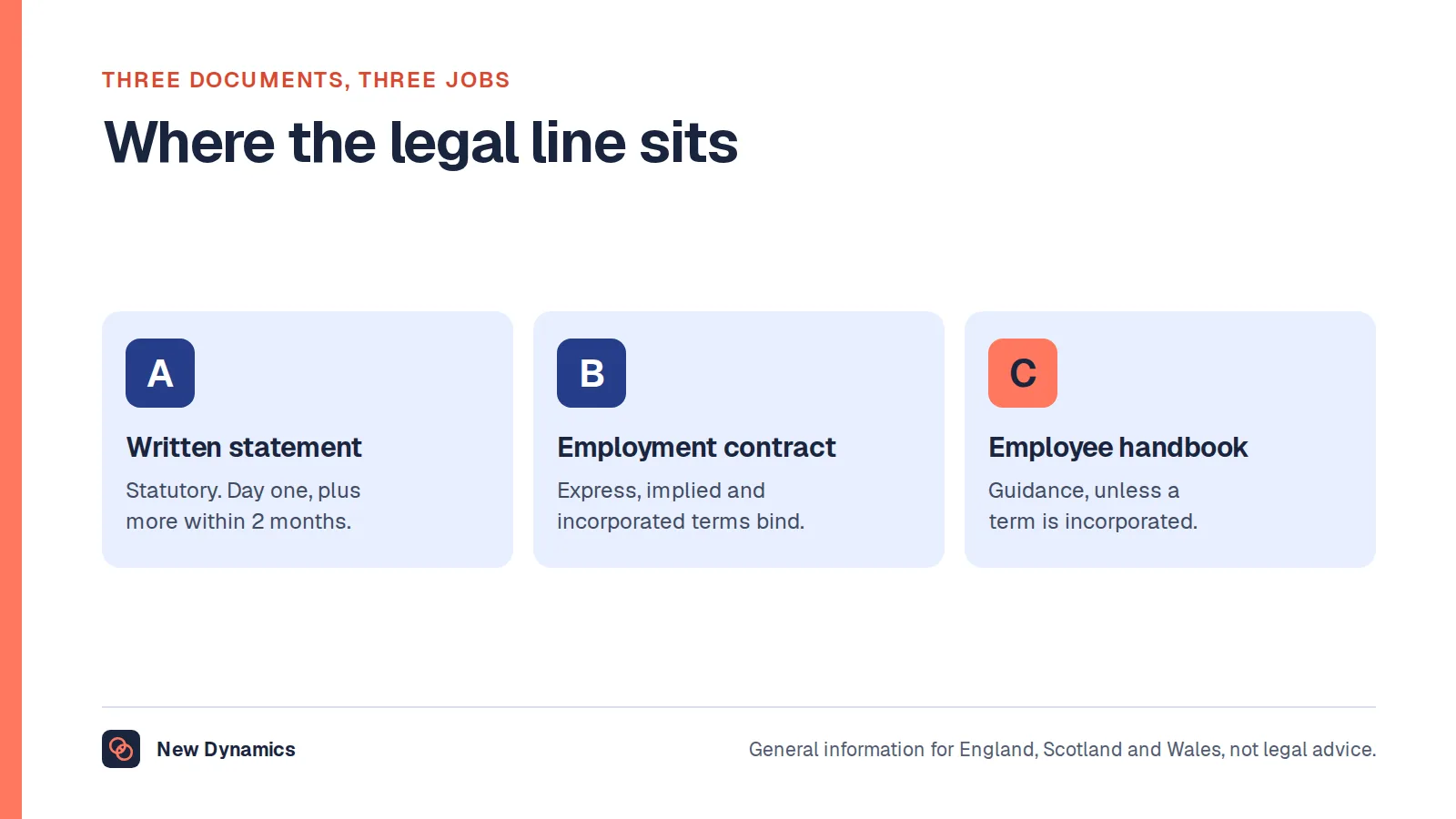
Now the other sense. The written statement puts the conditions governing the job on paper, and GOV.UK describes it in those words: "An employer must give employees and workers a document stating the main conditions of employment when they start work". The same page adds what it is not: "It is not an employment contract."
The deadline is where official sources differ in wording. GOV.UK, on the written statement of employment particulars, says the employer "must provide the principal statement on the first day of employment and the wider written statement within 2 months of the start of employment". Acas says "You must provide this on or before the person's first day of work". Section 1 of the Employment Rights Act 1996, at legislation.gov.uk, extent England, Wales and Scotland, settles it: "the statement must be given not later than the beginning of the employment."
Not later than the beginning. The statutory deadline and the Acas phrasing are therefore on or before day one, while the GOV.UK summary reads as day one itself. Treat the earlier as the deadline: issue it with the offer paperwork.
The principal statement content is a list rather than a judgement call, and one item is directly about conditions, because GOV.UK requires "how long any probation period is and what its conditions are". The rest covers the two names, job title and start date, pay and pay frequency, hours and days and how they may vary, holiday entitlement, place of work, how long the job is expected to last, other benefits, and obligatory training.
One item on that list is worth separating out, because people file probation with the pre-start conditions and it does not belong there. Acas, on probation periods, says "A probation period is a time at the start of employment to check if someone is suitable for a job", and that "There's no legal requirement to have a probation period. And they can be any length of time." It also warns that "'Day one' employment rights apply during probation periods", so probation suspends nothing. Conditions precedent ask whether someone is permitted and qualified to do the job. Probation asks whether they are doing it well. Our post on the probation review meeting covers the second.
One block is routinely missed. GOV.UK says that "On the first day of employment the employer must also provide the employee or worker with information about:" sick pay and procedures, other paid leave such as maternity and paternity leave, and notice periods. These may sit in the principal statement or separately, and if separate "this must be something that the employee or worker has reasonable access to, such as on the employer's intranet". The duty runs to workers as well as employees, so casual and zero hours staff are in scope.
The wider statement, due within two months, covers pensions and pension schemes, collective agreements, any other right to non-compulsory training, and disciplinary and grievance procedures. That last item is the legitimate route to a handbook, which is why our post on the employee handbook keeps guidance out of the contract.
Which conditions are statutory floors, and which are negotiable
Some conditions of employment are not conditions you set. They arrive with the job.
Acas puts the mechanism plainly: "Some terms are part of the employment contract because they're required by law. These are known as 'imposed terms'." GOV.UK lists the same category among the sources of contract terms, as terms "required by law (for example, an employer must pay employees at least the National Minimum Wage)". Then the rule that settles it, from Acas: "Employers cannot include anything in a contract that contradicts an imposed term. This is even if they write it down or discuss it directly with the worker."
Two floors show the shape of it. On pay, GOV.UK's National Minimum Wage and National Living Wage rates page notes that "The rates change on 1 April every year", and gives the April 2026 rate for workers aged 21 and over as £12.71 an hour. On holiday, GOV.UK's holiday entitlement guidance says "Almost all people classed as workers are legally entitled to 5.6 weeks' paid holiday a year (known as statutory leave entitlement or annual leave)", capped because "Statutory paid holiday entitlement is limited to 28 days". For the wider set of published figures, see our HR statistics hub.
The drafting rule is one sentence long. Write the floor as a floor and anything above it as a separate, labelled enhancement. "20 days including bank holidays" is unenforceable for a full-time five-day worker.
Express and implied: the conditions nobody wrote down
Conditions agreed openly, in writing or in conversation, are express terms. Conditions nobody agreed can bind you too, and those implied ones cause the surprises.
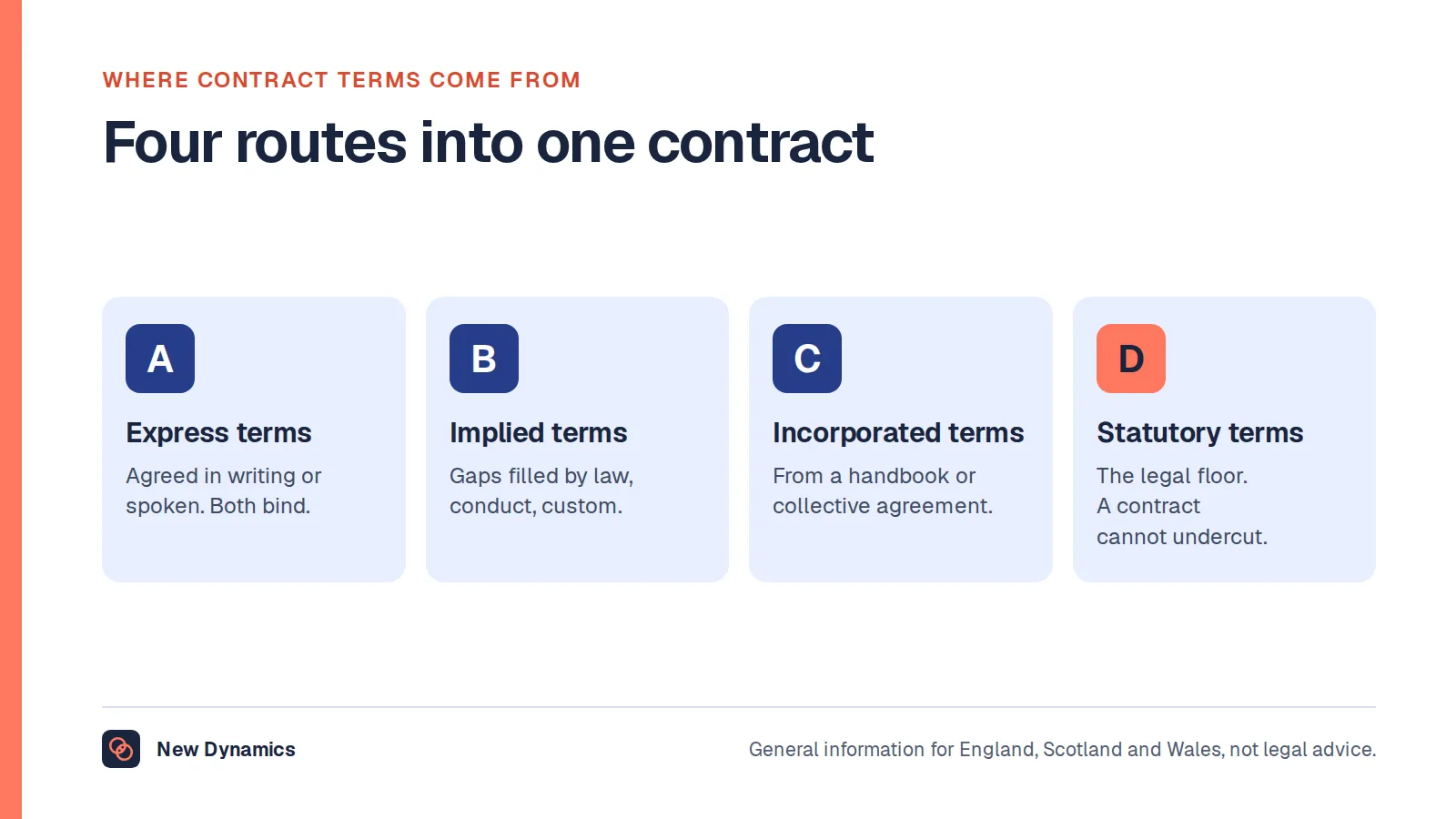
GOV.UK lists the sources of contract terms as a written contract or similar document, terms "verbally agreed", terms in "an employee handbook or on a company notice board", terms in an offer letter, terms required by law, terms in collective agreements, and "implied terms - automatically part of a contract even if they're not written down". Its examples of implied terms are so ordinary as to be instructive: "employees not stealing from their employer", an employer "providing a safe and secure working environment", the minimum holiday entitlement, and "something that's been done regularly in a company over a long time like paying a Christmas bonus".
That last example creates conditions by accident: a payment made every year without being written down can become a term. Acas sets the limit on the other side: "An implied term cannot contradict a written term." GOV.UK's instruction is the right habit: "The legal parts of a contract are known as 'terms'. An employer should make clear which parts of a contract are legally binding."
Varying conditions of employment later
Once a condition governs the job it is a term, and terms change by agreement. Acas, on employer responsibilities for changing an employment contract, gives the rule with its one exception: "Both you and the employee can propose changes to the agreed terms and conditions. You must both agree to the changes. This is unless there's a clause in the contract that allows you to make a change without agreement."
That exception is narrower than employers hope. A flexibility clause lets you move within what the clause describes, not redefine the deal, and the further it reaches into pay or hours the less likely a general clause carries it. Where a union is involved there is a duty: Acas says "By law, you must consult with a recognised trade union if you're considering changes to terms and conditions agreed with that union."
Once a change is agreed, the clock starts. Acas, on agreed contract changes, says "By law, you must put a change in writing within 1 month of the change", and removes the usual excuse for delay: "Employees do not have to sign a new contract for changes to take effect." GOV.UK says the same of the statutory document, within one month of making the change.
One more reason to vary properly rather than by reissue. Acas records that from March 2027, "'Fire and rehire' will become an automatically unfair dismissal in most cases", describing the practice as "dismissing someone then rehiring them on worse terms and conditions". That route of last resort is closing.
The HR process: one path from offer to day one
The law above fails in practice for operational reasons, and the failures are predictable.
The conditions and the start date live in different places. Somebody chases the reference, somebody else books the laptop, and a third person confirmed the start date without knowing a check was outstanding. The fix is one record per hire holding every condition, its owner, its deadline and its outcome.
The day one paperwork is treated as week one paperwork. The statement is due no later than the beginning of the employment, so drafting happens when the offer is accepted. Put the two-month items on their own dated task. Our employee onboarding checklist places these among the first week's tasks.
Recurring conditions have no next date. A time-limited right to work, a professional registration, a driving licence: each needs a renewal date against the person and a reminder that reaches somebody who can act. Nothing looks wrong until the day the condition has already lapsed.
Nobody can show what was agreed and when. Conditions become terms, terms get varied, and two years later the question is what applied in March, not what applies now. Keep the offer letter, the statement issued at the start and every variation letter with its date, as versions rather than one overwritten file. Our post on employee records retention covers the retention position.
One honest note on measurement. No official UK source publishes how many conditional offers are withdrawn each year, or how often a condition fails after a start date. If you want that figure you will have to count it yourself.
Frequently asked questions
What are conditions of employment?
The phrase has two uses. In the first, which is how GOV.UK uses it, conditions of employment are the terms that govern a job: pay, hours, place of work, holiday, sick pay, notice and benefits. GOV.UK says a contract is an agreement setting out an employee's employment conditions, rights, responsibilities and duties, and that these are called the terms of the contract. In the second, a condition of employment is something that must be satisfied before employment starts, such as a right to work check.
What is the difference between a condition of employment and a term of employment?
In everyday use there is no difference, because both describe what governs the job. The distinction that matters is between a term and a condition precedent. A term is a promise inside the contract and can only be changed by agreement. A condition precedent is a hurdle before the contract takes full effect, and it stops being available once employment has begun.
What is a conditional job offer?
It is a job offer that depends on stated conditions being met. Acas says a job offer letter should say whether it is a conditional job offer, and should state any conditions the applicant must meet before you employ them, giving suitable references and a health check as examples. You can then withdraw the offer if the applicant did not meet its conditions, and should tell them the reasons. Where no conditions were stated, Acas calls it an unconditional job offer and warns that withdrawing it could be against the law.
When must an employer give the written statement of employment particulars?
On or before the first day. Acas says you must provide it on or before the person's first day of work, and section 1 of the Employment Rights Act 1996 says the statement must be given not later than the beginning of the employment. GOV.UK summarises the duty as providing the principal statement on the first day, with the wider written statement within 2 months of the start. The safe reading is the statutory one, and the duty covers workers as well as employees.
Can an employer change the conditions of employment?
Only by agreement, in the normal case. Acas says both sides can propose changes to the agreed terms and conditions and that you must both agree to them, unless a clause in the contract allows a change without agreement. Once a change is agreed, Acas says you must put it in writing within 1 month, and that employees do not have to sign a new contract for it to take effect. Where terms were agreed with a recognised trade union, Acas says you must consult that union by law.
Can you withdraw a job offer if a condition is not met?
Yes, if you stated the condition. Acas says you can withdraw a job offer if the applicant did not meet its conditions, naming suitable references and criminal record checks, and that you should tell them the reasons. If the offer carried no conditions, Acas says it is an unconditional job offer and withdrawing it could be against the law. Once the person has started work, ending employment needs a fair reason and a fair process instead.
Your next step: name every condition, then put it on one path
- Open your offer letter template and check whether it lists the conditions as a numbered set, each with an owner and a deadline, or hides them behind a phrase about the usual checks.
- Confirm the right to work check sits in every offer, that copies and the check date are kept, and that any time-limited permission has a renewal date against the person.
- Check the sequence on health. Nothing about health is asked before the offer.
- Compare your day one documents against the GOV.UK principal statement list, including the sick pay, other paid leave and notice information.
- List the things people believe they are entitled to that appear in no document, and decide for each whether you intend it to be contractual.
- For every variation in the past two years, confirm it was agreed and put in writing within a month.
For the full first-day sequence, including who owns each document and where the checks sit, read and download our employee onboarding guide. The guide is free to read, and the PDF uses our short download form.
Want offer conditions, renewal dates and acknowledgement dates held against each person, with the history intact? Book a New Dynamics demo and bring your offer letter template. You can also email contact@new-dynamics.com.