TL;DR
- Shared parental leave is created by giving something up. GOV.UK states that you or your partner has to "take less than the 52 weeks of maternity or adoption leave and use the rest as SPL", leaving up to 50 weeks of leave and up to 37 weeks of pay to share in the child's first year.
- Unpaid parental leave is a separate right of 18 weeks for each child up to their 18th birthday, capped at 4 weeks a year per child. Since 6 April 2026 it starts on day one: Acas states that "employees are eligible for parental leave from the first day of employment", where a year's service was needed before.
- An employer cannot refuse the leave of an eligible employee who gives the right notice, only the pattern. GOV.UK's employer guide says "You cannot turn down a request for a block of leave if the employee is eligible and gives you the right notice", and that you need not agree to a block being broken into shorter periods.
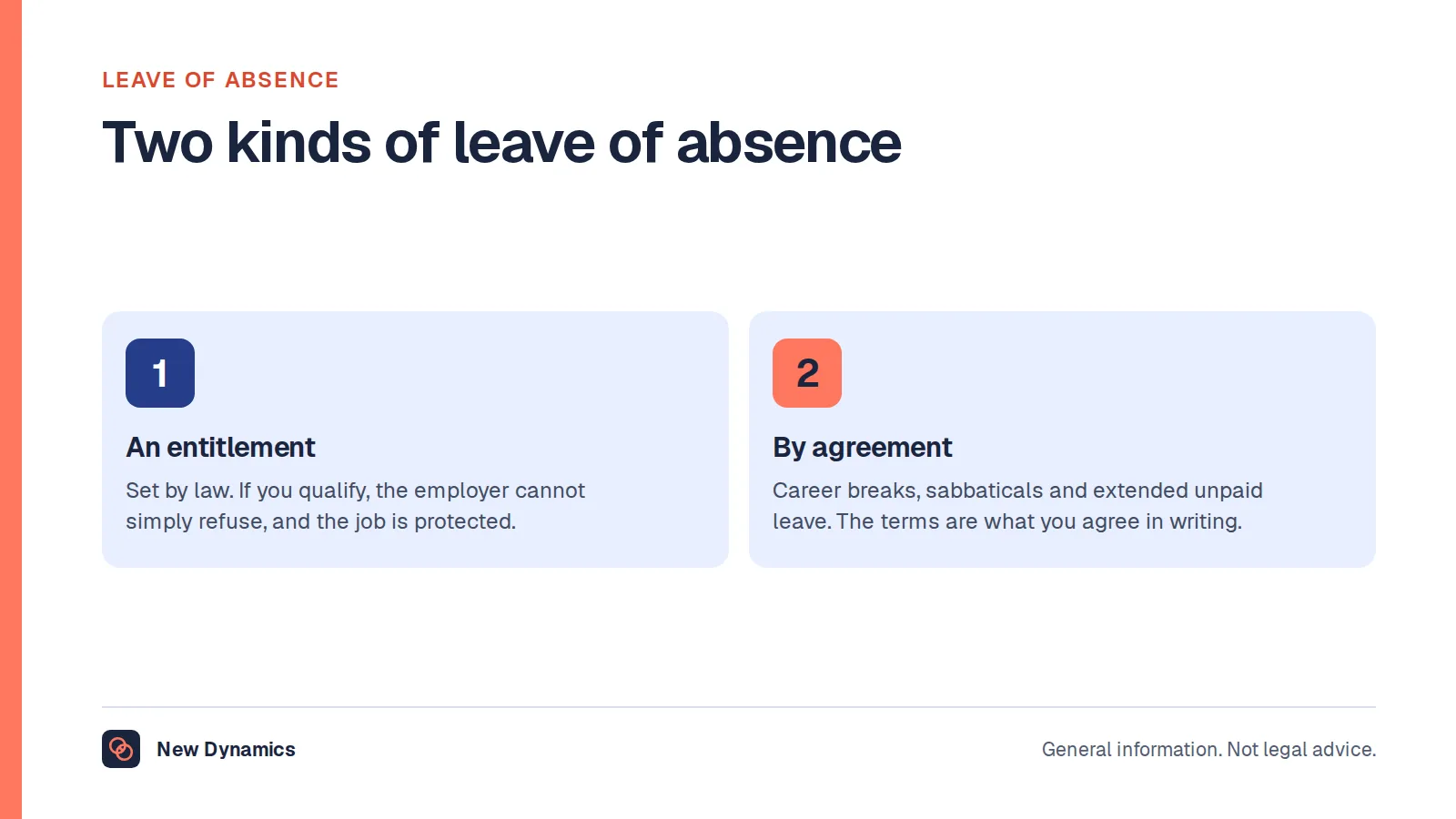
Two rights share almost the same name. Shared parental leave lets two parents split what is left of maternity or adoption leave in the child's first year. Unpaid parental leave is a separate entitlement of 18 weeks for each child, running until that child turns 18. Treating them as one right is how an employer refuses a request it had no power to refuse, or pays statutory money it cannot reclaim.
This article separates them, then covers who qualifies for shared parental leave, the step that creates the entitlement, how much leave and pay there is, the notice required, and what an employer may turn down. It applies to Great Britain, because GOV.UK's employer guide states that "SPL and ShPP are only available in England, Scotland and Wales". It is general information and not legal advice.
Family leave goes wrong in the handover rather than the policy: a notice sits in an inbox, a manager agrees a pattern nobody writes down, and the return date is reconstructed from memory months later. See how New Dynamics workflows hold the stages, forms, reminders and approvals for a process like this.
Shared parental leave and unpaid parental leave are different rights
Shared parental leave (SPL) is leave carved out of somebody else's entitlement. GOV.UK's guide to Shared Parental Leave and Pay says: "You can share up to 50 weeks of leave and up to 37 weeks of pay between you", and "You need to share the pay and leave in the first year after your child is born or placed with your family."
Unpaid parental leave, which Acas also calls ordinary parental leave, is shared with nobody. GOV.UK's guidance on parental leave states: "Parental leave is unpaid. You're entitled to 18 weeks' leave for each child and adopted child, up to their 18th birthday." The yearly limit is "4 weeks for each child (unless the employer agrees otherwise)", notice is 21 days, and the entitlement follows the child rather than the job.

Shared parental leave exists only once a mother or primary adopter releases part of theirs, and carries statutory pay for up to 37 weeks. Unpaid parental leave belongs to each parent outright, carries none, and can be postponed but not refused.
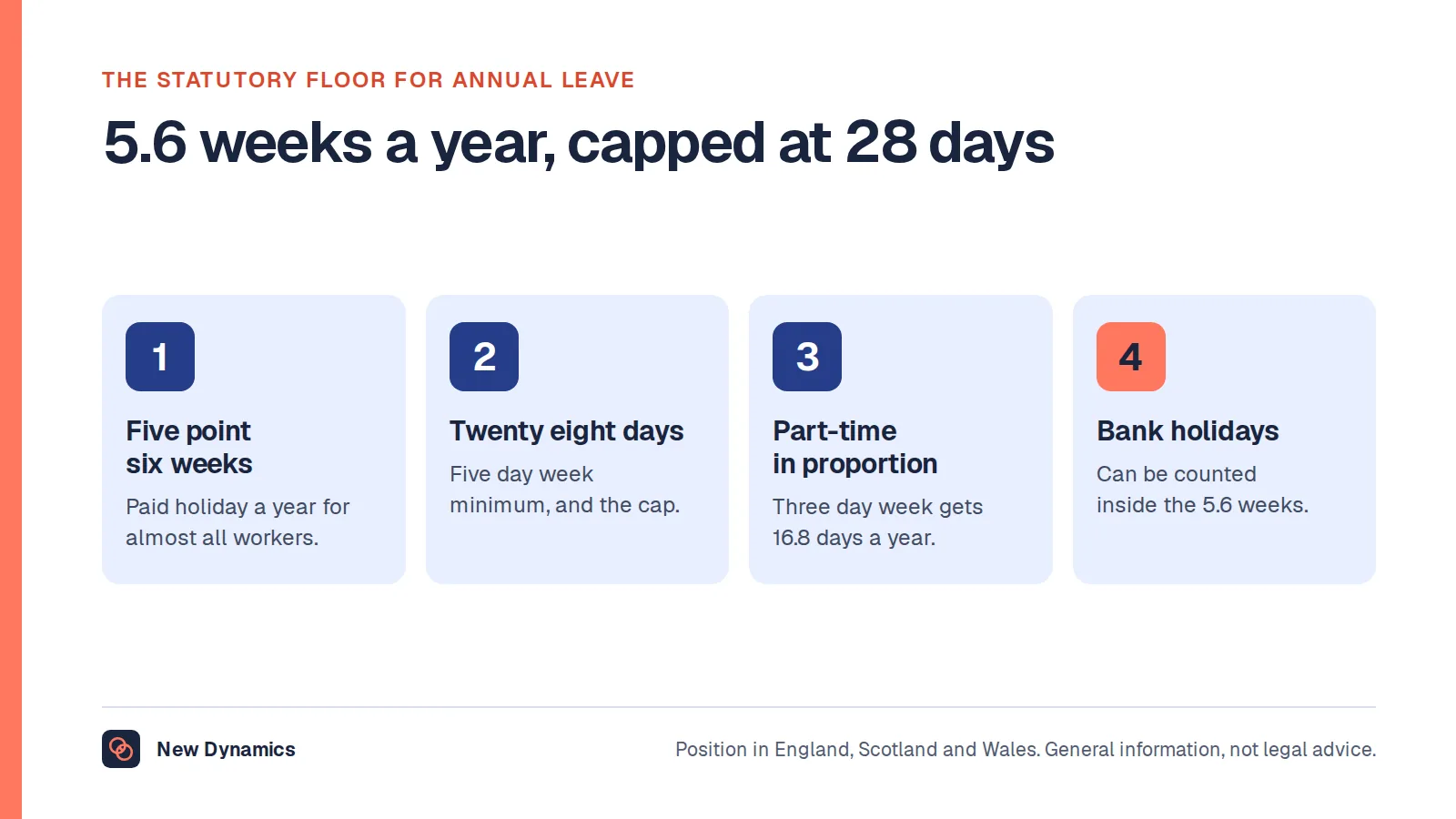
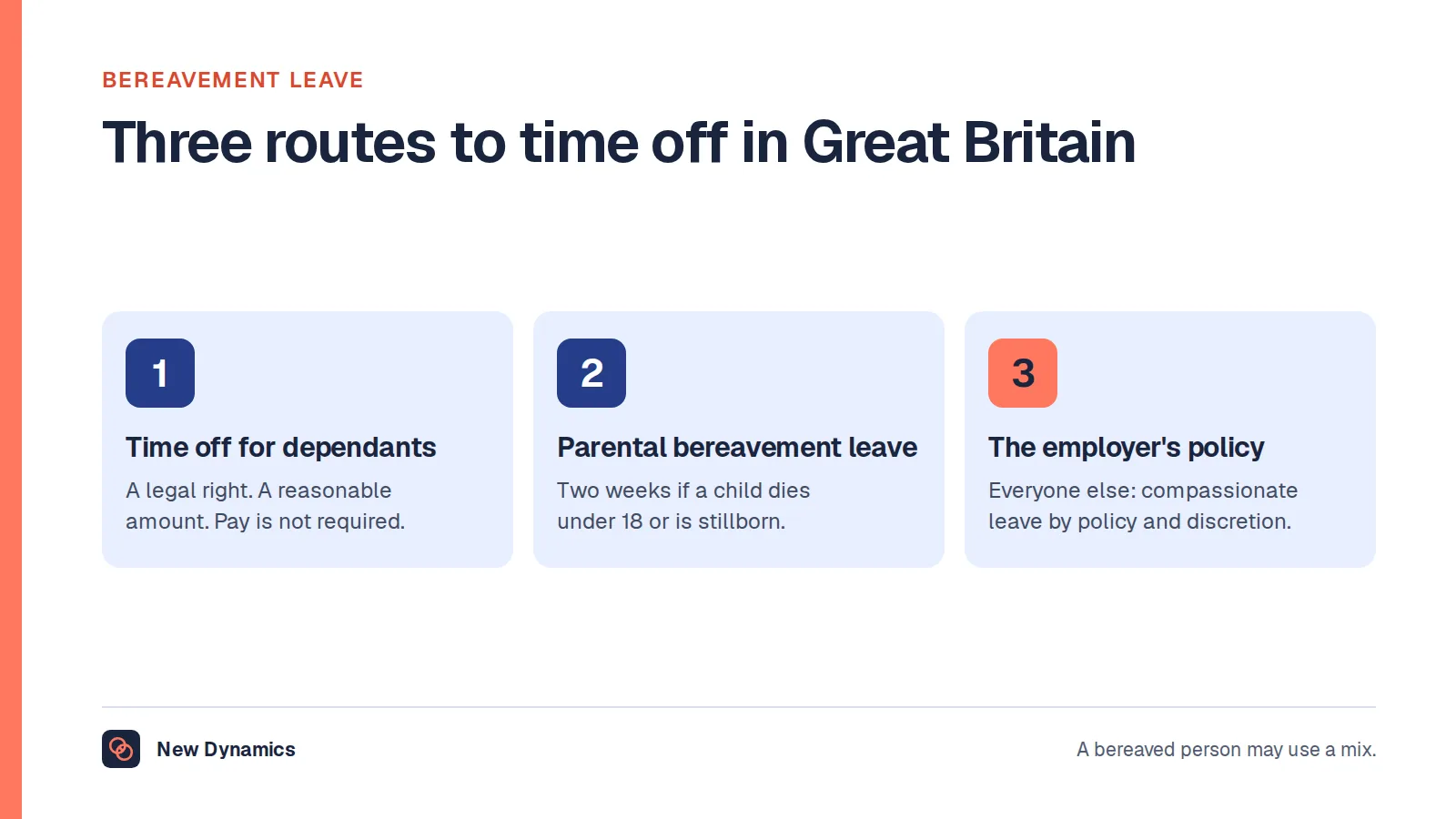
For the wider map of statutory and discretionary time off, see our post on a leave of absence, and on how family leave meets annual leave, our post on holiday entitlement.
How much leave and how much pay there is
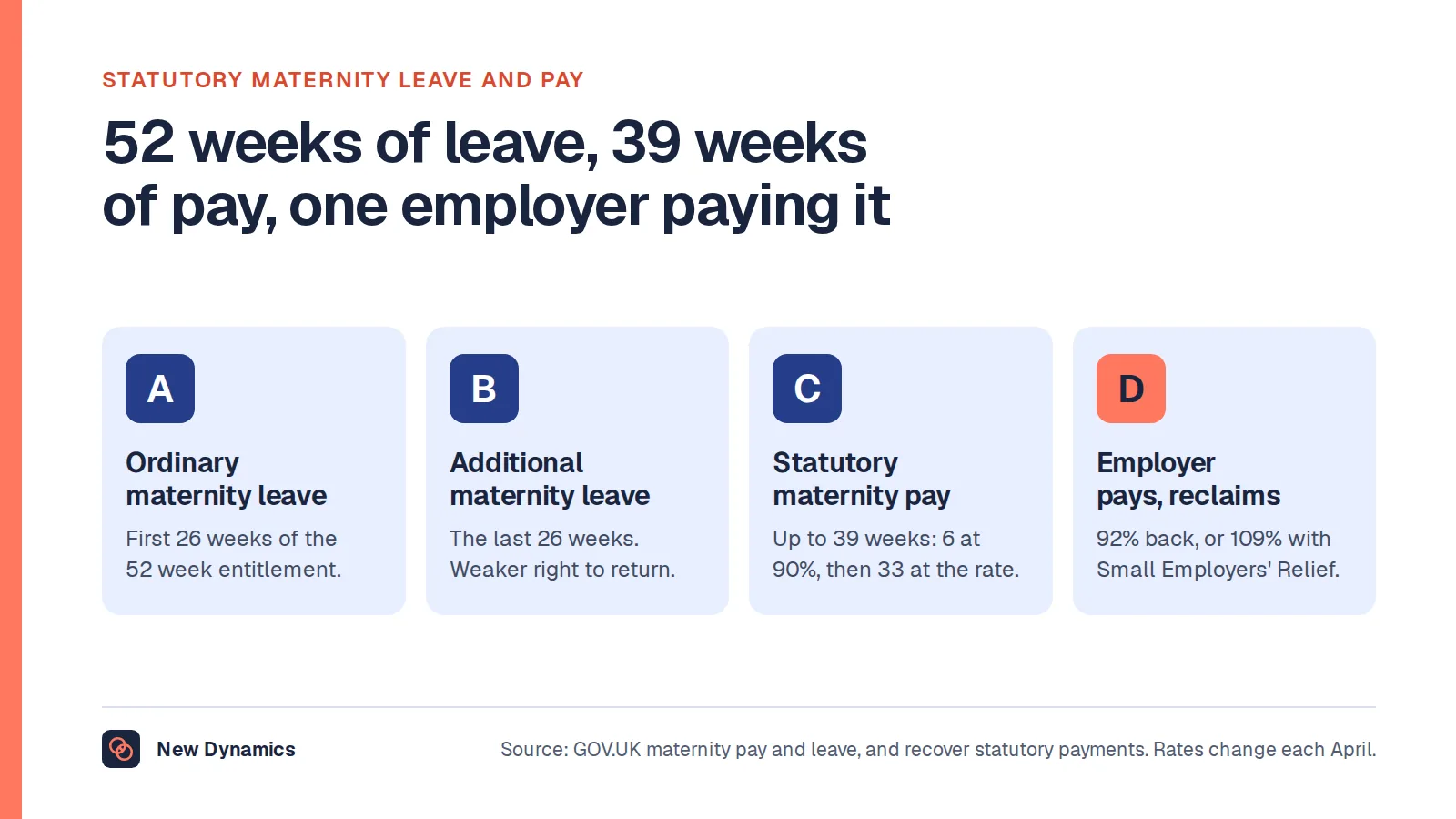
The arithmetic starts from the full maternity or adoption entitlement and subtracts what is taken. GOV.UK says that to get shared parental leave and pay, you or your partner has to "take less than the 52 weeks of maternity or adoption leave and use the rest as SPL" and "take less than the 39 weeks of maternity or adoption pay (or Maternity Allowance) and use the rest as ShPP".
Its worked example: "if you're the mother and you've taken 22 weeks of Maternity Leave and Statutory Maternity Pay, you can share 30 weeks of SPL and 17 weeks of ShPP with your partner." So 50 and 37 are ceilings, not allocations, because GOV.UK also states that "A mother cannot return to work before the end of the compulsory 2 weeks of maternity leave following the birth (4 weeks if they work in a factory)." Our post on maternity leave for employers covers the entitlement this is cut from.
Shared parental leave eligibility: two tests, one for each parent
Both parents are assessed even when only one will take the leave. The employers' technical guide to shared parental leave and pay names both tests.
The continuity of employment test applies to the parent taking the leave, who "must have been continuously employed by you for 26 weeks up to and including the 15th week before the week in which their baby is due to be born, and still be employed by you in the week before any shared parental leave is due to start". For an adopter or an adopter's partner, the 26 weeks run to the week the adopter was notified of being matched. The test sits in regulation 35 of the Shared Parental Leave Regulations 2014.
The employment and earnings test applies to the other parent, who "must have been an employed or self-employed earner in Great Britain for a total 26 weeks (not necessarily continuously) in the period of 66 weeks leading up to the week in which the child is due (or matched for adoption) and must have earned an average of £30 a week in 13 of the 66 weeks". GOV.UK's citizen guidance states that threshold as a total instead, "at least £390 in total across any 13 of the 66 weeks".
Two details catch employers out. GOV.UK's page on eligibility for birth parents states: "To be eligible for SPL, you must be 'employees' (not 'workers')", adding that "If either of you is a 'worker', you might be able to share ShPP but not SPL." The pay and the leave can separate. And each parent claiming pay must "earn on average at least £129 a week". Acas, on its shared parental leave and pay guidance last updated on 25 June 2026, adds that a self-employed parent cannot take the leave or the pay, but can still make their partner eligible by passing the employment and earnings test.
Curtailment: the step that creates the entitlement
Nothing can be shared until the mother or primary adopter closes down part of their own entitlement, and this is the step most often missed. GOV.UK's guidance on when you can start says they must either "return to work, which ends any maternity or adoption leave" or "give their employer 'binding notice' of the date when they plan to end their leave (you cannot normally change the date you give in binding notice)".
Binding notice is close to irreversible. GOV.UK warns that "They cannot restart maternity pay, Maternity Allowance or adoption pay once it's ended", and allows a change of mind only in three narrow cases, chiefly where neither parent turns out to be eligible.
Regulation 4 of the Shared Parental Leave Regulations 2014 is tighter still. It makes the mother's entitlement conditional on her having "ended any entitlement to statutory maternity leave by curtailing that leave under section 71(3)(ba) or 73(3)(a) of the 1996 Act (and that leave remains curtailed)". The words in brackets do real work: revoke the curtailment and the shared entitlement goes with it.
Notice, blocks, and what an employer may refuse
Eight weeks is the number to remember. GOV.UK says an employee must "give your employer at least 8 weeks' written notice of your leave dates", and that any later change needs "at least 8 weeks before the start of any leave". Regulation 12(3) of the 2014 Regulations says the same.

On booking blocks of leave, GOV.UK says: "You can book up to 3 separate blocks of Shared Parental Leave (SPL) instead of taking it all in one go, even if you are not sharing the leave with your partner." Each parent gets up to three, and "You can take more than 3 blocks of leave if your employer agrees." Splitting a block into shorter periods of at least a week also needs agreement.
Then the part employers get wrong in both directions. GOV.UK's employer guide on blocks of leave states: "You cannot turn down a request for a block of leave if the employee is eligible and gives you the right notice. You do not have to agree to the employee breaking the block of leave into shorter periods." On eligibility, the employer guide says: "You can refuse SPL or ShPP if the employee does not qualify. You must tell the employee the reason if you refuse ShPP. You do not have to give a reason for refusing SPL."
Regulation 14 covers a request for a broken pattern. The employer has two weeks to consent, propose alternative dates, or refuse without proposing any. If nothing is agreed in that fortnight, "the employee is entitled to take the total amount of leave requested in the notice as a continuous period of leave". Refusing a pattern does not reduce the leave, it converts it into one block.
Two mechanics belong in the policy. Each parent "can each work up to 20 days while you're taking SPL", called SPLIT days, on top of the 10 keeping in touch days during maternity or adoption leave, and both sides must agree each one. An employer may also ask for evidence within 14 days of the application.
Statutory shared parental pay in the 2026 to 2027 tax year
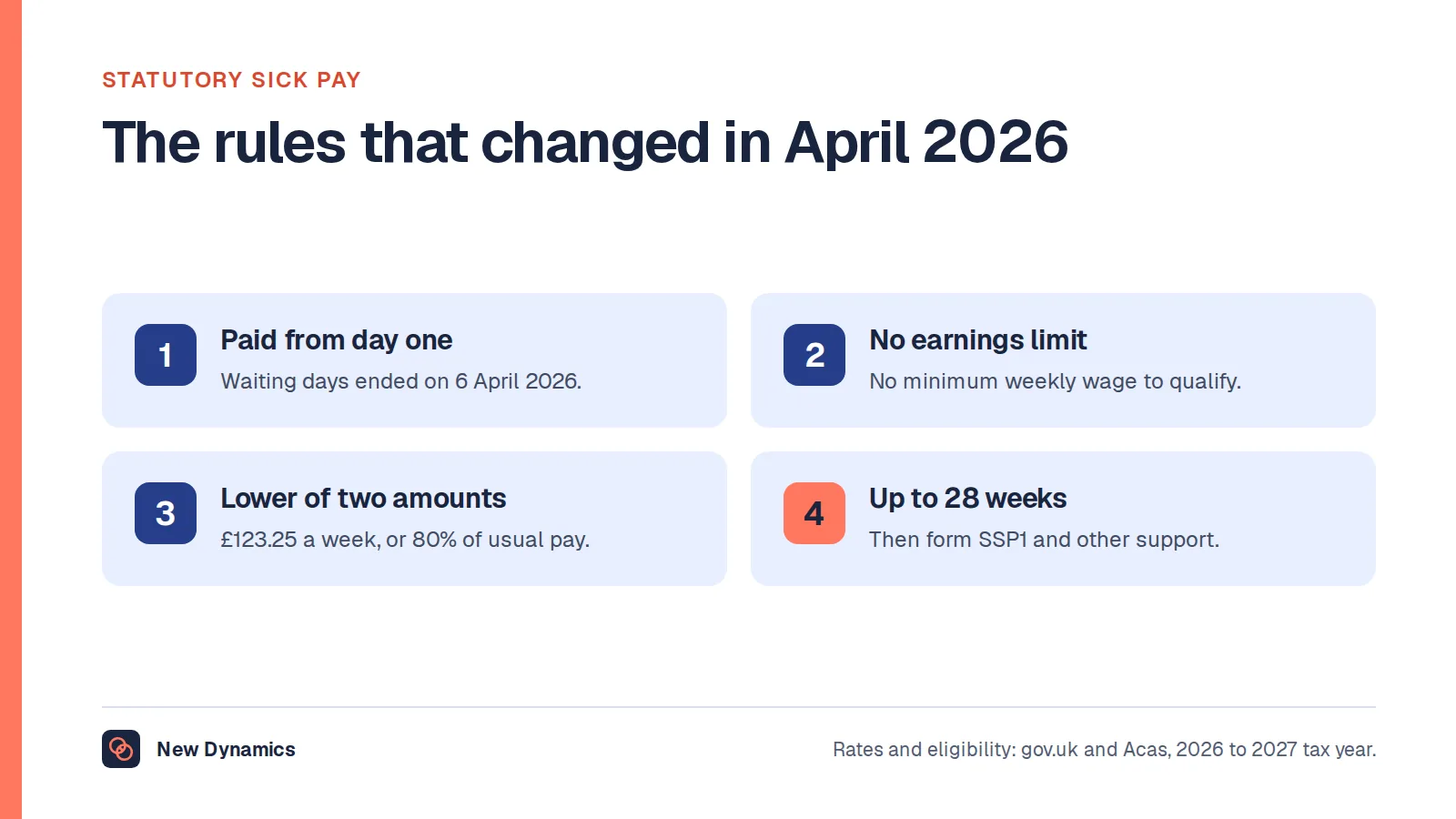
HMRC's guidance on rates and thresholds for employers 2026 to 2027 opens with the period it covers: "Unless otherwise stated, the following figures apply from 6 April 2026 to 5 April 2027." It gives the Statutory Shared Parental Pay weekly rate for 2026 to 2027 as "£194.32 or 90% of the employee's average weekly earnings, whichever is lower", and the lower earnings limit for that year as £129 a week, the figure behind the earnings condition for the pay.
GOV.UK's page on what you'll get explains why a mother's pay can fall when she moves across: shared parental pay "is the same as Statutory Maternity Pay (SMP) except that during the first 6 weeks SMP is paid at 90% of whatever you earn (with no maximum)". A higher earner switching inside those six weeks swaps an uncapped 90% for a capped weekly rate.
The same guidance gives the 2026 to 2027 recovery rate as 92%, or "109% if your total Class 1 National Insurance for the previous tax year is £45,000 or lower", and the employer guide requires records kept "for at least 3 years from the end of the tax year they relate to". Rates change each April, so check the current year's page rather than any figure in an article, including this one. We could not find a UK government statistics release giving a current take-up rate for shared parental leave, so this post does not quote one; the statistics hub collects the HR numbers that are published.
What changed on 6 April 2026
One of these two rights was reformed this year and the other was not.
Unpaid parental leave became a day one right. Acas's parental leave guidance, last updated on 7 April 2026, states: "From 6 April 2026, employees are eligible for parental leave from the first day of employment. Previously they needed to have worked for their employer for 1 year to be eligible." Section 15 of the Employment Rights Act 2025 is headed "Parental leave: removal of qualifying period of employment", and legislation.gov.uk records it in force from 6 April 2026, with the consequential regulations omitting the service condition from regulation 13(1) of the Maternity and Parental Leave etc. Regulations 1999. The same instrument records that section 17 removed "restrictions on taking paternity leave after having taken shared parental leave", which is why GOV.UK now says "You can take Paternity Leave and Pay before or after SPL and ShPP."
Shared parental leave kept its qualifying period. Legislation.gov.uk reports no outstanding effects for regulation 4 of the Shared Parental Leave Regulations 2014, and GOV.UK still publishes the 26 week continuity of employment test. A handbook saying family leave is now a day one right across the board is wrong. Our post on the employee handbook covers keeping statements like that under review.
Where two official pages read differently
On adoption, the wording diverges. GOV.UK's employer guide says: "The adoptive parent getting Statutory Adoption Pay must take at least 2 weeks' adoption leave." Acas says: "The primary adopter does not have to take 2 weeks' leave after the adoption. But, if they do not use it, they will lose it. The 2 weeks' leave cannot be shared."
Both are official and neither is a misprint. They can be reconciled: GOV.UK attaches the two weeks to the person claiming Statutory Adoption Pay, which is a payroll condition, while Acas describes the leave right in general. For an employer paying Statutory Adoption Pay, GOV.UK's guide is the instruction to work from, and either way those two weeks cannot be shared. Where adoption pay is not in play, take advice on the case rather than relying on either summary.
Acas sets out the protection running throughout: an employer "must not cause an employee 'detriment' for taking, or planning to take, shared parental leave", and dismissal for being on it is automatically unfair, a claim that can be brought "regardless of how long they've worked for their employer".
Frequently asked questions
What is the difference between shared parental leave and unpaid parental leave?
They are separate entitlements. Shared parental leave comes out of maternity or adoption leave, is limited to the child's first year, and can be paid for up to 37 weeks. Unpaid parental leave is 18 weeks for each child up to that child's 18th birthday, capped at 4 weeks a year per child, carries no statutory pay, and belongs to each parent separately.
How much notice is needed for shared parental leave?
At least eight weeks' written notice of the leave dates, and eight weeks again for any later change. The mother or primary adopter must separately give binding notice to end maternity or adoption leave or pay. GOV.UK warns that the date in binding notice normally cannot be changed, and that maternity pay, Maternity Allowance or adoption pay cannot be restarted once ended.
Who is eligible for shared parental leave?
The parent taking the leave must pass the continuity of employment test: 26 weeks' continuous employment with the same employer up to and including the 15th week before the week the baby is due, still employed in the week before the leave starts. The other parent must pass the employment and earnings test, meaning 26 of the 66 weeks before the due date in employed or self-employed work, and £390 across the 13 highest paying of those weeks.
How much is shared parental pay?
HMRC gives the Statutory Shared Parental Pay rate for the 2026 to 2027 tax year as "£194.32 or 90% of the employee's average weekly earnings, whichever is lower", applying from 6 April 2026. It runs for up to 37 weeks, reduced by weeks of maternity, adoption or Maternity Allowance pay already taken, and each claiming parent must earn on average at least £129 a week.
Can an employer refuse shared parental leave?
Only on eligibility or notice. GOV.UK's employer guide says "You cannot turn down a request for a block of leave if the employee is eligible and gives you the right notice", and that an employer need not agree to a block being split into shorter periods. Where a split request is refused and nothing is agreed within two weeks, regulation 14 of the 2014 Regulations entitles the employee to take the whole amount as one continuous block.
Your next step: make the entitlement calculable before anybody asks
- Write the two tests into the policy as questions with dates attached: 26 weeks' continuous employment to the end of the 15th week before the due date for the parent taking the leave, and 26 of the 66 weeks plus £390 across the best 13 for the other parent.
- Keep one curtailment record per case: when binding notice was given, the end date it names, and whether the curtailment still stands. Regulation 4 makes the entitlement depend on it.
- Check leave and pay separately. Somebody may qualify for the pay and not the leave, and a worker never qualifies for the leave.
- Put the eight week clock and the two week window for answering a split request into the calendar your managers already use, and say in the handbook that unpaid parental leave starts on day one from 6 April 2026 while shared parental leave still carries its 26 week qualifying period.
For the policy structure this belongs in, read and download our employee handbook guide. The guide is free to read, and the PDF uses our short download form.
Want leave notices, approvals and return dates in one record rather than in a manager's inbox? Book a New Dynamics demo and bring your current family leave policy. You can also email contact@new-dynamics.com.