TL;DR
- A career goal is a statement of where you want your working life to go, and what you will do next to move towards it. You need a long-term aim and short-term steps.
- Use the 40 examples as prompts. Good career goals build skills, experience, relationships or a way of working you can sustain. A promotion is only one kind.
- Write each goal so that you can tell whether it happened, share it with your manager and review it every few months. Plans change, and that is fine.
“Where do you see yourself in five years?” Most people dread the question because they hear it as a request for a job title. It is more useful to treat it as a question about direction. You do not need a detailed map. You need a rough destination and a clear next step.
This article gives you 40 examples of career goals, short-term and long-term, along with a simple method for setting your own and advice on talking about career growth with your manager.
If you want development goals to sit beside your everyday objectives, where you and your manager can both see them, explore New Dynamics Goals & OKRs.
What is a career goal?
A career goal is a statement of where you want your working life to go, together with what you will do next to move towards it. It differs from a performance goal, which concerns what you deliver in your current job this quarter. A career goal looks further ahead and belongs mainly to you.
Career goals come in four kinds. A good plan usually includes more than one.
- Skills: something you want to be able to do.
- Experience: something you want to have done.
- Relationships: people you want to learn from, work with or help.
- Way of working: the conditions you want, such as flexibility, location, income or balance.

Short-term and long-term career goals
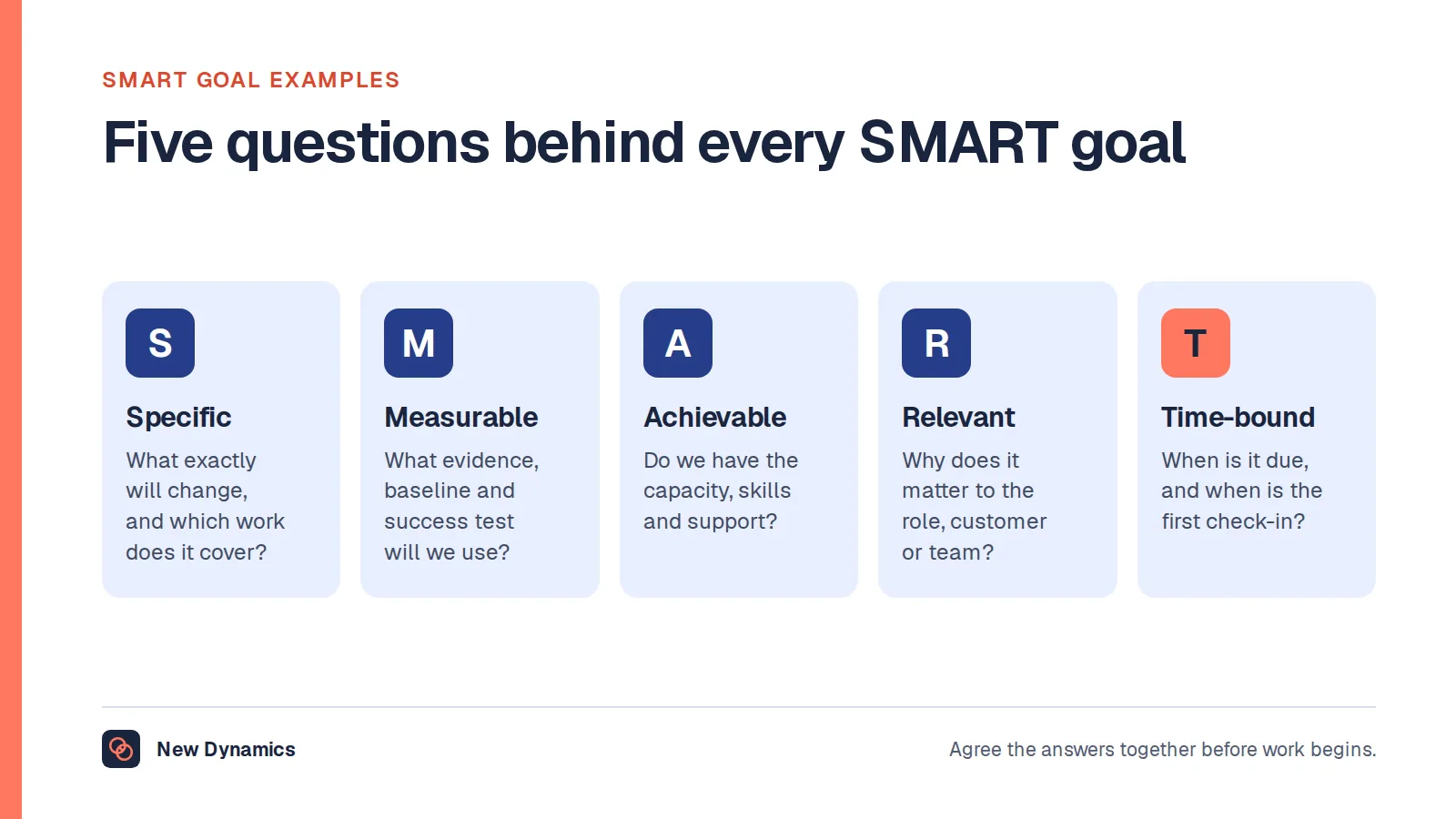
The UK's National Careers Service advises people to “develop your plan with a long term aim and short term goals so you can break up your time”, in its guide to understanding and developing your skills. The same page recommends setting SMART goals: specific, measurable, achievable, relevant and time-bound.
- A long-term career goal looks three to ten years ahead. It sets direction: lead a team, become a recognised specialist, change field, start a business.
- A short-term career goal covers the next three to twelve months. It is a concrete step: complete a qualification, lead a project, find a mentor.
Long-term goals without short-term steps are daydreams. Short-term steps without a long-term aim keep you busy without taking you anywhere in particular.
10 short-term career goals examples
- Complete a recognised qualification in my field within twelve months.
- Lead one project from start to finish this year, with my manager as sponsor.
- Learn to analyse our team's data well enough to build the monthly report myself within six months.
- Present to a senior audience three times this year, and ask for feedback each time.
- Find a mentor outside my team and meet them every six weeks.
- Shadow a colleague in another department for two days this quarter.
- Take over one responsibility from my manager, such as running the weekly team meeting.
- Ask three colleagues for specific feedback on how I run meetings, and change one thing as a result.
- Write down my achievements at the end of every month, so that my review and my CV are easy to update.
- Have a career conversation with my manager within the next month, and agree two development actions.
10 long-term career goals examples
- Move into a people management role within three years, having first led projects and mentored a new starter.
- Become the organisation's recognised expert in one specialism within five years.
- Move from an operational role into a strategic one, such as from HR adviser to HR business partner.
- Change field, for example from customer support into product management, using a planned series of projects and courses.
- Reach head of department within eight years.
- Work in another country for at least a year.
- Build the skills and savings to work for myself within ten years.
- Become a chartered member of my professional body.
- Lead a major change programme from start to finish.
- Reach a level of income and flexibility that lets me work four days a week.
Career goals by stage
Early career
- Try three different kinds of work in my first two years, to learn what I am good at and enjoy.
- Build one skill to a standard that colleagues rely on.
- Learn how the organisation makes money and where my work fits.
- Find two people a few years ahead of me and ask how they got there.
- Get comfortable asking for feedback, and asking for help.
Mid-career
- Decide whether I want to lead people or deepen my expertise, and test the choice with a trial project.
- Broaden my experience with a move sideways into a related function.
- Build a reputation outside my team by sharing what I know, in talks, articles or training sessions.
- Mentor someone earlier in their career.
- Renew my skills in one area that has changed since I trained.
Leadership
- Develop a successor for my own role.
- Build a team whose members are regularly promoted or recruited by other departments.
- Gain experience of a function I have never worked in, through a secondment or a board-level project.
- Improve one leadership behaviour each year, using feedback from my team. See the characteristics of a great leader.
- Serve as a trustee, governor or non-executive, to broaden my perspective.
Career goals about how you work
Progress is not only upward. Some of the most valuable goals concern the working life you want.
- Move to a role that lets me work from home three days a week within a year.
- Reduce regular overtime by agreeing priorities with my manager every month.
- Reach a salary that covers a specific life goal, and find out what skills and roles pay it.
- Return from a career break with a plan for the first six months.
- Stay in my current role, which I enjoy, and keep growing by taking on one new challenge each year.
That last example matters. Not everyone wants promotion, and contented, skilled people who keep learning are the backbone of most organisations.

How to set your career goals
- Start with where you are. List what you are good at, what you enjoy and what drains you. The National Careers Service suggests taking stock of your skills before you decide on next steps.
- Choose a direction. A rough one is fine. “More responsibility for people” or “deeper technical work” is enough to begin.
- Find the gaps. Compare yourself with people already doing what you want to do. What skills, experience and relationships do they have that you lack? Our list of job titles by level shows typical ladders.
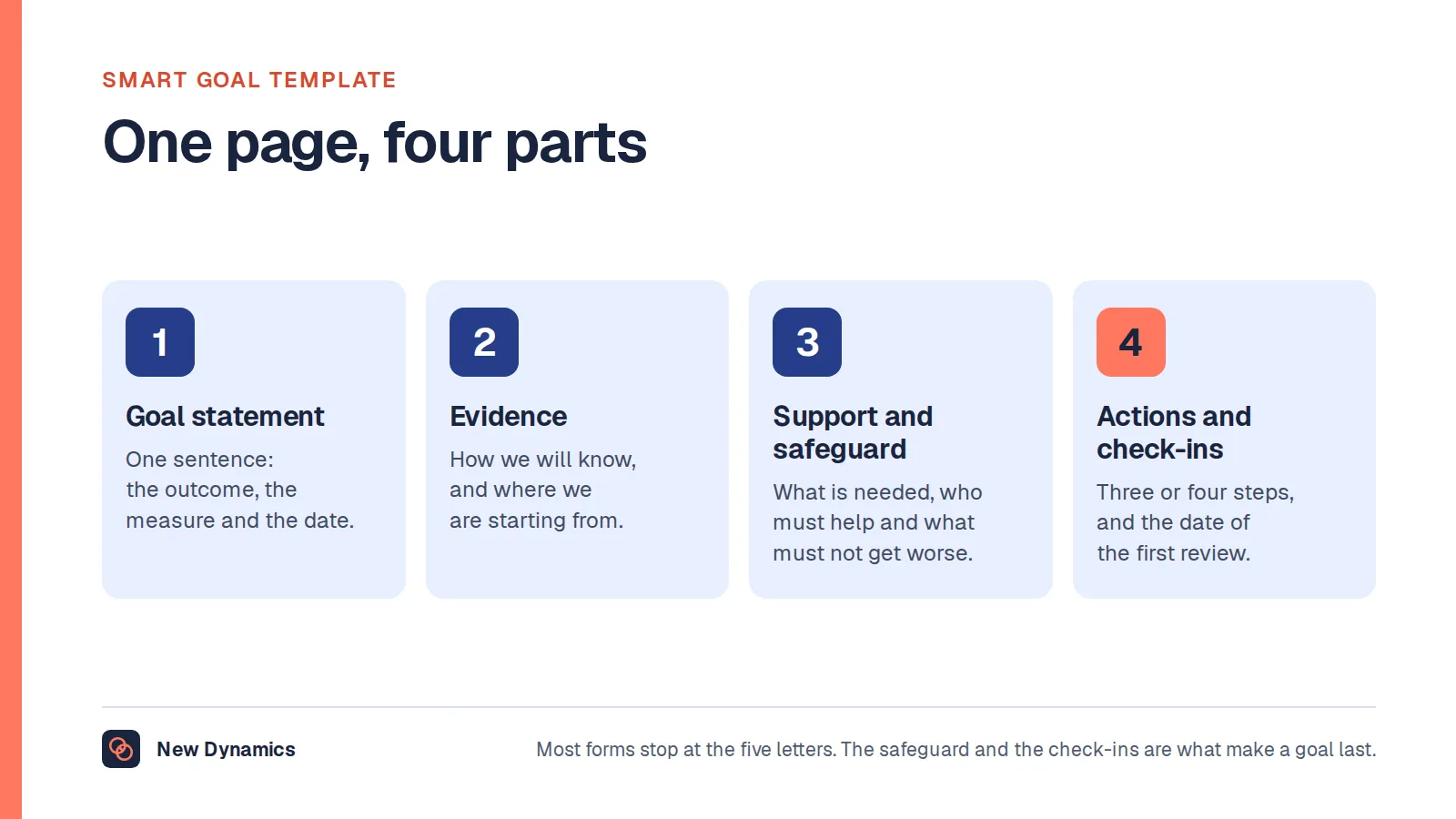
- Set two or three short-term goals that close the most important gaps. Word them so that you can tell whether they happened. Our 50 SMART goal examples show how.
- Be honest about time. The National Careers Service advises you to think about the time you can give, “taking into account your personal circumstances and work commitments”.
- Share the plan with your manager and, ideally, a mentor.
- Review every few months. The Civil Service HR Career Framework on career pathways recommends setting short, medium and long-term goals, seeking development opportunities such as mentoring, job shadowing, cross-functional projects or targeted training, and regularly reviewing whether your pathway still meets your needs.
Career growth: how to talk to your manager
Many people wait for their manager to raise the subject. Many managers are waiting too.
- Ask for a separate conversation. Career talk gets squeezed out of a normal one-to-one. Our one-to-one meeting guide has an agenda.
- Bring a draft. “Here is where I would like to be in three years, and two things I would like to do this year. What do you think?” is easy to respond to.
- Ask for opportunities, as well as courses. Much growth comes from doing new work with support. Ask for the project, the presentation or the secondment.
- Ask what is holding you back. Then listen.
- Agree who does what. You own your career. Your manager can open doors, give feedback and make time.
- Write it down and review it. A development goal that is recorded and revisited survives. One that is merely discussed does not.
If you manage people, the same points apply in reverse. See what talent means at work for why opportunity is the ingredient managers control.

Common mistakes with career goals
Making the job title the goal. Titles depend on vacancies and other people's decisions. Skills and experience are in your hands.
Setting only long-term goals. Without a step for this quarter, nothing changes.
Copying someone else's path. Their strengths and circumstances are not yours.
Keeping it secret. People cannot offer opportunities they do not know you want.
Never revising the plan. Interests, organisations and lives change. Changing your goal is a sign that you are paying attention.
Frequently asked questions
What are career goals?
Career goals are statements of where you want your working life to go and what you will do next to move towards it. They can concern skills, experience, relationships or the way you want to work. A useful plan has a long-term aim and short-term steps.
What are examples of career goals?
Short-term examples include completing a qualification, leading a project, finding a mentor and presenting to senior colleagues. Long-term examples include moving into management, becoming a recognised specialist, changing field, working abroad or starting a business.
What is a good answer to “what are your career goals?” in an interview?
Give a direction and a next step that fit the role. For example: “I want to grow into leading a customer team. In the next year I want to master this role, lead a small project and learn from your experienced managers.” Be honest and specific.
What is the difference between short-term and long-term career goals?
Short-term career goals cover roughly the next three to twelve months and describe concrete steps, such as a course or a project. Long-term career goals look three to ten years ahead and set direction, such as leading a department or changing field.
How do I achieve career growth without a promotion?
Career growth also means deeper skills, broader experience, a stronger network and better working conditions. Take on a new responsibility, move sideways, mentor someone, learn a new tool or lead a project. These build capability whether or not a vacancy appears.
How often should I review my career goals?
Review short-term goals every few months and your long-term direction at least once a year. Review sooner after a big change, such as a new manager, a restructure or a change in your life outside work.
Your next step: write one long-term aim and two steps
- Write one sentence about where you would like to be in three to five years.
- Write two things you can do in the next six months to move towards it.
- Tell your manager, and ask for one opportunity that would help.
- Put a review date in your diary.
For questions and a development plan template, read and download our career development guide. The guide is free to read, and the PDF uses our short download form.
Want development goals, feedback and reviews in one place? Book a New Dynamics demo and bring your current development process. You can also email contact@new-dynamics.com.