TL;DR
- Speaking like a leader has little to do with a deep voice or a big vocabulary. It means being clear about what you think, brief in how you say it, honest about what you do not know and calm under pressure.
- Ten habits build it: put the point first, use plain words, take ownership, cut the hedges, state decisions as decisions, ask more than you tell, pause, give credit, speak last and close with an action.
- Small swaps carry weight. “I think maybe we could possibly” becomes “I recommend”. “Someone should” becomes “I will”. “You failed to” becomes “what got in the way?”
Two people make the same proposal in the same meeting. One is heard, and the other is talked over. The difference is often not the idea, the job title or the volume. It is how the thing was said.
This article explains how to speak like a leader, whether or not you have the title. It sets out five qualities of a leader's voice, ten habits to practise, twelve phrases to swap and six steps for preparing an important conversation.
Leaders are judged by their conversations more than by their speeches. See how New Dynamics continuous feedback supports regular, honest conversation between managers and teams.
What it means to speak like a leader
It does not mean sounding important. Jargon, a booming voice and long words are imitations of authority, and most people see through them.
Speaking like a leader means that when you have finished, people know what you think, what you have decided or need, and what happens next. They also feel that they were treated with respect.
Communication is one of the behaviours that distinguishes effective managers in Google's research. Its summary of the research behind great managers lists ten behaviours of highly effective managers, and “Communicate effectively” is one of them, alongside “Be a good coach” and “Create a team environment that values everyone”.
Most of a leader's speaking is not done from a stage. The open textbook Principles of Management, published by OpenStax, observes in its section on the major channels of management communication that managers spend their days “in meetings, on the telephone, conducting interviews, giving tours” and at many informal events. It adds that shrewd managers see these “as opportunities to hear what others are thinking”. How you speak in a corridor matters as much as how you speak at a podium.
Five qualities of a leader's voice
- Clear. One main point, stated early, in plain words.
- Brief. Enough to be understood and no more. Attention is scarce.
- Honest. Including “I don't know”, “I was wrong” and the bad news.
- Calm. Steady pace and tone, most of all when things are tense.
- Inclusive. “We” more than “I”, questions as well as statements, and credit shared.

Ten habits of people who speak like leaders
1. Put the point first
Start with the conclusion, and then give the reasons. “I recommend that we delay the launch by two weeks. Here is why.” People who build slowly to their point lose the room before they arrive.
2. Use plain words
Say “use”, not “utilise”. Say “we lost the customer”, not “we experienced a negative retention event”. Plain language signals confidence. Jargon often hides uncertainty.
3. Take ownership
Use “I” for responsibility and “we” for credit. “I made the wrong call on the supplier” earns more respect than any explanation of how circumstances conspired.
4. Cut the hedges
“I just wanted to quickly maybe suggest…” apologises for speaking before anything has been said. One hedge is politeness. Four are a request to be ignored.
This does not mean pretending to be certain. “I am about 70% confident, and here is what would change my mind” is direct and honest at once.
5. State decisions as decisions
If you have decided, say so: “We are going with option B.” If you have not, say that: “I have not decided. I want your views by Friday.” Confusion starts when a decision is dressed as a discussion, or the other way round.
6. Ask more than you tell
“What do you think we should do?” “What am I missing?” “What would make this easier?” Good questions show confidence. Only an insecure leader needs to have every answer. Our one-to-one meeting questions offer many more.
7. Pause
A silence of two seconds feels long to the speaker and natural to the listener. Pause before you answer a hard question, and after you make an important point. Filling every gap with “um” and “you know” dilutes what you say.
8. Give credit by name
“Priya found the error that saved the contract” costs nothing and tells everyone that you notice. See our positive feedback examples.
9. Speak last
When the most senior person speaks first, the discussion is over. Give your view after you have heard the others. You will learn more, and they will say what they really think.
10. Close with an action
End every conversation and meeting with who will do what by when. A leader's words are judged by what happens afterwards.
Twelve phrases to swap
| In place of | Try | Why |
|---|---|---|
| “I just think maybe we could possibly…” | “I recommend…” | Removes the apology |
| “Someone should look at that.” | “I will look at that by Friday.” | Ownership |
| “Does that make sense?” | “What questions do you have?” | Invites real questions |
| “You failed to deliver.” | “The report was due on Monday. What got in the way?” | Facts, then curiosity |
| “That won't work.” | “What would have to be true for that to work?” | Tests the idea without killing it |
| “I'm sorry to bother you, but…” | “I need ten minutes on the budget. When suits you?” | Respects both people's time |
| “We've always done it this way.” | “Here is why we do it this way. Is the reason still good?” | Opens the question |
| “No problem.” | “You're welcome. I was glad to help.” | Accepts the thanks |
| “I'll try.” | “I will have it done by Thursday”, or “I can't commit to that. Here is what I can do.” | A clear promise, or a clear no |
| “They decided upstairs.” | “We have decided. Here is the reason.” | Owns the organisation's decisions |
| “To be honest…” | Say the honest thing | The phrase implies that the rest was not |
| “But” after praise | “And” | “But” erases what came before |

Speaking in the hard moments
Giving bad news. Say it in the first sentence. Give the reason. Say what happens next and what support there is. Then stop talking and listen. Do not soften it until it cannot be understood.
When you do not know. “I don't know. I will find out and tell you by Wednesday.” Then do it. People forgive ignorance, and they rarely forgive bluffing.
When you were wrong. “I got that wrong. Here is what I am changing.” Keep it short. A long apology makes the listener look after you.
Under challenge. Slow down. Repeat the question in your own words to be sure you understood it. Answer the question that was asked. If the challenger is right, say so.
When emotions run high. Lower your voice as others raise theirs. Name what you see: “I can tell that this matters a great deal to you.” Deal with the person first and the problem second.
Giving criticism. Describe the situation, the behaviour and its effect, without labelling the person. Our negative feedback examples show how.
How you sound
Words carry the message, and delivery decides whether it is heard.
- Pace. Most people speed up when they are nervous. Slow down deliberately, and more so for the important sentence.
- Volume. Loud enough to be heard easily by the person furthest away. No louder.
- Endings. Let statements end on a falling note. A rising tone turns a decision into a question.
- Eye contact. Look at people, one at a time, and finish a thought with each. On video, look at the camera for the key points.
- Stillness. Fidgeting signals unease. Plant your feet, and let your hands rest between gestures.
- Your own voice. Do not borrow an accent, a vocabulary or a persona. People follow those who sound like themselves on a good day.
Six steps to prepare for an important conversation
- Decide the one point. If they remember a single sentence, what should it be?
- Know the listener. What do they already know, what do they care about and what will worry them?
- Plan the first two sentences. Write them down. The rest can be notes.
- Prepare for the hard question. Decide what you least want to be asked, and work out an honest answer.
- Choose the close. What decision or action do you want at the end?
- Say it aloud once. Out loud, not in your head. You will hear what is too long.
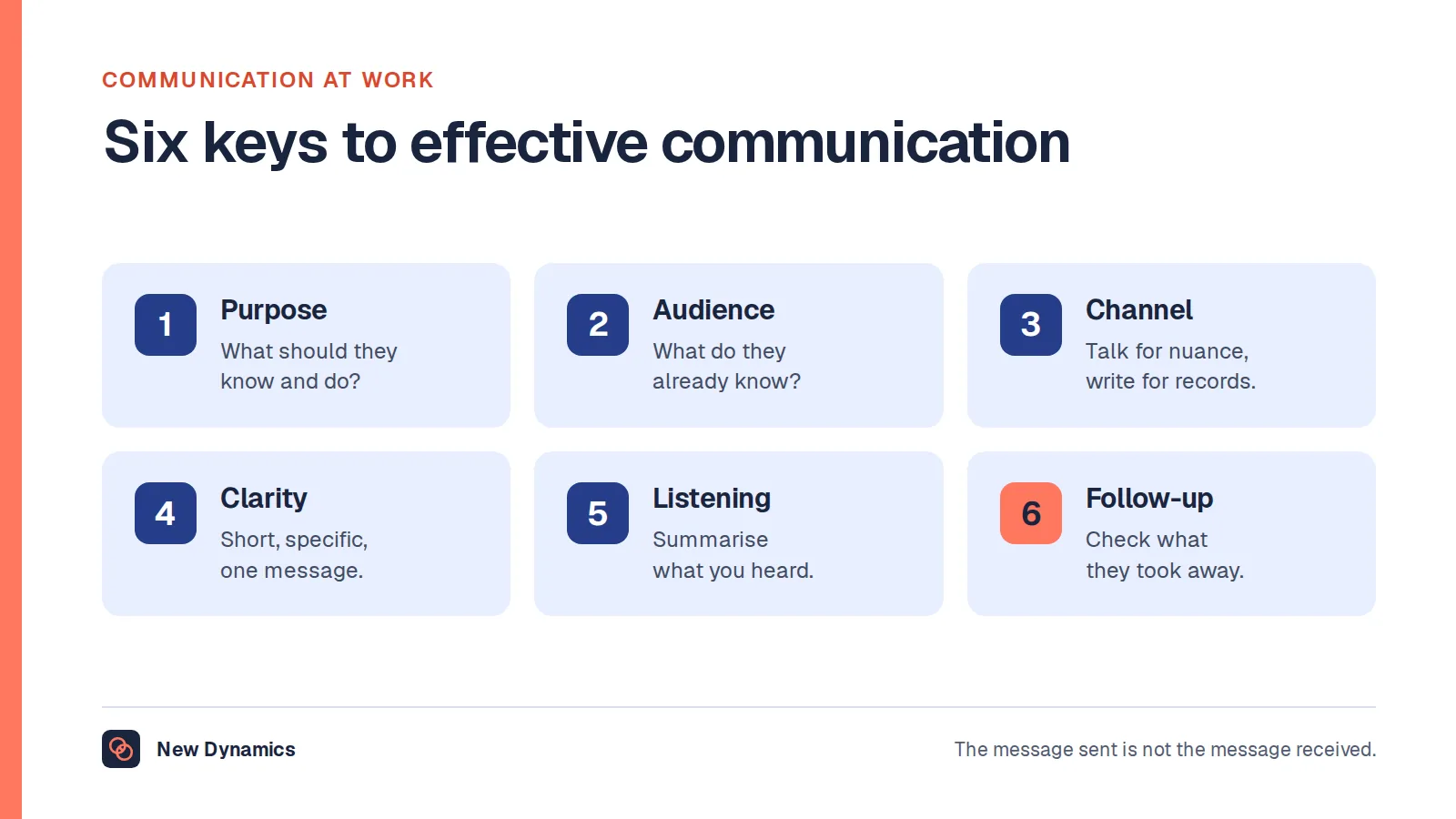
Our six keys to effective communication cover the fundamentals behind these steps.

Common mistakes
Talking to fill silence. The more you say, the less each sentence weighs.
Hiding behind “we” when it should be “I”. “Mistakes were made” fools nobody.
Performing confidence. Certainty that you do not have will be found out.
Interrupting. It tells people that your thoughts matter more than theirs.
Different voices for different ranks. Charming upwards and curt downwards is noticed by everyone.
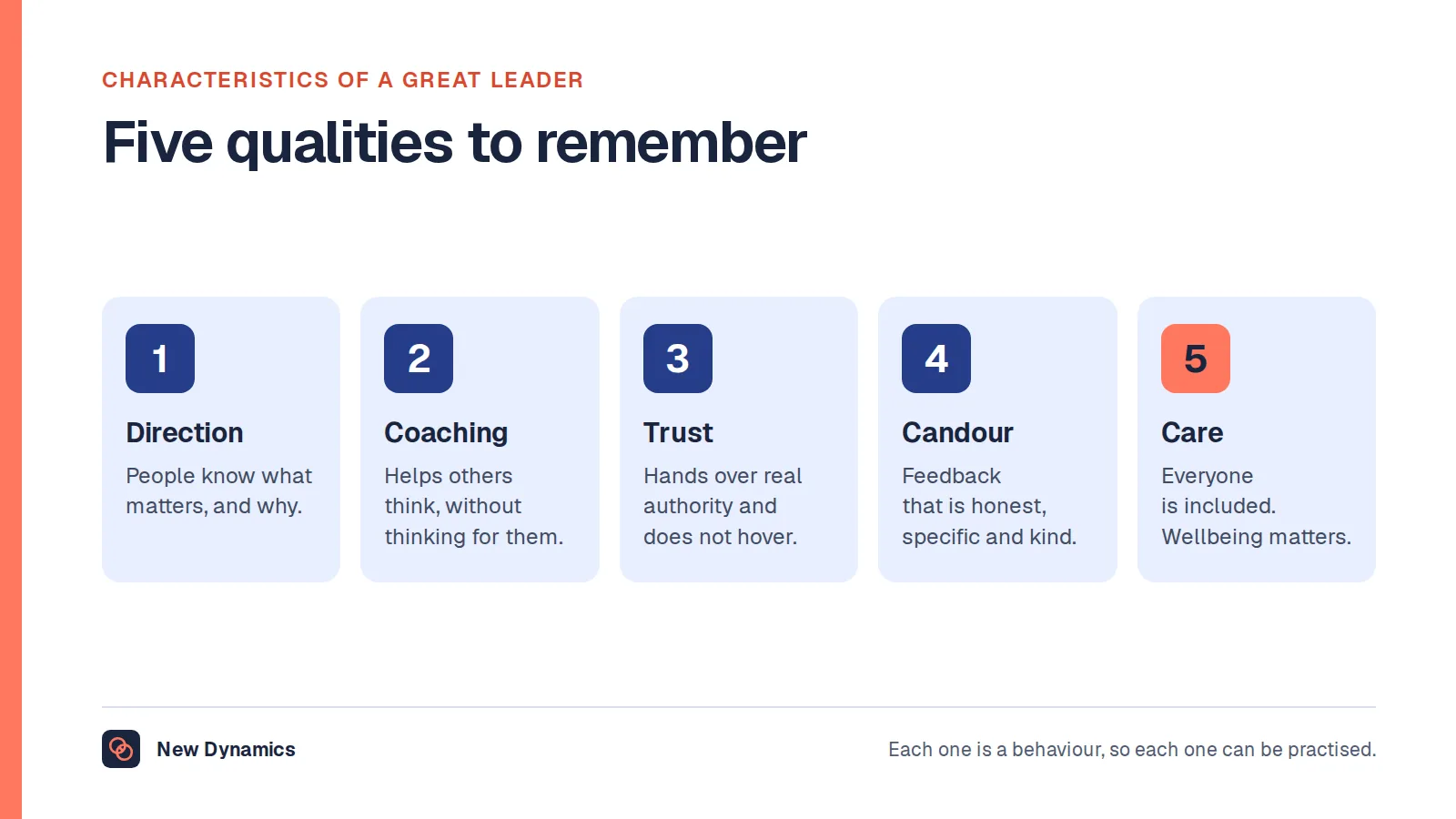
Forgetting to listen. Half of speaking like a leader is staying quiet. See the characteristics of a great leader.
Frequently asked questions
How do you speak like a leader?
Put your point first, use plain words, take ownership with “I”, cut unnecessary hedges, state decisions clearly, ask good questions, pause, give credit by name, speak last in discussions and close with a clear action.
What phrases do good leaders use?
Useful phrases include “I recommend”, “I will do that by Friday”, “What am I missing?”, “I don't know, and I will find out”, “I got that wrong”, “What got in the way?” and “What questions do you have?”
How can I sound more confident when I speak?
Slow down, pause before important points, let statements end on a falling tone, cut filler words and hedges, and prepare your first two sentences in advance. Confidence comes more from clarity about your point than from volume.
What should leaders avoid saying?
Avoid stacked hedges such as “I just think maybe”, blame such as “you failed to”, distancing such as “they decided upstairs”, empty promises such as “I'll try” and “but” straight after praise, which cancels it.
Can you speak like a leader without being a manager?
Yes. Leadership in speech is about clarity, ownership and respect, and none of them needs a title. People who speak this way are often the ones later chosen to lead.
How do leaders deliver bad news?
They say it in the first sentence, give the reason plainly, explain what happens next and what support is available, and then listen. They do not soften the message until it is unclear, and they do not blame others for the decision.
Your next step: record and review
- Record yourself in your next presentation or, with permission, in a meeting.
- Count your hedges and fillers, and note how long you take to reach your point.
- Choose one habit from the ten to practise for a fortnight.
- Ask a trusted colleague what they notice.
For prompts that turn these habits into better conversations with your team, read and download our one-to-one meeting guide. The guide is free to read, and the PDF uses our short download form.
Want feedback and regular check-ins to be part of how your managers lead? Book a New Dynamics demo and bring your current routines. You can also email contact@new-dynamics.com.