TL;DR
- SUB pay is supplemental unemployment benefit pay: a weekly employer top-up on top of state unemployment compensation, usually under a written plan and often in a collective agreement. The Department of Labor describes payments from an employer-financed trust fund bringing the combined total to a set proportion of former weekly earnings.
- The tax answer is not one rule. IRS Publication 15 for 2026 lists severance or dismissal pay as taxable for social security, Medicare and FUTA, and lists supplemental unemployment compensation plan benefits as Exempt under certain conditions. Publication 15-A sets out seven conditions, one of which is that benefits may not be paid in a lump sum.
- It can still reduce the state benefit. The Department of Labor's Comparison of State Unemployment Insurance Laws says supplementation of the layoff-only type without impacting unemployment compensation is permitted by all states except New Mexico, Puerto Rico, South Carolina and South Dakota.
Jurisdiction: United States. SUB pay is an American payroll and collective bargaining term, and everything below describes United States federal tax and unemployment insurance rules. It does not describe the United Kingdom, where the same two words usually mean something else; there is a short note for British readers near the end. Every rule quoted names the publication and the revision it came from. This is general information, not legal or tax advice.
SUB pay stands for supplemental unemployment benefit pay, and the word doing the work is supplemental. It is not a lump sum handed over at the door. It is a weekly amount an employer pays on top of what the state already pays an unemployed former employee, so the two together come to a planned fraction of former earnings. That structure is why the tax treatment differs from severance, and why getting the plan wrong turns a designed top-up into ordinary taxable wages.
A layoff generates a sequence of payments, notices and deadlines that each need an owner. See how New Dynamics workflows let you shape the stages, participants and approvals around your own process rather than a software template.
What SUB pay actually is
The clearest published description comes from the Department of Labor, not the IRS. Chapter 5 of the Comparison of State Unemployment Insurance Laws, whose most recent edition reflects "the status of state laws enacted as of January 1, 2023", defines it as follows: "A supplemental unemployment payment plan is a system whereby, under a contract, unemployed individuals receive payments from an employer-financed trust fund. The purpose is to provide the individual, while unemployed, with a combined UC and supplemental unemployment benefit payment amounting to a specified proportion of the individual's weekly earnings while employed."
Three features fall out of that. There is a contract, so the arrangement is written in advance. There is a fund the employer pays into, not a cheque written at separation. And the benefit is calculated by reference to the state payment, because the point is the combined figure.
The same chapter names two kinds of plan: "1) those under which the individual has no vested interest and is eligible for payments only if the individual is laid off by the company; and 2) those under which the individual has a vested interest and may collect if the individual is out of work for other reasons, such as illness or permanent separation." Which type the collective agreement created changes the state answer later.

SUB pay, severance pay and a WARN payment are three different things
These get confused because they can arrive in the same month.
Severance or dismissal pay compensates the fact of separation. It is typically a multiple of service or salary, is often a lump sum, and does not depend on anyone claiming from the state. IRS Publication 15 (2026), (Circular E), Employer's Tax Guide, for use in 2026, puts it in its Reminders without qualification: "Severance payments are wages subject to social security and Medicare taxes, federal income tax withholding, and FUTA tax."
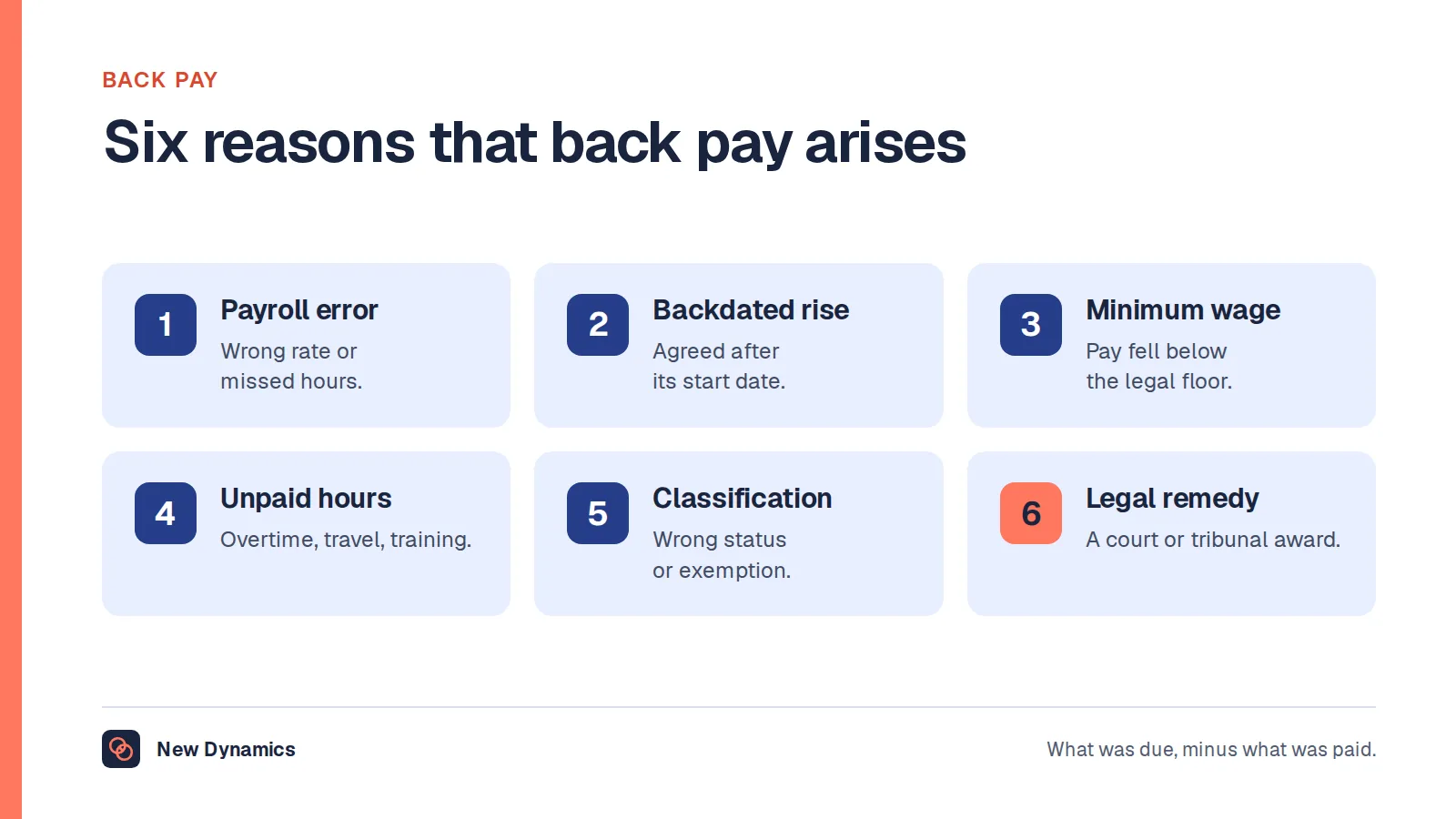
A WARN Act payment is damages, not a benefit. The Department of Labor's Employer's Guide to Advance Notice of Closings and Layoffs states the obligation plainly: the Act "requires employers to provide written notice at least 60 calendar days in advance of covered plant closings and mass layoffs". If notice is not given, "An employer who violates WARN is liable to each affected employee for an amount equal to back pay and benefits for the period of violation, up to 60 days." The guide is blunt about the shortcut employers reach for: "Neither the Act nor the regulations recognize the concept of pay in lieu of notice. WARN requires notice, making no provision for any alternative." It also says contractual severance will not cover the gap, because only "voluntary and unconditional" payments not "required by any legal obligation" offset back pay liability. The guide notes that it "is not an official statement of interpretation of WARN", and that the regulations appear at 20 CFR Part 639.
SUB pay is the only one of the three tied to the person actually receiving state unemployment compensation. That tie is what the tax rules turn on.
Why the distinction matters for social security and Medicare tax
Here is the part to be careful about, because the honest answer is conditional and plenty of writing on this subject states it as a flat rule.
Publication 15 for 2026 carries a table in section 15, "Special Rules for Various Types of Services and Payments", with three treatment columns: "Federal income tax withholding", "Social security and Medicare (including Additional Medicare Tax when wages are paid in excess of $200,000)" and "FUTA". Two rows sit near each other and say different things.
For "Severance or dismissal pay." the table reads "Withhold." for income tax withholding, "Taxable." for social security and Medicare, and "Taxable." for FUTA.
For "Supplemental unemployment compensation plan benefits." it reads "Withhold." for income tax withholding, then a single entry spanning the social security, Medicare and FUTA columns: "Exempt under certain conditions. See Pub. 15-A."
That is the federal position in two rows. Income tax withholding applies to SUB pay as it does to wages. The employment tax answer is conditional, and Publication 15 does not state it as a general rule. Neither does Publication 525 (2025), Taxable and Nontaxable Income, for use in preparing 2025 returns, which tells the recipient: "Benefits received from an employer-financed fund (to which the employees didn't contribute) aren't unemployment compensation. They're taxable as wages and are subject to withholding for income tax. They may be subject to social security and Medicare taxes."
Note "may be". If you want a general rule on whether a particular SUB payment is wages for social security and Medicare purposes, the IRS does not publish one and this article will not invent one. The conditions below are the test, and Publication 15-A (2026), Employer's Supplemental Tax Guide, for use in 2026, is the page to take to a tax adviser. It points beyond itself too: "For more information, see Revenue Ruling 90-72, 1990-36 I.R.B. 13."

The seven conditions in Publication 15-A
Section 5 of Publication 15-A opens on funding: "If you pay, under a plan, supplemental unemployment compensation benefits to a former employee, all or part of the payments may be taxable and subject to federal income tax withholding, depending on how the plan is funded." On withholding it is direct: "You should withhold federal income tax on the taxable part of the payments made, under a plan, to an employee who is involuntarily separated because of a reduction in force, discontinuance of a plant or operation, or other similar condition. It doesn't matter whether the separation is temporary or permanent." The mechanism is ordinary: withholding "must be based on the withholding certificate (Form W-4) that the employee gave to you."
Then come the conditions. The publication says "To be excluded from wages for such purposes, the benefits must meet the following requirements", the purposes being social security, Medicare and FUTA tax. All seven are quoted here as worded.
- "Benefits are paid only to unemployed former employees who are laid off by the employer."
- "Eligibility for benefits depends on meeting prescribed conditions after termination."
- "The amount of weekly benefits payable is based upon state unemployment benefits, other compensation allowable under state law, and the amount of regular weekly pay."
- "The right to benefits doesn't accrue until a prescribed period after termination."
- "Benefits aren't attributable to the performance of particular services."
- "No employee has any right to the benefits until qualified and eligible to receive benefits."
- "Benefits may not be paid in a lump sum."
Read as a set, they describe a benefit only a properly drafted plan can deliver. Condition 1 rules out a resignation or a dismissal for cause. Condition 3 means the arithmetic has to reference the state figure, so a flat weekly top-up chosen for simplicity is a design risk. Condition 7 catches employers out most often, because a lump sum is easier and closes the file.
How SUB pay interacts with state unemployment eligibility
Federal tax treatment is one question. Whether the state still pays its benefit is another, answered state by state.
The Department of Labor's page How Do I File for Unemployment Insurance? sets the frame: "Unemployment insurance is a joint state-federal program that provides cash benefits to eligible workers. Each state administers a separate unemployment insurance program, but all states follow the same guidelines established by federal law." On eligibility: "Each state sets its own unemployment insurance benefits eligibility guidelines, but you usually qualify if you: Are unemployed through no fault of your own."
The Comparison of State Unemployment Insurance Laws then gives two statements in the same chapter that have to be read together.
The first is in its section on deductible income: "Most states include provisions that an individual is ineligible for any week during which the individual receives or has received certain other types of remuneration, such as wages in lieu of notice, dismissal wages, worker's compensation, holiday and vacation pay, back pay, and benefits under a supplemental unemployment benefit plan. In many states, if the payment is less than the weekly benefit amount, the individual receives the difference; in other states, no benefits are payable for a week of such payments regardless of the amount of payment."
The second is in its section on SUB pay: "Supplementation of the first type, without impacting UC, is permitted by all states except New Mexico, Puerto Rico, South Carolina, and South Dakota. In 48 states, the authority to do so is based on an interpretive ruling by the state attorney general (27 states), by the employment security agency (10 states), or by Court decision (one state). 10 states permit supplementation of the first type by state statutes."
Neither sentence cancels the other. The deductible income list is the general position on payments that can make a claimant ineligible for a week, and SUB plan benefits appear on it. The SUB pay section records that for the layoff-only, non-vested type of plan, almost every jurisdiction has ruled that supplementation does not impact unemployment compensation, and in most the authority is an attorney general or agency ruling rather than a statute. What governs is your state's own law and ruling, so check the plan with the agency in every state where laid-off employees will claim. Four jurisdictions are on the exception list.
What an employer needs in the plan
The seven conditions are the drafting brief. Three practical points sit beside them.
A written plan and a funding route. Publication 15-A repeats "under a plan" through a short section and ties the taxable amount to how the plan is funded; the Department of Labor assumes a contract and an employer-financed trust fund. A top-up offered in a separation letter is not a plan.
An eligibility test anchored to the state claim. Conditions 1, 2, 3 and 6 all turn on the former employee being laid off, qualifying and claiming, so the plan needs a way to evidence the state award each week and a payroll process that acts on it.
A check against the severance pay regulation. A benefit paid on account of termination is also an ERISA question. 29 CFR 2510.3-2(b), with Title 29 of the Electronic Code of Federal Regulations current to 4 November 2026, keeps such an arrangement from being "deemed to constitute an employee pension benefit plan or pension plan solely by reason of the payment of severance benefits on account of the termination of an employee's service", on three provisos: payments are not contingent on the employee retiring, the total does not exceed "twice the employee's annual compensation during the year immediately preceding the termination", and payments complete "within 24 months after the termination of the employee's service". A limited programme of terminations must also be "described in a written document which is available to the Secretary upon request".
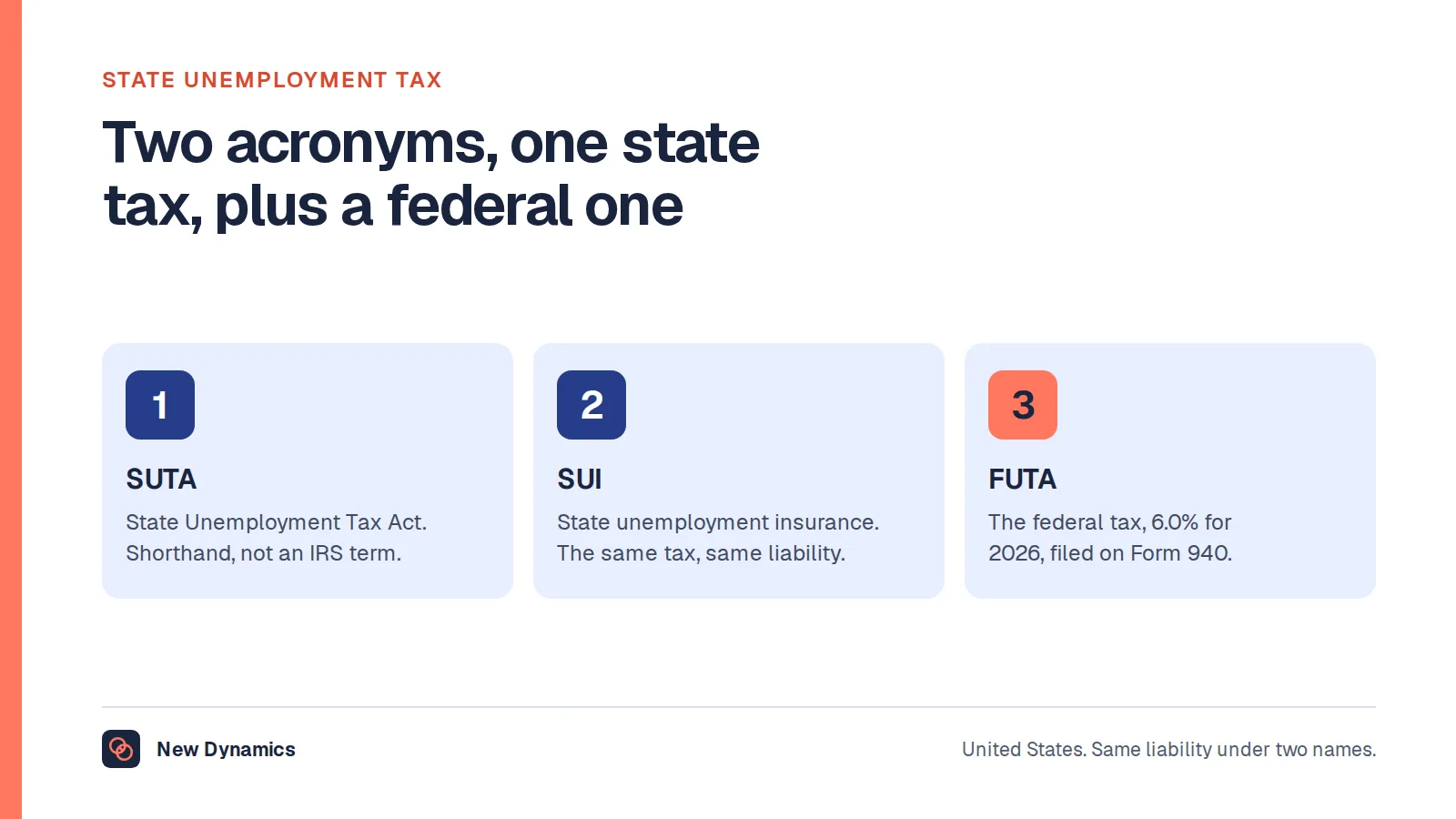
For the tax that funds the state side, see our post on SUTA and SUI state unemployment tax, and for what comes off a payment once classified, payroll deductions. Our HR statistics hub collects published workforce figures in one place.

A note for readers in the United Kingdom
If you searched "sub pay" from Britain, this is probably not your question. The acronym is American and depends on a state unemployment insurance system the United Kingdom does not have.
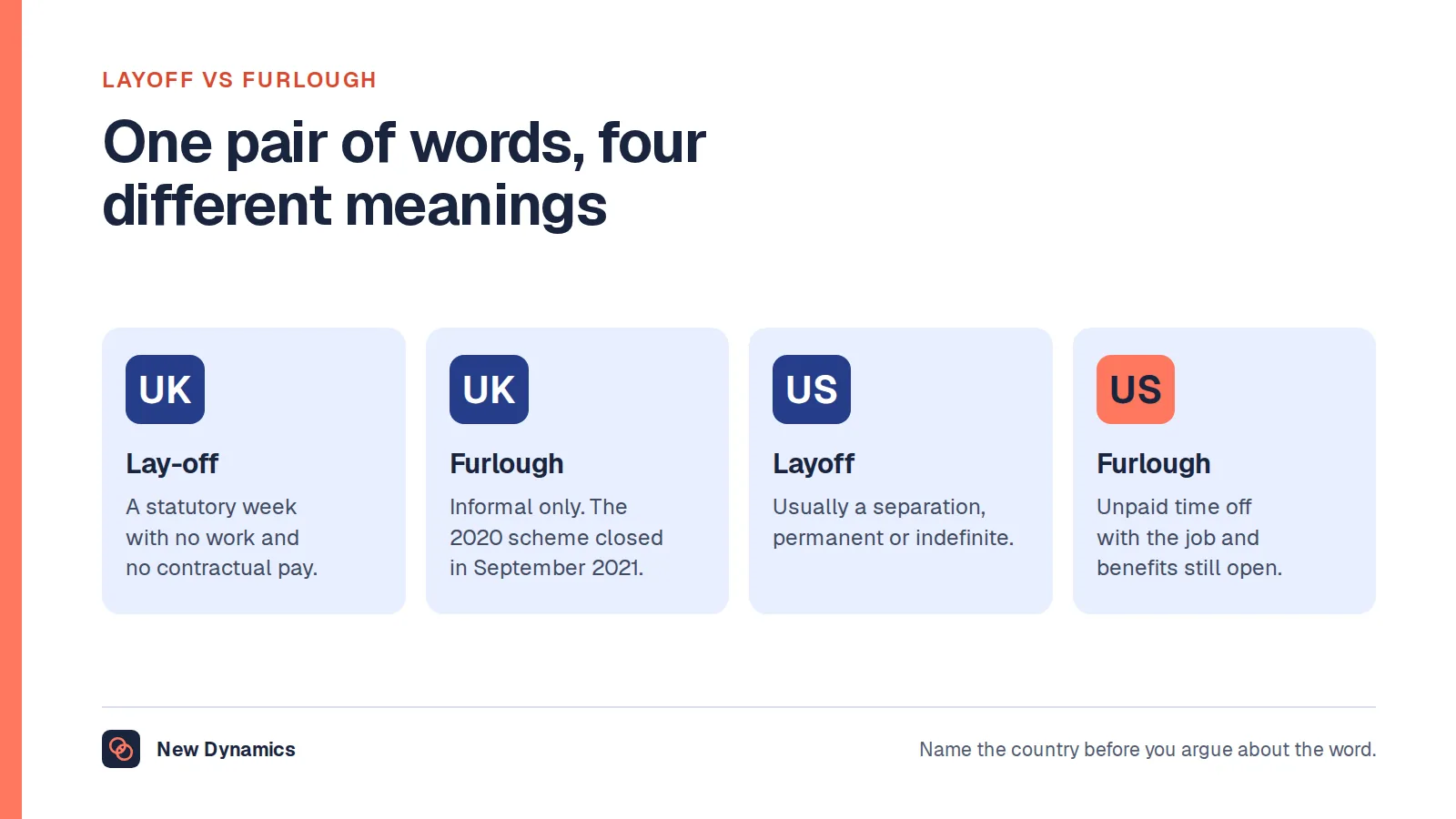
In British usage "sub" is not an acronym at all. It is commonly short for a subsistence payment or an advance against wages, and in a school context "sub pay" usually means pay for substitute or supply teaching. None of the rules above applies to any of those. For the United Kingdom position on payments at the end of employment, read our posts on severance pay and the definition of redundancy instead.
Frequently asked questions
What does SUB pay stand for?
SUB pay stands for supplemental unemployment benefit pay. It is a weekly payment an employer makes to a laid-off former employee on top of state unemployment compensation, so the combined amount reaches a proportion of former weekly earnings set by the plan. The Department of Labor describes payments from an employer-financed trust fund made under a contract.
Is SUB pay the same as severance pay?
No. Severance or dismissal pay compensates the fact of separation and does not depend on a state unemployment claim. The section 15 table in IRS Publication 15 for 2026 marks severance or dismissal pay "Taxable." for social security and Medicare and for FUTA, and marks supplemental unemployment compensation plan benefits "Exempt under certain conditions. See Pub. 15-A." A lump sum is a further giveaway, as the seventh condition above shows.
Is SUB pay subject to social security and Medicare tax?
It depends, and the IRS does not publish a general rule. Publication 15 for 2026 shows these benefits as exempt under certain conditions and refers the reader to Publication 15-A. Publication 525 for 2025 tells recipients only that they "may be subject to social security and Medicare taxes". The seven conditions in section 5 of Publication 15-A are the test, so take the plan document to them rather than to a summary.
Is federal income tax withheld from SUB pay?
Yes, on the taxable part. Publication 15-A for 2026 says to withhold on the taxable part of payments made under a plan to an employee involuntarily separated because of a reduction in force, a discontinuance of a plant or operation, or a similar condition, whether the separation is temporary or permanent. Withholding follows the Form W-4 the employee gave you.
Does SUB pay reduce state unemployment benefits?
Usually not for the layoff-only type of plan, but there are exceptions. The Department of Labor's Comparison of State Unemployment Insurance Laws says supplementation of that type without impacting unemployment compensation is permitted by all states except New Mexico, Puerto Rico, South Carolina and South Dakota. The same chapter also lists supplemental unemployment benefit plan benefits among remuneration that can make a claimant ineligible for a week, so check with the agency in each state where employees will claim.
How does SUB pay differ from a WARN Act payment?
A WARN Act payment is damages for a notice failure, not a benefit. The Department of Labor's employer guide says the Act requires written notice at least 60 calendar days in advance of covered plant closings and mass layoffs, and that an employer who violates it is liable for back pay and benefits for the period of violation, up to 60 days. The guide also says neither the Act nor the regulations recognise the concept of pay in lieu of notice.
Can SUB pay be paid as a lump sum?
Not if you want the social security, Medicare and FUTA exclusion. The seventh requirement in section 5 of Publication 15-A is that "Benefits may not be paid in a lump sum." A single closing payment is the design decision most likely to move a payment into ordinary severance.
Your next step: test the plan against the seven conditions
- Find the plan document. No document and no fund very likely means no SUB plan, and the payments are ordinary wages.
- Mark each of the seven conditions in section 5 of Publication 15-A against the plan text, paying particular attention to the lump sum prohibition and to whether the weekly amount references the state benefit.
- List every state where laid-off employees will claim and check the plan with each agency. New Mexico, Puerto Rico, South Carolina and South Dakota are on the Department of Labor's exception list.
- Separate the payment types in payroll. Severance, SUB pay and any payment made over a WARN notice period have three different treatments, and one combined line item destroys the distinction.
- Confirm the position in writing with your tax adviser before the first payment. The IRS publishes conditions here, not a general rule, and the conditions are about the plan rather than the payment.
For setting pay in a way you can explain to the people it applies to, read and download our compensation policy guide. The guide is free to read, and the PDF uses our short download form.
Want layoff and leaver admin to have an owner and a date rather than a good intention? Book a New Dynamics demo and bring your current process. You can also email contact@new-dynamics.com.