TL;DR
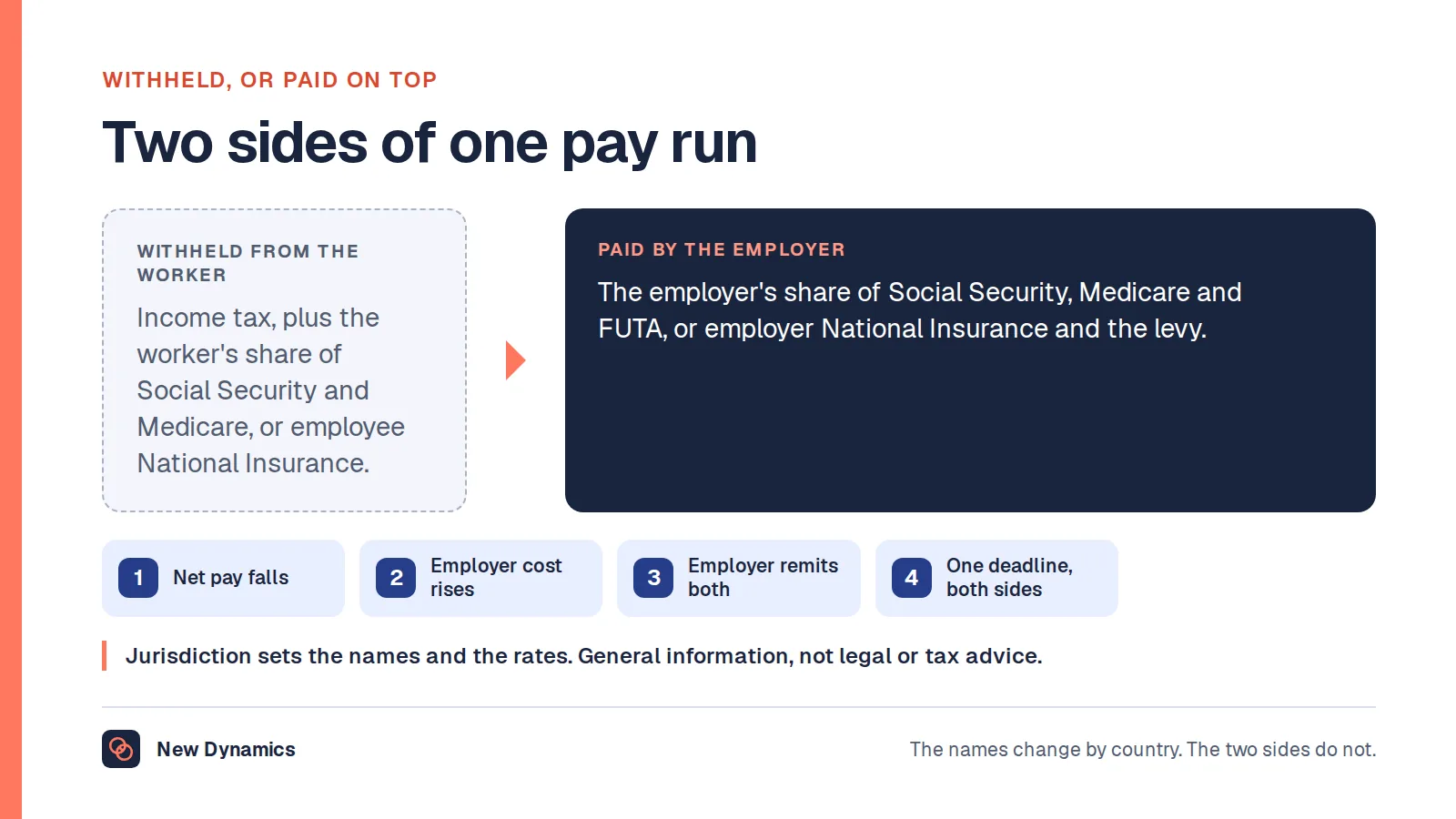
- There is no single taxable wages figure. Publication 15 (2026) starts from a wide definition, that "Wages subject to federal employment taxes generally include all pay you give to an employee for services performed", and then taxes three different subsets of it: income tax withholding, Social Security and Medicare, and FUTA.
- A pre-tax deduction does not reduce every tax. The IRS table in Publication 15 gives a 401(k) elective deferral as "Generally exempt" for federal income tax withholding and "Taxable" for Social Security, Medicare and FUTA, which is exactly why box 1 and box 3 of a Form W-2 disagree.
- The limits differ too. For 2026 the social security wage base limit is $184,500 and there is "no wage base limit for Medicare tax", the 0.9% Additional Medicare Tax starts at $200,000 of wages, and FUTA applies only to "the first $7,000 you pay to each employee as wages during the year".
Everything in this article is about the United States federal position, and nothing else. Taxable wages is an American payroll term. It belongs to a system in which federal income tax withholding, Social Security, Medicare and federal unemployment tax are charged on wages separately, each with its own base. None of it maps onto a United Kingdom payslip, where PAYE collects Income Tax and National Insurance through one mechanism with thresholds of its own, and where no figure called taxable wages carries the same meaning. A UK reader should not carry the numbers below across.
The question "how do you calculate taxable wages" usually arrives because two figures do not agree: the salary in the contract and the figure the tax was worked out on, or box 1 and box 3 of the same Form W-2. Both are normal. The reason is that there is no single taxable wages figure. One pay run produces several, and a payslip shows them side by side.
Payroll questions land on someone in HR before they reach payroll, and they stall when nobody owns the next step. See how New Dynamics workflows give each step an owner and a due date.
If you are paying people in the United Kingdom instead, read our post on gross wages, which covers what goes into the figure at the top of a UK payslip, and our post on pay stub deductions for what comes off it.
New Dynamics does not run payroll and does not give tax advice. What follows is general information, quoted from the publisher that sets each rule, with the tax year named every time a figure appears. Check the rules for the year you are paying in and take advice on your own position.
What the IRS counts as wages in the first place
Start wide, then subtract. Section 5 of Publication 15 (2026), (Circular E), Employer's Tax Guide, which the IRS marks "For use in 2026", opens the definition with no qualifications at all:
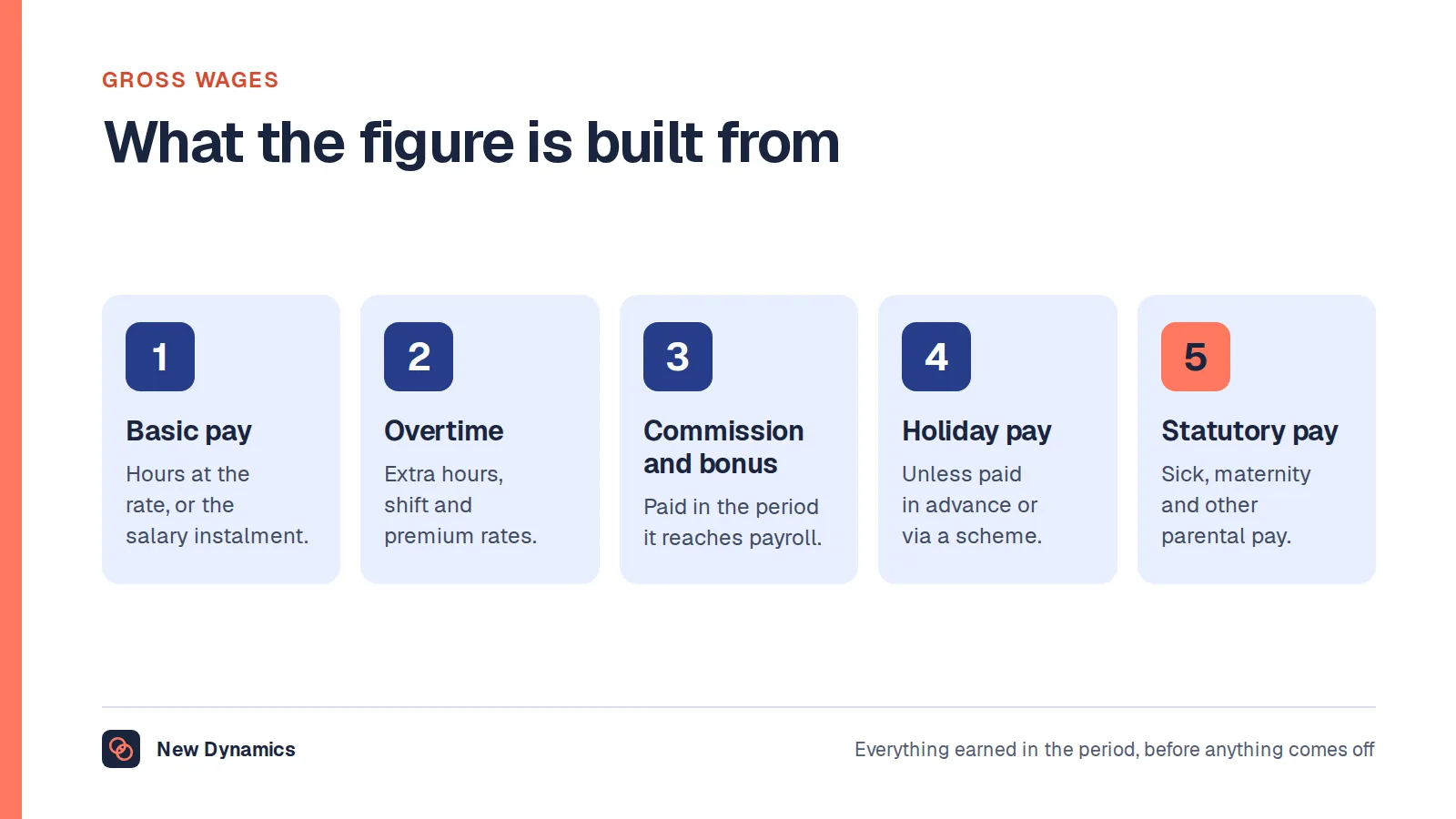
"Wages subject to federal employment taxes generally include all pay you give to an employee for services performed. The pay may be in cash or in other forms. It includes salaries, vacation allowances, bonuses, commissions, and taxable fringe benefits. It doesn't matter how you measure or make the payments."
The same section names items people assume are outside it. A signing bonus is in: amounts paid "as a bonus for signing or ratifying a contract in connection with the establishment of an employer-employee relationship", and an amount paid "for cancellation of an employment contract and relinquishment of contract rights", are "wages subject to social security, Medicare, and FUTA taxes and income tax withholding". Payment in kind is in: "Generally, the FMV of such payments at the time they're provided is subject to federal income tax withholding and social security, Medicare, and FUTA taxes."
Supplemental wages are in as well. Section 7 lists bonuses, commissions, overtime pay, payments for accumulated sick leave, severance pay, awards, prizes, back pay, reported tips, retroactive pay increases and payments for nondeductible moving expenses, and settles the question most often asked about them: "Regardless of the method you use to withhold income tax on supplemental wages, they're subject to social security, Medicare, and FUTA taxes." The income tax method can vary, at "a flat 22% (no other percentage allowed)" or by aggregation with regular wages. The payroll tax treatment does not.
So the starting figure is broad. Taxable wages is what is left after the exclusions that apply to each separate tax, and those exclusions are not the same.
Three taxable wage figures, not one

Publication 15 makes the split visible in its own layout. Section 15, "Special Rules for Various Types of Services and Payments", is a table with three treatment columns, and they are the three answers to "what are the taxable wages":
- Federal income tax withholding. The amount the employer takes from each payment towards the employee's eventual income tax bill, calculated "according to the employee's Form W-4 and the correct withholding table in Pub. 15-T".
- Social security and Medicare, which the heading qualifies as "including Additional Medicare Tax when wages are paid in excess of $200,000".
- FUTA, the federal unemployment tax, which the employee never sees because the employer pays it from its own funds.
Each column has its own answer for the same payment. Differential wage payments make the point in one line. Publication 15 says they "are wages for income tax withholding, but aren't subject to social security, Medicare, or FUTA tax", and tells employers to report them "in box 1 of Form W-2". One payment, inside one base and outside the other two.
The reverse exists too. Payments to statutory employees, the General Instructions for Forms W-2 and W-3 note, can be "subject to social security and Medicare taxes but not subject to federal income tax withholding". For how these taxes differ in character, see our post on payroll tax against income tax.
Before tax deductions, and which of the three figures each one reduces
This is where most calculations go wrong. A deduction described as "before tax" or "pre-tax" is before some taxes, not all of them, and the IRS sets out which in the section 15 table.
A 401(k) elective deferral. The table's row for "Elective employee contributions and deferrals to a plan containing a qualified cash or deferred compensation arrangement (401(k))" reads: "Generally exempt, but see section 402(g) for limitation" for federal income tax withholding, then "Taxable" for social security and Medicare, and "Taxable" for FUTA. So a 401(k) deferral lowers the figure income tax is withheld on and leaves the Social Security and Medicare figure untouched. Employee salary reduction contributions to a SIMPLE retirement account and to a section 457(b) plan are treated the same way, exempt for income tax withholding and taxable for the rest.
Employer contributions to a qualified plan are different again: "Exempt", "Exempt", "Exempt". They are not the employee's wages at all.
A section 125 cafeteria plan. The table's entry for "Cafeteria plan benefits under section 125" turns on the employee's choice: "If employee chooses cash or other taxable benefit, subject to all employment taxes. If employee chooses a nontaxable benefit, the treatment is the same as if the benefit was provided outside the plan." A footnote repeated through the table adds that "Benefits provided under cafeteria plans may qualify for exclusion from wages for social security, Medicare, and FUTA taxes". So a medical premium taken through a cafeteria plan can come out of all three figures, which a 401(k) deferral never does.
A health savings account, where the route decides the answer. Section 5 is unusually direct about this, and it is the clearest example on the page of a deduction whose label tells you nothing:
"Employee contributions to their HSAs or MSAs through a payroll deduction plan must be included in wages and are subject to social security, Medicare, and FUTA taxes, and federal income tax withholding. However, HSA contributions made under a salary reduction arrangement in a section 125 cafeteria plan aren't wages and aren't subject to employment taxes or withholding."
Two employees can pay the same amount into the same kind of account and have different taxable wages, because one employer runs it through a cafeteria plan and the other does not.

Post-tax deductions change none of the three. Union dues, a wage garnishment, a Roth contribution or a repayment to the employer come out after the taxes are figured. The General Instructions for Forms W-2 and W-3 (2026) confirm the Roth point by listing "Designated Roth contributions made under a section 401(k) plan" among the amounts to include in box 1. A post-tax deduction reduces take-home pay and nothing else, which is why two people with identical net pay can owe very different amounts of tax. Our post on payroll deductions covers the mechanics of taking them.
The rates and the limits that each figure meets
Having three bases only matters because the taxes on them behave differently.
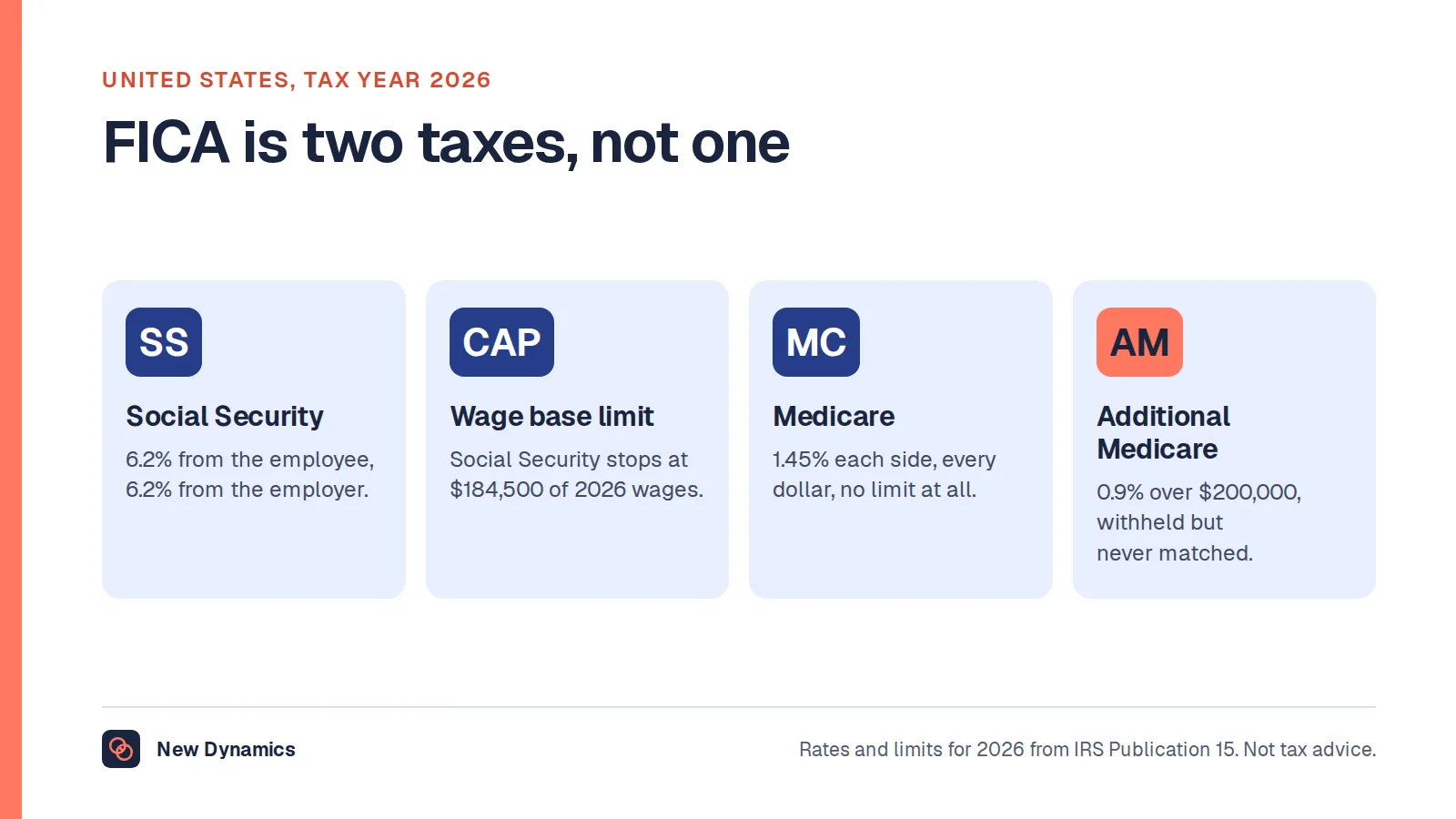
Social Security. Publication 15 (2026) states: "For 2026, the social security tax rate is 6.2% (amount withheld) each for the employer and employee (12.4% total). The social security wage base limit is $184,500." The publication defines the limit as "the maximum wage subject to the tax for the year", and the method as multiplying "each payment by the employee tax rate", not the annual salary.
Medicare. The same paragraph: "The tax rate for Medicare is 1.45% (amount withheld) each for the employee and employer (2.9% total). There is no wage base limit for Medicare tax; all covered wages are subject to Medicare tax."
Additional Medicare Tax. Publication 15 requires the employer to "withhold a 0.9% Additional Medicare Tax from wages you pay to an employee in excess of $200,000 in a calendar year", beginning "in the pay period in which you pay wages in excess of $200,000" and continuing to the year end. It is explicit that "Additional Medicare Tax is only imposed on the employee. There is no employer share of Additional Medicare Tax." Note the order of the two thresholds for 2026: Social Security stops at $184,500, so by the time the 0.9% starts at $200,000 only Medicare is still running. The arithmetic of all three is worked through in how FICA is calculated.
FUTA. Publication 15 (2026): "For 2026, the FUTA tax rate is 6.0%. The tax applies to the first $7,000 you pay to each employee as wages during the year. The $7,000 is the federal wage base. Your state wage base limit may be different." Most employers pay far less than 6.0%, because "the credit may be as much as 5.4% of FUTA taxable wages" for state unemployment tax paid in full and on time, and "if you're entitled to the maximum 5.4% credit, the FUTA tax rate after credit is 0.6%". The Department of Labor's Employment and Training Administration puts the same arithmetic on its unemployment insurance tax topic page, giving "a maximum FUTA tax of $42.00 per employee, per year". That page still points to FUTA year 2012 forms in places, so take the current rate and base from Publication 15 for the year you are paying in.
The wage base is the figure most likely to be stale in a payroll note. The rates have held steady: Publication 15's table of prior years gives the combined social security rate as 12.4% for 2025, 2024 and 2023, against wage base limits of $176,100, $168,600 and $160,200. The percentage is not what changes. Write the year next to every base.
A worked example you can check
One month for a salaried employee in 2026, paid monthly on $96,000 a year. The figures are a constructed case rather than anyone's actual payslip, and every line is arithmetic you can repeat.
| Line | Working | Amount |
|---|---|---|
| Gross wages for the month | $96,000 divided by 12 | $8,000.00 |
| 401(k) elective deferral | 6% of gross | $480.00 |
| Medical premium, section 125 plan | agreed monthly amount | $300.00 |
| HSA, salary reduction in the same plan | agreed monthly amount | $200.00 |
| Wages subject to income tax | 8,000 less 480 less 300 less 200 | $7,020.00 |
| Wages subject to Social Security | 8,000 less 300 less 200 | $7,500.00 |
| Social Security withheld | 7,500 at 6.2% | $465.00 |
| Medicare withheld | 7,500 at 1.45% | $108.75 |
Three figures, one pay run: $8,000.00 of gross wages, $7,020.00 of wages subject to federal income tax withholding, and $7,500.00 of wages subject to Social Security and Medicare. The $480 difference between the second and the third is the 401(k) deferral, and it is there because Publication 15 gives that deferral as exempt for income tax withholding and taxable for the other two.
FUTA runs on its own clock. The employer's FUTA taxable wages for this employee are $7,000 for the whole year, reached inside the first month, at 0.6% after the maximum state credit, which is $42.00.
Over twelve months the annual figures are $96,000.00 of gross wages, $84,240.00 of income tax wages and $90,000.00 of Social Security and Medicare wages. The last of those is well under the $184,500 limit for 2026, so no capping applies.

Where to read the three figures: the Form W-2
The year-end statement prints them in separate boxes, and the General Instructions for Forms W-2 and W-3 (2026) define each one.
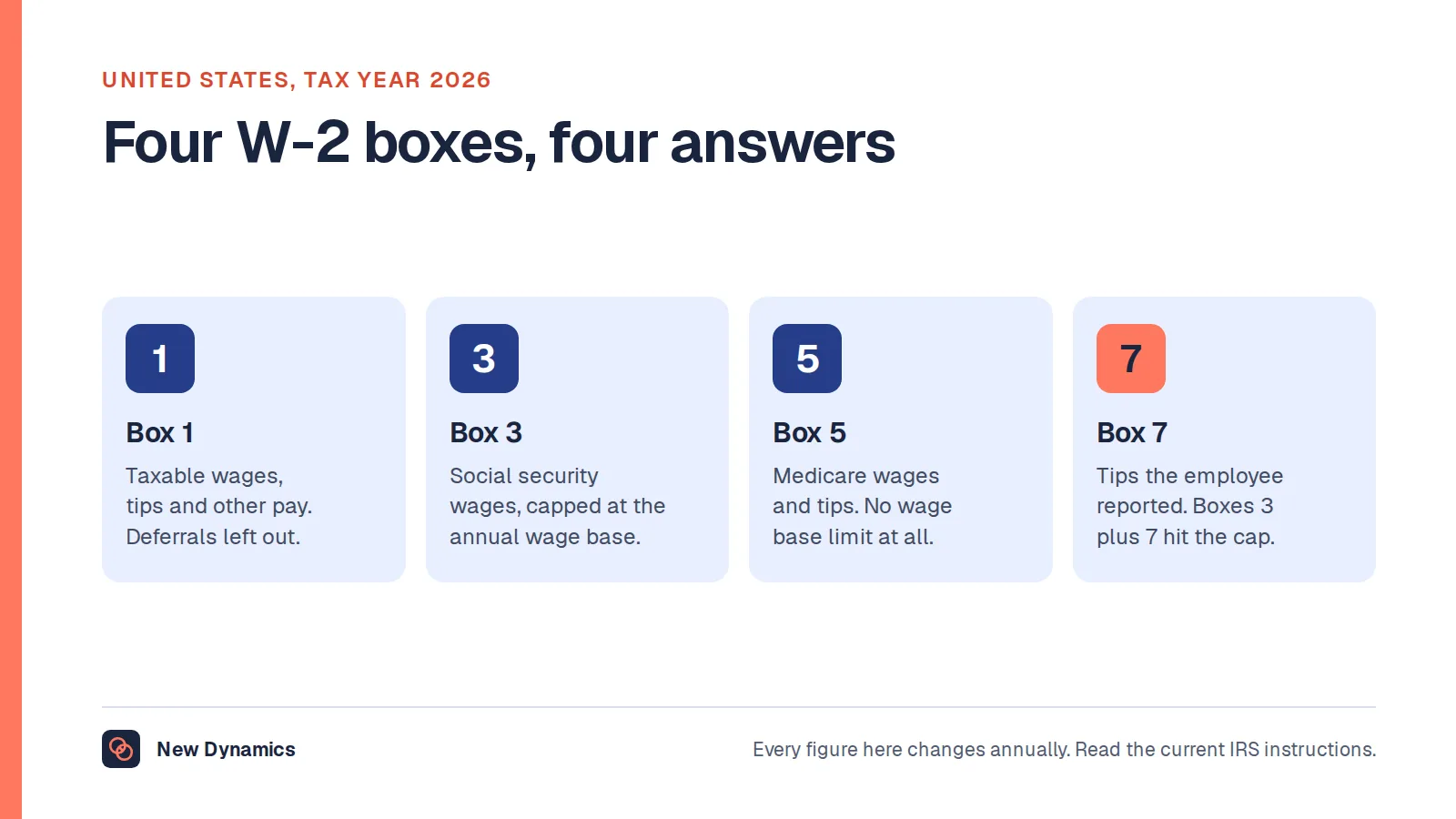
Box 1, wages, tips, other compensation. "Show the total taxable wages, tips, and other compensation that you paid to your employee during the year. However, do not include elective deferrals (such as employee contributions to a section 401(k) or 403(b) plan)."
Box 3, social security wages. "Show the total wages paid (before payroll deductions) subject to employee social security tax", and then the instruction that explains the whole difference: "Report in box 3 elective deferrals to certain qualified cash or deferred compensation arrangements and to retirement plans described in box 12 (codes D, E, F, G, and S) even though the deferrals are not includible in box 1." The instructions add the ceiling for the year: "The total of boxes 3 and 7 cannot exceed $184,500 (2026 maximum social security wage base)."
Box 5, Medicare wages and tips. "The wages and tips subject to Medicare tax are the same as those subject to social security tax (boxes 3 and 7) except that there is no wage base limit for Medicare tax."
In the example above, box 1 would read $84,240.00, box 3 and box 5 would each read $90,000.00, box 4 would read $5,580.00 and box 6 would read $1,305.00. The instructions also cap box 4, the social security tax withheld, saying that for 2026 the amount should not exceed $11,439, which is $184,500 at 6.2%. Our post on the Form W-2 walks the rest of the boxes.
Two things the IRS does not settle for you
State and local wages are a separate question. Publication 15 is federal. State income tax, state unemployment tax and local taxes each have their own definitions of taxable wages and their own bases, and Publication 15 says only that "your state wage base limit may be different". State unemployment rates are not published centrally and are not quoted here. The Department of Labor's own guidance is that "state law determines individual state unemployment insurance tax rates", so check with the state workforce agency for the state and the year.
A deduction on a tax return is not a change to taxable wages. Publication 15 (2026) describes new deductions under P.L. 119-21 for qualified tips and qualified overtime compensation, available on the individual's income tax return for tax years after 2024 and before 2029, and is careful about what they do not change. Tips "are still generally subject to both the employer share and employee share of social security tax and Medicare tax if the tips received are $20 or more per month", and "overtime compensation is still generally subject to both the employer share and employee share of social security tax and Medicare tax". The route is an updated Form W-4 and the withholding procedures in Publication 15-T, which changes what is withheld rather than what counts as wages.
For the published pay and workforce figures we cite across the site, see the HR statistics hub.
Frequently asked questions
What are taxable wages?
Taxable wages are the part of an employee's pay that a particular tax is charged on, in the United States. There is no single figure. Publication 15 (2026) starts from a wide base, that wages "generally include all pay you give to an employee for services performed", and then applies separate exclusions for federal income tax withholding, for Social Security and Medicare, and for FUTA. A pay run therefore produces three taxable wage figures, not one.
How do you calculate taxable wages?
Start with gross wages for the period, then subtract only the items the IRS excludes from the particular tax you are calculating. For federal income tax withholding, a 401(k) elective deferral and a nontaxable section 125 benefit come out. For Social Security and Medicare, the section 125 benefit comes out and the 401(k) deferral stays in. For FUTA, the same base applies but only to the first $7,000 of wages paid to that employee in the year.
Why is box 1 of my W-2 lower than box 3?
Because elective deferrals leave one figure and not the other. The General Instructions for Forms W-2 and W-3 (2026) tell employers not to include elective deferrals such as 401(k) contributions in box 1, and to report them in box 3 "even though the deferrals are not includible in box 1". If your 401(k) contributions for the year equal the gap between the two boxes, nothing is wrong.
Do before tax deductions reduce Social Security and Medicare wages?
Some do and some do not, and the label does not tell you which. Publication 15 gives a 401(k) elective deferral as generally exempt for income tax withholding but taxable for Social Security, Medicare and FUTA. A nontaxable benefit under a section 125 cafeteria plan may be excluded from all three. An HSA contribution is outside all of them if it is made by salary reduction in a cafeteria plan, and inside all of them if it is a payroll deduction outside one.
What is the taxable wage base for 2026?
For Social Security, Publication 15 (2026) gives the wage base limit as $184,500, and says there is "no wage base limit for Medicare tax". For FUTA the federal base is "the first $7,000 you pay to each employee as wages during the year". The 0.9% Additional Medicare Tax is not a base but a threshold, starting at $200,000 of wages in the calendar year, withheld from the employee with no employer share. State bases differ from the federal ones.
Are bonuses and overtime part of taxable wages?
Yes. Publication 15 lists bonuses, commissions, overtime pay, severance pay, awards, prizes and back pay as supplemental wages, and says that whichever income tax withholding method the employer uses, "they're subject to social security, Medicare, and FUTA taxes". The deductions for qualified tips and qualified overtime under P.L. 119-21 are claimed by the individual on their income tax return and do not take those payments out of the Social Security and Medicare base.
Does a post-tax deduction change taxable wages?
No. A post-tax deduction such as union dues, a garnishment or a designated Roth contribution is taken after each tax has been figured, so it reduces net pay and leaves all three taxable wage figures exactly where they were. That is why net pay is a poor guide to how much tax someone is paying.
Your next step: rebuild the three figures from one payslip
Jurisdiction: United States, federal. General information, not legal or tax advice.
- Take one payslip and write down gross wages for the period before any deduction.
- List every deduction and mark each one against the three columns in section 15 of Publication 15: income tax withholding, Social Security and Medicare, FUTA. Mark the route as well as the name, because an HSA contribution inside a cafeteria plan and one outside it are treated differently.
- Rebuild each taxable figure by subtracting only the items that column excludes. Two of the three will usually differ by the retirement deferrals.
- Check the year on every rate and base you used, and confirm the Social Security wage base at the publisher before each January. The rates are stable and the base is not.
- Reconcile against the Form W-2 boxes: box 1 for income tax wages, boxes 3 and 5 for Social Security and Medicare wages, with box 3 capped at the year's wage base.
If you set pay rules for other people, write them down in language the people they apply to can follow: read and download our compensation policy guide. The guide is free to read, and the PDF uses our short download form.
Want pay decisions, and the figures that follow from them, to rest on a record that already exists? Book a New Dynamics demo and bring the process you run today. You can also email contact@new-dynamics.com.