TL;DR
- A team charter is a working agreement a team writes for itself. No statute creates it, no official body defines it, and no official source publishes evidence that having one improves team performance. Its value is that decisions which were previously assumed become visible and arguable.
- A charter is not a contract and cannot change one. Terms of employment are set under the Employment Rights Act 1996 section 1, section 4 requires a written statement of any change, and Acas states that "Any changes must be agreed by both the worker and employer."
- A charter cannot reduce statutory rest. Regulation 35 of the Working Time Regulations 1998 makes void "Any provision in an agreement (whether a contract of employment or not)" so far as it purports to exclude or limit the Regulations, so a stated availability norm does not displace the 11 hour daily rest period.
Most teams already have a charter. It is just unwritten, inconsistent between members, and discovered by accident when someone sends a message at 10pm and two people disagree about whether a reply was expected. Writing it down does not create agreement by itself. It makes the disagreement visible early enough to settle cheaply.
This article gives a complete team charter example you can adapt, explains which sections actually earn their place, and is clear about the limits. A charter is a working agreement a team writes for itself. It is not an employment document, and a charter that reaches into contractual territory does something it has no power to do. This is general information about the position in the United Kingdom and not legal advice.
A charter also only survives if the work it describes is visible. See how New Dynamics goals and OKRs keep team priorities and individual goals in one place, so the question of who owns what is answered by a record rather than by memory.
What a team charter is, and what nobody publishes about it
A team charter is a short document in which a team states how it intends to work: what it is for, who decides what, when it meets, what response times people can expect of each other, and what happens when they disagree. Other names for the same thing are a team working agreement, a ways of working document and team ground rules.
Three things are worth saying plainly before the example.
No statute creates a team charter, and no official body defines one. There is no GOV.UK page, no Acas guidance and no British Standard that tells you what a charter must contain. Anything presented as the official structure of a charter is somebody's preferred structure, including the one below.
No official source publishes evidence that having a charter improves team performance. The Office for National Statistics does not measure it and Acas does not evaluate it, and the figures circulated in favour of charters generally come from consultancies with something to sell. So the honest claim is narrow and still worth making: a charter converts assumptions into statements that can be checked.
It matters more than it used to, because fewer teams share a room. The Office for National Statistics, in its 13 February 2023 article on the characteristics of homeworkers in Great Britain, reported that "Overall, 44% of workers reported home or hybrid working and 56% reported only travelling to work in the last seven days (September 2022 to January 2023)", with 28% hybrid and 16% working from home only. Norms that used to be absorbed by sitting near each other now have to be said out loud.

A charter is not a contract, and cannot override one
Terms of employment in the United Kingdom come from the contract, and the employer has a duty to set the main ones out in writing. Section 1 of the Employment Rights Act 1996 provides that "Where a worker begins employment with an employer, the employer shall give to the worker a written statement of particulars of employment", and the required particulars include "any terms and conditions relating to hours of work", specifically "normal working hours", "the days of the week the worker is required to work", and "whether or not such hours or days may be variable".
Those terms can only be changed by agreement. Acas, on its guidance about changes to employment contracts, states it in one line: "Any changes must be agreed by both the worker and employer." And a change has to be written down and given to the person. Section 4 of the same Act provides that where there is a change in any of those matters "the employer shall give to the worker a written statement containing particulars of the change", and that the statement "shall be given at the earliest opportunity and, in any event, not later than ... one month after the change in question".
So a charter that says "core hours are 10am to 4pm", or "we are reachable until 7pm", or "three missed stand-ups is a performance issue" fails in three ways at once. It is not a contract, so it creates no obligation. It was not individually agreed and no section 4 statement followed it, so it changes nothing. And because people treat a written norm as binding, it gets enforced socially while having no legal basis, which is the worst outcome of the three. Our post on the employment contract covers where terms actually come from and how a change is made properly.
A charter can legitimately record a team preference about working patterns and then point at the contract. "Our contractual hours are set individually. Within those hours, the team aims to overlap between 10am and 3pm, and anyone whose pattern does not allow that says so now rather than later" is a sentence a charter can carry. "Core hours are 10am to 4pm" is not.
A charter cannot reduce rest, either
Working time is the second place charters overreach. An availability expectation written into a charter does not touch the statutory rest entitlements, because the Working Time Regulations 1998 say explicitly that no agreement can do that. Regulation 35 provides that "Any provision in an agreement (whether a contract of employment or not) is void in so far as it purports ... to exclude or limit the operation of any provision of these Regulations, save in so far as these Regulations provide for an agreement to have that effect".
The entitlements behind that are specific. Regulation 10(1) gives a worker "a rest period of not less than eleven consecutive hours in each 24-hour period during which he works for his employer". Regulation 11(1) gives "an uninterrupted rest period of not less than 24 hours in each seven-day period". And regulation 12 provides that "Where a worker's daily working time is more than six hours, he is entitled to a rest break", which is "an uninterrupted period of not less than 20 minutes, and the worker is entitled to spend it away from his workstation if he has one".
The practical test is simple. If your stated norms would require someone finishing at 9pm to be available at 7am, the norm squeezes an 11 hour rest period into 10 and is void to that extent. Our post on rest breaks at work sets out what the 20 minute break does and does not cover.
Norms can disadvantage a disabled colleague, and the duty still applies
A charter's norms about availability, camera use, meeting length or response times are a practice, and practices are exactly what the reasonable adjustments duty bites on. Section 20 of the Equality Act 2010 sets out the first of three requirements in these words: "The first requirement is a requirement, where a provision, criterion or practice of A's puts a disabled person at a substantial disadvantage in relation to a relevant matter in comparison with persons who are not disabled, to take such steps as it is reasonable to have to take to avoid the disadvantage."
A provision, criterion or practice does not have to be a signed policy. A team norm written into a charter, or an unwritten one everybody follows, is a practice. Acas, in its guidance on reasonable adjustments, is direct about what that means in daily life: "It's not enough for employers to provide disabled people with exactly the same working conditions as non-disabled people. Employers must make reasonable adjustments by law." The duty arises when, among other triggers, employers "know, or could reasonably be expected to know, someone is disabled".
Three ordinary charter norms therefore deserve a second look. Cameras on disadvantages people with anxiety conditions and some neurodivergent colleagues. Reply within two hours disadvantages anyone whose condition makes their working day unpredictable. No meetings before 10am or after 4pm can cut across an adjustment someone already has. The fix is not to drop the norm. It is to write the norm with the exception already in it, and to make clear that an individual adjustment overrides the team default rather than requiring a negotiation each time.
The seven sections that earn their place
Most charter templates are too long, which is why most charters are written once and never read. Seven sections do real work.
- Purpose. One or two sentences on what the team exists to produce, in language someone outside the team would recognise. If you cannot write it without naming a department, it is not a purpose.
- Scope, and what the team does not do. The second half is the valuable half. The sentences beginning "we do not" prevent more wasted effort than anything else in the document.
- Decision rights. Which decisions anyone can take alone, which need a named owner, and which go to the whole team. Name roles, not people, so the charter survives someone leaving.
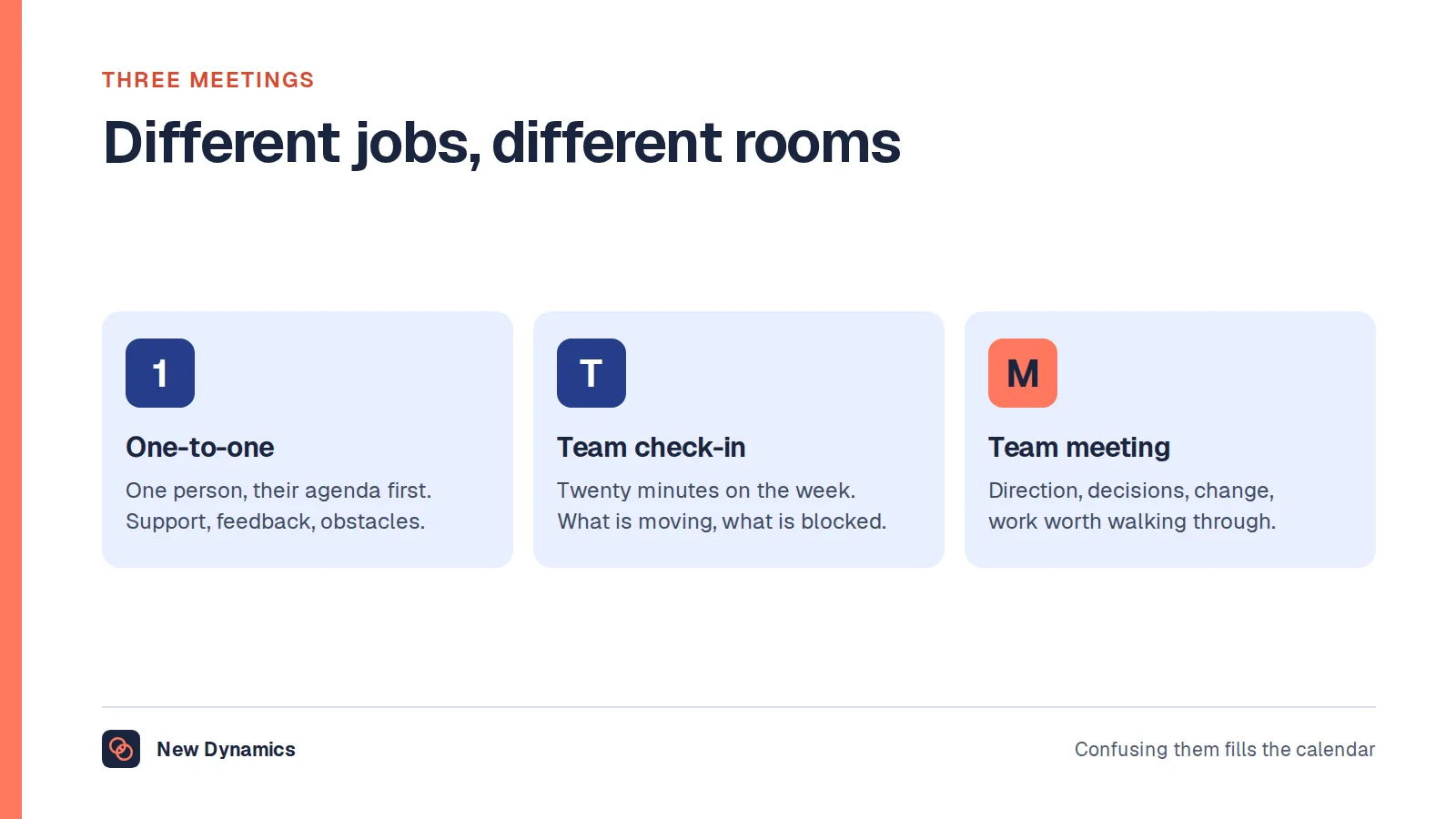
- Meeting rhythm. What meets, how often, for how long and for what purpose. Anything recurring with no stated purpose is a candidate for deletion. Our post on meeting cadence covers how to choose the intervals.
- Response-time expectations by channel. Not a single number but a channel-by-channel statement, including which channel means urgent and who is allowed to use it.
- How disagreement is handled. The route a disagreement takes, the point at which it is escalated and to whom. Our post on workplace conflict covers the informal stage and what comes after it.
- How work is made visible. Where work in progress lives, what counts as done and how someone outside the team finds out the state of something without asking.
What to leave out: anything contractual (hours, pay, leave, availability outside working time), anything disciplinary, values statements nobody can act on, and personal preferences dressed up as team rules.

The worked example
This is a complete charter for an imagined internal team. Replace the content; keep the shape and the length.
Charter: Customer Data team
Purpose. We keep customer records accurate and available, so that anyone in the company can answer a question about a customer from one place and trust the answer.
Scope. We own the customer record, the rules that keep it clean, and the reports built directly on it.
What we do not do. We do not build dashboards for individual teams, we do not run one-off data pulls that a self-serve report already covers, and we do not own marketing's campaign data. Requests in those three categories get a pointer, not a ticket.
Decision rights.
- Anyone on the team decides: how to implement an agreed change, which day to work on what, whether a bug is urgent enough to jump the queue.
- The data owner decides: schema changes, what enters the customer record, which requests fall outside scope.
- The whole team decides: what goes into the next six weeks, changes to this charter, anything that changes another team's work.
Meeting rhythm.
- Daily, 15 minutes, written in the team channel by 10am: what each person is on and what is blocked. Nobody waits for anyone else to post.
- Weekly, 45 minutes: review blocked items and the request queue. Cancelled if nothing is blocked and the queue has not grown.
- Every six weeks, 90 minutes: agree the next six weeks of work and review this charter.
- One to one with the manager every fortnight, 30 minutes, the person's agenda first.
Response-time expectations. Team channel: same working day. Email: two working days. Ticket queue: triaged within one working day, which means given a priority, not solved. Phone or direct call: this is the urgent channel, and it means something is broken in production now. No channel carries an expectation outside the individual's own working hours, and nobody is expected to read anything while on leave.
How we handle disagreement. Raise it with the person directly first, in a call rather than in writing. If it is still open after that conversation, bring it to the weekly meeting as a named item so the team hears both positions. If it is a decision that belongs to the data owner, they decide and write down why in the decision log. Disagreeing with a decision after it is made is fine; reopening it without new information is not.
How work is visible. Everything we are working on is a card on the team board, and a card not on the board is not work we have agreed to do. Done means merged, documented and announced in the channel. The decision log holds every schema decision with its date and reason.
Adjustments. These are team defaults. Any individual adjustment, agreed with the manager, takes precedence over them, and nobody needs to explain why to the rest of the team.
Agreed on. 18 September 2025. Next review at the six week planning session.
How to write one in a session, not over six weeks
A charter drafted by committee over a month is worse than one drafted in 90 minutes, because the long version collects everybody's favourite sentence. Run it once, with everyone who does the work in the room.

- Before the session (15 minutes each, done alone). Everyone writes three answers: one decision they are unsure who owns, one recurring meeting they would cancel, and one expectation they think the team holds but has never said.
- In the session, start with the disagreements. Read the answers out. Where two people have given incompatible answers, you have found the sections that matter. Write those first.
- Draft live, in the room, in one document. One person types, everyone watches. Phrases that are objected to get changed on the spot or deleted, not parked.
- Check it against the contract. Read every sentence and ask whether it is trying to set hours, availability or consequences. Rewrite or delete anything that is.
- Check it against adjustments. Read every norm and ask who it would disadvantage. Add the exception into the norm.
- Stop at one page. If it will not fit, the sections you cannot fit were not important enough.
When to revisit it
Put the review on a fixed interval, because a charter reviewed only when something goes wrong becomes a document about the last argument. Ten minutes at every planning cycle is enough most of the time.
Review it out of cycle when one of five things happens: the team's purpose or scope changes, someone joins or leaves, a decision got made badly and nobody could say who owned it, a norm was broken and the team had no agreed response, or someone's working pattern or adjustment changed. A new joiner reading it in their first week is the best available test of whether it still says anything true.
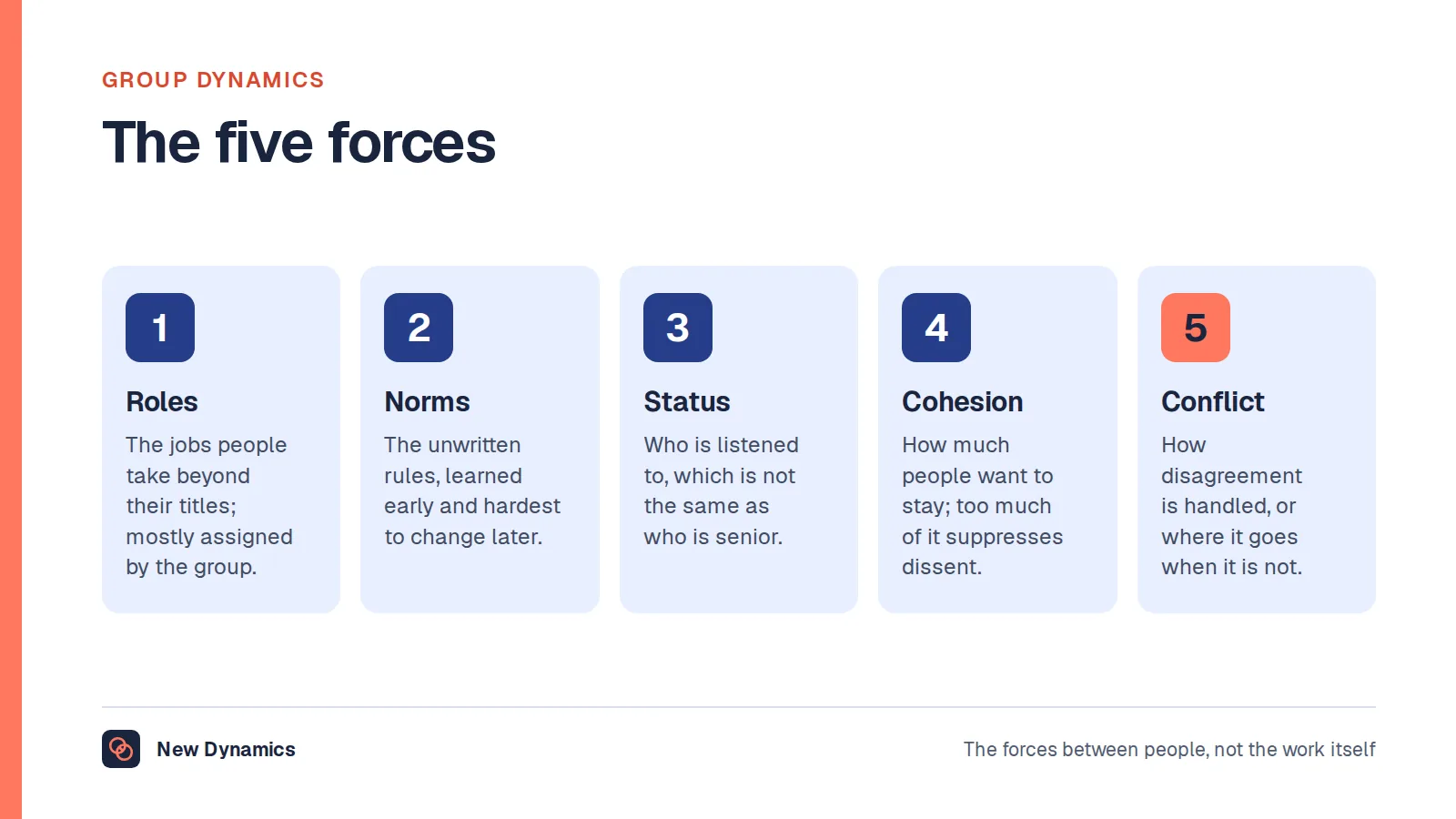
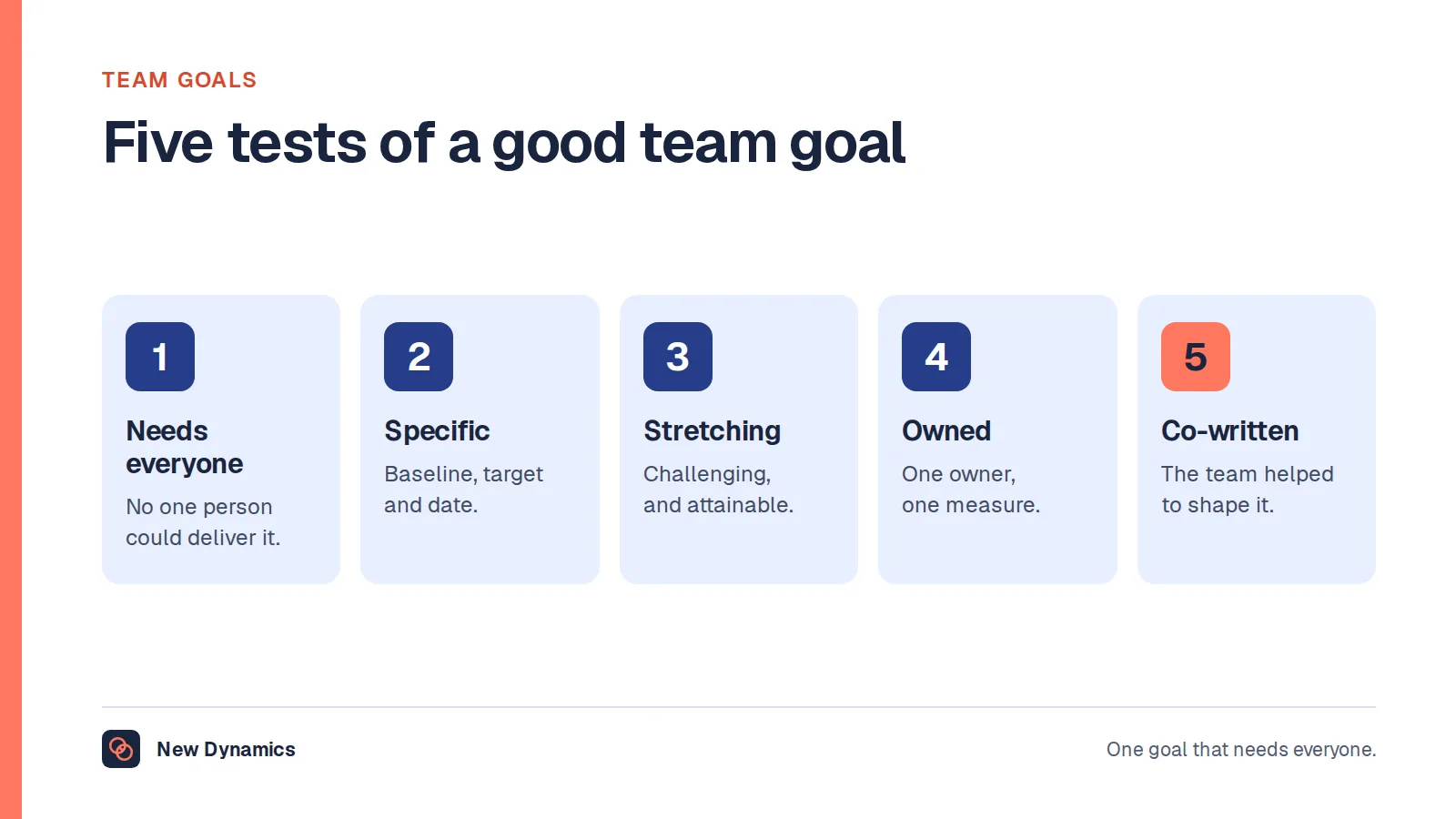
Team goals belong next to a charter, not inside it. Our post on team goals examples covers writing goals a team will own, our post on group dynamics explains the forces a charter makes visible, and our HR statistics hub holds the wider workforce picture behind the hybrid figures above.
Frequently asked questions
What is a team charter?
A team charter is a short document in which a team records how it intends to work together: its purpose, its scope, who decides what, when it meets, what response times people can expect of each other, how disagreement is handled and how work is made visible. It is written by the team for itself. No statute creates it and no official body defines its contents.
What should a team charter include?
Seven sections do most of the work: purpose, scope including what the team does not do, decision rights by role, meeting rhythm, response-time expectations by channel, how disagreement is handled, and how work is made visible. Keep it to one page. A charter nobody rereads has failed whatever it contains.
Is a team charter legally binding?
No. A team charter is not a contract and cannot change one. Terms of employment are set under section 1 of the Employment Rights Act 1996, Acas states that any changes must be agreed by both the worker and employer, and section 4 requires a written statement of a change not later than one month after it. A charter satisfies none of those requirements.
Can a team charter set working hours or availability?
It should not try. Hours are a contractual term, and a charter that states core hours or evening availability creates no obligation while being treated as binding in practice. Regulation 35 of the Working Time Regulations 1998 also makes void any provision in an agreement that purports to exclude or limit the Regulations, so a charter cannot reduce the 11 consecutive hours of daily rest or the 20 minute break after six hours.
How do team charter norms interact with reasonable adjustments?
A team norm is a practice, and section 20 of the Equality Act 2010 requires reasonable steps where a provision, criterion or practice puts a disabled person at a substantial disadvantage. Norms about cameras, response times and meeting hours are the usual culprits. Write the exception into the norm, and state that an individual adjustment overrides the team default.
Does having a team charter improve performance?
No official source publishes evidence that it does. The Office for National Statistics does not measure it and Acas does not evaluate it, and we will not quote a consultancy figure in place of one. The defensible claim is narrower: a charter makes assumptions explicit, which means they can be examined and corrected before they cause a problem.
What is the difference between a team charter and a team contract?
A charter is a voluntary working agreement between colleagues with no legal force. A contract of employment is between the employer and the individual, and its terms are enforceable. Calling the document a team contract invites exactly the confusion that gets charters into trouble, so call it a charter or a working agreement.
Your next step: write the first draft this week
- Book 90 minutes with everyone who does the work. Not a subset, and not a manager drafting it alone.
- Send the three pre-session questions a day ahead and insist on written answers, so the session starts with real material.
- Draft the seven sections live in one document and stop at one page.
- Read every sentence twice over: once asking whether it is trying to set a contractual term, once asking who the norm would disadvantage.
- Put the date on it, name the next review, and give it to the next person who joins on their first day.
For the conversations where most of this is actually settled, read and download our manager one-to-one guide. The guide is free to read, and the PDF uses our short download form.
Want team priorities, goals and feedback in one place, so a charter's promise that work is visible is actually true? Book a New Dynamics demo and bring your current team board. You can also email contact@new-dynamics.com.