TL;DR
- An award has two parts. Section 118 of the Employment Rights Act 1996 splits it into a basic award, calculated on age bands and a week's pay, and a compensatory award for actual loss. The basic award tops out at 30 weeks, and a week's pay is capped at £751 where the termination falls on or after 6 April 2026.
- The headline cap is not the one that usually applies. Section 124(1ZA) caps the compensatory award at the lower of £123,543 and 52 multiplied by a week's pay, and the week's pay in that second limb is not capped. Below about £123,500 a year, it is 52 weeks of your own pay that bites.
- The cap disappears on 1 January 2027. Section 25(3) of the Employment Rights Act 2025 omits section 124 outright, commenced by regulation 3(a) of S.I. 2026/559, and it does not apply where the effective date of termination falls before that date.
"How much is unfair dismissal worth?" is the question, and almost every answer to it quotes one number: a cap of just over £123,000. That number is real, and for most claimants it is irrelevant. The statute sets two caps, and the one that actually limits the award in a typical case is the other one.
This article sets out what an employment tribunal can award for unfair dismissal, quoted from the Employment Rights Act 1996 and the uprating order in force, with the dates and figures named. It covers the basic award and how age bands produce it, the compensatory award and what counts as loss, both caps, the dismissals where no cap applies at all, the deductions that come off before the cap is even reached, and the two remedies that are not money. It is general information about England, Wales and Scotland, and it is not legal advice. Northern Ireland has its own legislation and its own figures, and nothing below applies there.
Most of what decides the size of a compensatory award is the record of what happened before the dismissal, not the argument afterwards. See how New Dynamics performance reviews keep the goals, feedback and ratings attached to the cycle they belong to, so the reason for a decision exists in writing before anyone asks for it.

An award has two parts, and they are calculated differently
Section 112 of the Employment Rights Act 1996 sets the order of business. Where a tribunal finds a complaint well-founded, it must explain the reinstatement and re-engagement orders to the claimant and ask whether they want one. Only if no such order is made does subsection (4) require it to "make an award of compensation for unfair dismissal".
Section 118 then splits that award in two: "a basic award (calculated in accordance with sections 119 to 122 and 126)" and "a compensatory award (calculated in accordance with sections 123, 124, 124A and 126)". They are not two names for the same money. The basic award is a formula that ignores what the dismissal cost you. The compensatory award is the opposite, and ignores the formula.
The basic award: age bands, years of service and a week's pay
Section 119 does it in three steps: work out the period of continuous employment ending with the effective date of termination, count the years backwards from the end of it, and allow "the appropriate amount" for each year. Subsection (2) defines that amount by age:
- "one and a half weeks' pay for a year of employment in which the employee was not below the age of forty-one"
- "one week's pay for a year of employment (not within paragraph (a)) in which he was not below the age of twenty-two"
- "half a week's pay for a year of employment not within paragraph (a) or (b)"
Subsection (3) caps the count: once twenty years have been reckoned, "no account shall be taken under that subsection of any year of employment earlier than those twenty years". That gives an arithmetic ceiling of 30 weeks' pay, for someone over 41 throughout their last twenty years.
A week's pay is itself capped. Section 227(1) provides that for the purpose of calculating "a basic award of compensation for unfair dismissal", "an additional award of compensation for unfair dismissal" or "a redundancy payment", "the amount of a week's pay shall not exceed £751". That figure was substituted on 6 April 2026 by the Employment Rights (Increase of Limits) Order 2026 (S.I. 2026/310), which raised it from £719. So the maximum basic award is 30 multiplied by £751, which is £22,530.
The same order explains where the uprating comes from and how far it reaches. Its explanatory note records that "the increases made by this Order reflect the increase in the retail prices index of 4.5% from September 2024 to September 2025", and that they "apply where the event giving rise to the entitlement to compensation or other payment, or as relevant, the date proceedings were begun, occurred on or after 6th April 2026". Article 4 preserves the older sums where the appropriate date fell earlier. For an unfair dismissal basic award, article 4(2)(m) names that date as the effective date of termination. Check the date of the dismissal before you use any figure, including the ones in this article. Wider published employment figures sit on the statistics hub.
The minimum basic award in certain cases
Section 120(1) sets a floor of £9,157, also substituted on 6 April 2026 by S.I. 2026/310, where the reason for the dismissal (or for selection in a redundancy case) falls within section 100(1)(a) or (b), 101A(d), 102(1) or 103. Those are health and safety, working time, pension scheme trustee and employee representative dismissals.
The compensatory award: loss, not a tariff
Section 123(1) is the whole test: "such amount as the tribunal considers just and equitable in all the circumstances having regard to the loss sustained by the complainant in consequence of the dismissal in so far as that loss is attributable to action taken by the employer".
Subsection (2) says that loss "shall be taken to include" two things: "any expenses reasonably incurred by the complainant in consequence of the dismissal", and "loss of any benefit which he might reasonably be expected to have had but for the dismissal". In practice the bulk of it is lost earnings between the dismissal and a new job, plus pension loss and the value of benefits. There is no figure in the statute for injury to feelings on an unfair dismissal claim, and none for the manner of the dismissal.
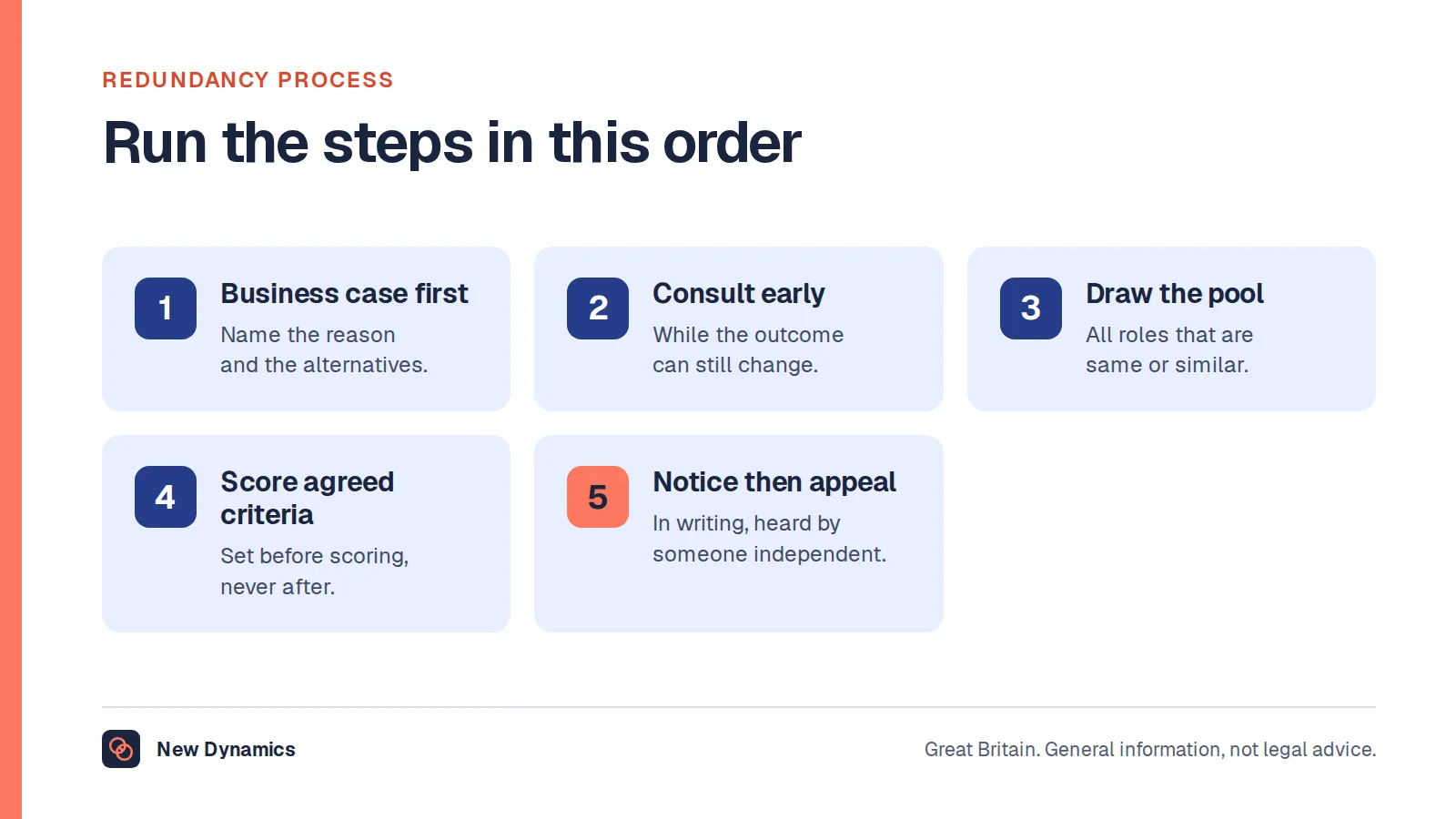
Subsection (3) handles the overlap with redundancy pay: where the loss is a redundancy payment or the expectation of one, only "the loss referable to the amount (if any) by which the amount of that payment would have exceeded the amount of a basic award" counts. If you were made redundant, our post on the redundancy process covers what should have happened first.
Two caps on the compensatory award, and the one that usually bites
Section 124 caps the compensatory award at "the amount specified in subsection (1ZA)". Subsection (1ZA) reads:
"The amount specified in this subsection is the lower of (a) £123,543, and (b) 52 multiplied by a week's pay of the person concerned."
The £123,543 figure was substituted on 6 April 2026 by S.I. 2026/310, up from £118,223. The important word is "lower". And the week's pay in limb (b) is not subject to the section 227 cap, because section 227(1) lists the basic award, the additional award and a redundancy payment, and does not list section 124. So limb (b) uses the claimant's actual weekly earnings.
Run the arithmetic and the headline number mostly disappears. £123,543 divided by 52 is £2,375.83. Someone earning less than that a week, which is under about £123,500 a year, is capped by 52 weeks of their own pay, not by the money figure. The cap most claimants meet is "a year's pay", and the six-figure number only binds the small group paid more than it.
Section 124(5) says when the cap is applied: to the amount the tribunal "would, apart from this section, award in respect of the subject matter of the complaint after taking into account" any payment already made by the respondent and "any reduction in the amount of the award required by any enactment or rule of law". The cap goes on last, after every deduction below.

The dismissals with no cap at all
Section 124(1A) disapplies the cap entirely, and it does so by cross-reference rather than by description:
"Subsection (1) shall not apply to compensation awarded, or a compensatory award made, to a person in a case where he is regarded as unfairly dismissed by virtue of section 100, 103A, 105(3) or 105(6A)."
Those four are worth reading in the original rather than paraphrasing.
- Section 100 is the health and safety case, which treats an employee as unfairly dismissed where the principal reason was carrying out designated health and safety activities, acting as a safety representative or committee member, or, where there was no such representative, bringing to the employer's attention "circumstances connected with his work which he reasonably believed were harmful or potentially harmful to health or safety".
- Section 103A is whistleblowing, in one sentence: an employee is regarded as unfairly dismissed "if the reason (or, if more than one, the principal reason) for the dismissal is that the employee made a protected disclosure".
- Section 105(3) and 105(6A) cover the redundancy versions of the same two, where the reason for selecting the employee for dismissal was one of those in section 100(1) or the reason in section 103A.
GOV.UK's employer guidance on dismissing staff says the same thing in plainer words: "There's a limit on the amount a tribunal can award for unfair dismissal, apart from in cases relating to: health and safety (for example where you unfairly dismiss someone for taking action on health and safety grounds); whistleblowing." Discrimination claims are a separate jurisdiction with no limit of their own, and the same page notes that a tribunal "may order the respondent to pay you compensation" without promising it.
The cap is being abolished, from 1 January 2027
This is the part that dates published guidance fastest, so check the date on anything you read, including this.
Section 25 of the Employment Rights Act 2025 is headed "Right not to be unfairly dismissed: qualifying period and compensation". Subsection (2) changes the qualifying period in section 108 from "two years" to "six months". It is six months, not day one, and that misreading is everywhere. Subsection (3) is a single line: "Omit section 124 (limit of compensatory award etc)."
Neither was in force at Royal Assent. The Employment Rights Act 2025 (Commencement No. 4 and Transitional and Saving Provisions) Regulations 2026 (S.I. 2026/559), made on 26 May 2026, brought section 25(5) partly into force on 1 July 2026, and regulation 3 provides that "section 25, to the extent not already in force" comes into force "on 1st January 2027, subject to the transitional and saving provisions in regulation 4". Regulation 4(1) keys it to the termination date: the amendments made by section 25(2) and (3) "have effect in any case where an employee is dismissed before 1st January 2027 but the effective date of termination falls on or after that date", and "do not have effect in any case where the effective date of termination falls before 1st January 2027".
So the cap still applies today, and still applies to any dismissal whose effective date of termination falls before 1 January 2027, however long afterwards the hearing happens. Acas puts the qualifying period half of that change plainly on its unfair dismissal guidance, last updated 27 October 2026: "Protection from unfair dismissal will become a right after 6 months of being in a job." It adds that the change "will happen in January 2027 and is not yet law". For the time limit for getting the claim in at all, which moved separately on 1 October 2026, see our post on employment tribunal time limits.
Note also that section 25 extends to England and Wales and Scotland only, as does S.I. 2026/310 by its own article 1(3).
What comes off: Polkey, contributory fault and mitigation
Three separate reductions can cut a compensatory award, and a tribunal can apply more than one.
The Polkey reduction reflects the chance that the dismissal would have happened anyway. The Employment Appeal Tribunal put it this way in M Jarosinski v Nestle UK Ltd [2026] EAT 129: "in Polkey v AE Dayton Services Ltd [1987] UKHL 8, [1987] ICR 142 the House of Lords held that the compensatory award may be reduced or limited to reflect the chance that the claimant would have been dismissed in any event and that the employers' procedural errors accordingly made no difference to the outcome." It can run to 100%, and in that case it did. It bites on the compensatory award only. As the EAT noted in NSL Ltd v Dean Bean [2026] EAT 132, "The Polkey rule would not apply to the claimant's basic award."
Contributory fault is statutory and applies to both parts, under different wording. For the compensatory award, section 123(6): where the tribunal finds the dismissal "was to any extent caused or contributed to by any action of the complainant, it shall reduce the amount of the compensatory award by such proportion as it considers just and equitable". For the basic award, section 122(2) asks whether conduct before the dismissal makes it just and equitable to reduce it. The two percentages need not match, and the Jarosinski appeal was argued on exactly that: a Polkey deduction for what a fair procedure would have produced is not the same thing as a deduction for the conduct itself.
The duty to mitigate is in section 123(4), and it imports the common law rather than inventing a test: the tribunal "shall apply the same rule concerning the duty of a person to mitigate his loss as applies to damages recoverable under the common law of England and Wales or (as the case may be) Scotland". In practice that means looking for work and taking a reasonable offer of it. Section 117(8) adds a specific instance: unreasonably preventing a reinstatement order being complied with is treated as a failure to mitigate.

The Acas Code uplift, and where in the sum it lands
The uplift is not in the Employment Rights Act. It is section 207A of the Trade Union and Labour Relations (Consolidation) Act 1992, which applies to the jurisdictions listed in Schedule A2. Where it appears to the tribunal that the claim concerns a matter to which a relevant Code of Practice applies, "the employer has failed to comply with that Code in relation to that matter", and "that failure was unreasonable", the tribunal "may, if it considers it just and equitable in all the circumstances to do so, increase any award it makes to the employee by no more than 25%". Subsection (3) is the mirror image where the employee is the one who failed to comply, reducing the award by up to 25%.
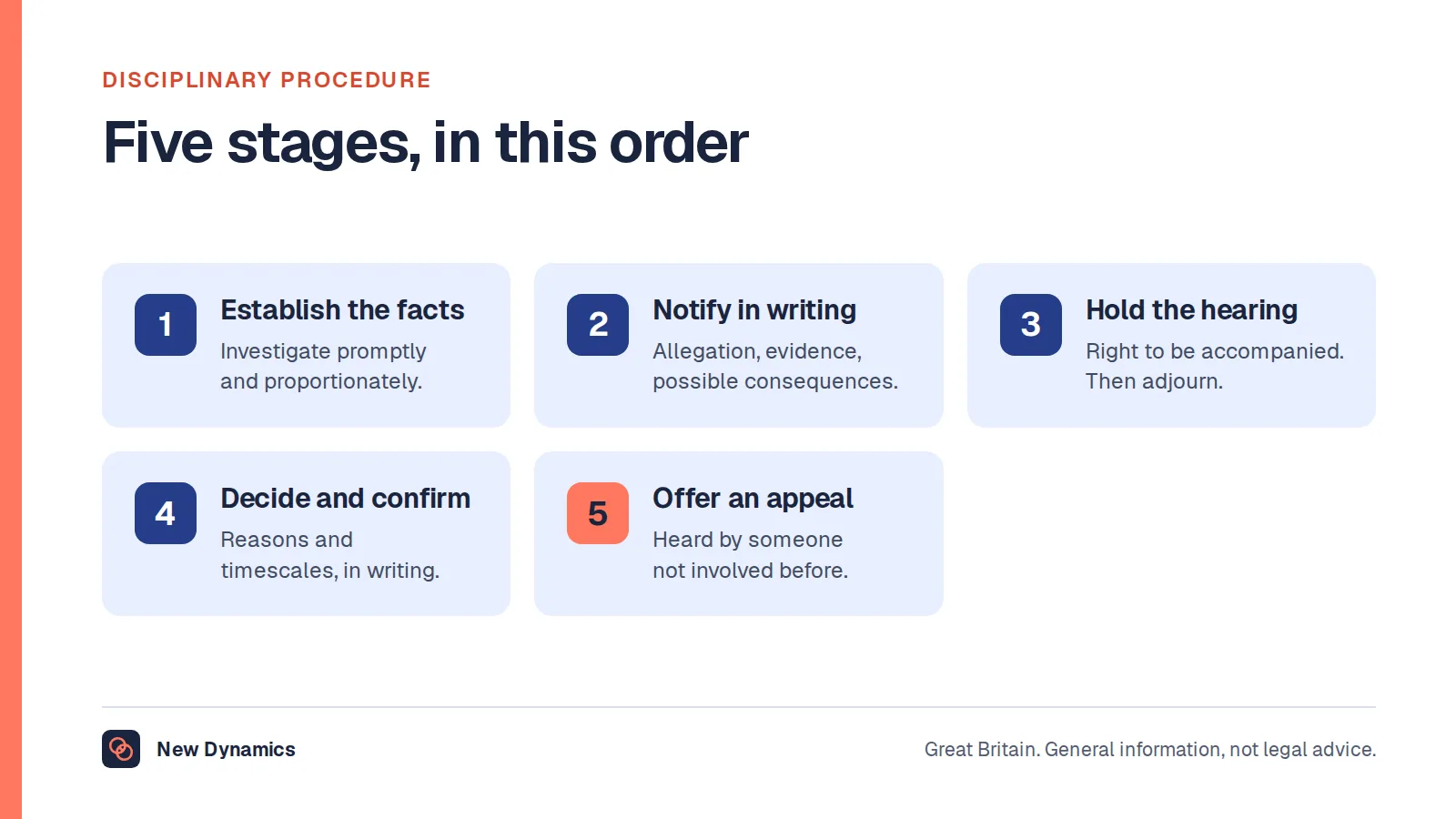
Where the uplift goes in the calculation is set by section 124A of the 1996 Act: the adjustment "shall be in the amount awarded under section 118(1)(b)", which is the compensatory award and not the basic award, "and shall be applied immediately before any reduction under section 123(6) or (7)". So the sequence is loss, mitigation, Polkey, uplift, contributory fault, and then the cap. The order matters, because an uplift applied before a 50% contributory reduction is worth half of an uplift applied after it. For the procedure the Code expects, see our post on the disciplinary procedure.
Reinstatement and re-engagement exist, and are rarely ordered
Section 113 offers two orders: reinstatement, putting the employee back in the same job, or re-engagement in a different one. Section 116 requires the tribunal to consider reinstatement first, taking into account "whether the complainant wishes to be reinstated", "whether it is practicable for the employer to comply", and, where the claimant contributed to the dismissal, "whether it would be just to order his reinstatement". Subsection (5) stops an employer relying on having hired a permanent replacement, unless it shows under subsection (6) that there was no practicable alternative.
The practicability test and the requirement that the claimant actually ask for it are why these orders are uncommon. There is a sanction if one is ignored. Section 117(3) requires the tribunal, where an order is made but not complied with, to award compensation for unfair dismissal plus "an additional award of compensation of an amount not less than twenty-six nor more than fifty-two weeks' pay", unless under subsection (4)(a) the employer satisfies the tribunal that compliance was not practicable. That additional award uses a week's pay capped at £751, so it runs from £19,526 to £39,052 at the current figure. GOV.UK puts the same point to employers in one line: "You might have to pay extra compensation if you do not follow a tribunal's order to reinstate someone."
What the official statistics will not tell you
There is no published average unfair dismissal award at the moment, and anyone quoting one is not quoting the government. The Ministry of Justice's Tribunal Statistics Quarterly, April to June 2026 says so directly: "Annual data on Representation, and Compensation and Costs awarded for the Employment Tribunal has been suspended in this publication." The reason given is the migration of single cases to a new case management system from July 2022, with "work ongoing to establish amalgamated data on Representation, and Compensation and Costs awarded (tables E_1 to E_10)". The release says the data "will be made available as soon as possible when the data is extracted and quality assured".
Until those tables return, the honest answer to "what is the average payout?" is that the publisher of the figure has stopped publishing it. What the statute gives you instead is a range and a method, which is what the sections above set out.
Frequently asked questions
How much compensation can you get for unfair dismissal?
Two awards, added together. The basic award is years of service multiplied by a week's pay on age bands under section 119 of the Employment Rights Act 1996, to a maximum of 30 weeks, with a week's pay capped at £751 where the effective date of termination falls on or after 6 April 2026. That is a ceiling of £22,530. The compensatory award is actual loss under section 123, capped by section 124 at the lower of £123,543 and 52 multiplied by a week's pay.
What is the maximum unfair dismissal compensation in 2026?
Section 124(1ZA) sets the compensatory award cap at "the lower of (a) £123,543, and (b) 52 multiplied by a week's pay of the person concerned". The £123,543 was substituted on 6 April 2026 by the Employment Rights (Increase of Limits) Order 2026, S.I. 2026/310. Because the week's pay in limb (b) is not capped, anyone earning less than about £123,500 a year is limited by 52 weeks of their own pay instead.
Is there a cap on employment tribunal compensation for whistleblowing?
No. Section 124(1A) provides that the cap "shall not apply" where the person is regarded as unfairly dismissed by virtue of section 100, 103A, 105(3) or 105(6A). Section 103A is dismissal for making a protected disclosure, section 100 covers health and safety dismissals, and the two section 105 subsections cover redundancy selection on the same grounds.
Is the unfair dismissal compensation cap being abolished?
Yes, for terminations on or after 1 January 2027. Section 25(3) of the Employment Rights Act 2025 says "Omit section 124 (limit of compensatory award etc)". Regulation 3(a) of S.I. 2026/559 commences it on 1 January 2027, and regulation 4(1) provides that it does "not have effect in any case where the effective date of termination falls before 1st January 2027". The cap therefore still applies to dismissals taking effect before that date.
What is a Polkey reduction?
A percentage cut to the compensatory award reflecting the chance the employee would have been dismissed anyway. The Employment Appeal Tribunal described it in M Jarosinski v Nestle UK Ltd as the rule that the award "may be reduced or limited to reflect the chance that the claimant would have been dismissed in any event and that the employers' procedural errors accordingly made no difference to the outcome". It can be 100%, and it does not touch the basic award.
Can a tribunal increase an award for ignoring the Acas Code?
Up to 25%, on the compensatory award only. Section 207A of the Trade Union and Labour Relations (Consolidation) Act 1992 lets a tribunal "increase any award it makes to the employee by no more than 25%" where the employer unreasonably failed to comply with a relevant Code. Section 124A of the 1996 Act puts that adjustment in the section 118(1)(b) amount, applied immediately before any reduction for contributory fault.
What is the average unfair dismissal payout?
No official figure is currently published. The Ministry of Justice's Tribunal Statistics Quarterly for April to June 2026 states that "Annual data on Representation, and Compensation and Costs awarded for the Employment Tribunal has been suspended in this publication", because of the move of single cases to a new case management system from July 2022. Figures quoted as averages elsewhere do not come from the government.
Will a tribunal order my job back?
Rarely, and only if you ask. Section 112 requires the tribunal to explain reinstatement and re-engagement and ask whether you want one, and section 116 then weighs whether it is practicable for the employer to comply and whether your own conduct makes it unjust. If an order is made and ignored, section 117(3) requires an additional award of 26 to 52 weeks' pay unless the employer shows compliance was not practicable.
Your next step: four dates and one calculation
- Write down the effective date of termination. Every figure above is keyed to it: the week's pay cap under article 4(2)(m) of S.I. 2026/310, and whether section 124 still applies at all under regulation 4(1) of S.I. 2026/559.
- Work the basic award first, because it is mechanical. Years of service, age in each year, a week's pay capped at £751, 30 weeks maximum, then any reduction under section 122.
- Then the loss, with evidence: pay, pension, benefits, the date a new job started, and what was done to find one. Section 123(4) will be applied to that last point whether or not you addressed it.
- Then compare the two caps, and expect 52 weeks of actual pay to be the binding one unless the salary is above about £123,500.
If any of this is live rather than theoretical, get it checked by Acas, a trade union or a solicitor before relying on an article, including this one. To get the written procedures a defensible dismissal depends on into one place, read and download our employee handbook guide. The guide is free to read, and the PDF uses our short download form.
Want the evidence behind a dismissal to exist before a tribunal asks for it? Book a New Dynamics demo and bring one decision you would struggle to explain two years on. You can also email contact@new-dynamics.com.