TL;DR
- The Department of Labor states that the federal minimum wage is $7.25 per hour effective July 24, 2009. It has not moved since, and DOL's own FAQ says why: "The minimum wage does not increase automatically. Congress must pass a bill which the President signs into law in order for the minimum wage to go up."
- There is no official annual minimum wage. At 40 hours a week for 52 weeks, $7.25 multiplied by 2,080 hours is $15,080 a year gross. That is our arithmetic, not a DOL-published figure, and it assumes full-time hours in every week with no unpaid absence.
- The federal floor is often not the operative rate. DOL says an employee subject to both state and federal minimum wage laws "is entitled to the higher of the two minimum wages", and a tipped employee can be paid a direct wage of $2.13 an hour with the rest made up by tips.
Somebody searching for the annual US minimum wage is usually checking a job offer, building a payroll budget or settling an argument. They expect a yearly number on a government website. It is not there. The Department of Labor publishes an hourly rate and leaves the multiplication to you.
So this post does the multiplication, in the open, and names the assumptions. It also covers the three things that most often make the answer wrong: a state or city rate above the federal floor, the tipped minimum wage, and the youth and student exceptions. Every figure is quoted from the Department of Labor with its effective date. This is general information for the United States, with one short United Kingdom contrast, and it is not legal advice.
Pay questions get easier to answer when the record already exists rather than being rebuilt from memory. See how New Dynamics performance reviews keep the year's goals, feedback and ratings attached to the cycle, so a pay decision is read off evidence.
The federal rate, and the date it last changed
This is the fact most readers do not know, so here it is in one sentence from the publisher. The Wage and Hour Division's minimum wage page states: "The federal minimum wage provisions are contained in the Fair Labor Standards Act (FLSA). The federal minimum wage is $7.25 per hour effective July 24, 2009."
July 24, 2009. The rate on a federal website in November 2026 took effect more than seventeen years earlier. The Division's minimum wage questions and answers explains the standstill without editorialising: "The minimum wage does not increase automatically. Congress must pass a bill which the President signs into law in order for the minimum wage to go up." There is no index, no annual uprating and no review body attached to the federal rate.
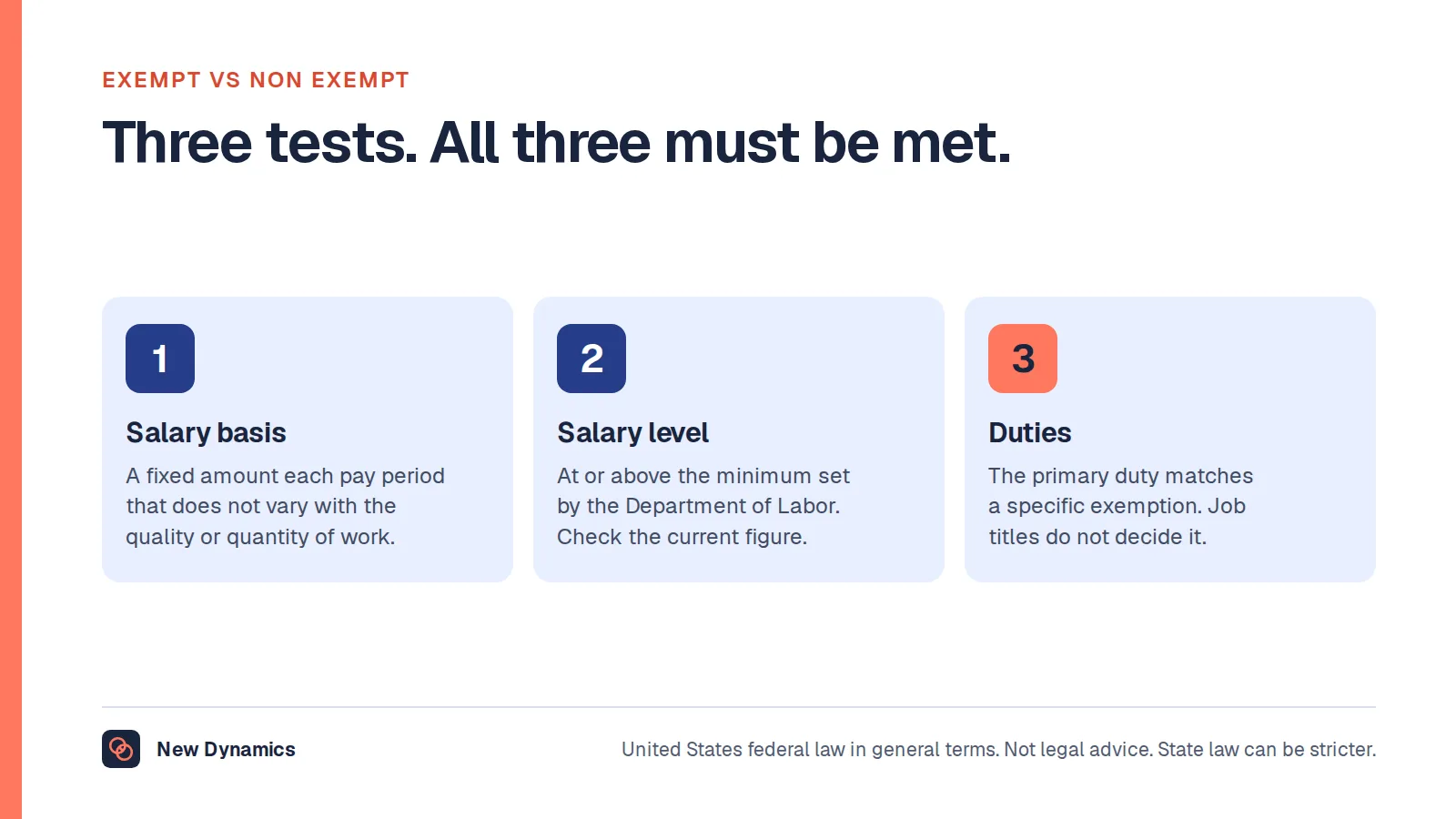
Two qualifications matter before you multiply anything. The rate applies to "covered nonexempt employees", and DOL sets the enterprise coverage test at employers "that have annual gross volume of sales or business done of at least $500,000", with individual coverage for employees engaged in interstate commerce at smaller firms. Exempt employees are a separate question, handled in our post on exempt and non-exempt employees.
The annual equivalent, with the arithmetic shown
The Department of Labor does not publish an annual minimum wage. No federal page states a yearly figure, because the duty is expressed per hour and federal law fixes nobody's hours. The number below is a calculation we have done, not a figure taken from DOL. Here is every step, so you can check it or change an assumption.
| Step | Working | Result |
|---|---|---|
| Hourly rate (DOL) | Federal floor | $7.25 |
| A 40 hour week | $7.25 x 40 | $290.00 |
| Hours in a 52 week year | 40 x 52 | 2,080 |
| Annual equivalent | $7.25 x 2,080 | $15,080 |
| Monthly equivalent | $15,080 / 12 | $1,256.67 |
| Fortnightly equivalent | $290 x 2 | $580.00 |

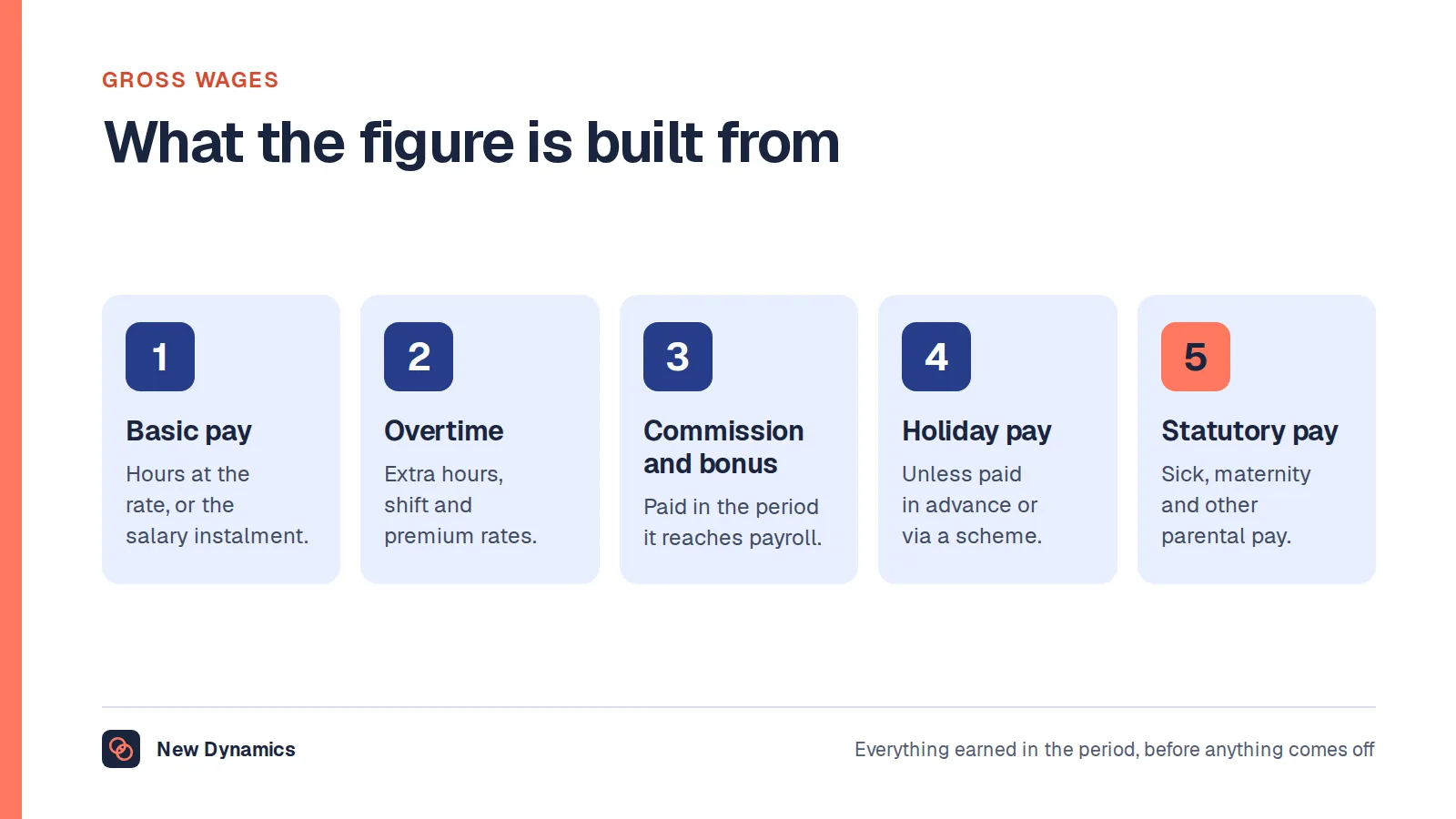
$15,080 a year is the annual equivalent at 40 hours a week, 52 weeks a year. It is gross, before federal withholding, Social Security, Medicare and state or local tax. Our post on gross wages covers what sits between that figure and a bank transfer.
Four assumptions do all the work, and each can break:
- 40 hours every week. At 30 hours the same rate gives $11,310, and at 20 hours $7,540.
- 52 weeks, all paid. A calendar year is 52 weeks and a day or two, so 2,080 slightly understates the hours available. More to the point, the FLSA requires no paid vacation, sick leave or holidays, so an unpaid week is a week with no pay in it.
- No overtime. Hours over 40 in a workweek attract time and a half for a non-exempt employee, which pushes the year above $15,080. See overtime pay.
- The federal rate is the operative one. Usually it is not, which is the next section.
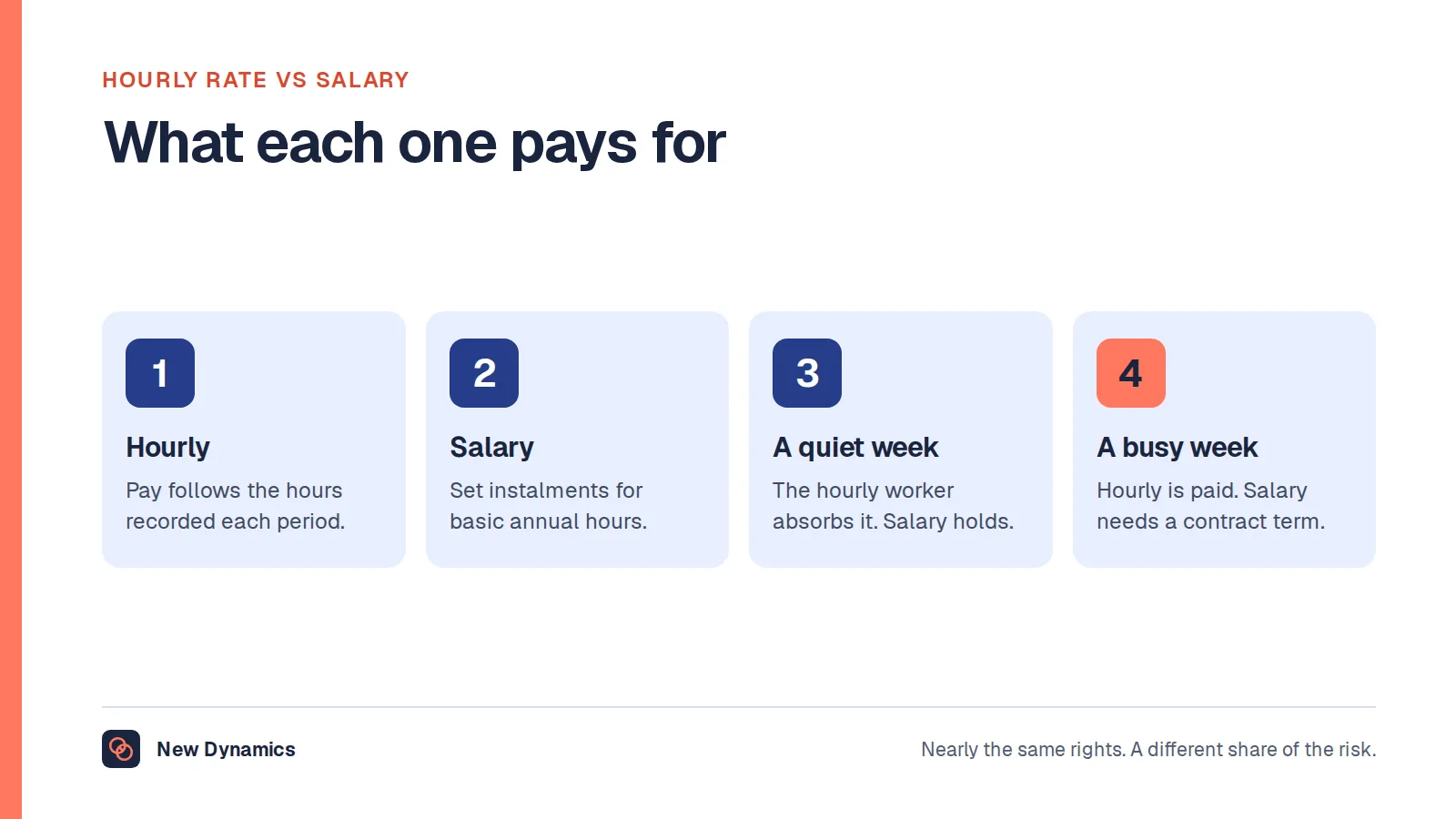
The 2,080 convention is American and it travels badly. If you are converting in the other direction, the method matters more than the multiplier, and hourly rate against salary sets out how to do it defensibly.
States and cities set higher rates, and the higher one wins
DOL's general minimum wage topic page states the rule plainly: "Many states also have minimum wage laws. In cases where an employee is subject to both the state and federal minimum wage laws, the employee is entitled to the higher of the two minimum wages." The FAQ puts it in one line: "Where state law requires a higher minimum wage, that higher standard applies."
We are not reproducing a table of state rates, because they move on different dates and a copied table goes stale quietly. Read them at the source: DOL maintains state minimum wage laws as a map with a table and footnotes, and that page carried the note "Updated November 5, 2026" when we checked it. On that version, 30 states and the District of Columbia sat above the federal rate, 13 states matched it at $7.25, two states set a lower rate so the federal rate applies, and five states had no minimum wage law of their own.
Cities and counties add a third layer in some states, and DOL's page covers state law only. The consequence for an annual figure is simple: calculate from the rate that applies at the employee's work location, not from $7.25, unless you have confirmed the federal floor is the highest one in play.
Tipped employees, and why the tip credit changes the answer
This is the exception that moves the number furthest. DOL's FAQ: "An employer may pay a tipped employee not less than $2.13 an hour in direct wages if that amount plus the tips received equal at least the federal minimum wage, the employee retains all tips and the employee customarily and regularly receives more than $30 a month in tips."
The mechanism has a name and a ceiling. Fact Sheet 15 states: "The maximum tip credit that an employer can currently claim is $5.12 per hour: ($7.25 - $2.13 direct (or cash) wage = $5.12)."
Run the same annualising on those two components and the split is stark. On 2,080 hours, a direct wage of $2.13 comes to $4,430.40 a year from the employer, and the $5.12 maximum tip credit comes to $10,649.60 a year from customers. The two add to $15,080, the same total, but only $4,430.40 of it is guaranteed by the payroll. If tips fall short, DOL says "the employer must make up the difference", and that test runs workweek by workweek rather than at year end.

State law frequently overrides this. Fact Sheet 15 is explicit: "some states require a higher cash wage than the federal direct (or cash) wage of $2.13 per hour or in some cases prohibit the taking of a tip credit."
Youth, students and student learners
Three further rates sit below $7.25, and each is narrow.
The youth minimum wage. DOL's FAQ: "A minimum wage of $4.25 per hour applies to young workers under the age of 20 during their first 90 consecutive calendar days of employment with an employer, as long as their work does not displace other workers." Annualised the same way, $4.25 on 2,080 hours is $8,840, but the 90 day limit means nobody can lawfully be paid at that rate for a full year.
The Full-time Student Program. DOL describes it as being "for full-time students employed in retail or service stores, agriculture, or colleges and universities", where a certificate from the Department "allows the student to be paid not less than 85% of the minimum wage" and "limits the hours that the student may work to 8 hours in a day and no more than 20 hours a week when school is in session".
Student learners. For "high school students at least 16 years old who are enrolled in vocational education (shop courses)", a certificate "allows the student to be paid not less than 75% of the minimum wage, for as long as the student is enrolled in the vocational education program".
All three need a certificate. DOL's subminimum wage page: "Certificates issued by the Department of Labor's Wage and Hour Division are required for this type of employment." None is an employer's unilateral option.

The United Kingdom contrast
The United Kingdom runs the opposite design and ends up with the same publishing gap. GOV.UK's National Minimum Wage and National Living Wage rates page states that "The rates change on 1 April every year", and that a worker must be "aged 21 to get the National Living Wage". Its current rates table gives the April 2026 row as £12.71 for 21 and over, £10.85 for 18 to 20, and £8 for under 18 and for apprentices, with April 2027 already published at £13.21 for 21 and over.
So the rate is reviewed annually and set by age band, which the federal rate is not. But GOV.UK publishes hourly rates only, with no annual figure on the page, so a British reader hits the same wall. On the same 40 hour, 52 week assumption, £12.71 multiplied by 2,080 hours gives £26,436.80. That is our arithmetic again, and the multiplier is more contested here, because statutory paid leave sits inside the paid year and British contracts are often 35, 37.5 or 39 hours. For the method GOV.UK actually asks an employer to use, see hourly rate against salary.
If you are budgeting or checking an offer
- Start from the operative rate. Check the state on DOL's state page, then check for a city or county ordinance.
- State the assumptions next to the number. "$15,080 at 40 hours a week for 52 weeks" is usable. "$15,080" alone invites an argument.
- Keep the annual figure out of the compliance test. The FLSA test runs per workweek, so a yearly average above $7.25 does not cure a workweek that fell short.
- Treat tipped roles separately. Most of the annualised tipped total comes from customers, not payroll, and the make-up duty is the employer's.
- Re-check in January and April. Most US state increases land on 1 January. UK rates change on 1 April.
For the wider set of workforce figures we keep sourced and dated, see our HR statistics hub.
Frequently asked questions
What is the annual US minimum wage?
There is no official annual figure. The Department of Labor publishes an hourly rate of $7.25, effective July 24, 2009, and no federal page converts it into a yearly amount. Multiplying $7.25 by 40 hours a week and 52 weeks gives 2,080 hours and $15,080 a year gross. That calculation is ours, and it assumes full-time hours in every week of the year with no unpaid absence.
How much is $7.25 an hour per year?
At 40 hours a week for 52 weeks, $7.25 an hour is $15,080 before any deduction, which is $290 a week, $580 a fortnight and about $1,256.67 a month. At 30 hours a week it is $11,310, and at 20 hours $7,540. Federal law requires no particular number of hours, so the annual figure follows the schedule rather than the statute.
When did the US federal minimum wage last change?
July 24, 2009. The Wage and Hour Division states that "The federal minimum wage is $7.25 per hour effective July 24, 2009". The Division also explains that there is no automatic uprating: "The minimum wage does not increase automatically. Congress must pass a bill which the President signs into law in order for the minimum wage to go up."
Does a state minimum wage override the federal one?
If it is higher, yes. DOL states that where an employee is subject to both state and federal minimum wage laws, "the employee is entitled to the higher of the two minimum wages", and that "Where state law requires a higher minimum wage, that higher standard applies". Where a state rate is lower, or a state has no minimum wage law, the federal rate applies to covered employees.
What is the annual equivalent for a tipped employee?
The total is the same but the source of it is not. An employer may pay a direct wage of not less than $2.13 an hour and claim a tip credit of up to $5.12, the difference between $2.13 and $7.25. On 2,080 hours that is $4,430.40 a year in direct wages and up to $10,649.60 a year in tips. If tips plus the direct wage do not reach the federal minimum wage, the employer must make up the difference.
Is there a lower minimum wage for young or student workers?
Yes, in three narrow cases. A youth minimum wage of $4.25 an hour applies to workers under 20 for their first 90 consecutive calendar days with an employer, provided the work does not displace other workers. Certificated programmes allow not less than 85 percent of the minimum wage for full-time students in retail, service, agriculture and higher education, and not less than 75 percent for student learners in vocational education.
Your next step: get the rate and the assumptions on one line
- Write down the work location for each role, look up the state rate on DOL's state minimum wage page, then check for a city or county ordinance.
- Record the contractual weekly hours. Without them no annual figure is defensible.
- Multiply the operative hourly rate by weekly hours, then by 52, and label the result as a calculation with both assumptions named.
- Flag every tipped role and check that hours, direct wages and tips are recorded together in each workweek rather than averaged.
- Diary 1 January and 1 April, the two dates on which the rates you depend on most often move.
To put rates, hours, overtime and the pay review method in one document people can read, read and download our compensation policy guide. The guide is free to read, and the PDF uses our short download form.
Want pay decisions to rest on a record that already exists rather than one rebuilt in the meeting? Book a New Dynamics demo and bring your current review form. You can also email contact@new-dynamics.com.