TL;DR
- An employee relations function advises, it does not decide. The manager who owns the team owns the outcome, and the specialist owns the fairness of the process that produced it. Blur that line and the appeal stage has nowhere to go.
- The Acas statutory Code of Practice says employers and employees “should raise and deal with issues promptly and should not unreasonably delay meetings, decisions or confirmation of those decisions” and “should act consistently”. Consistency across managers is the hardest thing the function delivers and the thing tribunals test.
- Case volumes measure nothing. Time to resolution, the proportion of concerns resolved informally and repeat cases by team measure the function. Keep the record to the ICO standard: only what is needed, for a stated period, visible only to those authorised to see it.
An employee relations function is easiest to describe by what happens when there is not one. Two managers meet the same conduct problem and reach opposite answers. A complaint sits in an inbox for five weeks because nobody owns it. An investigation report records a conclusion but not the evidence that produced it. And nobody can say how long the last ten cases took, because nobody was counting.
This article is about the function rather than the definition: what an employee relations team does day to day, the case types it carries, where a manager's decision ends and a specialist's advice begins, what the case record has to show, and how to measure the work without flattering it. It describes the position in England, Scotland and Wales, and it is general information rather than legal advice. Where a source is quoted, it is quoted as the publisher words it.
Most employee relations work is prevented rather than resolved. See how New Dynamics continuous feedback keeps small concerns surfacing in a one to one, while they are still cheap to fix.
For the definition of the term, how it differs from industrial relations and the career route into it, our post on employee relations covers the ground this article assumes.
What an employee relations function does day to day
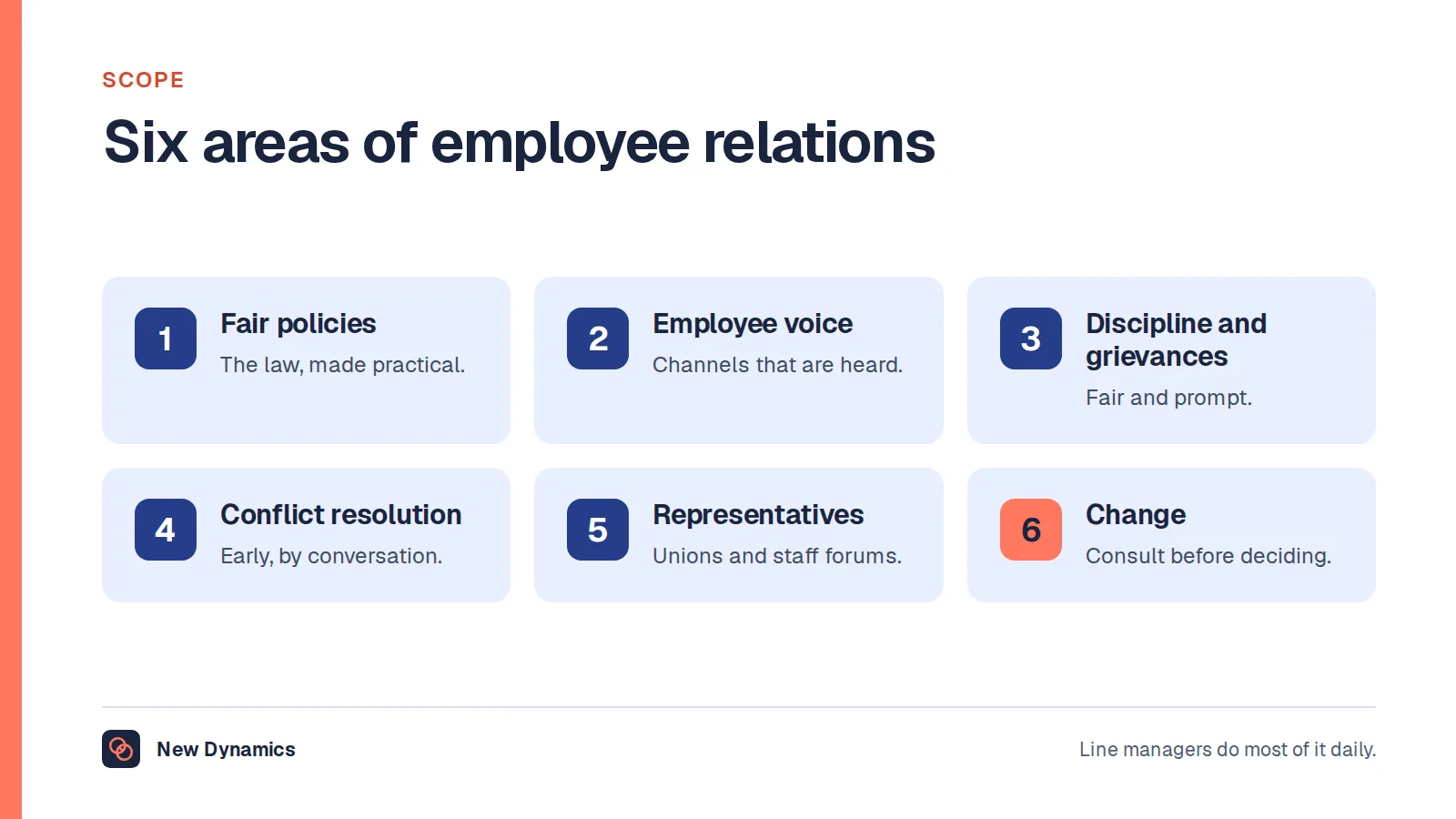
Strip away the job titles and the work falls into six streams. A small employer runs all six through one HR generalist. A large one has a team with a case management queue. The streams are the same either way.
- Triage and advice. A manager rings or messages with a situation. Somebody has to work out within a day whether this is a quiet conversation, a formal procedure, a health question, a pay query or something that has to go to a lawyer. Triage is the highest-value hour in the whole function, because it is where cases are sent down the right road or the wrong one.
- Casework support. Running alongside a manager through an investigation, a hearing and an outcome: drafting the invitation, checking the questions, reading the evidence, reviewing the outcome letter before it is sent.
- Policy and procedure. Writing and maintaining the disciplinary, grievance, absence, capability, anti-harassment and whistleblowing procedures, and the templates that go with them. Acas is blunt about the test a procedure has to pass: it should "be in writing and easy to find".
- Manager capability. Training, coaching and the quiet correction after a case has gone sideways. Most outcomes are decided in the first conversation, before the function hears about the matter at all.
- Records and reporting. One case file per case, built as the case runs rather than reconstructed afterwards, and a quarterly read of what the cases together are saying.
- Collective relationships. Recognition agreements, consultation, negotiation and the standing relationship with representatives, which is covered further down.
The statutory benchmark for streams one to three sits in the Acas Code of Practice on disciplinary and grievance procedures, issued under section 199 of the Trade Union and Labour Relations (Consolidation) Act 1992. The Code states that "Employers and employees should raise and deal with issues promptly and should not unreasonably delay meetings, decisions or confirmation of those decisions. Employers and employees should act consistently. Employers should carry out any necessary investigations, to establish the facts of the case."
Three obligations in two sentences: be quick, be consistent, find the facts. Almost everything an employee relations function builds exists to deliver one of those three.
The case types an employee relations function handles
Case types matter because each family needs a different first move, and because mixing them in one queue is how a function loses track of its own workload.
- Conduct. Lateness, misuse of systems, dishonesty, aggression, breaches of a policy. The decision is about behaviour and whether it happened.
- Capability and performance. Someone cannot do the job to the standard, with no suggestion of wilfulness. This usually belongs in a performance route first, and our guide to the performance improvement plan sets out that route.
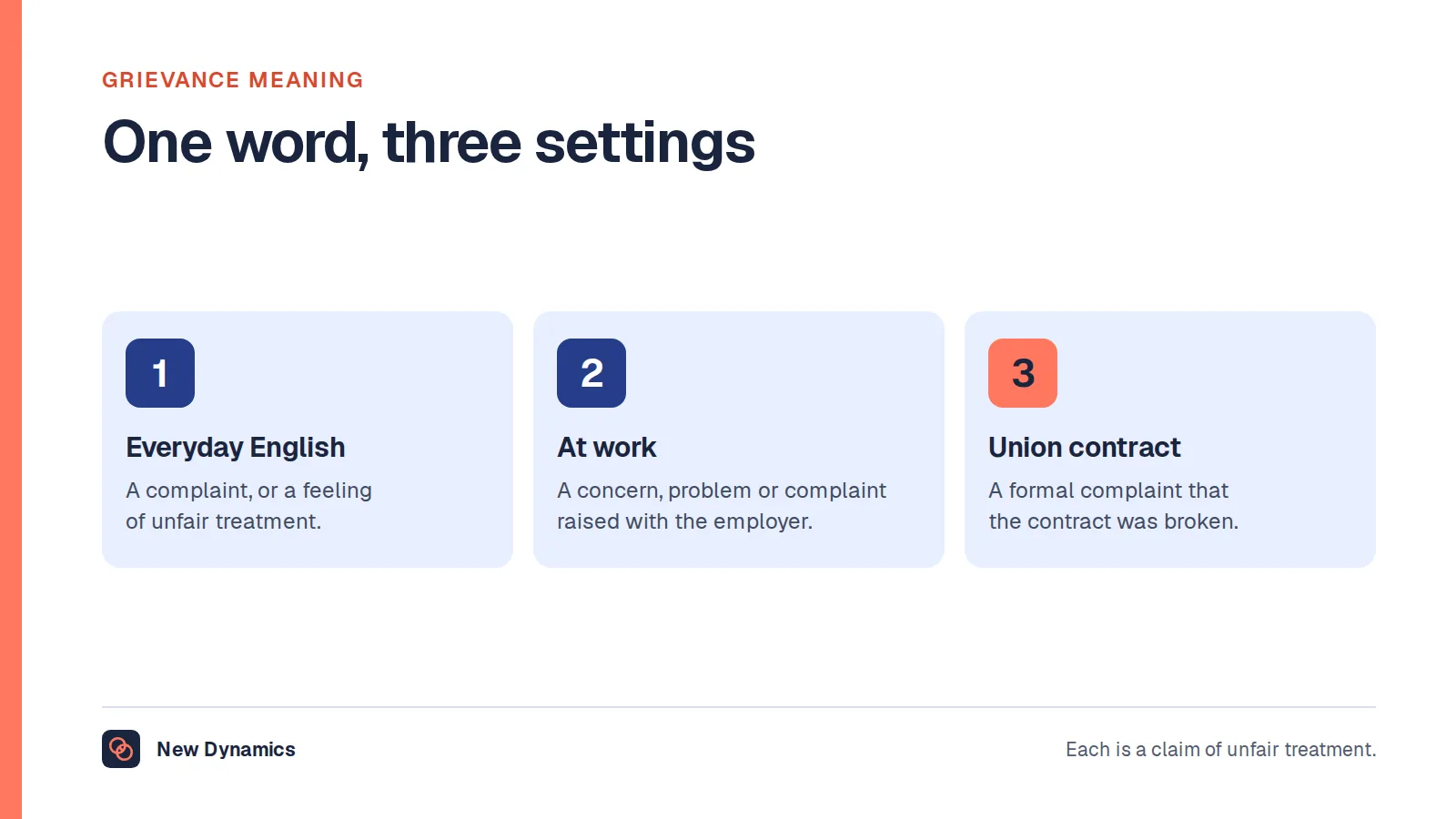
- Complaints and grievances. Someone raises something about the employer, a manager or a colleague. The meaning of grievance explains the formal version.
- Bullying, harassment and discrimination. Technically a complaint, practically its own family, because of the legal exposure, the need for a trained investigator and the duty to protect the complainant while the case runs.
- Absence and health. Short-term absence patterns, long-term sickness, fitness for work and reasonable adjustments. Our guide to absence management covers the process.
- Pay, contract and working time disputes. Often resolved by producing the correct calculation rather than by any procedure at all.
- Exits. Resignations with a complaint attached, dismissals, protected conversations and settlement discussions.
- Change and consultation. Restructures, redundancies and transfers, where consultation is a legal requirement rather than a courtesy.

Write the list down for your own organisation and name the owner of each family. The common failure is not that nobody owns absence cases, but that three people half own them.
Who owns the decision and who advises on process
This is the single most useful distinction in employee relations management, and it is routinely collapsed.
The manager owns the decision. They heard the case, they know the job, the team and the standard, and they will live with the consequence. The employee relations specialist owns the process. They make sure the right steps happened in the right order, that the evidence supports whatever is decided, and that the person on the receiving end was treated the way the next person in the same position will be treated.
The reason is not organisational tidiness. The Code requires that "Employers should inform employees of the basis of the problem and give them an opportunity to put their case in response before any decisions are made", and that "Employers should allow an employee to appeal against any formal decision made." If the specialist effectively decides the outcome and the manager reads it out, two things break. The person who heard the response is not the person who decided, and the appeal has nowhere independent to go, because the function that advised the first decision is now reviewing itself.
Four rules keep the line visible.
- Advice is written as options and consequences, not as an instruction. "These are the three outcomes open to you on this evidence, and here is the risk attached to each" rather than "issue a final written warning".
- The manager signs the outcome letter. If they are not willing to sign it, they have not decided it.
- The appeal hearer is more senior and has not been advised on the original case by the same person, wherever headcount allows.
- The specialist can stop a process, but not start an outcome. A veto on an unfair step is proper. A sanction chosen in HR is not.
Where a manager genuinely cannot be the decision maker, because they are a witness or the subject of the complaint, swap the manager rather than swapping the model.
The casework lifecycle, from first concern to closure

Stage 1. Concern raised and triaged. Log it the day it arrives, with the date, who raised it, what they say happened and what they want. Decide the family, the route and the owner. Set a target date now, not later.
Stage 2. Informal or formal. A single, explicit decision with a reason recorded. This stage is where most functions make their worst mistake, and it has its own section below.
Stage 3. Investigation. Proportionate to the allegation. Gather the documents, interview the people who were actually there, put the substance of any adverse account to the person it concerns, and separate what was observed from what was inferred. Our guide to workplace investigations covers the mechanics.
Stage 4. Hearing and decision. The person is told the basis of the problem, has the evidence in advance, and has a chance to respond before anything is decided. The Code adds that "Employers should allow employees to be accompanied at any formal disciplinary or grievance meeting."
Stage 5. Outcome, appeal and closure. A written outcome with reasons, the appeal route, and a defined end. Closure also means the follow-up actions have an owner: the mediation that was promised, the training, the rota change, the review date.
What the case record has to show
A case file is not a diary. It has to let a stranger reconstruct, months later, how a decision was reached and why it was reasonable. Five things have to be visible.
- The allegation or complaint as it was put, dated, in the words of the person who raised it.
- The evidence considered, including anything that pointed the other way. A file holding only the material that supports the outcome is a weaker file, not a stronger one.
- What the person said in response, and what the decision maker made of it.
- The decision, the reasons and who made it. "Not proven on the evidence" is a complete reason. "No further action" on its own is not.
- The timeline. Dates of each step, and a note explaining any gap. Delay that is explained on the file is a different matter from delay that is not.
On how long to hold it and who may see it, the Information Commissioner's Office is the authority in the UK. Its guidance on collecting and keeping employment records states that "The data minimisation principle says you must make sure the personal information you hold is adequate, relevant, and limited to what you need for your purposes." It adds that you "should set up a retention policy or schedule that lists: the types of record or information you hold; what you use it for; and how long you intend to keep it", and that you "could periodically review your records to check that the personal information you hold about your workers is still relevant and adequate for your purposes, and delete anything you no longer need."
Applied to casework, that means three habits: record the facts the decision needed and not the colour commentary, put a retention period against case files before you open the next one, and run the expired ones off at a fixed point each year rather than keeping everything for ever in case it is handy.
Informal resolution and formal procedure
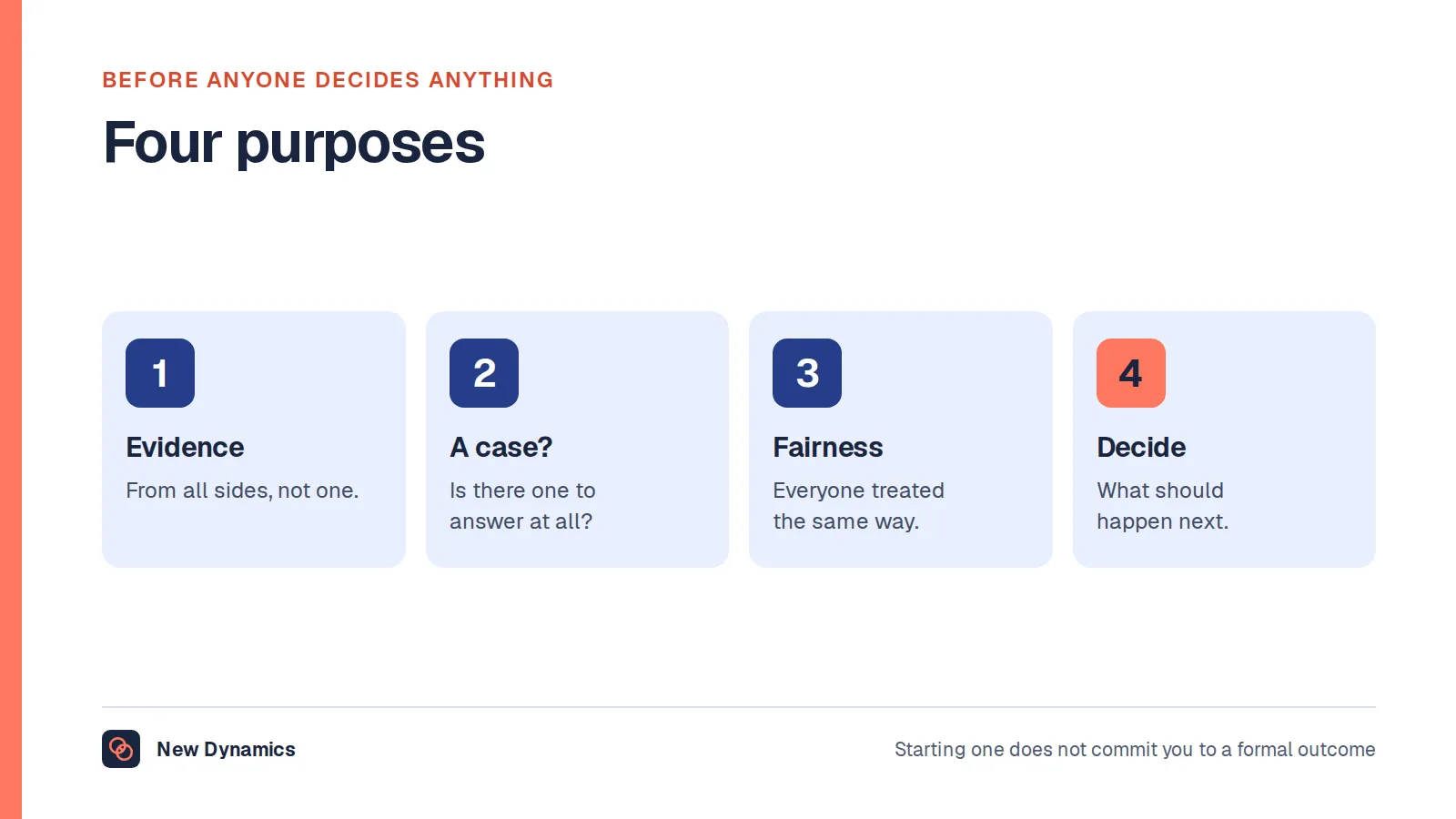
The Code is explicit that the formal route is not the first route: "Many potential disciplinary or grievance issues can be resolved informally. A quiet word is often all that is required to resolve an issue." Acas says the same from the employee's side in its grievance procedure guidance: "If an employee has a problem at work it's usually a good idea for them to raise it informally first." It also notes that "You can use mediation at any stage. Mediation involves an independent, impartial person working with both sides to find a solution", and that both sides need to agree to it.
Most organisations go formal too early, and the reasons are structural rather than careless.
- Fear. A manager who has heard that process protects you reaches for process, including when the matter is a misunderstanding about a rota.
- Policy wording. Procedures that describe the formal stages in detail and the informal stage in one line tell a reader which one is real.
- Ownership. Formalising a matter moves it off a manager's desk and into a system. That is a relief, and it is often the actual motive.
- Measurement. A function whose value is shown by case volumes has no reason to prefer the route that produces no case.
- The seriousness test is skipped. Some things must go formal immediately. Acas lists pursuing a formal grievance where "it's a very serious issue, for example sexual harassment or whistleblowing". Allegations of that kind, or of dishonesty or safety risk, are not candidates for a quiet word.
The practical fix is to make the informal stage a real stage rather than an absence of one. Give it a name, a time box of around ten working days, a named owner, a one-paragraph note on the file recording what was agreed, and a review date. Then the choice at stage two is between two defined routes, and the decision to go formal has to be justified rather than assumed.
Consistency across managers
Consistency is the hardest thing an employee relations function delivers, because it has to hold across people who never speak to each other, over years, under pressure. The Code's requirement is one clause long: employers and employees "should act consistently". Acas puts the operational version in its disciplinary procedure guidance: "To ensure fair treatment, employers must follow the procedure and policy in the same way for each disciplinary case."
This is also the thing that gets tested. The Code explains its own weight: "A failure to follow the Code does not, in itself, make a person or organisation liable to proceedings. However, employment tribunals will take the Code into account when considering relevant cases." It adds that "Tribunals will also be able to adjust any awards made in relevant cases by up to 25 per cent for unreasonable failure to comply with any provision of the Code."
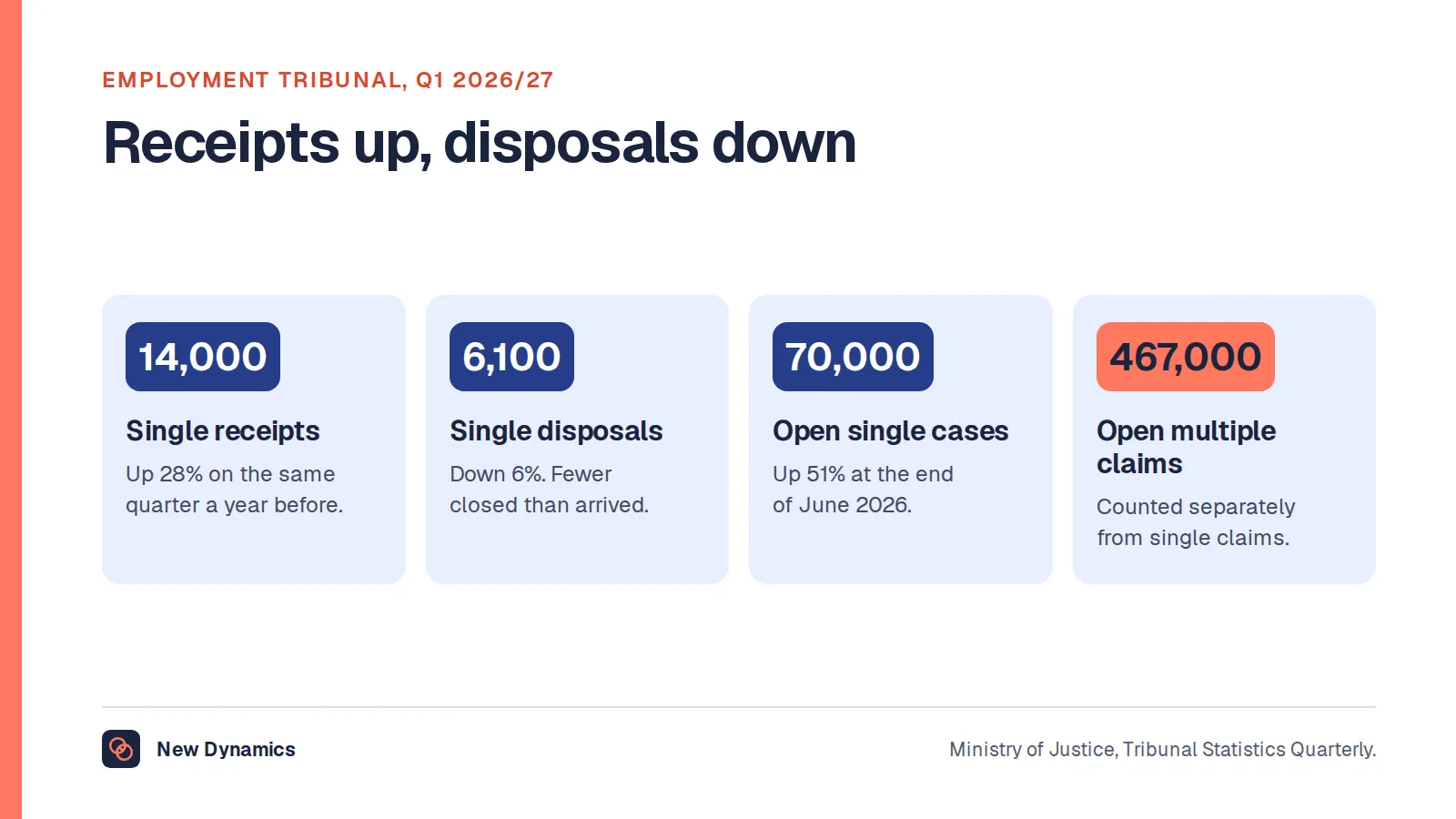
A tribunal does not only ask whether this decision was reasonable in isolation. It asks how comparable cases were handled, and inconsistent treatment of similar facts is one of the most reliable ways to lose a case that was defensible on its merits. The volumes and routes involved are set out in our post on employee relations statistics UK, where the Ministry of Justice tribunal receipts and open caseload and the Acas early conciliation outcomes are quoted with their reference periods. The short version from those figures: the queue is long, most disputes settle before a hearing, and the cases that go the distance are examined closely.
Five mechanisms do the work.
- A decisions log. One line per outcome: issue type, facts in summary, mitigation, sanction. Anonymised, searchable by the function. Before advising, read what happened last time.
- Process sign-off before any formal sanction. Not a sign-off of the decision, a sign-off that the steps happened.
- One set of templates, so the invitation, the notes and the outcome letter have the same shape in every department.
- Calibration. A quarterly session where managers and the function work through two or three anonymised cases and compare answers. Disagreement in the room is the point; it is cheaper there than at a hearing.
- Appeal pattern review. Appeals overturned on process, repeatedly, in one part of the business, are a training signal with a date on it.
Consistency is not uniformity. Two people who did the same thing can properly receive different outcomes, for reasons such as length of service, previous warnings, admission or genuine mitigation. The requirement is that the difference is explained on the file. Unexplained difference is the problem, not difference.
Confidentiality and who may see a case
A case file is some of the most sensitive data an employer holds. The ICO's record-keeping guidance sets the obligation in mandatory terms: you "must make sure that the employment records you hold: can only be accessed, altered, disclosed or deleted by those who are authorised to do so (and that those people only act within the scope of the authority you give them)." On passing information on, its guidance on using employment records is that you "should consider the request carefully and only share the information when you are satisfied it is right to do so."
In casework terms, write down who is authorised before you need to know.
- The decision maker, for the evidence their decision rests on.
- The adviser, for the whole file.
- The investigator, for the matter they are investigating, and not for the person's unrelated history.
- The appeal hearer, at the appeal stage.
- A note taker, bound by the same confidentiality as everyone else.
That list is short on purpose. A manager's curiosity about a colleague's grievance is not a need to know. Nor is a team's wish to be told why someone was absent, or an executive's request for the detail when the summary answers the question.
Two limits are worth stating out loud to participants. Full anonymity usually cannot be promised, because a person facing an allegation has to be told the basis of it in order to answer it, and the function should say so at the start rather than promise what it will have to withdraw. And a person can make a subject access request, so every case file should be written on the assumption that they will one day read it. That is a discipline, not a threat: it pushes writers towards facts and away from characterisation.
Keep live case files out of the general HR drive and out of personal mailboxes. Hold them in one place, with access by name, and close the access when the case closes.
Measuring the function honestly

Case volume is the measure most functions report and the one that says least. A rise can mean conflict is up, or that people finally trust the process, or that a new manager formalises everything. A fall can mean matters are being settled early, or that nobody believes raising anything is worth it. On its own the number cannot distinguish any of those.
Three measures carry real information.
- Time to resolution. Median days from the concern being raised to a written outcome, plus the slowest case in the period. Track both. The median shows the normal state of the function; the slowest case is the one that becomes a claim, and an average hides it.
- The proportion resolved informally. Of all concerns raised, the share closed at the informal stage with a recorded agreement. This is the clearest single indicator of whether the function is doing the Code's preferred thing or defaulting to procedure. Watch the trend rather than the level, and read it with the seriousness mix, since a quarter with three harassment allegations should formalise more.
- Repeat cases by team. Cases per 100 employees, by team and by manager, over a rolling year. A team producing cases repeatedly has a management, workload or design problem that casework cannot fix. This measure converts employee relations data into something the business can act on.
Three guardrails. Write the definitions down before the first count, including what you do with withdrawn cases and informal matters. Use rates rather than counts, so headcount growth does not read as conflict growth. And never publish manager-level numbers as a league table, because the fastest way to destroy the informal stage is to make managers look bad for logging anything. The wider published context sits in the HR statistics hub.
Collective employee relations, briefly
Employee relations also covers the employer's relationship with employees as a group, and a function that only runs individual casework is doing half the job. The collective side includes recognition and relationships with trade unions, pay and terms negotiation, elected representatives and staff forums where no union is recognised, consultation on restructures, redundancies and transfers, and the handling of collective disputes. Reporting on the year from 1 April 2025 to 31 March 2026, Acas states that "Acas was involved in over 400 collective disputes between employers and groups of workers with a settlement rate of 93%", which is a reminder that this work is live rather than historical.
Two practical points. Consultation has statutory triggers and timescales in change situations, so the function needs the calendar before the announcement, not after it. And a standing relationship with representatives, maintained when nothing is wrong, is what makes consultation possible when something is. Our guides to the meaning of a trade union and collective bargaining set out the mechanics, and an honest open door policy is the individual-level equivalent.
Frequently asked questions
What does an employee relations function do?
It triages and advises on cases, supports managers through investigations, hearings and outcomes, writes and maintains the disciplinary, grievance, absence and anti-harassment procedures, trains managers, keeps the case records and reporting, and handles collective relationships with unions and employee representatives.
Who makes the decision in an employee relations case?
The manager who heard the case makes the decision, because they heard the response, they know the job and the standard, and they will live with the result. The employee relations specialist advises on process, evidence and consistency, and should not choose the outcome, or the appeal stage has nothing independent to review.
When should a concern go formal rather than informal?
Go formal when informal resolution has been tried and has not worked, when the person raising it does not want it handled informally, or when the allegation is serious, for example harassment, dishonesty, a safety risk or whistleblowing. Acas states that many potential disciplinary or grievance issues can be resolved informally.
What should an employee relations case record contain?
The allegation or complaint as it was put and dated, the evidence considered including anything pointing the other way, the person's response, the decision with reasons and the name of the decision maker, and a dated timeline of each step. Hold only what the decision needed, with a stated retention period.
Who is allowed to see an employee relations case file?
Only those authorised: the decision maker, the adviser, the investigator for the matter in hand, the appeal hearer and a note taker. The ICO requires that employment records can only be accessed, altered, disclosed or deleted by those authorised to do so, acting within the scope of that authority. Curiosity is not a need to know.
How do you measure employee relations management?
Not by case volume, which rises when trust improves and falls when it collapses. Measure the median and slowest time from concern to written outcome, the proportion of concerns resolved informally, and repeat cases per 100 employees by team and manager over a rolling year.
Your next steps: four things to put in place this quarter
- Write the ownership line down. One page naming, for each case family, who decides and who advises, and circulate it to every manager who might need it.
- Give the informal stage a name, a time box and a note template, then record at stage two which route was chosen and why.
- Start the decisions log, anonymised, one line per outcome, and read it before advising on the next comparable case.
- Replace the volume report with the three honest measures, with the definitions written down before the first count.
Case records are the part of this work that is easiest to get wrong and hardest to fix afterwards. Read and download our employee data protection guide for mapping worker information, access and retention. The guide is free to read, and the PDF uses our short download form.
Want concerns reaching a one to one instead of a case file? Book a New Dynamics demo and bring your last four quarters of casework. You can also email contact@new-dynamics.com.