TL;DR
- Efficiency, productivity and utilisation are three different measures. Efficiency is about waste, productivity is a ratio, and utilisation is the share of time booked. A high utilisation target is the most common way to make a team slower.
- Trace one piece of work from request to done and separate the hours somebody touched it from the days it existed. The gap is waiting, and in office work the waiting is usually most of the elapsed time.
- Efficiency drives go wrong when they turn into intensification or monitoring. The ICO says you must select the least intrusive means to achieve your purpose, and HSE treats protecting workers from stress as the same legal duty as any other health and safety risk.
Somebody says "we need to improve efficiency" and a predictable set of things follows. A target. A dashboard. A message about focus. Possibly a tool that counts activity. Three months later the work takes exactly as long as it did, and the people doing it are more tired.
The reason is nearly always the same. In an office, the time a piece of work takes is dominated by the time it spends waiting: for a decision, for a colleague, for a slot in somebody's week, for the second attempt after the first one came back. Effort is already high. Delay is high and invisible, and asking people to work harder tends to add to it.
This article covers how to separate workplace efficiency from productivity and utilisation, how to find where the time goes before changing anything, the four usual culprits and what to do about each, why a fully utilised team cannot absorb anything, the manager behaviours that create delay, and where measuring individuals stops being legitimate.
Review cycles, goal check-ins and approvals are themselves processes with stages and handoffs. See how New Dynamics workflows set out the stages, participants and approvals for the process you already run.
For the national measure and the four things an employer controls, our post on employee productivity covers the ratio itself. This piece is about the delay inside it.
Efficiency, productivity and utilisation are three different things

Efficiency is about waste: the same result with fewer handoffs, less waiting, less rework and fewer approvals. An efficiency gain shows up as a shorter elapsed time, or a lower cost, for the same output and the same quality.
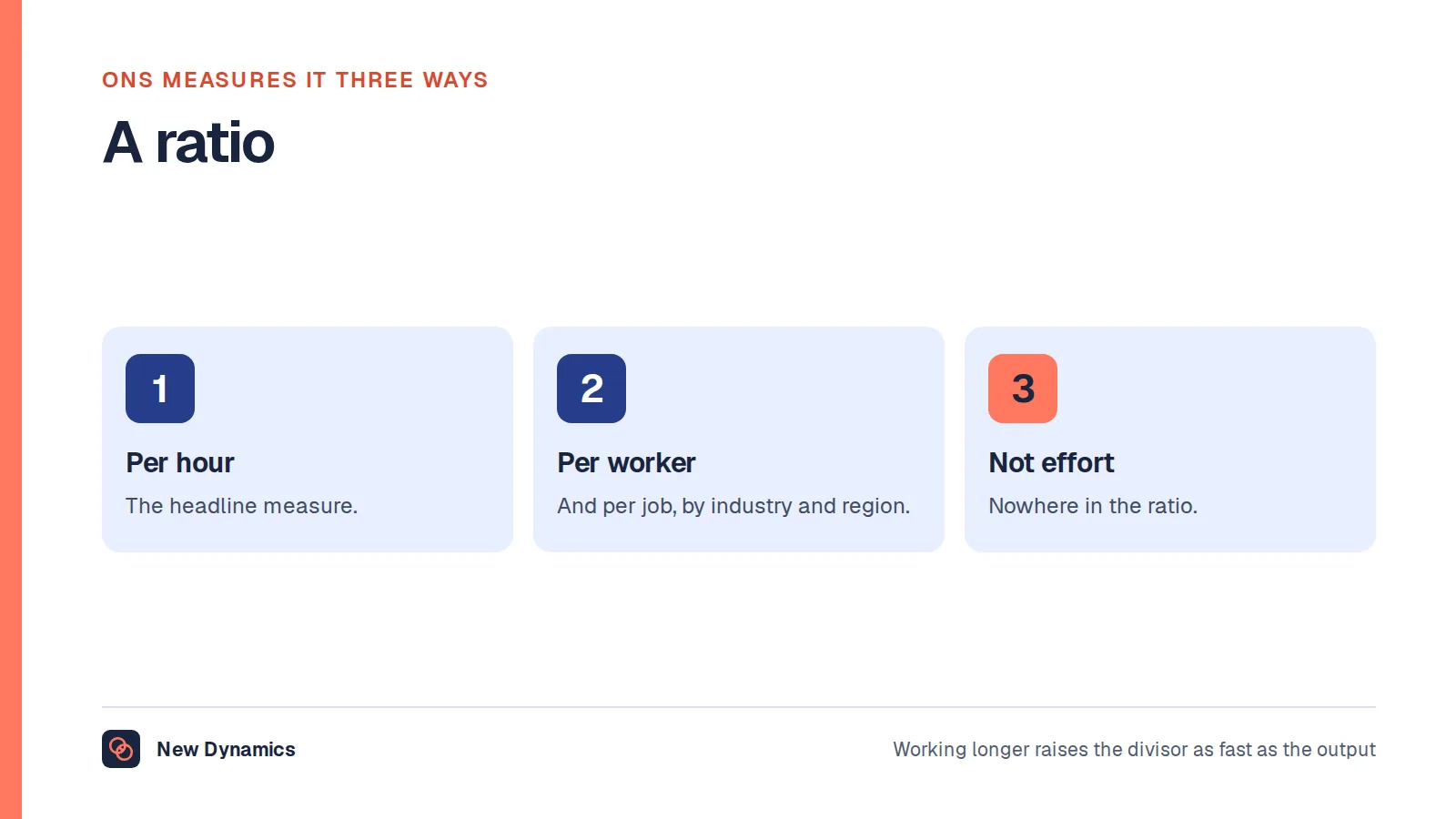
Productivity is a ratio. Output divided by a quantity of labour. The Office for National Statistics publishes it nationally, and its Productivity flash estimate and overview, UK: April to June 2026 and January to March 2026, released on 18 August 2026, shows exactly how the arithmetic behaves. On payroll data, output per hour worked growth "increased by 0.7% in Quarter 2 2026 compared with Quarter 2 2025. This is because GVA increased by 1.2% and the number of hours worked increased by 0.4%."
The ratio improved because output grew faster than hours. Had hours also grown by 1.2%, it would not have moved at all, however hard anybody worked. The same release puts output per hour 0.2% lower for the same period on Labour Force Survey data, and our post on UK labour productivity statistics covers why two official numbers disagree.
Utilisation is the share of available time assigned to work. It is not an output measure at all, and it is the one most often mistaken for efficiency. A team at 95% utilisation looks impressive on a slide and is usually the slowest in the building, for reasons covered further down.
Three practical consequences follow.
- A utilisation target and an efficiency target pull in opposite directions. If you want shorter elapsed times, you cannot also demand that every hour is booked.
- Productivity can rise while efficiency falls, if output rose because people worked longer. Check the denominator before celebrating.
- Only efficiency has a credible internal lever. National productivity moves by fractions of a percent a year, while the waiting inside your own process can often be halved, because nobody has ever looked at it.
So before a target is set, write one sentence: which of the three are we trying to move, and what will be different when it moves. If that sentence cannot be written, the programme is a mood rather than a plan.
Find where the time goes before you change anything
No official UK source publishes a figure for how much office time is lost to waiting, handoffs or rework. ONS measures output per hour by industry, HSE measures working days lost to ill health, and neither counts the days a purchase order spends in somebody's inbox. A precise national number for that is somebody's estimate. The only honest figure is your own, and it is cheap to get.
Pick one kind of work that matters: an invoice, a hiring decision, a client deliverable, a change request, a completed appraisal. Take the last five that finished and write down two numbers for each.
- Elapsed time. Request date to done date, in calendar days, including the days nothing happened.
- Touch time. The hours somebody was actually working on it. Ask the people involved; their guess is good enough.
Divide touch time by elapsed time and you have the share of that work's life in which anything was happening. In office processes the result is routinely in single-digit percentages. That is not a judgement on anybody, it is a statement about queues.
Then write down where each one stopped and for how long. You will get a list of named waits: four days with the approver, a week waiting for a figure from finance, two days because the brief was wrong, nine days because the only person who could sign was away. That list is the plan, and it needs no tool, consultant or target.
Two cheaper variants if that feels like too much. Ask five people, in a one-to-one rather than a survey, what stopped them finishing something last week, and do not defend what you hear. Or read the dates you already hold: request date to completion date is sitting in your ticketing, recruitment or finance system and nobody has plotted it.
Write the definition beside the number, every time. "Working days from the request being logged to the item being marked done" is a definition. "Efficiency: 62" is not. Our post on HR metrics covers why a measure without its formula cannot be compared with anything, including with itself last quarter.
Culprit one: waiting for a decision

This is the largest single source of delay in most organisations, and the cheapest to fix, because the fix is a sentence rather than a system.
The pattern is familiar. Work reaches a point where somebody more senior has to say yes. That person is in meetings. The work waits. When they do look at it they have a question, which goes back and waits again. None of this is anyone's fault, and all of it is designed.
What to do, in order of how much time it saves.
- Write down who decides what, and up to what value. Most delay comes from decisions that did not need to travel upwards at all. Set thresholds, under this amount the team decides and over it the manager does, then publish them.
- Give decisions a service standard. "Requests for sign-off get an answer within two working days" is a commitment a manager can keep and a team can plan around. Without one, every request is an open-ended wait.
- Say what happens if nobody answers. "If there is no response by Thursday, we proceed as proposed, and the decision is logged" removes a whole class of delay, and puts the cost of silence on the person who created it.
- Batch less. A weekly approval meeting adds days of waiting to every item that misses it. If approvals are batched for the approver's convenience, that convenience now has a measurable price.
- Keep a decision log, one line each: what, who, when, why. It stops the same question being reopened, which is a large share of rework.
If your traced five showed days sitting with one person, resist the urge to tell that person to be faster. Reduce what has to reach them. Our post on decision-making questions covers how to test whether somebody is ready to hold a decision before you hand it over.
Culprit two: rework from unclear requirements
Rework is the most expensive waste there is. You pay for the work twice and for the delay in between, and it is demoralising in a way that waiting is not.
It almost never comes from carelessness. It comes from work starting before anybody agreed what finished looks like: a verbal brief, acceptance criteria in somebody's head, two people holding different pictures of the same deliverable and both confident.
Acas lists "feeling unclear about roles and responsibilities" among the causes of stress at work, alongside "too many or conflicting demands" and "little control over how and when work is done or decision making". That is the same list a manager would write if asked where rework comes from, which is not a coincidence: unclear work is both slower and harder on people.
What to do.
- Agree the definition of done before work starts, in writing, in three or four lines. What it must contain, who it is for, what it will be checked against, when it is due. Fifteen minutes at the start reliably saves days at the end.
- Name the reviewer at the start, not the end. Most rework loops come from a reviewer who was not in the conversation that set the brief.
- Count rework. How many items came back, and why, in three categories: requirements unclear, quality below standard, or the request changed. The proportions tell you which problem you have, and the first is usually the biggest.
- Stop treating a change of requirement as a failure of the person doing the work. Record it as what it is, so the measure stays honest and people keep reporting it.
A falling rework rate is a real efficiency gain that no output count will show, because work that never had to be redone appears nowhere.
Culprit three: work in progress stacked too deep
This is the counter-intuitive one, and it is the reason a team that is visibly busy can be slow.
The arithmetic is simple. A team that finishes five items a week with twenty-five open at any moment makes every item wait about five weeks, whatever anybody's intentions are. Halve the open items and the average wait halves too, with no change in how fast anybody works. Run it with your own two figures, how many you finish in a week and how many are open.
Deep work in progress carries its own extra cost. Every open item needs tracking, status reporting and re-reading, and switching between them loses the thread each time. People start a second thing because the first is blocked, so the blockage is never confronted and two things are late instead of one.
What to do.
- Cap what is open. Pick a number, lower than today, and hold it. New work waits in a visible queue, which is a prioritisation conversation in a way that twenty-five half-finished items is not.
- Finish before starting. When something is blocked, resolve the blockage rather than opening a new item. That is uncomfortable, and it is the point: visible blockages get fixed.
- Prioritise by what is nearly done, not by what is loudest. Finishing releases capacity, starting consumes it.
Culprit four: meetings that exist to move information a document would carry
Some meetings earn their place: a decision that needs several people in the room, a difficult conversation, anything where the discussion is the output. Many recurring meetings are a human read-aloud of information that would be faster to read.
Cost one honestly: length, times attendees, times frequency. A weekly hour with twelve people is twelve hours a week, most of a full-time role, spent transferring status. Then ask the three questions that settle it. What decision did it produce in the last month, what would happen if it stopped for four weeks, and could the content be a written update with comments.
What to do.
- Convert status to writing. A short written update, posted before a deadline, read by whoever needs it. Nobody reads out what everybody has read.
- Require an agenda with a decision on it. No decision, no meeting. This single rule removes more recurring meetings than any audit.
- Default to 25 or 50 minutes, and cut the attendee list to the people who will speak or decide. Write down what was agreed, in five lines, and share it.
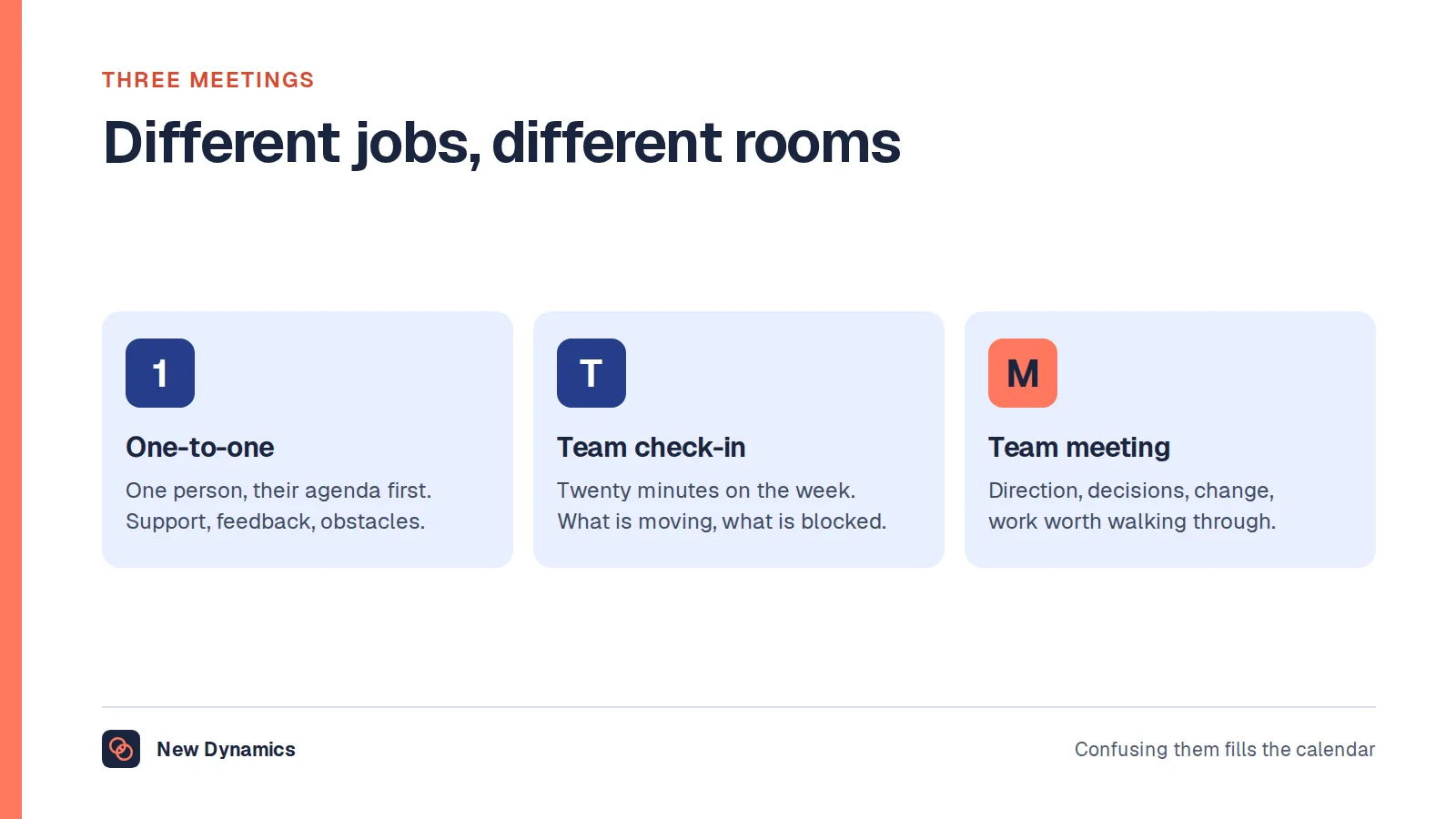
- Protect the conversations that are not status. When something has to go, cut the status meeting rather than the one-to-one. Our post on the meeting rhythm covers which conversation belongs where and how to decide what to drop.
A fully utilised team has no capacity to absorb anything
This is the finding most efficiency drives are built to ignore. As the share of booked time approaches 100%, waiting does not rise gently. It rises steeply, because no gap is left for anything unexpected to fit into, and the unexpected is a permanent feature of work.
Think of a corridor rather than a spreadsheet. At half occupancy people walk straight through. At nine tenths everybody shuffles, and nothing changed about how fast anyone can walk.
A team planned at 100% of its available hours has no slack for a sick day, an urgent client, a system outage, a new starter needing time or last month's rework. Each of those becomes a delay to something else, or it becomes unpaid overtime, which is the buffer the organisation did not admit to planning.
What to do.
- Plan to roughly four fifths of available time, and count the invisible load in it: interviews, onboarding a colleague, answering other teams, the recurring meetings above. The exact figure matters less than the principle that it is below 100%.
- Name who holds the buffer, or the unallocated time goes to whoever asks last and loudest.
- Watch for the overtime tell. If a team hits its dates only by working late, the plan is already over capacity and the cost has been moved onto people's evenings.
The manager behaviours that create the delay
Uncomfortable, and the fastest place to get a result, because it needs nobody's permission but your own. Each is a common, well-intentioned habit that adds days.
- Being the only approver. Every request queues behind your calendar. Delegate thresholds and publish them.
- Being hard to reach for a short answer. Many blockages are a two-minute question waiting four days for a thirty-minute slot.
- Changing priorities midweek. Each change strands part-finished work and resets context. Change them deliberately, on a known cadence, and say what is now not being done.
- Asking for status instead of removing blockages. A status request is work added to the person who is already stuck. Ask what is blocked and whether you can unblock it.
- Adding an initiative on top of the workload it is meant to reduce. Improvement work that is unfunded in hours will be done badly, late, or not at all.
- Reviewing work late, which makes the deadline fictional and the rework larger, and keeping requirements verbal, so at least two people remember them differently.
- Leaving a decision open after the discussion. A meeting that ends with "let's think about it" and no date is a queue with no exit.
On its page on preventing work-related stress, Acas says employers should "provide training for managers", giving managing conflict, change and work-related stress as the examples, and should support workers by "listening to concerns and acting on them quickly". Acting quickly on what you hear is also the largest single efficiency lever a manager holds.
Measuring individuals: the limits, and the monitoring boundary
Sooner or later somebody proposes measuring people instead of the process. This is where efficiency programmes acquire their bad name, and it is worth being precise about why.
The practical objection first. In nearly all office work, output is produced by a system: a brief from someone else, a tool, a queue, an approver, a handoff. Dividing a team's output by its headcount tells you about the system, so attributing the result to individuals is a measurement error with consequences. Any measure that drives pay or a rating also gets optimised, sometimes in ways that make real output worse.
The ICO gives an example of the same problem in its guidance on monitoring workers: reports from a tool measuring time spent in a case management system did not account for the reasonable adjustments some workers had, which meant they worked outside the system for some tasks. Its conclusion is that "Unless the employer takes into account the work done outside the system, the monitoring is unfair and inadequate."
Then the legal boundary. The following concerns the United Kingdom, and it is general information rather than legal advice, so take advice on your own circumstances.
The ICO's guidance on data protection and monitoring workers does not ban monitoring, but it sets the test squarely against the "improve efficiency" justification. Four points matter.
- Availability is not justification. The guidance states: "Just because a form of monitoring is available, does not mean it is the best way to achieve your aims. You must be clear about your purpose and select the least intrusive means to achieve it."
- Efficiency in the contract does not do the work. The ICO's own worked example is an employer who "inserts a clause into its employment contracts to say that it employs video surveillance across its premises to monitor productivity and improve efficiency", and the ICO's verdict is that "This would not be sufficient justification to use this lawful basis for such monitoring as there are other less intrusive ways of improving productivity."
- Fairness has a definition. It "means you should only monitor workers in ways they would reasonably expect and not in ways that cause unjustified adverse effects on them", and the guidance warns that "Excessive monitoring is likely to intrude into workers' private lives and undermine their privacy and mental wellbeing."
- Performance management is named as high risk. Among the ICO's examples of high-risk processing requiring a data protection impact assessment is "monitoring that may result in financial loss (such as performance management)". It also says that if you are planning to introduce monitoring, "you should seek and document the views of your workers or their representatives (such as trade unions), unless there is a good reason not to".
That last point is the one to act on first, because it is also good management. Our post on employee monitoring software sets out the duties in order and the proportionate alternatives to try before buying anything.
The workable rule is to measure the work rather than the worker. Elapsed time, waiting time, rework rate and queue length describe the process and need no individual attribution. Where an individual's performance genuinely is the concern, that is a conversation, a written standard and a review date, not a dashboard rolled out to everybody.
Intensification is not efficiency, and it has a health and safety dimension

The honest history of efficiency drives is that a good number became work intensification: same people, same process, more pressure. That is not only a morale question, because it sits inside health and safety law. What follows applies in Great Britain, and remains general information rather than legal advice.
HSE is direct about the duty. On its overview of work-related stress and how to manage it it states: "Employers have a legal duty to protect workers from stress at work by doing a risk assessment and acting on it. This is the same duty you have to protect people from other health and safety risks." HSE defines stress as "the adverse reaction people have to excessive pressures or other types of demand placed on them", which is a fair description of what an intensification programme produces on purpose.
HSE also names the areas to look at. Its page on the causes of stress at work says there are "six main areas that can lead to work-related stress if they are not managed properly. These are: demands, control, support, relationships, role and change." Demands and control are exactly what an efficiency drive changes, usually without anybody calling it a change to work design.
The scale is published. HSE's accredited official statistics release Work-related stress, depression or anxiety statistics in Great Britain, 2025, published on 20 November 2025 with data up to March 2025, reports that in 2024/25 "there were an estimated 964,000 workers suffering from work-related stress, depression or anxiety", which "resulted in an estimated 22.1 million working days lost", and that stress, depression or anxiety "accounted for 52% of all work-related ill health and 62% of all working days lost due to work-related ill health". The release also says that "The main work factors cited by respondents as causing work-related stress, depression or anxiety were workload pressures (including tight deadlines and too much responsibility) and a lack of managerial support", attributing that to a Labour Force Survey average estimate over 2009/10 to 2011/12, so it is the older part of the release rather than the latest year.
Set 22.1 million working days lost beside whatever your programme expects to save. Raising pressure to shorten a queue can lose more time than the queue ever cost, and the loss arrives later, in absence and turnover, where nobody connects it back to the programme.
Three tests before a plan starts. Does it reduce the work people hold at once, or only the time they are given for it? Does it give people more control over how the work is done, or less? Could it be described to the team plainly without anybody feeling misled? A plan that fails those tests is not an efficiency plan. For the wider set of published UK figures on work, our HR statistics hub collects them with the publisher and reference period attached.
Four weeks a manager can actually run
No programme, no budget, no software. One manager, four weeks.
Week one: measure one thing. Take the last five completed items of one kind of work. Record elapsed time, estimated touch time, and every point where each one stopped and for how long. Write the definition of the measure down.
Week two: pick the biggest wait and remove it. It will usually be a decision. Set a threshold so fewer things need your approval, publish a response time for the ones that still do, and state what happens if nobody responds. Tell the team what changed and why.
Week three: cap the open work and delete one meeting. Count what is open, pick a lower number, and hold the queue visibly instead. Cost your recurring meetings in hours per month, cancel the one that produced no decision, and replace it with a written update. Keep the one-to-ones.
Week four: fix one brief and re-measure. Rewrite the template for whichever work comes back most often, so the definition of done is agreed before anybody starts. Then repeat week one's measurement on the next five items and compare. One month is enough to show a change in elapsed time, and not enough to show one in anything annual.
Then tell people the result, including if nothing moved. An effort that reports honestly gets a second round. One that announces a success nobody recognises does not.
Three things to avoid while doing it.
- Setting a target before measuring anything, which converts a measurement problem into a trust problem.
- Comparing two teams with different work and treating the difference as effort.
- Measuring individuals because the process is harder to change. It is harder, and it is the thing that is wrong.
Frequently asked questions
What is workplace efficiency?
Getting the same output with less waste: less waiting, fewer handoffs, less rework and fewer approvals. It differs from productivity, a ratio of output to hours or people, and from utilisation, the share of available time that is booked. Efficiency is the only one of the three with a reliable internal lever.
How can you improve efficiency at work?
Trace one kind of work from request to completion, record where it stopped and for how long, then fix the biggest wait. That usually means fewer decisions travelling upwards, a published response time for the ones that do, agreed acceptance criteria before work starts, a cap on how much is open at once, and one recurring status meeting replaced by a written update.
What is the difference between efficiency and productivity?
Productivity divides output by a labour input, so it can improve simply because output rose faster than hours. The ONS flash estimate for Quarter 2 2026 showed output per hour up 0.7% because gross value added rose 1.2% while hours rose 0.4%. Efficiency is about the waste inside the process, so it can improve with no change in hours at all.
Why does a busy team get slower rather than faster?
Because waiting rises steeply as the share of booked time approaches 100%. A team with nothing unallocated cannot absorb a sick day, an urgent request or last month's rework, so each becomes a delay to something else. Deep work in progress adds to it: twenty-five open items at five finished a week is an average wait of five weeks.
Can you monitor staff to improve efficiency in the UK?
Data protection law does not prohibit monitoring workers, but the ICO requires a clear purpose and the least intrusive means of achieving it, and gives the specific example that a contract clause about video surveillance to monitor productivity and improve efficiency is not sufficient justification. Monitoring linked to performance management is listed as high risk, so an impact assessment is expected. This is general information about the United Kingdom and not legal advice.
How do you measure efficiency when output is not countable?
Use measures of the process rather than of people: elapsed time from request to done, the share of that time in which anything was happening, the rework rate with its reasons, and the number of items open at once. All four describe the system, need no individual attribution, and move within a month if something real has changed.
Your next step: trace one piece of work this week
- Take the last five completed items of one kind of work and record elapsed time, touch time and every point where each stopped.
- Write the definition of the measure beside the number, so next month's figure means the same thing.
- Publish a decision threshold and a response time for the approvals that still have to reach you.
- Count what is open, cap it below today's number, and hold the queue visibly.
- Cancel the recurring meeting that produced no decision last month, then re-measure after four weeks and tell the team what happened, including if nothing did.
For running goals, check-ins and reviews in a way that supports this rather than adding to it, read and download our modern performance management guide. The guide is free to read, and the PDF uses our short download form.
Want goals, feedback and review stages in one place instead of three spreadsheets and a chase? Book a New Dynamics demo and bring the process you run today. You can also email contact@new-dynamics.com.