TL;DR
- There is no general works council duty in Great Britain. The Information and Consultation of Employees Regulations 2004 give employees a right to request an agreement, and Schedule 1 brought undertakings of "At least 50" employees into scope from 6 April 2008.
- The request threshold is now 2%, not 10%. The figure was substituted on 6 April 2020 by the Employment Rights (Miscellaneous Amendments) Regulations 2019 (S.I. 2019/731), and regulation 7(3) puts a floor of 15 employees and a ceiling of 2,500 around it.
- Almost nobody uses it. The CAC Annual Report for the year ending 31 March 2026 records that for the second consecutive year no regulation 7 requests were made through the CAC, and that the cumulative total since the Regulations came into force "remains at 35".
Somebody on a group call asks whether the UK business needs a works council, because the German and Dutch entities have one and the London office does not. Great Britain has no general duty to establish a works council. What it has is a right for employees to ask for something narrower, with a different trigger, a different scope and a cap on what happens if the employer ignores it.
This article covers who is in scope, how many employees have to ask, what a pre-existing agreement does to the request, what the standard provisions impose if negotiation fails, how it is enforced, and which separate duties this gets confused with. It describes the law of the United Kingdom, notes where Northern Ireland differs, and is general information rather than legal advice.
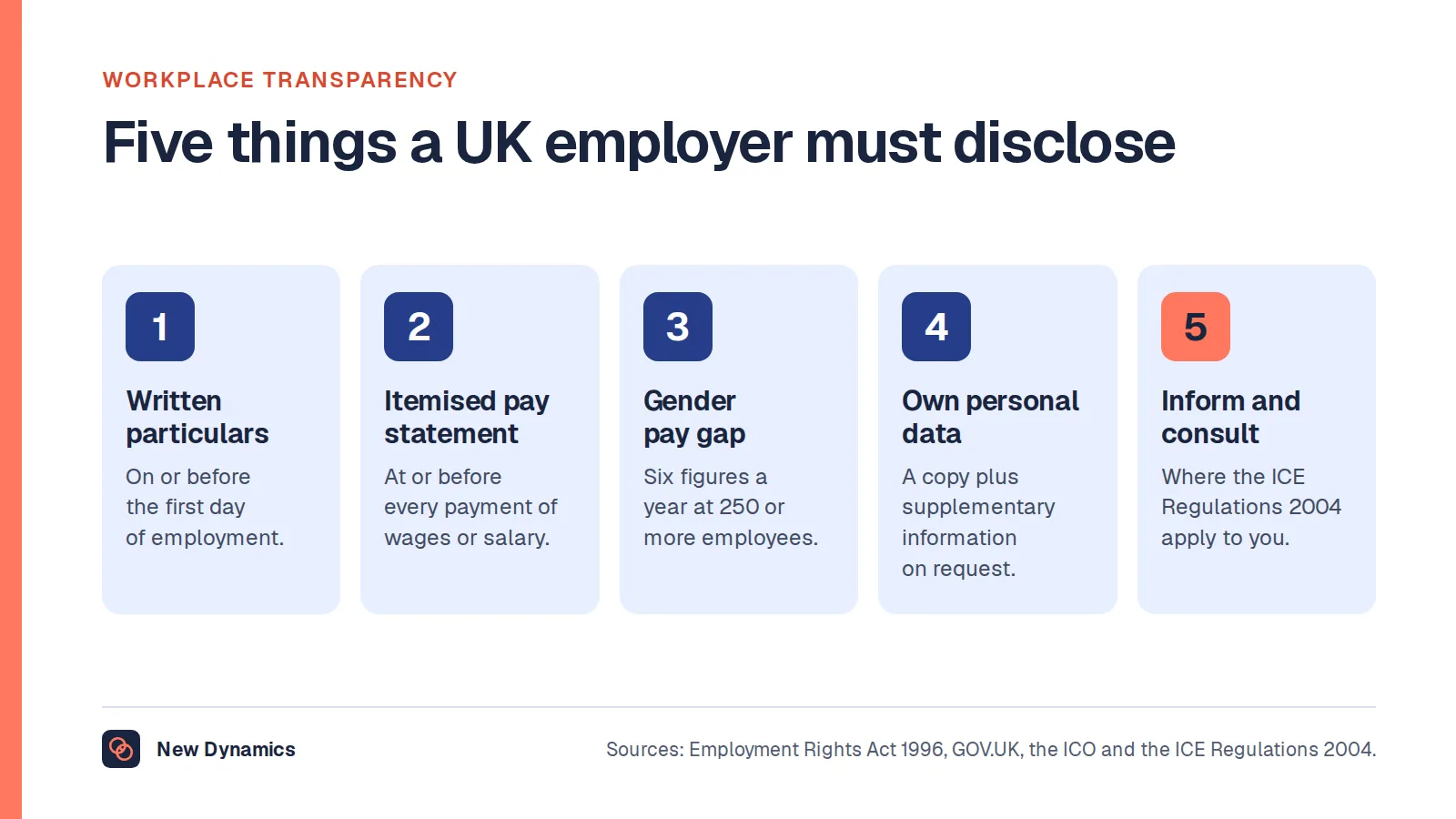
Whatever arrangement you end up with runs on dates and records rather than goodwill. See how New Dynamics workflows hold a process with fixed deadlines so the next step and its owner are never in doubt. For what gets shared with staff outside a formal agreement, see our post on workplace transparency.
The short answer: no mandate, but a right to request
No statute requires a UK employer of any size to create a works council, a staff council or an employee forum. Nothing obliges you to set one up, and nothing penalises you for not having one.
What exists is the Information and Consultation of Employees Regulations 2004, usually called the ICE Regulations. They do not impose arrangements. They give employees the right to ask for them, and they oblige the employer to respond in a defined way once enough employees do. What results is an "information and consultation agreement", a weaker instrument than a continental works council: no co-determination rights, no veto, no seat on a supervisory board.
GOV.UK puts the baseline plainly on its guidance on informing and consulting employees. All employers, whatever their size, must inform and consult on "selling the business or buying a new one", on "making 20 or more redundancies in a 90 day period", and on "health and safety issues". Beyond that, if you have more than 50 employees you may also have to "share other business information with your workforce if they request an information and consultation agreement". The word is request.
Who is in scope, and how the headcount is counted
Regulation 3(1)(a) applies the Regulations to undertakings employing at least the number of employees in the table in Schedule 1. Schedule 1 has three rows, each with the date it took effect: "At least 150" from 6 April 2005, "At least 100" from 6 April 2007, and "At least 50" from 6 April 2008. Only the last row is live.
Two official sources differ at exactly 50 employees. Schedule 1 says "At least 50", so an undertaking averaging 50 is in scope. GOV.UK's guidance says the obligation can arise if "you have more than 50 employees", and repeats that "If you have less than 50 employees (or not enough of your employees make a request) it's up to you if you want to make an information and consultation agreement". On a workforce of exactly 50 those two readings part company. The Regulations govern, and an employer sitting on 50 should assume it is in scope.
Regulation 3(1)(b) adds a location test, requiring an undertaking "whose registered office, head office or principal place of business is situated in Great Britain". Where the registered office is in Great Britain and the head office or principal place of business is in Northern Ireland, or the reverse, regulation 3(2) applies the Regulations only if the majority of employees are employed to work in Great Britain.
The headcount is an average, not a snapshot, and this is where people get it wrong. Regulation 4(2) requires it to be worked out "by determining the number of employees employed in each month in the previous twelve months (whether they were employed throughout the month or not), adding together those monthly figures and dividing the number by 12". Where, for a whole month, an employee works under a contract by which they would have worked 75 hours or less in that month, they "may be counted as representing half of a full-time employee for the month in question, if the employer so decides". That is the employer's choice, not an automatic discount.

The employee request: 2%, with a floor of 15 and a ceiling of 2,500
Regulation 7 is the trigger. On receipt of a valid employee request, the employer must initiate negotiations by taking the steps in regulation 14(1).
A request is valid only if made by at least 2% of the employees in the undertaking, either as a single request or as separate requests which, taken together, reach 2% within a period of six months. The 2% figure is recent, and much of the writing on this subject still quotes the old one. The word "10%" in regulation 7(2) and 7(3) was substituted with "2%" on 6 April 2020 by the Employment Rights (Miscellaneous Amendments) Regulations 2019 (S.I. 2019/731), regulations 1(2) and 16(3). If a source gives you 10%, it has not been checked since 2020.
Regulation 7(3) then brackets the percentage at both ends: "Where the figure of 2% in paragraph (2) would result in less than 15 or more than 2,500 employees being required in order for a valid employee request to be made, that paragraph shall have effect as if, for the figure of 2%, there were substituted the figure of 15, or as the case may be, 2,500."
So in a 200 person business, 2% is 4 people, the floor applies, and 15 must ask. In a 200,000 person business, 2% would be 4,000, the ceiling applies, and 2,500 is enough. GOV.UK summarises this as "15 employees or 2% of your total workforce (whichever number is greater)", which is right at the bottom of the range and silent on the 2,500 cap at the top.
Regulation 7(4) requires each request to be in writing, to be sent either to the employer's registered office, head office or principal place of business or to the Central Arbitration Committee, and to specify the names of the employees making it and the date it is sent.
How often this is actually used
Rarely, which is worth knowing before you plan for it. The Central Arbitration Committee's Annual Report for the year ending 31 March 2026, published on 3 July 2026, records that "For the second consecutive year, no requests were made by employees under regulation 7 for the establishment of information and consultation arrangements through the CAC. The cumulative total number of such requests since the Regulations came into force therefore remains at 35." On complaints: "Seven complaints were received under these Regulations, all of which were concluded during the year. Five complaints were withdrawn and two required formal panel decisions."
Read that figure precisely. Regulation 7(4) lets a request go to the employer instead of the CAC, and requests sent straight to an employer are never counted centrally. No official UK source publishes how many employers have an information and consultation agreement in place, so we do not give a number for that.
If you already have an agreement: the 40% endorsement ballot
An employer with existing arrangements is not automatically obliged to start again. Regulation 8 applies where a valid request has been made by fewer than 40% of employees and there are one or more pre-existing agreements which are "in writing", "cover all the employees of the undertaking", "have been approved by the employees", and "set out how the employer is to give information to the employees or their representatives and seek their views on such information".
Where all four are satisfied, the employer may ballot the workforce to endorse the request instead of negotiating. The timings are fixed: inform employees in writing within one month of the request, then hold the ballot as soon as reasonably practicable, but not before 21 days have passed since that notification.
The endorsement test is a double one. Under regulation 8(6) the request is endorsed only if both "at least 40% of the employees employed in the undertaking" and "the majority of the employees who vote in the ballot" vote in favour. Fail either and the employer is no longer obliged to negotiate. A written, workforce-approved arrangement covering everyone is therefore the most valuable document an employer can hold here, and an informal forum with no written terms is not it.
Negotiating, and the standard provisions if you do not
Regulation 14(1) sets the first moves: arrange for employees to elect or appoint negotiating representatives, inform employees in writing who they are, and invite them to negotiate. Every employee must end up represented and be entitled to take part in the election or appointment.
The clock in regulation 14(3) is two periods, not one. Negotiations "shall last for a period not exceeding six months commencing at the end of the period of three months beginning with the date on which the valid employee request was made", extendable if the employer and a majority of the representatives agree. GOV.UK says the same in plainer words: start discussions "within 3 months of receiving a valid request" and reach agreement "within 6 months of negotiations starting".
Regulation 16 sets out what an agreement must contain. It must cover all employees, be in writing, be dated, be signed by or on behalf of the employer, set out the circumstances in which the employer must inform and consult, and either provide for information and consultation representatives or for the employer to inform and consult employees directly. Since 1 October 2011 it must also provide that information about the employment situation includes "suitable information relating to the use of agency workers (if any) in that undertaking".

If nothing is agreed, the default lands. Regulation 18 applies the standard information and consultation provisions where the employer was obliged to initiate negotiations and did not, or where the parties did not reach agreement in time. In each case they bite either six months after the relevant date or when representatives are elected under regulation 19, whichever is sooner. Doing nothing therefore produces a worse outcome than negotiating, because the standard provisions are imposed rather than shaped.
What has to be informed and consulted on
Regulation 20 is the substance. Where the standard provisions apply, the employer must provide information on three things: "the recent and probable development of the undertaking's activities and economic situation"; "the situation, structure and probable development of employment within the undertaking" together with any anticipatory measures envisaged, "in particular, where there is a threat to employment within the undertaking"; and "decisions likely to lead to substantial changes in work organisation or in contractual relations".
Consultation is required on the second and third, not the first. On the third, regulation 20(4)(d) requires it to be conducted "with a view to reaching agreement on decisions within the scope of the employer's powers", the closest UK law comes to a negotiating duty outside collective bargaining. GOV.UK renders the three subjects as "the economic situation of the business", "job prospects" and "major changes in how work is organised".
Two provisions close off familiar excuses. Regulation 20(5) lets the duty on substantial changes give way to the redundancy, TUPE and pension consultation duties, but only where the employer has notified the representatives in writing that it will comply with the other duty instead, "provided that the notification is given on each occasion on which the employer has become or is about to become subject to the duty". Regulation 20(6) states that "a failure on the part of a person who controls the employer (either directly or indirectly) to provide information to the employer shall not constitute a valid reason for the employer failing to inform and consult". A silent parent company is not a defence.
Enforcement: the CAC, the Appeal Tribunal and £75,000
Enforcement runs through the Central Arbitration Committee, not an employment tribunal. Under regulation 22, a complaint may be brought to the CAC "within a period of three months commencing with the date of the alleged failure". If the CAC upholds it, it may order the employer to take specified steps within a specified period. Within three months of that declaration the applicant may apply to the Employment Appeal Tribunal for a penalty notice, which the Appeal Tribunal must issue unless satisfied the failure was beyond the employer's control or there is some other reasonable excuse. Regulation 23(2) caps it: "No penalty set by the Appeal Tribunal under this regulation may exceed £75,000." The amount turns on gravity, duration, reason, the number of employees affected and the size of the undertaking, and under regulation 23(7) the money goes to the Consolidated Fund rather than to employees.
The limit of the remedy is the point most often missed. Regulation 22(9) provides that no CAC order "shall have the effect of suspending or altering the effect of any act done or of any agreement made by the employer or of preventing or delaying any act or agreement which the employer proposes to do or to make". The decision stands. The penalty is the consequence.
The duties this is not
Three separate regimes get folded into the works council question, each with its own trigger.
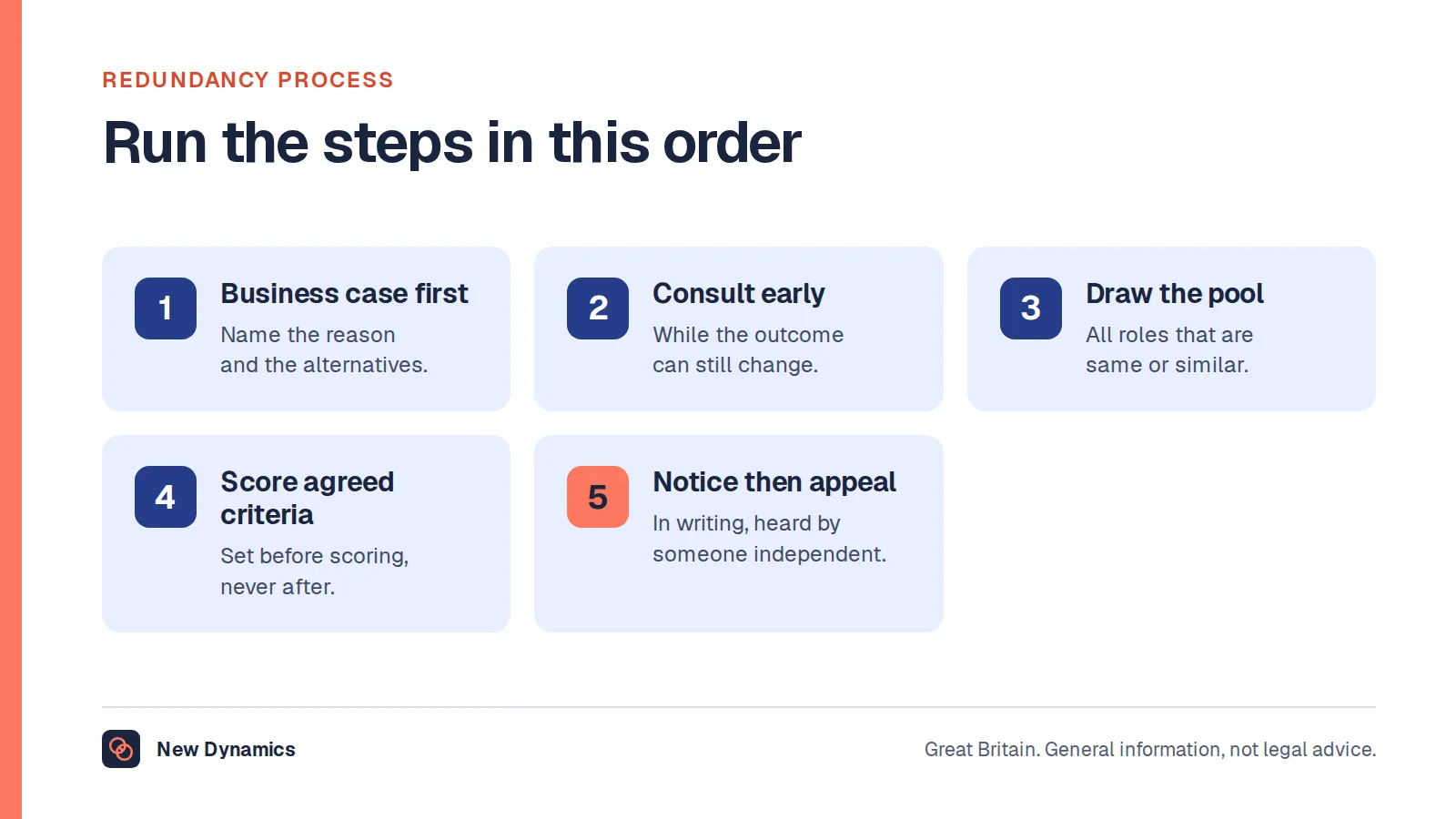
Collective redundancy consultation. Section 188 of the Trade Union and Labour Relations (Consolidation) Act 1992 is the duty GOV.UK describes as applying to all employers. From 6 January 2026 the new subsection (A1), inserted by section 29 of the Employment Rights Act 2025 and commenced by S.I. 2026/3, applies it where an employer proposes to dismiss as redundant within 90 days or less either "at least the threshold number of employees (see section 195A)" or "20 or more employees at one establishment". Section 195A sets no figure itself: it leaves the threshold number to regulations, providing only that "the regulations may not provide in any case for the threshold number of employees to be lower than 20". The periods in section 188(1A) are unchanged, at least 45 days where 100 or more dismissals are proposed and at least 30 days otherwise, "before the first of the dismissals takes effect". Our post on the redundancy process covers the sequence.
TUPE. Regulation 13 of the Transfer of Undertakings (Protection of Employment) Regulations 2006 requires the employer, "Long enough before a relevant transfer to enable the employer of any affected employees to consult the appropriate representatives of any affected employees", to inform them of the fact, date and reasons for the transfer and of "the legal, economic and social implications of the transfer for any affected employees". There is no day count. Our post on the TUPE transfer sets out the duty.
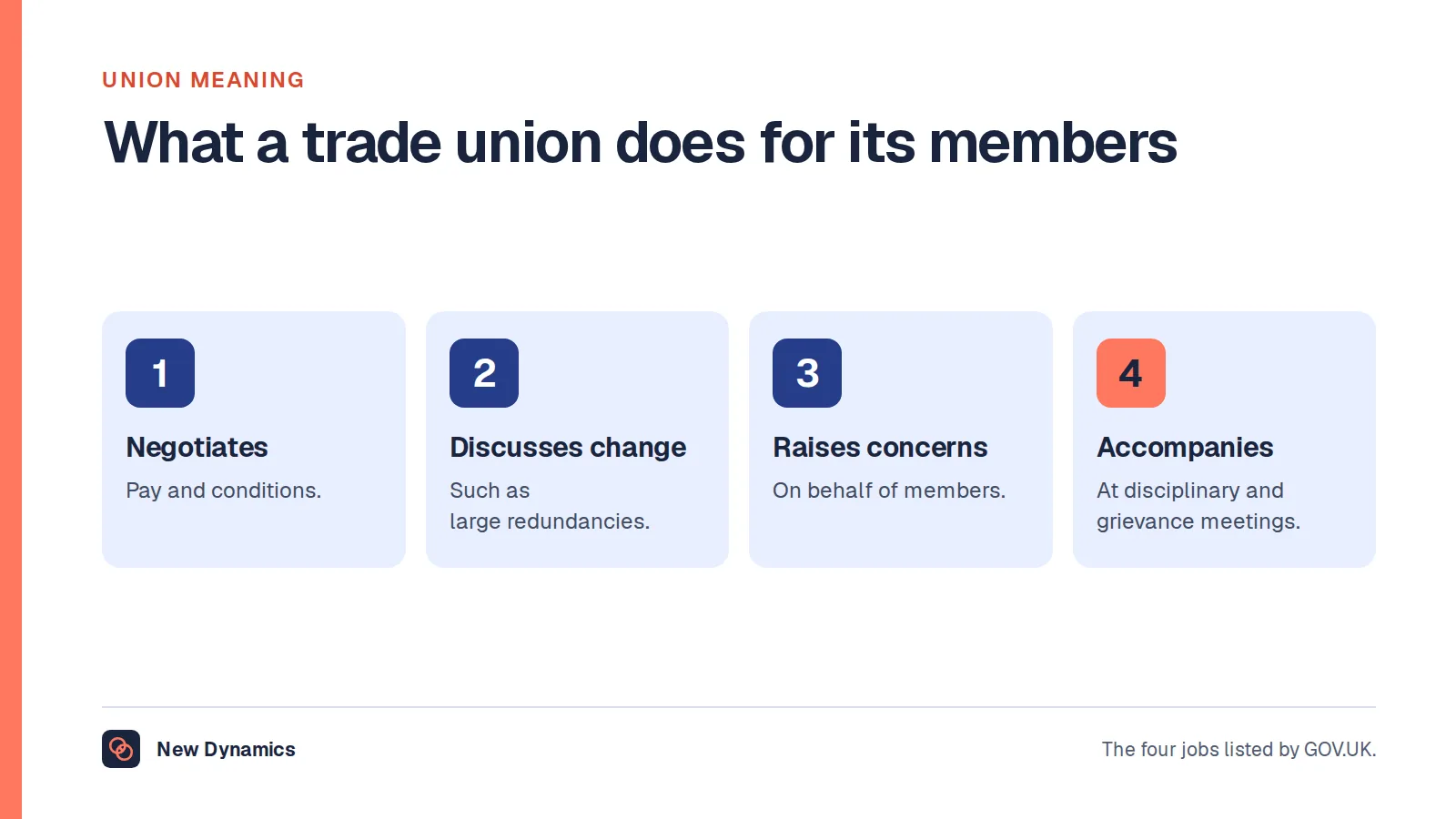
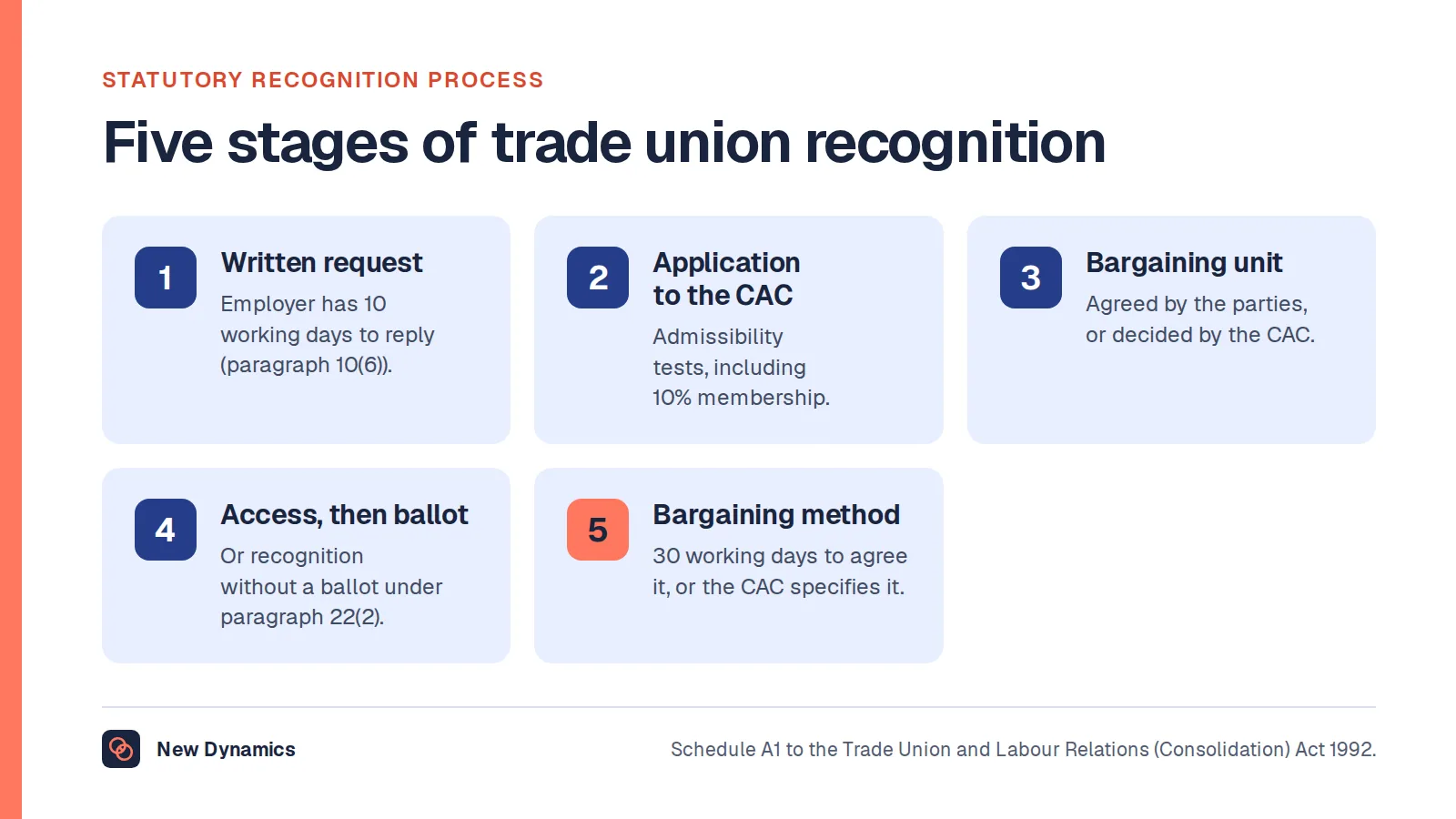
Trade union recognition. A different route to a different outcome. Recognition under Schedule A1 to the 1992 Act produces collective bargaining over pay, hours and holidays, is triggered by a union rather than by employees, and is decided by the CAC. An information and consultation agreement does none of that. Our posts on trade union recognition and the meaning of a trade union cover it.

European Works Councils after EU exit
A European Works Council is not the same animal, and the UK position changed. The Transnational Information and Consultation of Employees Regulations 1999 still exist, and regulation 1(2) still states that "These Regulations extend to Northern Ireland". But regulations 7 to 10, which included the request to negotiate for a European Works Council, were omitted on 31 December 2020 by the Employment Rights (Amendment) (EU Exit) Regulations 2019 (S.I. 2019/535), Schedule 2 paragraph 9. No new European Works Council can be requested under UK law.
The saving is narrow. Schedule 2 paragraph 34 of that instrument provides that "Despite the amendments and revocations made by Part 1 of this Schedule, the 1999 Regulations continue, on and after exit day, to have effect in relation to a request for information made under regulation 7(1) before exit day as they had effect immediately before that day, but subject to the modifications". Councils established before that date, and the enforcement around them, continue: the CAC's Annual Report for the year to 31 March 2026 records that "Four complaints were received under these Regulations." The regime is closed to new entrants, not switched off.
Northern Ireland
The ICE Regulations 2004 extend to England, Wales and Scotland only. GOV.UK confirms that "There's a different process if your organisation is based in Northern Ireland", unless both its head or registered office is in England, Scotland or Wales and most employees work there. A Northern Ireland employer should work from the Northern Ireland rules, not from this article's regulation numbers.
Frequently asked questions
Does a UK employer have to have a works council?
No. There is no statutory duty in Great Britain to establish a works council, staff council or employee forum of any kind. What the law provides instead is a right for employees to request an information and consultation agreement under the Information and Consultation of Employees Regulations 2004, which the employer must then negotiate. This is general information and not legal advice.
How many employees trigger the ICE Regulations?
Schedule 1 to the Regulations brought undertakings with "At least 50" employees into scope from 6 April 2008, and that is the figure in force. Regulation 4 makes it an average of the number employed in each of the previous twelve months divided by 12, with an option for the employer to count an employee contracted for 75 hours or less in a month as half an employee.
How many employees have to ask for an agreement?
At least 2% of the employees in the undertaking, under regulation 7(2). Regulation 7(3) substitutes 15 where 2% would mean fewer than 15 employees, and 2,500 where it would mean more than 2,500. The 2% figure replaced 10% on 6 April 2020 under the Employment Rights (Miscellaneous Amendments) Regulations 2019.
What happens if we already have a staff forum?
Regulation 8 may let you ballot instead of negotiating, but only if the arrangement is in writing, covers all employees, has been approved by them, and sets out how you give information and seek views. Even then it applies only where fewer than 40% of employees made the request, and the ballot must win both 40% of the whole workforce and a majority of those voting.
What is the penalty for ignoring a request?
A complaint goes to the Central Arbitration Committee within three months of the alleged failure, and the applicant can then apply to the Employment Appeal Tribunal for a penalty notice. Regulation 23(2) provides that no penalty may exceed £75,000, and the sum is paid to the Secretary of State rather than to employees. The underlying decision is not reversed.
Can we still set up a European Works Council in the UK?
No. Regulations 7 to 10 of the Transnational Information and Consultation of Employees Regulations 1999, which contained the request to negotiate, were omitted on 31 December 2020 by the Employment Rights (Amendment) (EU Exit) Regulations 2019. Councils established before that date continue, and the CAC still handles complaints about them.
Your next step: find out where you stand before anyone asks
- Run the regulation 4 calculation on your own payroll: twelve monthly headcounts, added and divided by 12. Record the answer and the date.
- If that average is 50 or more, work out your 2% figure and apply the floor and the ceiling, so you know how many employees a valid request actually needs.
- Check any existing arrangement against the regulation 8 conditions. If it is not in writing, does not cover everyone or was never approved by employees, fix it now rather than during a 21 day ballot window.
- Decide who owns the three month and six month clocks, and where the regulation 20(5) written notification comes from when a redundancy or TUPE duty overtakes the agreement.
- Record what you already tell staff about the economic situation, employment prospects and major changes, because that is the ground the standard provisions cover.
If changes to jobs are part of the picture, read and download our redundancy and workforce change guide. The guide is free to read, and the PDF uses our short download form.
Want the consultation record, the dates and the documents in one place instead of scattered across inboxes? Book a New Dynamics demo and bring your current arrangement. You can also email contact@new-dynamics.com.