TL;DR
- A billing specialist turns work that has been done into an invoice that is accurate, complete and understandable. That is a different job from accounts receivable, which starts once the invoice exists and chases the money. Billing is the step before.
- Most billing errors are inherited rather than made. The hours, the meter readings, the delivery notes and the contract rates all come from somewhere else, and billing is where the mistakes become visible to a customer. Credit notes are the symptom, not the problem.
- Four sector variants are genuinely different jobs: professional services time and materials, subscription and usage billing, construction applications for payment, and medical billing, which is largely an American role built around insurance coding. This article covers United Kingdom requirements and is general information rather than legal, accounting or tax advice.
Two finance jobs get confused constantly, and the confusion costs real money. One chases invoices that already exist. The other creates them, out of timesheets, meter readings, delivery notes and a contract somebody signed eighteen months ago. The second job is billing, and the person who does it is a billing specialist.
The distinction matters because almost every late payment treated as a collections problem began as a billing problem. An invoice that arrived three weeks late, or at the wrong rate, or with a description the customer's purchase order does not recognise will not be paid on time however politely it is chased.
Billing runs on a monthly timetable of cut-offs, reviews and approvals, so it belongs in a system rather than in one person's memory. See how New Dynamics configurable workflows keep owners, stages and due dates in one place.
Where law or tax appears below it describes the United Kingdom, and it is general information rather than legal, accounting or tax advice. Take advice on your own arrangements.
What is a billing specialist?
A billing specialist produces the invoices a business sends out, and makes sure each one is right before it leaves. The title appears as billing specialist, billing clerk, billing coordinator, biller or revenue administrator. The work is the same at heart: take what the business delivered, work out what the customer owes under the contract, and produce a document they can match, approve and pay.
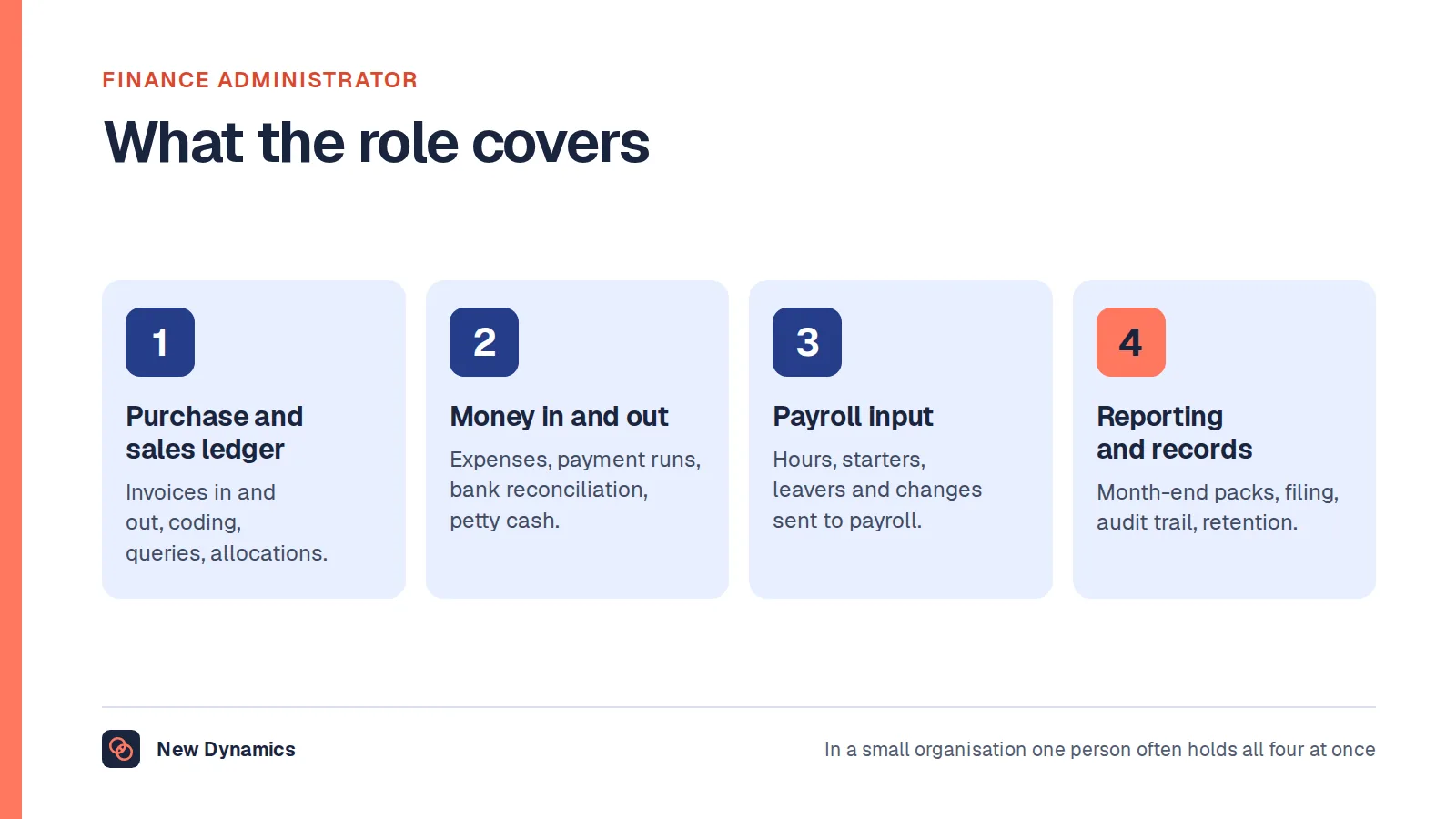
There is no National Careers Service profile for "billing specialist" in the United Kingdom, which tells you something about how the title is used here. The nearest published profiles are broader: the finance officer profile describes officers who "manage the income and spending of an organisation, and maintain accurate financial records for reporting and compliance purposes" and lists "deal with payroll, invoices, expenses and VAT", while the accounting technician profile lists "process and pay invoices". Neither is a billing specialist. In a small business, billing is one slice of a finance administrator's week, and our finance administrator job description covers that role.
In the United States the occupation is classified directly. O*NET, published by the US Department of Labor, lists Billing and Posting Clerks under code 43-3021.00 and describes the work as "Compile, compute, and record billing, accounting, statistical, and other numerical data for billing purposes. Prepare billing invoices for services rendered or for delivery or shipment of goods." Its reported job titles include Biller, Billing Clerk and Billing Specialist. That is an American classification, quoted as the clearest official description available.
Billing is not accounts receivable
Billing ends when an accurate invoice has been issued and any query about it resolved. Its outputs are invoices, credit notes and an unbilled work report.
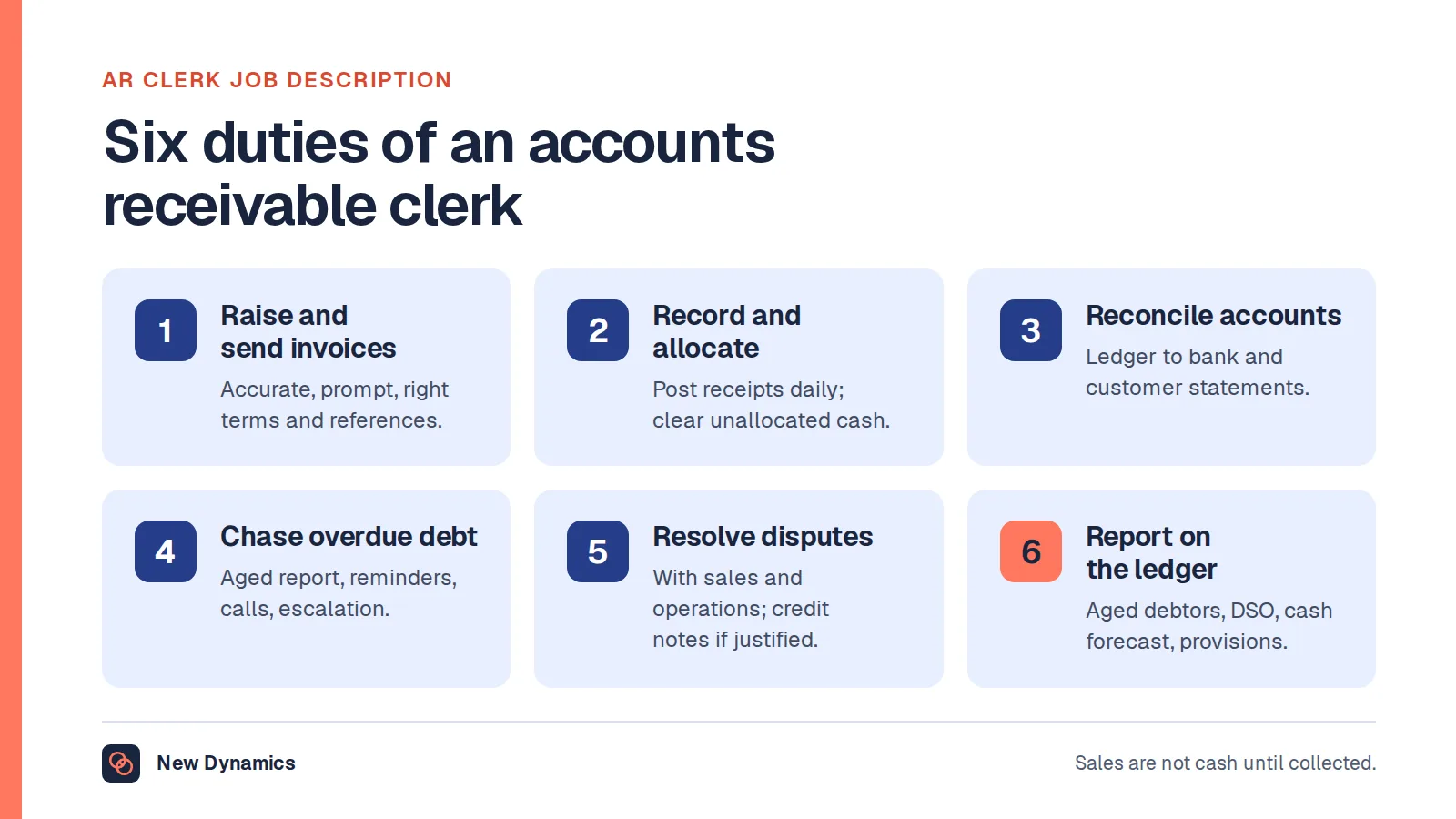
Accounts receivable begins once the invoice exists. Its outputs are cash, an aged debt report and a chase history. Our accounts receivable clerk job description covers that side, including the United Kingdom rules on charging interest for late commercial payment.
In a team of three the same person does both, and you should say so. In a team of thirty they are different desks. They also fail differently: collections fails when nobody picks up the phone, while billing fails silently, weeks earlier, in a spreadsheet nobody checked.
Billing duties and responsibilities
Strip out the local variation and eight responsibilities remain.
- Collect what is billable. Pull hours, usage, quantities, deliveries, expenses and milestones from the systems and people that hold them, and know when data is missing.
- Price it against the contract. Apply the rates, discounts, caps, commitments and tax treatment, reading the contract rather than copying last month's invoice.
- Produce the draft and get it reviewed. Circulate it to whoever owns the customer relationship, and hold the invoice until they confirm.
- Issue the invoice correctly. Right entity, address, purchase order reference, dates and format, by the route the customer requires.
- Run the billing calendar. Cut-offs, run dates, approval deadlines and the monthly close. Billing is a timetable job, and the timetable is the deliverable.
- Handle queries and credit notes. Investigate the dispute, correct what is wrong, raise credit notes under proper authority and record the reason every time.
- Report the unbilled position. Work delivered but not invoiced, drafts held, disputes open, credits raised.
- Keep the records. Copies of every invoice and credit note, in the form and for the period the law requires.

The billing cycle, end to end
Most adverts describe step four and ignore the rest. Here is the whole cycle, with the question that decides whether each step worked.
Capture. Timesheets submitted, usage metered, deliveries confirmed, expenses coded, milestones certified. Is the capture deadline earlier than the billing deadline, and who enforces it?
Validation and pricing. Check the data is plausible, such as twelve hours a day for fourteen days straight, then apply the rates, uplifts, discounts, allowances, overage, caps and tax treatment. Where do the contract rates live, and who may change them?
Draft and review. A draft goes to the engagement owner or project manager, who confirms scope, write-offs and anything promised. Does the invoice go out if the review deadline passes?
Issue. Numbered, dated and sent by the route the customer's accounts payable team actually reads, often a portal. Are those submission rules written down?
Query and credit. Some comes back. Investigate, correct or defend, credit where the charge was wrong. Is the reason for every credit note recorded in a way you can count?
Handover. The debt passes to accounts receivable, and billing reports what it billed, held and credited. Can anyone see the unbilled balance without asking?
Where billing actually goes wrong
The data comes from somewhere else, and it is wrong
Billing is downstream of almost everything. The hours come from fee earners who filled in a timesheet on Friday afternoon. The quantities come from a delivery system owned by operations. The rates come from a contract negotiated by sales and sometimes amended by email.
A billing specialist cannot fix those sources, but the job description should say plainly that spotting and escalating bad upstream data is part of the role. The best billing people notice that a customer's usage halved and ask why.
Unbilled work
The expensive failure is not the wrong invoice. It is the invoice that never goes out. Work delivered, nobody captured it, nobody noticed, revenue gone. It happens wherever capture depends on somebody remembering: variations agreed verbally on site, out-of-hours support given as a favour, users added mid-term.
Unbilled work appears in no standard report, because the absence of an invoice generates no record. It is found by reconciliation: compare what the delivery system says was done against what the ledger says was billed. Put that in the job description as a named monthly task with an owner and you will find money. Our post on analytical thinking describes the habit behind it.
Credit notes are a symptom
Every credit note is an error that reached a customer. Some are unavoidable. The rest measure how well billing works, and are the most useful number the function produces.
So count them, and categorise them: wrong rate, wrong quantity, duplicate, wrong entity, goodwill, scope agreed but not recorded. Within two months the categories show where the real defect is, and it will usually not be in the billing team. Credit notes also have content requirements here. GOV.UK's guidance on keeping VAT records says a credit or debit note must include the "same information as the VAT invoice", the "reason why it was issued", the "total amount credited, excluding VAT" and the "number and date of the original VAT invoice". One without a reason is an incomplete record, not just weak management information.
Disputes caused by an unclear invoice
A surprising share of disputes are not about the amount but about legibility. The customer's accounts payable team cannot match the invoice to their purchase order, or cannot find the reference their system demands, so it sits in a query queue and thirty days later somebody starts chasing it.
The cure is dull and effective. Carry the customer's own reference, describe the work in their language rather than your internal project code, show the period covered, and break a large invoice into the lines they approve against.

What a UK VAT invoice must contain
A billing specialist needs this cold, because getting it wrong can leave a customer unable to reclaim the tax. The GOV.UK guidance on invoicing and taking payment from customers states that "If you sell a customer a product or a service, you need to give them an invoice (bill) by law if both you and the customer are registered for VAT (a business to business transaction)", and that "An invoice is not the same as a receipt, which is an acknowledgement of payment."
For a VAT invoice specifically, HMRC's VAT guide (VAT Notice 700) is the source. Paragraph 16.2.1 says that "Whenever you supply standard-rated or reduced-rated goods or services to another VAT-registered person, you must give that person a VAT invoice", because customers "need VAT invoices as evidence for reclaiming, as input tax, the VAT you have charged them". Paragraph 16.3.1 lists what you must show:
- "a sequential number based on one or more series which uniquely identifies the document"
- "the time of the supply (tax point)"
- "the date of issue of the document (where different to the time of supply)"
- "your name, address and VAT registration number"
- "the name and address of the person to whom the goods or services have been supplied (your customer)"
- "a description sufficient to identify the goods or services supplied"
- "for each description, the quantity of the goods or the extent of the services, the rate of VAT, and the amount payable excluding VAT"
- "the gross total amount payable, excluding VAT"
- "the rate of any cash discount offered"
- "the total amount of VAT chargeable", which "must be expressed in sterling"
- "the unit price"
Two consequences. The number series must be sequential and unique, which rules out three people numbering invoices independently. And the tax point, not the issue date, decides which VAT period a supply falls in: Notice 700 says you must "normally issue a VAT invoice within 30 days of the tax point arising" unless you have already issued one that created a tax point. A simplified invoice is allowed where "the value of the supply you are making is £250 or less" and the customer agrees.
The record keeping duty
GOV.UK's guidance on keeping VAT records says you must keep a record of "everything you buy and sell (including zero-rated, reduced and VAT exempt items)", "copies of all invoices you issue", "all invoices you receive (original or electronic copies)", "self-billing agreements (where the customer prepares the invoice)" and "debit or credit notes".
On duration it is specific: "Begin keeping records when you register for VAT. You must keep VAT records for at least 6 years (or 10 years if you are using the VAT One Stop Shop (OSS) scheme or used the VAT Mini One Stop Shop (MOSS) scheme)." Unless you are exempt from Making Tax Digital for VAT, some records must be kept digitally, and where more than one software package is used "you need to link them. This must be a digital link. You cannot manually transfer this data, or 'copy and paste', between software."
That last rule bites on billing: a process that exports a report, adjusts it by hand in a spreadsheet and re-keys the result into the ledger is exactly the pattern it targets. These rules are as published at the time of writing and apply in the United Kingdom. Check the current pages before relying on them, and take your own advice.
Four sector variants that are genuinely different jobs
"Billing specialist" covers four jobs that share a name and little else. Hire for the wrong one and you get somebody competent who cannot do your work.
Professional services: time and materials
In a law firm, consultancy, accountancy practice or agency, billing converts recorded time and disbursements into a bill a client will accept. The specialist runs the work in progress report, chases unsubmitted timesheets, prepares draft bills, takes them to the engagement lead, applies write-offs and narrative changes, and issues the final bill in whatever format the engagement letter requires.
What makes this version hard is the review loop. The billing specialist does not control the decision to bill, and the people who do have other priorities, so the job is half production and half polite pursuit of partners. Measure days from month end to bill issued, and write-offs by engagement. Our professional services page describes review cycles in these firms.
Subscription and usage billing
Here the invoice comes from a contract and a usage record rather than from somebody's labour, and the complexity sits in the edge cases: mid-term upgrades and downgrades, pro-rating, seat counts that change daily, commitments with overage, multi-currency, and credits for service levels missed. This specialist spends less time chasing people and more time reconciling systems: the contract record, the usage data and the ledger should agree, and where they do not the difference is either lost revenue or a credit note waiting to happen.
VAT Notice 700 matters here, because recurring billing is a continuous supply. Paragraph 14.3 says that "If you supply services on a continuous basis and receive payments regularly or from time to time, there's a tax point every time you issue a VAT invoice, or receive a payment, whichever happens first". A United Kingdom rule, and general information rather than tax advice.
Construction: applications for payment
Construction billing is not invoicing, and this is the variant most often mis-hired. A contractor or subcontractor submits an application for payment, usually monthly, valuing the work done to date including measured work, variations and materials on site. A valuation and a payment notice follow, and the invoice is a later, administrative step.
The framework is statutory. Part II of the Housing Grants, Construction and Regeneration Act 1996, as amended, applies to construction contracts in England, Wales and Scotland. Section 109 says "A party to a construction contract is entitled to payment by instalments, stage payments or other periodic payments for any work under the contract" unless the contract specifies, or the parties agree, that the work is to last less than 45 days. Section 110A requires the contract to provide for a payment notice, from the payer or the payee, "not later than five days after the payment due date", specifying the sum considered due and "the basis on which that sum is calculated". Section 111 then says "the payer must pay the notified sum (to the extent not already paid) on or before the final date for payment" unless a notice of intention to pay less is given. The text is on legislation.gov.uk. Scotland has separate commencement arrangements and Northern Ireland its own legislation, so check your jurisdiction and take legal advice. General information only.
So construction billing is a deadline and notice role: miss an application date and a month of cash slips. Hire somebody who understands valuations, retention, variations and the notice calendar, and say so in the advert. There is a VAT quirk too: Notice 700 says authenticated receipts "are used in the construction industry in place of VAT invoices for supplies of services, or of goods and services, made under contracts which provide for periodic payments to be made". Our construction and property page covers site and office teams in one cycle.
Medical billing is largely an American role
Search for billing jobs and a large share of the results are medical billing. Be clear what that is. It is predominantly a United States occupation, built around submitting coded claims to insurers, and it exists at that scale because American healthcare is paid for claim by claim. O*NET's Medical Records Specialists occupation, code 29-2072.00, covers work to "Classify medical and healthcare concepts, including diagnosis, procedures, medical services, and equipment, into the healthcare industry's numerical coding system", and notes "Includes medical coders". We are not going to list American coding certifications, because we have no official source for their current requirements.
In the United Kingdom the National Health Service model means the equivalent job is different. Patients are not generally billed per episode, so the volume of claim-level billing is not there. Coding still happens, but for records, planning and statistics rather than to collect from an insurer. The National Careers Service health records clerk profile lists tasks including "translate patient information into clinical codes for administrative purposes" and "collect statistics like admission numbers, discharges and waiting lists", and names a Clinical Coder Level 3 Advanced Apprenticeship among the entry routes.
So read any "medical billing specialist" wording carefully before reusing it in Britain. The British equivalents are health records and clinical coding roles, plus conventional billing in private healthcare, dentistry and veterinary practice. If you are hiring for American billing, say so.
Controls and segregation of duties
Someone who can both issue an invoice and credit it can conceal a diverted payment. Someone who can change a contract rate unilaterally can quietly discount. That is not a reason to distrust a billing specialist. It is a reason to write the boundaries into the job description, so the post holder can show that a mistake was a mistake. The principles below are general financial control good practice, not a statutory rule we are quoting at you.
- The person who raises an invoice does not approve the credit note that cancels it.
- Credit notes above a stated value need a named second approver, and every one carries a reason code.
- Write-offs and bad debt decisions sit with a manager, not with billing.
- Contract rates are master data, changed by somebody other than the person who bills, with a record of who changed what.
- New customer records, and changes to a billing entity or address, are set up independently of billing.
- Invoice numbering is sequential and system-generated, with gaps investigated, and somebody reviews the credit note log and the unbilled report monthly.

In a team of two you cannot split everything, so name the compensating controls instead: the second approver, the limit above which they are needed, and who reviews the log. The accounts payable job description covers the mirror-image controls on the supplier side.
Skills a billing specialist needs, and how to test them
Five things matter, and each can be tested in under an hour.
Accuracy under a deadline. Give the candidate a short set of timesheet or usage data, a rate card and a contract extract, and ask for the invoice lines. Plant two errors, a wrong rate and a duplicate line, and watch whether they find them.
Contract reading. The commonest cause of a wrong invoice is billing the rate somebody remembers. Hand over a contract extract with a volume discount, a cap and an escalation clause, and ask what a given month should be billed. Then ask what they would do if that contradicts last month's bill.
Reconciliation. Give a usage report and a billed-value summary that do not agree, and ask them to list the differences and what they would do about each.
Communication outside finance. Billing depends on fee earners, project managers and operations handing data over on time, and none of them report to billing. Ask the candidate to draft the email chasing a bill approval from a senior colleague for a third time.
Judgement about escalation. Ask the question that matters most here: tell me about a time you were asked to bill something you did not think was right. A candidate who describes quietly fixing it alone has told you something.
Deliberately not on that list: a degree or a full chartered qualification. Those requirements shrink the field for transactional work and remove candidates who took a vocational route. On rewriting duties as testable outcomes, see our guide to how to write a job description.
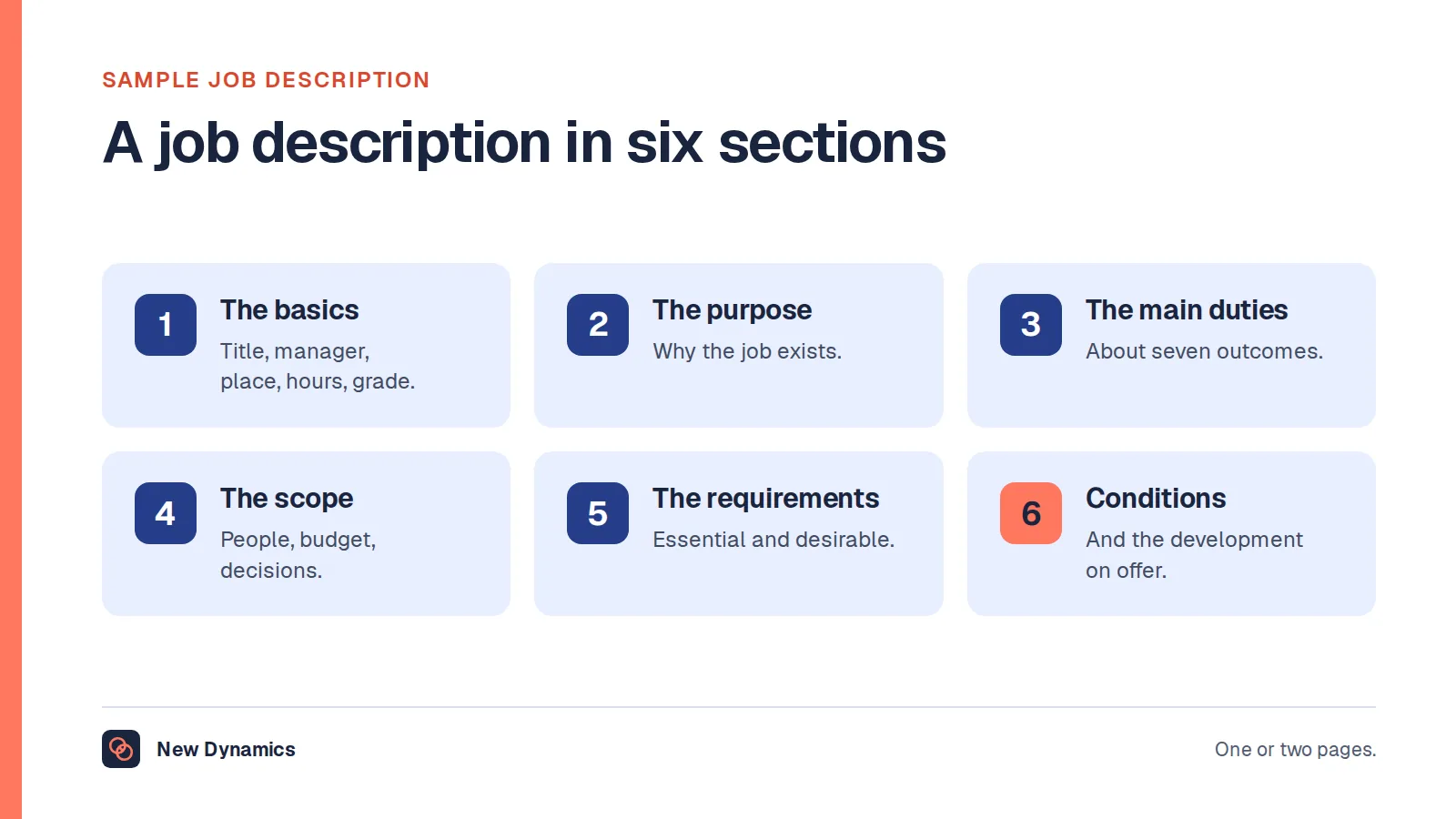
Billing specialist job description template
Adapt it. Replace every bracketed prompt with your own facts and delete what does not apply.
Job title: Billing Specialist (billing coordinator, revenue administrator)
Reports to: [Finance manager or financial controller]
Scope: [n] invoices a month across [n] accounts, [billing model], on [systems]. Cut-off on [day], invoices issued by [day].
Purpose: To turn work the business has delivered into accurate, understandable invoices, issued on time and under proper authority, so that customers can pay without querying and nothing delivered goes unbilled.
Accountabilities, written as outcomes:
- All billable work for the period is captured, priced to the contract and either invoiced or reported as unbilled with a reason.
- Invoices are issued within [n] working days of period end, by the route each customer requires, carrying the reference their team approves against.
- Queries are acknowledged within [n] working days and resolved or escalated within [n].
- Credit notes are raised only under the approval limits below, and every one carries a reason code.
- The unbilled report and the credit note log are produced monthly and reviewed with [role].
- Rates applied in billing agree with the signed contract, and copies of every invoice and credit note are retained to the record keeping policy.
Controls the role works within:
- Credit notes up to [value] approved by [role]; above [value] by [role].
- Write-offs and bad debt decisions are not made by this role.
- Rate card changes, new customer records and billing entity changes are made by [role], not by billing.
- Invoice numbering is system-generated and sequential; gaps are investigated.
Skills and experience:
- [One to two] years in billing, invoicing or a sales ledger at similar volume
- Accurate under a monthly deadline, and willing to say when something looks wrong
- Able to read a contract and apply its rates, caps and discounts
- Reconciliation experience: comparing two sources and explaining the difference
- Confident with [billing system], [accounting system] and spreadsheets
After six months: three billing runs issued on time, the unbilled report falling, credit notes categorised with the top cause escalated.
Three mistakes to avoid: calling the role accounts receivable when it bills, describing only the invoice run, and pasting American medical billing language into a British advert. Our job description template explains the structure, and the accounting clerk job description covers the adjacent role.
Pay, qualifications and progression
Pay. No official United Kingdom source publishes a pay figure for the title "billing specialist", and we are not going to borrow a number from a job board and present it as official. What is published, for adjacent and broader roles, is this: the National Careers Service gives an average salary for a finance officer of £26,000 for a starter to £38,000 for someone experienced, and for an accounting technician £24,000 to £35,000. Those are different jobs with wider remits, quoted as published and not as a billing specialist salary. For wider workforce figures, see our HR statistics hub.
Qualifications. None are required to start. A bookkeeping or accounting technician qualification, or progress towards one, is a reasonable ask and employers commonly fund it. Our bookkeeper job description sets out the ledger role those qualifications lead into. For construction billing, familiarity with the payment notice regime matters more.
Progression. Three routes come off this desk. Depth: senior billing specialist, billing team leader, revenue controller, billing manager. Breadth: sales ledger, credit control, then the wider finance function. Sideways into billing systems work, because billing is where revenue data, contract data and the ledger meet. Put at least one in the advert.
Frequently asked questions
What is a billing specialist?
A billing specialist produces the invoices a business sends out and makes sure each one is accurate before it leaves. The work covers collecting what is billable, pricing it against the contract, getting the draft reviewed, issuing the invoice in the format the customer requires, resolving queries, raising credit notes under proper authority, and reporting work delivered but not yet billed.
What are the main billing duties and responsibilities?
Eight. Collect what is billable, price it to the contract, produce the draft and get it reviewed, issue the invoice correctly, run the billing calendar, handle queries and credit notes, report the unbilled position, and keep the records. The first three and the last two are the ones adverts omit, and they are where the money is.
What is the difference between billing and accounts receivable?
Billing creates the invoice; accounts receivable collects on it. Billing ends when an accurate invoice has been issued and any query resolved, so its outputs are invoices, credit notes and an unbilled work report. Accounts receivable starts there, and its outputs are cash, an aged debt report and a chase history. Small teams combine the two, so say which yours does.
What must a UK VAT invoice contain?
HMRC's VAT Notice 700 requires a sequential number uniquely identifying the document, the tax point, the date of issue where it differs, your name, address and VAT registration number, the customer's name and address, a description sufficient to identify what was supplied, the quantity or extent, VAT rate and amount excluding VAT for each description, the gross total excluding VAT, the rate of any cash discount, the total VAT chargeable in sterling, and the unit price. A United Kingdom position, and general information rather than tax advice.
Is medical billing a UK job?
Not in the form the phrase usually describes. Medical billing is largely an American occupation built around submitting coded claims to insurers. Under the National Health Service model patients are not generally billed per episode, so the British equivalents are health records and clinical coding roles, which code for records and statistics rather than to collect from an insurer.
Your next step
- Decide whether the role bills, collects or both, and write the purpose statement to match.
- Name the billing model, the volume, the systems and the monthly calendar.
- Rewrite the duty list as the eight outcomes above, and add the unbilled reconciliation as a monthly task.
- Set the approval limits for credit notes and write-offs, and put them in the document.
- Build the two practical exercises before you advertise.
For a structured way to run the vacancy, read and download our recruitment and selection guide. The guide is free to read, and the PDF uses our short download form.
Want the billing calendar, the approvals and the finance team's objectives in one place, with an audit trail? Book a New Dynamics demo and bring your job description. You can also email contact@new-dynamics.com.